
An Evening with Three Legendary Rebel Women at Le Poisson Rouge, January 27, 2017: Margot Olavarria, Bibbe Hansen, and Alice Bag
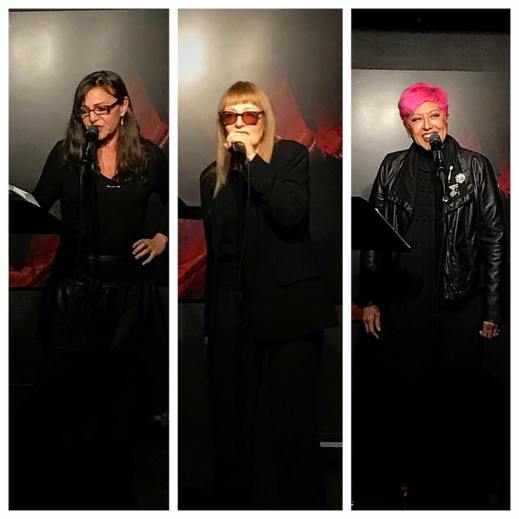

Image of Alice Bag used with her permission (thank you!)
For full intro and part one of the series click here. For part two, click here. For part three click here.
Our Punk Sound series implicitly argues that sound studies methodologies are better suited to understanding how punk works sonically than existing journalistic and academic conversations about musical genre, chord progressions, and/or genealogies of bands. Alexandra Vasquez’s sound-oriented work on Cuban music, for example, in Listening in Detail (2014) opens up necessary conversations about the “flashes, moments, sounds” in music that bear its meanings and its colonial, raced, classed, and gendered histories in material ways people can hear and feel. While retaining the specificity of Vasquez’s argument and the specific sonic archive bringing it forth, we too insist on “an ethical and intellectual obligation to the question: what do the musicians sound like” (12) and how do folks identifying with and through these musical sounds hear them?
In this series, we invite you to amplify varied historicized “details” of punk sound–its chunk-chunk-chunk skapunk riffs, screams, growls, group chants, driving rhythms, honking saxophones–hearing/feeling/touching these sounds in richly varied locations, times, places, and perspectives: as a pulsing bead of condensation dripping down the wall of The Smell in Downtown LA (#savethesmell), a drummer making her own time on tour, a drunk sitting too near the amp at a backyard party, a queer teenager in their bedroom being yelled at to “turn it down” and “act like a lady[or a man]”. . .and on and on. Today we feature Elizabeth Keenan, documenting an evening with three of punk’s legendary Rebel Women at a time of political crisis.
SOUND!
–Aaron SO! (Sounding Out!) + Jenny SO! (Sounding Out!)
This is not normal/let’s not pretend.
–Alice Bag, “Reign of Fear”
Since November 8, nothing has felt normal in the United States. Instead, every day brings new concerns about what the Trump administration might dismantle, destroy, or defund. The first two months have brought two attempts at an executive order barring immigrants to the US from predominantly Muslim countries and re-introduced the nation to the following cast of characters: a billionaire with no public education experience placed in charge of the Department of Education seeking to push a religious agenda; a man who once vowed to abolish the Department of Energy nominated to helm it; a white supremacist, Breitbart-editor consigliere; and a conspiracy-theorist National Security Advisor with suspicious ties to Russia.
This is not normal.
Let’s not pretend.
But in her song, “Reign of Fear,” Bag counters with defiance: “We’ll resist you/We won’t stand by.”
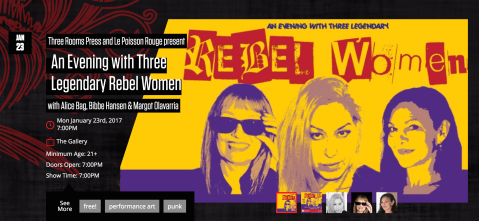
“Reign of Fear,” which Bag performed last at “Rebel Woman,” an event at (le) Poisson Rouge in New York City, encapsulated the evening’s message of resistance. Hosted by Three Rooms Press, “Rebel Women” featured readings from Margot Olavarria, Bibbe Hansen, and Alice Bag, all of whom have crafted careers that blend music and literary performance. Olavarria is the founding bass player for the Go-Go’s; she later played bass for post-punk experimental band Brian Brain, and holds a PhD in political science. Hansen, an actress, artist and musician, grew up in New York City’s art world. As a teen, she worked with Andy Warhol and played music with Jan Kerouac. Later, she co-founded the ironic Black Flag tribute band, Black Fag, with “terrorist drag artist” Vaginal Creme Davis (who also played with Alice Bag in Cholita). As lead singer and co-founder of the Bags, Alice Bag emerged as one of the most influential Chicana voices in the punk rock scene in Los Angeles in the 1970s (She later documented the women of this scene on her website). Since then, her musical career has included groundbreaking bands Castration Squad, Cholita, and Las Tres, as well as her self-titled solo debut in 2016. Her memoirs Violence Girl (2011) and Pipe Bomb for the Soul (2015) document her music and activism, from L.A. to Nicaragua.
“Rebel Women,” held just two days after the Women’s March on Washington, D.C.—and the satellite marches across the country and internationally—offered an opportunity to reflect on approaches to resistance, whether through music, words, or direct action. Although the Women’s March came under criticism for an initial lack of diversity, it became a protest led by activist women of color, with speakers and performers pushing back against the normalizing of misogyny from a pussy-grabbing president. Both Bag and Olavarria had attended the march in Washington, D.C.; many in the audience had marched there or in the crowd of 500,000 in New York City, which gave “Rebel Woman” a particularly urgent charge.

Image from Flickr user astoller (CC BY-NC-ND 2.0)
And our present moment calls for such urgency; among many other necessary actions, we need popular music scholars to rethink how resistance continues to be a productive idea for musicians and protesters, especially those with marginalized identities. In the past few months, “resistance” has experienced a resurgence in political circles. Many of the most popular posters at the Women’s march picked up on the idea of resistance, including one featuring Star Wars’ Princess Leia and the slogan, “A Woman’s Place Is in the Resistance.” #Resist has become a buzzword for organizing against the Trump administration, whether for women’s rights or against the administration’s racism, for health care or against various cabinet nominations. As a hashtag, #resist is remarkably open, allowing social media users to make connections between causes. This is what the performances of “Rebel Women” did so well for the audience at Le Poisson Rouge.
Calling an event “rebel women” positions Bag, Hansen, and Olavarria as “resistance” fighters. The title “Rebel Women” conjures Bikini Kill’s “Rebel Girl” and the punk-rock feminism of Riot Grrrl, a generation of feminism after Bag and Olivarria participated in the L.A. punk scene and nearly two decades after Hansen starred in a Warhol film based on her own life. Bag and Olavarria, first active as musicians during the 1980s, connected the present moment to the time when punk rock positioned itself against the policies of the Reagan administration. Situating their resistance in their Latina identities (Bag is Chicana, Olavarria is Chilean, both are Angelenos), they conveyed to the mostly white, mostly middle-class New York audience an urgent, intersectional politics. Hansen, who said she wasn’t “given the memo” to connect her reading to politics, read what she called a “time capsule.”
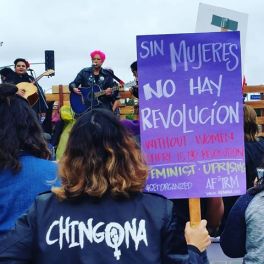
Alice Bag performing at the International Women’s March, January 21, 2017
The stark contrast between these performances brought up questions of power and privilege around what types of memoir are available to different types of women. Bag and Olivarria performed the intersectional oppressions that shaped their lives and connected them to politics, while Bibbe got to be “herself” (that is, unmarked, apolitical, and white). Was this a sign of a tacit understanding white women aren’t going to be as affected by Trump’s policies? (after all, white women elected Trump). Are women of color always expected to perform the emotional labor of connecting their oppressions to political policy, while white women can merely tell stories? Because it is exhausting for women of color to perform this emotional labor–and it can often be exploitative–its all the more important to recognize that Bag and Olivarria chose to do so at Le Poisson Rouge, as I am certain they constructed their performances to speak to this audience (to think otherwise would deny some incredibly smart women their agency).
With those differences in mind, “Rebel Women” underscored for me that intersectional feminism has much to offer in terms of reframing studies of resistance within popular music and is key to ensuring the field’s continued viability in the face of multiple, destructive Trump policies. The concept of intersectionality, developed by Kimberlé Crenshaw to describe the ways that multiple axes of identity—for example, gender, race, ethnicity, religion, or class—affect people in multi-dimensional ways. Crenshaw’s work stresses the importance of seeing intersectionality as an expression of structural power, not just an individual’s conception of their personal identity. Drawing on these intersections can help add complexity to how we understand “resistance” (or even #resistance).
While the study of resistance used to be common in popular music studies—especially in the 1990s—the framework rightly came under criticism as too binary, a position of counterculture vs. mainstream that worked well for glossing 1960s antiwar protests and punk rock, but too simplistic for exploring the nuances of the late-capitalist marketplace. As a theory that emerged from Marxist scholars and examined mostly close-knit, male-dominated subcultures (with formative texts such as Resistance Through Rituals and Subculture: the Meaning of Style), “resistance” was never ideal for grappling with networks organized from a diverse population. An intersectional view, however, understands that the “resistance” group is not evenly or equally affected by the policies of the dominant group; that multiple oppressions shape the forms of resistance available to individual actors; that people facing multiple oppressions also face heightened stakes when they engage in political protest; and that responding to the dominant group requires a commitment to others whose oppressions you may not share.
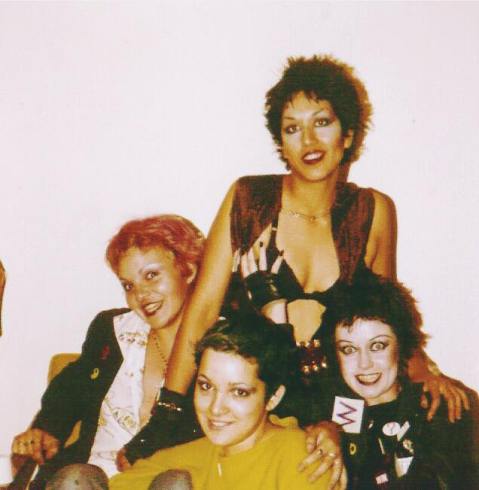
Archival Photo courtesy of Alice Bag, (from l-r) Margot Olavarria, Alice Bag, Jane Wiedlin, and Shannon Wilhelm
Olavarria’s performance, which opened the evening, illustrated intersectional resistance by interweaving work from the past and present. Instead of feeling piecemeal, each fragment signaled how structural power and resistance intersected in her life. In the first vignette, she described how, shortly after Trump received the Republican nomination, she ducked into a bar in Florida to escape the rain. A man next to her began to praise Trump. So did another. Finally, one turned to her, to ask what she thought of Trump’s policies. She responded: “’No habla Inglés. Yo soy Mexicana.’ I’m not really Mexican. I’m from Chile, known for poetry and protest. But today we are all Mexican, all Muslims, all immigrants.” Of course, we aren’t all Mexican, Muslims, or immigrants—but we can show thoughtful solidarity. Olavarria’s act of resistance worked because she effectively deployed her Latina identity to make a powerful intersectional point.
Intersectionality offers an important understanding, that not all moments are prime for resistance from every body in the same way. Women of color, for example, face different stakes and consequences than white women at the airport and at border crossings. In an excerpt from her entry in the musician’s guide Tour Smart, Olavarria recalled her band Brian Brain being pulled over by the US border patrol in the late 1980s. Dressed head-to-toe in thrift-store plaid in honor of their record label, Plaid Records, Olavarria didn’t look the part of a stowaway. But that didn’t stop the border guards from questioning her although she had a valid driver’s license, and her English bandmate’s visa had expired: “I was quizzed on civics. Then it was where did you go to high school? Who was your kindergarten teacher?” As the questioning grew more in depth, Olavarria “started to imagine working in Juarez in plaid attire.”
Olavarria’s story cannot be separated from Latinx identity, nor can they be separated from the politics of race, borders, and national identity in the United States. Instead, she illustrates that proposals such as Trump’s proposed “wall” have deep roots in anti-Mexican, anti-immigrant policies, and they show dark possibilities about the eagerness with which ICE embraced Trump’s “Muslim Ban.” Her story also emphasizes that, although our current moment is certainly an intensification of such harassment, deportation, and incarceration, women of color have faced these dangers in the U.S. for a very long time. What’s new, beyond Trump’s policies, is increased white feminist attention to these issues, an opportunity for both increased resistance and wary skepticism. Olavarria ended her segment with six suggestions for resistance reminding the audience that in these dark times, “walking around thinking we’re totally fucked will not change anything.” She certainly spoke to my struggle in that moment; the response in the room suggested I wasn’t alone.
Margot Olivarria’s Tips for Resistance:
- Wear your safety pin. It is appropriate that a punk fashion accessory has become the symbol of political dissidents. It may also come in handy when militarized police tear your clothes.
- Enjoy yourself. Walking around thinking we’re totally fucked will not change anything.
- If you have numb yourself, go ahead, as long as you don’t become addicted.
- Spread love. The only thing that will counter Trump’s hate is love.
- It may be that the only way we can say, “You’re fired!” to Trump is through the vote. Register as many progressive minded people as you can. Midterms will be crucial.
- If you see something, do something. Protest against all injustices we witness. Art mightier than the sword. Surround yourself with like-minded people and express outrage. As love Trumps hate, expression beats depression.
Hansen’s “time capsule” from 1964 described events leading to her starring in Andy Warhol’s film, Prison, based on her experiences in reform school. Hansen’s performance, told from behind her dark “reading sunglasses,” took on the tenor of a world-weary teenager.
She had run away from her parents—her father was Fluxus painter Al Hansen and her mother was poet and New York bon vivant Audrey Ostlin Hansen (who died at age 37 in 1968)—and was feeling stir-crazy at her friend Jeff’s apartment, because he only had “the same 40 books every hipster has.” So when her pal Janet Kerouac called with an invite of learning to cook spaghetti and taking acid for the first time, she jumped at the chance, even though she wasn’t sure about the acid part, because it was “too earnest.”
By ten that night, we’re rolling around, and spaghetti is everywhere. We’re dipping it in sauce, hurling it everywhere. We slither and roll across the floor like the first reptiles emerging from the primordial ooze. All the guys have hard-ons. I’m not really into orgies. They’re more like work, you know?
Hansen’s skill as an actor was on full display in her reading, as she vanished into her narration, capturing a unique combination of jadedness and enthusiasm. But every once in a while, a line like, “I may be a kid, but I’m also a freak,” would jump out. It was only toward the end of her reading, when Bibbe describes herself, still high, playing hopscotch with kids in the neighborhood that she reminds us: this is a child of twelve. The kids’ mom takes Bibbe in and gives her some cake, and she is astonished that this what normal parents do for kids.

Still from Bibbe Hansen’s screen test for Andy Warhol, 1964
The moment reveals the vulnerability of Bibbe, the runaway. She might have some agency in choosing to spend time with hipster boys and Jan Kerouac, but those come along with expectations of orgies and acid. It doesn’t leave much room for childhood, hopscotch, and cake. After this realization, Bibbe decides to call her father, who tells her, “I ain’t going to jail, so I guess you are.” In this powerlessness, Hansen found an upside: the day her father got her out of juvenile detention, he took her to lunch with Andy Warhol. Finding that upside does not mean that Hansen lacks self-awareness; instead, the moment read as one of acceptance. She cannot create a new girlhood for herself, just as she couldn’t escape her family by hiding with hipsters. “In the end,” she said, “you get what you get.”
Although Hansen’s reading felt disconnected from current politics, I heard her contribution to the evening as a moment of personal resistance. Hansen has often been defined by the men surrounding her: daughter Al Hansen, youngest of Andy Warhol’s Factory stars, mother of musician Beck. Instead of giving us Bibbe through her connections to her father, or to Warhol, she reframed her adolescent experiences so that they became side characters, opening up space for her unique, clear, adolescent voice, recast through a woman’s perspective.
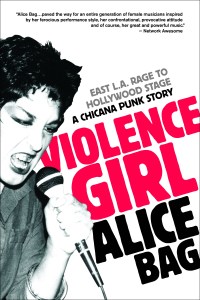 Alice Bag, singer of The Bags, finished out the night with combined spoken word and live musical performance. After playing in many bands since, Bag released her first solo album in 2016 on the independent punk label Don Giovanni Records. In the intervening years, she worked as an activist and teacher, both in the United States and in Central America. Her combination of readings from her memoirs and musical performance with Tanya Pearson evoked a lifetime of resistance. As the only performer to combine spoken word and live musical performance, Bag situated her songs in the readings she selected from her memoirs. Although the songs are relatively new, they drew on her rich experience with Latinx activism and education.
Her first excerpt, from Violence Girl, described the march for the National Chicano Moratorium on March 29, 1970, the largest anti-Vietnam protest by a minority group. Bag went to the march with her father. Until that moment, she said, “I had never realized I was part of a minority. Our enemies were not afraid to throw bottles at us, or shoot us.” The moment inspired a song that Bag performed, “White Justice.” Framed from a child’s perspective, “White Justice” explores the dawning realization that a march is not a parade, and that it may have dangerous consequences, even violence. At first filled with vivid colors of “blue skies/brown berets,” “green lawns,” and “yellow corn,” the mood turns when the police arrive, with “black gloves/blue collars/blood red/silver dollars,” a moment she connected to the present day: “Our struggle then was here at home/And it’s still going on.”
Bag encouraged the audience to sing along at the chorus of “White Justice”—and many members of the mostly white audience did. This eager participation stood in stark contrast to an incident I witnessed at the Women’s March in New York City, when a man tried to get a “Black Lives Matter” chant going during the New York City march and it was slow going.
 Bag’s next story, from Pipe Bomb for the Soul, illustrated that, while she was a member of an oppressed minority in the United States, she brought privilege with her as a teacher in Nicaragua. In her words, “I discovered a lot of things, mostly my own ignorance.” She returned to the United States and taught for over 20 years. Her next song, “Programmed,” expressed her frustration at the post-Leave No Child Behind state of education. At a certain point, she said, “The kids were asked to bubble in Scantrons. We need to teach kids to think for themselves, to value their heritage and experience.”
Finally, Bag ended with the song that began this blog post: “Reign of
Fear.” Inspired by the election, the song acknowledges both fear and
resistance. It is fear that elected Trump; it’s fear that now
motivates some of thethe resistance against him is a stance against
that fear. The fears that elected Trump are fears that treat rights as
a zero-sum game—that if women, or people of color, or queer people, or
Muslims, or Mexicans, or anyone else should gain rights or power, then
white men will lose theirs. In rejecting this view, Bag offers an
intersectional resistance in a punk song, noting “the future comes in
all colors and creeds.” Women of color have been leaders of the
resistance since Trump was elected, but they have also laid a
groundwork for intersectional feminist activism over decades of work.
This is not normal. Let’s not pretend.
But, in resistance lies hope.
In the small space below Le Poisson Rouge, Bag’s voice and Pearson’s guitar swelled to fill the room with that hope:
We reject your/Reign of fear. The future is female/the future is queer. Look out, man/’Cause the future is here.
—
Featured Image of Margot Olavarria, Bibbe Hansen, and Alice Bag by Christine Tottenham, Used here with permission of the Women of Rock Oral History Project.
—
Elizabeth K. Keenan completed her doctorate in ethnomusicology at Columbia University in 2008.She is currently reworking her academic work on popular music and feminism since 1990 into a book for normal humans. She has published in Women and Music, Journal of Popular Music Studies, Archivaria, and Current Musicology, as well as two chapters in Women Make Noise: Girl Bands from Motown to the Modern (2012). Her proudest moment is finally getting to interview Carrie Brownstein, for NYLON, more than ten years after she tried to interview Brownstein for her dissertation. She sometimes writes for the Chronicle of Higher Education’s Vitae website, and her occasional blogging can be found at badcoverversion.wordpress.com.
—

REWIND! . . .If you liked this post, you may also dig:
G.L.O.S.S., Hardcore, and the Righteous White Voice – Chris Chien
If La Llorona Was a Punk Rocker: Detonguing The Off-Key Caos and Screams of Alice Bag– Marlen Ríos-Hernández
Riot-Grrrl, Punk and the Tyranny of Technique – Tamra Lucid
SO! Amplifies: The Women in L.A. Punk Archive
Share this:

G.L.O.S.S., Hardcore, and the Righteous White Voice

Image of Alice Bag used with her permission (thank you!)
For full intro and part one of the series click here. For part two, click here. For part three click here.
Our Punk Sound series implicitly argues that sound studies methodologies are better suited to understanding how punk works sonically than existing journalistic and academic conversations about musical genre, chord progressions, and/or genealogies of bands. Alexandra Vasquez’s sound-oriented work on Cuban music, for example, in Listening in Detail (2014) opens up necessary conversations about the “flashes, moments, sounds” in music that bear its meanings and its colonial, raced, classed, and gendered histories in material ways people can hear and feel. While retaining the specificity of Vasquez’s argument and the specific sonic archive bringing it forth, we too insist on “an ethical and intellectual obligation to the question: what do the musicians sound like” (12) and how do folks identifying with and through these musical sounds hear them?
In this series, we invite you to amplify varied historicized “details” of punk sound–its chunk-chunk-chunk skapunk riffs, screams, growls, group chants, driving rhythms, honking saxophones–hearing/feeling/touching these sounds in richly varied locations, times, places, and perspectives: as a pulsing bead of condensation dripping down the wall of The Smell in Downtown LA (#savethesmell), a drummer making her own time on tour, a drunk sitting too near the amp at a backyard party, a queer teenager in their bedroom being yelled at to “turn it down” and “act like a lady[or a man]”. . .and on and on. Today’s essay is by the amazing and prolific Chris Chien. Join Chris as he questions the the uneven intersection of racial and sexual vocalization in punk’s legacy.
SOUND!
–Aaron SO! (Sounding Out!) + Jenny SO! (Sounding Out!)
Eddy is white, and we know he is because nobody says so. – Toni Morrison, Playing in the Dark
We just celebrated the 4th of July, which is really just national Fuck the Police Day… I bet that during the Revolutionary War, there were songs similar to mine. — Ice-T, interview in Rolling Stone, August 1992
I think it’s real important that us as Americans recognize the fact that we have a lot of violence inherent in us, you know, it’s like part of our culture; it’s part of our art, you know, the 1950s, the great artists, like [Jackson] Pollock and [Willem] de Kooning, and we should work now, now that wars are over to not be ashamed to put violence in our art; I have a lot of violence in my art — Patti Smith, interview from Rock My Religion
INTRO
In a 2015 interview with Terry Gross on NPR, Toni Morrison recounts the time her father threw a drunken white man down the stairs because he thought the man was coming for his daughters. She concluded that it made her feel protected. Gross circuitously questions this rationale, implying that her father’s act, his black violence, must have been terrifying for Morrison and her sister to see. Morrison responds, “Well, if it was you and a black man was coming up the stairs after a little white girl and the white father threw the black man down, that wouldn’t disturb you.” Chastised, Gross adds, “I think it’s a product of being in this, like, not-very-violent, working-class, middle-class family where I didn’t see a lot of violence when I was growing up, so any violent act would probably have been very unnerving to me.” Gross’ response to Morrison’s childhood memory of black fatherly love and protection, coded to elevate her white, middle-class upbringing, left me wondering: whose violence is acceptable, and whose is not?
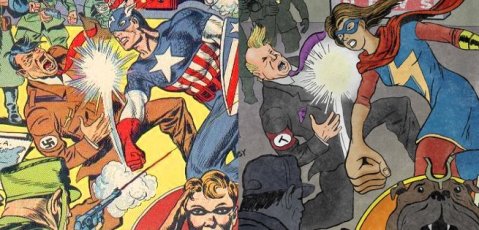
An example of the “punch a nazi” meme. Image reproduced for purposes of critique.
This question remains pressing in today’s climate. In the past year, state-sanctioned violence against indigenous, black, brown, queer and trans people, which has run like rich, nourishing marrow through the backbone of this country, is once again being openly and actively fomented throughout the public sphere by the figures at the apex of state power. In reaction, antifa anarchist groups, responsible for the much-publicized #PunchANazi meme have revived the use of black bloc tactics; along with the rise of “left-leaning” gun clubs, these responses have given renewed currency to the notion of arming up to fight back out of fear, disgust, and rage.
Olympia queer and trans hardcore band G.L.O.S.S. embodies many of these impulses, especially in their most recent (and now final) EP, Trans Day of Revenge. Through calls to direct action and explicit violence, the band rages against every oppressor that has ever crossed its path. On the whole, popular and critical reception to the EP has been positive, even celebratory, due in part to the preceding lineage of music criticism in which the violence of hardcore music is neutralized or intellectualized because of the implicit whiteness of the genre. And, in mirroring both critical and popular reactions to the work of Black Lives Matter and other black social movements, the calls to direct action in rap and hip hop are either discredited or disavowed. In other words, certain white genres of music, and the violence therein, appear to require intellectual analysis or even possess an inherent rationalization. (Dan Graham’s seminal video essay Rock my Religion is an early example of this foundational project in the history of intellectualizing rock.) The mutation into either incredibility or physical threat, on the other hand, accompanies music produced by certain racialized subjects—in America, almost always the black musician. By looking at the critical reception to G.L.O.S.S.’ Trans Day of Revenge, I will examine the dynamic that celebrates the white voice, especially when it calls for violence, as righteous and “metaphysical,” exemplified by the Patti Smith interview in the epigraph (note the use of the uninterrogated second person), and condemns the voice of black rage in rap and hip hop, for its “thuggery.” To question this dynamic is not specific to G.L.O.S.S. but is meant to denaturalize the uneven musical imaginary that supports the white ‘voice’ and smothers the black, as symptomatic of the way in which the political horizons of black political action are foreclosed in favor of righteous white action.
While there may be a seeming disconnect between music criticism and the politics of activism, radical hip hop’s roots in Black Power movements and hardcore and punk’s roots in the politics of white disaffection of the 1970s have both been well-documented. These political-sonic genealogies bind these respective genres to their racialized origins and mark the political stakes of G.L.O.S.S.’ message and its critical reception. The primary difference between the two genres is that the former genre was racialized from the start while the latter remains “unmarked” to this day, despite its early, close connection to white supremacy as documented by, among others, influential rock critic Lester Bangs. Even fascinating work that links and critiques American machismo and hardcore violence completely occludes the valence of race in discussions of masculinity. A closer look at the critical reception to Trans Day of Revenge will help to tease out the ongoing influence of the racialized origins of these two genres on contemporary music and political movements.
To be clear, it is not my intent to moralize the use of violence in leftist social movements. It would be foolish to deny the trans and queer rage that permeates Trans Day of Revenge, and which G.L.O.S.S. literally embody as an apt and poignant expression of a life lived under state-sponsored brutality and domestic abuse. No where is it more poignant than the opening, which is inaugurated with squealing feedback, dense, chugging guitar, and then a strained scream from lead singer Sadie Switchblade: “When peace is just another word for death, it’s our time to give violence a chance!” The four songs that follow, totaling a mere 7 minutes, all tap into the well-established tradition of nihilistic vengeance in G.G. Allin’s “Violence Now—Assassinate the President,” direct aggression in antifa punk in Oi Polloi’s seminal “Pigs for Slaughter” and “Bash the Fash,” and hardcore staples such as Black Flag’s “Police Story” and The Dicks’ “Hate the Police,” which center on booting (or shooting) oppressors in the face. More than that, however, G.L.O.S.S. is intent on smashing the culture of respectability and pacifism of LGBT politics, singing, “Your calls for peace are ignorant and basic / Self-appointed leaders / Who put you in charge?”
In a glowing review that invokes Jose Esteban Muñoz’s Cruising Utopia, Brad Nelson of Pitchfork insists that, “At its best, hardcore is personal; it tends to erase the spatial distinctions between performer and audience, until there is a primordial flow of bodies, ideas, and energy.” Putting aside the cognitive dissonance of quoting Muñoz in a review of an album that urges the use of outright violence, Nelson espouses the grounding liberal, “post-racial” ideology that informs many contemporary conceptions of punk and hardcore. And in doing so, Nelson papers over the racialized history of hardcore while quickly conflating the specificity of state-sanctioned anti-black violence, which G.L.O.S.S. is explicit about, with generalized notions of state oppression. Other reviewers have similarly intellectualized the band’s explicit incitements to violence. Embedded within these glowing reviews, all of which fail to mention the white racial position from which the band speaks and celebrate their calls to violent action, then, is the assumption that white violence is inherently justified because it’s so rare. Put simply, if it’s happening, it’s happening for a good reason. Contrast this with perception that direct action and (self-defensive) violence in both black activism and music reveal some corruption of being, such as an essential “violent character” or the well-worn notion of a savage nature.
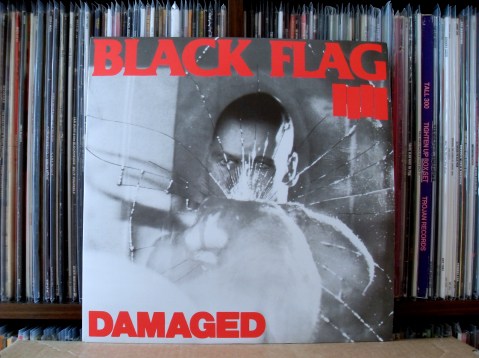
Image by mtarvainen @Flickr CC BY-ND
It is certainly possible to argue for trans and queer ways of knowing and creating art that evade these hetero-masculinist histories but this does not seem to be the case here: many reviewers cite the band’s positive influence on hardcore as both genre and scene, work that the band themselves seem invested in. Such interventions in the scene, then, compel us to recognize that the band’s message is channeled through the generic conventions of hardcore, which prime listeners to appreciate the role of violence as a necessary outcome of and antidote to oppression. The main progenitor of this narrative is Black Flag’s Damaged, which invokes the chaotic, uncontrollable violence of white male angst in songs such as “Damaged I.” (Golden Age country music provides an apt analogue with its generic figure of the violent, romantic white outlaw.) Though G.L.O.S.S. rails against murderous gender and sexual violence, they do so by asserting their position in the tradition of white rage that made Black Flag and Minor Threat the deified figureheads of hardcore—though admirable of gender-nonconforming and transfolk to do this work, this tension of lineage is neither addressed nor resolved. In this way, the violent implications of the genre, along with the issue of a privileged white voice, are absorbed and normalized—just a part of the scene.
Indeed, not a single review so much as gestures towards the band’s race, which, as Toni Morrison suggests, codes the neutral as white (whether this is true to their “actual race” or not is not the point—it’s a matter of perception). This is all the more glaring as multiple songs encourage fighting racist police violence against black trans women; yet this message inhabits a continuum of hardcore and punk that has long held an equivocal relationship with white supremacy, which has often been positioned as either a simple matter of white male disillusionment or edgy nihilism. And while there has certainly been anti-racist music in hardcore, the message becomes mixed by veneration of and apologias for songs such as Minor Threat’s “Guilty of Being White” and Black Flag’s “White Minority.” This muddled message appears in G.L.O.S.S.’ work as well. During the opening track, Switchblade screams: “anti-racist doesn’t mean non-racist!” The lyric may be a riff on a Guardian video by Marlon James in which he insists that “non-racist doesn’t mean anti-racist.” He asserts that non-racism (non-action, moral statement of belief) is inadequate since it does not prevent racial violence. Instead, one must go further and adopt an anti-racist (active) stance. G.L.O.S.S.’ inversion of James’ formulation in the context of hardcore and punk, however, reads with an added bit of irony: if even active anti-racist action does not preclude one from holding racist views, then this highlights the submerged racial dynamics of voice that hold up G.L.O.S.S.’ violent aesthetic and that elude the onslaught of sloganeering that shape their lyrics.
Certainly G.L.O.S.S. screaming the refrain “black lives don’t matter in the eyes of the law!” is critical work being done to highlight anti-black violence and their commitment to addressing oppression of all kinds. But it does not preclude them from criticism for benefiting from structural racism, which includes enjoying the unquestioned privilege of being feted for advocating extreme violence rather than, say, being placed on an FBI watchlist. Simply put, the band has the option of espousing this violence from a position of relative safety, especially from state-sanctioned repercussion and harassment. These unnuanced lyrics make it all the more difficult to square some of their anti-racist lyrics with their intersectional politics. The generic bounds of hardcore dictate crafting lyrics like volleys of missiles, and here such pithy concision becomes an easy conflation of anti-black, anti-queer, anti-trans, and anti-femme oppressions that threatens, ironically, to erase the hard work and frequent clash of axes of oppression in the formation of transversal alliances rather than support it.
Still from “Style Wars” Hip Hop Documentary. Image reproduced for purposes of critique.

Still from “Style Wars” Hip Hop Documentary. Image reproduced for purposes of critique.
If the new hardcore that G.L.O.S.S. spearheaded intends to responsibly involve itself in social justice, the lyrics must move beyond sloganeering. The continued submersion of the multiple and complex intersections of race in white activism is an elision that performs its own form of silencing, a repression of a black voice that has long and often erupted into righteous anger and violence. Scholar Tricia Rose provides an extensive history and analysis of this dynamic in in Hip Hop Wars. In addition to Rose, many scholars from Houston A. Baker to Nelson George, have noted the deep indebtedness of early gangsta rap and radical hip hop (Public Enemy and dead prez, for example) to the tradition of anti-passive philosophies of Malcolm X, the Black Panthers, and earlier pre-Civil Rights movement radicals. Due to these genre’s callback and conscious inhabitation of the genealogy of the black resistance in order to address the historical nature of their continued material oppression, critical responses to this music focus largely on the music’s racial aspects (unlike G.L.O.S.S., or hardcore music in general). Consequently, the condemnation of violent action against oppression rather than celebratory accreditation is always couched in the fear of the black voice and active body.
This dynamic is nowhere clearer than the press’ reaction to Ice-T’s side project Body Count, which featured the controversial song “Cop Killer.” Ice-T has stated that the album as a whole was meant to actively invoke the sonic cues of not only hardcore but metal (also known for its troubled relationship to white supremacist politics) the mainstream media applied the label of “rap” to it in order to identify the violence as both gendered and racialized, that is, more closely with a black, male genre of music, with all that that entails to American society. Ice-T’s transgressive identification of black genres of music in the epigraph, “music like mine,” with the originary, rebellious violence of the Revolutionary War speaks to the divide within the American imaginary between “justified” revolutionary, white violence, and corrupted black violence. He observed:
There is absolutely no way to listen to the song “Cop Killer” and call it a rap record. It’s so far from rap. But, politically, they know by saying the word rap they can get a lot of people who think, “Rap-black-rap-black-ghetto,” and don’t like it…They don’t want to use the word rock & roll to describe this song. (qtd. in Rose 130)
In contrast to criticism of heavy metal, Rose, in Black Noise: Rap Music and Black Culture in Contemporary America, explains, “The terms of the assault on rap music are part of a long-standing sociologically based discourse that considers black influences a cultural threat to American society” (130). She explains, young fans of rap are themselves in concert with the music, ready agents of destruction whereas heavy metal is a threat to the fans, young white males, inherently innocent but in danger of corruption. Put simply, the dynamics of racialized music criticism reflect the attitudes of society writ large: the dismissal of the righteousness of violence in black genres of music mirror the same in black social movements or personal survival.
Across the spectrum of black musical genres, we see the same dynamic. Beyoncé, a master of combining maximalist visuals, nuanced political messages, and hyper-popular culture, was greeted with boycotts and protests after her performance at Super Bowl 50, which invoked a Black Panther aesthetic and, presumably, the group’s promotion of anti-passive and self-defense ideologies. Similarly, she faced a backlash to her music video for Formation, which was perceived as “anti-police” and resulted in an attempted nationwide police boycott of her Formation World Tour. Outside the strict confines of the music industry, black folks, especially black transwomen of color, are held to a different standard in eschewing the avenues of violent protest and activism—or even self-defense (see the tragic case of CeCe McDonald). In a seven-minute EP, G.L.O.S.S. highlights the continued violence against black transwomen in their work, which is positive, critical work. But the uneven reception of black political music by the American public proves just how fraught that project can be without full knowledge of one’s positions of privilege, or the history from which one speaks.
OUTRO
In the end, this issue of voice is about political horizons. G.L.O.S.S. is entirely future-oriented: Switchblade sings, “we break the cycle with revenge,” the band’s name stands for Girls Living Outside of Society’s Shit, and their first EP features a song called “G.L.O.S.S. (We’re from the Future).” But just how much do their actions refuse repetition?
Jose Muñoz was no stranger to witnessing and experiencing the horrors of anti-queer police brutality. In Cruising Utopia he recalls the brutality of riot police attacking a peaceful vigil after the murder of Matthew Shepard (while recognizing that “if Shepard had not been a pretty white boy, there would have been no such outcry”) (63). Muñoz fights against the violence of the “here and now,” the quagmire of political expediency, which is analogous to G.L.O.S.S.’ anger at the pragmatism of LGBT politics. Yet, in a very real way, violence at all costs can be considered a “political expediency” of its own for what occurs after violence? Is revenge and ultra-violence as sole response really “breaking the cycle”? In the rush to implement such violence, who is left by the wayside as we seize and assert our power? This is a question of effectivity, not morality.
For his part, Muñoz insists on breaking the cycle of the present by citing the use of “queer anger” through activism as public performance (64). This is the means toward utopian possibility, that imagines otherwise in a violent, repressive heteronormative present. But he stops short of arguing that queers must take up arms. The critique often levied against revolutionary utopian theorizing has been the obviation of the conditions of “the post-revolution” in favor of dreamy, uncritical rhetoric. Indeed, the same can be said here in the case of G.L.O.S.S. and all others who uncritically embrace not only outright violence but also intersectional politics blanched of much-needed nuance. As a vehicle to bringing trans and queer folk together, G.L.O.S.S.’ rage is a form of Muñoz’s ‘public performance’; they have poignantly invoked his “critical dissatisfaction.” But the generic bounds of hardcore preclude a nuanced conception of his “collective potentiality” (189), particularly one that is attentive to the racial hierarchies of voice. In short, there are yet songs to be sung. Though they have disbanded, we can thank G.L.O.S.S. for helping to set the stage.
–
Cover image is G.L.O.S.S. by Sid Sowder @Flickr CC BY-NC-ND.
—
Chris Chien is an American Studies and Ethnicity graduate student at the University of Southern California, and is doing research on early Asian gay and lesbian organizing in North America, and these social movements’ place within contemporary transpacific, diasporic narratives of a liberalizing Asia, particularly Hong Kong. He has previously written on Sounding Out! about the sonic materiality of diasporic feeling through the relic of the cassette tape, and has an upcoming article on righteous white violence in the music of trans-hardcore band G.L.O.S.S. He hadn’t seen Moonlight or even a trailer before this screening, but heard from many people he respects that it was magical. When SO! ed-in-chief JS reached out after seeing him post about attending on FB, he immediately embraced the idea of a conversation with Shakira.
–
REWIND! . . .If you liked this post, you may also dig:
Listening to Punk’s Spirit in its Pre-, Proto- and Post- Formations – Yetta Howard
Feeling Through the Keen and Grind: Team Dresch’s Personal Best – Gretchen Jude
Riot-Grrrl, Punk and the Tyranny of Technique – Tamra Lucid
Share this:




Current Top Posts





April 2021

January 2020

November 2019

October 2019

August 2019

April 2014

November 2017

March 2015

December 2017

October 2015
 Sounding Out!
Recent Comments