
The Specialty Record Shop

Harold Kelley holds "Blue Danube," a 78 record. Single 78s are visible on the rack below. Behind him is the store's soundproof listening booth. Circa 1949.
In 1947, my grandparents converted a room connected to their small home in downtown Richmond, Indiana, into a record shop. According to my grandmother, my grandfather—perhaps enamored with the family’s new “Airline” table model automatic phonograph (purchased from Montgomery Ward the year before)—somehow managed to persuade her, my great aunt Ina, and my great uncle Henry to embark on the venture. On May 12, 1947, the Monday after Mother’s Day, the Specialty Record Shop opened its doors. It would become the first black owned and operated retail establishment in the area to serve both black and white customers. (The store closed in 1980.)
Many years later, so many things strike me about this ambitious undertaking. Mostly, I realize that their actions were, particularly at that time, a very bold step across a profoundly demarcated color line in American life and music, even in Richmond, which was, with its Quaker history, somewhat more tolerant of African Americans. While Richmond’s public schools had been integrated by 1947, official segregation in the City of Richmond didn’t end until 1965. Long after my mother graduated from high school (1957), blacks and whites lived mostly separate lives—and listened to different music.

The shop's second location on Main Street in Richmond, Indiana, circa 1955.
This seems especially true in the early days of the shop, although among the nearly 100 78 rpm, ten-inch breakable shellac records that comprised the store’s first inventory were records by Nat King Cole, who by 1947 had himself made it across the color line into popular music. For the week ending January 3, 1947, King Cole’s “I Love You (For Sentimental Reasons)” was among Billboard’s top ten “Honor Roll of Hits,” a tabulation of the most popular tunes in the nation. Other popular songs carried by the shop on opening day were Alvino Rey’s “Near You” and Tex Williams’s “Smoke! Smoke! Smoke! (That Cigarette).”
.
Specialty would come to distinguish itself from its five Richmond competitors by carrying all kinds of music and special ordering any sound a customer wanted: classical, country and western, bluegrass, jazz, R&B, spiritual, folk. Music that other stores didn’t stock, Specialty carried, and its inventory eventually included more than 400 different labels. White customers who listened to sounds outside of mainstream popular music of the day found a home at Specialty, but on occasion would still feel the need to discreetly whisper their requests for the latest country and western or bluegrass hit, as if embarrassed by their own musical tastes. Such was the climate in those early days.
.In the 1950s, the Specialty Record Shop, which had from its inception boasted the “Greatest Variety in Recordings,” was in its advertisements not only marketing all genres of music but also both white and black musicians. A November 24, 1954, advertisement, for example, promotes Specialty’s wide variety of “albums and single records of popular, children’s, classical, religious, western, rhythm and blues, and jazz.” And an earlier advertisement from May 19, 1954, for example, promotes Tommy Dorsey (“Little White Lies”), Artie Shaw (“Special Delivery Stomp”), Fats Waller (“Honeysuckle Rose”), Duke Ellington (“Solitude”), Jimmie Lunceford (“Jazznocracy”), and Coleman Hawkins (“Body and Soul”).

A "Tips on Tops" Specialty advertisement promoting music by Perez Prado, Sarah Vaughn and Dinah Shore, Johnny Desmond, Les Baxter and Roy Hamilton, and Sauter-Finegan. This ad also features Specialty's outlet store in Connersville, Indiana. Richmond Palladium-Item, May 11, 1955.
Still, what’s painfully clear from the majority of advertising during that time is that mainstream music of the day reflected “popular” (that is, white) tastes. While black teenagers like my mother listened to “Ain’t That a Shame” by Fats Domino, her white counterparts listened to “Ain’t That a Shame” by Pat Boone. On and on, two versions of records—black and white—and two audiences: Among black songs covered by white artists that my mother remembers from her youth (most certainly carried in my grandparents’ store in both incarnations) are “Fever” by Little Willie John and “Fever” by Peggy Lee, “Long Tall Sally” by Little Richard and “Long Tall Sally” by Pat Boone, “Good Night, Irene” by Leadbelly and “Good Night, Irene” by the Weavers, and “Hound Dog” by Big Mama Thornton and “Hound Dog” by Elvis Presley.
.
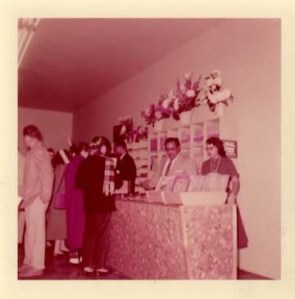
Marilyn Kelley, fifteen, helping customers with Henry Bass and Harold Kelley at the Main Street shop, 1955.
The R & B sounds that my mother, Marilyn Kelley, favored in musical artists in the 1950s were the familiar sounds of (or “sepia” as it was called early on), gutbucket, and melisma—black musical sounds and pronunciation not acceptable to the parents of white teenagers (although white youth were of course becoming familiar with these sounds). Covers changed that sound and made popular rhythm and dance music acceptable to white parents while satisfying white teens and keeping them “inside the fold.” White people (and black people) regularly heard and saw Dinah Shore, Peggy Lee, Pat Boone, Elvis Presley, and other white performers on radio and television, as the record companies heavily promoted these artists and their versions of popular songs. Black performers, on the other hand, were much harder for black people (or everybody else, for that matter) to discover. In the Midwest you had to catch Randy, a white disc jockey out of Nashville, who played black performers’ records and sold them through mail order (see WLAC—Radio). My mother listened to Randy’s show from her bedroom nearly every Saturday night.
.
I had never heard of Little Willie John or his version of “Fever” until my mother mentioned it, but when I listened to his voice for the first time I immediately understood what compelled my parents as teenagers to desire this song, even without lots of radio play or the benefit of television. When I sent my mother a link to Gayle Wald‘s review of a book about the musician (Fever: Little Willie John: A Fast Life, Mysterious Death and the Birth of Soul), she remarked that as a young girl in the rural Midwest she knew not a single thing about him except for the sound of his voice on that one song, which has stuck in her memory all these years. Few people in rural America knew what budding black artists looked like in those days. For listeners like my mother it was all about sound because there was practically nothing else. Pure sound drove her to enjoy these artists and made her want to hear their music again and again.
Into this world jumped two ordinary black couples, moved by their own phonograph player and records to turn a space they had leased to a succession of black beauty parlor operators into a small storefront: Harold Kelley, my grandfather, a carpenter by training who tended as carefully to the foundations of the store as to its customers; my grandmother, Elizabeth, who handled the register and advertising; my great aunt Ina, who mostly worked behind the scenes as the bookkeeper; and my great uncle, Henry Bass, known among the family as “the promoter,” likely as much for his knowledge of music, particularly jazz, as for a habit of walking up and down the street talking to people (a young African-American man named John would join the four after first lingering in the shop as a customer, then helping as a volunteer, until finally becoming an invaluable employee in 1955.)

Kelleys and Basses: Left to right: Henry Bass, Mary Ina Bass, Elizabeth Kelley, and Harold Kelley, co-owners of the Specialty Record Shop, circa 1963.
Benefiting first from their proximity to downtown at 611 South A Street, beneath a rose-colored neon sign, and later in the more spacious Main Street shop—with its “high fidelity” room in the basement—that I remember, the Kelleys and Basses managed to put several other record stores out of business, but more significantly they forged a small community—white and black—around music at the heyday of a vast industry and at one of the peaks of cultural segregation, which even now, so many decades later, seems like no small accomplishment.
Last year, my mother and I traveled to Richmond to visit both Specialty locations, maybe thinking that in all their metaphorical glory they would inspire us to write down what we remember. We went first to the storefront on Main Street, the place that I knew, and then to the small frame house on South A Street, the early shop and my mother’s childhood home. The drabness of the place knocked any hint of nostalgia out of both of us: The bushes and flowerbeds were gone, and the building looked cold and empty, slightly seedy, and a little miserable—these days no doubt valued more for the land it sits on than for the property itself. Thinking now of how my mother must have felt to see her childhood home diminished so mercilessly by time and progress still pains me.
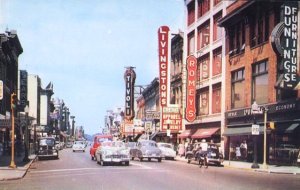
Main Street, Richmond, Indiana in the 1950s
She said then and I write with certainty now that it was more than it looked, which brings me back to what Specialty was, which must be something larger than what stands in our memories or I would not be writing this. It is difficult to attach particular significance to the place in a simple essay about music except to say that as with sound with Specialty meaning was everywhere, and as with music, Specialty reached everyone, at least in Richmond. Its soundproof booth, five-by-five feet square, drew high-fidelity enthusiasts to listen longer than perhaps should have been allowed. A single door connecting the store to my grandparents’ home, sometimes left open by chance, invited curiosity and even boldness from some customers who, stumbling upon the family’s dining room table with its treasure trove of uncataloged records may well have lingered too long in a private space but were never scolded or turned away. The record company representatives who, swept up in the excitement of Specialty’s open house in 1955, began helping customers buy any record, regardless of its label. Taken together, these shared experiences become a narrative of human experience as intricate and complicated as music itself, not so unlike the tapestry of sound that compelled my mother to listen to the magnetic voice of Little Willie John.
In the musical amalgam of today, it is at times difficult to imagine an America so rural, isolated, and segregated, at least in these particular ways. These days “black” music—that is, music by African-American performers—is likely more accepted by and certainly more fully integrated into mainstream America than is the black population itself. Virtual musical communities like turntable, Spotify, Grooveshark, and Pandora are as much growing purveyors of music as are iTunes and Amazon, the new corner record stores, and as such hold much promise for unprecedented global musical cross-pollination and exchange.
 As we may rightly celebrate the cultural integration of more sounds into a larger and perhaps more democratic musical landscape, it is also appropriate to mourn the passing of brick and mortar record stores (and bookstores and libraries, too, I might add) like Specialty, as much for their fidelity as for the ephemeral things these spaces once contained: qualities that bring kinship and serendipity to human experience—sound, yes, but also light, smell, touch, and color, with all its complications.
—
Jacqueline Dowdell received a B.A. from the University of Michigan and an M.F.A. from Cornell University. She is a communications coordinator at Cornell Law School. Thanks to her mother’s memories, her grandmother’s meticulous archive of Specialty history, and a newfound enthusiasm for sound, she is working on a memoir about the Specialty Record Shop.
.
Share this:

Sounding Out! Occupies the Internet, or Why I Blog

Ticker Tape Parade, New York City Financial District, by Kitty Wallace
Welcome to our 100th post! It’s me, Jennifer Stoever Editor-in-Chief, Guest Posts Editor, and Co-Founder of Sounding Out! : The Sound Studies Blog, which has been faithfully “pushing sound studies into the red since 2009.” Together with Liana Silva, Co-Founder and Managing Editor, and Aaron Trammell, Co-Founder and Multimedia Editor, we thank you for your faithful readership, your enthusiasm, and of course, your likes, shares, retweets, and good, old-fashioned word-of-mouth!! We are going to keep serving up sound studies’ latest and greatest for a long time to come, for anyone who wants to listen. Keep a look out for our site redesign coming in January 2012: same good stuff, just that much easier on the eyes.
In honor of this momentous occasion, I am going to get all “meta-“ on you and take you behind the scenes of Sounding Out!, sharing some of the reasons why we decided to start a public conversation about sound studies on the Internet. A manifesto of sorts, this post is adapted from a talk I gave a few weeks back at the American Studies Association annual meeting in Baltimore as part of an excellent panel called “Digital Displays: Women Imagining The Blogosphere as Alternative Public Spheres,” sponsored by the American Studies Women’s Committee, organized by Nicole Hodges Persley (University of Kansas) and featuring the excellent work of Tanya Golash-Bolaza, Judy Lubin, and Jamie Schmidt Wagman.
With all that has happened in the short time that has passed since mid-October—especially at #Occupy sites across the country and around the world—I am only more convinced of the need to empower ourselves by building our own microphones, platforms, and audiences, rather than wait for “official” channels to open up; more often than not, they are cut off, nonresponsive, non-existent or just plain hijacked. Without stretching the metaphor too far or confusing what we do with front-line activism—no one is pepper spraying SO!, let’s be real—I’d like to think that the story of Sounding Out! is also a tale of occupation in its own way. In that spirit of solidarity and D.I.Y. information exchange, here’s a bit about why I blog. I hope to inspire you to join in the conversation.
(P.S. Check our November 2011 coverage of the acoustics of the #Occupy movement thanks to guest writers Gina Arnold and Ted Sammons)
***
In their introduction to the hot-off-the presses special issue of American Quarterly on sound studies—which actually mentions Sounding Out!, on page 451! Yes!—editors Kara Keeling and Josh Kun report receiving an unusual number of submissions from junior faculty members and graduate students, which they describe as “a sign not only of sound’s quantitative currency but the promise of its future as a field of ongoing inquiry, and its importance and relevance to the future of American Studies itself” (452). Keeling and Kun’s editorial openness to newer work is a wonderful exception in traditional academic publishing, where issues of access can loom large for emerging scholars struggling to publish and build a national reputation, particularly for women, scholars of color and/or first-generation scholars, whose expertise in their particular fields is rarely taken for granted. I use the term access here to refer to breaking into the centers of power on our campuses and/or in our respective fields. When you are a “nontraditional” scholar frequently isolated at and from your institution, marginalized in your field, and excluded from formal and informal networks of power, all key characteristics cited by Rosabeth Kanter’s influential study of “Tokenism,” gaining a foothold in the increasingly bleak academic landscape can seem insurmountable.

The Logo of the Women’s Audio Mission: Changing the Face of Sound
Because Sound Studies is not yet fully institutionalized—there are beginning to be sound studies masters’ concentrations at a few schools like NYU and the New School, but there are still no “sound studies” departments in the United States—I believe the kind of intervention that I am helping to stage with Sounding Out! is even more important. Scholars working in audio cultures are spread across, and often isolated in, many fields that are themselves identified as white and male dominated, both in terms of demographics and research agenda: media studies, the history of science and technology, popular music, sound art and design, and film studies, to name a few. When considered alongside the abysmal numbers of many professional fields for sound practitioners, like video game design, radio announcing, and audio recording—the Women’s Audio Mission reports that 95% of the professional recording industry is currently male—the need is even more clear for two-way channels that increase the access of women and people of color to the central conversations of their industries and academic fields while improving the access of other scholars and wider reading publics to our work.

Blast from the Pre-Sounding Out! Past: BU Sound Studies Collective Logo Circa 2008
Rather than wait for a platform for our sound studies scholarship to arise, I helped to build a public conversation in a medium that could not only be more responsive to the lightning-paced nature of sound studies’ breakthrough moment, but also one that could be more responded to: open, collaborative, and in conversation with a wide range of interested parties. Way back in 2009, there were few traditional publication venues for research on sound; sound studies scholars had to rely on rare special issues or occasional essays on the margins of various disciplines’ journals. The first print journal primarily devoted to sound launched in Summer 2008, Music, Sound, and the Moving Image, but it still left large gaps for those not working in film. Not only did we lack the considerable resources necessary to start a print journal, but the medium wasn’t quite up to our tasks. A blog seemed much more flexible, able to build a continuously updated, networked, public archive of sound studies scholars, while sustaining what Kathleen Fitzpatrick describes as “an open, post-publication review process [that] is a non-anonymous discussion by a community of scholars working together on collective issues” in her September 30th, 2011 interview with Inside Higher Ed.
Paul Krugman called such interventions “breaking in from anywhere” in his October 18th, 2011 blog for the New York Times, “Our Blogs, Ourselves,” arguing that the blogosphere makes academia’s “magic circles” seem “less formal and less defined by where you sit or where you went to school.” Krugman argues blogging has “showed what things are really like. If some famous economists seem to be showing themselves intellectually naked, it’s not really a change in their wardrobe, it’s the fact that it’s easier than it used to be for little boys to get a word in.” We at Sounding Out! like to think we’re also helping women (little, big, or otherwise) to join this conversation, and more importantly, to change it.
 While voices like those on Team Sounding Out! are often central to the “ground floor” conversations that shape a new field at conferences, online, and/or at our home institutions, they are often left behind when a field crystallizes in print journal publishing, which, given its limited space and slower-pace, favors the seasoned scholar. Publishing a blog can both complement peer-reviewed research and intervene in its recalcitrant institutional practices. As Claire Potter, author of the blog Tenured Radical, writes, the blogosphere “works against the stultifying tendency of the academy to keep untenured people in as subservient a state as possible for the longest possible time.” Sounding Out! enables our untenured but knowledgeable editorial crew to approach the field with agency and gusto, actively seeking out the “ground floor” intellectual labor and innovation happening in sound studies, making it audible and visible in a public forum that is far from ghettoized. We deliberately curate an integrated, and dynamic collaboration between junior scholars, senior scholars, graduate students, and sound professionals. Thanks to you, we’ll be topping 50,000 hits this week.
Before this all sounds too rosy, I should also be clear that running Sounding Out! is plenty of work, even with a brilliant editorial team. I am constantly surprised at how much time I spend just wrestling with WordPress, let alone the cooler parts of the gig. Not to mention, its role in my tenure case remains to be seen. However, even when the hours get long (squeezed in on nights and weekends after already impossibly long days and weeks), I will also say that it is work that is deeply satisfying and creative, work that feels both truly my own and yet deeply connected to a worthy collective goal.
I am also thrilled to report that several members of my non-academic family have told me that, thanks to the blog, they “finally understand what the hell it is I do,” which is one of the highest compliments I have received in a long while. As Editor-in-Chief, one of my main missions for Sounding Out! has always been for the blog to become—and remain—a smart, well-written, and informative-yet-irresistible venue for the work of emerging sound studies scholars for academics and non-academics alike. That is ultimately why we work so hard over here at SO!: to share the most vital and important findings of our field in a way that impacts lives as well as careers.
—
Jennifer Stoever is co-founder, Editor-in-Chief and Guest Posts Editor for Sounding Out! She is also Assistant Professor of English at Binghamton University and a Fellow at the Society for the Humanities at Cornell University.
Share this:


Current Top Posts





April 2021

January 2020

November 2019

October 2019

August 2019

April 2014

November 2017

March 2015

December 2017

October 2015
 Sounding Out!
Recent Comments