
The Idea (of an Idea) of North (Of the North): Glenn Gould’s Piece at 50

AMBIENCE
On December 28, 1967, the Canadian Broadcasting Corporation debuted a radio piece by famed pianist Glenn Gould, titled The Idea of North. Opaque yet spacious, this experiment would become the first in a trio of ambient documentaries to be produced over the next decade. Each episode explores the theme of solitude from a different geographical vantage, co-implicating form and content; for, as Gould demonstrates, telegraphy had long since complicated isolation as a lifestyle. But Gould’s obsessive pursuit of this ideal produces a multiperspectival portrait of settler consciousness, at the same time as it thematizes and intervenes in its medium as a technical means of colonial expansion.
With an ear to Europe, these radio pieces were assembled after the fashion of major postwar developments in tape music and collage. Stylistically, The Idea of North seems conspicuously stricken with an anxiety of influence befitting of an incipient nationalism; for it was clearly Gould’s intent to furnish his avant-garde composition a local character. As to whether Gould meant to modernize Canadian content, or to Canadianize modern form, his approach presumes ambiguity, to make strange a standard broadcast format. In Gould’s hourlong intervention, the soothing probity of the professional narrator’s voice is edged out by so much overlapping and uncertain talk. While certain formal precedents for this collaged approach de-emphasize semantics in favour of timbral and or ‘purely musical’ characteristics of source sounds, Gould’s regionalist reply preserves the referentiality of each sound as recorded; if only to sublate them altogether in a narrative tapestry.
Would it have been uncomfortable for general interest listeners—a postulate from which proceeds the mandate of national radio, but who actually identifies with this mean temperament?—to encounter The Idea of North in 1967? At the time of the original broadcast, it had been more than three years since Gould’s last public performance, during which hiatus he had come to champion recording as a frontier, commending radio to his purposes. But where these compositions are concerned, Gould’s method of assembly sought to bewilder certain basic expectations of the medium, and moreover, the idiom, of public radio. In North of Empire (2009), Jody Berland extols the eclectic texture of a favourite radio drama; yet even as she praises its narrator for imbuing each of his characters with individual depth, her attention, she tells us, remains fixed on a voice “replete with storytelling pleasures and the sonic signature of the CBC.” The voice of radio itself is most salient; a guarantor of sense and place.
THE UNSOLITARY SETTLER
Gould’s Solitude Trilogy evokes three differently isolated places; the Northern territories, a Newfoundland fishing village, and a Mennonite community on the prairies. The first-person accounts of each terrain that Gould collects are often contradictory, and left alone; for any commentary would thwart the sought-after intimacy of the vignette. Each is a sample—yet none an apt synecdoche—of a nebulous “Canadian” identity. For this reason, Mark Kingwell suggests in his biography of Gould (2009) that Gould’s evocation of the fugue is a red herring, for his radio works defy the expectation of resolution that defines the form. As Kingwell notes, Gould himself uses a critical alter-ego to offer that “the real counterpoint is ideological, between the exercise of individual freedom and the ‘tremendously tyrannical force’” of the social, which one must overcome in order to gain from solitude. (131)
The Idea of North enacts a tussle with a landscape too variously vast to be interiorized as home. This fact appears an obstacle to any attempt to forge or describe a monolithic Canadian identity; so it is encouraging that Kingwell finds in Gould’s radio work a not-so-covert theme of hospitality, an openness to the “novelty of the unknown person” thrust upon one in an unknown clime. Even so, the North, cast as a contiguous and unfathomable neighbour-threshold, exists for the southerner Gould “to dream about, to spin tall tales about, and in the end, avoid.” In this regard, a reactive refusal of hospitality is geographized so as to obscure the political stakes.

Screen Capture from the CBC television adaptation of The Idea of North
To rethink Canadian identity on the model of hospitality is to name an obvious standard by which to flunk the extant state. Following the work of Toula Nicolacopoulos and George Vassilacopoulos in Indigenous Sovereignty and the Being of the Occupier (2014), one might suggest that hospitality requires a frank response to the question “where do you come from?” Any such self-accounting is specifically repressed in the conscience of the settler, and the romantic conception of North America as a vast wilderness, untrammelled and unpeopled prior to European influence, is an outcome and requirement of this repression. It is possible, and moreover desirable, to think the contrapuntal weft of voices comprising Gould’s radio play as a practice of hospitality; but first one must acknowledge the degree to which, after the means of its realization, this open narrative remains a one-sided overture.
According to Avital Ronell’s The Telephone Book (1989), what operates behind the radio in its appeal to “a tremendous national ear” is an obscure sense of the absolute priority of the other to oneself. (21) As seen above, a latent dialogue haunts every monovocal broadcast. However, one should complicate the too-readily metaphysicalized trope of the other with reference to the specific preoccupancy of a specific space by specific people, rather than fetishize otherness as a philosophico-poetic model for the production of pleasurable moral quandaries. Gould’s radio play would suggest as much, if negatively.
COMPOSING THE NATION-STATE
The fascinating effect of radio, R. Murray Schafer observes in The Soundscape (1994), has to do with the manner in which “broadcasting is separated into independent information channels so that the confusion of simultaneity, so often present in the soundscape at large, is absent.” (234) This facilitates the “deliberate attempt to regulate the flow of information according to human responses and information-processing capabilities.” (ibid) In short, radio functions as a half-conversation, an analysis turned in on itself, facilitating fanaticism and transference. Its domineering guise is the voice on which Berland fixates above, a sonic signature eliding content.

Glenn Gould publicity photo for The Idea of North, courtesy of Canada’s BiblioArchives/ LibraryArchives
Gould bewilders this unitary vision, insisting upon crowded conditions, interruption and subjective chafe. In this regard, his programme is not only contrapuntal, as argued by Kingwell, but enacts a spatial intervention directly analogous to those undertaken in modern music. Schafer explains that the radio technician must account for perspective. The technician, he writes, conceives of the sound-scene in three main parts—the Immediate, the Support, and the Background—the interaction of which permits the listener to hierarchicalize and excerpt information. “The three-stage plan of the radio technician corresponds precisely to the classical layout of the orchestral score with soloist, concertino group and tutti accompaniment.” (234) Gould, after the fashion of his maverick performances, which involved a kind of escalating competition between the orchestra and the soloist, revels in conditions of uncertainty as to which features of the soundscape are ground and which are figure. At crowded moments, the determination of semantic signal and ambient support, is at the listener’s discretion.
“I was fascinated by the country as such,” The Idea of North begins; and this abstraction collapses back into the desire that it originates, for the speaker’s geographical cathexis manifests a country from above, a mottled sublime: “I felt that I was almost part of that country, part of that peaceful surrounding, and I wished that it would never end.” The “almost” of this encounter is Gould’s theme. One speaker contradicts himself in tracing the evasiveness of an imaginary terrain: “I can’t conceive of anyone being in close touch with the North, whether he lived there all the time or simply traveled it month after month, year after year. I can’t conceive of such a person being really untouched by the North for the rest of his life.” By this conflicted account, one can neither touch, nor remain untouched by, this terrain. That the idea of the North will never coincide with any terrain seems logically apparent; for the object under discussion is designated by a cardinal direction, an expression of spatial relation. One must be south of North to perceive it as such: the idea would be necessarily southern.
Gould frequently qualified his vantage over the course of his life: his composition was ineluctably nostalgic, shaped by southern biases, and so on. This modesty is itself a token of mandatory modernity, mediated by professional politesse. But the work largely concerns the composer’s own difficulty before intransigent material. “It’s not da gold, it’s de finding da gold,” one speaker quotes in order to affirm his own designs upon the landscape, and the phatic article before the questing verb suggests a more salient problem of definition: “I think the North is process,” the ruminant continues, without specifying the (innocent or sordid) processes in which one’s fantasy may be enrolled. “North is multiple, shifting, elastic,” Sherrill Grace writes in her book, Canada and the Idea of North (2007), suggesting that Canadians can change their ideas of this destination, in spite, or because, of their unseemly and persistent attachment to myriad partial representations. (17)

Screen Capture from the CBC television adaptation of The Idea of North
In 1967, however, Gould’s panel reproduces a paternalistic depiction of the territories and their denizens. “Considering a place romantic means that one doesn’t know too much about it,” our first speaker opines, professing helplessness before communities she had intended to rescue. At this telling point in the collaged “discussion,” which evades a certain burden of representation by evacuating the narrative center, a pointed racism crests, albeit in a version intended to ambiguate pernicious stereotypes by distributing them across so many unreliable voices. But the denominator of this chorus is all too Canadian. However multiple, the voices that were selected to depict a democratic and multi-perspectival clamor did not have the least moral difficulty ruling upon the communities that they encountered in pursuit of their own obscure desires.
TALKING BACK
Grace titles the penultimate section of her book “The North Writes Back,” attempting a theory of Northern discourse to broadly refute colonial description. The voices presented here run counter to the documentary attempts of Glenn Gould, Pierre Berton, and so many others outlined in the first chapter, “Representing North.” Inuit artist Alootook Ipellie furnishes an epigram: “Let us put, without hesitation, a voice in the mouth of our silent mind.” (227) This rebukes the repeat characterization of (the idea of) North as a state of silence, vacancy, or isolation; and the secondhand zen of the willfully itinerant settler, determined to meditate unto epiphany upon any unassimilable strangeness. The silencing conditions to which Ipellie addresses himself may well be the din of interlopers and their presumptions, rather than the manifold soundscape of their common destination. To place voice in the mouth of mind is to reply to silencing conditions: the operative distinction between voice and mouth evokes a talk-back capacity implicit in receipt, if unrealized.
Artist and DJ Geronimo Inutiq’s 2015 work, ARCTICNOISE, commissioned by curators Britt Gallpen and Yasmin Nurming-Por, responds directly to Gould’s radio play. A multilingual, multimedia portrait of the sovereign voices of an irreducible North, Inutiq’s installation extends the discursive counterpoint of Gould’s composition, spanning platforms as well as perspectives. As Sydney Hart remarks in his essay, Reading Contrapuntally (2016), Inutiq’s formal extrapolation of Gould’s structure resonates with Edward Said’s musical thoughts on postcolonial literature and its plurality of voices. Contrapuntal reading entails a “simultaneous awareness both of the metropolitan history that is narrated and of those other histories against which (and together with which) the dominating discourse acts.” (62)

“ARCTICNOISE” Still from 2015 Installation, image by Trinity Square Video and imagineNATIVE Film + Media Arts Festival
In Inutiq’s installation, multiple video projections appear at cross-rhythms to each other, abstract digital art contrasting documentary interviews and archival footage. This juxtaposition aptly demonstrates the uneven contours of international development, mapped over the immersive course of Inutiq’s multipanoramic presentation. The context is combined and contradictory: resource extractive projects impelling settlers North, technological and military expansion into contested space during the Cold War, and a gallery-backed effort to create and claim Inuit artistic production, ready to market, as a national treasure, all play a part. These angles on the North are strategic abstractions, too; but to map them in simultaneity allows for a concerted, and concrete, critique.
Grace’s attempt to consolidate a “Northern” reply to a southern settler’s imaginary stalls upon qualification, as her ungrounded anthropology finds an innocuous “topographical and meteorological diversity” recapitulated at the highly localized level of attendant practice. By comparison, Inutiq’s ARCTICNOISE foregrounds interference in its very name. To call the multidiscursive clamour of the landscape ‘noise,’ an antecedent backing of any strong signal, is a totalizing gesture in the negative; at least where the transmissibility of identity to the state is concerned. In As We Have Always Done (2017), Nishinaabeg scholar Leanne Betasamosake Simpson cites nêhiyaw (Plains Cree) and Dene Suline scholar and artist Jarrett Martineau, describing Indigenous artistic practice as “noise to colonialism’s signal.” (198) This work, Simpson says, operates at an “elegant level of protection and disruption,” declining any susceptibility to a settler’s interception or interpretation, such as I cannot render here.

“ARCTICNOISE” Still from 2015 Installation, image by Trinity Square Video and imagineNATIVE Film + Media Arts Festival
This complicates the philosophical trope of counterpoint, which requires the horizontal elaboration of two or more mutually dependent themes, as well as their vertical separation in space for clarity. Settler colonialism and capitalism alike oversee any number of encroachments, such that this meaningful categorical distinction lapses into convolution. If Gould’s ideal is a melodically assured phraseology, each soloist empowered to give a self-account, Inutiq’s challenge restores a prerequisite space to the arrangement of voices. The additive model of liberal civics—the progressivist notion that we only need for more diversity of talk-for-trade—swaps the necessity of a collaborative space for more and greater time, in which span all will be forgiven. To visually recompose Gould’s ad hoc townhall, with greater geographical and cultural specificity, is a powerful reminder that the purposes of any settler-artist’s pilgrimage may coincide with a place of their choosing, but never essentially.
PROGRAMME MUSIC
What does the radio voice shore in a Canadian context? Gould’s selective chorus is a demonstration of certain normative commitments, formally reiterative of an impasse of representation. The difficulties implicit in broadcast cannot simply be addressed at the level of more and authoritative voices, for it is not the radio voice that is the problem here so much as the body from which it is presumed to emanate.

Screen Capture from the CBC television adaptation of The Idea of North
“I am indeed a Northern listener then,” the Virgilian surveyor McLean proclaims late in the broadcast, “and the pity of it all is that I’m not always able to select what I want to hear. I hear what other people inflict upon me. You know, the noise, the noise of civilization and its discontents.” In this vulgarized Freudian remark, the speaker identifies ‘noise’ as a claustrophobic condition, from which one might escape. While Freud’s text details the aversive attempt by an individual ego to differentiate itself over-against bracing reality, Gould’s soloist attempts identification with a synthetic perspective straddling this opposition: “I do believe able to reflect on that selection makes you more than the mere analyst that most of us claim we are [. . .] in detaching and in reflecting and in listening I suppose I’m able to synthesize, to have these different rails meet in the infinity that is our conscious hope.” However multiply determined, this identification—of transportation infrastructure with a vastly collective desire—remains laudably materialist, emphasizing the production of heretofore unheardof proximities in space.
In heavy handed analogy to symphonic form, The Idea of North ends more or less where it began, generically elsewhere. The metaphorical journey by train concludes with the armchair philosophical pontifications of panelist W. V. MacLean, backed with a defamiliarized recording of Sibelius’ fifth symphony, which threatens at moments to swallow MacLean’s climactic speech. Paraphrasing William James, MacLean posits struggle against provisional alterity as a psychological necessity and subjective virtue. Today, he posits brazenly, “the moral equivalent of war is going North.” Gould concludes the piece with this bon mot, a surprise analogy that relies for its effect on the presumption that Canadian designs in this direction are more often peaceable than not. This is far from certain, and Gould’s finale reminds the listener that the vehicle of this idea is itself susceptible to weaponization, as radio develops in periods of conflict and conquest. Then the least technologically contingent aspect of Gould’s epochal docudrama would appear the most bizarre today—the desire to test one’s conflictual mettle in flight.

Screen Capture from the CBC television adaptation of The Idea of North
CODA
How these examples speak to today’s post-broadcast episteme would require another survey altogether. Surely today’s ideological counterpoint would sound far more dissonant, a disputatious and often collaborative din. But this idealized polyvocality may itself manifest a one-sided desire, a dialogic fantasy of which agenda national radio is but one diagram. Practical matters, of land and its capture, are obscured by this restaging of the stakes of colonialism as a conversation rather than an occupation.
A key theme of The Idea of North would be the practice and depiction of utopia for loners, but a counter-message sounds as clearly: that wherever one travels to find oneself, one is forever destined to find other people in their place. There are no definitive arrivals, and everything depends upon what happens next—on hospitality contra the arrogance of occupation. One historical staging of this quandary has been named “Canada,” and Gould’s mythopoetic play for voices is a crucial document of its becoming, flaws and all. As with any broadcast, it is up to each listener to imagine a possible reply.
—
Featured Image:Screen Capture from the CBC television adaptation of The Idea of North
—
CAM SCOTT is a poet, critic, and improvising non-musician from Winnipeg, Canada, Treaty One territory. He performs under the name Cold-catcher and writes in and out of Brooklyn. His visual suite, WRESTLERS, was released by Greying Ghost in 2017.
—
 REWIND! . . .If you liked this post, you may also dig:
Unsettled Listening: Integrating Film and Place — Randolph Jordan
Unsettling the World Soundscape Project: Soundscapes of Canada and the Politics of Self-Recognition–Mitchell Akiyama
Becoming Sound: Tubitsinakukuru from Mt. Scott to Standing Rock–Dustin Tahmahkera
EPISODE 60: Standing Rock, Protest, Sound and Power–Marcella Earnest
Share this:

The Firesign Theatre’s Wax Poetics: Overdub, Dissonance, and Narrative in the Age of Nixon

The Firesign Theatre are the only group that can claim among its devoted fans both Thom Yorke and John Ashbery; who have an album in the National Recording Registry at the Library of Congress and also coined a phrase now used as a slogan by freeform giant WFMU; and whose albums were widely distributed by tape among U.S. soldiers in Vietnam, and then sampled by the most selective classic hip hop DJs, from Steinski and DJ Premier to J Dilla and Madlib.
Formed in 1966, they began their career improvising on Los Angeles’s Pacifica station KPFK, and went on to work in numerous media formats over their four-decade career. They are best known for a series of nine albums made for Columbia Records, records that remain unparalleled for their density, complexity, and sonic range. Realizing in an astonishing way the implications of the long playing record and the multi-track recording studio, the Firesign Theatre’s Columbia albums offer unusually fertile ground for bringing techniques of literary analysis to bear upon the fields of sound and media studies (and vice versa). This is a strategy that aims to reveal the forms of political consciousness that crafted the records, as well as the politics of the once-common listening practices binding together the disparate audiences I have just named. It is no accident that the associative and referential politics of the sample in “golden age” hip hop would have recognized a similar politics of reference and association in Firesign Theatre’s sound work, in particular in the group’s pioneering use of language, time, and space.

The Firesign Theatre (wall of cables): John Rose, Image courtesy of author
The Firesign Theatre is typically understood as a comedy act from the era of “head music” — elaborate album-oriented sounds that solicited concerted, often collective and repeated, listening typically under the influence of drugs. But it may be better to understand their work as attempting to devise a future for literary writing that would be unbound from the printed page and engaged with the emergent recording technologies of the day. In this way, they may have crafted a practice more radical, but less recognizable, than that of poets —such as Allen Ginsberg or David Antin, both of whose work Firesign read on the air — who were also experimenting with writing on tape during these years (see Michael Davidson’s Ghostlier Demarcations: Modern Poetry and the Material Word, in particular 196-224). Because their work circulated almost exclusively on vinyl (secondarily on tape), it encouraged a kind of reading (in the strictest sense) with the ears; the fact that their work was distributed through the networks of popular music may also have implications for the way we understand past communities of music listeners as well.
The period of Firesign’s contract (1967-1975) with the world’s largest record company parallels exactly the recording industry’s relocation from New York to Los Angeles, the development of multitrack studios which made the overdub the dominant technique for recording pop music, and the rise of the LP as a medium in its own right, a format that rewarded, and in Firesign’s case required, repeated listening. These were all factors the Firesign Theatre uniquely exploited. Giving attention to the musicality of the group’s work, Jacob Smith has shown (in an excellent short discussion in Spoken Word: Postwar American Phonograph Cultures that is to date the only academic study of Firesign) how the group’s attention to the expansion of television, and in particular the new practice of channel-surfing, provided both a thematic and a formal focus for the group’s work: “Firesign […] uses channel surfing as the sonic equivalent of parallel editing, a kind of horizontal or melodic layering in which different themes are woven in and out of prominence until they finally merge. Firesign also adds vertical layers to the narrative in a manner analogous to musical harmony or multiple planes of cinematic superimposition” (181). But more remains to be said not only about the effect of the Firesign Theatre’s work, but about its carefully wrought semantics, in particular the way the “horizontal” and “vertical” layers that Smith identifies were used as ways of revealing the mutually implicated regimes of politics, culture, and media in the Vietnam era — at the very moment when the explosion of those media was otherwise working to disassociate those fields.
The group’s third album, Don’t Crush That Dwarf, Hand Me the Pliers is typically understood as their first extended meditation on the cultural phenomenology of television. Throughout the record, though there is much else going on, two pastiches of 1950s genre movies (High School Madness and a war film called Parallel Hell!) stream intermittently, as if through a single channel-surfing television set. The films coincide in two superimposed courtroom scenes that include all the principal characters from both films. By interpenetrating the school and the war, the record names without naming the killing of four students at Kent State and two students at Jackson State University, two events that occurred eleven days apart in May 1970 while the group was writing and recording in Los Angeles. Until this point rationalized by the framing fiction of a principal character watching both films on television, the interpenetration of the narratives is resolvable within the album’s diegesis—the master plot that accounts for and rationalizes every discrete gesture and event—only as a representation of that character’s having fallen asleep and dreaming the films together, a narrative sleight of hand that would testify to the group’s comprehension of literary modernism and the avant-garde.
The question of what may “cause” the interpenetration of the films is of interest, but the Firesign Theatre did not always require justification to elicit the most outrageous representational shifts of space (as well as of medium and persona). What is of more interest is the way rationalized space — the space implied by the “audioposition” of classic radio drama, as theorized by Neil Verma in Theater of the Mind— could be de-emphasized or even abandoned in favor of what might instead be called analytic space, an aural fiction in which the institutions of war and school can be understood as simultaneous and coterminous, and which more broadly represents the political corruptions of the Nixon administration by means of formal and generic corruption that is the hallmark of the Firesign Theatre’s approach to media (35-38).
While the techniques that produce this analytic soundscape bear some resemblance to what Verma terms the “kaleidosonic style” pioneered by radio producer Norman Corwin in the 1940s — in which the listener is moved “from place to place, experiencing shallow scenes as if from a series of fixed apertures” — even this very brief sketch indicates how radically the Firesign Theatre explored, deepened, and multiplied Corwin’s techniques in order to stage a more politically diagnostic and implicative mode of cultural interpretation. Firesign’s spaces, which are often of great depth, are rarely traversed arbitrarily; they are more typically experienced either in a relatively seamless flow (perspective and location shifting by means of an associative, critical or analytical, logic that the listener may discover), or are instead subsumed within regimes of media (a radio broadcast within a feature film which is broadcast on a television that is being watched by the primary character on the record album to which you are listening). According to either strategy the medium may be understood to be the message, but that message is one whose horizon is as critical as it is aesthetic.

Firesign Theatre (pickup truck): John Rose, Image courtesy of author
The creation of what I am terming an analytic space was directly abetted by the technological advancement of recording studios, which underwent a period of profound transformation during the years of their Columbia contract, which spanned the year of The Beatles’s Sergeant Pepper’s Lonely Hearts Club Band (arguably the world’s first concept album, recorded on four tracks) to Pink Floyd’s Wish You Were Here (arguably that band’s fourth concept album, recorded on 24 tracks). Pop music had for years availed itself of the possibilities of recording vocals and solos separately, or doubly, but the dominant convention was for such recordings to support the imagined conceit of a song being performed live. As studios’ technological advances increased the possibilities for multitracking, overdubbing, and mixing, pop recordings such as Sgt. Pepper and the Beach Boys’ Pet Sounds (1966) became more self-evidently untethered from the event of a live performance, actual or simulated. In the place of the long-dominant conceit of a recording’s indexical relation to a particular moment in time, pop music after the late 60s came increasingly to define and inhabit new conceptions of space, and especially time. Thus, when in 1970 Robert Christgau asserted that the Firesign Theatre “uses the recording studio at least as brilliantly as any rock group” (and awarding a very rare A+), he was remarking the degree to which distortions and experiments with time and space were if anything more radically available to narrative forms than they were to music.
The overdub made possible much more than the simple multiplication and manipulation of aural elements, it also added depth and richness to the soundfield. New possibilities of mixing, layering, and editing also revealed that the narrative representation of time, as well as spatial element I’ve just described, could be substantially reworked and given thematic meaning. In one knowing example, on 1969’s How Can You Be in Two Places at Once When You’re Not Anywhere at All, an accident with a time machine results in the duplication of each of the narrative’s major characters, who then fight or drink with each other.
This crisis of the unities is only averted when a pastiche of Franklin Delano Roosevelt interrupts the record’s fictional broadcast, announcing the bombing of Pearl Harbor, and his decision to surrender to Japan. On a record released the year the United States began secret bombing in Cambodia, it is not only the phenomenological, but also the social and political, implications of this kind of technologically mediated writing that are striking: the overdub enables the formal representation of “duplicity” itself, with the gesture of surrender ironically but pointedly offered as the resolution to the present crisis in Southeast Asia.
To take seriously the Firesign Theatre’s experiments with medium, sound, and language may be a way of reviving techniques of writing — as well as recording, and of listening — that have surprisingly eroded, even as technological advances (cheaper microphones, modeling software, and programs from Audacity and Garage Band to Pro Tools and Ableton Live) have taken the conditions of production out of the exclusive purview of the major recording studios. In two recent essays in RadioDoc Review called “The Arts of Amnesia: The Case for Audio Drama Part One” and “Part Two,” Verma has surveyed the recent proliferation of audio drama in the field of podcasting, and urged artists to explore more deeply the practices and traditions of the past, fearing that contemporary aversion to “radio drama” risks “fall[ing] into a determinism that misses cross-fertilization and common experiment” (Part Two, 4). Meanwhile, Chris Hoff and Sam Harnett’s live performances from their excellent World According to Sound podcast are newly instantiating a form of collective and immersive listening that bears a resemblance to the practices that were dominant among Firesign Theatre listeners in the 1960s and 70s; this fall they are hosting listening events for Firesign records in San Francisco.
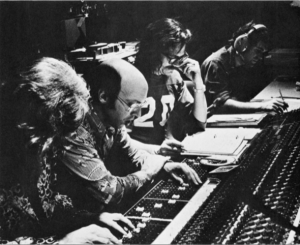
The Firesign Theatre (mixing board): Bob & Robin Preston, Image courtesy of author
It is tempting to hope for a wider range of experimentation in the field of audio in the decade to come, one that either critically exploits or supersedes the hegemony of individualized listening emblematized by podcast apps and noise-cancelling headphones. But if the audio field instead remains governed by information-oriented podcasts, leavened by a subfield of relatively classical dramas like the very good first season of Homecoming, a return to the Firesign Theatre’s work can have methodological, historical, and theoretical value because it could help reveal how the experience of recorded sound had an altogether different political inflection in an earlier era. Thinking back to the remarkably heterogeneous set of Firesign Theatre fans with which I began, it is hard not to observe that the dominant era of the sample in hip hop is one where it was not the Walkman but the jambox — with its politics of contesting a shared social space through collective listening — was the primary apparatus of playback. However unwished- for, this determinist line of technological thinking would clarify the way media audiences are successively composed and decomposed, and show more clearly how, to use Nick Couldry’s words in “Liveness, ‘Reality,’ and the Mediated Habitus from Television to the Mobile Phone,” “the ‘habitus’ of contemporary societies is being transformed by mediation itself” (358).
—
Featured Image: The Firesign Theatre (ice cream baggage claim): John Rose, courtesy of author.
—
Jeremy Braddock is Associate Professor of English at Cornell University, where he specializes on the production and reception of modernist literature, media, and culture from the 1910s throughout the long twentieth century. His scholarship has examined the collective and institutional forms of twentieth-century authorship that are obscured by the romanticized figure of the individual artist. His book Collecting as Modernist Practic— a study of anthologies, archives, and private art collections — won the 2013 Modernist Studies Association book prize. Recent publications include a short essay considering the literary education of Robert Christgau and Greil Marcus and an essay on the Harlem reception of James Joyce’s Ulysses. He is currently working on a book on the Firesign Theatre.
—
REWIND! . . .If you liked this post, you may also dig:

“Radio’s “Oblong Blur”: Notes on the Corwinesque”–Neil Verma
The New Wave: On Radio Arts in the UK–Magz Hall
This is Your Body on the Velvet Underground–Jacob Smith
Share this:


Current Top Posts





April 2021

January 2020

November 2019

October 2019

August 2019

April 2014

November 2017

March 2015

December 2017

October 2015
 Sounding Out!
Recent Comments