
Can’t Nobody Tell Me Nothin: Respectability and The Produced Voice in Lil Nas X’s “Old Town Road”
It’s been ten weeks now that we’ve all been kicking back in our Wranglers. allowing Lil Nas X’s infectious twang in “Old Town Road” to shower us in yeehaw goodness from its perch atop the Billboard Hot 100. Entrenched as it is on the pop chart, though, “Old Town Road”’s relationship to Billboard got off to a shaky start, first landing on the Hot Country Songs list only to be removed when the publication determined the hit “does not embrace enough elements of today’s country music to chart in its current version.” There’s a lot to unpack in a statement like that, and folks have been unpacking it quite consistently, especially in relation to notions of genre and race (in addition to Matthew Morrison’s recommended reads, I’d add Karl Hagstrom-Miller’s Segregating Sound, which traces the roots of segregated music markets). Using the context of that ongoing discussion about genre and race, I’m listening here to a specific moment in “Old Town Road”— the line “can’t nobody tell me nothin”—and the way it changes from the original version to the Billy Ray Cyrus remix. Lil Nas X uses the sound of his voice in this moment to savvily leverage his collaboration with a country music icon, and by doing so subtly drawing out the respectability politics underlying Billboard’s racialized genre categorization of his song.

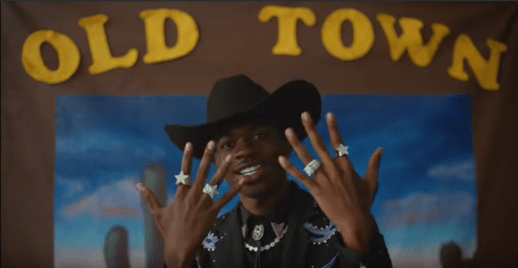
Screenshot, “Lil Nas X – Old Town Road (Official Movie) ft. Billy Ray Cyrus”
After each of Lil Nas X’s two verses in the original “Old Town Road,” we hear the refrain “can’t nobody tell me nothin.” The song’s texture is fairly sparse throughout, but the refrains feature some added elements. The 808-style kick drum and rattling hihats continue to dominate the soundscape, but they yield just enough room for the banjo sample to come through more clearly than in the verse, and it plucks out a double-time rhythm in the refrain. The vocals change, too, as Lil Nas X performs a call-and-response with himself. The call, “can’t nobody tell me nothin,” is center channel, just as his voice has been throughout the verse, but the response, “can’t tell me nothin,” moves into the left and right speaker, a chorus of Lil Nas X answering the call. Listen closely to these vocals, and you’ll also hear some pitch correction. Colloquially known as “autotune,” this is an effect purposely pushed to extreme limits to produce garbled or robotic vocals and is a technique most often associated with contemporary hip hop and R&B. Here, it’s applied to this melodic refrain, most noticeably on “nothin” in the call and “can’t” in the response,
After Billboard removed the song from the Hot Country chart in late March, country star Billy Ray Cyrus tweeted his support for “Old Town Road,” and by early April, Lil Nas X had pulled him onto the remix that would come to dominate the Hot 100. The Cyrus remix is straightforward: Cyrus takes the opening chorus, then Lil Nas X’s original version plays through from the first verse to the last chorus, at which point Cyrus tacks on one more verse and then sings the hook in tandem with Lil Nas X to close the song. Well, it’s straightforward except that, while Lil Nas X’s material sounds otherwise unaltered from the original version, the pitch correction is smoothed out so that the garble from the previous version is gone.
In order to figure out what happened to the pitch correction from the first to second “Old Town Road,” I’m bringing in a conceptual framework I’ve been tinkering with the last couple of years: the produced voice. Within this framework, all recorded voices are produced in two specific ways: 1) everyone performs their bodies in relation to gender, race, ability, sex, and class norms, and 2) everyone who sings on record has their voice altered or affected with various levels of technology. To think about a produced voice is to think about how voices are shaped by recording technologies and social technologies at the same time. Listening to the multiple versions of “Old Town Road” draws my attention specifically to the always collaborative nature of produced voices.
In performativity terms—and here Judith Butler’s idea in “Performative Acts and Gender Constitution: An Essay in Phenomenology and Feminist Theory” that “one is not simply a body, but, in some very key sense, one does one’s body” (521) is crucial—a collaboratively produced voice is a little nebulous, as it’s not always clear who I’m collaborating with to produce my voice. Sometimes I can (shamefully, I assure you) recognize myself changing the way my voice sounds to fit into some sort of, say, gendered norm that my surroundings expect. As a white man operating in a white supremacist, cisheteropatriarchal society, the deeper my voice sounds, the more authority adheres to me. (Well, only to a point, but that’s another essay). Whether I consciously or subconsciously make my voice deeper, I am definitely involved in a collaboration, as the frequency of my voice is initiated in my body but dictated outside my body. Who I’m collaborating with is harder to establish – maybe it’s the people in the room, or maybe my produced voice and your listening ears (read Jennifer Stoever’s The Sonic Color Line for more on the listening ear) are all working in collaboration with notions of white masculine authority that have long-since been baked into society by teams of chefs whose names we didn’t record.

“Tools in a Recording Studio” by Flickr user Carol VanHook (CC BY-SA 2.0)
In studio production terms, a voice’s collaborators are often hard to name, too, but for different reasons. For most major label releases, we could ask who applied the effects that shaped the solo artist’s voice, and while there’s a specific answer to that question, I’m willing to bet that very few people know for sure. Even where we can track down the engineers, producers, and mix and master artists who worked on any given song, the division of labor is such that probably multiple people (some who aren’t credited anywhere as having worked on the song) adjusted the settings of those vocal effects at some point in the process, masking the details of the collaboration. In the end, we attribute the voice to a singular recording artist because that’s the person who initiated the sound and because the voice circulates in an individualistic, capitalist economy that requires a focal point for our consumption. But my point here is that collaboratively produced voices are messy, with so many actors—social or technological—playing a role in the final outcome that we lose track of all the moving pieces.
Not everyone is comfortable with this mess. For instance, a few years ago long-time David Bowie producer Tony Visconti, while lamenting the role of technology in contemporary studio recordings, mentioned Adele as a singer whose voice may not be as great as it is made to sound on record. Adele responded by requesting that Visconti suck her dick. And though the two seemed at odds with each other, they were being equally disingenuous: Visconti knows that every voice he’s produced has been manipulated in some way, and Adele, too, knows that her voice is run through a variety of effects and algorithms that make her sound as epically Adele as possible. Visconti and Adele align in their desire to sidestep the fundamental collaboration at play in recorded voices, keeping invisible the social and political norms that act on the voice, keeping inaudible the many technologies that shape the voice.
Propping up this Adele-Visconti exchange is a broader relationship between those who benefit from social gender/race scripts and those who benefit from masking technological collaboration. That is, Adele and Visconti both benefit, to varying degrees, from their white femininity and white masculinity, respectively; they fit the molds of race and gender respectability. Similarly, they both benefit from discourses surrounding respectable music and voice performance; they are imbued with singular talent by those discourses. And on the flipside of that relationship, where we find artists who have cultivated a failure to comport with the standards of a respectable singing voice, we’ll also find artists whose bodies don’t benefit from social gender/race scripts: especially Black and Brown artists—non-binary, women, and men. Here I’m using “failure” in the same sense Jack Halberstam does in The Queer Art of Failure, where failing is purposeful, subversive. To fail queerly isn’t to fall short of a standard you’re trying to meet; it’s to fall short of a standard you think is bullshit to begin with. This kind of failure would be a performance of non-conformity that draws attention to the ways that systemic flaws – whether in social codes or technological music collaborations – privilege ways of being and sounding that conform with white feminine and white masculine aesthetic standards. To fail to meet those standards is to call the standards into question.

So, because respectably collaborating a voice into existence involves masking the collaboration, failing to collaborate a voice into existence would involve exposing the process. This would open up the opportunity for us to hear a singer like Ma$e, who always sings and never sings well, as highlighting a part of the collaborative vocal process (namely pitch correction, either through training or processing the voice) by leaving it out. To listen to Ma$e in terms of failed collaboration is to notice which collaborators didn’t do their work. In Princess Nokia’s doubled and tripled and quadrupled voice, spread carefully across the stereo field, we hear a fully exposed collaboration that fails to even attempt to meet any standards of respectable singing voices. In the case of the countless trap artists whose voices come out garbled through the purposeful misapplication of pitch correction algorithms, we can hear the failure of collaboration in the clumsy or over-eager use of the technology. This performed pitch correction failure is the sound I started with, Lil Nas X on the original lines “can’t nobody tell me nothin.” It’s one of the few times we can hear a trap aesthetic in “Old Town Road,” outside of its instrumental.
In each of these instances, the failure to collaborate results in the failure to achieve a respectably produced voice: a voice that can sing on pitch, a voice that can sing on pitch live, a voice that is trained, a voice that is controlled, a voice that requires no intervention to be perceived as “good” or “beautiful” or “capable.” And when respectable vocal collaboration further empowers white femininity or white masculinity, failure to collaborate right can mean failing in a system that was never going to let you pass in the first place. Or failing in a system that applies nebulous genre standards that happen to keep a song fronted by a Black artist off the country charts but allow a remix of the same song to place a white country artist on the hip hop charts.
 The production shift on “can’t nobody tell me nothin” is subtle, but it brings the relationship between social race/gender scripts and technological musical collaboration into focus a bit. It isn’t hard to read “does not embrace enough elements of today’s country music” as “sounds too Black,” and enough people called bullshit on Billboard that the publication has had to explicitly deny that their decision had anything to do with race. Lil Nas X’s remix with Billy Ray Cyrus puts Billboard in a really tricky rhetorical position, though. Cyrus’s vocals—more pinched and nasally than Lil Nas X’s, with more vibrato on the hook (especially on “road” and “ride”), and framed without the hip hop-style drums for the first half of his verse—draw attention to the country elements already at play in the song and remove a good deal of doubt about whether “Old Town Road” broadly comports with the genre. But for Billboard to place the song back on the Country chart only after white Billy Ray Cyrus joined the show? Doing so would only intensify the belief that Billboard’s original decision was racially motivated. In order for Billboard to maintain its own colorblind respectability in this matter, in order to keep their name from being at the center of a controversy about race and genre, in order to avoid being the publication believed to still be divvying up genres primarily based on race in 2019, Billboard’s best move is to not move. Even when everyone else in the world knows “Old Town Road” is, among other things, a country song, Billboard’s country charts will chug along as if in a parallel universe where the song never existed.
 As Lil Nas X shifted Billboard into a rhetorical checkmate with the release of the Billy Ray Cyrus remix, he also shifted his voice into a more respectable rendition of “can’t nobody tell me nothin,” removing the extreme application of pitch correction effects. This seems the opposite of what we might expect. The Billy Ray Cyrus remix is defiant, thumbing its nose at Billboard for not recognizing the countryness of the tune to begin with. Why, in a defiant moment, would Lil Nas X become more respectable in his vocal production? I hear the smoothed-out remix vocals as a palimpsest, a writing-over that, in the traces of its editing, points to the fact that something has been changed, therefore never fully erasing the original’s over-affected refrain. These more respectable vocals seem to comport with Billboard’s expectations for what a country song should be, showing up in more acceptable garb to request admittance to the country chart, even as the new vocals smuggle in the memory of the original’s more roboticized lines.
While the original vocals failed to achieve respectability by exposing the recording technologies of collaboration, the remix vocals fail to achieve respectability by exposing the social technologies of collaboration, feigning compliance and daring its arbiter to fail it all the same. The change in “Old Town Road”’s vocals from original to remix, then, stacks collaborative exposures on top of one another as Lil Nas X reminds the industry gatekeepers that can’t nobody tell him nothin, indeed.
_
Featured image, and all images in this post: screenshots from “Lil Nas X – Old Town Road (Official Movie) ft. Billy Ray Cyrus” posted by YouTube user Lil Nas X
_
Justin aDams Burton is Assistant Professor of Music at Rider University. His research revolves around critical race and gender theory in hip hop and pop, and his book, Posthuman Rap, is available now. He is also co-editing the forthcoming (2018) Oxford Handbook of Hip Hop Music Studies. You can catch him at justindburton.com and on Twitter @j_adams_burton. His favorite rapper is one or two of the Fat Boys.
_
 REWIND! . . .If you liked this post, you may also dig:
Vocal Anguish, Disinformation, and the Politics of Eurovision 2016-Maria Sonevytsky
Cardi B: Bringing the Cold and Sexy to Hip Hop-Ashley Luthers
“To Unprotect and Subserve”: King Britt Samples the Sonic Archive of Police Violence-Alex Werth
Share this:

Ghosts in the Machine: Sampling Dr. King

Education is never politically neutral. Many of us advocate for social justice when we’re outside of the classroom but struggle to continue that work inside as well, especially with issues that appear on the surface largely unrelated to our disciplines. This inaction maintains the centering of the white experience, continuing to normalize and prioritize it at the expense of all others. Marginalized voices remain marginalized. We don’t need our own students to be directly impacted by policies to advocate on behalf of those who are. This is work we all must do.

“New Orleans Street Musicians …” by Flickr user sswj, CC BY-NC-ND 2.0
While social issues have made important inroads within musicology and ethnomusicology, they rarely make an appearance in music theory or composition, especially in a classroom setting. To begin these conversations, we must expand the scope beyond the purely technical and examine the ways in which music is a social and cultural phenomenon. Understanding how a triad functions, for example, is only part of the story. We must also recognize that any musical activity involves a network of people who might be engaged in any combination of producing, performing, buying, selling, listening, analyzing, teaching, institutionalizing, and so on. Discussing these networks means discussing their persistent systemic inequalities and power differentials, and understanding that these are social and not just musical issues. Cultivating this awareness is crucial in the development of our students as critical thinkers who can question the society in which they live, who can locate injustice and fight to advance social good. Abstract music theory is important, but music theory combined with a social awareness is vital.
Georgetown University hosts an annual Let Freedom Ring! initiative, a recurring project to honor the legacy of Dr. Martin Luther King. “Teach The Speech,” in particular, is a cross-campus curriculum project where interested faculty and staff incorporate that year’s selected work by Dr. King in our courses and workshops, sparking campus-wide conversations rooted in themes of social justice. The first time I joined the “Teach the Speech” efforts, I redesigned my basic theory class to include guiding principles from King’s entire body of work. In addition to covering the expected chords, scales, and other technical material, we discussed the disparity in representation faced by women and POC within music, viable modes of protest in music, and the possible roles of government sponsorship and censorship of artists. We rooted these issues in the real-life examples of the Grammy’s, the Women’s March, and the threats by the Trump administration to cut funding to the NEA and the NEH. Final projects based on these bigger-picture topics provided students further opportunity to reflect on the ways in which these and similar topics manifest in their own lives, transcending a preoccupation with “notes on a page.”

“Free at Last” by Flickr user Thomas Hawk, CC BY-NC 2.0
My second time participating in the “Teach the Speech” initiative, I used a recording of Dr. King delivering “I Have Been to The Mountaintop” as part of a module on sampling for my DJing and production class. Students had to create short tracks using this recording as the only permissible sound source. Anything resembling a kick, snare, hi-hat, melody, or harmony had to be constructed from a sample. Using something we don’t typically consider to be music as the sound source for creating music demonstrates the power of the studio and illustrates just how far creative slicing, dicing, and processing can take us. Beyond these important practical applications, though, the use of speech provides us with a framework for discussing why context matters. Do context and history always travel alongside the immediate acoustic phenomenon of sound? Can we identify something as “the music itself”? Through wrestling with these and related questions, students begin to understand sample-based composition as both a musical and a moral undertaking.
The process of sampling is largely a process of curation, involving a responsibility not just for the product but also for the source. If a student chooses to sample a large-enough portion of Dr. King’s speech, so that one can recognize words, phrases, even full sentences, then her choice includes the layers of extra-musical meaning attached to those words in addition to their musical qualities. “Violence,” for example, has a particular sonic profile and meaning that most listeners understand. How we actually interpret this word depends on many factors, including the context in which it is used in the original source, the identity of the speaker, and any audio processing that students might apply. The addition of distortion, for example, will influence the impact of that word on and its reception by the listener. The sampled word might be a fragment of a larger word, “violence” snipped from “nonviolence,” and never appear in its own right in the source. These and other complex issues involved in the process of sampling exist whether or not the student chooses to engage with them.
If the student samples an extremely small fragment of the Dr. King speech, obscuring the source and working with sound on an almost molecular level, then perhaps these questions go away. Can we still discuss the attendant connotations and denotations of indecipherable fractions of words or slices of the ambient hiss between the words? In this situation, is the origin of the sample still relevant for the work being done? When the ties connecting a heavily processed source to the finished product are untraceable, does it matter where we sampled from? Is white noise simply white noise?

“White noise on the Columbia” by Flickr user jaisril, CC BY-NC-ND 2.0
Arriving at these kinds of questions is largely the point of the exercise. With a little deliberation, students realize that there is a very clear distinction between sampling the word “violence” from a speech by Trump and from a speech by MLK. There is a context, a lineage, and a history to samples that lives outside the phenomenon of pure sound, and this holds true even at the molecular level. This is crucial for students to understand, and its implications extend far beyond a music class.

“Pride (In the Name of Love)” by Flickr user T, CC BY-NC-ND 2.0
We can, for example, ask students to consider the related question about whether or not it’s possible to separate art from the artist. Can we ever listen to pre-MAGA Kanye with the same ears? How do we interpret a post-MAGA Kanye song about uplift and resilience? What does it mean to watch a film where Harvey Weinstein had a major role in producing? A minor role? Moral dilemmas form a part of every media interaction we have, and similar questions comprise other aspects of our lives. Can we continue to allow the misappropriation of Dr. King’s “I have a dream that my four little children will one day live in a nation where they will not be judged by the color of their skin, but by the content of their character” without acknowledging the “radical” Dr. King? Can we reconcile a country built on expropriation, slavery, and genocide with one whose propaganda extolls the principles of equality and freedom? These are indeed crucial lines of moral inquiry, and our pretending otherwise enables current systems to remain in place. Sampling King’s speech enables my students to engage with those lines of inquiry from an angle they have not considered before: at the level of sound.
This is work we all must do. Within academia, we need to combat injustice inside the classroom as well as outside to bend the arc of the moral universe toward justice. One way we can engage is through careful attention both to the examples we choose and the way we contextualize them. Students and educators alike need to understand the political nature of education that is too often a means of upholding the power structures within society that position whites at the top, and white males at the very top. These largely invisible systems have very real impacts on our lives, and the only way we can evolve to a more just society is by questioning their seeming inevitability. We must foster dialogue that transcends the classroom. We must engage with social problems. We must look beyond the accumulation of knowledge as an end in itself. We must, in short, to do good. This is work we all must do.
—
Featured image: “Martin Luther King, Jr. Memorial” by Flickr user Cocoabiscuit, CC BY-NC-ND 2.0
—
Dave Molk teaches composition and theory at Georgetown University. He’s close friends with producer Olde Dirty Beathoven, a founding member of District New Music Coalition, and a board member of New Works for Percussion Project. Outside of music, Dave is a leader of CCON, an organization devoted to supporting undocumented communities in higher ed in the DMV. Find him online at https://www.molkmusic.com/ and @DaveMolkMusic.
—
 REWIND!…If you liked this post, you may also dig:
A Listening Mind: Sound Learning in a Literature Classroom–Nicole Furlonge
Freedom Back: Sounding Black Feminist History, Courtesy the Artists– Tavia Nyong’o
My Music and My Message is Powerful: It Shouldn’t be Florence Price or “Nothing”–Samantha Ege
Share this:


Current Top Posts





April 2021

January 2020

November 2019

October 2019

August 2019

April 2014

November 2017

March 2015

December 2017

October 2015
 Sounding Out!
Recent Comments