
Listening to and as Contemporaries: W.E.B. Du Bois & Sigmund Freud


 Inspired by the recent Black Perspectives “W.E.B. Du Bois @ 150” Online Forum, SO!’s “W.E.B. Du Bois at 150” amplifies the commemoration of the occasion of the 150th anniversary of Du Bois’s birth in 2018 by examining his all-too-often and all-too-long unacknowledged role in developing, furthering, challenging, and shaping what we now know as “sound studies.”
It has been an abundant decade-plus (!!!) since Alexander Weheliye’s Phonographies “link[ed] the formal structure of W.E.B. Du Bois’s The Souls of Black Folk to the contemporary mixing practices of DJs” (13) and we want to know how folks have thought about and listened with Du Bois in their work in the intervening years. How does Du Bois as DJ remix both the historiography and the contemporary praxis of sound studies? How does attention to Du Bois’s theories of race and sound encourage us to challenge the ways in which white supremacy has historically shaped American institutions, sensory orientations, and fields of study? What new futures emerge when we listen to Du Bois as a thinker and agent of sound?
Over the next two months, we will be sharing work that reimagines sound studies with Du Bois at the center. Pieces by Phillip Luke Sinitiere, Kristin Moriah, Aaron Carter-Ényì, Austin Richey, Julie Beth Napolin, and Vanessa Valdés, move us toward a decolonized understanding and history of sound studies, showing us how has Du Bois been urging us to attune ourselves to it. To start the series from the beginning, click here.
Readers, today’s post (the first of an interwoven trilogy of essays) by Julie Beth Napolin explores Du Bois and Freud as lived contemporaries exploring entangled notions of melancholic listening across the Veil.
–Jennifer Lynn Stoever and Liana Silva, Eds.
When W.E.B. Du Bois began the first essay of The Souls of Black Folk (1903) with a bar of melody from “Nobody Knows the Trouble I See,” he paired it with an epigraph taken from a poem by Arthur Symons, “The Crying of Water”:
O water, voice of my heart, crying in the sand,
All night long crying with a mournful cry,
As I lie and listen, and cannot understand
The voice of my heart in my side or the voice of the sea,
O water, crying for rest, is it I, is it I?
All night long the water is crying to me.
A listener, the poem’s speaker can’t be sure of the source of the sound, whether it is inward or outward. Something of its sound is exiled and resonates with Symons’ biographical position as a Welshman writing in English, an imperial tongue. At the heart of the poem is a meditation on language, communication, and listening. Personified, the water longs to be understood and sounds out the listener’s own interiority that struggles to be communicated. The poem’s speaker hears himself in the water, but he is nonetheless divided from it. If he could understand the source of the sound in a suppressed or otherwise unavailable memory, the speaker might be put back together. But listening all night long, that understanding does not come.

Démontée, Image by Flickr User Alain Bachellier
Together, the poem and song serve as a circuitous opening to Du Bois’ “Of Our Spiritual Strivings,” an essay that grounds itself in Du Bois’ training as a sociologist to detail “the color line,” which Du Bois takes to be the defining problem of 20th century America. The color line is not simply a social and economic problem of the failed projects of Emancipation and Reconstruction, but a psychological problem playing out in what Du Bois is quick to name “consciousness.” As the first African American to receive a PhD from Harvard in 1895, Du Bois had studied with psychologist William James, famous for coining the phrase “the stream of thought” in his modernist opus, The Principles of Psychology (1890). In her study of pragmatism and politics in Du Bois, Mary Zamberlin describes how James encouraged his students to listen to lectures in the way that one “receives a song” (qtd. 81). In his techniques of writing, Du Bois adopts and reinforces the paramount place of intuition and receptivity in James’ thought to conjoin otherwise opposed concepts. Demonstrated by the opening epigraphs themselves, Du Bois’ techniques often trade in a lyricism that stimulates the reader’s multiple senses.
I argue that Du Bois surpasses James by thinking through listening consciousness in its relationship to what we now call trauma. While I will remark upon the specific place of the melody in Du Bois’ propositions, I want to focus on the more generalized opening of his book in the sounds of suffering, crying, and what Jeff T. Johnson might call “trouble.” The contemporary understanding of trauma, as a belated series of memories attached to experiences that could not be fully grasped in their first instance, comes to us not from the scientific discipline of psychology, but rather psychoanalysis.
Among the field’s first progenitors, Sigmund Freud, was a contemporary of Du Bois. Though trained as a medical doctor, Freud sought to free the concept of the psyche from its anatomical moorings, focusing in particular on what in the human subject is irrational, unconscious, and least available to intellectual mastery. His thinking of trauma became most pronounced in the years following WWI, when he observed the consequences of shell-shock. Freud discovered a more generalizable tendency in the subject to go over and repeat painful experiences in nightmares. Traumatic repetition, he noted, is a subject struggling to remember and to understand something incredibly difficult to put into words. At the heart of Freud’s methods, of course, was listening and the observations it afforded, grounding his famous notion of the “talking cure.” Because trauma is so often without clear expression, Freud listened to language beyond meaning, beyond what can be offered up for scientific understanding.

Image by Flicker User Khuroshvili Ilya
The beginning of Souls, along with its final chapter on “sorrow songs,” slave song or spirituals, tells us that Du Bois’ project shared that same auditory core. Du Bois was listening to consciousness, that is, developing a theory of a listening (to) consciousness in an attempt to understand the trauma of racism and the long, drawn-out historical repercussions of slavery. Importantly, however, Du Bois’ meditation on trauma precedes Freud’s. But Du Bois’ thinking also surpasses Freud in beginning from the premise that trauma is the sine qua non of theorizing racism, which makes itself felt not only outwardly in social and economic structures, but inwardly in consciousness and memory.
Du Bois claimed that he hadn’t been sufficiently Freudian in diagnosing white racism as a problem of irrationality. He didn’t mean by this that Freud himself made such a diagnosis, but rather that Freud was correct in refusing to underestimate what is least understandable about people. Freud’s thinking, however, remained mired in racist thinking of Africa. Though he claimed to discover a universal subject in the structure of the psyche—no one is free from the unconscious—racist thinking provided the language for the so-called “primitive” part of the human being in drives. This primitivism shaped Freud’s myopic thinking of female sexuality, famously remarking that female sexuality is the “Dark Continent,” i.e. unavailable to theory. Freud drew the phrase from the imperialist travelogues of Henry Morton Stanley in the same moment that Du Bois was turning to Africa to find what he called, both with and against Hegel, a “world-historical people.” As I argue, Du Bois found in the music descended from the slave trade not only a “gift” and “message” to the world, but the ur-site for theorizing trauma.
Ranjana Khanna has shown how colonial thinking was the precondition for Freudian psychoanalysis. Anti-colonial psychiatrist Frantz Fanon, for example, both took up and resisted Freud when he elaborated the effects of racism as the origin of black psychopathology, i.e. feelings of being split or divided. Du Bois, like Fanon after him, was hearing trauma politically as a structural event. The complex intellectual biography of Du Bois, which includes a time of studying (in German) at Berlin’s Humboldt University, mandated that he took from European philosophical interlocutors what he needed, creating a hybrid yet decidedly new theory of listening consciousness. That hybridity is exemplified by the opening of his book, an antiphony between two disparate sources bound to each other across the Atlantic through what I will call hearing without understanding. In this post, I ask what Du Bois can tell us about psychoanalytic listening and its ongoing potential for sound studies and why Freud had difficultly listening for race.
***

“Before the Storm,” Image by Flickr User Marina S.
“Psychoanalysis . . . , more than any twentieth-century movement,” writes Eli Zaretsky in Political Freud, “placed memory at the center of all human strivings toward freedom” (41). He continues, “By memory I mean no so much objective knowledge of the past or history but rather the subjective process of mastering the past so that it becomes part of one’s identity.” In 1919, Freud gave a name to the experience resounding for Du Bois in Symons’ poem “The Crying of Water:” “melancholia.” Unlike mourning after the death of a loved one, whose aching and cries pass with time, melancholia is an ongoing, integral part of subjects who have lost more inchoate things, such as nation or an ideal. This loss, Freud contended, could in fact be constitutive of identity, or the “ego,” Latin for “I” (“is it I? Is it I?” Symons asks). In mourning, one knows what has been lost; in melancholia, one can’t totally circumscribe its contours.
Zaretsky details the way that Freudianism, particularly after its rapid expansion in the US after WWI, became a resource for the transformation of African American political and cultural consciousness, playing a pronounced role in the Harlem Renaissance, the Popular Front, and anti-imperialist struggles. Zaretsky rightly positions Du Bois and his 1903 text as the beginning of a political and cultural transformation, but it is an anachronism to suggest that Freudianism contributed to Du Bois’ early work. Not only does Du Bois’ analysis of “The Crying of Water” predate Freud’s “Mourning and Melancholia” by nearly two decades, the two thinkers were contemporaries. In the years that Freud was writing his letters to Wilhelm Fliess, which became the body of his first book, The Interpretation of Dreams (1900), Du Bois was compiling his previous publications for The Souls of Black Folk, along with writing a new essay to conclude it, “The Sorrow Songs,” a sustained reflection on melancholia and its cultural reverberations in song. 1903 is the year of Souls compilation, not composition.
Du Bois’ thinking of a racialized listening consciousness is not only contemporary to Freud, but also fulfills and outstrips him. To approach Du Bois and Freud as contemporaries involves positioning them as listeners on different, but not opposing sides of what Du Bois calls the “Veil.” It is the psychological barrier traumatically instantiated by racialization, which Du Bois famously describes in the first chapter of Souls. The Veil, Jennifer Stoever describes, is both a visual and auditory figure, the barrier through which one both sees and hears others.
To better define the Veil, Du Bois—like Frederick Douglass before him—returns to a painful childhood scene that inscribed in his memory the violence of racial difference and social hierarchy. Early works of African American literature often turn to memoir, writing their elided subjectivity into history. But we miss something if we don’t recognize there a proto-psychoanalytic gesture. In the middle of a sociological, political essay, Du Bois writes of the painful memory of a little white girl rejecting his card, a gift. In this, we can recognize the essential psychoanalytic gesture of returning to the traumatic past of the individual as a forge for self-actualization in the present.

“Storm Coming Our Way” by Flickr User John
As Paul Gilroy has described, Du Bois’ absorption of Hegel’s thought while at Humboldt cannot be underestimated, particularly in terms of the famous master-slave dialectic. In this dialectic, the slave-consciousness emerges as victorious because the master depends on him for his own identity, a struggle that Hegel described as taking place within consciousness. Like Hegel, Zaretsky notes, Du Bois understood outward political struggle to be bound to “internal struggle against . . . psychic masters” (39). I would state this point differently to note that Du Bois’ traumatic experience as a raced being had already taught him the Hegelian maxim: the smallest unit of being is not one, but two. For Hegel, the slave knows something the master doesn’t: I am only complete to the extent that I recognize the other in myself and that the other recognizes me in herself. That is the essential lesson that an adult Du Bois gleans from the memory of the little girl who will not listen to him. He recognizes that she, too, is incomplete.
The essential difference between psychoanalysis and the Hegelian thrust of Du Bois’ essay, however, is that while a traditional analysand seeks individual re-making of the past—not only childhood, but a historical past that shapes an ongoing political present– Du Bois emphasizes the collective and in ways that cannot be reduced to what Freud later calls the “group ego.” If we restore the place of Du Bois at the beginnings of psychoanalysis and its ways of listening to ego formation, then we find that race, rather than being an addendum to its project, is at its core.
We can begin by turning to a paradigmatic scene for psychoanalytic listening, the one that has most often been taken up by sound studies: the so-called “primal scene.” In among the most famous dreams analyzed by Freud, Sergei Pankejeff (a.k.a. the “Wolf Man”) recalls once dreaming that he was lying in bed at night near a window that slowly opened to reveal a tree of white wolves. Silent and staring, they sat with ears “pricked” (aufgestellt). Pricked towards what? The young boy couldn’t hear, but he sensed the wolves must have been responding to some sound in the distance, perhaps a cry.

“The Wolf Man’s Dream” by Sergei Pankejeff, Freud Museum, London
In “The Dream and the Primal Scene” section of “From the History of An Infantile Neurosis” (1914/1918), Freud concluded that the dream was grounded in the young boy’s traumatic experience of witnessing his parents having sex. Calling this the “primal scene,” Freud conjectured that there must have been an event of overhearing sounds the young boy could not understand. In the letters he exchanged with Fliess, Freud had begun to attend to the strange things heard in childhood as the basis for fantasy life and with it, sexuality.
The primal scene is therefore crucial for Mladen Dolar’s theory in A Voice and Nothing More when he pursues the implications of an unclosed gap between hearing and understanding. In the Wolf Man’s case, it is impossible, Freud writes, for “a deferred revision of the impressions…to penetrate the understanding.” In Dolar’s estimation, the deferred relation between hearing and understanding defines sexuality and is the origin of all fantasy life. This gap in impressions cannot be closed or healed, and, for Jacques Lacan it also orients the failure of the symbolic order to bring the imaginary order to language. From this moment forward, psychoanalytic theory argues the subject is “split,” listening in a dual posture for the threat of danger and the promise of pleasure. Following Lacan, Dolar, Michel Chion, and Slavoj Žižek return to the domain of infantile listening—listening that occurs before a person has fully entered into speech and language—to explain the effects of the “acousmatic,” or hearing without seeing.
After Freud, the phrase “primal scene” has taken on larger significance as a traumatic event that, while difficult to compass, nonetheless originates a new subject position that makes itself available to a collective identity and identification. The original meaning of hearing sexual and libidinal signals without understanding them, I would suggest, holds sway. Psychoanalytic modes of listening, particularly if restored to its political origins in racism, offer resources for what it means to listen beyond understanding, but such thinking of race immediately folds into intersectional thinking of gender and sexuality. Consider the place of the traumatic memory of the little girl who rejects the card. In The Sovereignty of Quiet, Kevin Quashie returns to Du Bois’ primal scene to note how the scene takes place in silence, for she rejects it, in Du Bois’ terms, “with a glance.” I want to expand upon this point to note that where there is silence, there is nonetheless listening. Du Bois is listening for someone who will not speak to him; he desires to be listened to and the card—a calling card—figures a kind of address.

Vintage Calling Card, Image by Flickr User Suzanne Duda
It has gone largely unnoticed that, to the extent that the scene is structured by the master-slave dialectic, it is also structured by desire. This scene of trauma is shattering for both boy and girl. The desire coursing through the scene is suppressed in Du Bois’ adult memory in favor of its meaning for him as a political subject. What would it mean to recollect, on both sides, the trace of sexual (and interracial) desire? In “Resounding Souls: Du Bois and the African American Literary Tradition,” Cheryl Wall notes the scant place for black women in the political imaginary of this text. This suppression, I would argue, already begins in the memory of the girl who appears under the sign of the feminine more generally. The fact that she is white, however, casts a greater taboo over the scene and therefore allows more for a suppression of sexuality in his memory. Du Bois emerges as a political agent disentangled from black women—with one notable exception, the maternal, and this exception demands that we listen with ears pricked to “The Sorrow Songs,” as Du Bois’ early contribution to the psychoanalytic theory of melancholia.
Next week, part two will further explore The Souls of Black Folk as a “displaced beginning of psychoanalytic modes of listening,” emphasizing the African melodies once sung by his grandfather’s grandmother that Du Bois’s hears as a child, as “a partial memory and a mode of overhearing.”
—
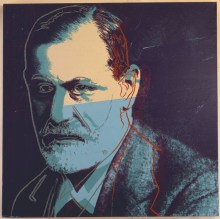
Featured Images: “Nobody Knowns the Trouble I See” from The Souls of Black Folk, Chapter 1, “W.E.B. Du Bois” by Winold Reiss (1925), “Sigmund Freud” by Andy Warhol (1962)
—
Julie Beth Napolin is Assistant Professor of Literary Studies at The New School, a musician, and radio producer. She received a PhD in Rhetoric from the University of California, Berkeley. Her work participates in the fields of sound studies, literary modernism and aesthetic philosophy, asking what practices and philosophies of listening can tell us about the novel as form. She served as Associate Editor of Digital Yoknapatawpha and is writing a book manuscript on listening, race, and memory in the works of Conrad, Du Bois, and Faulkner titled The Fact of Resonance. Her work has appeared in qui parle, Fifty Years After Faulkner (ed. Jay Watson and Ann Abadie), and Vibratory Modernism (ed. Shelley Trower and Anthony Enns).
—
 REWIND! . . .If you liked this post, you may also dig:
“A Sinister Resonance”: Joseph Conrad’s Malay Ear and Auditory Cultural Studies–Julie Beth Napolin
“Scenes of Subjection: Women’s Voices Narrating Black Death“–Julie Beth Napolin
Unsettled Listening: Integrating Film and Place — Randolph Jordan
Share this:

The Queer Sound of the Dandiya Queen, Falguni Pathak


co-edited by Praseeda Gopinath and Monika Mehta
Our listening practices are discursively constructed. In the sonic landscape of India, in particular, the way in which we listen and what we hear are often normative, produced within hegemonic discourses of gender, class, caste, region, and sexuality. . . This forum, Gendered Soundscapes of India, offers snapshots of sound at sites of trans/national production, marketing, filmic and musical texts. Complementing these posts, the accompanying photographs offer glimpses of gendered community formation, homosociality, the pervasiveness of sound technology in India, and the discordant stratified soundscapes of the city. This series opens up for us the question of other contexts in India where sound, gender, and technology might intersect, but, more broadly, it demands that we consider how sound exists differently in Pakistan, Sri Lanka, the Maldives, Bangladesh, Bhutan, Nepal, and Afghanistan. How might we imagine a sonic framework and South Asia from these locations? —Guest Editors Praseeda Gopinath and Monika Mehta
For the full introduction to the forum, click here.
To read all of the posts in the forum, click here.
—
The late 1990s was a pivotal time for activism around queerness in India. The violent response of the Hindu right to Deepa Mehta’s Fire (1998), a film portraying a romantic and sexual relationship between two women, prompted widespread debate on the question of censorship generally and of sexual-minority rights in particular. By rendering homosexuality explicit in its visuals and dialogues, and charting a linear trajectory of queerness—the protagonists move from unhappiness to happiness, denial to acceptance—Fire valorizes “coming out.” In the film, as in liberal strands of LGBT activism, it matters not only that one is out, but that one is seen as such. The premium placed on visibility in this formulation is undercut by the “queer” figure of Falguni Pathak. A tomboyish singer with a high-pitched voice, Pathak shot to fame with her debut album Yaad Piya Ki Aane Lage in the same year that Fire was released in India. Her performances mobilize disparate, even contradictory, signs of gender and sexuality at once, inviting us to examine the relationship between visuality and aurality in constructing queerness.
Falguni Pathak’s stardom is typically understood in the context of economic liberalization and the reconfiguration of Indian public culture that followed. The 1990s boom in the music industry was facilitated by the spread of satellite television, which gave non-film singers a new platform and a new set of audiences. Pathak’s “cute” and catchy love songs circulated endlessly on television countdown shows, turning her into an unlikely sensation. I say “unlikely” because Pathak’s apparent tomboyishness seemed at odds with the hyper-femininity and heteronormativity of the narratives in her music videos. Romantic quests, schoolgirls giddy with love, feminine bonding over make-up and men—these are standard features of Pathak’s videos, as is her own smiling presence as the singer-narrator. Through her gestures and lyrics, she comments on the lovesick teen’s plight and steps in occasionally to comfort or help the young girl, as in her first hit, “Chudi.”
For instance, in “Maine payal hai chhankai” (“The tinkling of my anklets,” 1999) she cheers on a group putting on a dance and puppet show for a school function. In songs like “Chudi/Yaad piya ki aane lagi” (“Bangles/I remember my lover,” 1998), “O piya” (“O beloved,” 2001), and “Rut ne jo bansi bajai” (“The music of the weather,” 2012) she is portrayed as a pop star.
The singer-as-pop-star was a common trope in early Indipop music videos (Kvetko). But Pathak dressed very differently than other pop stars. Whether on or off screen, she was (and is) always in men’s clothing, with a short, unfussy haircut and little make-up. Pathak’s style was mirrored on occasion by a minor character in her music videos. (“Chudi” includes a tomboyish school girl who struggles with the dance moves her friends choreograph.) Thus, Pathak’s visible presence in her videos brushed against the pitch, timbre, and style of her singing, which together articulated a hyper-feminine pop sensibility.
This sense of a “mismatch” (Fleeger) continues in Pathak’s contemporary performances. She is the most sought-after vocalist for Navratri festivities in Mumbai each year. On each night of this nine-day long Hindu festival, the “Queen of Dandiya” appears on stage dressed in a brightly colored kurta, vest, and trousers, and sings traditional Gujarati songs and hymns. The women in her audience dress more conventionally and more elaborately, in saris, salwaar kameez, and ghaghra-cholis. They dance in circles, performing recognizable garba moves. Meanwhile, Falguni Pathak saunters around the stage, engaging cheerfully with her fellow musicians and fans. Neither Pathak’s clothes nor her unfeminine dance moves bother the revelers as they dance the night away. For example, note how Pathak sways and rocks to the beat 34 seconds into this lively 2012 stage performance of Suneeta Rao’s hit song “Pari hun mein.”
Falguni Pathak’s temple performances at other times of the year are similar. They draw huge crowds unconcerned with the apparent mismatch between sound and image in her star persona. She tends to be as immersed in the devotional songs she sings as her audience. But her movements, plain clothes, and floppy hair-style make her look more like the male percussionists who accompany her, rocking and whipping their heads from side to side as they keep the beat, than the middle-class women clapping and singing along.
Performative traditions of mimicry and cross-dressing abound in India. But Pathak’s gender performance does not align with those religious, folk, and filmic traditions (and tropes) because it never registers as masquerade. The very casualness of her look, the fact that she dresses in t-shirt and trousers in all of her public appearances, suggests that this is not a temporary or theatrical adoption of a gender role. When asked in interviews why she eschews traditionally feminine clothing, Pathak always responds that she never has worn anything other than pants and t-shirts and is comfortable as she is. There were certainly other pop stars in the 1990s whose musical performances had masculine elements to them. Recall, for instance, Shweta Shettty’s suited look in “Johnny Joker” (1993). But none of Pathak’s peers sported a butch look as consistently and nonchalantly as she did—and none of them sang in as saccharine a voice. After six decades of Lata Mangeshkar’s vocal hegemony in Hindi cinema, such a “sweet,” contained, and unadorned voice has come to represent ideal Indian femininity. Pathak sounds charming and benign in her songs and interviews, but she does not dress the part.
 Pathak’s challenging of conventional gender norms through her appearance and through the fact that she has never been married raises the specter of queerness in public discourse. But even that is difficult to pin down. Popular commentators and fans sometimes suggest that she looks like Kiran Bedi, a high-ranking (retired) police officer who enjoys celebrity status, making it hard to read the masculine details of Pathak’s persona as “gay.” Even as she is a queer icon (Giani), Pathak never comments on her sexuality or love life. She either evades questions about relationships or simply states that she is single. Where some celebrities come out publicly or keep alive innuendoes about their sexuality (Singh), she treats it as a non-issue. All in all, what we get in Falguni Pathak’s music videos and star persona is a queerly gendered performance that seems both utterly “natural” (because it seems comfortable and casual) and profoundly mismatched.
To be clear, my argument is not so much that Falguni Pathak looks or sounds queer. The latter point is as hard to prove as the former is easy. If, for just a second, we manage to shut out of our mind’s eye the image of Pathak singing, her voice sounds thoroughly conventional. She sings in a traditional idiom, of traditional themes. No matter how intently I listen, no “queer timbre” (Bonenfant, Chaves Dasa), no “butch throat” (Glasberg) reaches out to touch me. Thus on the one hand, Pathak, like the other “mismatched women” Jennifer Fleeger writes about, confounds heteronormative expectations about gender and sexuality. On the other, her voice eludes “queer listening” (Bonenfant). What do we do with a queer figure who doesn’t sound queer? How might we understand her voice vis-à-vis queerness in Indian public culture? How do her live performances today continue to disrupt the emphasis on visibility in queer studies and politics—that is, the fixation on visual representations and “coming out” of the closet? Finally, how might Pathak’s “vocalic body” (Connor) help us conceive of the intersection of aurality and queerness in South Asian public culture?
Falguni Pathak intervened in a cultural field that was just beginning to deal with LGBT visibility. This becomes apparent when we remember that the 1990s was a period not just of economic liberalization but of vibrant queer activism as well. Pathak’s non-feminine image was startling for a pop star, but her voice was familiar and “good.” Her safe sound allowed her to push the boundaries of desire in televisual representations of the time. But it did more than that, too. The disjuncture between her feminine voice and butch look was critical to the complex landscape of desire her music videos evoked. It created space for ambiguity and incongruity amid charged debates about alternative sexual identities.
In “Main teri prem diwani/Indhana winva” (“I am madly in love with you,” 2001), Pathak stars as the neighbor to whom the protagonist turns for advice in matters of love. In an amazingly campy move, Pathak urges the young woman to seduce her lover by donning outfits inspired by Moulin Rouge (2001), specifically the song “Lady Marmalade” (00:36-00:55), and The Mummy Returns (2001) (1:59-2:03). Queerness is also writ large in “Meri chunnar udd udd jaye” (My scarf flies away, 2000), where Pathak appears as the beloved friend of a young girl in exile. The girl misses her friend intensely and attempts to recreate the dance moves and games she played with her older friend, this time with another mysterious woman who steps out of a painting.
Men’s roles in this and other Falguni Pathak music videos are ambiguous at best (Giani). Thus, despite the happy ending to the teen love stories, what lingers is Pathak’s simultaneous disruption and enabling of straight romance. This is why she is remembered fondly as a queer icon, even as the music scene in India has moved on from the “cuteness” of the 1990s. She offered LGBT audiences a way to read and revel in non-normative desires (Giani), without completely unseating “traditional” ways of living and loving.
The broader lesson in Falguni Pathak’s performances is that we cannot think of visuality apart from aurality, and vice versa. No matter how hard NBC’s “The Voice” tries to convince us (Tongson), we cannot in fact understand the sound of a singer’s voice as separate from the image of her as a performer and the contexts in which she emerges on the scene. It is not Pathak’s tomboyish appearance so much as the apparent disjuncture between that look and her voice that is key. What is queer about her voice is the look of it.
—
Featured Image: Falguni Pathak’s classic pose.
—
Pavitra Sundar is Assistant Professor of Literature at Hamilton College, where she teaches courses on global film and literature. Her scholarly interests span the fields of cinema studies, sound studies, postcolonial literary and cultural studies, and gender-sexuality studies. She is currently completing a book manuscript on the politics of Bollywood film sound and music. Her work has been published in journals such as Meridians, Jump Cut, South Asian Popular Culture, and Communication, Culture, and Critique, as well as in anthologies on South Asian and other cinematic traditions.
—
 REWIND!…If you liked this post, you may also dig:
Ritual, Noise, and the Cut-up: The Art of Tara Transitory—Justyna Stasiowska
Moonlight’s Orchestral Manoeuvers: A duet by Shakira Holt and Christopher Chien
If La Llorona Was a Punk Rocker: Detonguing The Off-Key Caos and Screams of Alice Bag–Marlen Rios-Hernández
Share this:


Current Top Posts





April 2021

January 2020

November 2019

October 2019

August 2019

April 2014

November 2017

March 2015

December 2017

October 2015
 Sounding Out!
Recent Comments