
SO! Amplifies: Feminatronic

SO! Amplifies. . .a highly-curated, rolling mini-post series by which we editors hip you to cultural makers and organizations doing work we really really dig. You’re welcome!
—
FEMINATRONIC began with a simple idea : link with other women who were–and are–creating electronic music, particularly in the Ambient / Space community and then spur each other on by being part of an all-female electronic artist podcast.
I quickly realised that there were more women creating electronic music out in the aether than I had known—and I was shocked by the lack of visibility on my part. If I didn’t know these artists—someone who follows the scene closely–how was our music getting to listeners? especially with the lack of wider publicity?
After a short while, I quickly concluded that this perceived invisibility occurred in all genres of electronic music creation by women. At best, the electronic music scene is fractured and comprised of a myriad of genres. Across the Internet, playlists are heavily geared towards male artists. As an electronic musician myself, who just happens to be female, working in isolation from many other artists and genres meant I wasn’t really aware of the great female electronic artists out in the world. I had a feeling that there were others like me quietly creating music, soundscapes and sonic art, beavering away using a huge plethora of electronic means to create music, a sound, installations and a voice for themselves but they were unknowns to me and to a wider audience. Provoked by my sense of isolation and invisibility, I set up the website Feminatronic to get word out that there were and are, women from all genres of electronic music making, creating music in a variety of interesting ways.
.
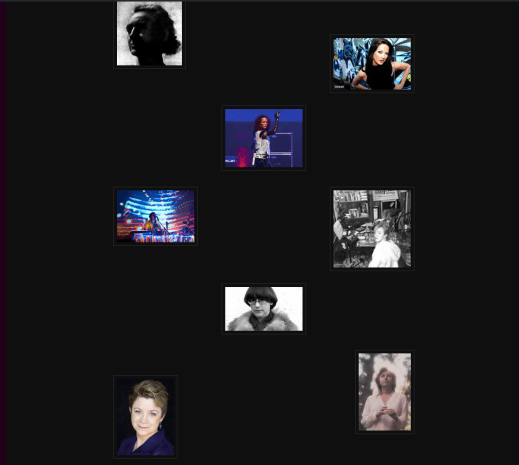
The site’s main aim is to highlight and promote women who create music and sound via electronic processes. My definition of “electronic music” has evolved from the original synth studio based electronic music to include sound art, installations, field recordings, noise, classical, electroacoustic and everything in-between. I designed Feminatronic as an inclusive site that would appeal to those interested in a huge range of genres, from Ambient and Space to Field Recording, DJing and EDM to Sound Installation and Experimental. The site features an A-Z catalogue of electronic artists who identify as female, as well as women behind the scenes, the producers, sound designers, and engineers who help make music possible.
In addition to keeping up the catalogue, Feminatronic shines a spotlight on as much electronic music, artists, news, events and sites as possible, via the website and social media (Twitter handle: @feminatronic; Feminatronic is also on Soundcloud, Facebook, and 8tracks). I believe strongly in collaboration through curation; therefore Feminatronic frequently reblogs articles and reviews from other sites, creating a chain reaction of posts and tweets that increases visibility and widens the audience for artists and the forums that feature them.
.
Despite all the creativity that I have uncovered since beginning my work, only a fraction of female electronic artists ever get their heads above the parapet and get huge coverage, or even minimal props. Since beginning this site in 2013, I have discovered for myself so much talent and much of it remains well under the radar. Such continued omission gave me the idea to begin an ongoing series of posts called “Today’s Discovery,” a very effective way to give publicity to new releases, back catalogues, and artists both new and established. This series also creates more space for genres that don’t often get a wider audience and to challenge the perception of so-called “women’s music.”
One of Feminatronic’s most popular features is our “Sunday Mixes.” These are monthly playlists based on a theme that intertwine poetry and electronic music. This project allowed me to combine two things that I love and to explore the music of poetry and the poetics of sound, while introducing new listeners to electronic music and new readers to poetry. Past mixes explored themes such as “Voices,” “Forests,” and “The Moon.”
Alongside sites such as Pink Noises, Female Pressure, Her Noise, and Her Beats, Feminatronic is a small but vital cog in a growing movement to shed light on artists who create music and sound via electronic processes, artists who just happen to be women and who deserve to be seen and heard. My work is a voyage of discovery and as such, the site remains an on-going evolving project perennially under construction.
—
 REWIND!…If you liked this post, you may also dig:
Aural Guidings: The Scores of Ana Carvalho and Live Video’s Relation to Sound–Maile Colbert
SO! Amplifies: Mega Ran and Sammus, The Rappers With Arm Cannons Tour–Enongo Lumumba-Kasongo
SO! Amplifies: Mendi+Keith Obadike and Sounding Race in America–Mendi + Keith Obadike
Share this:

SO! Amplifies: Josh Shepperd on the Radio Preservation Task Force of the Library of Congress (from FlowTV)

SO! Amplifies. . .a highly-curated, rolling mini-post series by which we editors hip you to cultural makers and organizations doing work we really really dig. You’re welcome!
Thank you to Josh Sheppard and FlowTV for permission to reprint this excellent call to action.
—
Primary Sources, Primary Sounds: The Radio Preservation Task Force of the Library of Congress
Sound history is cultural history. And a giant part of our history has yet to be preserved, researched, or taught in our classrooms. Our omissions are disproportionately distributed among the local and the liminal, the pastoral and the public, and marginalized and minority experiences. Sound trails continue where paper trails end, and we have an opportunity to provide new insight into the cultural history of the U.S. thanks to recent innovations in sound preservation technology. The Radio Preservation Task Force (RPTF) of the National Recording Preservation Board (NRPB) of the Library of Congress (LOC) is a growing 125-faculty member and 275-archive Digital Humanities initiative working to broaden the historical record by unearthing, mapping, and making available materials that that chronicle experiences neglected in existing historical accounts, such as minority, political, orientation, social advocacy, and educational groups. Perspectives and events that have remained unaddressed by the primary document record will receive new recognition by focusing preservation on the conversational and community building character of noncommercial and local radio history.

Soul Music/Civil Rights Legend DJ Herb Kent at WVON-Chicago
A historical marvel of nation-building, serialization, and aesthetic innovation, radio has also been utilized for multiple purposes beyond entertainment: from education, to a technology of opinion-formation, to a medium for political problem-solving. Much of the early history of the ether consists of distance learning broadcasts, public forums, and civic debates, and in addition to local theatrical and drive time programming the task force is concerned with making these important historical records accessible for the first time. To frame the project in historiographical terms, the RPTF is approaching radio history as a study of what the Birmingham school might call the genealogy of how strategies for circulation of discursive codes, as representations, became central to an expanded concept of the public sphere that included popular culture. If we accept the historiographical argument that content representations are also implementations of discursive, political, and industrial strategies, then radio might be viewed as a medium in which institutional and intellectual projects endeavored to communicate with and persuade community members about a specific perspective or initiative. In this way, radio history has the capacity to reveal the development and dissemination of cultural aspirations and viewpoints, and its consequent archive can be understood as a series of concurrent media advocacies that sought to define conditions of social attunement.
[Reblogged from FlowTV, to continue reading Josh on the RPTF, please click here.]
—
RPTF Logo, courtesy of the author; designed by artist Daniel Murphy (University of Wisconsin-Milwaukee).
—
Josh Shepperd is Assistant Professor of Media Studies at Catholic University in Washington D.C. He teaches courses related to critical, conceptual, and methodological approaches to media studies. He is also actively involved in digital humanities media preservation, and currently serve as the National Research Director of the Radio Preservation Task Force for theNational Recording Preservation Board of the Library of Congress.
—
REWIND!…If you liked this post, you may also dig:
The New Wave: On Radio Arts in the UK–Magz Hall
SO! Amplifies: Ian Rawes and the London Sound Survey–Ian Rawes
SO! Amplifies: Carleton Gholz and the Detroit Sound Conservancy–Carleton Gholz
Share this:


Current Top Posts





April 2021

January 2020

November 2019

October 2019

August 2019

April 2014

November 2017

March 2015

December 2017

October 2015
 Sounding Out!
Recent Comments