
SO! Reads: Todd Craig’s “K for the Way”: DJ Rhetoric and Literacy for 21st Century Writing Studies

or, Last Summer a DJ Saved My Life
“Hip Hop does work that a lot of other things don’t do” Young Guru (viii).
The way that we imagine English Studies, specifically Composition and Rhetoric (Comp/Rhet), today needs a radical shift. Specifically, we need new techniques for Writing Studies pedagogy to reach students in a more meaningful and contemporary fashion. Todd Craig’s “K for the Way:” DJ Rhetoric and Literacy for 21st Century Writing Studies (Utah State University Press, 2023) both documents the need for this shift and enacts it. Craig’s work enables us to recognize the pedagogical impact on writing that Hip Hop has had over the last 50 years—specifically how the DJ/deejay as twenty-first century new media reader and writer teaches students not just to think about sound, but to compose with it, too.
An Associate Professor of English at CUNY Graduate Center, Craig has little desire to shake the foundations of English Studies, but instead do what Hip Hop has always done—make a way where there is none. The point is to (re)imagine new ways of doing old things; in this case, of teaching and reaching students who arrive in First-Year Writing courses. “K for the Way” does more than demonstrate the ways in which the DJ is a twenty-first century pedagogical savant; it also teaches readers, using DJ Rhetoric and DJ Literacy, about the culture that makes them possible.
This summer, a DJ really did save my life: as someone who feels consistently overwhelmed by the vast nature of scholarly discourse, “K for the Way” gave me a chance to breathe, to identify with something that has been a part of me for the better part of my life, and to see myself in a conversation about a topic I am more than passionate about. For Craig, community, history, and culture are the core of his mission as a scholar, educator, and DJ.
Craig defines several new terms that bridge the worlds of Hip Hop and Composition and Rhetoric. First, we have DJ Rhetoric, which can be understood as the modes, methodologies, and discursive elements of the DJ. For Craig, it “encompasses the quality of oral, written, and sonic language that displays and expresses sociocultural, historical, and musical meanings, attitudes, and sentiments” (23). Next, there is DJ Literacy, which is the “sonic and auditory practices of reading, writing, critically thinking, speaking, and communicating through and with the rhetoric of Hip Hop DJ culture” (23). These two definitions, operating in conjunction, situate the DJ as a kind of griot, a figure that Adam Banks invokes as a carrier of tradition, stories, and histories in Digital Griots: African American Rhetoric in a Multimedia Age (Studies in Writing and Rhetoric) (2011). The mission of the griot is to carry stories and translate them to various audiences while adhering to the rhetorical conventions and modes of whichever audience they find themselves before; similarly, the DJ is responsible for “communicating the pulse and the evolution of a culture that once sat as ‘underground’ but now has dramatically evolved to ‘mainstream’” (25). These definitions serve as guides for the reader as they are tethered to all of the concepts and (re)imagining happening throughout the book.
Craig is intimately close to the work he is doing. He lives and breathes Hip Hop; and what should a book about the Hip Hop DJ be if not written by someone who embodies the role, culture, and practice of DJing? Craig uses a a research methodology known as hiphopography in which Hip Hop ways of being are central to studying it. Coined by James G. Spady, this term is defined as “a shared discourse with equanimity, not the usual hierarchical distancing techniques usually found in published and non-published (visual-TV) interviewers with rappers” (27). Craig states that hiphopography “allowed me to engage a variety of Hip Hop DJs while also maintaining my own shared values and sentiments around my love of Hip Hop culture and DJ practices” (28). Hiphopography constructs a conversational, intimate space—touched by history, culture, and music—wherein the interviewer and interviewee can engage and produce meaningful data. This methodology—and Craig’s many interviews with DJs about their craft—becomes part of the text’s core as we begin to see how Craig’s two-pronged argument connects DJ Rhetoric and DJ Literacy to bring both life throughout the book.
If one understands the DJ as a twenty-first century rhetorician and compositionist and considers the ways in which the DJ is a cultural meaning-maker, sponsor, and master sampler, then one can clearly see the connections between the DJ, DJ culture, and Writing Studies in the contemporary moment. In the first part of his argument supporting the significance of DJ Rhetoric and Literacy in writing pedagogy Craig asserts that, “it is essential that the academy at large works to strengthen students’ undergraduate experiences by reinforcing their racial, ethnic, and cultural ties” (14). This perspective provides the foundation for the second part of his argument that “the DJ (and thus, Hip Hop DJ culture) is the epicenter of Hip Hop culture’s creation” (23). Taken together, these dynamic arguments make the claim that the DJ offers a powerful model of a new media reader, writer, and critic. Today, our students come to writing classrooms with a “vast array of cultural capital. . .in their philosophical and cultural backpacks” (107). If we, as writing teachers, want to honor that cultural capital and build with it, we should follow Craig’s lead and look toward the DJ for some pointers on how to expand students’ access to a language that represents them.
Readers will also see a developing research agenda in “K for the Way” that thinks toward changing the culture beyond the present, while acknowledging the groundwork laid for the current moment and building genealogically upon that foundation, just as DJs do with sampling. Craig best exemplifies this when he writes, “in order to fully engage in a conversation—whether intellectual, pedestrian or otherwise—that discusses what DJ Rhetoric might look like, one has to think about the cultural and textual lineage of sponsors and mentors” (51). This notion of textual lineage is borrowed from Alfred W. Tatum who explains the term as “Similar to lineages in genealogical studies” and continues to note that textual lineage is “made up of texts (both literary and nonliterary) that are instrumental in one’s human development because of the meaning and significance one has garnered from them” (Tatum, qtd. in Craig, 51). Craig builds upon Tatum’s idea by introducing sonic lineage, which follows the same logic as Tatum’s term, but through sound (51). What becomes apparent, is that the DJ, as a cultural sponsor, can deploy sonic lineage as a way of communicating history and culture to members within and outside of the Hip Hop community and, more specifically, DJ culture.
Chapter three, especially, works at the interdisciplinary junction of Sound Studies, Writing Studies, and Hip Hop studies to convey a clear critique of the dominant discourse surrounding plagiarism. Craig is unsatisfied with the black-and-white conception of plagiarism as it presents itself in the academy. As a result, he moves to inquire “how we as practitioners [of teaching composition] approach citation methods and strategies within a twenty-first century landscape” (75). Craig promptly turns us toward the DJ’s conceptualization of sampling as a citation practice. Sampling in Hip Hop, as defined by Andrew Bartlett, “is not collaboration in any familiar sense of the term. It is a high-tech and highly selective archiving, bringing into dialogue by virtue of even the most slight representation” (77). The highly selective archiving, a.k.a crate diggin’, builds upon the idea of sonic lineage.
For the DJ, the process of diggin’ through crates to find that right sound, that one joint that going to get the party jumpin’, is a key element in the practice of “text constructing” (79). The Hip Hop sample functions alongside an understanding, offered by Alasdair Pennycook, of “transgressive-versus-nontransgressive intertextuality,” which, for an academic audience, complicates the idea of plagiarism.. The DJ becomes a figure through which we can understand intertextuality, sampling becomes the practice through which we can see parallels to citation through text construction, and the mix is where we begin, with the help of Pennycook, to complicate notions of plagiarism. In this chapter, readers are able to understand through sound.
Subsequently, Craig explores the concept of revision as it relates to the DJ’s ability to engage with an emcee on the point of “remix as revision” (107). Building from on Nancy Sommers’ article, “Revision Strategies of Student Writers and Experienced Adult Writers,” Craig lifts and examines four strategies of revision through the lens of the Hip Hop DJ: deletion, substitution, addition, and reordering (Sommers, qtd. in Craig, 107). These practices not only identify the Hip Hop DJ as a master of revision but also center the DJ, in the context of the writing classroom, as a key figure for understanding editorial practice. As teachers of writing—and especially for those of us who are deeply connected to Hip Hop culture—we have traditional scholars, such as Sommers, but we also have the DJ as cultural scholar, which offer new models with communicating and practicing the craft of writing in the twenty-first century.

Chapter Five, which is co-written by Craig and Carmen Kynard, centers on six women DJs: DJs Spinderella, Pam the Funkstress, Kuttin Kandi, Shorty Wop, Reborn, and Natasha Diggs to work toward developing a “Hip Hop Feminist Deejay Methodology” that positions women in Hip Hop culture as a key source of key knowledge production–as meaning-makers, theoreticians, storytellers–and as tastemakers in twenty-first century discourse about education, technologies, race, and gender. This chapter is also apt representation of hiphopography at work, as both Craig and Kynard ground their position in the interviews of these six women deejays, “deliberately situating their stories first… as opposed to the usual academic expectation that a tedious delineation of methods and an extant literature review come before a discussion of the actual subjects” (123).
In part, this chapter focuses on the affordances and limitations—political, social, and economic—present in DJ culture, and the effects it has on these women DJs to make it do what it does. For example, the introduction of the digital software Serato has simultaneously made access to music easier, and complicated access to the cultural archive that made the music possible in the first place. Natasha Diggs, states, “While she values the ability to access mp3 files so readily, she argues a deejay’s research and craft suffer, because many times the mp3 files do not include information about an artist’s name, history, or band” (129). Pam the Funkstress ties this sentiment up nicely when she argues, “There’s nothing like vinyl” (129).
The final chapter is fashioned like a Hip-Hop outro, with Craig leaving with a few parting ideas. Most important among them is his vision of “Comp 3.0,” a version of Comp/Rhet wherein “we have to push the scope of writing and rhetoric—with or without the field’s permission or acknowledgement” (171). For scholars of composition and rhetoric and writing teachers who ground part of their understanding of the field in Black Studies, Hip Hop, and the DJ, we gotta make it do what it do, regardless of who says what! Comp 3.0 does not seek approval or recognition from the powers that be; instead, it focuses on the new ways of thinking and writing, and of teaching, that we are able to conjure—with history, culture, and practice propelling us—when we invoke that which got us to the academy in the first place.
What is at stake, for those of us who engage Black Studies, Sonic Studies, Comp/Rhet, and Hip Hop Studies as critical points of departure for the teaching of writing, is that our presence—our being, methods, and our teaching—is crucial for developing a genealogy of scholars and world citizens who are aware of the myriad possibilities present in the twenty-first century.
—
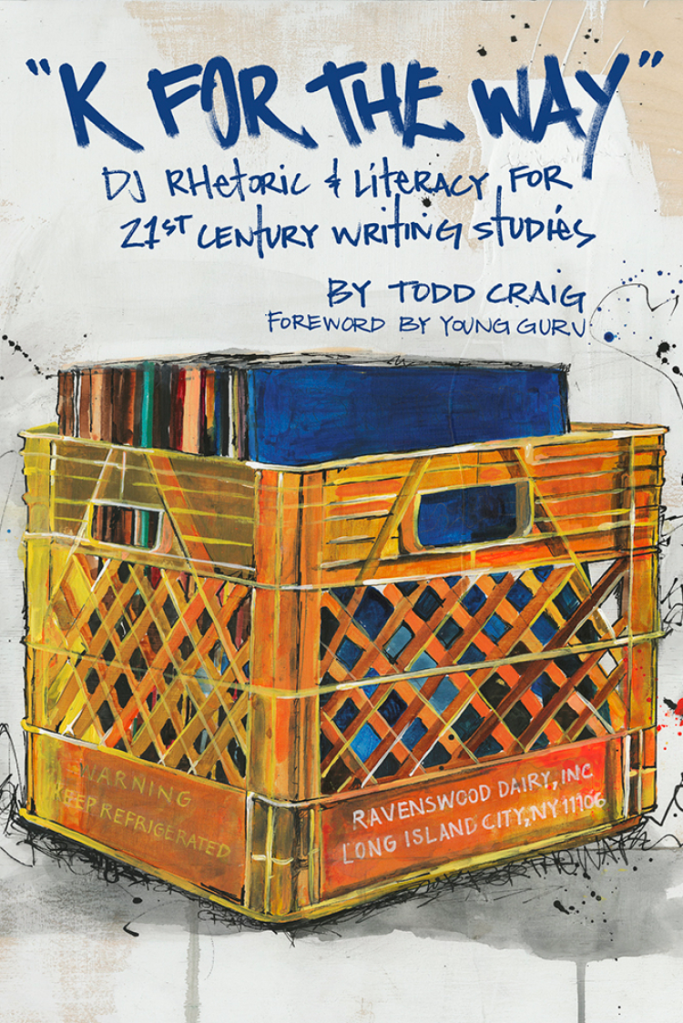
Featured Image: Cover Art for “K for the Way”: DJ Rhetoric and Literacy for 21st Century Writing Studies by Cathey White
—
DeVaughn (Dev) Harris is a PhD student studying composition and rhetoric in NYC. His academic interests are mainly in writing studies and pedagogy, but those are often supported by other sub-interests in music, creative writing, African American studies, and philosophy. When not reading or writing, Dev enjoys making music wherever and however possible. He has published music before under the collective AbstraktFlowz.
—

REWIND! . . .If you liked this post, you may also dig:
“Heavy Airplay, All Day with No Chorus”: Classroom Sonic Consciousness in the Playlist Project—Todd Craig
Deep Listening as Philogynoir: Playlists, Black Girl Idiom, and Love–Shakira Holt
SO! Reads: Steph Ceraso’s Sounding Composition: Multimodal Pedagogies for Embodied Listening--Airek Beauchamp
The Sounds of Anti-Anti-Essentialism: Listening to Black Consciousness in the Classroom- Carter Mathes
Contra La Pared: Reggaetón and Dissonance in Naarm, Melbourne–Lucreccia Quintanilla
Ill Communication: Hip Hop and Sound Studies–Jennifer Stoever
SO! Amplifies: Regina Bradley’s Outkasted Conversations
A Listening Mind: Sound Learning in a Literature Classroom–Nicole Brittingham Furlonge
Share this:

SO! Reads: Tsitsi Jaji’s Africa in Stereo: Modernism, Music, and Pan-African Solidarity

 While most books are confined to the pages held within them, Tsitsi Jaji’s Africa in Stereo (2014) begins with a link to an aural space: the book’s companion site, hosted by Oxford University Press. There, readers find a range of images and recordings referenced in the text: an excerpt from Bob Marley’s 1979 “Zimbabwe,” a recording of Léopold Sedar Senghor’s speech on métissage, and scenes from John Akomfrah’s 1995 Last Angel of History, which was produced through Black Audio History Collective. This collection of primary sources signals Jaji’s commitment to not only foregrounding the sensory–and in particular the act of listening–but also to creating a sonic archive of the twentieth-century Black Atlantic.
 The site’s own characteristics mirror the theoretical ambition and methodological innovation of the book itself, which, in simplest terms, considers how Africans heard (and “read”) African-American music in the twentieth century. While the focus on listeners, audiences, and consumers might–in different hands–tend toward a kind of passivity, for Jaji it becomes a rich heuristic for understanding how Africans navigated modern media. By centering Africans as listeners and consumers, Jaji not only challenges the “originary” or “native” status of Africans in the diaspora but moreover uncovers new strategies for understanding the dialogic and intermedial processes through pan-African politics and culture were formed. She does so through a wide range of sources–including recordings, transcriptions, film, literature, websites, and magazines–which become an unprecedented archive of what Jaji terms “stereomodernism,” a “heuristic for analyzing texts and cultural practices that are both political and expressive, activated by black music and operative within the logic of pan-African solidarity” (14). Located largely in Senegal, Ghana, and South Africa, the book thus explores how music in particular helped to define real (and imagined) relationships across the Black diaspora.
After detailing her scope and methodology in the first chapter, Jaji then moves into substantive analysis in the following five chapters, which are organized around different modes of listening and reading, but are nevertheless chronological. She begins with the early twentieth century and in particular the work of transcription, which describes the act of creating musical notations for a recording or a piece of music. Looking at a group of South African writers, including Solomon Plaatje, John and Nokutela Dube, and Charlotte Maxeke, Jaji argues that the medium of transcription was in fact a way of finding (and sharing) oppositional strategies from the African-American musical tradition. As this chapter suggests, the liberatory potential in the musical form was amplified by the act of transcription, which created new linkages among South African and African American writers.
Jaji next turns to what she terms Négritude musicology, which serves as a rubric for reassessing Léopold Sédar Senghor’s theorization of black culture from the 1930s through the 1960s, a period that encompassed the explosion of interest in African-American music in the Francophone world. Influenced by both African-American writers and French jazz critics, Senghor found in jazz (and blues) a potent metaphor for the essential beauty and power of Black cultural traditions. Reminding us of the extraordinary gift of this poet-statesman, Jaji’s analysis clarifies the sonic dimensions in his poetry and prose–the “fricative phonemes” (77) and “rhythmic tension” (77)–and connects it to African-American aural traditions, like Stephen Henderson’s “worrying the line” (76) or Samuel Floyd’s “repetition with a difference” (75). She ends this chapter by returning to the culmination of Senghorian négritude–the 1966 World Festival of Negro Arts in Dakar–and how it became a critical forum for debating the meaning of Black Atlantic music.

Image by Flickr User Jean-Pierre Dalbéra, Documents présentés dans l’exposition Dakar 1966, 1er festival mondial des Arts Nègres du 1er au 24 avril 1966, Site de l’exposition du Musée du quai Branly (CC BY 2.0).
In one of the most exciting chapters, Jaji focuses on two magazines–Zonk! (South Africa) and Bingo (Senegal and France)–not so much to mine evidence of authorial intention but instead as a means to consider African women envisioned their realities and futures. In these magazines, Jaji finds evidence for how women would have navigated the emergence of new media forms, including magazines, radio sets, LPs, and film. While the advertisements suggested that modernity needed to be “ratified through consumption” (111), Jaji instead argues that women engaged in what she terms “sheen reading,” which enabled them to read these new forms critically and to, in effect, become modern through their critical engagement of consumerism and the new “audiotechnological landscape.” While specific in many respects to postwar Africa, Jaji’s careful and clear analysis of gender, media, and sound could (and should) be a heuristic for scholars in other domains.
While focused on distinct media forms, the last two chapters together help clarify the work of memory and futurity in the late twentieth century Black Atlantic. Jaji first examines the recording and reproduction of narratives of the Middle Passage, moving from Ghanaian poetry to the 1971 documentary Soul to Soul to many diasporic memoirs set in Ghana. Building from this corpus, Jaji considers the possibilites and limits in these varied acts of memorialization, particularly in response to the immense loss of transatlantic slavery.
The final chapter begins by looking at the memorialization of older technology (or “technonostalgia”) in two Senegalese films, Ousmane Sembene’s Camp de Thiaroye and Moussa Sene Absa’s Ça Twiste à Popenguine. Both films include scenes of somewhat furtive, or secretive, listening to African-American music on record players, which thus takes on a new kind of political meaning not simply because of the sounds themselves but in fact because of the “sonic world” that each has disrupted by introducing the literal and metaphorical record scratch.
Building from this analysis, Jaji considers how piracy figures into Black Atlantic musical formations in the digital age, using a film, novel, and the internet radio project, the Pan-African Space Station, which creates a future claim to pan-African solidarity not only by rejecting the logic of colonial and apartheid radio, but also the disingenuous claims to openness peddled by multinational corporations. The site doesn’t feature “podcasts”—and their barely disguised endorsements of “pod” products—but instead shares its own “passcasts” to open up the truly liberatory potential in music.
This last illustration exemplifies the broader impact of Jaji’s work, which clarifies the centrality of Africa (and African people) to global flows of media and culture and provides a powerful model for placing race, pan-africanism, and Black cultural production at the center of sound studies.

Studio One, set up by Rita Marley, Bob Marley’s widow, between Accra and Kumasi, Image by Flickr User Carsten ten Brink, April 2012 (CC BY-NC-ND 2.0)
In this, Jaji joins an exciting conversation among scholars who have challenged the ways in which the history of sound and technology have, as Alexander Weheliye has described, been heretofore been read as a white, Western project. This intervention is audible in a range of recent scholarship, including recent work on sound and empire by Ronald Radano, Tejumola Olaniyan, Hisham Aidi, J. Griffith Rollefson, and Michael Denning; in analyses of race and sound by Josh Kun, Dolores Inés Casillas, Jennifer Stoever, and Nina Eidsheim; in studies of sound in Africa by David F. Garcia, Robin D.G. Kelley, and Eric Charry; and finally, in recent interdisciplinary work that has explored the varied soundscapes of the African diaspora, including work by Shana Redmond, Tina Campt, Louis Chude-Sokei, Vanessa Valdés, Ingrid Monson, Njelle Hamilton, and Edwin Hill. What distinguishes Jaji’s work is her profound re-reading of the act of listening, which becomes in her analysis a critical means of challenging the racist logic of consumerism and empire. Indeed, she ends her book by asking the reader to “Come, listen with me.” After reading Africa in Stereo, it becomes clear that this request—and admonition—to simply listen is neither passive nor deferential, but instead a liberatory act, and one that has the potential to change the field.
—
Featured Image: Screen capture from Moussa Sene Absa’s Ça Twiste à Popenguine.
—
Celeste Day Moore is assistant professor in the Department of History at Hamilton College and is a historian of African-American culture, media, and technology in the twentieth century. She is currently completing first book, Soundscapes of Liberation, which traces the history of African-American music across the Francophone world, wherein it took on new meaning, value, and political power alongside the decolonization of the French empire. Most recently, her work has appeared in American Quarterly and in the first edited volume of the African American Intellectual History Society (AAIHS). Follow her on twitter at @celestedaymoore.
—
 REWIND! . . .If you liked this post, you may also dig:
SO! Reads: Hiromu Nagahara’s Tokyo Boogie-Woogie: Japan’s Pop Era and Its Discontents–Shawn Higgins
SO! Reads: Susan Schmidt Horning’s Chasing Sound: Technology, Culture and the Art of Studio Recording from Edison to the LP— Enongo Lumumba-Kasongo
SO! Reads: Steph Ceraso’s Sounding Composition: Multimodal Pedagogies for Embodied Listening–Airek Beauchamp
SO! Reads: Roshanak Khesti’s Modernity’s Ear–Shayna Silverstein
Share this:


Current Top Posts





April 2021

January 2020

November 2019

October 2019

August 2019

April 2014

November 2017

March 2015

December 2017

October 2015
 Sounding Out!
Recent Comments