
Reflective Sound Gathering via the New England Soundscape Project

Beyond the confines of recording studios, stages, and music classrooms, a vast and shifting sonic canvas exists for field recorders. This personal essay explores my awakening to a new creative recording process through the New England Soundscape Project , an ongoing sound-gathering mission whereupon I use small digital recorders—paired with various microphones, an iPhone, and a genuine sonic curiosity—to record brief moments throughout New England’s rich coastal, urban, and rural landscapes across six U.S. states. I received a modest seed grant from my University to pursue some creative work in field recording and sound studies. Over the next year, my travels will take me to the National Parks, cities, and historic landmarks in Connecticut, Vermont, Rhode Island, Maine, New Hampshire, and Massachusetts.
While near limitless possibilities on where and how to produce sonic and electroacoustic musical compositions endure, starting theNew England Soundscape Project challenged me to hone my listening skills while simultaneously dealing with nature’s unpredictability. Moreover, as a budding sound artist, I had to contend with the cognitive and emotional issues affecting a brand-new and unexplored creative practice. I came to believe that a holistic method of field recording offered me certain advantages—enabling an emerging sound artist to detach from rigidly defined agendas and instead focus on reflection, deep breathing, environmental awareness, gratitude, and an observational spirit. The listening exercises I detail in this post made me a newly introspective practitioner—one capable of a heightened sensitivity that improved my production and composition skills across multiple media.
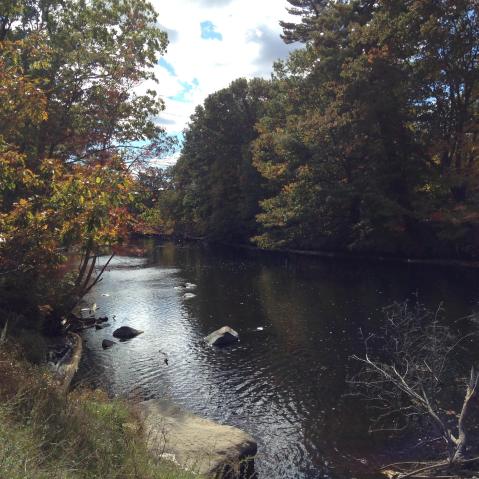
Merrimack River, New Hampshire, USA. All images by author.
Field Recording: An End Goal in Mind?
Field recording involves a delicate balance of technical skill, careful planning, and patience. Stepping away from a controlled environment, capturing audio on location presents many random and often erratic trials. From wind noise and poor site accessibility to recording malfunctions and user error—a host of issues arise once the recordist enters unfamiliar territory. Here, unfamiliar territory includes both new places and nascent approaches to research-based production and artistic data collection. Where do I situate a project like the New England Soundscape Project among new media production, sound studies, and music composition? Does that issue even matter?

Otter Brook Dam/Edward MacDowell Lake, Keene, New Hampshire, USA. All images by author.
The notion of practice-based work usually implies an end goal in mind. What if there is not an end goal in sight? What happens then? Would the New England Soundscape Project be “enough” of a contribution to creative scholarship when approached as a type of audio ethnography—much like the immersive storytelling recently curated by Leonardo Cardoso? The New England region is lush and robust, with many diverse landscapes. I hoped to document these in some way, but wondered how to continue. Truthfully, I had some hesitation on where to start.
Media artists and music composers learn the mechanics of their craft in colleges, universities, conservatories, at home, and on the job. Some of these techniques include audiovisual production, computer programming, coding, editing, and arranging using digital software. I am both self-taught and a product of an academic and Eurocentric, conservatory training system. This presents some tension, as I discuss below. Although traditional audio engineers and music composers often work towards completing a project without a predefined trajectory, how can budding sound artists develop and hone an inner acuity to find the “right” material during their creative processes?
While the process remains largely subjective, I found it helpful to begin by answering the following questions:
- What kind of project is this?
- How is the sound to be used?
- Where and how will the project be displayed?
- Who is the intended audience?
- What are the sound artist’s intentions?
- What tools are needed?
I draw inspiration from the Sound Studies Lab’s position that this type of work is diverse, fluid, and balances technical, artistic, and theoretical aims. The challenge is that the answers to the questions above are not immediately clear and require me to look inward at who I really am.

Boot Mill Threading Machine, Lowell, Massachusetts, USA. All images by author.
Following the Sonic Muse
Beyond the obvious technical and aesthetic factors affecting an expansive multisite recording project, we know little about how a nascent sound artist begins. Whom do they emulate? Should they take notes? pictures? What should they pay attention to onsite?
If the project is exploratory, the recordist may experience hesitation—as I did— and frustration that can block their creative process, especially because the pathways toward a finished sound project aren’t as established as those of a sound engineer, for example, or a songwriter. Nevertheless, my experiences have shown me that a nascent sound artist/recordist can also find intrinsic meaning and realize their mission—particularly by establishing a detached yet perceptive listening ethos, as I did to begin my work on the New England Soundscape Project.
For me, framing a detached and perceptive mindset involved:
- Remaining sensitive to my surroundings at each location;
- Focusing on stillness, deep breathing, and a quiet mind while recording;
- Adopting a respectful, unobtrusive manner at each site—taking care not to disrupt or distract others;
- Calmly monitoring my technology and its use;
- Trusting that I am intended to be in that exact moment at that exact time;
- Avoiding being overly concerned with the “end game” of their practice;
- Embracing the role of a sound gatherer and observer;
It is perhaps the final objective—adopting the philosophy of sound gatherer and observer—where truly sensitive listening begins. Here, the recordist aims to remove their personal goals and agenda from the field recording process. Before proceeding, the attentive recordist looks around them, focuses on quiet breathing, and views their microphones as lenses and without fear of what the result should be. To what or whom am I observing?
Here’s the problem. It dawned on me that I know little about who I am as a sound artist, and how my voice positively contributes to the world, if at all. I need to learn to listen—not just to the sounds in nature, but also to the sounds of the voices of the persons with whom I interact. Could solitude and introspective listening lead me to listen through a newly formed self, capable of deeper connections with my peers and environment? I found that my detachment involved investigating, acknowledging, and, whenever possible, setting aside my own biases, fears, and, importantly, my own agendas. By removing my ego and cluttered mind from the process, I could start to be an inclusive practitioner—one whom cultivates positive relationships daily and is capable of crafting a deeper sonic art that embraces rather than one that marginalizes.

Merrimack River, Lowell Massachusetts, USA. All images by author.
The Art of Meditative Listening
Rather than taking on a stringent approach with little flexibility, I practice observational recording by gathering audio as my muse and as environmental conditions dictate. By remaining attentive to my recording levels, I gather source materials up close, from afar, and for any length of time. Meanwhile, as this creative progression unfolds, I stay quiet—bringing almost meditative quality to my practice. Moreover, concentrating on deep breathing and stillness allows me to adopt a grateful mindset—one that is appreciative of my surroundings and for being present at that precise moment. It is then that the environment becomes the focus of sound gathering and not notions of a “final product.”

Scarborough State Beach, Newport, Rhode Island, USA. All images by author.
I found an artistic renewal—even healing—by adopting this meditative practice. As the New England Soundscape Project takes shape over the coming months and years, I hope to document the beauty of the Northeast through music, sound, and images. Yet, it is enough simply to be present in each location while aspiring to produce thoughtful and reflective sound art. Although there is no overarching method that best describes every aspect of a multisite field recording process, the “art” in the sound can truly emerge by striving to banish fear and doubt from the recording process. Addressing the “why” during each moment is just as important as addressing the “how” and the “why” in pre- and post-production. The recordist’s humanity plays a key role in determining how creative decisions are made, and the ability to remove the need for control determines how free—and freeing—the process can be.
This Thursday, SO! will feature my podcast on reflective listening with audio examples from the New England Soundscape Project thus far. I look forward to producing future episodes (and essays) on this project in the coming months. I hope you can tune in on Thursday and thank you for listening!
—
Featured Image: Scarborough State Beach, Newport, Rhode Island, USA. All images by author.
—
Acknowledgements
An Internal Seed Grant from the University of Massachusetts Lowell supports the New England Soundscape Project.
—
Daniel A. Walzer is an Assistant Professor of Composition for New Media at the University of Massachusetts Lowell. Walzer’s research and reviews appear in the Leonardo Music Journal, the Journal of Music, Technology & Education, the Journal of Radio & Audio Media and forthcoming articles in TOPICS for Music Education Praxis, and the Music Educators Journal. Walzer received his MFA in Music Production and Sound Design for Visual Media from Academy of Art University, his MM in Jazz Studies from the University of Cincinnati and his BM in Jazz Studies from Bowling Green State University. Walzer is currently pursuing doctoral studies in education at the University of the Cumberlands. Read more at http://www.danielwalzer.com
—
REWIND!…If you liked this post, you may also dig:
SO! Amplifies: Ian Rawes and the London Sound Survey–Ian Rawes
SO! L.A.: Sounding the California Story–Bridget Hoida
Sound-politics in São Paulo, Brazil–Leonardo Cardoso
Share this:

Afecto Caribeño / Caribbean Affect in Desi Arnaz’s “Babalú Aye”

Recently, the new biopic and telenovela Celia, La Serie on the life of Celia Cruz reminded me of how her iconic call “Azucar!”(translated as sugar) engaged audiences to feel the sabrosura of her music. The soap-opera included documentary footage of the larger iconic events in Celia’s career that could not be recreated, scenes that captured how Cruz and the audience connected. The scenes that best captured this are when Celia performs with Fania at Yankee Stadium in 1973 and in Zaire in 1974. When she felt the audiences’ joy in her performance she’d share that expressive sentiment of the sweetness in the moment, taking audiences to a deeper ecstatic place.
I also felt and witnessed this myself when I saw Cruz perform at the Hollywood Bowl decades ago. It’s akin to what I sensed when also hearing Damaso Pérez Prado’s guttural “Maaam-bO” in his “Mambo No 5.” While watching Celia, La Serie, I asked my mom if she had ever watched Desi Arnaz on I Love Lucy. Her response included a dislike for Arnaz, while I remembered enjoying his performance of “Babalú Aye.” Our exchange raised the question: can Arnaz’s performance, like Cruz’s expressive phrasing or Pérez Prado’s musical cue, unify a Latinx and African diaspora through sound and affect?
 I posit that Arnaz’s televised performances of “Babalú Aye” like Celia’s “Azucar” or Prado’s “Mambo” exemplify what Alejandra T. Vazquez calls in Listening in Detail “vocal armament and ornament” (132), a sound that cultivates an afecto caribeño among Spanish-speaking diasporic migrants and their descents. My use of afecto here is a key sonic detail, playing upon the Spanish meaning to show tenderness and emotion. I also appreciate affect theory as it provides a framework by which to explore the emotionality and connection to experiences that have not been named. For example, in “Feeling, Emotion, Affect,” Eric Shouse writes about affect as “the body’s way of preparing itself for action in a given circumstance by adding a quantitative dimension of intensity to the quality of an experience. The body has a grammar of its own that cannot be fully captured in language.” I attempt here to cultivate a language that address how Arnaz’s physical and sonic articulation sets an entry to examine contributions by members of the Latinx Caribbean diaspora and its reach to those of us hearing and seeing them in a US context.
Growing up bilingual and bicultural in Los Angeles, I saw how my mom retained a bit of her homeland by watching a variety show called Siempre en Domingo. Many of the artists who performed were also heard on the local Spanish language station K-Love. The ritual gathering on Sunday nights as we watched the show metaphorically united my mom with her family.I believe that viewing and hearing her Mexico made the distance away from her family soften. For me, listening to the songs I heard on Siempre en Domingo then replayed on the radio helped codify something more than Mexican; it was pan-Latino. These moments of engaging with television shows mediate my experience of sound and affect, which I’ve named afecto caribeño (translated to “caribbean affect”).
 My fondness of Desi Arnaz stems from a familiarity of Spanglish when I saw my first episodes of I Love Lucy (1951-1957) on Saturdays on KTLA. Its stars, Lucille Ball and Desi Arnaz, played a married couple, and the comedy of errors would inevitably involve “Lucy Ricardo” trying to scheme something. In real life, Ball and Arnaz were a Hollywood power couple who produced their show, establishing a practice of syndication rights paid to the actors. Arnaz played “Ricky Ricardo,” the owner of the Tropicana nightclub where he was also the bandleader. When scenes featured him at the club he would always play the congas, thus creating a continuum of his earlier career as a musician to now television star.
Hearing Desi Arnaz speaking inglés with a Cuban accent was familiar to my ears. I knew that sound of English blended with español because it was what I heard from my parents and their acquaintances. In the show, misunderstandings happened because one could not decipher what “Ricky” meant or said. The mistranslations led to some comedic moments and the establishment of a long-running comedic television trope at the expense of Latino characters and actors, as explored by Dolores Inés Casillas and Sebastien Ferrada in “Listening to Modern Family’s Accent.” However, in Life on the Hyphen, Gustavo Pérez-Firmat describes Arnaz’s nilingüe–someone who speak neither Spanish nor English—and argues his nilingüe-ism was personified through “Ricky Ricardo” as “Spanish utterances shot through anglicisms so that the monolingual viewer can understand what he was saying” (43). But, Arnaz did not reach only “English-only’ ears. To my pocha ears Arnaz spoke a familiar—and not incorrect—spoken Spanish. As a young viewer, I had no reference for his mistakes. Sonically “Ricky’s” familiarity came through when he complained about “Lucy” in Spanish. Hearing the español I spoke at home on “I Love Lucy” is how I connected to the hyphened Americano via tv. Nowhere was this more pronounced than with Ricardo’s frequent performances of “Babalú”.
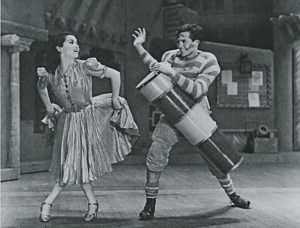
Diosa Costello and Desi Arnaz in Too Many Girls (1939)
Before his film career, Arnaz was known as the mambo king. Due to his lackluster rise as a “Latin Lover” in Hollywood, Arnaz returned to work as a musician and began singing his signature “Babalú” around 1943. The song is attributed to Margarita Lecuona and published in 1939. “Babalú” conflates the popular 1940s-50s big band sound with a Cuban folksong (or son) sung to the Orishas (deities or gods). Babalú is an Orisha deity who oversees health and is revered because of his power over life and death, and is also known as San Lázaro within the pantheon of Catholic saints. By the time Arnaz made the song popular in the United States, the song had also been associated with Miguelito Valdés, who was known as “Mr. Babalú.” Other musical contemporaries like Damaso Pérez Prado were also making a name for themselves by developing a new sound that Latinized dance music in the U.S. According to Ed Morales in Living in Spanglish, it is in the 1950s that Prado creates his signature sound in Mexico City by “mixing North American swing and bebop” known as mambo (152). However, it is Arnaz’s performance that I reference because of its reach to a multi-generational audience through syndication of the “I Love Lucy” show.
 Each time Arnaz performs “Babalú” it serves as an offering to the Orisha to heal the longing for a homeland he left long ago, as experienced by many musicians like Cruz who live in exile. With each performance on the “I Love Lucy Show,” Arnaz reconnects to his cultura. Performing this on national television it’s not about the Anglo viewer who only sees Arnaz as the “Rhumba Rhythm King” (sic) (Pérez-Firmat, 52) made famous in movies; rather it is about Arnaz creating a space of agency through a prayer and healing ritual in song, thus an expression of Afecto Caribeño connecting the Latinx diaspora to something beyond national borders and generations.
For example, in Season 2 episode 21 “Lucy Takes a Job at the Bank,” Arnaz (as Ricky Ricardo) brings out his son Ricky Jr. to play the congas alongside him. Ricky as proud father shares his joy in this moment. The camera pans out to Lucille Ball and her co-star Vivian Vance sitting at the table. Arnaz instructs his son to “say thanks” and he replies in Spanish “gracias.” This exchange is profound because it accentuates the bilingualism and bicultural exchanges that happen in the home space now introduced to many via television. Arnaz continues, “Even though Little Ricky was born in America, there’s lots of Cuban in his heart.” The Cuban in his heart plays out in sonic beats through a father-and-son performance on the congas and the calling upon “Babalú Aye.” Both Lucille Ball and Desi Arnaz are happy parents, not just stage parents, who revel in this moment. As Ricky Jr. plays, his mother bangs on the table too and Arnaz looks up to the sky as if in gratitude for this moment to the Orisha Babalú.
Upon reflection, I am aware of how television informed my childhood search for something that reflected how I spoke and heard the world. In these linguistic-sonic moments I reconnected to my mother’s homeland and sought to make sense of my pocha identity when I heard English spoken with a Spanish accent. In Relocations, Karen Tongson names these moments of connection that occur through a technological network as “remote intimacies” that can “account both technically and affectively, for the symbiosis that can happen between disparate subjects. . .I like to think that these imaginary correspondences sometimes have to happen across greater distances, both conceptually and topographically with other ethnicities, accents, nations (130)” The conceptual and topographical correspondence informs afecto caribeño as a means to enable critical connections to a Latinx diaspora centered en el Caribe highlighting the mestizaje of African and Spanish heritage, thus expanding upon Paul Gilroy’s notion of the “black Atlantic” on how the Atlantic slave trade also impacted culturally el Caribe. Upon singing “Babalú Aye” Arnaz’s performance not only is a disruption to Anglo American viewers, but also “disrupts the myth of Cuban whiteness” (Vasquez, Listening in Detail, 150).
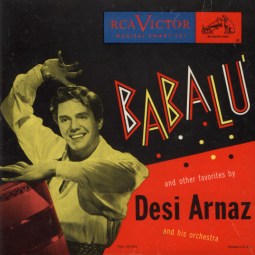 I am drawn to sonic experiences that can help unpack Latinidad and the multicultural roots that are informed by other migrations of Africans, Asians, and Spaniards to the Américas. I am a descendant of these mestizajes, as Gloria Anzaldúa writes in her canonical text Borderlands / La Frontera. A concept like afecto caribeño addresses the social and emotional exchanges that emanate from the complexity of these migrations and how they reveal themselves in momentary connections. When Arnaz performs as “Ricky,” he breaks that character upon playing the congas. Here he does not act as the nightclub owner; the reverberation of the conga mediates an embodiment of his true self exemplifying un afecto caribeño.
—
reina alejandra prado saldivar is an art historian, curator, and adjunct lecturer in the Women, Gender and Sexuality Studies Program and Liberal Studies Department at CSULA and in the Critical Studies Program at CALArts. As a cultural activist, she focused her earlier research on Chicano cultural production and the visual arts. Prado is also a poet and performance artist known for her interactive durational work Take a Piece of my Heart as the character Santa Perversa (www.santaperversa.com) and is currently working on her first solo performance entitled Whipped!
—
Featured Image: Desi Arnaz performing with Diosa Costello, 1948.
—
REWIND!…If you liked this post, you may also dig:
The Sweet Sounds of Havana: Space, Listening, and the Making of Sonic Citizenship – Vincent Andrisani
SO! Amplifies: Shizu Saldamando’s OUROBOROS–J.L. Stoever
SO! Reads: Dolores Inés Casillas’s ¡Sounds of Belonging! – Monica de la Torre
Share this:


Current Top Posts





April 2021

January 2020

November 2019

October 2019

August 2019

April 2014

November 2017

March 2015

December 2017

October 2015
 Sounding Out!
Recent Comments