
A Tribe Called Red Remixes Sonic Stereotypes


Welcome back to “The Wobble Continuum,” a three part series here on Sounding Out!. When we last left you, Mike D’Errico had brought us to the intersection of patriarchal cultural norms, music production practices and aesthetics, and the Military Entertainment Complex. His particular focus was on the sounds and practices of brostep (be sure to check out D’Errico’s SO! Comment Klatsch from last week on gendered sounds, too), and some of those sounds leak through to today’s post from Christina Giacona. Giacona turns her ear to the group A Tribe Called Red in order to hear how they reappropriate and redress the sounds of colonization and racism.
As the series’ title suggests, her essay entails another journey to the low end, where things will once again get wobbly.
Guest Editor Justin D. Burton
—
Since first contact, Native Americans have consistently needed to combat the European stereotypes that portray them as inferior and uncivilized. Barraged with echoes of the same handful of Native tropes since Buffalo Bill’s Wild West Shows, contemporary American society often treats the stereotypical Native American princess, chief, and savage as historical truths, represented recently in Johnny Depp’s portrayal of Tonto in The Lone Ranger. But it is not just the visual image of the Native American that has been stereotyped, so has their sonic sensibility. As documented in the film Reel Injun, Native languages and musics have consistently been “faked” by Hollywood with tricks like backwards English, pig-Latin, and Westernized imaginings of a ubiquitous Native music based on a pan-Indian society that never actually existed. Hollywood often uses Native American music to show a “primitive” society where music’s sole function is to prepare for war. However, the “Indian” drumbeat that accents the first beat of a group of four cannot be found in any traditional Native American or Aboriginal music.
While Native American-directed motion pictures such as Smoke Signals, Powwow Highway, and Atanarjuat: The Fast Runner finally gave agency to Natives in film, it was the all-Native DJ collective A Tribe Called Red’s self-released album and popularization of the Electric Powwow that directly challenges the perception of Native American music in modern society. In this post, I analyze the sonic composition of ATCR’s song “Braves,” exploring how A Tribe Called Red challenges North American stereotypes of Native Americans through the cultural re-appropriation of racist sounds.

“A Tribe Called Red – Hall 4 (1)” by Flickr user Trans Musicales, CC BY-NC 2.0
After World War I, intertribal powwow gatherings served as a place to celebrate newfound unity among Native Nations returning home from the war. By the 1950s intertribal powwows had spread throughout North America. With the continued strength and importance of the powwow in contemporary Native society, urban Natives in locations like New York City and Ottawa, Canada, have begun to search for ways to create the same sense of unity in urban venues. In 2008, DJs NDN and Bear Witness formed the DJ collective “A Tribe Called Red” and began curating performances in Ottawa the second Saturday of every month called the Electric Powwow: a “wild party” focused on showcasing native talent and aboriginal culture. ATCR’s website describe the music as “ the soundtrack to the contemporary evolution of the powwow.“ Bear elaborates in an interview with NOW magazine, “[the Electric Powwow] was also about creating a space for our community within the club environment.” Hip-hop DJ and turntable champ DJ Shub was invited to join the group in 2010, and the trio spent the next two years evolving the sound of the Electric Powwow into a mash-up of powwow and First Nations music with contemporary club sounds including hip-hop, dubstep, and dance hall.

“Tribe Called Red” by Flickr user Dav Yaginuma, CC BY-NC-SA 2.0
Much like Fela Kuti’s popularization of Afrobeat in the 1970s, made up of a combination of traditional Nigerian Yoruba polyrhythms with a blend of Western jazz and funk, and Reggaeton’s fusion of Caribbean rhythms with the aesthetics of American hip-hop in the 1990s, the Electric Powwow merges a historically traditional and non-syncretic music with popular and cosmopolitan music in a way that both honors cultural heritage and makes it relevant to a new generation. As NDN points out on Noisey, even their name follows this trend, simultaneously referencing the introduction of Nations at powwows and famous Afrocentric hip-hop group A Tribe Called Quest. The Electric Powwow events are not just about the creation of a new genre of music, but they also serve as a site for ATCR to speak publicly about aboriginal issues and represent themselves as a contemporary face for the urban Native youth renaissance. ATCR’s music videos and live-show projections extensively sample racist imagery from movies and cartoons including old westerns, Back to the Future III, Bugs Bunny, and Disney’s Peter Pan. As a result of their audio-visual activism, the group has become the unofficial soundtrack for the Idle No More movement, which is attempting to reassert Indigenous sovereignty rights and previously signed treaties in Canada.
By taking both visual and sonic symbols that depict racist stereotypes out of their cultural contexts, ATCR draws attention to both the specific racism of each individual image and the ubiquity of racist stereotypes. In their track “Braves,” A Tribe Called Red takes on the U.S. baseball team the Atlanta Braves by remixing the baseball organization’s Tomahawk Chop anthem, itself adopted from Florida State University.
ATCR’s version transforms the innocuous-sounding chant by showcasing its core as a Hollywood-esque stereotype of Native American song. By re-contextualizing the anthem, “Braves” prompts listeners to reinterpret this facet of American sports culture as a racist pageantry of “savage violence.”
The association of the “war chant,” the motion of the Tomahawk Chop, and the fact that these actions call for one team to attack all make it clear that American sports culture appropriates Native Culture as an example of “savagery” and “uncivilized” behavior. The Tomahawk Chop also forgoes the use of a language-based text entirely and instead chooses to use vocables that cannot be attributed to any particular Native nation, ceremony, or meaning. Like Hollywood’s use of backwards English and the war drumbeat to represent “Indians,” the Tomahawk Chop bears no resemblance to any real Native Nation’s music, acting as yet another imagined primitive stereotype that marginalizes actual Native American music.
On A Tribe Called Red’s SoundCloud page, “Braves”’s description reads, “We wanted to make a song for all the racist and culturally inappropriate sports teams that are still used today!” The group accomplishes this by creating dissonance between contemporary electronic drumbeats and the “traditional” paramilitary marching band arrangement of the “Tomahawk Chop.” “Braves” utilizes a standard dubstep song structure in 4/4 at 140 beats per minute that includes an intro, two main sections that include melodic materials, a breakdown/buildup section, a vocal “drop” which announces and is followed by the climax of the piece, and an outro that brings the track to a close. However, “Braves” does differ from other dubstep songs in the marked separation and interaction between the Tomahawk Chop samples performed by voices and marching band and the composed elements of the song performed as the Wub—a deep, wobbly synthesized sound—and accompanied by a HiHat cymbal pecking away at syncopated rhythms. Even though all the melodic content of “Braves” is based on variations of the Tomahawk Chop melody, ATCR never fully integrates actual samples of the Tomahawk Chop into the composition. The marching band and chant samples are treated as an unwanted and unexpected visitor to a party; they seem important at the entrance, but they are given an increasingly diminished role until they finally exit with a whimper.
Written as a protest against racist sports organizations to help convince them to stop using characterized ceremonies and mascots, “Braves” contains that struggle within the composition itself: dubstep, sounded as the Wub and HiHat, eventually renders the Tomahawk Chop sonically impotent. The “Tribe” drop, when ATCR marks the song by saying “tribe,” acts as the turning point in “Braves.” After this point the Wub and HiHat consistently overwhelm the sampled material. In a standard dubstep song, the tribe drop would be followed by the climax: the strongest, most complex musical section of the piece. However, the Tomahawk Chop sample that follows this drop is immediately swallowed up by a low-pass filter that rubs out the tune, starting with the highest pitched sounds, over the course of sixteen measures, heightening the lower end of the sonic spectrum. Only then does the true climax occur. The Wub and HiHat appear here for the first time without the sample band or vocalizations. After the “Tribe” drop, the samples of the Tomahawk Chop are either dominated by the Wub or swallowed up by low-pass filters and fades.

“Tomahawk” by Flickr user Lorianne DiSabato, CC BY-NC-ND 2.0
In this way, “Braves” acts as a three-minute sonic story of reappropriation. The marching band arrangement and vocables represent the common stereotypes of Native American music perpetuated by Western Culture. The Wub and HiHat act as disapproving commentary on these stereotypes. “Tribe,” the only word used in the entire song, not only sounds ATCR as a group, but also marks the point in the song when ATCR begins to create their own image of Native music while simultaneously disempowering the strength of the marching band.
Just like the rebel American marching band’s reappropriation of the song Yankee Doodle in the Revolutionary War, A Tribe Called Red employs irony: in order to get the song the audience has to understand the racism, and while that sort of understanding seems to represent a steep learning curve for a culture so saturated in racist stereotypes, it is also exactly the sort of understanding a multicultural nation needs in order to thrive. Like Afrobeat, Reggaeton, and the more recent alternative hip-hop group Das Racist, ATCR is an underground voice within American popular culture that speaks with reverence for its own traditions while challenging the popular perception of race relations and breaking new ground in contemporary art. “Braves” proves that the reappropriation of sonic space is a powerful tool in the fight for cultural agency.
—
Featured image: “ATCR 4” by Flickr user MadameChoCho, CC BY-NC-SA 2.0
—
Christina Giacona is the Director of the Los Angeles New Music Ensemble and Instructor of Music at the University of Oklahoma. Dedicated to performing and researching the music of her generation, Christina teaches courses in Native American, World, and Popular Music. Since founding the Los Angeles New Music Ensemble in 2007, Christina has commissioned and premiered over twenty new works for the ensemble; run an international composers competition, recorded three albums, and collaborated with DJs, MCs, animators, choreographers, projectionists, and film producers.
—
 REWIND!…If you liked this post, you may also dig:
“One Nation Under a Groove?: Music, Sonic Borders, and the Politics of Vibration”-Marcus Boon
“Live Electronic Performance: Theory and Practice”-Primus Luta
“Remixing Girl Talk: The Poetics and Aesthetics of Mashups”-Aram Sinnreich
Share this:

Heard Any Good Games Recently?: Listening to the Sportscape

Sound and music play important roles in shaping our experiences of sports. Every sport has its own characteristic sounds and soundscape; some are very silent while others can be dangerously noisy. Barry Truax, in his engagement with R. Murray Schafer’s concept of soundscape in the book Acoustic Communication, states that the listener is always present in a soundscape, not solely as a listener but also as a producer of sound (10). Both Truax and Schafer use the term hi-fi to describe environments where sounds may be heard clearly, while lo-fi, often urban, environments, have more overlapping sounds. When an audio environment is well balanced (hi-fi), there is a high degree of information exchange between sound, listeners and the environment, and the listener is involved in an interactive relationship with the other two components (Truax 57). Truax’s understanding of the concepts of hi-fi and lo-fi enable a better understanding of the power relations between the key sonic elements of sports: players, the audience and the organizer (usually a game DJ), an increasingly prominent role in today’s team sports events due to permeation of recorded music. Using examples from Finnish soccer, pesäpallo (“Finnish baseball”), and ice hockey, I track how a particular game’s sonic balance can be altered to shape the atmosphere of the event and, even influence the game’s outcome.
In Europe, soccer is overwhelmingly associated with crowd chants, as noted by Les Back in his article “Sounds in the Crowd.” Without the sounds from the audience, the soccer soundscape would be more hi-fi, revealing the keynote sounds of the sport clearly: for example, the thuds from kicking the football, individual shouts from both the players and the spectators. The clear hi-fi signal articulation may be desirable at other times, but from a home team perspective, it does not provide a good soccer atmosphere. However, while playing recorded music to engage the crowd preceding free kicks or corner situations is not prohibited, it breaks the unwritten rules of the game. This means that creating a good atmosphere becomes the crowd’s responsibility; thus, the infamous songs and chants.

“Final!” by Flickr user liikennevalo, CC BY-NC-SA 2.0
The culture of avoiding electronically reproduced music reveals the potential vulnerability of soccer’s soundscape to silence as much as chants, if not more so. Silence often becomes a way of effecting change at the level of soundscape. A silent, passive, crowd can mirror, for example, the team’s performance on the field or reflect a general lack of interest. Organized supporter groups can also demonstrate their dissatisfaction with something by refusing to sing.
This sound clip demonstrates how keynote sounds of soccer are exposed while approximately 1200 people in the audience seem to be “just watching” a very important home game at the end of the Veikkausliiga season 2012. In the end of the clip the home team, FF Jaro, equalizes and eventually went on to avoid relegation by just 1 point.
In contradiction to soccer, an important part of the pesäpallo experience (Finnish baseball, the national sport of Finland) is actually listening to the continuous communication of the teams. The key to pesäpallo, and the most important difference between pesäpallo and American baseball, is the vertical pitching. Hitting the ball, as well as controlling the power and direction, is much easier. This gives the offensive game much more variety, speed and tactical dimensions than in baseball. The fielding team is forced to counter the batter’s choices with defensive schemes and the game becomes a mental challenge. The continuous communication by the batting team standing in a half circle around the dueling batter and pitcher influences the pesäpallo soundscape. For a better appreciation of the sport, spectators must carefully tune in to the teams’s communiqués.

“Pesäpallo, Hyvinkää, Finland” by Flickr user Robert Andersson, CC BY-NC-ND 2.0
The male pesäpallo team Vimpelin Veto from the small village of Vimpeli in rural Finland has a very active crowd, with a high know-how of the sport. The village has only a little over 3200 inhabitants but had an average of 2087 spectators/game during the 2012 season. In a local newspaper article Veto’s player Mikko Rantalahti reveals that when the crowd is making lots of noise the visiting players’ tactical “wrong”-shouts (“väärä” in finnish), like when a pitched ball is too low, can’t be heard by the fielding players of the visiting team. The audiences’ collective shouting makes the soundscape more lo-fi and the visiting team’s communication difficult.
This tradition of strategic noisemaking has, before the use of headsets, also been heard in American football, when crowds make noise to make the vocal communication difficult for the visiting team. According to Matthew Mihalka’s PhD dissertation “From the Hammond Organ to ‘Sweet Caroline’: The Historical Evolution of Baseball’s Sonic Environment,” crowd noise in baseball is viewed as less influential since directions are sent via hand signals (44). Even though the pesäpallo manager leads the offensive play with a multicolored fan and other visual signals much of the communication is verbal.
(starting point ~16:30)
In this video clip from the 2011 Superpesis final between Vimpelin Veto and Sotkamon Jymy, the audience tries not only to disturb the focus of the hitter, but also the communication of the visiting team standing in the half circle around the batter. Even the commentators are struck by the crowd noise and note its influence.
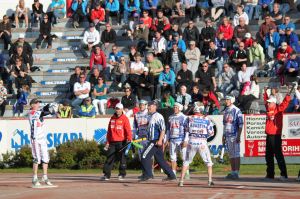
“Vimpelin Vedon jokeri Toni Kuusela lyöntivuorossa” by Picasa user Nurmon Jymy, CC BY-NC-ND 3.0
At Vetos games, the audience creates the sonic atmosphere just as in soccer. When the home team is batting, the audience engages in rhythmic hand clapping, deliberately uncoordinated with the organizers’ music. In 2012, I interviewed the managing director J-P Kujala, who is responsible for the music at Vetos games, and he stated that the atmosphere at Veto’s home games is so good that “there is no need for musical reinforcements.” He also doubted that the audience would react positively to music played to activate the audience. At the stadium, music is only heard before the game, during warm-up and intermissions. Kujala refrains from playing music when the visiting team is batting since that can be considered as “disturbing. . .we don’t do that here.” From the organizers’ perspective, the teams are sonically treated equally, but if the home audience creates a sound wall that drains out the visiting teams’ tactical shouts—making the soundscape more “lo-fi”—it is considered as home court advantage. In this context, lo-fi is not related to the use of technology and playing music, but instead to the audience’s sounds.
However, in contrast to the Vetos’ home court sound culture, more teams are beginning to play music inside the actual game, not only when the home team is batting (2:19) but also when the visiting team is batting. DJs often use songs to create funny remarks at the visiting team’s expense. Whatever the implied interpretation of the music might be, the strategy of playing music in this core situation also modifies something very authentic about the pesäpallo experience. In this sound clip from Koskenkorvan Urheilijat’s home game one can hear the visiting team Pattijoen Urheilijat communicating underneath the Finnish hit song Älä tyri nyt (“Don’t mess up now”). Notice that the home crowd, unlike at Vetos games, is not actively making noise—hence the use of music.
As this clip shows, the increasing use of music in pesäpallo calls attention to the need to develop up-to-date rules for the use of recorded music rather than relying on custom or practice.

“Ice Hockey World Championships Finland-Belarus” by Flickr user Chiva Congelado, CC BY-NC-SA 2.0
When discussing the soundscape of ice hockey, the most popular sport in Finland, the question is no longer about whether or not to play music but which music suits certain situations best. As in soccer, the most active fans often get cheaper tickets to fill in their own fan sections and sing from the curve behind the goals. Apart from singing along to iconic goal songs or team anthems, the fans very seldom interact with the other music played by the DJ. Moving toward a more mediated sport experience, the ice hockey soundscape is also becoming more lo-fi and the balance of sound making has shifted towards the organizers, with lots of sound events using recoded sound (music, videos, commercials etc.) to entertain the crowd during breaks of play. This shift from hi-fi to lo-fi can, according to Truax, encourage the feeling of being cut off from the environment and may begin to dramatically shift the audience’s experience of the sport (20).
There is no doubt that supporter groups have an important role as creators of meaningful sounds and good atmosphere in Finnish ice halls. In that sense it is a paradox that much of the music played “from record” overlaps their activity. John Bale has written that “fully modernized sport will alter the nature of the soundscape of stadiums and arenas […] and that electronically amplified sound will also increase and hence reduce the spontaneity of the crowd’s songs and chants” (141). The hockey example above with its planned rituals confirms this statement. Discussing and choosing the right songs for the right moment in an attempt to not only entertain but also coordinate the crowd is of course a way to deal with this schizophonic clash of sounds. A more and more common way to integrate the fans in the formation of the soundscape is the possibility of interacting with the DJ through for example Twitter. This is also a way to recognize the power relations in the soundscape.
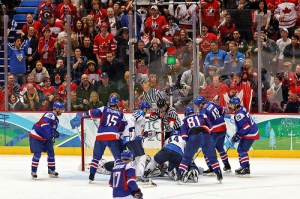
“Men’s Bronze Medal: Finland vs. Slovakia” by Flickr user s. yume, CC BY 2.0
The ice hockey team HC TPS, together with a long time sponsor, recently came up with the idea of “buying silence” and donating the spot to fans. The sponsor also provided the organizers and fans with radiotelephones. That way they could, when prompted by a text on the video screens in the hall, communicate when the spot is being played and make the best out of the situation. This innovative action alters the balance of the soundscape allowing other sounds to be produced and heard more clearly. It makes the ice hockey soundscape hi-fi again; the fans’ interaction with the environment improves and showcases how the balance in the soundscape of hockey is now entangled with the use of technology for sound reproduction.
As highlighted by the examples above, sounds play an important role for experiencing sports. For the audience, making sounds is a way to participate and interact with the event. When the use of music, at least in finnish sports, seems to increase there is also a need to identify the underlying necessity to the play music; it becomes a race to not only find suitable sport music but identify why music is played and which effects it might have on the soundscape as a whole. In soundscape research there has been a certain romanticization for hi-fi soundscapes, but in the cases I have studied there are no clear dichotomies where the one stands for something negative (lo-fi) and the other for something to strive for (hi-fi). Both hi-fi and lo-fi environments reveal power relations in how they connect to the audience’s motivation and ability to contribute with sounds, in addition to the use of technology.
—
Featured image: “Finland vs. Belarus” by Flickr user s. yume, CC-BY-2.0
—
Kaj Ahlsved is a PhD student in musicology at Åbo Akademi University in Turku, Finland. His research focus is on the ubiquitous music of our everyday life and especially how recorded music is used during sport events. He does ethnographic field work in team sports, mainly focusing on Finnish male teams in ice hockey, soccer, pesäpallo (“finnish baseball”), volleyball, floorball and basket. His research is funded by PhD Program in Popular Culture Studies and he is a member of the Nordic Research Network for Sound Studies (Norsound). He holds a master’s degree in musicology and bachelor’s degree in music pedagogy (classical guitar). Kaj is a Finnish-swede living with his wife and three children in the bilingual town of Jakobstad/Pietarsaari. He is, of course, a proud fan of the local soccer team FF Jaro.
Share this:


Current Top Posts





April 2021

January 2020

November 2019

October 2019

August 2019

April 2014

November 2017

March 2015

December 2017

October 2015
 Sounding Out!


Recent Comments