
SO! Reads: Rebecca Tuhus-Dubrow’s Personal Stereo
 In Personal Stereo, Rebecca Tuhus-Dubrow’s eminently readable history of the Walkman and its kind, it is telling to learn that Sony founders Masaru Ibuka and Akio Morita were prone to conversing in ‘something akin to a private shared language’ or idioglossia. “They would sit there,” recounts Morita’s eldest son, “and we would listen but we had no idea what they were saying” (21). In later life, following strokes, both lost the ability to speak; Ibuka’s son characterises their subsequent relationship as “communicating without words’.” Even the name Sony itself, notes Tuhus-Dubrow, with its origins in the Latin sonus and the English slang “sonny,” was ultimately “a word in no language’” (13). It is as though aural perception, delivered on an intimate scale, is somehow revelatory in a way that transcends the typical organising principles of language. The incorporation of the sonic into everyday life forever approaches a kind of affective intensity.
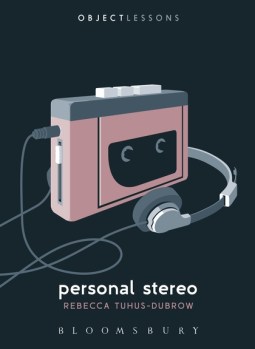 Personal Stereo tunes into this frequency and – by virtue of its array of research and skilful marshalling of social and cultural history – offers a compelling map of its coordinates. If, as part of Bloomsbury’s Object Lessons series, one of its central tasks is to apprehend the affective resonance of the inanimate, it is testament to Tuhus-Dubrow’s work that she is able to manage the breadth of her material into an adroit and concise narrative while at the same time allowing space for her writing to approach these contained moments of intensity. “When I think of [the Walkman] now, I think of joy,” she writes in the introduction (1). While acknowledging that undue celebration of the past can stymie the present, she offers a quietly persuasive case for an examination of nostalgia amid the anxiety of contemporary life, which almost serves as a rallying cry for a generation pinioned between the two: ‘The past, whatever its shortcomings, has the virtue of having already happened. And we survived it.’
As iTunes – like the glory of the world – passes into epilogue, it is again time to consider how we might frame obsolete technologies as echoes of a particular moment in our lives, anchored between progress and decay. As texts, they harbour a kind of degraded cartography: a summation of meaning and collapse.
The story of the Walkman begins in the bombed-out ruins of 1940s Tokyo, as Ibuka and Morita establish the foundations of the company that would become a consumer electronics giant as part of Japan’s ill-fated post-war boom. It is striking how much of the Walkman’s development was shaped by the ravages of warfare: Tuhus-Dubrow notes how its antecedent, the tape recorder, was first used in the German military, and early headphones were issued to fighter pilots. It is possible to read the subsequent commercial adoption of personal listening devices as an attempted refashioning of the domestic interior, transgressed so violently in acts of conflict. One of Ibuka’s founding principles for Sony was to “apply highly advanced technologies…developed in various sectors during the war to common households” (12). Tuhus-Dubrow also recounts the case of Andreas Pavel, a native of post-war Berlin, who emigrated with his family to São Paulo and developed what we might term a “counter-prototype” to the Walkman, partly inspired by the internal acoustics of his mother’s home – “a mecca of sound” – in Cidade Jardim. Object lessons are formed through disintegration and salvaged materials. Morita compares his formative partnership with the older Ibuka to a newly-established familial unit: “It was almost as though an adoption were taking place” (13).

Akio Morita (left) and Masaru Ibuka (right), 1961. Courtesy of Sony
This elides neatly with Tuhus-Dubrow’s central chapter, which is also the strongest. Here, she discusses the reception of private listening within the public domain, and how existing societal norms apprehended this new sonic phenomenon. It is intriguing, and at times hilarious, how much of the reaction operates as moral critique: from a 1923 article comparing the very act of solo listening to alcohol abuse or a drug habit, to rather more recent takes that foreshadow the current intergenerational culture wars. “The personal stereo,” harrumphs A.N. Wilson, ‘became the archetypal accessory of the me-generation” (68).
Tuhus-Dubrow’s research is smart and on point, not least because it leads to a productive consideration of how the cathartic element of the private soundtrack becomes something that society struggles to assimilate. She takes to time to weave in personal testimonies and reminiscences that are effective and somehow touching: “the Walkman,” she admits, “was a source of elation and comfort” (85). A friend recalls how “[my] inner world was enriched by the freedom to explore music on my own” (84). Pavel describes how the first use of his prototype, in the snows of St Moritz, evoked “a state of ecstasy,” in which life temporarily assumed a cinematic quality. “Suddenly,” he remembers, curiously switching to the present tense, “I’m inside a film” (27).

Darryl with a new Walkman, December 25, 1982, Image by Flickr User Kent Kanouse
Others speak of how musical accompaniment aids a more immersive interaction with the world around them, and it is here that perhaps the real strength of Tuhus-Dubrow’s work emerges: the generosity of an approach that permits mutual recognition; the summoning of an experiential quality that is elusive in its definition but vivid and immediate in its resonance. It is a mode of writing – and indeed a mode of listening – that is resolutely contemporary, formed in a firestorm of technological innovation that was both oppressive and liberatory, attuning us to new ways of being at the same time as it degrades and erodes old certainties.
It bears resemblance to what Tuhus-Dubrow recognises as “the logic of our own bodies, with organs and limbs whose motions are connected to their functions, and which are susceptible to injury and gradual breakdown” (102). Earlier she writes, “as one song neared its end, I would begin to hear the opening chords of the next in my head.”
What is it, this sense of auditory anticipation?
It is the forming of new waves. We have blood in our ears.
—
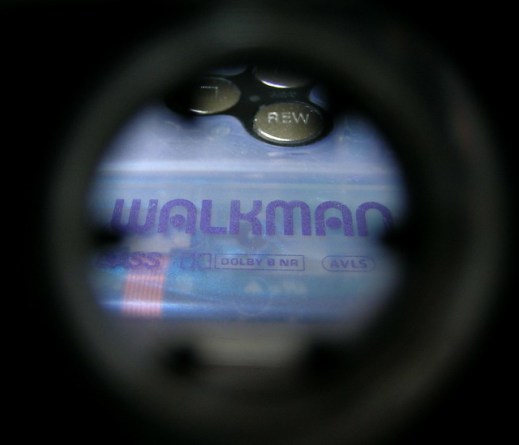
Featured Image: “Walkman through the cassette” by Flicker User Narisa (CC BY-NC-ND 2.0)
—
Lewis Jones is a writer and itinerant based in Brighton, UK. He received an MA in Literature, Culture and Theory from the University of Sussex, having previously graduated in English Literature from the University of Winchester. He is interested in how artistic and aesthetic mediums might be used to develop new theoretical approaches to culture and society. He particularly likes urban spaces, as visual and auditory environments, and the intersections between music, movement and the body. He thinks that dancing about architecture is a perfectly valid exercise.
—
 REWIND! . . .If you liked this post, you may also dig:
SO! Reads: Hiromu Nagahara’s Tokyo Boogie-Woogie: Japan’s Pop Era and Its Discontents–Shawn Higgins
SO! Reads: Janet Borgerson and Jonathan Schroeder’s Designed For Hi Fi Living–Gina Arnold
SO! Reads: Susan Schmidt Horning’s Chasing Sound: Technology, Culture and the Art of Studio Recording from Edison to the LP— Enongo Lumumba-Kasongo
SO! Reads: Steph Ceraso’s Sounding Composition: Multimodal Pedagogies for Embodied Listening–Airek Beauchamp
Share this:

SO! Amplifies: The Blues and Jazz Dance Book Club

—
Breaking down the paywalls of academia can take many forms, but lifelong learning collectives centered around a shared passion may perhaps be one of the most fun. The Blues and Jazz Dance Book Club is an international group of people connected by a love of blues and jazz culture, who read books together and tune in—free of charge—via Youtube Live to lectures and Q and As from experts and scholars from around the United States. Literature scholars such as Jessica Teague have discussed jazz poetry and August Wilson’s blues influence; dancer and scholar Dr. Fenella Kennedy has offered an online mini-workshop and discussion forum; and blues musician Tad Walters has played music and discussed the Delta Blues and its origins, among other lectures. All of these lectures are available on the Book Club’s website and on YouTube for anyone to enjoy.
 An open-access scholarly project founded in 2014, The Blues and Jazz Dance Book Club (BJDBC) was the brainchild of Sara Cherny, Damon Stone, Devona Cartier, Brenda Russell, and Kelly Porter (no longer a participating member). This team envisioned a free online space where people could learn about and discuss the history of blues, jazz, and African American dances, enriching both their own knowledge and the knowledge of the blues and jazz groups in which they participated. The Book Club’s current administrator, Chelsea Adams—PhD candidate at the University of Nevada, Las Vegas with a specialty in blues and African American dances in literature—took over operations in 2016.
Since then, Adams has worked hard to create a space where all blues and jazz lovers could access new scholarship on both the music and the dances done to that music, building a website to better facilitate the growing global group. Adams even coordinates live lectures at times that work the best to connect audiences who regularly chime in or visit the BJDBC website from Australia, England, Korea, Spain, France, Canada, Brazil, Sweden, the Netherlands, Germany, China and Hong Kong, among other places.
A Blues and Jazz Book Club live lecture by Dr. Jessica Teague, UNLV English
Recently, the Book Club has expanded to include multiple offerings for both scholar and enthusiast. One addition is quarterly feature articles, interviews, and community spotlights on blues and jazz topics. International dance instructor Julie Brown recently wrote the article “A Landscape of Slow Drag,” cataloguing and exploring how scholars and dancers have described the partnered blues idiom dance. Also featured is a never-before-published interview with Joe McQueen, the Oklahoma Jazz Hall of Fame inductee and Ogden, Utah’s King of Jazz.
Other feature articles have been spotlights on community engagements, literary criticism, and even a how-to on how to dive into research on blues and jazz topics. Practicioner and dance historian Damon Stone’s “A Brief Introduction to Savoy Walk,” Dr. Caryl Loney-McFarlane’s “‘Inside Nothing’: The Silent Protest March in Tony Morrison’s Jazz“ and Dr. Licia Morrow Hendricks’s “A Dog Named Blue: Song as Patrilineal Legacy in August Wilson’s Fences“ have all been popular pieces among group members and beyond. The website will soon publish an article all about Barbara Morrison‘s work in LA for the California Blues and Jazz Museum and the charity event called Signifyin’ Blues that raises money for her museum (forthcoming June 15th, 2019). And, in September 2019, Pat Taylor will be writing our third feature for the year on her work and life as a jazz dance choreographer.

Start Jookin’ with the Blues and Jazz Book Club this Summer!
The Blues and Jazz Dance Book Club’s signature offering is of course its quarterly book readings, where groups around the globe read together. Currently, we are reading Beyond the Crossroads: The Devil and the Blues Tradition by Adam Gussow, which we will finish during the first week of July 2019 (access the schedule here). Should you want to join us to read in 2019, future offerings include Jookin’: The Rise of Social Dance Formation in African-American Culture by Katrina Hazzard-Gordon (Summer 2019; start date July 21), Moanin’ at Midnight: The Life and Times of Howlin’ Wolf by James Segrest and Mark Hoffman (Fall 2019; start date September 15), and a blues-inspired novel for December 2019, Alice Walker’s The Color Purple (December 1). For the full 2019 reading list, click here.
Furthermore, the group’s website is a hub that also offers new reading lists and watch lists, including ones on African American history (and soon to include updated lists for blues and jazz music, and African American dance) and a discussion questions archive, where readers can find past discussion questions for previous books and films that they can access for their own thought or to read and discuss these books with others. Our Facebook page not only has regular posts about not only the Book Club, but also shares other research, news and information on blues and jazz around the United States, as does our Facebook Group.

The JBDBC will be reading Moanin’ at Midnight this Fall!
“Open access groups like Book Club offer a friendly environment to learn how to approach academic literature,” Book Club Organizer Adams says, “while enjoying gaining more knowledge about their hobbies and interests. It’s a form of scholarly outreach that I think is vital if we truly believe in the idea that our research can make a difference outside of the academy.
Groups like this are important because they offer guided access to scholarship and literature to people who for one reason or another do not have the opportunity to learn in formal academic environments or other professional institutions. Scholarly literature is a specific and often intimidating genre to tackle alone, even if someone is interested in learning more about a topic.”
And the engagements the Book Club has are rich and multifaceted. “My favorite experience with a live lecture,” Adams remembers, “was with Dr. Kennedy, when they demonstrated dances out of Jean and Marshall Stearns’ diagrams from their book Jazz Dance. Watching the group actually learn how to dance some of these dances listed in the book was a joy.”
In April 2018, the Blues and Jazz Dance Book Club announced the goal to provide two yearly scholarships: a Community Learning Scholarship for blues and jazz events to bring out a scholar, musician, or practitioner to teach about blues or jazz culture and history, and another for an individual with financial need to attend an event with a blues or jazz history and culture focus or to perform research. To provide these scholarships, the Book Club relies solely on community donations. To date, they have been able to raise the money to fund one Community Learning Scholarship, which will be open for applications starting in August of 2019.
If you would like to participate in the Blues and Jazz Dance Book Club, please check out our website: bluesjazzbookclub.com. We accept abstract submissions for feature articles on a year-round basis, and have multiple volunteer positions available, from one-time positions like guest lecturer to rolling positions such as book discussion leader. If you would like to support the open-access project goals but do not have time to volunteer, we always welcome donations to the cause!
—
Featured Image from the Blues and Jazz Book Club, “A Landscape of Slow Drag,” 1925/Published 1961, Info Likely from Harlem, NY Dancers.
—
Currently a PhD candidate in English at UNLV, Chelsea Adams focuses her studies on African American literature, blues and jazz music, and African American dance. She writes about minority culture representation in literature, with a focus of representation of black musicians, dancers, and the art forms they produce. She also runs the Blues and Jazz Dance Book Club, an international online book club project, to offer the public open access information about the history of blues, jazz, and black dances. You can learn more about Chelsea and her work at cjuneadams.com.
—
REWIND!…If you liked this post, you may also dig:
SO! Amplifies: Memoir Mixtapes–Kaitlyn Liu
SO! Amplifies: Cities and Memory–Stuart Fowkes
Share this:


Current Top Posts





April 2021

January 2020

November 2019

October 2019

August 2019

April 2014

November 2017

March 2015

December 2017

October 2015
 Sounding Out!
Recent Comments