
Instrumental: Power, Voice, and Labor at the Airport
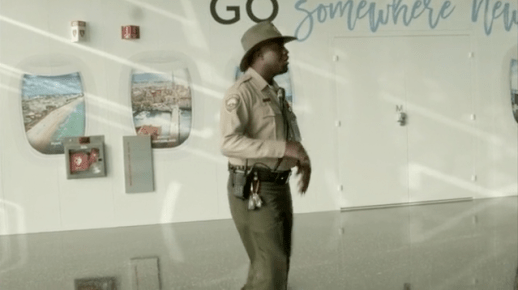
 Welcome to Voices Carry. . . a forum meditating on the material production of human voices the social, historical, and political material freighting our voices in various contexts. What are voices? Where do they come from and how are their expressions carried? What information can voices carry? Why, how, and to what end? Artist Asa Mendelsohn opens the forum with his critical and artistic work on the voice as an instrument of power. We are also honored that he lent Voices Carry a still from his work for our icon!–Jennifer Stoever
important, critical, foundational
Can we all do something about language here, and the frames that we use? […] We need to…stop already pre-redacting ourselves so that we can be quote ‘heard’ by these jackasses! They’re never gonna listen to us! — Mariame Kaba
Instrumental is a body of work featuring a series of vocal performances by airport security workers I filmed at the San Diego International Airport. The work takes up Mariame Kaba’s provocation, that those currently in power are never going to listen. How might relations of power be reordered around a voice? If voices are instruments, operating at once through a body and as a body, what kind of instrument is a voice of authority?
T
In September 2017, my proposal to produce a version of this project is accepted as part of a yearlong program curated by and for the San Diego International Airport. In October I put out a call for participation to airport security workers, in search of singers to perform songs of their choosing in front of a camera. There are emails with curators and security managers, logistics, parameters. I film over the winter and install a version of the work as a public art project in the spring, the first year of my medical gender transition.
When we meet at the far end of Terminal 2 in January, T is a combination of nervous and enthusiastic I wasn’t expecting. He’s so jittery that I almost tell him to stop and rest. I link my sneaking feeling of shame to an assumed position of authority, having arrived like this, multiple cameras, my university affiliation.
But while nervous, T’s also brimming, lighting up. His name tag catches gold light, bouncing against his gray Air Traffic Officer uniform.
T proposes two songs. Neither are in languages that he speaks in his daily life and he keeps forgetting words.
How am I going to forget you?
T says he learned the song from a former partner. He says girlfriend. He says he always felt self-conscious he couldn’t speak more Spanish. I guess that his family are Afro-Caribbean Spanish-speakers. I’m wrong. He’s also wrong about where I’m from. San Francisco, right?
T likes to sing karaoke. A coworker heard him and the rumor started going around: T has a beautiful voice. T’s voice is a soft instrument. In the airport, it is easily swallowed by environmental noise.
I film with T a second time, again meeting the last two hours of his ten-hour shift. He starts tired, nervous: stopping and restarting a song. Slowly, he warms up, dancing a cumbia. I sing with him when he forgets a line. We allow ourselves to take up more space in this quiet zone beyond the Air Canada counters. T dances with a moving chair.
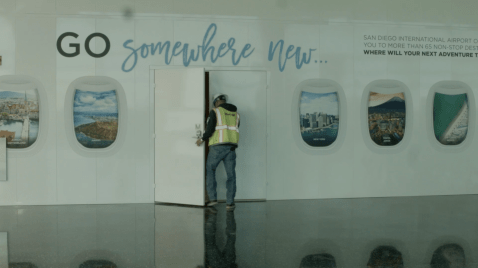
Where will your next adventure take you?
Men in construction vests come in and out of a door beneath a banner: “Go Somewhere.” Construction is in process to expand the space occupied by border security.
Working in security means exercising jurisdiction over how other people move, who can move where, and with what freedom. What kind of freedom or movement is possible between us while someone is watching (an institution, a camera)?
Artist Gregg Bordowitz writes that “posing for the camera in advance of anticipated capture by the lens is a form of self-defense in the age of surveillance. It’s an act of self-authorship.” I don’t feel I understand fully what calls someone forward to perform. Is it a feeling they have something to share, a will towards “self-authorship”? I’m interested in not knowing where a performance starts and ends, not knowing when we become performers or our own authors, when we become complicit, exploited, when we are on or off the job. Most people work and are watched most of the time, without being heard: a series of performances delivered and received with varying degrees of care.
The sterile zone
The post-9/11 commercial airport in the United States is one among other types of places designed to reinforce a culture of surveillance and fear, to remind travelers the state has a say in their freedom of movement. A place designed to instill one kind of horror while thinly concealing another.
Spending time at the airport with people who spend a lot of time at the airport, the intricacy of the place unfolds, resembling what theorist Simone Browne calls a “security theater.” At moments SAN blurs into every other airport in the U.S. I’ve moved through or seen on a screen: streams of moving walkways, escalators — travelers wheeling bags, waiting, scrolling for ticket information on smartphones, scanning, travel-themed advertisements and watery public art commissions — a fragmented, moving stage.
From Asa Mendelsohn, Instrumental (2018)
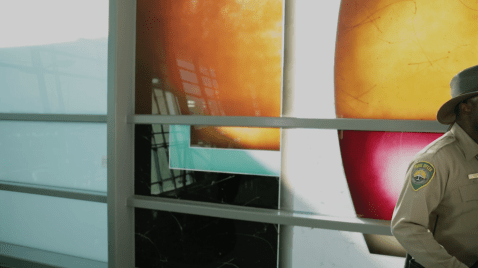
The voice of the overhead announcement is an instrument of the airport security theater, summoning the stress of being read and misread, abused, glibly entertained, and sold overpriced breakfasts, while you are also in fear of missing something: everything that makes airports ultimate theaters for the machinery of the security state. As I edit footage from the airport, I become preoccupied by moments of tension between a singer’s voice and the voice of the overhead security announcement, instructing us about checkpoint procedures, orienting us, interpellating. A singer pauses to wait, or they continue, enduring the interruption. For a security worker vocalizing in uniform, does the space of the airport become an extension of their body? (Does their uniform matter?) In these moments of tension, it becomes more clear that a security worker’s performance as an extension of the airport’s body is an uneven one.
While SAN seems like any other airport in the U.S., there are points of exceptionality. SAN is much smaller than other airports serving international commercial flights. It is located centrally, widely accessible from much of the city. Checkpoint lines are rarely very long. SAN is, of course, primarily the port of entry for travelers with valid state identification and the ability to buy an airline ticket. These factors do not make SAN an equitable place to work, but they do add up to an effect: airport as sanitized space, a clean space, that, in my subjective experience, other airports aspire to but rarely achieve. A small feat of whitewashing, eighteen miles by car from the border crossing at San Ysidro. Friends have suggested about this project: “you would not have been able to do that anywhere else.” I would not have been granted access.
As I prepare to film at SAN, I’m sent mixed messages. Initially, a curator tells me I’ll be granted access to shoot in post-checkpoint areas of the airport, areas I learn that security workers call “the sterile zone.” Shortly before my first shoot, I’m told that, actually, it’d be too much work to get me clearance. I’m restricted to what are called “public” spaces, pre-security, outside the sterile zone.
From Asa Mendelsohn, Instrumental (2018)
Throughout this process, I wonder how I’m seen by people at the airport. I do not doubt that being white, small-bodied, and soft-voiced make me seem non-threatening. I’m a patient director. I smile at my own perversity. Staff approach me cautiously while I’m setting up and ask if I have a permit to be there, but always eventually smile back. A curator overlooks or disregards my pronouns, misgendering me in email correspondences and later in the interpretive text about the work. They eventually apologize.
How are my interests as an artist read? While “speaking up,” or “using your voice,” is often understood as a political right and responsibility of democratic process, appropriating someone else’s is at particular stake in art and documentary ethics. At the airport, I am seeking a form through which to acknowledge the ways we use each other’s voices and labor, to acknowledge the multiple zones within which we work at once.
Instrumentalized: used
A voice is always a shape and product of its body, and, at the same time, something other. Theorist Freya Jarman-Ivens writes: “As my voice leaves me, it takes part of my body with it — the sound of its own production.” The voice in your head that you claim as your own is never, physically, the same voice as that which lands in the ear of another, that you also claim as your own, as when you claim on the phone “it’s me.” Jarman-Ivens names this paradoxical, “looped” quality of the voice its “queerness,” traveling between bodies and between language and non- language.
Increasingly, state terrorism marks the airport as a space in which people are alienated on the basis of identity. The anxiety that comes while waiting in line for your body to be scanned epitomizes that alienation. The invasive acts of being scanned, read and misread, are not one-way operations. Security personnel, particularly those whose classed, raced, and gendered bodies straddle multiple identifications and categories of oppression, occupy a tense space: at once agents of the security apparatus and subjects within it.
At the airport I am trying to represent realities in which a speaker’s voice changes and morphs with and through their body and environment. Through collaborations with non-professional actors — with people performing as versions of themselves — I am hoping to communicate the slip and stutter between performance and real life that José Esteban Muñoz might describe as “failure,” or an “active political refusal.” “Failure” is, as I understand Muñoz’s writing and legacy, an opening into another space of relating, a break from performative norms, from a performance of a norm, such as “real life,” or “gender.” Does the performance start when a security worker starts singing? When they become the airport? A worker? When they become a man?
Featured image still from Asa Mendelsohn’s Instrumental.
—
Asa Mendelsohn is from New York. He makes performances and media projects that develop through a process of recording, writing, and collaboration. His work combines observational and narrative storytelling practices, often focusing on personal relationships and desire as ways to navigate seemingly inaccessible infrastructures, histories, and systems of power.
—
 REWIND! . . .If you liked this post, you may also dig:
Unlearning Black Sound in Black Artistry: Examining the Quiet in Solange’s A Seat At the Table–Kimberly Williams
“Listening to the Border: ‘”2487″: Giving Voice in Diaspora’ and the Sound Art of Luz María Sánchez”-D. Ines Casillas
On Sound and Pleasure: Meditations on the Human Voice– Yvon Bonenfant
Share this:

Everyone’s Going to the Rumba: Trap Latino and the Cuban Internet
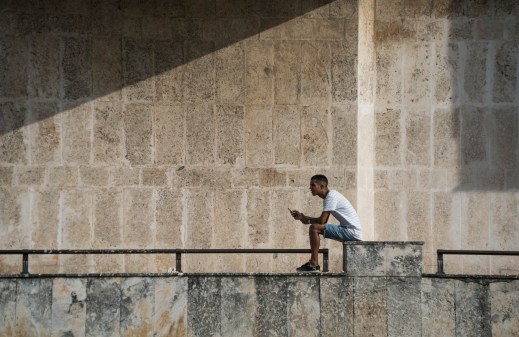
 In “Asesina,” Darell opens the track shouting “Everybody go to the discotek,” a call for listeners to respond to the catchy beat and come dance. In this series on rap in Spanish and Sound Studies, we’re calling you out to the dance floor…and we have plenty to say about it. Your playlist will not sound the same after we’re through.
Throughout January, we will explore what Spanish rap has to say on the dance floor, in our cars, and through our headsets. We’ll read about Latinx beats in Australian clubs, and about femme sexuality in Cardi B’s music. And because no forum on Spanish rap is complete without a mixtape, we’ll close out our forum with a free playlist for our readers. Today we start No Pare, Sigue Sigue: Spanish Rap & sound Studies with Michael Levine’s essay on Trap cubano and el paquete semanal.
-Liana M. Silva, forum editor
—
Trap Latino has grown popular in Cuba over the past few years. Listen to the speakers blaring from a young passerby’s cellphone on Calle G, or scan through the latest digital edition of el paquete semanal (the weekly package), and you are bound to hear the genre’s trademark 808 bass boom in full effect. The style however, is almost entirely absent from state radio, television, and concert venues. To the Cuban state (and many Cubans), the supposed musical and lyrical values expressed in the music are unacceptable for public consumption. Like reggaetón a decade before, the reputation of Trap Latino (and especially the homegrown version, Trap Cubano) intersects with contemporary debates regarding the future of Cuba’s national project. For many of its fans however, the style’s ability to challenge the narratives of the Cuban state is precisely what makes Trap Latino so appealing.
In an article published last year by Granma (Cuba’s official, state-run media source), Havana-based journalist Guillermo Carmona positions Trap Latino artists like Bad Bunny and Bryant Myers as a negative influence on Cuba’s youth, claiming the music sneaks its way into the ears of unsuspecting Cuban youth via the illicit channels of Cuba’s underground internet. With lyrics that celebrate the drug trade and treat women as “slot machines,” coupled with a preponderance of sound effects instead of “music notes,” Carmona considers Trap Latino aggressive, dangerous, and perhaps most perniciously of all, irredeemably foreign.
Towards the end of the article, Carmona focuses on his biggest concern: the performance of Trap Latino in public spaces. Carmona writes of those who play Trap from sound systems that “…they use portable speakers and walk through the streets (dangerously), like a baby driving a car. The combat between the bands that narrate some of these songs gestures towards another battlefield: the public sound space.” For Carmona, this public battlefield is sonically marked by Trap Latino’s encroachment on Cuba’s hallowed musical turf. His complaints highlight the fact that this Afro-Latinx style largely exists in Cuba on one side of what Jennifer Lynn Stoever refers to as the sonic color line, an “interpretive and socially constructed practice conditioned by historically contingent and culturally specific value systems riven with power relations” (14).
In Cuba, historically constructed power relations are responsible for much of the public reception of Afro-Cuban popular music, including rumba, timba, and reggaetón. But Trap Latino’s growing presence on the digital devices of Cuban youth is reshaping the boundaries of Cuba’s sonic color line. While these traperos are generally unable to perform in public (due to strict laws governing uses of Cuba’s public spaces) their music is nonetheless found across Havana’s urban soundscape, thanks to the illicit, but widespread, distribution of the “Cuban Internet.”Historically marginalized Afro-Cuban artists, like Alex Duvall, are today using creative digital strategies to make their music heard in ways that were impossible just a decade ago.
The Cuban Internet
To get around the lack of an internet infrastructure either too costly, or too difficult to access, Cubans have developed a network for trading digital media referred to as “el paquete semanal,” contained on terabyte-sized USB memory sticks sold weekly to Cuban residents. These memory sticks contain plenty of content: movies, music, software applications, a “Craiglist”-styled bulletin board of local products for sale, and even an offline social network, among others. The device is traded surreptitiously, presumably without the knowledge of the state.
(There is some question surrounding the degree at which the state is unaware of the paquete trade. Robin Moore, in Music and Revolution, refers to the Cuban government’s propensity to selectively enforce certain illegalities as “lowered frequency”. Ex-president Raul Castro has publicly referred to the device as a ‘necessary evil,” suggesting knowledge, and tacit acceptance, of the device’s circulation.)
By providing a means for artists to circulate products outside of state-sanctioned channels of distribution, el paquete semanal greatly broadens the range of content available to the Cuban public. The importance of the paquete to Cuba’s youth cannot be overstated. According to Havana-based journalist José Raúl Concepción, over 40% of Cuban households consume the paquete on a weekly basis, and over 80% of citizens under the age of 21 consume the paquete daily. A high percentage of the music contained on these devices is not played on the radio or seen in live concerts. For many Cubans, it is only found in the folders contained on these devices. The paquete trade therefore, serves as an invaluable barometer of music trends, especially those of younger people who represent the largest number of consumers of the device.

A listing of folders on el paquete semanal from October 30, 2018.
Alex Duvall
There is a random-access, mix-tape quality to the paquete that encourages consumers to discover music by loading songs onto their cellphones, shuffling the contents, and pressing play (a practice as common in Cuba as it is in the US). This mode of consumption encourages listeners to discover music to which they otherwise would not be exposed. Reggaetón/Trap Latino artist Alex Duvall takes advantage of this organizing structure to promote his work in a unique manner: Duvall packages his reggaetón music separately from his Trap Latino releases. As a solo act, his reggaetón albums position catchy dembow rhythms alongside lyrics and videos that celebrate love of nation, Cuban women, and Havana’s historic landmarks. As a Trap Latino artist in the band “Trece,” his brand is positioned quite differently. Music videos like Trece’s “Mi Estilo de Vida” for instance, contain many of the markers that journalist Guillermo Carmona criticized in the aforementioned article: a range of women wear the band’s name on bandanas covering their faces, otherwise leaving the rest of their bodies exposed. US currency floats in mid-air, and lyrics address the pleasures of material comforts amid legally questionable ways of “making it.”
Especially as it becomes more and more common for Latinx artists to mix genres freely together in their music (as the catch-all genre format referred to as música urbana shows), it is significant that Alex Duvall prefers to keep these styles separate in his own work. The strategy reveals a musical divide between foreign and domestic elements. Duvall’s reggaetón releases emphasize percussive effects, and the Caribbean-based “dembow riddim” that many Cubans would quickly recognize. The synthesized elements in his Trap Latino work however, belong to an aesthetic foreign to historic representations of Cuban music, representing broader circulations of sound that now extend up to the US. Textures and rhythms originating from Atlanta (along with their attendant political and historical baggage) now share space in the sonic palette of a popular Cuban artist.
Going to the Rumba
These cultural circulations complicate narratives coming from the Cuban state that tend to minimize the cultural impact of music originating from the yankui neighbor to the north. These narratives exert powerful political pressure. Because of this, artists are careful when describing their involvement with Trap music. Duvall’s digital strategy allows for a degree of freedom in traveling back and forth across the sonic color line, but permits only so much mobility.
In an interview conducted by MiHabanaTV, Duvall distances himself from Trap Latino’s reputation, defending his project by appealing to the genre’s international popularity, and the need to bring it home to Cuba. But the 2017 song “Hasta La Mañana” documents one of his most concise explanations for his involvement in Trece, in the following lyrics:
| “El tiempo va atando billetes a cien Pero todos va para la rumba Entonces yo quiero sumarme tambien.” |
Time is tying hundred dollar bills together Everyone is going to the rumba And I also want to join. |
He uses “rumba” here as shorthand to refer to the subversive actions that people take in order to succeed in difficult situations. Duvall needs to make money. If everyone else gets rich by going to “the rumba,” why can’t he? The reference is revealing. Rumba marks another Afro-Cuban tradition with a history of marginalized figures engaged in debates over appropriate aural uses of public space. Today, cellphone speakers and boom boxes sound Havana’s parks and streets. Historically, Afro-Cuban rumberos made these spaces audible through live performance, but similar issues of race animate both of these moments.
In the essay “Walking,” sociologist Lisa Maya Knauer explains that it was not uncommon for police to break up a rumba being performed in the streets or someone’s home throughout the twentieth century “on the grounds that it was too disruptive.” (153) Knauer states that rumba music is historically associated with “rowdiness, civil disorder, and unbridled sexuality, while simultaneously celebrated as an icon of national identity”. (131) The quote also reveals a contrast between the public receptions of rumba and Trap Latino. Duvall’s work, and Trap Latino more generally, is similarly fixed amid a complex web of racialized associations. But unlike rumba, refuses to appeal to state-sanctioned ideals of national identity.
Afro-Cuban musicians are often pressured to adopt nationally sanctioned modes of participation in order to acquire official recognition and state funding. The acceptable display of blackness in Cuba’s public spaces, especially while performing for the country’s growing number of tourists, is a process that anthropologist Marc D. Perry calls the “buenavistization” of Cuba in his work Negro Soy Yo. This phrase refers to the success of popular Son heritage group Buena Vista Social Club, and the revival of Afro-Cuban heritage musical styles that this group and its associated film popularized. Unlike Rumba and Son however, Trap Latino is considered irredeemably foreign (given its roots in both the US city of Atlanta and later, Puerto Rico), therefore presenting difficulties in assimilating the genre to dominant models of Cuban national identity. This tension, I believe, is also responsible for it’s success among Cuba’s youth.
Trap Cubano’s growing appeal stems instead from artists’ adoption of a radically counter-cultural positionality often avoided in popular contemporary styles like reggaetón. While it would be unfair to accuse reggaetón as being entirely co-opted (a point musicologist Geoff Baker makes convincingly in “Cuba Rebelión: Underground Music in Havana”), it is certainly true that as reggaetóneros achieve greater success in ever widening circles of international popularity, the amount of scandalized lyrics, eroticized imagery, and the sound of the original dembow riddim itself (with its well documented roots in homophobia and virulent masculinity) has diminished considerably. Trap Latino’s sonic subversions fill this gap. While the genre similarly praises the fulfillment of male, material fantasies, it troubles the narrative that increased access to money solves social, racial, and gender imbalances, while sonically acknowledging the role that the US shares in shaping it’s musical terrain.
This centering of materialism amid representations of marginalized Afro-Cuban artists is foreign to both historic and touristic representations of Cuba, but relevant to a younger generation increasingly confronted with the pressures of encroaching capitalism. Trap Cubano renders visible (and audible) an emerging culture managing life on the less privileged side of the sonic color line. From the speakers blaring from a young passerby’s cellphone on Calle G, to the USB stick plugged in to a blaring sound system, to the rumba where Alex Duvall is headed, Trap Latino broadcasts the concerns of a younger generation challenging what it means to be Cuban in the 21st century, and what that future sounds like.
—
Involving himself in the music scenes of Brooklyn, N.Y. over the past decade and currently attending The University of North Carolina at Chapel Hill’s musicology program, Mike Levine utilizes a dual background in academic research and web-based application technologies to support sustainable local music scenes. His research now takes him to Cuba, where he studies the artists and fans circulating music in this vibrant and fast-changing space via Havana’s USB-based, ‘people-powered’ internet (el paquete semanal) amidst challenging political and economic circumstances.
—
Featured image: “Hotel Cohiba – Havana, Cuba” by Flickr user Chris Goldberg, CC BY-NC 2.0
—
REWIND!…If you liked this post, you may also dig:
Spaces of Sounds: The Peoples of the African Diaspora and Protest in the United States–Vanessa Valdes
SO! Reads: Shana Redmond’s Anthem: Social Movements and the Sound of Solidarity in the African Diaspora–Ashon Crawley
Music Meant to Make You Move: Considering the Aural Kinesthetic– Imani Kai Johnson
Share this:


Current Top Posts





April 2021

January 2020

November 2019

October 2019

August 2019

April 2014

November 2017

March 2015

December 2017

October 2015
 Sounding Out!
Recent Comments