
“Share your story” – but who will listen?
 Editor’s Note: Welcome to the second installment in the “DH and Listening” blog series for World Listening Month, our annual forum that prompts readers to reflect on what it means to listen. This year’s forum considers the role of “listening” in the digital humanities (DH, for short). We at Sounding Out! are stoked to hear about (and listen to) all the new projects out there that archive sound, but we wonder whether the digital humanities engage enough with the the notion of listening. After all, what’s a sound without someone to listen to it?
On our opening week, Jacqueline Wernimont from the Vibrant Lives team shared with us about the ethics of listening to 20th century sterilization victims’ records. Then, Emmanuelle Sonntag introduces us to a figure from a long time ago, “la soeur écoute,” a nun whose was responsible for sitting in and listening when another nun had a visitor. This week, Fabiola Hanna reflects upon what DH means when it talks about participatory practices. –Liana Silva, Managing Editor
—
Germanic and Holocaust historian and Digital Humanist Todd Presner has worked through more than 52,000 testimonies of the Shoah Foundation’s Visual History Archive, perhaps the largest archive of testimony, to investigate “the ethics of the algorithm.” The scale of this participatory archive has prompted Presner to ask: is it possible for a computer to listen to testimony?
Digital Humanities (DH) projects are, in varying degrees, led by the desire to engage with a wider public. Some often include actions such as inviting participants to share their stories, images, audio clips, drawings, and videos. In order to avoid lumping all DH works under a broad category that includes, among others, text analysis, mapping, visualization, 3D, and archiving. Below I examine DH projects that collect oral histories: memories, stories, and testimonies.
I argue that it is not enough to share stories; it is also important to recognize how these stories are shared. A majority of these living histories end up in an audio or video database displayed in full on a webpage, not unlike oral history transcripts ending up in a dusty closet. Listening as an active mode of participation can provide us with a framework that reveals the relationships, aesthetics and politics engendered by participation. Although seemingly about access (and some have started questioning whether users of such an archive should have access by default, or whether you need to be part of a community in order to access certain stories, see Mukurtu CMS), my focus is rather on the medium that these stories are circulated in, how they are displayed to the user and what the user’s participation does to these stories.
I take the space here, on the one hand, to think through participation from two fields, archives and interactive documentary (i-docs), and on the other hand to write about how sound studies, particularly an attention to listening and its aesthetics, its affordances, and its politics, can offer another approach to participation.

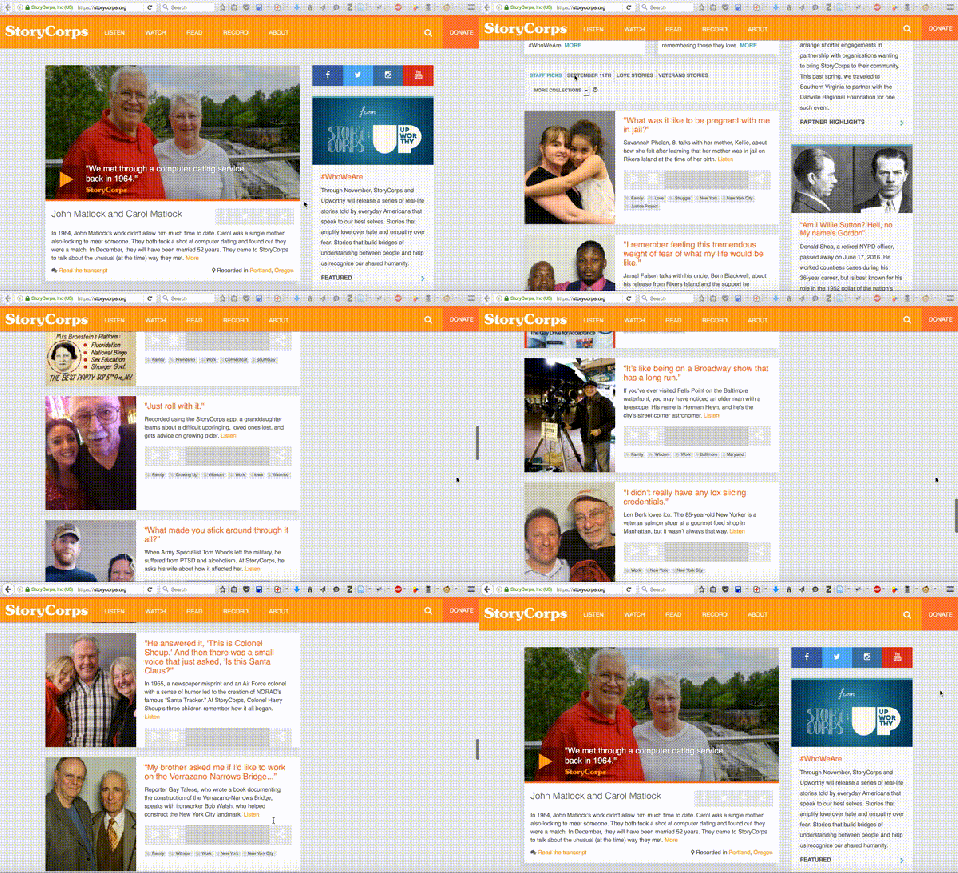
SO! Screen Capture from Irene Lustzig’s “The WorryBox Project”
DH + participation: steps towards making place for popular
The work of requesting participation is in itself an accomplishment. It’s only been since the 1950s/60s, and perhaps more broadly since the 1990s, that ordinary peoples’ stories have been valued in the tradition that oral historians have established. It is possible to trace the field’s origins to Augusto Boal’s Theatre of the Oppressed (itself rooted in Paolo Friere’s work), to Howard Zinn’s A People’s History of the United States, or to postmodernism, the death of the author, and the end of grand narratives. With the arrival of Web 2.0, oral history seemed like the perfect medium for the ideals of participation on the Internet, precisely because it was about the everyday and involved “anyone” (with an internet connection). Video, audio and live streaming technologies made it possible for oral history to be recorded and displayed, and social media enabled unprecedented circulation through sharing. So the recent push to preserve everyday histories online, in DH projects, follows these ideals of stories from below.
Listening to stories as a mode of engagement is fitting with regards to oral history and testimony. Making space with openness and silence for someone’s testimony, especially when difficult, is a mode of participation that we aspire to. Media scholar Wendy Chun has argued that “a politics and practice of listening [is] a necessary complement to a politics of testifying.” In the case of Holocaust testimony, for instance, many scholars have argued that there is a responsibility to listen (Laub & Felman and Henry Greenspan).
I differentiate between two types of listening:
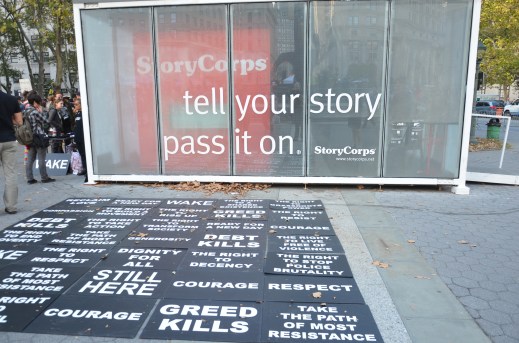
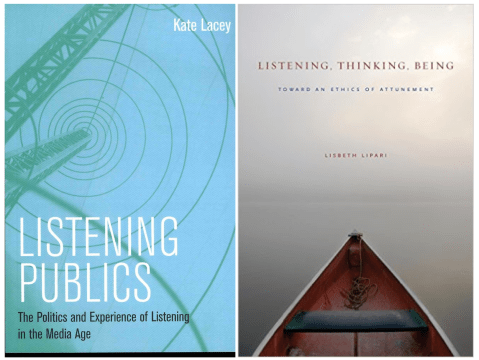
- Listening on the part of the users of these DH projects. Is it realistic to expect that users will listen to large archives of testimony? In Listening Publics, Kate Lacey writes that listening has been absent from theories of the public sphere, even where “the objective of political agency is often characterized as being to find a voice – which surely implies finding a public that will listen, and that has a will to listen” (viii). Because of their scale, these large archives of testimony pose a significant design challenge to the user, which could be resolved through curation. To build on one of the most successful digital storytelling projects, the Storycorps team knows very well that if they didn’t curate and edit together shorter versions, then no one would listen to the longer interviews in full.
- Listening on the part of the interface and its design. This involves questioning the medium and its effects on what it houses. Here I find Susan Bickford’s work very useful in her definition of listening and what it accomplishes: ‘the riskiness of listening comes partly from the possibility that what we hear will require change from us’ (1996, 149). If interfaces for stories pre-close any openness to what contributed stories could change, then listening is not being considered. This is more directly seen in the tagging of videos and their categorization without additional interpretational work. This will to not “add” to these stories seems to come from the premise that these testimonies should “speak for themselves” (I get to this point in a little bit); that no added interpretation is needed, even that any added interpretation distracts from the directness of the stories. But this often also means the medium and its effects on these stories are not carefully examined.
Contrary to Western cultural beliefs, listening can be seen as an active mode of participation in conversation. As Jodi Dean rightly argues, it is not enough to express one’s opinion, or for a message to be circulated: it is crucial to get a response to the message. Lisbeth Lipari writes that even in Dean’s formulation, however, the response as speech is still emphasized, thereby ignoring the work that happens beforehand: the listening. Apart from the major contribution of Susan Bickford, mentioned above, with the concept of political listening, little attention has been paid to listening in the field of political theory.
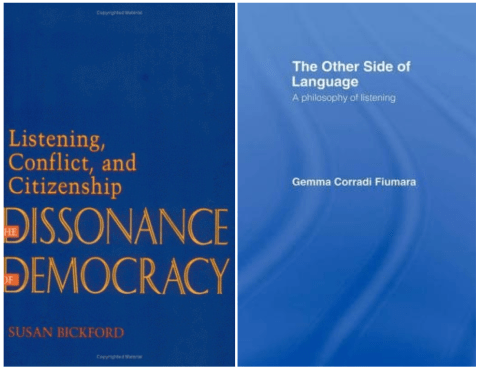
As arguably the most important philosopher on listening, Gemma Corradi Fiumara, writes: “listening involves the renunciation of a predominantly moulding and ordering activity; a giving up sustained by the expectation of a new and different quality of relationship” (as quoted by Lipari, 8). For Fiumara, listening is a mode of participation that is open and that does not pre-close potential possible contributions. Listening, therefore, as a mode of engagement can provide a useful method for thinking about participation in various contexts.
DH + Archives + i-docs
If a mission of a certain DH project is to engage with a wider public, then preservation of stories is not enough. More often than not, DH projects are already under difficult strain of resources, due to costs for developing technological projects and time for interviewing, collecting, indexing, tagging, uploading and making sense of these larger collections. DH have taken on a lot: preserving and archiving everyday stories with the mission to share with a wider public. It is useful to draw from experts who have been working through ideas of preservation and access: archivists. Archives generally have a mission of preservation, but when demands of sharing with a public arise, there are not many models from which to draw. Rick Prelinger writes that although the archive as a theoretical concept is overly theorized, its practice (in the plural form of the word) is under theorized.
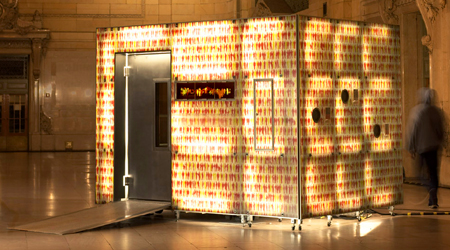
Image of StoryCorps collection area by Aaron “tango” Tang (CC BY 2.0).
Francis X Blouin and William G. Rosenberg trace the intersection of history and archives and found that Ranke, during the enlightenment, conceptualized history as a scientific endeavor in that truth could be extracted from archives through rigorous methodologies. This led to the idea that documents could “speak for themselves” (Blouin, 24). As if simply making documents available, without providing context of any sort, would reveal their inner truth. This is one of many cases where the reading of documents is taken for granted. It also ignores the effect that archivists have on the collecting, saving, and indexing of documents. Influential archivists such as Terry Cooke, Richard Brown and Brian Brothman have brought about new attitudes to repositories with an acknowledgment of the effect that archivists have on documents (as quoted by Richard J Cox, 33). This relatively recent push in archival theory, therefore, points to the flaws in the claim that documents on their own can represent themselves: that would be ignoring all the various power relationships at play, as well as the medium itself in which the stories are communicated.
In thinking about collaboration, with the unstated but implied goal of providing knowledge of a given subject, non-fiction film has experimented by inviting self-interested participants online and offline to contribute to projects. Sandra Gaudenzi makes clear that interactive documentaries, also called i-docs (documentaries designed for online or mobile viewing), are very distinct and that it is important to recognize the varying strategies employed by these digital projects: “uploading content is the most common way to collaborate in the case of online documentary, but it is definitely not the only one. […] contributions of content lead to co-creation but not to co-authorship, since the latter require a degree of intervention in the overall concept (i.e., form) of the product.” In her differentiation of co-creation and co-authorship, Gaudenzi points to the medium-limiting effect that users have in their participation. The “degree of intervention,” as a coming in between that leads to change, which Gaudenzi requires for co-authored documentaries, might be attained through listening, a listening through the work itself, such as The WorryBox Project.
Listening in The WorryBox Project
Irene Lusztig’s The WorryBox Project (2011) web-based documentary invites mothers to write their worries in an online form, which Lusztig then individually writes down on a piece of paper, rolls-up and stores in a physical box. The act of writing down in analog form what was input into a digital box goes an extra step beyond collection. It is emblematic of an extended care for these worries. The additional layer of documenting these actions, as part of the artwork itself, not only points to the embodiment of these worries but also to their representation.

Because listening has often been thought of as passive and feminine, it is also associated with a specific kind of caring, also in its passive and feminine forms. But I don’t equate that definition of care with listening, which surely the readers of this blog will question. In this case, care extends as a mode of listening because it pushes against the active/passive binary for speaking/listening. I use care in the sense it gave to curating (care is its early root), where curating points to the work of engagement and conversation. Curating as a form of listening.
This extended care would be an example of the listening I am thinking of. The work of translating the form’s digital input into the handwritten words and the documentation of that act stretch the layering of interpretation and with it the care given to these submissions. The change that occurs in this writing is definitely not an agreement or an endorsement of what is submitted but an open attitude of listening, of reception. This reinforces the notion that listening is not passive, but an active mode of participation.
This mode of listening does not imply an understanding, as the receipt of information in cybernetics theory suggested by Shannon and Weaver. Rather this mode of communication embraces the notion that listening does not necessarily mean an understanding. The audio action collaborative Ultra-Red conveys this idea perfectly: “Sound possesses a palpable promiscuity in relation to the body. One may say what one means, but somewhere between the mouth that speaks and the ear that hears, sound always exceeds its master. Politically, it may be useful to say that we hear the truth in the voice or that we listen with obedience, but sound always transgresses such duties.” So for DH storytelling projects to be participatory, it is beneficial to allow stories the space for listening, in a similar sense to Hannah Arendt’s “distancing” in order to understand. This brings me to media and communication’s scholar Lisbeth Lipari’s term for this: “listening otherwise.”

SO! Screen Capture of Irene Lustzig’s “The Worry Project”
For Lipari, in engaging with difficult stories or perhaps stories that offer different perspectives: “It is […] a listening otherwise that suspends the willfulness of self- and foreknowledge in order to receive the singularities of the alterity of the other” (185, emphasis in original). For this “listening otherwise” to work online, I argue that it is important for the employed structures, systems and processes to reflect this specific kind of participation. In other words, in addition to placing “different voices” side-by-side, it is equally critical for these different perspectives to exist in a space where the medium, whether the recording, the software, the interface and its design, listens to what these differences are. An interface designed in order not to predetermine, not to predict or preclose what others might contribute would then be an example of this listening. Anthropomorphizing aside, for a computer to listen to testimony, as Presner asks, it must be designed to be open to changing itself.
—
Fabiola Hanna is a new media artist & software designer currently working towards a PhD in Film and Digital Media at UC Santa Cruz where she also holds an MFA in Digital Arts & New Media. Her doctoral work is on building an automatic editing machine that weaves together competing narratives about the history of Lebanon, which has led her to engage with software studies & digital humanities, archives & memory and new media art activism.
Her work has been exhibited widely in California at the Museum of Art and History in Santa Cruz, the New Children’s Museum in San Diego, the SubZero Festival in San Jose, the Digital Arts Research Center in Santa Cruz, and the Maker Faire in San Mateo. She is also a 2015 fellow of the Institute for Critical Social Inquiry at the New School, New York and has previously taught at University of California, San Diego and at various maker spaces including FabLab San Diego and MakerPlace.
Her website is fabiolahanna.com and she can be reached by email fhanna {@} ucsc {dot} edu.
—
Featured Image: “Story Corps” by Steve Rhodes, (CC BY-NC-ND 2.0)
—
 REWIND!…If you liked this post, you may also dig:
What Mixtapes Can Teach Us About Noise: Reading Shannon and Weaver in 2010–Aaron Trammell
Machinic Ballads: Alan Lomax’s Global Jukebox and the Categorization of Sound Culture–Tanya Clement
“Digital Analogies: Techniques of Sonic Play“-Roger Moseley
Share this:

Me & My Rhythm Box

I’m fortunate to have quite a few friends with eclectic musical tastes, who continually expose me some of the best, albeit often obscure, sources for inspiration. They arrive as random selections sent with a simple “you’d appreciate this” note attached. Good friends that they are, they rarely miss the mark. Most intriguing is when a cluster of things from different people carry a similar theme, converging to a need on my part for some sort of musical action.
The Inspiration
A few years back I received a huge dump of gigabytes of audio and video. Within it were some concert footage and performances this friend and I had been discussing; I consumed those quickly in an effort to keep that conversation going. Tucked amidst that dump however, was a copy of the movie Liquid Sky. I asked the friend about it because the description of the plot–“heroin-pushing aliens invade 80’s New York”–led me to believe it wasn’t really my thing (not a big fan of needles). Although my friend insisted I’d enjoy it, it took me several months if not a whole year before I finally pressed play.
Even though Liquid Sky was not my favorite movie by any measure, it was immediately apparent to my ears why my friend insisted I check it out. The film’s score was performed completely on a Fairlight CMI, capturing the synthesized undercurrent of the early 80’s New York music scene, more popularly seen in the cult classic Downtown 81, starring Jean Michel Basquiat. While the performances in that movie are perhaps closer to my tastes, none of them compare to one scene from Liquid Sky that I fell in love with, instantly:
The song grabbed me so much, I quickly churned out a cover version.
Primus Luta “Me & My Rhythm Box (V1)”
While felt good to make, there remained something less than satisfying about it. The cover had captured my sound, but at a moment of transition. More specifically, the means by which I was trying to achieve my sound at the time had shifted from a DAW-in-the-box aesthetic to a live performance feel, one that I had already begun writing about here on Sounding Out! in 2013. Interestingly, the inspiration to cover the song pushed me back to my in-the-box comfort zone.
It was good, but I knew I could do more.
As I said, these inspirations tend to group around a theme. Prior to receiving the Liquid Sky dump, I had received an email out of the blue from Hank Shocklee, producer and member of the Bomb Squad. I’ve been a longtime fan, and we had the opportunity to meet a few years prior. Since then he’s played a bit of a mentoring role for me. In the email he asked if I wanted to join an experimental electronic jazz project he was pulling together as the drummer.
I was taken aback. Hank Shocklee asking me to be his drummer. Honestly, I was shook.
Not that I didn’t know why he might think to ask me, but immediately I started to question whether I was good enough. Rather than dwell on those feelings, though, I started stepping up my game. While the project itself never came to fruition, Shocklee’s email led me to building my drmcrshr set of digital instruments.
 A year or so later, I ran into Shocklee again when he was in Philadelphia for King Britt’s Afrofuturism event with mutual friend artist HPrizm. By this time I had already recorded the “Me and My Rhythm Box” cover. Serendipitously, HPrizm ended up dropping a sample from it in the midst of his set that night. A month or so later, HPrizm and I met up in the studio with longtime collaborator Takuma Kanaiwa to record a live set on which I played my drmcrshr instruments.
Not too long after, I received an email from NYC-based electronic musician Elucid, saying he was digging for samples on this awesome soundtrack. . .Liquid Sky.
The final convergence point had been hanging over my head for a while. Having finished the first part of my “Toward a Practical Language series on Live Performance” series, I knew I wanted the next part to focus on electronic instruments, but wasn’t yet sure how to approach it. I had an inkling about a practicum on the actual design and development of an electronic instrument, but I didn’t yet have a project in mind.
As all of these things, people, and sounds came together–Liquid Sky, Shocklee, HPrizm, Elucid–it became clear that I needed to build a rhythm box.
The History
What stands out in Paula Sheppard’s performance from Liquid Sky is the visual itself. She stands in the warehouse performance space surrounded by 80’s scenesters posing with one hand in the air, mic in the other while strapped to her side is her rhythm box, the Roland CR-78, wires dangling from it to connect to the venue’s sound system. She hits play to start the beat launching into the ode for the rhythm machine.
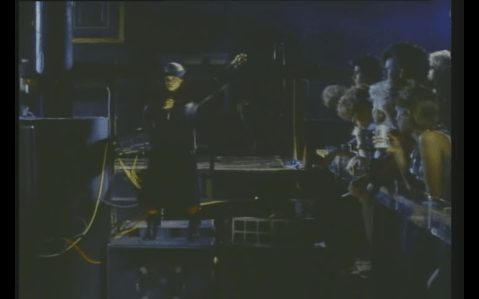
Contextually, it’s far more performance art than music performance. There isn’t much evidence from the clip that the CR-78 is any more than a prop, as the synthesizer lines indicate the use of a backing track. The commentary in the lyrics however, hone in on an intent to present the rhythm box as the perfect musical companion, reminiscent of comments Raymond Scott often made about his desire to make a machine to replace musicians.
My rhythm box is sweet
Never forgets a beat
It does its rule
Do you want to know why?
It is pre-programmed
Rhythm machines such as the CR-78 were originally designed as accompaniment machines, specifically for organ players. They came pre-programmed with a number of traditional rhythm patterns–the standards being rock, swing, waltz and samba–though the CR-78 had many more variations. Such machines were not designed to be instruments themselves, rather musicians would play other instruments to them.
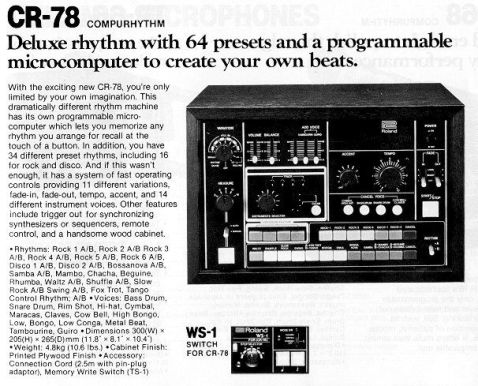
In 1978 when the CR-78 was introduced, rhythm machines were becoming quite sophisticated. The CR-78 included automatic fills that could be set to play at set intervals, providing natural breaks for songs. As with a few other machines, selecting multiple rhythms could combine patterns into new rhythms. The CR-78 also had mute buttons and a small mixer, which allowed slight customization of patterns, but what truly set the CR-78 apart was the fact that users could program their own patterns and even save them.

TR-808 (top) and TR-909
By the time it appeared in Liquid Sky, the CR-78 had already been succeeded by other CR lines culminating in the CR-8000. Roland also had the TR series including the TR-808 and the TR-909, which was released in 1982, the same year Liquid Sky premiered.
In 1980 however, Roger Linn’s LM-1 premiered. What distinguished the LM-1 from other drum machines was that it used drum samples–rather than analog sounds–giving it more “real” sounding drum rhythms (for the time). The LM-1 and its predecessor, the Linn Drum both had individual drum triggers for its sounds that could be programmed into user sequences or played live. These features in particular marked the shift from rhythm machines to drum machines.
In the post-MIDI decades since, we’ve come to think less and less about rhythm machines. With the rise of in-the-box virtual instruments, the idea of drum programming limitations (such as those found on most rhythm machines) seems absurd or arcane to modern tastes. People love the sounds of these older machines, evidenced by the tons of analog drum samples and virtual and hardware clones/remakes on the market, but they want the level of control modern technologies have grown them accustomed to.
Controlling the Roland CR-5000 from an Akai MPC-1000 using a custom built converter
The general assumption is that rhythm machines aren’t traditionally playable, and considering how outdated their rhythms tend to seem, lacking in the modern sensibility. My challenge thus, became clearer: I sought out to build a rhythm machine that would challenge this notion, while retaining the spirit of the traditional rhythm box.
Challenges and Limitations
At the outset, I wanted to base my rhythm machine on analog circuitry. I had previously built a number of digital drum machines–both sample and synthesis-based–for my Heads collection. Working in the analog arena allowed me to approach the design of my instrument in a way that respected the limitations my rhythm machine predecessors worked with and around.
By this time I had spent a couple of years mentoring with Jeff Blenkinsopp at The Analog Lab in New York, a place devoted to helping people from all over the world gain “further understanding the inner workings of their musical equipment.” I had already designed a rather complex analog signal processor, so I felt comfortable in the format. However, I hadn’t truly honed my skills around instrument design. In many ways, I wanted this project to be the testing ground for my own ability to create instruments, but prior experience taught me that going into such a complex project without the proper skills would be self defeating. Even more, my true goal was centered more around functionality rather than details like circuit board designs for individual sounds.
To avoid those rabbit holes–at least temporarily, I’ve since gone full circuit design on my analog sound projects–I chose to use DIY designs from the modular synth community as the basis for my rhythm box. That said, I limited myself to designs that featured analog sound sources, and only allowed myself to use designs that were available as PCB only. I would source all my own parts, solder all of my boards and configure them into the rhythm machine of my dreams.
Features
The wonderful thing about the modular synth community is that there is a lot of stuff out there. The difficult thing about the modular synth community is that there’s a lot of stuff out there. If you’ve got enough rack space, you can pretty much put together a modular that will perform whatever functionality you want. How modules patch together fundamentally defines your instrument, making module selection the most essential process. I was aiming to build a more semi-modular configuration, forgoing the patch cables, but that didn’t make my selection any easier. I wanted to have three sound sources (nominally: kick, snare and hi-hat), a sequencer and some sort of filter, which would all flow into a simple monophonic mixer design of my own.
For the sounds I chose a simple kick module from Barton, and the Jupiter Storm unit from Hex Inverter. The sound of the kick module was rooted enough in the classic analog sound while offering enough modulation points to make it mutable. The triple square wave design of the Jupiter Storm really excited me as It had the range to pull off hi-hat and snare sounds in addition to other percussive and drone sounds, plus it featured two outputs giving me all three of my voices on in two pcb sets.
Filters are often considered the heart of a modular set up, as they way they shape the sound tends to define its character. In choosing one for my rhythm machine the main thing I wanted was control over multiple frequency bands. Because there would be three different sound sources I needed to be able to tailor the filter for a wide spectrum of sounds. As such I chose the AM2140 Resonant Filter.
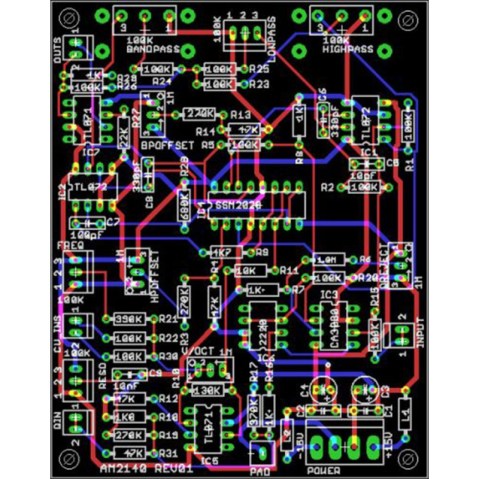
I had no plans to include triggers for the sounds on my rhythm machine so the sequencer was going to be the heart of the performance as it would be responsible for any and all triggering of sounds. Needing to control three sounds simultaneously without any stored memory was quite a tall order, but fortunately I found the perfect solution in the amazing Turing Machine modules. With its expansion board the Turing machine can put out four different patterns based on it’s main pattern creator which can create fully random patterns or patterns that mutate as they progress.
The Results
I spent a couple of weeks after getting all the pcb’s parts and hardware together, wiring and rewiring connections until I got comfortable with how all of these parts were interacting with each other. I was fortunate to happen upon a vintage White Instruments box, which formally housed an attenuation meter, that was perfect for my machine. After testing with cardboard I laid out my own faceplates, which and put everything in the box. As soon as I plugged it in and started playing, I knew I had succeeded.
Early test of RIDM before it went in the Box
I call it the RIDM Box (Rhythmically Intelligent Drum Machine Box). I’ve been playing it now for over two years, to the point where today I would say it is my primary instrument. Almost immediately afterward I built a companion piece called the Snare Bender which works both as a standalone and as a controller for the RIDM Box. That one I did from scratch hand wired with no layouts.
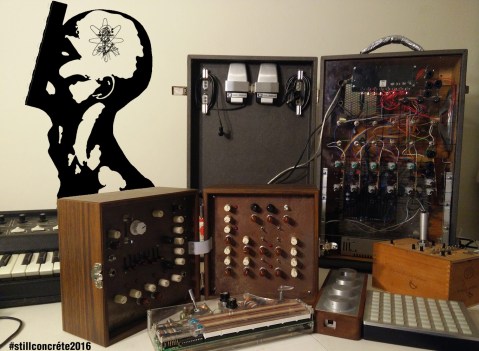
While this is by no means a standard approach to modern electronic instrument design (if a standard approach even exists), what I learned through the process is really the value of looking back. With so much of modern technology being future forward in its approach, the assumption is that we’re at better starting positions for innovation than our predecessors. While we have so many more resources at our disposal, I think the limitations of the past were often more conductive to truly innovative approaches. By exploring those limitations with modern eyes a doorway opened up for me, the result of which is an instrument like no other, past or present.
I will probably continue playing the two of these instruments together for a while, but ultimately I’m leaning toward a new original design which takes the learnings from these projects and fully flushes out the performing instrument aspect of analog design. In the meantime, my process would not be complete if I did not return to the original inspiration. So I’ll leave you with the RIDM Box version of “Me & My Rhythm Box”—available on my library sessions release for the instrument.
—
Primus Luta is a husband and father of three. He is a writer and an artist exploring the intersection of technology and art, and their philosophical implications.
—
REWIND!…If you liked this post, you may also dig:
Heads: Reblurring The Lines–Primus Luta
Into the Woods: A Brief History of Wood Paneling on Synthesizers*–Tara Rodgers
Afrofuturism, Public Enemy, and Fear of a Black Planet at 25—andré carrington
Share this:


Current Top Posts





April 2021

January 2020

November 2019

October 2019

August 2019

April 2014

November 2017

March 2015

December 2017

October 2015
 Sounding Out!
Recent Comments