
My Time in the Bush of Drones: or, 24 Hours at Basilica Hudson
Ed. Note: We wanted to run this piece in advance of the Basilica Hudson’s SoundScape event taking place this Friday, September 14 – Sunday, September 16, 2018. Our Amplifying Du Bois at 150 forum will return next week.
—
“But why?”
Three weeks into a new semester and I am packing for another weekend of irresponsible travel. Irresponsible financially (because air travel on a graduate stipend is a decadence rarely rewarded) and irresponsibly professionally (because missing an annual department event, grading in a car, and sleeping on the ground for two days is a string of realities that stand sternly opposed to anything like good sense). I am doing all this in order to attend Basilica Hudson’s Soundscape: a wide and ranging line up of musicians and artists whose aesthetic commitments fall, shall we say, considerably aslant from the pop-cultural median. I am doing all this because of something that happened last year at this place, something I am still trying to work out. And this means, amongst concerned colleagues and family and friends, I’m again hearing that familiar, stuttering articulation of disbelief. Phrased, with equal parts confusion and concern, they rejoin:
Why?
This question first started popping up late last March. It came repeatedly, unblinkingly, and, I should add, not-unreasonably. What’s more, this was, in a very real way, my fault. For I had failed to develop a pithy ready-to-hand account of precisely why I was to travel from Chicago to New York City and New York City to Hudson, only to sleep on a thin mat on the concrete floor of a converted foundry while listening to loud, sustained bursts of noise (with varying degrees of harmonic familiarity) for an unbroken period of 24 hours.
Instead, I had only an intuition that failed to pass even the slightest of critical muster: Basillica Hudson’s 24-HOUR DRONE festival seemed weird and extreme and like something might happen there. On this basis, it seemed like a good thing to do.
I can now state with some clarity (though still lacking anything like critical poise) that something did in fact happen there, and it was indeed a good thing to do. Though what that “something” was remains frustratingly elusive.

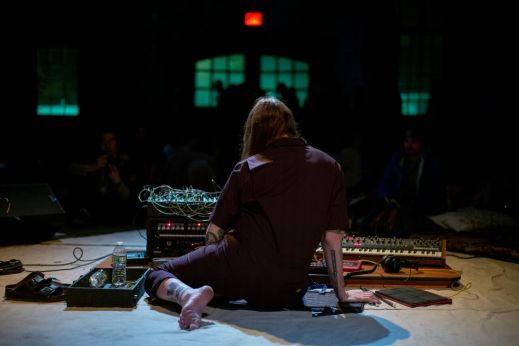
24-Hour Drone, Image by Alt
This piece thus began as a review, but ended necessarily quite differently. The conventions of a review call for evaluation and normative judgement; they require statements regarding the quality of an event or object. I can offer very little in this vein. I’m still trying to wrest from memory something stubbornly mute and fleeting — still trying to figure out what it was, precisely, that happened there.
The drive up remains clear enough in memory. The usual crackle of reunited conversation between dear friends long-separated by geography; a decision not to listen to the then-new Grouper album (we would have enough heart-dragging ambient texture in the coming hours, we concluded); the sounds of Brooklyn passing into that hushed early-Spring upstate on Route 84. We at one point, for reasons that need not become articulate, listened to the Gin Blossoms. But as we pulled into the graveled parking lot a sense of anticipation and confusion returned. What was this thing?
To begin, we might reasonably call it an event.
Basilica Hudson — an upstate New York-based non-profit for the arts that puts on the event annually — admirably describes it thus:
An immersive event and all-encompassing experience, 24-HOUR DRONE is a roving, international series presented by Basilica Hudson and Le Guess Who?, featuring musicians and sound artists experimenting within the spectrum of drone to create 24 hours of unbroken, uninterrupted sound.
Through this expanded programming, 24-HOUR DRONE strives to break down barriers across borders, offering an opportunity to connect diverse musical communities and traditions, offering a localized snapshot of DRONE within the larger context of an imagined universal sound.
The language here should scan as familiar to anyone accustomed to reading music and arts press. Roving, experimental, barrier-breaking, border-crossing: these terms all call up a restless energy, the excitement of the wholly new, the different, the thoroughly non-normative. As it turns out, all these attributes turn out to be more-or-less (if uninterestingly) true.
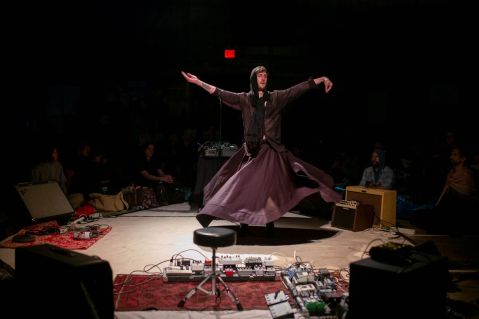
24-Hour Drone, Image by Alt
Over the course of the day and night, I heard the ethereal saxophone of PAUL, the whipping clangor of Pharmakon, and — I want to emphasize this — the absolutely breathless New Castrati, January Hunt’s exceptional and mournful work living up to her billing elsewhere as “synth, drones, and the annihilation of man.” A sentence above, though, still merits pause: “a localized snapshot of DRONE within the larger context of universal sound.” Roving energy and shattering experiment here take shape as a snapshot, the whirring and calamitous universal stalling for a moment in a discrete particular. 24-HOUR DRONE attempts to lends form to what was too diffuse to be seen.
So, modestly, in lieu of aesthetic judgement, a proposition: the value of Basilica Hudson’s 24-HOUR DRONE is to offer space to sound.
Indeed, for an event so centrally concerned with sound, 24-HOUR DRONE is as much about the Basilica — a converted nineteenth-century cathedral-esque foundry — as it is about sound. And for good reason: the Basilica has been beautifully repurposed — gutted of its original use and re-asserted as an malleable and improbably elegant arts space. Hundred-plus foot ceilings dwarf individual bodies, it’s begrimed upper windows modulate the midday sun into a speckled and hazy sepia, and the elaborate truss-work grids the scene in an industrial domework. The Basilica is a work of architecture meant to imagine and hold, however briefly, those fleeting shards and fragments of something yearning toward a “universal sound.”
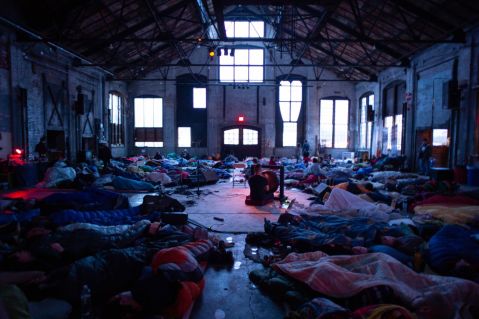
24-Hour Drone, Image by Alt
Though even as stunning a work of architecture as the Basilica can only ever confer a loose limit. These fragments are always clamoring for a more robust scene, always threatening to join the broader universal that awaits. Sound passes through walls, vibrates along concrete, penetrates skin and mingles among bodies. Spaces focalize sound’s capacities for the social and ethereal, by preserving and witnessing its constitutive ephemerality. Different spaces draw our attention to sound’s actually-existing materiality: a materiality that doesn’t quit, one that loosens our grip on our more ready-to-hand material worlds.
Grasping this materiality is not easy; it is maybe impossible. What possible cognitive torque will allows us to grasp at this overtopping universal? One option, it seems, is sheer brute force.
The term “endurance” rightly comes up repeatedly in press-documents and FAQs. For the event is knot of time and space (24 hours at the Basilica) which commands an attention to sound as a given, but sounding too as demanding an economy of attention wholly strange–a fidelity to sound that is without end. Limning out these ambitious parameters, to reign sound in, if for only a moment, requires something added.
Space, then.
Sonic spaces have a familiar, if knotty, history. Cathedrals invoke a beatific space, trussed by elaborate ornament and a spiritualized verticality. Music festivals inscribe traditions of sound and histories of capital — crowds and power, in Gina Arnold’s felicitous adaptation of Elias Canetti. Dwellings and offices, cafes and bars. Spaces arrange us in sound, and sound among us.
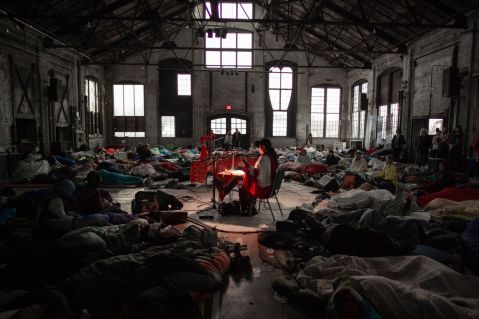
24-Hour Drone, Image by Alt
DRONE, then, is a provocation to think about sound — to think it over time, and to do so in a necessarily rarified space. This provocation worked; but I felt it only at an extreme limit.
At the twentieth hour (8 AM) I needed coffee. I had slept (kind of) through the night, rose to a bell ceremony, and walked immediately, groggily outside. As I passed through the door frame into the dewy and drizzly upstate morning, the sound — as if from a vacuum — muted and was voided of weight. I walked through the mostly empty streets.
These empty streets were, as it turned out, raucously loud. Distant cars motoring across country byways, the buzzing of a streetlight long past its prime; my tinnitus — a steadily pitched pulse acquired in those irresponsible salad days standing too-close to a crash cymbal — reminding me of all I may one day not hear. These sounds were, quite suddenly, clamoring for my attention, demanding my thought, straining for distinction. The espresso machine, the door hinges, the bathroom sink. Floorboards and rain and leaves and the Hudson and, and, and.
I walked back, not a little unsettled.
I had breakfast outside the venue among gravel-scraping shoes and overheard conversation.
Finally, I went back inside for what turned out to be the final act: Dronechoir Syllaba. The scene remains hauntingly clear.
A grouping of women entered, dressed entirely in white, each with one earbud in-ear, the other hanging loose. Some, if not all, had a length of yarn tied around their waist and dragging along the ground behind them a screw, nail, metal implement, which, as they walked produced a fragile, slender tone. They congregated in the center of the room and produced a careful and lush chord, its density piling up toward the far reaches of the ceiling. Slowly, the chord broke apart.
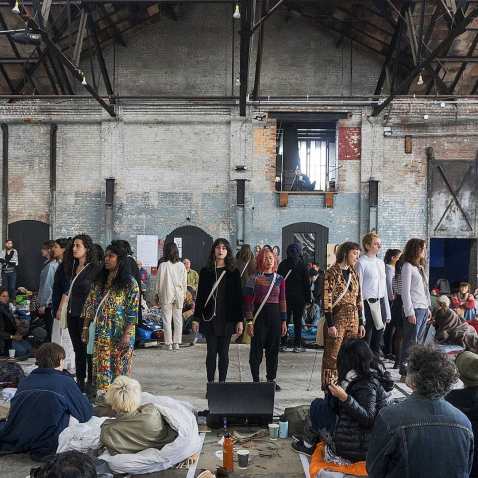
Dronechoir Syllaba, Basilica Hudson, 2018, Image by #noamplification
But, then, that’s not true.
I should say: slowly, the women moved apart, the chord remained, stretched and pitched against new and different coordinates, inhabiting the Basilica’s elastic space in a new configuration. Notes moved, their bearers slowly pacing around the exhausted and supine bodies of Droners along the floor.
A choir member approached me, holding out her free earbud. I shook my head, wearing a nervous grin. She insisted; I put it in. Playing quietly in that tinny bud was a reference tone for me to share. I looked at her as though I didn’t understand, and she smiled as if she did. Insisting. I managed a small hum, off-kilter and out of tune, before handing it back to her. Looking around, I saw the relationship I had repeated among others across the room. The chord kept mutating — dilating and contracting, swelling and receding, different tones calibrated along moving spatial coordinates. The choir returned to formation in center.
At noon, silence.
Everyone was smiling, dazed, like milkdrunk babies or punchdrunk lovers. We had slept amongst each other, passing a night in a shared space, while sound had enwrapped and enraptured us. We had borne witness to valences of sound hitherto under-noticed. We had joined a choir, if only for an offkilter moment in a space out-of-joint.
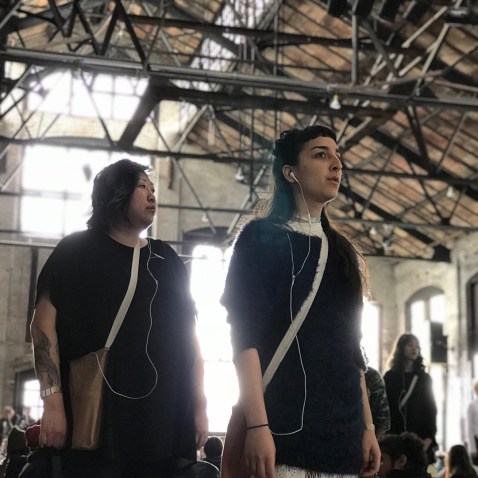
Dronechoir Syllaba, 24-Hour DRONE, Image by Andrew LaVallee via Instagram
***
We thought, my traveling companion and I, we thought the car ride back to the city would be for silence. For what else could you thirst after 24 such hours in the heart of sound? But this turned out to be deafening uncomfortable, weird. We were, in our own private ways, estranged from sound. Which is really another way of saying we were in different relation to sound and to the spaces it fills. There, a foundry. Here, a car. We put on, in lieu of silence, a little slice of magic, the condensation of all groove and beat, the most organized flash of pop brilliance this side of 1980. We of course put on Thriller.
As we roiled down the road to this joyous whispered desire — wanna be startin’ somethin’, got to be startin’ somethin’ — in a vehicle not made for dancing, the force of the Drone event began to take shape.
So, again: why?
To give attention to what we all already share — space and sound, history and music. To be adrift but not asleep in it all.
As for what happened?
I’ll try to grasp that next year.
—
Featured Image by Alt
—
Robert Cashin Ryan is a PhD candidate in the department of English at the University of Illinois-Chicago. He has written in various places about literary form and formalism, the relationship between Herman Melville and Charles Dickens, and Christmas as an intellectual problem. He curated and introduced a gathering of essays on music, sound, and noise for Post-digital forthcoming from Bloomsbury 2019.
—
REWIND!…If you liked this post, you may also dig:
This is Your Body on the Velvet Underground–Jacob Smith
Live Through This: Sonic Affect, Queerness, and the Trembling Body–Airek Beauchamp
Share this:

Sounds of Life: Fetal Heartbeat Bills and the Politics of Animacy

June 2018 was marked by the amplification of distant warning sounds regarding the fate of abortion rights in the United States. Although within recent months there have been positive steps forward, such as in Ireland and Argentina, within a broader politics of abortion, the medical procedure remains illegal and inaccessible across large swaths of the globe. Since abortion was legalized in the U.S. in 1973, anti-abortion advocates have chipped away at the constitutional “right” such that its current status is more of a “privilege.” After a recent victory for “crisis pregnancy centers” (fake clinics), in combination with the resignation of Justice Anthony Kennedy from the Supreme Court, the past few weeks have sounded further alarms within the decades-long “abortion wars.” These wars have included not only devastating anti-abortion legislation such as the Hyde amendment, but violence against abortion clinics (including 11 murders and 26 attempted murders) and the quieter yet just as nefarious technologization and romanticization of the fetal heartbeat.
***
The “Heartbeat Protection Act” of 2017 (H.R. 490) would make it illegal for physicians to “knowingly perform an abortion: (1) without determining whether the fetus has a detectable heartbeat, (2) without informing the mother of the results, or (3) after determining that a fetus has a detectable heartbeat.” Introduced by the 115th United States Congress, the bill is a nation-wide version of existing, state-level “heartbeat bills” promising to “protect every child whose heartbeat can be heard.” The “Heartbeat Protection Act” would effectively make it illegal for doctors to terminate pregnancies after six or seven weeks’ gestation, at which time a heartbeat typically can be detected. The bill makes it clear that the abortionist, and not the pregnant person, is the moral agent within the context of pregnancy termination: “A physician who performs a prohibited abortion is subject to criminal penalties—a fine, up to five years in prison, or both,” while “A woman [sic] who undergoes a prohibited abortion may not be prosecuted for violating or conspiring to violate the provisions of this bill.” As of May 2018, a total of 59 heartbeat bans have been proposed over the past seven years.
“Heartbeat” bills not only articulate the subjecthood of physicians and the objecthood of pregnant bodies; they also rely on the animating capacity of sound in their efforts to enliven embryos and fetuses. In Animacies: Biopolitics, Racial Mattering, and Queer Affect, Mel Chen describes “animacy” as a “slippery” value problematizing the contemporary biopolitical boundaries between ontological categories dividing “the living” from “the dead” (9). Hierarchies of animacy indicate the ways in which entities perceived to be nonhuman or nonliving, such as monkeys, lead, and toxins, are endowed with racialized and/or gendered “human” qualities through the politicization of language and figuration (The 2007 “lead panic” in the U.S., in which Chinese-manufactured toys were viewed as unidirectional transmitters of racialized toxicity, is an example). The sounds of fetal heartbeats are implicated in the construction of a hierarchy of animacy as they render pregnant bodies less animate. Drawing from Chen in exploring a politics of animacy can help us understand the animating and silencing capacities of reproductive healthcare legislation and restrictions. Within this politics, the fetal heartbeat becomes so loud that it silences the pregnant person.
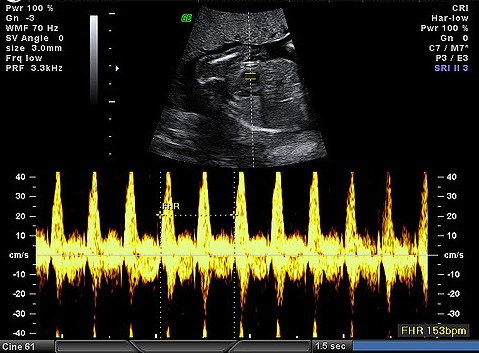
A sonogram and Doppler visualization, Image by Flickr User DYT, (CC BY-NC-ND 2.0)
This silencing and objectification of pregnant bodies occurs not only through anti-abortion legislation but in the sphere of the everyday. The pregnant body becomes animated with the capacity (and expectation) for nurturing and selflessness, while its contents are animated with qualities of potentiality and personhood. As feminist phenomenologist Iris Marion Young points out in an essay on pregnant embodiment (which can be found in her collection On Female Body Experience), the pregnant body not only becomes a synecdochal figuration for heteropatriarchal structures and narratives, but is experienced as “Other” even from a first-person perspective: “in pregnancy I literally do not have a firm sense of where my body ends and the world begins” (50). Pregnant people can expect to be stared at, to get asked personal or even inappropriate questions, and to have their bodies touched without consent as they move through public space. The presumed ownership over female-presenting bodies is magnified when these bodies are perceived as housing another living being presumed to be the progeny and property of a male “father figure.” The blurred line between internality and externality allows for a further window through which the surveillant male gaze can stare, and through which the sounds of sonic patriarchy can be broadcast.

Image by Flickr User jennykarinaflores, (CC BY 2.0)
The concept of the “male gaze” is at this point well recognized; “sonic patriarchy” can be heard to be its aural counterpart. Sonic patriarchy is a concept I have theorized in order to give name to the domination of a sound world in gendered ways, as well as to the control of gendered bodies via sound. In public space, sonic patriarchy can be heard in the catcalls and whistles and mansplaining that grope their way into the aural space of female and feminine bodies. And, as Christine Ehrick points out, masculine voices can be heard as a signifier of power within a “gendered soundscape.” Sonic patriarchy can be heard within private space, too; recently, a friend texted me about a roommate’s boyfriend who never bothers to use headphones when listening to music in the living room “even though he doesn’t even live here!” Both the male gaze and sonic patriarchy are misogynist and objectifying forces that shape and control space, demarcating boundaries of safety, mobility, and accessibility for many female and gender-nonconforming bodies. However, these modes of surveillance and control have been discussed primarily through a visual lens within the realm of feminist and queer theory.
The sonification of the male gaze manifests in mundanities, such as the daily catcalls women are subjected to in literally every corner of the world, and in more disturbing contexts such as anti-abortion rhetoric, which I’ve observed through my ethnographic work at abortion clinics throughout the United States. At these demonstrations, the bodies of clinic patients are invaded both literally, with the shouting of the protesters, and figuratively, in the making-public of the figure of the fetus with four-foot-tall posters depicting mangled fetal body parts. Ironically, these inanimate posters animate the figure of the fetus as they lend more humanity and visibility to the imagined contents of a pregnant body; meanwhile the pregnant person fades into a mere backdrop for this spectacle. This voyeurism also occurs sonically, as the protesters ‘give voice to’ imaginary fetuses by yelling “Mommy, mommy don’t kill me!” In the space of the clinic protest, feminized ears exist as gendered and sexualized organs in which masculine vocalizations can penetrate and reverberate. Just as misogynist conceptions of female sexual receptivity frequently ignore the word “no” and the concept of consent itself, these vocalizations ignore the active non-consent of the patients as they persistently rupture their aural space.
The patriarchal control of the sound world, whether on the sidewalk outside an abortion clinic or in a doctor’s office, is a reminder of broader schemes of biopolitical control that have been at play in the U.S. since the late 1970s, when previously apolitical evangelical Christians were drawn into political conversations through the transformation of abortion access into a “moral issue.” Within this discourse, the politicized female body is assumed to be perpetually pre-pregnant, a muted object housing a potential subject. At abortion clinic protests, the seemingly mundane act of “exercising free speech” vocalizes not only an opposition to abortion as a medical procedure, but also an assertion of the four decades of “moral authority” that have limited access to and availability of this medical procedure through a sustained regulation of the bodily autonomy of female citizens. The fetus is animated in service of this authority through tactics that range from fetal heartbeat bans to the amplification of an “acousmatic fetus” at a North Carolina abortion clinic protest:
https://twitter.com/heyitscalla/status/991719274178863104
When it comes to anti-abortion politics, the rhetoric hinges on the making public of the internal space of the womb in order to more effectively level the male gaze (and its listening ear) at the figure of the fetus. Anti-abortion rhetoric relies on the dissolution of boundaries between the public and the private; remember that the right to an abortion was eventually won in 1973 not on the grounds of bodily autonomy but on the constitutional “right to privacy.” These boundaries perpetuate gendered divisions of space that deem public space the space of men, while relegating women to the “private space” of the home. Female-presenting bodies are therefore seen (and heard) to be out of place in public space, even when the contents of their bodies are not. And when the focus always lies on these possible contents, female-presenting bodies are always assumed to be pregnant. Their bodies come to represent what Lauren Berlant, in her 1994 essay titled “America, ‘Fat,’ the Fetus,” describes as “fetal motherhood” (147). Within this representation, the female body possesses value only through the promise of its eventual maternal status. Within a patriarchal economy of reproduction and citizenship, the female body accrues value through its capacity to sustain and revitalize “the nation”; Berlant points out that pro-life rhetoric has in its turn revitalized the female body as a symbol of nation-formation.
Berlant argues that political and cultural rhetoric in the U.S. transforms pregnant people into babies and unborn babies into full-on “persons” through this process of “fetal motherhood.” She details this process and its implications within a broader sociopolitical discourse that hinges not only on dehumanizing tactics that reduce women to objects, but on the expectation and exploitation of the all-too-human capacity for nurturing and motherhood that society demands from women. This rhetoric is meant to mobilize the figure of the fetus in what Berlant refers to as “the nationwide competition between the mother and the fetus that the fetus, framed as a helpless, choiceless victim, will always lose” since “the fetus has no voice” (150-151). Providing a voice for the fetus has been a primary tactic in anti-abortion strategies within this “competition.” Animating the fetus’s body and voice therefore always involves the erasure and silencing of the pregnant person, who, in the state of “fetal motherhood,” is flattened into an entity as two-dimensional as an anti-abortion protester’s photoshopped poster. And just as dominant narratives and vocabularies for sonic reproduction frequently neglect the gendered implications of the term, broader political concepts of “reproduction” listen more closely to the product of motherhood than to mothers themselves.

Image by Flickr user TR Haun, (CC BY-ND 2.0)
The heartbeat bans are only one component of the anti-abortion trend in the U.S., where 288 abortion restrictions have been enacted since 2010. These bills typically deny the agency of pregnant people, while affirming the moral agency of doctors and the “personhood” of embryos and fetuses. Yet that has not stopped pregnant people, and particularly pregnant people of color, from enduring punishment. The most well-known case is probably that of Purvi Patel, an Indian American woman who self-aborted in 2015 and was subsequently sentenced to 20 years in prison after an Indiana jury found her guilty of feticide (She served about a year and a half before a judge reduced her sentence to eighteen months, resulting in her release). Within the dominant hierarchy of animacy in contemporary reproductive rights, the agency of potential persons is amplified so loudly that it drowns out the agency of actual people existing in the world. Control of the sound world doesn’t just mirror visual control over bodies and the worlds they move through, it enacts new and arguably more invasive limits on these bodies. Whether clamoring for an audience on the sidewalks of public space, or quietly sonifying potential life via Doppler technology, the sounds of sonic patriarchy continue to interrupt feminist endeavors for autonomy and agency.
—
Featured Image: March for Life, Washington DC 2015 by Flickr User American Life League, (CC BY-NC 2.0)
—
Rebecca Lentjes is an NYC-based writer and gender equality activist. Her work has appeared in VAN Magazine, Music & Literature, TEMPO Quarterly Review of New Music, Bachtrack, and I Care If You Listen. By day she researches anti-abortion protests as an ethnomusicology PhD student at Stony Brook University and works as an editor and translator at RILM Abstracts of Music Literature; by night she hatches schemes to dismantle the patriarchy.
—
REWIND!…If you liked this post, check out:
A Tradition of Free and Odious Utterance: Free Speech & Sacred Noise in Steve Waters’s Temple–
Gabriel Salomon Mindel and Alexander J. Ullman
Gendered Sonic Violence, from the Waiting Room to the Locker Room–Rebecca Lentjes
Sounding Out! Podcast #63: The Sonic Landscapes of Unwelcome: Women of Color, Sonic Harassment, and Public Space–Locatora Radio
Share this:


Current Top Posts





April 2021

January 2020

November 2019

October 2019

August 2019

April 2014

November 2017

March 2015

December 2017

October 2015
 Sounding Out!
Recent Comments