
(Dis)orienting the Bell: Aural Assault from A Game of Thrones to Richard Coer de Lyon


series co-editors Dorothy Kim and Christopher Roman
Hear YE! Below is the introduction to the latest installment of Medieval Sound, Aural Ecology, by series co-editors Dorothy Kim and Christopher Roman. To read their previous introduction, click here. To read the first run of the series in 2016, click here.
Aural Ecology
What is considered music, noise, or harmony is historically and culturally contingent. For example, some medieval musical theory, or musica speculative, such as Jan Herlinger’s “Music Theory of the Fourteenth and Early Fifteenth Centuries” in Music as Concept and Practice in the Late Middle Ages, defined music as “contemplation that serves the moral edification of the mind” (293). Influenced by the work of Boethius’s De Musica, music is not just everyday music but “connotes harmony conceived broadly enough to encompass the relationships obtaining in the human body and psyche and governing the motions of planets” (293). This kind of ecological harmony is explored in the work of Boethius, especially in his discussion of abstract qualities in the prelude to the De Musica, The Book of Arithmetic (as translated by Calvin Martin Bower) “Indeed these things themselves are incorporeal in nature and thrive by reason of their immutable substance, but they suffer radical change through participation in the corporeal, and through contact with variable things they change in veritable consistency” (24). For Boethius these “essences” are concordant with mathematical properties expressed in music. Thus, music was both speculative and moral, and these intertwining purposes derived from music’s phenomenological pleasures derived in the environment, “for nothing is more consistent with human nature than to be soothed by sweet modes and disturbed by their opposites” (Bower 32).
Boethius also comments on the psychological effects experienced in hearing music as they “affect and remold the mind into their own character” (Bower 34). Boethius gives examples of how certain groups of peoples, such as the Thracians or Lacedaemonians, delight in different kinds of music that harmonizes with their natures. For Boethius, music is transcendent in that it exists as a kind of eternal sound, but also an immanent sound, in that it appeals to various peoples depending on their nature and environment. Boethius’ speculations lead him to think about harmony and sound as available to reason and sensory perception. Thus the notion of harmony itself is “the faculty of considering the difference between high and low sounds using the reason and senses. For the senses and reasons are considered instruments of this faculty of harmony” (Bower 295). Harmony (and disharmony in the form of noise) became a marker of the aural ecology for an individual or group.
The essays in “Aural Ecologies” also address the issue of unharmonious sounds, sounds that often mark dissonant critical identities—related to race, religion, material—that reverberate across different soundscapes/landscapes. In this way, this group of essays begins to open up the stakes of Medieval Sound in relation to what contemporary sound studies has begun to address in relation to cultural studies, architectural and environmental soundscapes, and the marking of race through the vibrations of the body. —Dorothy Kim and Christopher Roman
In the neo-medieval A Game of Thrones (2011), the medieval Saracen-inspired and violent Dothraki utilize bells as a symbol of victories in battle. Each time a leader or khal defeats a foe, he incorporates the bells from his foe’s shorn black braid into his own braid. Khal Drogo, khal of the most powerful khalasar in Essos, sports an uncut braid sensuously described by George R. R. Martin as “black as midnight . . . hung with tiny bells that rang softly as he moved. It swung well past his belt, below even his buttocks” (37).
Dothraki bells serve both a hypermasculine and deterritorializing function: esteem and prowess for Eastern men comes from the symbolic castration of their enemies and the eradication of civilizations. For the Dothraki, sexualized and territorial conquest is centralized around amplitude of noise made by an aggregate of bells adorning a phallic braid. Drogo is frightening because of his noise: he wears “[b]ells so his enemies w[ill] hear him coming and grow weak with fear” (802). In the pilot episode of Season 1 of HBO’s Game of Thrones, writers David Benioff and D. B. Weiss and director Tim Van Patten emphasized the contrast in noise between the copper-skinned Dothraki and the white Valyrians of the Free Cities:
East disrupts West in this scene through a racialized auditory disruption of white silence.
The association of the Middle East with noise pervades Western culture. One need only recall juxtapositions of quietly carefully groomed news anchors in sterile American news sets conversing with correspondents struggling to be heard in earsplitting raucous streets embroiled in Middle Eastern crises in countries like Iraq and Syria. See Aron Brown of CNN announcing the U.S. War on Iraq in 2003, for example:
However, this association of the Arab world with noise is not a new one. In medieval literature, noise played a crucial role in distinguishing Saracen East from Christian West. Bells and particularly the cacophonous noise they cumulatively make came to be associated with a violent imagining of the East in literature of the medieval period. The late medieval crusading romance Richard Coer de Lyon, centered on the exploits of the twelfth-century crusading king, Richard the Lionheart, situates the pealing bell as its central object. [Note: Richard Coer de Lyon is cited by line number. All quotations come from the widely-used complete modern version, Richard Löwenherz, ed. Karl Brunner, Wiener Beiträge zur Englischen Philologie (Vienna and Leipzig, 1913)].
As in Dothraki warrior culture in A Game of Thrones, bells gain symbolic power in the romance through replication and accumulation. Richard Coer de Lyon features pealing bells in two crucial episodes concerned with the East and a maternal rather than phallic male body: 1) the exorcism of Richard’s demonic Eastern mother at Mass with a sacring bell (l.221-34); and 2) the appearance of Saladin’s demonic mare arrayed in clamorous bells attached to her crupper at the climactic battle of Acre (l.5532-49, 5753-8). Drawing on both medieval treatises on the function of bells and Gilles Deleuze and Felix Guattari’s theory of the refrain, I argue that the bell—initially a symbol of Christian order, the West, and patriarchy—becomes a disorienting aural force associated with chaos, the East, and maternity.
Early on in the romance, the king’s men try the piety of Richard’s mother, Cassodorien of Antioch, a bewitching foreigner whose only apparent fault is that she cannot remain in church to hear Mass, by physically restraining her during a service. To the shock of the English parishioners, at the ringing of the sacring bell, Cassodorien breaks free of her male captors, seizes two of her children, and flies through the church roof never to be seen again:
And whene þe belle began to ryng,
And when the bell began to ring,
The preest scholde make þe sakeryng,
And the priest was about to do the sacring,
Out off þe kyrke sche wolde away…
Out of the church she tried to go away…
Out of the rofe she gan her dyght,
Out of the roof she began to make her way/transform,
Openly before all theyr syght…
Openly before all of their sight…
— Richard Coer de Lyon, 221-5.
At this striking moment of contact between queen and masculine material object, the bell is forever altered, (re)oriented on a trajectory that transmogrifies it from a symbol of priestly power to a chaotic symbol of maternity and the East.

Sacring Bells in Aberdeen, Scotland. Image by Flickr User rethought (CC BY-NC 2.0)
Medieval thinkers conceptualized the church bell as an agent for revealing both foreign and demonic threats from within the community. In The Rationale Divinorum Officiarum of William Durand of Mende thirteenth-century French liturgical writer and bishop, William Durand,xplains the significance of the pealing of bells– “when the bell rings . . . the people are unified with the unity of faith and charity” (51) –but also expounds on this exorcising function of the church bell:
[T]he bells are rung in processions so that the demons who fear them will flee . . . They are so fearful when they hear the trumpets of the Church militant, that is the bells, that they are like some tyrant who is fearful when he hears in his own country the trumpets of some powerful king who is his enemy (51).
Durand conflates the demonic with the East, both qualities embodied by Cassodorien who hails from Antioch (near the border of Syria and Turkey). He also imbues the bell with an emasculating quality; it renders even a tyrant fearful. The measured sounding of the church bells forms a tonal refrain, an aural sequence to familiarize Christian space.
The purpose of the aural refrain, for Gilles Deleuze and Felix Guattari, is to deterritorialize and then reterritorialize unfamiliar space. In A Thousand Plateaus, they explain the refrain/‘ritournelle’ as a threefold place of disorientation, the familiar, and escape:
They are three aspects of a single thing, the Refrain (ritournelle)…. Sometimes chaos is an immense black hole in which one endeavors to fix a fragile point as a center. Sometimes one organizes around that point a calm and stable “pace” (rather than a form): the black hole has become a home. Sometimes one grafts onto that pace a breakaway from the black hole (312).
The bell was arguably the most important and pervasive aural symbol in medieval Europe, one whose refrain regularly demarcated Christian spaces in times of chaos. Sound theorist R. Murray Schafer has called the medieval church bell “the most salient sound signal in the Christian community” in The Tuning of the World (53), and a unifying force “acoustically demarking the civilization of the parish from the wilderness beyond its earshot” (55). Yet, as the bell multiplies through contact with Cassodorien and Richard wanders into the wilderness or black hole of the East, its sound is layered and its signification coopted by the East and transformed into a disorienting force that decenters Saladin’s enemies.

Richard battles Saladin, Luttrell Psalter, BL42130, 4v
The bell resurfaces once more as Richard prepares for his epic battle against Saladin at the gates of Babylon. In this climactic battle with a second pairing of mother and son, reimagined in the form of a demonic belled “mere” and her “colt” summoned by Saladin’s necromancer, bells occupy a central place of prominence on the mare’s accoutrements. In 1192, Saladin reportedly sent two new horses to Richard after his horse was slain in battle (For an overview of this event, see page 73 of Sir Steven Runciman’s A History of the Crusades, Vol.3: The Kingdom of Acre and the Later Crusades). The mare, as one of only two mothers in the romance, uses the same aural symbol to assault the English Christians that they had used to exorcise Cassodorien. As Saladin’s mare proudly strides onto the battlefield, the poet emphasizes the deterritorializing effect of her cacophonous bells:
þerffore, as þe book vs telles,
Therefore, as the book tells,
Hys crouper heeng al ful off belles,
The mare’s crupper hung all full of bells;
And hys peytrel, and his arsoun.
From the armor, too, and the saddlebow,
þree myle men my3ten here þe soun.
For three miles men could hear the sound.
Þe mere gan ny3e, here belles to ryng,
His mare began to neigh, her bells she rang
Ffor gret pryde, wiþouten lesyng.
With great pride, it is no lie.
–Richard Coer de Lyon, 5753-8.
Fascinatingly, Brunner again diverges in this passage from Caius 175, and changes “þe mere” to “his mere,” further stripping the demonic mare of her agency.
Whereas the church bell is a singular symbol of order, symmetrical and “acoustically demarking” space with its meted refrain, the bells of the mare are multiple, discordant, chaotic, and cacophonous, designed to disorient rather than to unify (see Schafer 55). The medieval illuminator of the Luttrell Psalter (c.1325-1335) similarly emphasizes the clamorous quality of the belled mare, and distinguishes Saladin’s mount from Richard’s by the vast array of bells attached to its crupper and the noise these bells suggest.
The noise, suggested in the Luttrell Psalter by the movement and detail given to the crupper bells, can be heard on a smaller scale in the following video clip of a horse merely walking noisily with a smaller bell-laden crupper:
One can easily infer the discordant sound a running mare might make with a crupper “hung all full of bells.” The poet suggests that the noise encompassed an aural disturbance of three-miles and disrupted the Christian crusaders. The bells also serve an insidious maternal purpose: they serve as a trap to lure her colt to abandon Richard and “knele adoun, and souke hys dame” (kneel down and suck his dame)” (Richard Coer de Lyon, 5547). In A Thousand Plateaus, Deleuze and Guattari suggest the layering of sounds, particularly maternal sounds, can disrupt and deterritorialize space. In their discussion of the reterritorializing effects of layered song, Deleuze and Guattari provide the strikingly maternal example of Debussy’s Sirens, which, they posit, integrates voice with orchestra to make the voices of child and woman inextricable from “the sea and the water molecule” (340). In much the same way in Richard Coer de Lyon, the mare’s imbrication of voice over bells seeks to make the dichotomies of the romance—mother and son, east and west, chaos and order, demonic and angelic—implode as the demarcated boundaries between them are dissolved in her cacophonous demonic lullaby.

Daenerys, Created in ArtRage Studio by Flickr User Happy Snapper 80 (CC BY-NC 2.0)
While A Game of Thrones and its HBO counterpart pick up on the resonances of medieval noise to differentiate between East and West, noise is gendered differently. In RCL the threat signaled by the sound of bells is that Richard will be emasculated by his inability to cut ties with the specter of his mother’s influence and disambiguate himself from the Eastern Saracens she represents. However, in Martin’s series, the Dothraki bells, like much of Dothraki culture, exist only to be subsumed under Daenerys’ imperial ambitions for an Iron Throne the Dothraki neither care about nor want. Daenerys’ bell, affixed to her hair after the death of Drogo and the dissolution of his khalasar, becomes a symbol of cultural and racial appropriation Martin stages under the guise of (white) feminism. That is, the issues noise signals have changed from the challenge of excising Christian West from Islamic East (a fear literalized in Richard’s cannibalistic consumption of Saracen flesh) to cultural appropriation (the devouring of Dothraki culture for the benefit of white colonialism).
—
Featured Image: Proceso Khal Drogo by Flickr User Orgita Sucubita, (CC BY-NC-ND 2.0)
—
Thomas Blake is Assistant Professor of English at Austin College.
—
REWIND!…If you liked this post, you may also dig:
Sounding Out! Podcast #54: The Sound of Magic-K.A. Laity
Mouthing the Passion: Richard Rolle’s Soundscapes–Christopher Roman
Playing with the Past in the Imagined Middle Ages: Music and Soundscape in Video Game–James Cook
Share this:

Spaces of Sounds: The Peoples of the African Diaspora and Protest in the United States

The slaves who were ourselves had known terror intimately, confused sunrise with pain, & accepted indifference as kindness. – Ntozake Shange, Sassafrass, Cypress & Indigo
Sanford. Baltimore. Chicago. Staten Island. Charlotte. Cleveland. Oakland. Austin. Los Angeles. The Bronx.
Despair in the United States is nothing new. It is neither an emotion confined to the neatly-drawn borders of this land nor is it experienced more acutely by any one group of people. The vast discrepancy between the results of the popular vote and the electoral college’s selection of Donald Trump as forty-fifth president of the United States amply reveals despair to be an sentiment viscerally experienced by a wide swath of people in this country, irrespective of race, ethnicity, gender, class, or sexuality.
Such despair has been ignored, however, by those who have caused and who continue causing the suffering of peoples of both indigenous and, later, African descent. We are taught that men from what we now recognize as Europe arrived in this hemisphere in the late fifteenth century, settling initially on a strip of earth in the Caribbean Sea that would become the first site of massacre and genocide, acts which unleashed, if one lends credence to the narrator of Junot Díaz’s The Brief Wondrous Life of Oscar Wao, the fukú, the “Curse and the Doom of the New World.” The narrating voice himself characterizes the curse not in the actions of death, but in the “screams of the enslaved, [..] the death bane of the Tainos, uttered just as one world perished and another began […]” (1). The fukú resonated through the sounds that these human beings made.

Image of the People’s History of Telegraph Avenue mural, designed by Osha Neumann, painted in 1976, restored and enlarged in 1999, at the corner of Haste and Telegraph in Berkeley. Image by Flickr user nursenicole329 (CC BY-NC-ND 2.0).
.
Not a house in the country ain’t packed to its rafters with some dead Negro’s grief. – Toni Morrison, Beloved
The State’s unwillingness to hold George Zimmerman responsible for the murder of Trayvon Martin–and its subsequent refusal to hold any police officer accountable for the hundreds of deaths they have caused–has galvanized the United States in the last four years. Hundreds of thousands of men, women, and children alike have taken to the streets, as #BlackLivesMatter, a true and succinct sentence, has roused ghosts of the past who have never left us, who have always been present, accompanying us on this journey.
This post is not a reflection of the music that has served as a soundtrack to these protests, though there are articles that have done so, such as this one, this one, and this one. These pieces do not include the extensive list of articles that address perhaps the most widely-viewed piece of protest music thus far, Beyoncé’s “Formation” video, a scarce offering of which can be found here, here, and here. Instead, it is an essay inspired by the sounds of the protesters themselves, the noises made by the minds, bodies, and spirits of the men, women and children who have taken to public spaces and sometimes commercial zones in order to confront and object to the protections applied to those who kill men, women, and children, often of African descent.
Listen to Los Angeles in 2013. . .
. . .to Houston in 2014. . .
. . .to New York City in 2014. . .
. . .and to Charleston in 2015. . .
. . .
 In his pivotal Cities of the Dead: Circum-Atlantic Performance (1996), Joseph Roach characterized New Orleans and London as urban centers marked by two simultaneous, consistent acts: appropriation by white people and white power structures of the cultures of the peoples they have violently marginalized, and then, at the same time, a clear distancing from those very cultures and peoples. Although now in its twentieth year of publication, Roach’s theorization of the circum-Atlantic world remains vastly underutilized in scholarly circles—particularly in sound studies, where it should have special resonance– and has become increasingly critical to our understanding of this historical moment, as it “insists on the centrality of the diasporic and genocidal histories of Africa and the Americas, North and South, in the creation of the culture of modernity” (4). With this configuration, Roach accomplishes two feats simultaneously: first, he decentralizes the United States as the focal point of studies about the so-called New World, instead, placing on equal footing all of the histories and cultures of the Americas. For this scholar of the literatures of the Americas, particularly those written by men and women of African descent, Roach’s is a critical gesture that facilitates comparative work across national boundaries.
Second, and most importantly, Roach emphasizes the role of murder, rape and the destruction of whole cultures indigenous to the American and African continents in the foundation of the nations of this hemisphere. Ta-Nehisi Coates is perhaps the most recent writer to remind us that the most potent legacy of such modernity, racism, “is a visceral experience, that is dislodges brains, blocks airways, rips muscle, extracts organs, cracks bones, breaks teeth” (Between the World and Me, 10). That which we know as “modernity,” itself a deeply flawed construct that remains in need of serious revision, was born of broken backs, mutilated limbs, hushed middle-of-the-night tears of indigenous and African peoples. Moans and sighs, whispers and wails, cries and screams, they are the musical score of this hemisphere’s American experiment.
The slaves who were ourselves aided Indigo’s mission, connecting soul & song, experience & unremembered rhythms –Ntozake Shange

Harriet Tubman Memorial Monument, Harlem, Image by Flickr User John Mannion (CC BY-NC-ND 2.0).
In the face of a populace accustomed to ignoring the wailing of mothers who have buried their children, who have disregarded their dignity and the weight and shape and taste of their loss, men, women, and children have mobilized. They have made manifest that which communities of peoples of African descent have spoken of and have documented since the founding of this nation. As Roach has utilized the term performance, the literal rituals of mourning by communities of African heritage not only commemorate those who have recently passed but they also invoke the spirits of those who have long borne witness to such violence. Throughout his study, Roach distinguishes between a European heritage that begins to segregate the living from the dead during the Enlightenment (50), and more traditional cultures, particularly African ones, where spirits mingle with their human counterparts. While written texts may not, and often do not, adequately commemorate the loss of lives deemed marginal to the larger society, performance itself – chants, wails, songs – serve not only to memorialize but also as gestures of restoration.
Protesters and activists are no longer satisfied with the well-established decree that we should wait for a distant moment for a more perfect realization of the United States’s many promises. No, instead, they have identified this as the historical moment in which those oaths are to be fulfilled. They have walked, marched, and stomped through streets, on sidewalks, parks, churches, filling malls and transportation hubs with their bodies as testimony. They have repossessed and redefined spaces once thought of as simply neutral, transparent space as Katherine McKittrick refers to it in Demonic Grounds, revealing the fault-lines of difference based on class, race, gender, and sexuality in this society (xv). They have done so manipulating sound, both recycling chants used through the decades to protest injustice and, at times, simply occupying space, without a word uttered.
The silence waged in the 2014 protest in Grand Central Terminal after the non-indictment of Daniel Pantaleo in the murder of Eric Garner does not represent erasure, but rather a purposeful demonstration of the willful humanity of those unwilling to forget.
They quiet themselves. They replace the sounds of unfettered pain and grief with its absence, until all that you hear is the mechanized announcement of train schedules. The contrast is stark: the moment highlights what Claudia Rankine has identified as the condition of black life in Citizen, that of mourning (145), against a backdrop of technological advancement, that which has been built on the backs of and through the physical, emotional, and intellectual labor of black life. Here, the members of this community enact what has been called a “die-in”: simulating the physical positioning of bodies in caskets, they force onlookers to confront an uncomfortable truth about the history of this country and of the nations of this hemisphere.
All of us walk on land soaked in the blood of those who have made our lives easier and more convenient. The men and women at Grand Central make manifest what Roach terms surrogation: in the chasm left by death, they offer a replacement, one that both evokes those who have died and disturbs the complacency of survivors themselves (2). The performance serves to confront those who dare say that the violence of genocide and enslavement of past generations should remain in the past; no, these men and women and the spirits they invoke respond. Time is not linear, as we have been taught. For past, present, and future are temporal constructs used to service oppression and domination; this will no longer do.

From Kara Walker’s 2014 exhibit, “A Subtlety,” at the Domino Sugar Factory in Brooklyn (CC BY-NC 2.0)
Here, in this here place, we flesh; flesh that weeps, laughs; flesh that dances on bare feet in grass. Love it. Love it hard. – Toni Morrison
We bear witness to the reclamation of grief, of lives cut short at the hand of a government charged with protecting those human beings who inhabit its borders, at least theoretically. While, as Roach surmises, “memory [may be] a process that depends crucially on forgetting” (2), we hold space to those dedicated to not forget, to instead excavate the silences, breathe life into those histories, remembering that the stories we have heard, the pages we have read, were once human beings. We create “counter-memories” as challenge and testimony, as a sacred pledge to those who are no longer present physically in this realm (Roach 26). We recall the cultures and practices of those who lived before the written form was a tool of exclusion, when remembrance was a practice of community.
American culture, in the hemispheric sense, incorporates all such rituals, across generations; as Roach notes, it is performance that “works on behalf of living memory, by bringing the parties together as often as necessary” (138). No longer consigned to the past, the spirits of those killed by the state are revived, their existences in the human plain celebrated. They are not defined by how they died but instead by how they lived. While literacy of the written form can separate, sound and gesture more effectively bypass the fictions of difference based on race, ethnicity, gender, class, and sexuality. Cities of the Dead amplifies how “performance can articulate what otherwise may not be properly communicated” (161).
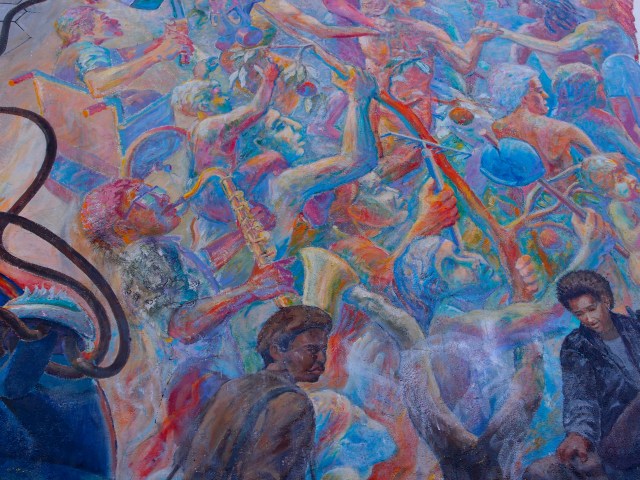
Image of the People’s History of Telegraph Avenue mural, designed by Osha Neumann, painted in 1976, restored and enlarged in 1999, at the corner of Haste and Telegraph in Berkeley. Image by Flickr user nursenicole329 (CC BY-NC-ND 2.0).
It’s so magic folks feel their own ancestors coming up out of the earth to be in the realms of their descendants – Ntozake Shange
We say their names. We say their names: Eleanor Bumpers. Anthony Báez. Sean Bell. Aiyana Stanley-Jones. Tyisha Miller. Oscar Grant. Rekia Boyd. Trayvon Martin. Tanisha Anderson. Renisha McBride. Eric Garner. Yvette Smith. Tamir Rice. Sandra Bland. Freddie Gray. Korryn Gaines. Akia Gurley. Alton Sterling. Philando Castile. Micah Jester. Deborah Danner. Walter Scott. Michelle Lee Shirley.
The list, tragically, grows, and still we say their names. We do so as an act of remembrance. As an offering. As peoples of African descent around the world do in times of ceremony, in the name of ritual. We remember those who have come before us, who have birthed this current historical moment of awakening here in the United States. We say their names.
And, as the sounds of their names said aloud echoes, we pray. Ashé.
—
Vanessa K. Valdés is associate professor of Spanish and Portuguese at The City College of New York; she is the editor of Let Spirit Speak! Cultural Journeys through the African Diaspora (2012) and The Future Is Now: A New Look at African Diaspora Studies (2012) and the book review editor of sx salon. She is the author of Oshun’s Daughters: The Search for Womanhood in the Americas (2014). The title of this essay is inspired by Josh Kun’s Audiotopia: Music, Race, and America, where he writes that his book is “focusing on the spaces of music, the spaces of songs, and the spaces of sounds” (25).
—
Featured Image “Freedom Marchers” by Flickr User Keoni Cabral, Photoshop processed digital image from the Martin Luther King Center in Atlanta, Georgia (CC BY 2.0).
—
 REWIND! . . .If you liked this post, you may also dig:
SO! Reads: Shana Redmond’s Anthem: Social Movements and the Sound of Solidarity in the African Diaspora—Ashon Crawley
Music Meant to Make You Move: Considering the Aural Kinesthetic–Imani Kai Johnson
Black Mourning, Black Movement(s): Savion Glover’s Dance for Amiri Baraka–Kristin Moriah
Something’s Got a Hold on Me: ‘Lingering Whispers’ of the Atlantic Slave Trade in Ghana–Sionne Neely
Share this:


Current Top Posts





April 2021

January 2020

November 2019

October 2019

August 2019

April 2014

November 2017

March 2015

December 2017

October 2015
 Sounding Out!
Recent Comments