
This is What It Sounds Like . . . . . . . . On Prince (1958-2016) and Interpretive Freedom
Can you imagine what would happen if young people were free to create whatever they wanted? Can you imagine what that would sound like?–Prince, in a 2015 interview by Smokey D. Fontaine
Prince leaves an invitingly “messy” catalog—a musical cosmos, really—just as rich for those who knew it well as for those encountering it with fresh ears. He avoided interviews like he avoided conventions. He made few claims. Read him as you will.
We are free to interpret Prince, but not too free. Yes, art is open, and perhaps Prince’s art especially. And yet many eulogies have described him as indescribable, as if he were untethered by the politics of his world; he wasn’t. Some remembrances assume (or imagine) that Prince was so inventive that he could escape stultifying codes and achieve liberation, both as musician and human being. For example, Prince has often been called “transcendent”—of race, of musical genre, even of humanity itself. This is overstated; he was rooted in all of these. Better to say, maybe, that he was a laureate of many poetics, some musical and some not. He responded to race, genre, and humanity, all things that he and we are stuck with. He was a living artwork, and these, by way of sound, were his media.
Prince was not transcendent. He was just too much for some to assimilate.

Since Prince’s passing last month, I’ve been struck by the idea that his career might have been, deliberately or not, an elaborate quotation of the career of Little Richard, who anachronistically has outlived him. Or, a sonic version of what Henry Louis Gates Jr. calls “signifyin(g)” in the African American artistic tradition in The Signifying Monkey: repetition with a difference, a re-vision—and, especially appropriate here—a riffing (66). Both Prince and Richard in their way defined rock music, even as rock—as a canonized form—held them at a distance. They were simultaneously rock’s inventive engine and its outer margins, but never, seemingly, its core—at least from the perspective of its self-appointed gatekeepers.

Rock and race have, to put it mildly, an awkward history. African-American rock artists rarely get their due from labels and taste-making outlets, in money or posterity, a phenomenon not at all limited to the well-known pinching of Elvis and Pat Boone. One might consider, for example, Maureen Mahon’s anthropology of the Black Rock Coalition, a group home to Greg Tate, Living Colour, and others dwelling on rock’s periphery. Canons are one way to understand how this denial works.
To be sure, some black artists have been canonized in rock, but always with a handicap, as Jack Hamilton has explained lucidly. In, for example, best-of lists (which I have browsed obsessively since Prince died, as if enshrinement there might confirm something about him; he is usually #40 or #50), there are only so many slots of color: Hendrix is the black guitar god; Little Richard the sexual sentinel rising in a repressed era; James Brown the lifeline to funk; Big Mama Thornton the grandmaternal footnote. Best-of lists published by major magazines and websites such as Rolling Stone and VH1, tend to name about 70% white artists, as well as 90-95% male ones. These lists have become just a smidgen more inclusive in the past decade or so. Still, only the Beatles and Rolling Stones are regular contenders to be named history’s greatest rock band.
We are free to interpret greatness, but not too free.
For those who care about lists enough to comment on them, much of the point is in the arguing, the freedom to declare an opinion that cannot be challenged on logical grounds. I certainly wouldn’t argue for more “correct” best-of lists, either for aesthetics or inclusivity. Lists have every right to be subjective. But they are also fascinatingly unmoored by any explicit standard for judgment. As a result, the debates that surround their ordering are full of unvarnished pronouncements of truth (and falsity), even for those who acknowledge the subjectivity of lists, which I observed first hand as I joined and posted on a Beatles forum and an Eagles forum to research this article (“…putting the Police and the Doors ahead of the Eagles is absurd, IMHO”). But why would anyone declare certainty about a question such as the best rock artist of all time, when it is so plainly open to personal interpretation?
Yes, lists are subjective. But who are the subjects that invest in them?
Prince’s career began in the late 1970s, a musical moment deeply reflective of what Robin DiAngelo calls “white fragility.” The Beatles were gone after the 1960s and guitar music stood under their long shadow. Led Zeppelin were bloated and breaking up. Disco was in ascent. Rock had somehow convinced itself that it was neither rooted in nor anchored by queer, female, and racially marked bodies, as it indeed was and in fact had always been. White male rock critics and fans were busily constructing the “rock canon” as a citadel—impenetrable to “four on the floor beats” and diva-styled vocals—and there was nothing in its blueprint to suggest that there would be a door for someone like Prince.
Just one month after Prince finished recording his breakthrough, self-titled album in July 1979—the record gave us “I Wanna Be Your Lover” and “I Feel For You,” which Chaka Khan would take to chart topping heights in 1984—Chicago “shock jock” Steve Dahl staged an infamous event at Comiskey Park called Disco Demolition Night. The fascistic spectacle, which took place between games of a White Sox doubleheader, asked fans to bring disco records, which would be demolished in an explosion and ensuing bonfire on the field.
It was a release of pent-up frustration and a wild-eyed effort to rid the world of the scourge of disco, which many listeners felt had displaced rock with plastic rhythms, as Osvaldo Oyola discussed in a 2010 SO! post “Ain’t Got the Same Soul,” a discussion of Bob Seger, who famously sang in 1979, “Don’t try to take me to a disco/you’ll never even get me out on the floor.” Excited, drunk defenders of the “rock canon” rioted around the fire. The nightcap was cancelled.
These are the subjects who invest in lists.
Many who witnessed the event, both in person and on television, experienced its personal, racially charged, and violent implications. Aspiring DJ Vince Lawrence, who worked as an usher at the Disco Demolition Night game, was later interviewed for a BBC documentary entitled Pump Up the Volume: The History of House Music: [see 9:00-10:15 of the clip below]:
It was more about blowing up all this ‘nigger music’ than, um, you know, destroying disco. Strangely enough, I was an usher, working his way towards his first synthesizer at the time, what I noticed at the gates was people were bringing records and some of those were disco records and I thought those records were kinda good, but some of them were just black records, they weren’t disco, they were just black records, R&B records. I should have taken that as a tone for what the attitudes of these people were. I know that nobody was bringing Metallica records by mistake. They might have brought a Marvin Gaye record which wasn’t a disco record, and that got accepted and blown up along with Donna Summer and Anita Ward, so it felt very racial to me.
Lawrence notes that blackness was, for rock’s canonizers, part of a mostly inseparable bundle of otherness that also included queer people, among others. Although the disco backlash is often regarded as mainly homophobic, in fact it points to even deeper reservoirs of resentment and privilege.
When music companies decided to mass-market the black, queer sound of disco, they first called it “disco-rock”; two words that American audiences eventually ripped apart, or demolished, perhaps. Black and queer people—and women too, of all races and sexualities—represented the hordes outside of rock’s new citadel, whose walls were made from the Beatles’ cheeky jokes, Mick’s rooster-strut, Robert Plant’s cucumber cock, and Elvis’s hayseed hubris.
Little Richard, for example, was black and queer like disco; what to do with him? His drummer invented the straight eight rhythm, perhaps the genre’s most enduring motif. Here’s Little Richard was rock incarnate, total frenetic energy; Richard’s brilliant, singular approach to the piano would launch a thousand rock tropes in imitation. But in canonization he could only be the nutrient-rich soil of rock—say, #36 on a best-of list—never its epitome, somehow.
I don’t know if Prince—a lifelong resident of Minneapolis, who came of age in the volatile Midwestern American milieu of white disco demolitions AND underground black electronic music culture—cared to consider this history, but he floated in it. He effectively signified on Little Richard not so much by quoting his music (though he owed a debt to him just like everyone who played rock), but by reproducing his position in the music industry. He was a queer noncomformist, never in the business of explaining himself, obsessed with control, whose blackness became a way of not flinching in the face of an industry that would never embrace him, anyway.

I interpret Prince’s musical personae as queer, not in the sense of inversion, as the anti-disco folks had it, but as a forever-exploration of sexual life. Prince’s queerness was not, strictly speaking, like Little Richard’s, but Prince took it on as an artistic possibility nonetheless. If Richard dwelled on this particular fringe as a consequence of his body, his desires, and the limits of social acceptance and religious conviction, Prince chose it as his identity. But Prince also lived and worked within limits of morality and, also like Little Richard, religion.
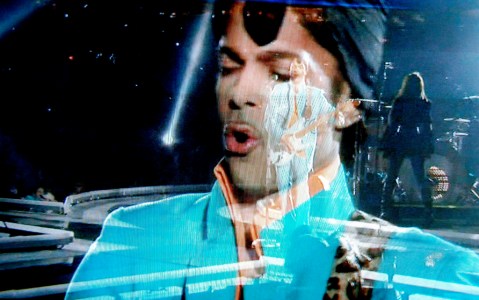
Image by Flickr User Ann Althouse, 2007
Touré writes in a New York Times obit of Prince’s “holy lust,” the “commingling” of sexuality and spirituality. Jack Hamilton writes of the doubt and moral uncertainty that coursed through songs like “Little Red Corvette.” Holy lust is arguably the central pursuit of rock; the term “rock and roll” is etymologically linked either to intercourse or worship, appropriately, emerging in both cases from African-American vernacular. Prince’s queer play with sex, sexuality identity, and religion is as rock and roll as it gets.
As punk sputtered, Simon Reynolds writes in Rip it Up and Start Again, funk appeared to rock fans as a racially tinged, politically and sexually charged savior. Bass, the heart of funk, was key to punk becoming post-punk around 1980. The instrument was suddenly charged with new symbolic and structural importance. During the same period, it is remarkable how many of Prince’s songs either have no bass, or rework bass’s role entirely. “When Doves Cry,” from Purple Rain (1984), Prince’s 6th studio album, is the best-known example of an ultra-funky track that withholds bass entirely, but “Kiss” lacks it, too, as well as “Darling Nikki.”
Earlier on Purple Rain, the bass on “Take Me with U” plays almost as a drone, buzzing like a minimalist’s organ.“Kiss,”from 1986’s Parade and Prince’s second-biggest hit —yet only #464 on the Rolling Stone list of the 500 Greatest Songs of All Time—is so tight, so locked in, so populated by alluring timbres that suggest an alien plane of instrumentation, that you forget it’s even supposed to have bass by rock top 40 convention. On much of 1980’s Dirty Mind, it is difficult to know which carefully tweaked synthesizer tone is supposed to index the bass, if any. Prince’s funk was even funkier for being counterintuitive, as Questlove notes. This gesture wasn’t rejection, of course, it didn’t “transcend” funk. Prince was still playing inarguably funky music, and the lack of bass is so unusual that it’s almost even more apparent in its absence. Free, but not too free.
Prince approached rock iconicity much as he approached bass, which is to say that he embraced clichés, but performed them inside-out, calling attention to them as both limits and possibilities, as constraint and freedom. “Raspberry Beret,” from 1985’s Around the World in a Day, is a boppy “girl group” song with sly allusions to anal sex, that uses exotic instruments and is written in an obscure mode. The virtuosic riff on “When Doves Cry,” instead of going where guitar solos go, comes right at the beginning of the track, before the drums, both seemingly isolated from the rest of the song and yet heralding it, too.
All of this worked very well, of course. His songs are just idiomatic enough to give listeners a foothold, but brave enough to evoke a world well beyond idiom. In retrospect, this is precisely what Little Richard had done. This is also what Hendrix and George Clinton and Tina Turner and OutKast have done, from where they rock out—way beyond the citadel, mastering many idioms, then extending them, at once codifying and floating away from genre.

Andre 3000 of OutKast rocking outside the box at Lollapalooza 2014, Image by Flickr User Daniel Patlán
Prince’s career calls back to the personal and artistic concerns, as well as the innovations, of Little Richard and other artists’ sonic expressions of blackness that both built rock’s house and sounded out the tall, white walls of the citadel that would exclude them. All of these artists, I suspect, find little point to hanging out near the citadel’s gates; there are other, funkier places to live. Prince himself was perfectly comfortable working athwart Warner Brothers, the press, stardom. He did more than fine.
We are free to interpret Prince, but not too free. Creative as he was, he lived in his time; he was no alien. The greatest testament to his genius is not that he escaped the world, nor that he rendered a new musical landscape from scratch, but rather that he worked in part with rock’s sclerotic structural materials to create such beautiful and fluid work.
—
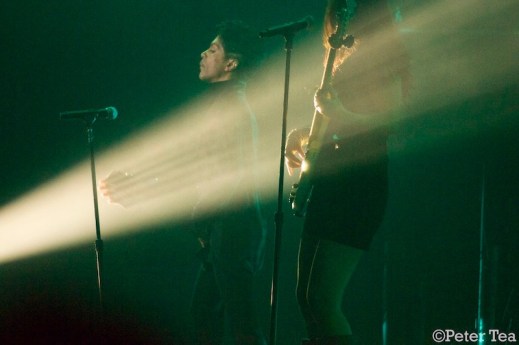
Featured Image by Peter Tea, July 12, 2011, under Creative Commons license No Derivatives 4.0 International (CC BY-ND 4.0)
—
Benjamin Tausig is assistant professor of ethnomusicology at Stony Brook University, where he works on sound studies, music, and protest in Bangkok and other urban spaces. He is on Twitter @datageneral
—
 REWIND!…If you liked this post, you may also dig:
Enacting Queer Listening, or When Anzaldúa Laughs–Maria Chaves
Learning to Listen: The Velvet Underground’s “Once Lost” LPs–-Tim Anderson
Music Meant to Make You Move: Considering the Aural Kinesthetic-Imani Kai Johnson
Black Mourning, Black Movement(s): Savion Glover’s Dance for Amiri Baraka–Kristin Moriah
Share this:

SO! Amplifies: #hearmyhome and the Soundscapes of the Everyday
 SO! Amplifies. . .a highly-curated, rolling mini-post series by which we editors hip you to cultural makers and organizations doing work we really really dig. You’re welcome!
—
Pause for a moment.
Listen.
What do you hear?
Is it the quiet hum of a furnace or fan? Perhaps the muffled chatter of your colleagues or children down the hall? Can you hear sirens or birds or the passing of a car or train? Likely, these are sounds that, over time, you have learned to tune-out. Perhaps you have even complained about such ‘noise’ as something that distracts you from your work or disrupts you from your sleep.
But are these sounds really just noise? What would it mean to move beyond hearing such sounds as noise and instead (re)learn to listen to these soundscapes of the everyday as representative of community?
From February to April of 2016, #hearmyhome encourages users to play, innovate, and compose soundscapes through a series of eight sonic events. In doing so, our goal is to help users ‘tune-in’ to their everyday surroundings. By (re)learning to listen to the sounds that surround them, participants may begin to better understand community. In other words, #hearmyhome considers how hearing difference and listening to community may (re)educate our senses by attuning to the rhythms and reverberations of culture.
Prefer an Audio Overview? Listen here and follow us on SoundCloud!
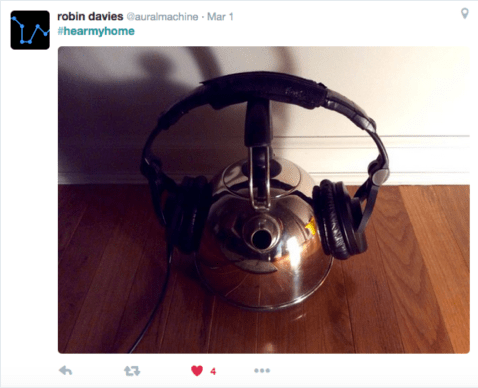
User example from Sonic Event #4: Visualizing Listening
Currently in its earliest phases, #hearmyhome, led by Jon M. Wargo and myself, explores how choosing to ‘tune-in’ facilitates not only an increased awareness of the acoustic territories and rhythmic rituals which surround us, but also the impact of such sonic experiences on our bodies. In doing so, #hearmyhome interrogates how, with and through sound, people write and compose community.
Each of us became interested in studying soundscapes through different avenues. For Jon, his interest in sound and sonic composition emerged from his longitudinal ethnographic examination of LGBT youth writing with mobile media. Sound was a medium used by many of the young people to architect experience and write community. As a traditionally neglected mode, he was curious how historically marginalized youth (LGBT youth of color) used sound to compose counter-narratives of self and community.
Sparked by travels abroad, I first began capturing soundscapes while in Indonesia during Ramadan. Using Snapchat’s video tool, I not only captured the sounds of the call to prayer, but also sounds across Southeast Asia—from the busy streets of Jakarta to the dropping of coins into the 108 bowls within the Temple of Reclining Buddha in Bangkok, Thailand. Through these sonic experiences, I began to question how sound might be used by educators and youth to explore difference and diversity amongst local and global communities.
Developing materials on a multitude of scales—from local community asset maps in teacher education classes to the larger collaborative of networked sounds—each is created with the goal of hearing, recognizing, and sustaining community. #hearmyhome takes heed of the frequencies and rhythms of culture in hopes to architect, design, and teach towards equitable landscapes for learning. Refracted through the aural perspective, we see sound re-teaching the senses by working with participants to compose constructs like ‘home’ and ‘place.’ Geared towards PK-16 teachers and students, #hearmyhome is a pedagogical endeavor. Yet, as a research project, we are interested in examining the following research questions: What are the soundscapes of a networked collaborative? How do users and participants compose with sound, attune towards difference, and write with place?
Towards a Networked Vision for Tuning-In to Sound
#hearmyhome’s vision is guided by three central tenets: collaboration, pedagogy/praxis, and research
Collaboration
Focusing on “everyday” cultural heritage, #hearmyhome invites youth and adult participants to “earwitness” community through expansive personal learning networks (PLN). At the conclusion of the sonic events, participants’ soundscapes and ambient acoustics will be archived on an open-networked soundscapes map. We hope that these will be accessed as curricular resources for youth and teachers globally. #hearmyhome is an “affinity space” wherein participants share both knowledge and life experiences (hosted and inspired through their sonic events series). Through this map, for instance, a teacher in Montana may have access to the sounds of Chicago’s subway while simultaneously youth in Michigan may opt to write with the sounds of a kookaburra captured by second graders in Australia. Ideally, an “affinity space” helps to form interpersonal relationships and collaboratively create a fuller understanding of community and culture for participants. As the community expands through new partnerships and members, we hope it serves as a hub connecting participants with research opportunities, (g)local initiatives—integrating and making the more global knowledge local—and online resources and tools.
Pedagogy/Praxis
One of #hearmyhome’s larger goals is to develop curricular materials for teachers via the collaborative network and shared space on writing with and through sound. As an “open” project, resources will be shared widely via the #hearmyhome website as well as across our social media platforms as we hope to develop powerful practices of hearing, listening, and witnessing sound across communities. Interested in contributing? While our sonic events are available now, throughout the summer #hearmyhome’s homepage will be updated with additional curricular resources. If you are an educator, please consider contributing to this crowd-sourced effort. Join us by signing up for our weekly emails here or like our page on Facebook for more information on each sonic event, or simply ‘lurk and learn’ by following the #hearmyhome hashtag across Instagram, Facebook, and Twitter!
Research
Supported by the Cultural Heritage Informatics Fellowship and the National Council of Teachers of English’s Conference on English Education Research Initiative, #hearmyhome explores the sonic possibilities of writing with sound. We use sound to amplify what Steph Ceraso calls “multimodal listening,” or attending to the bodily, material, and contextual aspects of sonic interactions and relations. Sound allows for more expansive understandings of space, place, and self. We decided to hang our research on the hashtag, #hearmyhome, to aggregate data because it allows us to index user-produced soundscapes while attending to the wider goal of exploring the multiple homes of our global participants. The research component of the project investigates how the acoustic territories of the everyday write culture. For example, how might the writing of a ‘Where I’m From…’ poem shift if one does not choose to write using alphabetic print, but instead chooses to use sound? However, #hearmyhome by its very nature is open to everyone regardless of participation in the formal “research” study. Researchers will always seek members’ consent before sharing any work beyond the online community networked collaborative. For more on this, please see our standards of research statement.
Follow Along with #hearmyhome’s Sonic Events
https://twitter.com/allievoigt/status/701785249454247936
Joining #hearmyhome is as simple as opting in to our sonic events. To do so, visit the #hearmyhome homepage and select “Sonic Events.” Then, after reading across the prompt, use your phone or another device to record the soundscapes that are the focus of the sonic event. You can easily upload and share your recording using Instagram, Twitter, or Soundcloud. By including the #hearmyhome hashtag as well as the appropriate hashtag for the sonic event you are responding to (ex. #SE5 for sonic event 5), your response will be indexed in the #hearmyhome stream. To later be included in our networked map, it is important to also turn on the geotag to demarcate your location. Your contribution will then be accessible to teachers and youth as they explore different communities and writing with and through sound!
While there is no right or wrong way to participate in #hearmyhome, we wanted to share an example from one of our participants, sound scholar Steph Ceraso. By clicking the Soundcloud link below, you can listen to how Steph responded to the prompt for our fifth #hearmyhome sonic event that asked participants to share the sounds of the ‘in-between’ moments of their day. We chose Steph’s example as it illustrates not only the beauty of noise, silence, and everyday hearings, but also for her ability to remix these sounds into a song all of their own.
Although the sonic events go “live” during the weeks listed on the homepage (February 7 to April 1 2016), we encourage you to use these sounds in any way and to join the #hearmyhome collaborative at any time. Reading across the soundscapes of networked participation, we ultimately believe attuning towards difference and “hearing” home and community will help (re)mediate learning about culture by voicing stories of the everyday, highlighting the rhythmic resonances of ritual, and attuning towards community difference.
—
Cassie J. Brownell is a Graduate Fellow in the Residential College in the Arts and Humanities and a doctoral student in Curriculum, Instruction, and Teacher Education at Michigan State University.
Jon M. Wargo, an International Literacy Association (ILA) 30 Under 30 awardee, is a University Fellow and doctoral candidate in Curriculum, Instruction, and Teacher Education at Michigan State University. In Fall 2016, Jon will join the Wayne State University faculty as an Assistant Professor of Reading, Language, and Literacy.
Follow #hearmyhome on Soundcloud, Twitter, and Instagram.
—
REWIND!…If you liked this post, you may also dig:
SO! Amplifies: Ian Rawes and the London Sound Survey–Ian Rawes
SO! Amplifies: Cities and Memory–Stuart Fowkes
Share this:


Current Top Posts





April 2021

January 2020

November 2019

October 2019

August 2019

April 2014

November 2017

March 2015

December 2017

October 2015
 Sounding Out!
Recent Comments