
Tape Hiss, Compression, and the Stubborn Materiality of Sonic Diaspora

In an article for Pitchfork, music critic Adam Ward reminisces about digital music files that sound as if they’re “being played through a payphone,” and calls the extreme compression of the low-quality MP3 “this generation’s vinyl crackle or skipping CD.” The crackles, hisses, and compression that characterize such sound files are what I term “encoded materiality.” Focusing on the encoded materiality of the digital helps us to reconfigure our approach to sonic media, understanding how the compression of early MP3s and tape hiss remind us not only of lost fidelity, but also of the richness of exchange. These warm and stubborn sonic impurities, having been encoded in our digital listening formats and thus achieving repeatability and variability, act as persistent reminders that we can think diaspora beyond melancholy and authenticity, sidestepping the questions of purity and loss that so often characterize dialogues in the field of diaspora studies.
In Mechanisms, his work on electronic textuality, Matthew Kirschenbaum proposes a “material matrix governing writing and inscription in all forms” composed of four elements: “erasure, variability, repeatability, and survivability” (xiii). The defects of sonic technology that become encoded in digital files are one such type of inscription. Tape hiss and other recording accidents–such as Casey Kasem ruining your attempt to tape record the first Western song you fell in love with after leaving Hong Kong by fading the outro and butting in with his banter–achieve repetition and survival during the digital encoding process, becoming a welcome reminder of time and place. Such materiality helps us to better understand the politics of diaspora. It clues us in to how the elements of textual encoding (erasure, variability, repeatability, and survivability) become embedded within diaspora’s complex logic.

Image by DraconianRain @Flickr CC BY-NC.
To think through these complex moments of exchange, let me offer a story about my experience with tape hiss. I grew up listening to music touched by this particular sonic grain: a ground level of noise upon which my sonic experiences were built. After I received my first iPod in 2005, I connected a tape player to the input of my computer, recorded a stack of tapes, and then manually split them into MP3s—pseudo-piracy committed in earnest. A few weeks ago, I dug up these same files and put them on my phone, once again returning the buried albums to their former glory on a constant rotation playlist. I keep returning to these particular files, rather than finding the now easily available digital versions, because I admire the survivability of their materiality. The materiality of these tracks allowed me to trace the complexity of my own history—the tape hiss is just as much a part of this history as the songs themselves.
After first moving to Canada from Hong Kong, my family and I established ourselves by unswervingly performing the same routine each weekend. We would have late lunch at our favorite dim sum restaurant, drive around for a bit, and then relax at home; there wasn’t much to do in the ex-urbs of Toronto. On those drives, we listened to selections from a stack of cassette tapes in the glovebox of our old Pontiac Bonneville. Sally Yeh’s 1987 album Blessing was on constant rotation and received its fair share of wear. This was one of the tapes I recorded to my computer, destined for digitization.
Because I hit the record button a few seconds early, my MP3 of Sally Yeh’s Blessing begins with a few seconds of silence. It’s enough to trick me into thinking that the song isn’t playing. In a quiet enough spot, I can hear that it’s actually tape hiss. No matter where I am, on the road or in the shower, my mind fills in the blank with the thick ker-chunk of the cassette entering that Pontiac stereo right before that familiar tape hiss would fill the car, always giving us a few sometimes-needed, sometimes-awkward moments of silence before the music started. The sonic texture of that tape stems from its material nature as plastic and metal. The hiss itself is due to the size of the magnetized particles on the plastic. Because of these sounds, the song tells its own story. It recalls our shared sonic and material experience as I migrate it from device to device.
Before Blessing made its way into our car, it was one of the few cassette tapes that my parents carefully packed into a dozen cardboard boxes and shipped by sea to Canada in the late 1980s. This was in the midst of the countrywide protests in China that led to the events at Tiananmen Square. That insistent ker-chunk of plastic on metal that my brain inserts every time I play the MP3s keeps my experience of the music grounded in this earlier history, too. Strange that a fluffy pop song would remind me of the serious political strife taking place on the doorstep of a Hong Kong nervously awaiting its “handover.” This sonic anchor’s ability to recall to me these snippets of history, both personal, national, and transpacific has been crucial in the development of my own diasporic identity. Listening to this particular recording of Blessing helps me to keep track of my self and my history.
Ker-chunk.
The act of withdrawal that many of us perform in order to interface with our sonic technologies, as Alexander Weheliye shows in his reading of Ralph Ellison’s Invisible Man in Phonographies, can play a powerful role in understanding one’s own racial subjectivity. Weheliye focuses on the scene in which the titular narrator-protagonist retreats to a subterranean cave-like space to listen to Louis Armstong’s recorded, disembodied voice in complete solitude. He asserts that the narrator builds his own subjectivity through a recognition of the self by projecting that self onto Louis Armstrong’s “vocal apparatus,” that is, his voice coming through a phonograph (143). “The phonograph’s ability to disconnect the singing voice from its face, or rather to replace it with a technological visage, further heightens its materiality, which impels the protagonist to imbue Armstrong’s voice with a surplus of signification” (Weheliye 145).
More than a black and white photo or a stern historical lecture from the elders, the “heightened materiality” of the digital format, a type of “technological visage” cathects my own diasporic history most forcefully to the sonic anchor of tape hiss because it acts as a “voice without a face” in the same way as the phonographic Armstrong. But despite the privacy of the phonographic listening act in this scenario, Weheliye suggests that
the phonographic listening modality also bears the traces of sociality… since the listening subject is drawn out of him/herself by encountering the technologically mediated sounds of other subjects—we might even go so far as to suggest that the phonograph itself functions as a subject, especially in its interfacings with various humans. (165)
So it is with similar sonic technologies that can encourage the “eschewing [of] the social” such as iPhones, CDs, and, yes, cassette tapes. Like Ellison’s narrator interfacing with the mechanical apparatus that conveys Armstrong’s voice, the insistent “defects” kept on the digital file keep the mechanism of its delivery at the fore, allowing me first to understand that diasporic feeling of dis-ease—and to imagine beyond it.
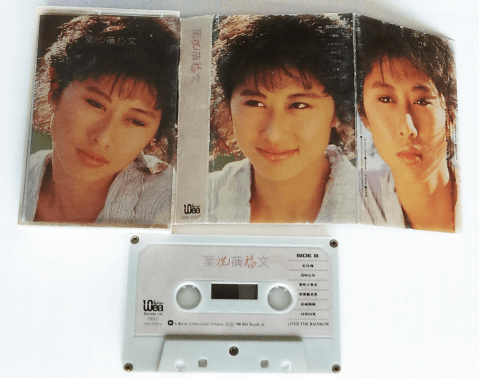
Sally Yeh’s “Blessing.” Image used with permission by the author.
What I gain from the digital yet still stubbornly material tape of Blessing is not any overt lyrical or thematic gesture to a diasporic subjectivity on the artist’s part, but rather an induction into what Giorgio Agamben calls, “the idea of an inessential commonality, a solidarity that in no way concerns an essence” (18), or perhaps a community based on “belonging itself” (84). Likewise, Weheliye’s “diasporic citizenship coarticulate[s] the national and transnational instead of playing a zero-sum game with political identification” (369). If diaspora is defined by the perpetual desire to seek an imagined originary point of true identity that inevitably leads to melancholy, as psychoanalysis maintains, tape hiss and other encoded materialities turn the gaze away from the mists of origin, validating instead the development of diasporic identity in the aftermath of emigration. Of course, loss and melancholy are legitimate psychic aspects of the diasporic experience, as persuasively demonstrated by scholars such as David Eng, Shinhee Han, Anne Anlin Cheng, but they neither define the whole experience nor are they mutually exclusive to it. It is in this way that we can think of diaspora as a community of belonging by becoming.
A consideration of the stubborn ways that materiality is encoded in the digital helps us to think of diaspora as more than psychic fait accompli—it is also a ‘coming community’ characterized by the process of belonging. Kirschenbaum’s matrix provides the right foundation for a study which considers how material inscriptions are related to our diasporic lives. The inscription that defined my diasporic becoming came from the cassette tape that travelled across the ocean in a boat for five weeks, escaped erasure, survived repeated playings, became digital, and lives on now as a hissing reminder of our history of emigration. What else may we find about our own becoming and belonging if we attune our ears to the encoded materialities of sonic diaspora?
–
Featured image “Decayed Cassette” by darkday @Flickr CC BY.
–
Chris Chien is a Ph.D. candidate in the Department of English at the University of Southern California working variously in the areas of sound, diaspora and transpacific studies, all with a distinctly queer bent. He completed his M.A. in English Literature at Loyola Marymount University and his Honors B.A. in English Literature and Latin at the University of Toronto. Chris has presented papers on angelic gender fluidity in John Milton’s Paradise Lost and post-colonial affect in the work of Herman Melville and Amitav Ghosh at the Rocky Mountain MLA and South Atlantic MLA conferences respectively. He is currently developing a paper that examines the performativity of diaspora, masculinity, and the capitalist ethos in Eddie Huang’s memoir Fresh Off the Boat and its adaptation as an ABC sitcom.
–
 REWIND! . . .If you liked this post, you may also dig:
Pushing Play: What Makes the Portable Tape Recorder Interesting?—Gus Stadler
SANDRA BLAND: #SayHerName Loud or Not at All — Regina N. Bradley
Listening (Loudly) to Spanish-language Radio — Dolores Inés Casillas
Brasil Ao Vivo!: The Sonic Pleasures of Liveness in Brazilian Popular Culture — Kariann Goldschmitt
Share this:

Afrofuturism, Public Enemy, and Fear of a Black Planet at 25
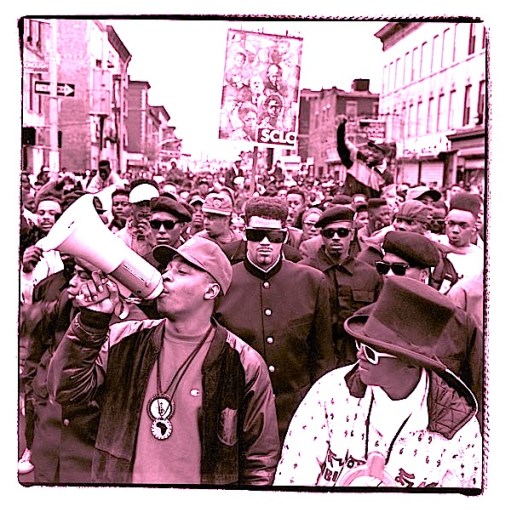
Twenty-five years after Do the Right Thing was nominated but overlooked for Best Picture, Spike Lee is about to receive an Academy Award. At the beginning of that modern classic, Rosie Perez danced into our collective imaginations to the sounds of Public Enemy. Branford Marsalis’s saxophone squealing, bass guitar revving up, she sprung into action in front of a row of Bed-Stuy brownstones. Voices stutter to life: “Get—get—get—get down,” says one singer, before another entreats, “Come on and get down,” punctuated by James Brown’s grunt, letting us know we’re in for some hard work. In unison, Chuck D and Flavor Flav place us in time: “Nineteen eighty-nine! The number, another summer…” The track’s structure, barely held in place by the guitar riff and a snare, accommodates Marsalis’s saxophone playing continuously during the chorus, but intermittent scratches and split-second samples make up the plurality of the sounds. The two rappers’ words take back the foreground in each verse, and their cooperative and repetitive style reinforces the song’s message during the chorus, when they trade calls and responses of “Fight the power!”
.
Throughout the credits, lyrics and musical elements are shot through with noise: machine guns, helicopters, jet engines—even the sax, the only conventional instrument at work, seems to cede ground to these disruptions. The dancing form of Perez, unlike the other figures taking part in the performance, is silent but visible; she’s the only one who seems fully in control of the relationship between her body and the sounds. Perez’s performance of “Fight the Power” is an antidote to fantasies of masculine technological mastery: her movements, while sometimes syncopated, are discrete to the point of appearing martial—the steps are improvised but the skills are practiced; she’s ready to step into the ring.
Fulfilling Spike Lee’s request to Public Enemy to provide a theme for the movie, “Fight the Power,” made it onto the group’s iconic album Fear of a Black Planet the following year. In Anthem, Shana Redmond names the song “perhaps the last Black anthem of the twentieth century,” noting that it bridges divides like the space between America’s East and West Coasts (261-262). It does so as part of the film’s opening sequence through juxtapositions: the sound of helicopters, a signature of LAPD surveillance, crosses the New York City streetscape in stereo. On the album, however, a radically different opening sets the tone for the track. A speech by Thomas Todd taunts, “Yet our best trained, best equipped, best prepared, troops refuse to fight. Matter of fact, it’s safe to say that they would rather switch than fight.” The speaker draws out the breathy, sibilant ending of the word “switch” to create a double entendre; voiced this way, “they would rather switch” connotes both disloyalty in the “fight” and a swishy movement of the hips attributed to effeminate men. In later years, the crystal-clear sample would resurface across genres; it was the only lyrical component of DJ Frankie Bones’s “Refuse to Fight” in 1997, a track purely intended for dancing in the blissful atmosphere of the rave scene, which evacuated militancy to make room for “Peace, Love, Unity, and Respect.”
On PE’s album, the version of the song introduced by this sample strikes a stark contrast with its rendition in the film as the vehicle for an inexhaustible and defiant female dancer in a neighborhood wracked by disempowerment.
Identifying Fear of a Black Planet as “the first true rap concept album,” Tom Moon of the Philadelphia Inquirer recognizes the role of the DJ and production team in achieving its unique synthesis between melodic and meaning elements. At first he calls the sample-heavy stage for the rap performance “a bed of raw noise not unlike radio static,” but he later parses out how this “noise” actually consists of a rich informational emulsion:
an environment that can include snippets of speeches, talk shows, arguments, chanting, background harmonies, cowbells and other percussion, drum machine, treble-heavy solo guitar, jazz trumpet, and any number of recorded samples.
The underlying concept driving the album is the ominous encounter between Blackness and whiteness, which has become an object of fear and fascination throughout centuries of American culture. As the role of their anthem in the film about a neighborhood undergoing violent transformation indicates, the meeting of Black and white is not a fearsome future to come, but a present giving way to both reactionary and revolutionary possibilities. And it goes a little something like this.

“Chuck D in Hamburg/Germany 2000” by Wikimedia user Mika Väisänen, CC BY-SA 4.0
In this post, I provide track-by-track sonic analysis to show how, over the past 25 years, Fear of a Black Planet has contributed to Afrofuturism through its invocation of prophetic speech and through its place on the cultural landscape as a touchstone for the beginning of the 1990s. As the first song, “Contract on the World Love Jam,” insists, in one of the “‘forty-five to fifty voices’” Chuck D recalls sampling for this track alone, “If you don’t know your past, then you don’t know your future.”
This moment continues to resonate in the present as a repository of ideas and modes of expression we still need. Along with the hypnotic efficacy of rhetoric like “Laser, anesthesia, ‘maze ya/ Ways to blaze your brain and train ya,” and Flavor Flav’s subversive humor, I argue that Fear of A Black Planet engages with Afrofuturism by using sound to instigate the kind of “disjuncture” that Arjun Apparurai called characteristic of culture under late modern global capitalism. This kind of practice thematizes Fear of a Black Planet: it uses sound to confront the boundaries of information, desire, and power on decisively African Americanist terms. PE cut through the noise with a new sound, one that still resonates 25 years later.
Sampling is an indispensable strategy on Fear of a Black Planet. Yet as Tricia Rose contends, the sound of hip-hop arises out of a systematic way of moving through the world rather than as a “by-product” of factors of production. In Capturing Sound, Mark Katz identifies Public Enemy’s sampling with “the predigital, prephonographic practice of signifying that arose in the African American community” (164). Scholars and music critics alike have dubbed this era the “golden age” of digital sampling, a moment when new technology made it possible for musical composition to rely on audio appropriated from a panoply of sources but before the financial and methodological obstacles of copyright clearance emerged in force. As Kembrew McLeod and Peter Di Cola argue in Creative License, challenges imposed by the cost of licensing fees now associated with sampling make contemporary critics doubtful that Black Planet could be produced today (14). In retrospect, the album shows us how the “financescape” of popular music has evolved out of sync with the technoscape: by placing property rights in the way of the further development of the tradition inaugurated by the Bomb Squad (PE DJs Terminator X, Hank Shocklee, Keith Shocklee, and Eric “Vietnam” Sadler).
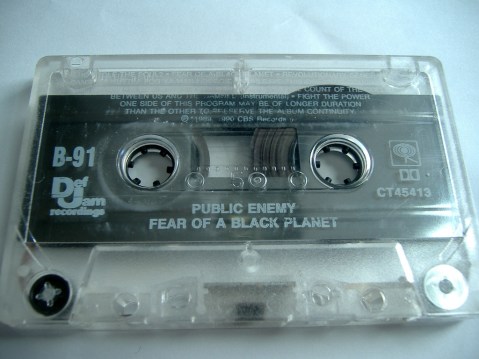
“Fear of a Black Planet Cassette” by Flickr user Emory Maiden, CC BY-NC 2.0
In 2011, when asked by NPR’s Ira Flatow about sampling as an art form, Hank Shocklee pointed out that, “as we start to move more toward into the future and technology starts to increase, these things have to metamorphosize, have to change,” further insisting that this means, “everything should be fair use, except for taking the entire record and mass producing it and selling it yourself.” Realizing how sampling entails not just the use of sound but its transformation, he stakes out a radical position on intellectual property, noting that the law tends to protect record companies rather than performers:
Stubblefield, [the drummer], is not a copyright owner. James Brown is not a copyright owner. George Clinton is not a copyright owner. The copyright owners are corporations… when we talk about artists, you know, that term is being used, but that’s not really the case here. We’re really talking about corporations.
Driven by such a skeptical orientation to the notion of sound as property, Fear of a Black Planet is both unapologetic and unforgiving in its sonic promiscuity. It weds a dizzying repertoire of references from the past to a sharp political critique of the present, embodying the role of hip-hop in transforming the relationship between sound and knowledge through whatever means the moment makes available.
A different Spike Lee joint (Jungle Fever, 1991, with a soundtrack by Stevie Wonder) enacts the spectacle behind the title track on Fear of a Black Planet. Interracial sexuality, as one of many dimensions of living together across the color line, is the most explicit “fear” a Black Planet has in store, but two tracks undercut the flawed notions of white purity at the heart of the issue.
Chuck D dismisses the concerns of an imaginary white man at the start of each verse: “your daughter? No she’s not my type… I don’t need your sister… man, I don’t want your wife!” He subsequently shifts focus to the questions of “what is pure? who is pure?” what would be “wrong with some color in your family tree?” and finally, whether it might be desirable for future generations to become more Black, owing to the adaptive value of “skins protected against the ozone layers/ breakdown.” Chuck’s line of questioning assuages the anxiety that the imagined white interlocutor might feel in order to address more fundamental planetary concerns, like environmental degradation. In addition to staging a conversation in which a Black man enjoins a white man to listen to reason, the structure of the track involves Flavor Flav in a parallel dialogue. Flav replies to each of Chuck’s initial reassurances the same playful counterpoint: “but suppose she says she loves me?” He keeps posing the hypothetical in one verse after another, despite Chuck D’s repeated insistences that he isn’t interested in white women, suggesting that “love,” an irrational but undeniably powerful motivation for interracial encounter, is just as compelling as a putatively rational browning of the planet’s people. “Pollywannacracka” riffs on the same subject with hauntingly distorted vocals and a chorus that includes a mocking crowd calling the Black woman or man who desires a “cracka” out their name (the drawn out refrain is the word “Polly…”) and a teasing whistle. These derisions reduce the taboo topic of interracial liaisons to the stuff of schoolyard taunts while playing out tense confrontations among Black men and Black women in between the verses.
Black Planet also presented PE the first opportunity to reconstruct their reputation after former manager, Professor Griff, made anti-Semitic comments–“Jews control the media”—in an interview. PE takes the public’s temperature on “Incident at 66.6 FM,” which reiterates snippets from listeners calling in to radio broadcasts; most of the callers represented excoriate the group but a few defend them, including erstwhile DJ Terminator X, who shouts himself out.
This inward-facing archive acquires more material on the album’s most self-referential track, “Welcome to the Terrordome.” The song elliptically places the scrutiny the group has faced in perspective through allusions that are rendered even more involuted through repetition and internal rhyme: “Every brother ain’t a brother… Crucifixion ain’t no fiction… the shooting of Huey Newton/from the hand of a nig that pulled the trig.” The brother who allegedly ain’t one was David Mills, the music journalist who publicized Griff’s comments.
Noting Chuck’s rather transparent analogy between this betrayal and the myth that the Jewish community was responsible for killing Jesus, Robert Christgau, in Grown Up All Wrong, concludes that “the hard question isn’t whether ‘Terrodome’ is anti-Semitic—it’s whether that’s the end of the story” (270-271). It isn’t. “War at 33 1/3” redraws these same lines by advising that “any other rapper who’s a brother/Tries to speak to one another/Gets smothered by the other kind,” hearkening back to the earlier song’s assertion not all skinfolk are kinfolk. The song samples speech from Nation of Islam leader Louis Farrakhan that frames the titular “war” as a rhetorical contest.
The most collaborative jam on the album, co-written by Rage Against the Machine’s Zack De La Rocha, “Burn Hollywood Burn” enacts an acerbic critique of media representations of Blackness against the most party-perfect hooks on the album, including a sampled crowd repeating the three words of the refrain like a protest chant, a timeline provided by a pea whistle, and a horn sample looped for the gods.
Sustaining a militant ideal of Black masculinity in defiance of Hollywood’s Stepin’ Fetchit and Driving Miss Daisy scripts (both referenced by name), featured MCs Ice Cube and Big Daddy Kane occupy the track’s. Their forward-leaning posture demands they be taken seriously, like Chuck D, rather than coming off as whimsical and indulgent like Flavor Flav. Yet PE’s sound would be unrecognizable without Flav’s flavor to carry out the call-and-response structure of their performances. Flav voices a skit on the final verse of “Burn Hollywood Burn” in which he is invited to portray a “controversial Negro” as an actor; he asks if the role calls on him to identify with Huey P. Newton or H. Rap Brown, but to his chagrin, the invitation calls for “a servant character that chuckles a little bit and sings.” Contemporary audiences might associate Flavor Flav with the latter based on his reality TV persona, but the comic wit he brings to PE knowingly undermines strident posturing and demands that the audience listen more closely.

“Flavor Flav of Public Enemy at Way Out West 2013 in Gothenburg, Sweden” by Wikimedia user Kim Metso, CC BY-SA 3.0
Despite the comparatively trivial content of his lyrical presence on most tracks, Flav enhances the repertoire of knowledge at work across Fear of a Black Planet, deepening its cultural frame of reference and accentuating different elements of its sonic structure. On “Who Stole the Soul,” for example, after Chuck says, “Banned from many arenas/ Word from the Motherland/ Has anybody seen her,” Flav repeats after him, “Have you seen her,” emphasizing the allusion to ”Have You Seen Her?” by the Chi-Lites. Then, before Chuck has finished his next line, Flav repeats himself, stylizing the question “Have You Seen Her” with the same melody used by the Chi-Lites. Ingeniously, Flav modifies the allusion that Chuck makes in verbal form by using the timing and melodic structure of his repetition to produce a new timeframe within the existing track, doubling the ways in which this line alludes to a prior work.
On his own, Flav’s performances on Black Planet laugh through the pain of urban dystopia, the. concentrated poverty, premature death, and alienation from the amenities of citizenship he explores in “911 is a Joke” and “Can’t Do Nuttin’ For Ya Man.” “911” is especially notable for coupling Flav’s cynical appraisal of life and death in the hood to repetitive verse structures, a tight rhyme scheme consisting mostly of couplets, a chart-ready beat (the song reached #1 on the Billboard Hot Rap Singles list), and an unforgettable quatrain as the hook: “Get up, get, get, get down/911 is a joke in your town/ Get up, get, get, get get down/Late 911 wears the late crown.”
.
The notion of getting down to misery is disturbing, but that’s all you can do. The track ends with a particularly macabre sample: the laughter of Vincent Price, the same heard at the harrowing conclusion of Michael Jackson’s “Thriller.” “Can’t Do Nuttin’ For Ya Man,” on the other hand, ends with Flav’s raspy laughter. While “911” ironizes the withdrawal of public resources from “your town” amid concentrated poverty, this song sends up the misfortunes urban denizens bring on themselves. The funky tune profanes the serious concerns of a man who’s fallen into a life of crime, offering no Chuck D-style self-help just “bass for your face.”
Mark Anthony Neal has called the generation that came of age in the 1990s the “Post-Soul” generation, and the many funk and soul references on Fear of a Black Planet, from the preceding sounds to the rallying cry of “Who Stole the Soul,” connect the first hip-hop of the 1990s to the prior generation of Black music. Repetition with difference allows the group to maintain a dialogue between their precedents in socially conscious popular music and the new intervention they intend to make. If “Fight the Power” signals the dawn of new era, so does the largely-forgotten “Reggie Jax,” the downtempo freestyle on which Chuck D coins the term “P-E-FUNK.”
Chuck’s neologism, which he introduces by spelling it out, “P-E-F-U-N and the K,” is a performative citation linking PE’s brand of hip-hop to the P-Funk of the 1970s: perhaps the defining expression of Afrofuturism in popular music. The morphology of “P-E FUNK” is highly novel, infixing a new element within an existing word and also facilitating the flow between the terms by enunciating their assonant sounds. This tactic for naming the fusion of hip-hop and P-Funk allows PE to continue a pattern initiated by their predecessor Afrika Bambaataa, whom they sample on “Fight the Power,” by inserting themselves into a particular artistic genealogy (traced by Ytasha Womack in Afrofuturism) animated by George Clinton, Bootsy Collins, and the mind-expanding antics of Parliament/Funkadelic.
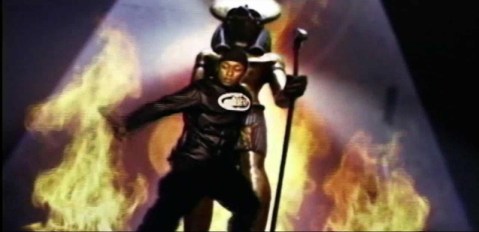
Still from Public Enemy video for “Do You Wanna Go My Way?”
The intense polyrhythmic edifice of Fear of a Black Planet link past to (Afro)future, engaging in a radically heteroglossic practice of treating sound as information. Deploying the sound of knowledge and the knowledge of sound in the service of envisioning the world as it is, the album charts a dystopian itinerary for the 1990s that we need to comprehend how we arrived at the present. Rather than worrying that a Black Planet is something to fear, we might consider the lessons that emerged from past efforts to cope with developments already underway. If we listen to Flavor Flav and find that coping strategies are futile, at least we can party. And if we were right to call Chuck a prophet, then the dawn of the Black Planet he warned us about—characterized by neoliberal governance, gentrification, and boundaries that demand to be crossed—is a moment when the avant-garde tactics of Afrofuturism are becoming important to everyone. Citizens of Earth: Welcome to the Terrordome.
—
andré carrington, Ph.D., is Assistant Professor of African American Literature at Drexel University. His research on the cultural politics of race, gender, and genre in popular texts appears in journals and books including African and Black Diaspora, Politics and Culture, A Companion to the Harlem Renaissance, and The Blacker the Ink: Constructions of Blackness In Comics and Sequential Art. He has also written for Callaloo, the Journal of the African Literature Association, and the Studio Museum in Harlem. His first book, Speculative Blackness: The Future of Race in Science Fiction, is being published by University of Minnesota Press.
—
Featured Image: Still from “Fight the Power” video, color altered from b & w by SO!
—
REWIND! . . .If you liked this post, you may also dig:
Straight Outta Compton… Via New York — Loren Kajikawa
Fear of a Black (In The) Suburb — Regina N. Bradley
They Do Not All Sound Alike: Sampling Kathleen Cleaver, Assata Shakur, and Angela Davis — Tara Betts
Share this:


Current Top Posts





April 2021

January 2020

November 2019

October 2019

August 2019

April 2014

November 2017

March 2015

December 2017

October 2015
 Sounding Out!
Recent Comments