
Soundscapes of Narco Silence
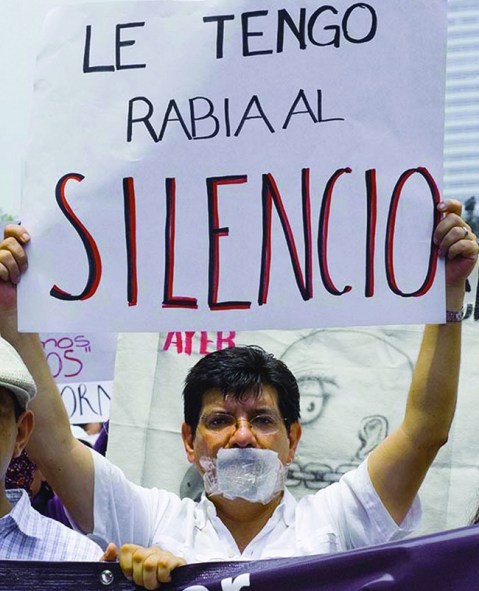
Journalists protest in silent march in Mexico City, Courtesy of the Knight Foundation
Since the drug war began, the lives of approximately 95,000 people have been claimed, with an estimated total of 26,000 disappearances (“Continued Humanitarian Crisis at the Border” June 2013 Report). At the University of Texas, Pan American – an institution located 25 miles north of Reynosa, Mexico (a Mexican city that has been hard hit by drug violence in recent years) – I teach students who have been dramatically impacted by drug war violence. Many have close relatives affected or hear horrific stories of those who have been kidnapped by the cartels; many fear traveling to Mexico to visit loved ones as a result and, in some cases, they report having relatives involved in the drug cartel business. Dinorah Guerra, psychotherapist and head of the Red Cross in Reynosa, describes the devastating psychological and physical toll: “There is a huge risk for people’s self esteem. They cannot speak about what they have seen or what they have heard. [They] lose [themselves] and lose [their] identity” (qtd. in Pehhaul 2010).
I name the space of the drug war and its resulting terror in the U.S.-Mexico border the “soundscape of narco silence.” This soundscape includes death and intimidation, from the brutal killings of news reporters by cartel members to the decapitation of citizen-activists who use online media to alert communities of narco checkpoints. It also consists of those powerful acts that call attention to silence as a tactic of terror. The Movement for Peace with Justice and Dignity, for instance, brought together tens of thousands of people in Mexico to speak out against drug violence through silent marches. Cultural productions, such as narcocorridos, or contemporary drug ballads that document the cross-border drug economy, also become part of the soundscape. The narcocorridos function as a powerful critical response to silence and fear because they enable those in Mexican society, as Jorge Castañeda, author of El Narco: La Guerra Falllida, explains, “to come to terms with the world around them, and drug violence is a big part of that world. The songs are born out of a traditional Mexican cynicism: This is our reality, we’ve gotten used to it” (Qtd. in Josh Kun 2010).
In this blog post, I focus on the role of U.S. Latina/o theater produced in the South Texas border region as it responds to the soundscape of narco silence. Building on David W. Samuels, Louis Meintjes, Ana Maria Ochoa, and Thomas Porcello’s definition of “soundscapes” in “Soundscapes: Towards a Sounded Anthropology” as “the material spaces of performance and ceremony that are used or constructed for the purpose of propagating sound” (330), I suggest that soundscapes of silence in theater function as material spaces of performance that focus the public’s attention on silence – with the intent of intervening in acts that propagate silence and fear. Soundscapes of narco silence are characterized not only by violence and terror, but by cultural productions that function as forms of critical resistance – those works that focus the publics’ attention on the economy of silence and fear that fuels the drug war, and in the process, enable communities to cope with narco violence.
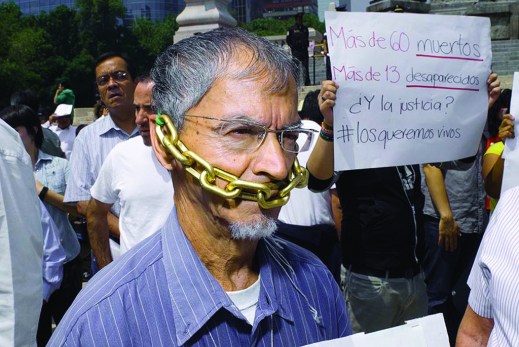
Journalists protest in silent march in Mexico City, Courtesy of the Knight Foundation
To closely listen to the soundscape of narco silence, I engage with the play script and production of Tanya Saracho’s play El Nogalar at South Texas College Theatre (STC) under the direction of Joel Jason Rodriguez in McAllen, Texas in June 2013. The play was first produced at the Goodman Theater in Chicago in April 2011, with a West Coast premiere at the Fountain Theater in Los Angeles in January 2012. I critically analyze the STC Theatre production’s incorporation of a multi-genre soundtrack that included narcocorridos, rancheras, and nortec (norteño + techno). I argue that this soundtrack focused audiences’ attention not only on the devastating effects of silence, but also the function of silence as a form of capital for those most excluded in society. I also offer a brief critical listening of the script’s rendering of silence through character dialogue and stage directions.
El Nogalar tells the story of an upper-class Mexican family comprised of three generations of women (Maité, Valeria, and Anita) whose land and home in the fictionalized estate of Los Nogales in Nuevo Leon, Mexico, and its adjacent nogalar (pecan orchard), are under threat by the maña (drug cartels) moving into the region. The play focuses on the women’s responses to the drug war economy as a result of their different relationships to home (both their estate and the space of Mexico). It also centers the experiences of Dunia, their maid, and López, a former field worker who now works for the maña.
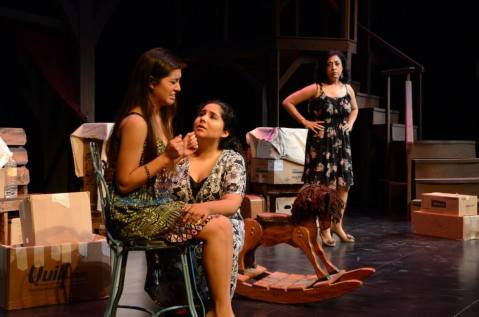
STC Theater Production of El Nogalar. Photo Credit: Miguel Salazar
Cecilia Ballí, in her article “Calderón’s War: The Gruesome Legacy of Mexico’s Antidrug Campaign,” explains the particular circumstances of marginalized men in this society: “The worst casualties of this ‘civil war’ were the estimated 7 million young men to whom society had closed all doors, leaving them the options of joining a drug gang or of enlisting in the military, both of which assured imprisonment of death” (January 2012, 48). With the characters López and Dunia, the play asks audiences then to listen to the impact of the drug war on the most vulnerable populations in Mexico and the US-Mexico border region.
The play script conveys how “narco silence” can be used by those who either seek to preserve traditional class hierarchies (the story of the matriarch Maité) or to survive and profit in the new drug economy (the story of López). “Narco silence,” a term coined by reporter Jonathan Gibler in his book To Die in Mexico, refers to “not the mere absence of talking, but rather the practice of not saying anything. You may talk as much as you like, as long as you avoid the facts. Newspaper headlines announce the daily death toll, but the articles will not tell you anything about who the dead were, who might have killed them or why. No detailed descriptions based on witness testimony. No investigation” (2011, 23). In an early exchange between López and Dunia, López defends “narco silence” as a strategy of survival:
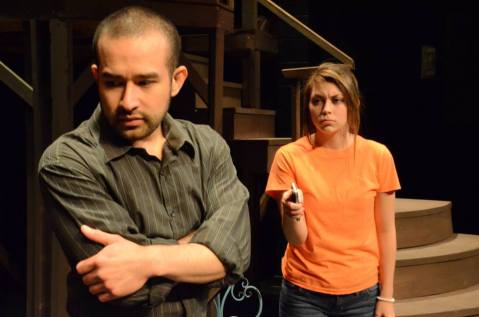
STC Theater Production of El Nogalar. Photo Credit: Miguel Salazar
DUNIA: Why are you the only one they leave alone, Memo?
LÓPEZ:….
DUNIA: All the men your age. Killed. Why Memo? (Beat).
LÓPEZ: Because I know when to keep my mouth shut which is not something I can say for you….
DUNIA: So that’s all it takes to be best of friends with the Maña? That doesn’t seem so hard to do? (American Theatre Magazine July/August 2011, 74).
Later in the play, Dunia, heeding López’s advice, offers a powerful observation of how “narco silence” enables her community to cope with death: “We all just walk around like we’re a movie on mute. You can see people’s mouths moving but all you hear is the static (my italics)” (American Theatre Magazine July/August 2011, 73-74).
The STC Theatre production enhanced the script’s soundscape of narco silence through its sound design, with a soundtrack that included rancheras, narcocorridos, norteño and nortec. This music provided audiences with a connection to the world of Los Nogales and captured each character’s process of coping with narco violence. For example, Maité’s soundtrack consists of several rancheras, such as Lola Beltran singing “Los Laureles” and Chavela Vargas’s powerful rendition of “Que te vaya Bonito.” Beltran’s “Los Laureles” – a cancion ranchera that includes Beltran’s powerful female vocals and mariachi orchestra instrumentation – invites audiences to hear Maité’s nostalgia and desire for an idealized Mexican society and her wish to preserve traditional class hierarchies.
.
Vargas’s powerful rendition of “Que te vaya Bonito” captures Maite’s pain and suffering as she loses her home to the cartels. In Vargas’s version of “Que te Vaya Bonito” – a song about love and abandonment – audiences hear Vargas’s choking and sobbing voice, accompanied by a single guitar.
.
Vargas’s voice conveys, what Lorena Alvarado powerfully argues, is “the body’s dilemma between the hysteria of sobbing and the intelligibility of words, between resignation and retribution” (2010, 4). Vargas’s powerful singing also conveys, as Alvarado further describes, “un nudo en la garganta,” a common expression in Spanish that describes “the knot in the throat, when one cannot speak because words will not come out, but the desperate, or quiet, breath of tears” (Alvarado 2010, 5).
To sonically register the drug cartel economy and lifestyle underlying the “new” Los Nogales, the soundtrack also included narcocorridos. The first sounds we hear in the play are from the narcocorrido “El Carril Número Tres” – which includes two acoustic guitars and an electric bass – by Los Cuates de Sinaloa.
.
“El Carril Número Tres” – tells the story of a secret “lane number three” that allows a Mexican drug lord to freely go back and forth between the US and Mexico because he makes a deal with the CIA and DEA. With this focus on the US government’s involvement in the drug trade, the song centers how silences north of the US-Mexico border have perpetuated drug violence.
The music also included nortec, with songs by the Mexican Institute of Sound, particularly the track “Mexico,” which is a critique of the Mexican government’s complicity with the narcos.
.
With “Mexico,” audiences hear a fusion of norteño, electronic, and hip-hop with lyrics that use the symbols of Mexican national identity and culture to focus the public’s attention on violence and terror. With the lyrics “green like weed, white like cocaine, red your blood” (referencing the Mexican flag) and “at the sound of the roar of the cannon” (alluding to the national anthem), the song powerfully invokes the visual and sonic soundscape of violence that terrorize Mexican residents. With this charged critique of government corruption, “Mexico” momentarily interrupts the soundscape of narco silence rendered in the play script and rest of the soundtrack.
Ultimately, the production’s combination of rancheras, narcocorridos, and nortec captured the class tensions in Mexican society and emphasized the play’s critique of class structures that have enabled drug war violence to persist. With this range of music, the director explains he wanted to “maneuver between the [various] aspects of [the story]: the nostalgia, the corridos, the narcocorridos, and also this fusion of saying ‘we want something more,’ and so that was the whole aspect of it; the blending of the old, the new, and what the present is” (Interview with author July 2013).
The production also deliberately incorporated the sound of silence, particularly in the final scene. By the end, López buys the Los Nogales estate, thereby increasing his class status and social power. Saracho’s stage directions in this final moment indicate “an interpretive sound of trees falling. Now don’t go cueing chainsaws because it’s not literal. Just make me feel trees are falling. Along with the upper class” (87). The play’s reference to the staging of “an interpretive sound of trees falling” brings to mind the philosophical question: “If a tree falls in a forest and no one is around to hear it, does it make a sound?” We might then interpret the final sounds of El Nogalar as inviting audiences to listen attentively to the soundscape of narco silence, implicating audiences as social actors in the politics of the drug war that continue to devastate Mexican society.
—
Featured Image: Journalists Protest against rising violence during march in Mexico, Courtesy of the Knight Foundation
—
Marci R. McMahon received her Ph.D. from the University of Southern California with affiliations in the Department of American Studies and Ethnicity. She is an assistant professor at the University of Texas, Pan American, where she teaches Chicana/o literature and cultural studies, gender studies, and theater and performance in the Departments of English and Mexican American Studies. She is the author of Domestic Negotiations: Gender, Nation, and Self-Fashioning in US Mexicana and Chicana Literature and Art published by Rutgers University Press’ Series Latinidad: Transnational Cultures in the United States (May 2013). Her essays on Chicana literature and cultural studies have been published in Aztlán: A Journal of Chicano Studies; Chicana/Latina Studies: The Journal of MALCS; and Frontiers: A Journal of Women’s Studies. Her second book project, Sounding Latina/o Studies: Staging Listening in US Latina/o Theater explores how contemporary Latina/o drama uses vocal bodies and sound to engage audiences with recurring debates about nationhood, immigration, and gender.
—

REWIND! . . .If you liked this post, you may also dig:
Listening to the Border: “’2487’: Giving Voice in Diaspora” and the Sound Art of Luz María Sánchez–D. Ines Casillas
Quebec’s #casseroles: on participation, percussion and protest–Jonathan Sterne
Deejaying her Listening: Learning through Life Stories of Human Rights Violations— Emmanuelle Sonntag and Bronwen Low
Share this:

Musical Objects, Variability and Live Electronic Performance

This is part two of a three part series on live Electronic music. To review part one, click here.
In the first part of this series,”Toward a Practical Language for Live Electronic Performance,” I established the language of variability as an index for objectively measuring the quality of musical performances. From this we were able to rethink traditional musical instruments as musical objects with variables that could be used to evaluate performer proficiency, both as a universal for the instrument (proficiency on the trumpet) and within genre and style constraints (proficiency as a Shrill C trumpet player). I propose that this language can be used to describe the performance of electronic music, making it easier to parallel with traditional western forms. Having proven useful with traditional instruments we’ll now see if this language can be used to describe the musical objects of electronic performance.
We’ll start with a DJ set. While not necessarily an instrument, a performed DJ set is a live musical object comprised of a number of variables. First would be the hardware. A vinyl DJ rig consists of at least two turntables, a mixer and a selection of vinyl. A CDJ rig uses two CD decks and a mixer. Serato and other vinyl controller software require only one turntable, a mixer and a laptop. Laptop mixing can be done with or without a controller. One could also do a cassette mix, reel to reel mix, or other hardware format mixing. Critical is a means to combine audio from separate sources into one uniform mix. Some of the other variables involved in this include selection, transitions and effects.
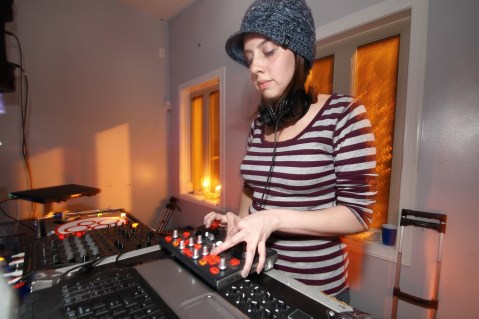
DJ Lush, FORWARD Winter Session 2012, Image by JHG Photography (c)
Because DJ sets are expected to be filled with pre-recorded sounds, the selection of sounds available is as broad as all of the sounds ever recorded. Specific styles of DJ sets, like an ambient DJ set, limit the selection down to a subset of recorded music. The choice of hardware can limit that even more. An all-vinyl DJ set of ambient music presents more of a challenge, in terms of selection, than a laptop set in the same style, because there are fewer ambient records pressed to vinyl than are available in a digital format.
Connected to selections are transitions, which could be said to define a DJ. When thinking of transitions there are two component factors: the playlist and going from one song to another. The playlist is obviously directly tied to the selection; however, even if you select the most popular songs for the style, unless they are put into a logical order, the transitions between them could make the set horrible.
One of the transitional keys to keeping a mix flowing is beat matching. In a turntable DJ set the beat mapping degree of difficulty is high because all of the tempos have to be matched manually by adjusting the speed of the two selections on the spinning turntables. When the tempos are synchronized, transitioning from one to the other is accomplished via a simple crossfade. With digital hardware such as the laptop, Serato and even CDJ setups, there is commonly a way to automatically match beats between selections. This makes the degree of difficulty to beat match in these formats much lower.
Effects, another variable, rely on what’s available through the hardware medium. With the turntable DJ set, the mixer is the primary source of effects and those until recent years have been limited to disc manipulation (e.g. scratching), crossfader, and EQ effects. Many of the non vinyl setups and even some of the vinyl setups now include a variety of digital effects like delay, reverb, sampler, granular effects and more.
With these variables so defined it becomes easier to objectively analyze the expressed variability of a live DJ set. But, while the variables themselves are objective, the value placed on them and even how they are evaluated are not. The language only provides the common ground for analysis and discussion. So the next time you’re at an event and the person next to you says, “this DJ is a hack!” you can say, “well they’ve got a pretty diverse selection with rather seemless transitions, maybe you just don’t like the music,” to which they’ll reply, “yeah, I don’t think I like this music,” which is decent progress in the scheme of things. If we really want to talk about live electronic performance however we will need to move beyond the DJ set to exemplify how this variable language can work to accurately describe the other musical objects which appear at a live electronic performance.

Joe Nice at Reconstrvct in Brooklyn NY on 2-23-2013, Photo by Kyle Rober, Courtesy of Electrogenic
Take for example another electronic instrument: the keyboard. The keyboard itself is a challenging instrument to define; in fact I could argue that the keyboard is itself not actually an instrument but a musical object. It is a component part of a group of instruments commonly referred to as keyboards, but the keyboard itself is not the instrument. What it is is one of the earliest examples of controllerism.
On a piano, typically fingers are used to press keys on the keyboard, which trigger the hammers to hit the strings and produce sound. The range of the instrument travels seven octaves from A0 to C8, and can theoretically have 88 voice polyphony, though in typical that polyphony is limited to the ten fingers. It can play a wide range of dynamics and includes pedals which can be used to modify the sustainabilty of pitches. With a pipe organ, the keyboard controls woodwind instruments with completely different timbre, range, and dynamics; the polyphony increases and the foot pedals can perform radically different functions. The differences from the piano grow even more once we enter the realm where the term “keyboard,” as instrument, is most commonly used: the synthesizer keyboard.
The first glaring difference is that, even if you have an encyclopedia of knowledge about keyboard synthesizers, when you see a performer with one on stage you simply cannot know by seeing what sounds it will produce. Pressing the key on a synthesizer keyboard can produce an infinite number of sounds, which can change not just from song to song, but from second to second and key to key. A performer’s left thumb can produce an entirely different sound than their left index finger. Using a keyboard equipped with a sequencer, the performer’s fingers may not press any keys at all but can still be active in the performance.

Minimoog Voyager Electric Blue, Image by Flickr User harald walker
When the keyboard synthesizer was first introduced, it was being used by traditional piano players in standard band configurations, like a piano or organ, with timbres being limited to one during a song and the performance aspect being limited to fingers pressing keys. Some keyboardists however used the instrument more as a bank for sound effects and textures. They may have been playing the same keys, but one wouldn’t necessarily expect to hear a I IV V chord progression. Rather than listening for the physical dexterity of the player’s fingers, the key to listening to a keyboard in this context was evaluating the sounds produced first and then how they were played to fit into the surrounding musical context.
Could one of these performers be seen as more competent than the other? Possibly. The first performer could be said to be one of the most amazing keyboard players in the piano player sense, but where they aren’t really maximizing the variability potential of the instrument, it could be said they fall short as a keyboard synthesizer performer. The second performer on the other hand may not even know what a I IV V chord progression is and thus be considered incompetent on the keyboard in the piano player sense, but the ways in which they exploit the variable possibilities shows their mastery of the keyboard synthesizer as an instrument.
Well, almost.
While generally speaking there isn’t a set of variables which define the keyboard synthesizer as an instrument, if we think of the keyboard synthesizer as a group of musical instruments, each of the individual types of keyboard synthesizers come with their own set of fixed variables which can be defined. Many of these variables are consistent across the various keyboards but not always in a standard arrangement.
As such, while the umbrella term “keyboard” persists it is perhaps more practical to define the instruments and their players individually. There are Juno 60 players, ARP Odyessy players, MiniMoog players, Crumar Spirit players and more. Naturally an individual player can be well versed in more than one of these instruments and thusly be thought of as a keyboardist, but their ability as a keyboardist would have to be properly contextualized per instrument in their keyboard repertoire. Using the MiniMoog as an example we can show how its variability as an instrument defines it and plays into how a performance on the instrument can be perceived.

Minimoog, Image by Flickr User Francesco Romito
The first variable worth considering when evaluating the MiniMoog is that it is a monophonic instrument. This is radically different from the piano; despite one’s ability to use ten fingers (or other extremity) only one note will sound at one time. The keyboard section of the instrument is only three and a half octaves long, though the range is itself variable. On the left-hand side there is a pitch wheel and a modulation wheel. The pitch wheel can vary the pitch of the currently playing note, while the modulation wheel can alter the actual sound design.
As a monophonic instrument, one does not need to have both hands on the keyboard, as only one note will ever sound at a time. This frees the hands to modify the sound being triggered by the keyboard exemplified via the pitch and modulation wheels, but also available are all of the exposed controls for the sound design. This means that in performance every aspect of the sound design and the triggering can be variable. Of course these changes are limited to what one can do with their hands, but the MiniMoog also features a common function in analog synths, a Control Voltage input. This means that an external source can control either the aspects of the sound design and/or the triggering for the instrument.
Despite this obvious difference from the piano, playing the MiniMoog does not have to be any less of a physical act. A player using their right hand to play the keyboard while modulating the sound with their left, plays with a different level of dexterity than the piano player. The right and left hand are performing different motions; while the right hand uses fingers to press keys as the arm moves it up and down the keyboard, the left hand can be adjusting the pitch or modulation wheels with a pushing action or alternately adjusting the knobs with a turning action. Like patting your head and rubbing your belly, controlling a well-timed filter sweep while simultaneously playing a melody is nowhere near as easy as it sounds.
At the same time playing the MiniMoog doesn’t have to be very physical at all. A sequencer could be responsible for all of the note triggering leaving both hands free to modulate the sound. Similarly the performer may not touch the MiniMoog at all, instead playing the sequencer itself as an intermediary between them and the sound of the instrument. In this case the MiniMoog is not being used as a keyboard, yet it retains its instrument status as all of the sounds are being generated from it, with the sequencer being used as the controller. Despite not having any physical contact with the instrument itself, the performer can still play it.

Minimoog in Live DJ Performance, Image by Fluckr Users Huba and Silica
Taking it one step further – if a performer were to only touch a sequencer at the start of the performance to press play and never touch the instrument, could they still be said to be playing the MiniMoog live? There is little doubt that the MiniMoog is indeed still performing because it does not have the mechanism to play by itself, but requires agency to illicit a sonic response. In this example that agency comes from the sequencer, but that does not eliminate the performer. The sequencer itself has to be programmed in order to provide the instrument with the proper control voltages, and the instrument itself has to be set up sonically with a designed sound receptive to the sequencer’s control. If the performer is not physically manipulating either device however, they are not performing live, the machines are.
From this we can establish the first dichotomy of electronic performance; the layers of variability in an electronic performance can be isolated into two specific categories: physical variability and sonic variability. While these two aspects are also present in traditional instrument performance, they are generally thought to not be mutually exclusive without additional devices. The vibrato of an acoustic guitar is only accomplished by physically modulating the strings to produce the effect. With an electronic instrument however, vibrato can be performed by an LFO controlling the amplitude. That LFO can be controlled physically but there does not have to be a physical motion (such as a knob turn) associated with it in order for it to be a live modulation or performance. The benefit of it running without physical aid is that it frees up the body to be able to control other things, increasing the variability of the performance.
In a situation where all of the aspects of the performance are being controlled by electronic functions, the agency in performance shifts from the artist performing live, to the artists establishing the parameters by which the machines perform live. Is the artist calling this a live performance a hack? Absolutely not, but it’s important that the context of the performance is understood for it to be evaluated. Like evaluating the monophonic MiniMoog performer based on the criteria of the polyphonic pianist, evaluating a machine performance based on physical criteria is unfair.

Daniel Carter on horn during Overcast Radio’s set at EPICENTER: 02, Photo courtesy of Raymond Angelo (c)
In the evaluation of a machine performance, just as with a physical one, variability still plays an important role. At the most base level the machine has to actually be performing and this is best measured by the potential variability of the sound. This gets tricky with digital instruments, as, barring outside influences, it is completely possible to repeat the exact same performance in the digital domain, so that there is no variation between each iteration. But even such cases with a digital sequencer controlling a digital instrument, with no physical interaction, are still a machine performances; they just exhibit very little variability. The performance aspect of the machine only disappears when the possibility for variability is completely removed, at which point the machine is no longer a performance instrument but a playback device as is the case with a CD player playing a backing track. The CD player if not being manipulated physically or by an external control is not a performance instrument as all of the sound contained within it can only be heard as one fixed recorded performance, not live. It is only when these fixed performances are manipulated either physically (ie a DJ set) or by other means, that they go from fixed performances to potentially live ones.

Mala and Hatcha in Detroit, Image by Tom Selekta
From all of this we arrive at four basic distinctions for live electronic performances:
• The electro/mechanical manipulation of fixed sonic performances
• The physical manipulation of electronic instruments
• The mechanized manipulation of electronic instruments
• A hybrid of physical and mechanized manipulation of electronic instruments
These help set up the context for evaluating electronic performances, as before we can determine the quality of a performance we must first be able to distinguish what type of performance we are observing. So far we’ve only dealt with a monophonic instrument, but even with its limitations can see how the potential variability is quite high. As we get into the laptop as a performance instrument that variability increases exponentially.
This is part two of a three part series. In the next part we will begin to exemplify the laptop as performance instrument, using this language to show the breadth of variability available in electronic performance and perhaps show that indeed, where that variability continues to be explored, there is merit to the potential of live electronic music as an extension of jazz.
—
Native Frequencies at the Trocadero 2013, Featured Image Courtesy of Raymond Angelo (C)
—
Primus Luta is a husband and father of three. He is a writer, technologist and an artist exploring the intersection of technology and art, and their philosophical implications. He is a regular guest contributor to the Create Digital Music website, and maintains his own AvantUrb site. Luta is a regular presenter for the Rhythm Incursions Podcast series with his show RIPL. As an artist, he is a founding member of the live electronic music collective Concrète Sound System, which spun off into a record label for the exploratory realms of sound in 2012.
—
REWIND! . . .If you liked this post, you may also dig:
Experiments in Agent-based Sonic Composition–Andreas Pape
Evoking the Object: Physicality in the Digital Age of Music–-Primus Luta
Sound as Art as Anti-environment–Steven Hammer
Share this:


Current Top Posts





April 2021

January 2020

November 2019

October 2019

August 2019

April 2014

November 2017

March 2015

December 2017

October 2015
 Sounding Out!
Recent Comments