
Press Play and Lean Back: Passive Listening and Platform Power on Nintendo’s Music Streaming Service

I remember long car rides as a kid in the early 2000s, headphones on, gazing out the window at the passing scenery while looping background music from The Legend of Zelda and Pokémon games on my Game Boy. After school, I’d occasionally throw the Super Smash Bros. Melee soundtrack on my Discman CD player, keeping me motivated while doing homework. Like many others, I found Nintendo’s music to be an effective accompaniment to everyday activities, a kind of functional listening long before streaming platforms like Spotify and YouTube made it trendy. Which raises the question: how has Nintendo adapted to the streaming age?
Unlike many other game publishers, Nintendo has conspicuously kept its music off streaming services—despite having some of the most recognizable soundtracks in video game history, such as Super Mario Bros., Donkey Kong, and Metroid. Instead, the company took a different direction by unveiling its own music streaming service in October 2024, aptly titled Nintendo Music. The platform, available to Nintendo Switch Online subscribers, showcases soundtracks spanning the company’s history, from 1980s NES titles to recent Nintendo Switch 2 releases.
In a listening landscape dominated by Spotify, Apple Music, and YouTube Music, Nintendo’s decision to launch its own proprietary streaming service makes it unique among video game companies. This move is idiosyncratic in a way that feels characteristically Nintendo, but it is also a bold bid to compete in the broader attention economy. By situating itself alongside, rather than within, the major music streaming services, Nintendo signals that its soundtracks are valuable cultural content worth curating and controlling directly.
Nintendo Music caters specifically to video game fans by including screenshots with each track, having a “Spoiler” filter that lets users block music from games they haven’t played, and making personalized recommendations based on each user’s play history. But perhaps most notable is its emphasis on background listening: through features like mood playlists and an “Extend” tool, video game music is explicitly framed as a companion for contexts like relaxing, working out, or doing household chores.
By repurposing game soundtracks as tools for everyday routines, Nintendo Music capitalizes on nostalgia and contemporary listening habits to deepen fan engagement and retain control over its brand—a strategic move from a company that is famously (over)protective of its intellectual property. More generally, it also reflects neoliberal logics in which music is woven into daily life to regulate mood and productivity, revealing the increasing reach of digital platforms over how we work, listen, and live.
Listening in Loops: Video Game Music in the Background
In advertisements for Nintendo Music, actors hum and sing along to famous video game tunes while carrying out their daily activities. “Whether you’re grocery shopping, straightening up at home, or getting some studying done, Nintendo Music can be the background sound to your everyday life,” the description to one video reads.
This marketing is strikingly similar to strategies by streaming services such as Spotify, which encourage listening to music in any and every context. Playlists based around specific moods or activities—like Spotify’s “Gym Hits,” “Intense Studying,” and “sad girl starter pack”—use music as a tool to manage listeners’ energy levels, focus, and emotions as they go about their lives. Anahid Kassabian’s concept of “ubiquitous listening” helps describe this phenomenon, showing how even passive, background engagement can shape listeners’ affects and experiences.
In many ways, video game music is ideal for the ubiquitous listening that streaming services promote. Game soundtracks are generally (though not always) designed for the background and are usually instrumental, setting the emotional tone of on-screen action, from serene soundscapes to intense boss battles. Unlike other multimedia soundtracks, such as film scores, much video game music is also composed to loop indefinitely, making it especially effective for sustained listening.
As Michiel Kamp demonstrates in Four Ways of Hearing Video Game Music, “background listening” is one of the main ways users experience video game soundtracks. He writes that “background music both in games and elsewhere requires us to be so attuned to it that it offers no experiential friction in need of interpreting, and through this it has the capacity to attune us to our environment, be it a mythical underworld full of dangers or a convenience store full of groceries” (2024, 175).
While Kamp primarily focuses on background listening while playing games, game music can attune listeners to moods, activities, or environments even when heard outside of gameplay. In fact, video games train us to listen in this way, using music to establish the appropriate affect for narrative events, settings, and characters. These immersive qualities have made video game music immensely popular on streaming services: soundtracks from games and franchises like Halo, Final Fantasy, The Elder Scrolls, Undertale, and Minecraft have collectively garnered over a billion streams on Spotify alone.
But Nintendo, by launching its own proprietary platform, trades streaming royalties and wider exposure for something arguably more valuable: the ability to control how and where fans experience its content.
Features in Focus: Nintendo Music’s Approach to Passive Listening
Nintendo Music’s features illustrate how the service adapts soundtracks for continuous, everyday listening. Perhaps most notable is the service’s unique Extend feature, which allows users to stretch the runtime of tracks up to 60 minutes. Described in the app as “the perfect accompaniment to studying or working,” this feature facilitates seamless background listening without the distraction of frequent track changes. So if you’ve ever wanted to loop the Wii Shop music for a full hour—and let’s be honest, who hasn’t—now you can.


Alongside complete soundtracks, Nintendo Music also foregrounds curated playlists, including those based around specific video game characters, themes, and moods. The “Powering Up” playlist features “up-tempo tracks to fill you with energy,” for example, while “Good Night” has “down-tempo tracks to help you drift into dreamland.” Screenshots for each track further immerse listeners, visually reinforcing the moods and environments the music is designed to evoke. On these playlists, Nintendo’s music is presented less as individual compositions and more as “vibes.”

Packaging music around moods or vibes is not a neutral act. In Mood Machine: The Rise of Spotify and the Costs of the Perfect Playlist, Liz Pelly asserts that “organizing music by mood is a way to transform it into a new type of media product. It is about selling users not just on moods, but on the promise of the very concept that mood stabilization is something within their control. It’s a tactic for luring users to double click and start streaming” (2025, 40). Pelly’s observation underscores that mood-based playlists do more than entertain: they are a way for platforms to influence how listeners organize their time and attention.
Furthermore, Nintendo Music’s approach positions music not only as a creative or cultural artifact, but also as a commodified resource for self-regulation. This aligns with Eric Drott’s claim that streaming services often employ music as a “technology of social reproduction,” used to structure and maintain day-to-day existence. For Drott, this is “part of a broader tendency under neoliberal capitalism that prizes music, the arts, and culture not on account of their aesthetic worth but on account of their ‘expediency’ for other social, political, and economic ends” (2024, 197).
Many users still actively listen to their favourite Nintendo soundtracks on the platform, and there’s also nothing inherently wrong with background listening—it’s how much of this music was originally designed to be heard. However, presenting music as an aid to concentration, productivity, or mood regulation also risks repurposing soundtracks as a form of “neo-Muzak,” a vehicle for continuous consumption designed to keep listeners plugged into Nintendo’s broader product ecosystem.
Background Benefits: Nintendo’s Platform Power
Beyond guiding listening habits, Nintendo Music reinforces the company’s brand image of nostalgia, innovation, and family-friendly fun while increasing engagement with its intellectual property on its own terms. As a Nintendo spokesperson said in an interview with Nippon TV News, “To increase the number of people who have access to Nintendo IP, we believe that game music is an important and valuable form of content. Nintendo Music is a service that allows us to deliver this game music in a way that is uniquely Nintendo. . . . We hope that Nintendo Music will help you recall some of your favorite gaming experiences and think that it will also encourage people to play the games again” (translation by Nicholas Anderson).
Nintendo’s efforts to centralize its music are also likely, at least in part, a response to fans unofficially circulating soundtracks online. As part of a broader trend of functional music compilations (think lofi beats to study/relax to), YouTube hosts countless user-generated Nintendo music playlists designed for activities such as studying and sleeping. Despite Nintendo’s notoriety for issuing takedown notices over copyright infringement—including shutting down the massively popular YouTube video game music channel GilvaSunner in 2022—many of these unofficial videos and reuploads continue to accrue millions of views.
By providing an official home for soundtracks and its own contextual playlists, Nintendo Music is a subtle exercise in platform power, gating access to subscribers. It redirects listeners from other platforms, letting Nintendo control its content without diluting its brand on third-party services. Although Nintendo Music’s catalogue is currently slim—as of writing it has roughly 100 soundtracks—the company continues to trickle out new music most weeks, incentivizing listeners to keep coming back.
Nintendo Music promotes ongoing background listening not only to attract users who are already accustomed to mood and activity playlists, then, but also to keep them on the platform and connected to the company’s games and services. After all, every minute a listener spends on Nintendo Music looping David Wise’s “Aquatic Ambiance” from Donkey Kong Country is a minute they aren’t spending on YouTube, Spotify, or any other entertainment platform.
* * *
Video game music is, in many respects, perfectly suited for the streaming age. From the popularity of playlists to the ascent in ambient music, streaming services’ focus on passive listening aligns with the background function of video game soundtracks. As we’ve seen, Nintendo Music takes full advantage of this, using its marketing and features to bolster branding, solidify control over IP, and encourage engagement.
For many, Nintendo Music offers an enjoyable experience and a convenient way to stream nostalgic soundtracks. But the service also exposes how proprietary platforms concentrate power and leverage passive listening for ongoing consumption, reinforcing broader patterns where work and leisure become intertwined with corporate interests. By prompting users to integrate Nintendo’s music into their activities, the platform extends the reach of its games beyond the screen and into daily life.
Whether you’re listening to famed composer Koji Kondo or everyone’s favourite troubadour dog K.K. Slider, Nintendo’s message is clear: press play and lean back.
—
Featured Image: “Mario Kart” by MIKI Yoshihito (#mikiyoshihito), CC BY 2.0
—
Ryan Blakeley is Visiting Assistant Professor at Northeastern University and holds a PhD in Musicology from the Eastman School of Music. His research investigates how digital platforms like music streaming services are shaping creative practices, listening habits, and music industry power dynamics.
—
REWIND!…If you liked this post, you may also dig:

Video Gaming and the Sonic Feedback of Surveillance: Bastion and the Stanley Parable–Aaron Trammell
Playing with the Past in the Imagined Middle Ages: Music and Soundscape in Video Games–James Cook
Beyond the Grave: The “Dies Irae” in Video Game Music–Karen Cook
Sounding Out! Podcast #29: Game Audio Notes I: Growing Sounds for Sim Cell–Leonard J. Paul
Papa Sangre and the Construction of Immersion in Audio Games— Enongo Lumumba-Kasongo
Share this:

Critical bandwidths: hearing #metoo and the construction of a listening public on the web

“A focus on listening [with technology] shifts the idea of freedom of speech from having a platform of expression to having the possibility of communication” (K. Lacey)
One of the biggest social media event of the past decade, #metoo stands out as a pivotal shift in the future of gender relations. Despite its persistence since October 2017, #metoo is still under-theorized, and since its permutations generate countless hashtag sub-categories each passing week, making sense of it presents a conceptual quagmire. Tracing its history, identifying key moments, mapping its pro- and counter-currents present equally tough challenges to both data science and feminist scholars.
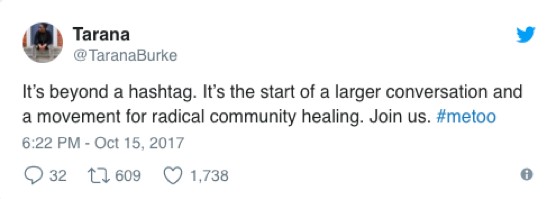
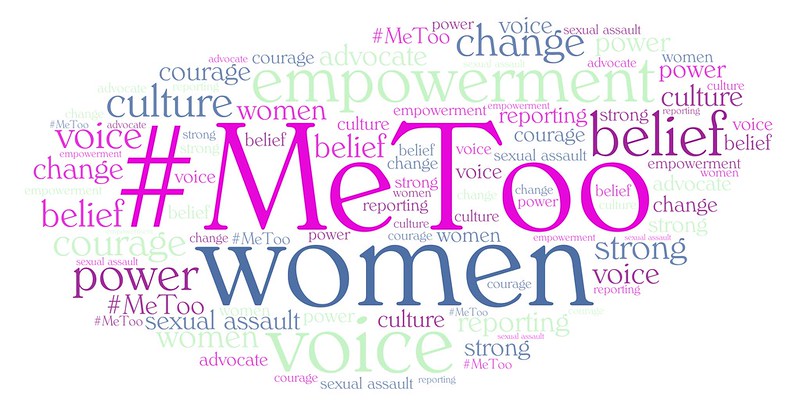
Meta-communication about #metoo abounds. Infographics and visualizations attempt to contain its organic growth into perceivable maps and charts; pop news media constantly report on its evolution in likes, counts, and retweets, as well as—and increasingly—in number of convictions, lawsuits, and reports. At the same time, #metoo has arguably created a discernible listening public in the way that Kate Lacey (2013) argues emerged with national radio: women’s stories have never been listened to with such wide reach and rapt attention.

The project I discuss here takes ‘hearing’ #metoo a step further into the auditory realm in the form of data sonification so as to to re-imagine an audience compelled to earwitness not just the scope but the emotional impact of women’s stories. Data sonification is a growing field, which from its inception has crossed between art and science. It involves a conceptual or semantic translation of data into relevant sonic parameters in a way that utilizes perceptual gestalts to convey information through sound.
Brady Marks and I created the #metoo sonification you’ll hear below by drawing from a public dataset spanning October 2017 to the early Spring of 2018 obtained from data.world. Individual tweets using the hashtag are sonified using female battle cries from video games; the number of retweets and followers forms a sort of swelling and contracting background vocal texture to represent the reach of each message. The dataset is then sped up anywhere between 10x to 1000x in order to represent perceivable ebbs and flows of the hashtag’s life over time. The deliberate aim in this design was to convey a different sensibility of social media content, one that demands emotional and intellectual attention over a duration of time. Given Twitter’s visual zeitgeist whereby individual tweets are perceived at a glance and quickly become lost in the noise of the platform the affective attitude towards “contagious” events becomes arguably impersonal. A sonification such as this asks the listener to spend 30 minutes listening to 1 month of #metoo: something impossible to achieve on the actual platform, or in a single visualization. The aim, then, is to interrupt social media’s habitual and disposable engagements with pressing civic debates.
A critique of big data visualization
To date, there have been more than 19 million #MeToo tweets from over 85 countries; on Facebook more than 24 million people participated in the conversation by posting, reacting, and commenting over 77 million times since October 15, 2017. In a global information society ‘big data’ is translated into creative infographics in order to simultaneously educate an overwhelmed public and elicit urgency and accord for political action. Yet ideological and political considerations around the design of visual information have lagged behind enthusiasm for making data ‘easy to understand’. At the other end of the spectrum, social media delivers personalized micro-trends directly and in real time to always-mobile users, reinforcing their information silos (Rambukkana 2015). Between these extremes, the mechanisms by which relevant local, marginalized or emergent issues come to be communicated to the wider public are constrained.
With this big idea in mind, the question we ask here is what would it mean to hear data? Emergent work in sonification suggests that sound may afford a unique way to experience large-scale data suitable for raising public awareness of important current issues (Winters & Weinberg 2015). The uptake of sonification by the artistic community (see Rory Viner, Robert Alexander, among many others) signals its strengths in producing affective associations to data for non-specialized audiences, despite its shortcomings as a scientific analysis tool (Supper, 2018). Some of the more esoteric uses of sonification have been in the service of capturing what Supper calls ‘the sublime’ – as in Margaret Schedel’s “Sounds of Science: The Mystique of Sonification.”
Who’s listening on social media?
Within the Western canon of sound studies “constitutive technicities” (Gallope 2011) or what Sterne calls “perceptual technics” embody historically situated ways of listening that center technology as a co-defining factor in our relationship with sound. Within this frame, media sociologist Kate Lacey traces the emergence of the modern listening public through the history of radio. Using the metaphor of ‘listening in” and “listening out,” Lacey reframes media citizenship by pointing out that listening is a cultural as well as a perceptual act with defined political dimensions:
Listening out is the practice of being open to the multiplicity of texts and voices and thinking of texts in the context of and in relation to a difference and how they resonate across time and in different spaces. But at the same time, it is the practice and experience of living in a media age that produces and heightens the requirement, the context, the responsibilities and the possibilities of listening out (198)
According to Lacey, a focus on listening instead of spectatorship challenges the implicit active/passive dualism of civic participation in Western contexts. More importantly, she argues, we need to move away from the notion of “giving voice” and instead create meaningful possibilities to listen, in a political sense. Data sonification doesn’t so much ‘give voice to the voiceless’ but creates a novel relationship to perceiving larger patterns and movements.
Our interactions with media, therefore, are always already presumptive of particular dialogical relations. Every speech act, every message implies a listening audience that will resonate understanding. In other words, how are we already listening in to #metoo? How and why might data sonification enable us to “listen out” for it instead? In order to get a different hearing, what should #metoo sound like?

Sonifying #metoo: the battle cries of gender-based violence
It is unrealistic to expect that your everyday person will read large archives of testimony on sexual harassment and gender-based violence. Because of their massive scale, archives of #metoo testimony pose a significant challenge to the possibility for meaningful communication around this issue. Essentially drowning each other out, individual voices remain unheard in the zeitgeist of media platforms that automates quantification while speeding up engagement with individual contributions. To reaffirm the importance of voice would mean to reaffirm inter-subjectivity and to recognize polyphony as an “existential position of humanity” (Ihde 2007, 178). This was the problem to sonify here: how to retain individual voices while creating the possibility for listening to the whole issue at hand. Inspired by the idea of listening out, myself and artist collaborator Brady Marks set out to sonify #metoo as a way of eliciting the possibility for a new listening public.

The #metoo sonification project intersected deeply with my work on the female voice in videogames. My choice to use a mixed selection of battle cry samples from Soul Calibur, an arcade fighting game, was intuitive. Battle cries are pre-recorded banks of combat sounds that video game characters perform in the course of the story. Instances of #metoo on Twitter presumably represent the experiences of individual women, pumping a virtual fist in the air, no longer silent about the realities of gender-based violence. So hearing #metoo posts as battle cries of powerful game heroines made sense to me. But it’s the meta layers of meaning that are even more intuitive: as I’ve discussed elsewhere, female battle cries are notoriously gendered and sexualized. Listening to a reel of sampled battle cries is almost indistinguishable from listening to a pornographic soundscape. Abstracted in this sonification, away from the cartoonish hyper-reality of a game world, these voices are even more eerie, giving almost physical substance to the subject matter of #metoo. Just as the female voice in media secretly fulfils the furtive desires of the “neglected erogenous zone” of the ear (Pettman 2017, 17), #metoo is an embodiment of the conflation of sex with consent: the basis of what we now call ‘rape culture.’
Sonifying real-time data such as Twitter presents not only semantic (how should it sound like) but also time-scale challenges. If we are to sonify a month – e.g. the month of November 2017 (just weeks after the explosion of #metoo) – but we don’t want to spend a month listening, then that involves some conceptual time-scaling. Time-scaling means speeding up instances that already happen multiple times a second on a platform as instantaneous and global as Twitter. Below are samples of three different sonifications of #metoo data, following different moments in the initial explosion of the hashtag and rendered at different time compressions. Listen to them one at a time and note your sensual and emotive experience of tweets closer to real-time playback, compared to the audible patterns that emerge from compressing longer periods of time inside the same length audio file. You might find that the density is different. Closer to real-time the battle cries are more distinctive, while at higher time compressions what emerges instead is an expanding and contracting polyphonic texture.
Vocalizations of female pleasure/affect, video game battle cries already have a special relationship to technologies of audio sampling and digital reproduction as Corbett & Kapsalis describe in “Aural sex: the female orgasm in popular sound.” This means that the perceptual technics involved in listening to recorded female voices are already coded with sexual connotations. Battle cries in games are purposely exaggerated so as to carry the bulk of emotional content in the game’s experiential matrix. Roland Barthes’ notion of the “grain of the voice”—the presence of the body in (singing) voice—is frequently evoked in describing the substantive role that game voices play in the construction of game world immersion and realism. In the #metoo sonification, I decontextualize the grain of the voice—there are no visual images, narrative, or gameplay; the battle cries are also acousmatic, in that there are no bodies visually represented from which these sounds emanate.
The battle cry in this #metoo sonification is the ultimate disembodied voice, resisting what Kaja Silverman (1988) calls the “norm of synchronization” with a female body in The Acoustic Mirror (83). As acousmatic voices, these battle cries could be said to exist on a different conceptual and perceptual plane, “disturbing the taxonomies upon which patriarchy depends,” to quote Dominic Pettman in Sonic Intimacy. (22). In other words, the sounds exist in a boundary space between combat sounds and orgasmic sounds highlighting for the listener the dissonance between the supposed empowerment of ‘speaking out’ within a culture that remains staunchly set up to sexualize women; something one can hardly ignore given the media’s reserved treatment of #metoo.

Liberated from the game world these voices now speak for themselves in the #metoo sonification, their sensuality all the more hyper-real. The player has no control here, as the battle cries are not linked to specific game actions, rather they are synchronized autonomously to instances of #metoo confessionals. In fact, the density of the sonification as time speeds up will overwhelm listeners with its boundlessness; echoing how contemporary media treats the sounds of the female orgasm as a renewable and inexhaustible resource, even as reports of sexual harassment and gender-based violence continue to pile on in 2021. Yet we intend that the subject matter resists pleasure, rendering the sonic experience traumatic as the chilling realization sets in that listeners are hailed to accountability by #metoo. The experience should instead be unsettling, impactful, grotesque, and deeply embodied.
Concluding remarks
Listening both metaphorically and literally goes to the very heart of questions to do with the politics and experience of living and communicating in the media age. In her paper on the sonic geographies of the voice, AM Kanngieser notes in “A Sonic Geography of Voice“: “The voice, in its expression of affective and ethico-political forces, creates worlds” (337). It is not just in the grain but in the enunciation that battle cries find their political significance in this sonification. As the hyper-real gasps and moans of game heroines animate individual moments of #metoo the codification of cartoonish voices resists being subconsciously “absorbed into the dialogic exchange” (342) of habitual media consumption. Listening to the sonification is instead an experience of re-coding the voice, reconfiguring the embedded meanings of game sound to a new and contradictory context: a space that challenges neoliberal appropriations of radical communication and discourse (348). This is not data sonification that delights the listener or simply grants them access to ‘information’ in a different format; rather it calls on the listener to de-normalize their received technicity and perceptions and to connect to the emotional inter-subjectivity of this call to action.
Most importantly, the #metoo sonification invites the auditeur to listen in, to take an active role in the reconfiguration of meanings and absorb their political dimensions. These are the stories of #metoo; these are the voices of women, of men, of marginalized peoples, emerging from the zeitgeist of Twitter to ask us to earwitness gender-based violence. We are a new listening public, wanting and needing to create new worlds. A critical bandwidth is the smallest perceivable unit of auditory change, in psychology terms. This sonification begs the question, how many battle cries will it take for us to end gender-based violence by fostering equitable worlds?
—
Featured Image: “Listen to What You See” by Flickr User Hernán Piñera (CC BY-SA 2.0)
—
Milena Droumeva is an Assistant Professor and the Glenfraser Endowed Professor in Sound Studies at Simon Fraser University specializing in mobile media, sound studies, gender, and sensory ethnography. Milena has worked extensively in educational research on game-based learning and computational literacy, formerly as a post-doctoral fellow at the Institute for Research on Digital Learning at York University. Milena has a background in acoustic ecology and works across the fields of urban soundscape research, sonification for public engagement, as well as gender and sound in video games. Current research projects include sound ethnographies of the city (livable soundscapes), mobile curation, critical soundmapping, and sensory ethnography. Check out Milena’s Story Map, “Soundscapes of Productivity” about coffee shop soundscapes as the office ambience of the creative economy freelance workers.
Milena is a former board member of the International Community on Auditory Displays, an alumni of the Institute for Research on Digital Learning at York University, and former Research Think-Tank and Academic Advisor in learning innovation for the social enterprise InWithForward. More recently, Milena serves on the board for the Hush City Mobile Project founded by Dr. Antonella Radicchi, as well as WISWOS, founded by Dr. Linda O Keeffe.
—

REWIND! . . .If you liked this post, you may also dig:
“One Scream is All it Takes: Voice Activated Personal Safety, Audio Surveillance, and Gender Violence“—María Edurne Zuazu
Gendered Sonic Violence, from the Waiting Room to the Locker Room–Rebecca Lentjes
SO! Amplifies: Mendi+Keith Obadike and Sounding Race in America
detritus 1 & 2 and V.F(i)n_1&2 : The Sounds and Images of Postnational Violence in Mexico–Luz María Sánchez
Hearing Eugenics—Vibrant Lives
Share this:


Current Top Posts





April 2021

January 2020

November 2019

October 2019

August 2019

April 2014

November 2017

March 2015

December 2017

October 2015
 Sounding Out!
Recent Comments