
Learning to Listen: The Velvet Underground’s “Once Lost” LPs

 Welcome back to Start a Band, our two-part series on Lou Reed and the Velvet Underground, focusing on what the band’s sonic provocations mean for sound studies today. Last week, we heard from Jake Smith, who introduced us to a way of thinking about the Velvets that emphasized the “haptic” qualities that emerge so often while listening to them. Following that idea, Smith took us on a kind of journey from the skin to the musculature and the viscera through a deep analysis of key songs in their catalog — “This is your body on the Velvet Underground.”
This week, we’re delighted to welcome to Sounding Out! a writer whose work we’ve been eager to feature for a long while — Tim Anderson, Associate Professor of Communication and Theatre Arts at Old Dominion University. Tim has written extensively on popular music and sound, and is currently a leader of the Sound Studies Scholarly Interest Group at the Society for Cinema and Media Studies, one of the scholarly groups associated with the SO! Thursday stream. It’s such a pleasure to present this sensitive and personal account of the Velvet Underground — and of learning to listen.
– NV
—

Lou Reed and Andy Warhol as the respective definers of audible and visual cool for misfits and undergroundlings for the last five decades.
Reports of Lou Reed’s death came on a Sunday. Even though he was 71, it was still a shock. To many present-day friends and colleagues Reed’s Velvet Underground are a band that they understand are important, but just don’t get. In the case of an artist like Lou Reed, an artist who never had a top ten charting single and only two gold albums, you could see their point.
Still, I obsessed. Rattled from my travels in Washington, DC, I called my wife and we talked about his music for about an hour or so, after which I took a long walk to the Washington Mall. It was a sunny fall day, October 27, 2013, and I walked past the Smithsonian with its prominent memorials, such a clean space for so much past, some of which the nation has buried and some of which we don’t even bother to think about. The deceased have always done the most important work in our nation’s capital.
The day after, I really don’t remember doing much. I took a train home, read everything I could online about Reed, and thought a lot about his records. The ones I liked —New York and The Blue Mask—the ones I learned to like —it took me years to enjoy Transformer—and the ones I loved —The Velvet Underground and Nico, White Light, White Heat, The Velvet Underground and VU. Those four records, more than any records I can remember, altered me, many of my friends in my teens and in college, and almost every rock musician I admired in the 1980s. Velvet Underground records were simply foundational. Writing about Reed’s death, rock critic Greg Kot summed up the Velvet’s influence by claiming that they were “as influential as The Beatles” and if you named “just about any left-of-centre band or artist since the ‘70s”, some of whom like R.E.M., U2 and Talking Heads “became mainstream giants”all of them would “acknowledge a deep debt to the Velvet Underground.”
This influence is the reason that the collective mourning of such a marginally popular figure swelled to such a crescendo. However, to paraphrase the words of one of Reed’s most storied rivals, Lester Bangs, on the death of John Lennon, this was not the mourning of a person. Most of us never met Lou Reed. Instead, we were mourning ourselves. To lose Lou Reed was tantamount to losing the author of a proverbial urtext of a kind of secret rock language that has been passed down since the late 1960s on how to be cool. It was a language of composed of style, gestures, and reactions. It was one that was filled with a fun that was not of the obligatory “hey-dude-let’s-party!” party. The Velvet’s overdriven guitars repeatedly underscored that teenage kicks included other aesthetic pleasures such as contemplation and melancholy. Most importantly, the Velvet Underground offered a language of listening passed down from one rock underground to another.
Because pop fans of all stripes must learn how to be a fan, learning how and what to listen to is a taste-defining social exercise. Simon Frith once explained that, for him, “one aspect of learning how to be a rock fan in the 1960s was, in fact, learning to prefer [original records made by black artists of the 1950s] to covers [made by white artists of the same era]. And this was, as I recall, something that had to be learned [by Frith]: nearly all the records I had bought in the late 1950s had been the cover versions” (Performing Rites: On the Value of Popular Music, 1996). In my case, learning to listen also meant learning what to listen to while listening to The Velvet Underground, a process involving peers, record clerks, friends, musicians and reviews.
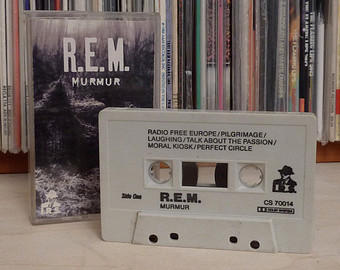
R.E.M.’s 1983 LP release of “Murmur” on cassette
As a young rock fan who began first collecting cassettes —that’s right, cassettes —this process would begin through an obsession with R.E.M.’s Murmur, a cryptic, odd inscrutable cassette with no lyrics, a black and white picture and layers of reverb. The copy I found had been severely discounted in a ma and pa record store in Globe, Arizona. In Summer 1983 I read a rave review in a copy of Rolling Stone and at 14 had purchased a cassette unlike anything I had ever heard; I wasn’t sure I enjoyed it. Why did so many reviewers seem to fall over themselves about this record? To solve this puzzle, it meant learning how to listen to music invested in tone rather than ostentatious chops. It meant paying attention to drones rather than solos. It meant following those features to Velvet Underground records after peers, record clerks, friends, musicians and reviews made a point that Murmur reminded them a bit of VU records.
Murmur was also the first record I ever purchased that embraced what Jacob Smith so wonderfully identifies as a distinctive trait of all Velvet Underground records. For Smith, these pop records are part of a genealogy that “stress evocative timbres, idiosyncratic voices, and signature sounds over structural or lyrical complexity.” The distillation of this pop ethos onto record was one of the reasons that so many musicians whose abilities may have been limited but whose tastes tended toward the poetic found The Velvets so influential. As Jonathan Richman explained, “I didn’t start singing or playing till I was 15 and heard the Velvet Underground. They made an atmosphere, and I knew that I could make one too!” (Quoted in Greil Marcus, Lipstick Traces: A Secret History of the Twentieth Century, 61). Indeed, Smith notes that the deceptive complexity of VU Records “can be found more on the level of timbre than in musical structure or instrumentation” and “lyrics often encourage a blurring of listening and touching”; his post actually reads like many of the conversations and reviews surrounding R.E.M.’s debut LP. The same could also be said of records released by other 1980s and 90s artists such as The Pixies, My Bloody Valentine, Opal, Mazzy Star, Radiohead, The Dream Syndicate, Galaxie 500, The Rain Parade, Green on Red, New Order, Joy Division, The Feelies, Spacemen 3, Sonic Youth, The Pretenders, The Sisters of Mercy, Ministry, The Jesus and Mary Chain, and The Violent Femmes, to name but a few who drew water from the Velvet Underground well. Bands sonically inspired by the Velvets often providing feedback before solos, drummed without cymbals, and portrayed dark themes sung in monotones that sounded sophisticated and obscure.
.
However, actually hearing a Velvet Underground record in 1983 and 1984 was a significant problem for newer fans, as their MGM catalog was out of print. Many understood these records to be effectively buried by label president Mike Curb’s infamous axing of the act from MGM along with seventeen others who allegedly promoted and exploited “hard drugs through music” (Tiegel, Eliot “Mgm Busts 18 Rock Groups.” Billboard, November 7 1970, 1, 70). As Lou Reed himself once noted, “it’s depressing when you’re still around and your albums are out of print.” I have often wondered if this was one of the reasons that The Velvets catalogue would have such a profound effect on so many of us. Sure, I had found a copy of Loaded, the band’s fourth official release, but its bright tones had none of the subversive menace that so many reviewers alluded to when speaking of the Velvets. Even in a mountain town in Arizona, I had a better chance of finding used copies of The Grateful Dead’s Wake of the Flood or Blues for Allah than I did The Velvet Underground and Nico. In other cities, in other record stores, when I did find those records they were used and prices started at $15 and up. They were records I simply could not afford to listen to.

The Velvet Underground’s “lost” fourth album, “VU”
All that changed after 1985, when every MGM Velvet Underground record would appear in my life for less than $25. Bill Levenson’s efforts as Polygram’s then A&R manager to reissue the buried and lost MGM catalog on Verve provided me and every other young person who had only “heard of The Velvet Underground” the chance to finally to listen to all of these records at once. Indeed, the moment of the catalogue’s reissue was simply a sonic flood, one where sounds filled in gaps that had been cut deeply by conversations, descriptions and my own imagination. Writing at the time about these reissues and the unveiling of a lost album’s worth of material that would be titled V.U., David Fricke argued that “rock historians and fans alike owe Bill Levenson, the executive producer of V.U., a debt of thanks for resurrecting these tracks and for giving the band’s first three LPs the proper reissue they’ve long deserved. At $5.98 list price, The Velvet Underground and Nico,White Light/White Heat and The Velvet Underground are essential purchases —certainly essential listening for any study of Seventies and Eighties punk evolution. As for V.U., the Great Lost Velvet Underground Album is no longer lost. It is simply great” (Fricke, David. “The Velvet Underground – V.U.” Rolling Stone, March 14 1985).

A 2012 ad for another reissue of the MGM Velvet Underground catalog and Nico’s first solo LP
Is it too much to suggest a that the pent up desire to hear a secret history sparked by The Velvet Underground’s reissues created the 80s/90s iteration of “alternative rock”? Perhaps, but history is filled with desires asserted, accepted and denied. Indeed, most of those aforementioned 80s alternative acts I came into contact with had been performing and recording and releasing records years before 1985. However, there is no doubt that the VU reissues turned a number of ears predisposed to hearing in a certain way onto new ways of listening to the Velvets concentrated doses of moody darkness, modes that earlier Velvet Underground fans simply had little access to.
Ignoring the impact of the sonic flood of VU material that fell upon my ears during this period turns away from a specific history of listening that, while personally unique, was an opportunity available to so many of my contemporaries. Indeed, if sounds have histories because their traces persist, then listening must have histories guided partially by testimonial. To hear these histories we might ask ourselves to remember how, why, and with whom did we listen, and to trade in this information. If we did so, we might better understand how we learned to listen: especially what to listen to and why it was important. And, without these testimonials of our pasts as listeners, we just may lose sound’s crucial other half.
—
Featured Image: “Velvet Underground Yellow Label Mono” by Flickr user Simon MurphyThe Velvet Underground – Yellow label mono
—
Tim J. Anderson is an Associate Professor of Communication and Theatre Arts at Old Dominion University where studies the multiple cultural and material practices that make music popular. He has published numerous book chapters, refereed journal articles, and two monographs: Making Easy Listening: Material Culture and Postwar American Recording (University of Minnesota Press, 2006) and Popular Music in a Digital Music Economy: Problems and Practices for an Emerging Service Industry (Routledge, 2014). His latest research project focuses on recordings, musicians, listeners and the public sphere. His website is timjanderson.weebly.com and he can be contacted at tjanders@odu.edu.
—
 REWIND!…If you liked this post, you may also dig:
“One Nation Under a Groove?: Music, Sonic Borders, and the Politics of Vibration” -Marcus Boon
“Sound + Vision: Andy’s Mick” -Eric Lott
“Hold this Thread: A Partial History of a Rock n’Roll Relationship”-Benjamin Gold
Share this:

The Blue Notes of Sampling

 This is article 2.0 in Sounding Out!‘s April Forum on “Sound and Technology.” Every Monday this month, you’ll be hearing new insights on this age-old pairing from the likes of Sounding Out! veterano Aaron Trammell along with new voices Andrew Salvati and Owen Marshall. These fast-forward folks will share their thinking about everything from Auto-tune to techie manifestos. So, turn on your quantizing for Sounding Out! and enjoy today’s supersonic in-depth look at sampling from from SO! Regular Writer Primus Luta. –JS, Editor-in-Chief
—
My favorite sample-based composition? No question about it: “Stroke of Death” by Ghostface and produced by The RZA.
.
Supposedly the story goes, RZA was playing records in the studio when he put on the Harlem Underground Band’s album. It is a go-to album in a sample-based composer collection, because of the open drum breaks. One such break appears in the cover of Bill Wither’s “Ain’t No Sunshine”, notably used by A Tribe Called Quest on “Everything is Fair.”
.
RZA, a known break beat head, listened as the song approached the open drums, when the unthinkable happened: a scratch in his copy of the record. Suddenly, right before the open drums dropped, the vinyl created its own loop, one that caught RZA’s ear. He recorded it right there and started crafting the beat.
This sample is the only source material for the track. RZA throws a slight turntable backspin in for emphasis, adding to the jarring feel that drives the beat. That backspin provides a pitch shift for the horn that dominates the sample, changing it from a single sound into a three-note melody. RZA also captures some of the open drums so that the track can breathe a bit before coming back to the jarring loop. As accidental as the discovery may have been, it is a very precisely arranged track, tailor-made for the attacking vocals of Ghostface, Solomon Childs, and the RZA himself.

“How to: fix a scratched record” by Flickr user Fred Scharmen, CC BY-NC-SA 2.0
“Stroke of Death” exemplifies how transformative sample-based composition can be. Other than by knowing the source material, the sample is hard to identify. You cannot figure out that the original composition is Wither’s “Ain’t No Sunshine” from the one note RZA sampled, especially considering the note has been manipulated into a three-note melody that appears nowhere in either rendition of the composition. It is sample based, yes, but also completely original.
Classifying a composition like this as a ‘happy accident’ downplays just how important the ear is in sample-based composition, particularly on the transformative end of the spectrum. J Dilla once said finding the mistakes in a record excited him and that it was often those mistakes he would try to capture in his production style. Working with vinyl as a source went a long way in that regard, as each piece of vinyl had the potential to have its own physical characteristics that affected what one heard. It’s hard to imagine “Stroke of Death” being inspired from a digital source. While digital files can have their own glitches, one that would create an internal loop on playback would be rare.
*****

“Unpacking of the Proteus 2000” by Flickr user Anders Dahnielson, CC BY-NC-SA 2.0
There has been a change in the sound of sampling over the past few decades. It is subtle but still perceptible; one can hear it even if a person does not know what it is they are hearing. It is akin to the difference between hearing a blues man play and hearing a music student play the blues. They technically are both still the blues, but the music student misses all of the blue notes.
The ‘blue notes’ of the blues were those aspects of the music that could not be transcribed yet were directly related to how the song conveyed emotion. It might be the fact that the instrument was not fully in tune, or the way certain notes were bent but others were not, it could even be the way a finger hit the body of a guitar right after the string was strummed. It goes back farther than the blues and ultimately is not exclusive to the African American tradition from which the phrase derives; most folk music traditions around the world have parallels. “The Rite of Spring” can be understood as Stravinsky ‘sampling’ the blue notes of Transylvanian folk music. In many regards sample-based composing is a modern folk tradition, so it should come as no surprise that it has its own blue notes.
The sample-based composition work of today is still sampling, but much of it lacks the blue notes that helped define the golden era of the art. I attribute this discrepancy to the evolution of technology over the last two decades. Many of the things that could be understood as the blue notes of sampling were merely ways around the limits of the technology. In the same way, the blue notes of most folk music happened when the emotion went beyond the standards of the instrument (or alternately the limits imposed upon it by the literal analysis of western theory). By looking at how the technology has evolved we can see how blue notes of sampling are being lost as key limitations are being overcome by “advances.”
 First, let’s consider the E-Mu SP-1200, which is still thought to be the most definitive sounding sampler for hip-hop styled sample-based compositions, particularly related to drums. The primary reason for this is its low-resolution sampling and conversion rates. For the SP-1200 the Analog to Digital (A/D) and Digital to Analog (D/A) converters were 12-bit at a sample rate of 26.04 kHz (CD quality is 16-bit 44.1 kHz). No matter what quality the source material, there would be a loss in quality once it was sampled into and played out of the SP-1200. This loss proved desirable for drum sounds particularly when combined with the analog filtering available in the unit, giving them a grit that reflected the environments from which the music was emerging.
 On top of this, individual samples could only be 2.5 seconds long, with a total available sample time of only 10 seconds. While the sample and conversion rates directly affected the sound of the samples, the time limits drove the way that composers sampled. Instead of finding loops, beatmakers focused on individual sounds or phrases, using the sequencer to arrange those elements into loops. There were workarounds for the sample time constraints; for example, playing a 33-rpm record at 45 rpm to sample, then pitching it back down post sampling was a quick way to increase the sample time. Doing this would further reduce the sample rate, but again, that could be sonically appealing.
An under appreciated limitation of the SP-1200 however, was the visual feedback for editing samples. The display of the SP-1200 was completely alpha numeric; there were no visual representations of the sample other than numbers that were controlled by the faders on the interface. The composer had to find the start and end points of the sample solely by ear. Two producers might edit the exact same kick drum with start times 100 samples (a fraction of a millisecond) apart. Were one of the composers to have recorded the kick at 45 rpm and pitched it down, the actual resolution for the start and end times would be different. When played in a sequence, these 100 samples affect the groove, contributing directly to the feel of the composition. The timing of when the sample starts playback is combined with the quantization setting and the swing percentage of the sequencer. That difference of 100 samples in the edit further offsets the trigger times, which even with quantization turned off fit into the 24 parts per quarter grid limitations of the machine.
 Akai’s MPC-60 was the next evolution in sampling technology. It raised the sample and conversion rates to 16-bit and 40 kHz. Sample time increased to a total of 13.1 seconds (upgradable to 26.2). Sequencing resolution increased to 96 parts per quarter. Gone was the crunch of the SP-1200, but the precision went up both in sampling and in sequencing. The main trademark of the MPC series was the swing and groove that came to Akai from Roger Linn’s Linn Drum. For years shrouded in mystery and considered a myth by many, in truth there was a timing difference that Linn says was achieved by delaying certain notes by samples. Combined with the greater PPQ resolution in unquantized mode, even with more precision than the SP-1200, the MPC lent itself to capturing user variation.
Despite these technological advances, sample time and editing limitations, combined with the fact that the higher resolution sampling lacked the character of the SP-1200, kept the MPC from being the complete package sample composers desired. For this reason it was often paired with Akai’s S-950 rack sampler. The S-950 was a 12-bit sampler but had a variable sample rate between 7.5 kHz and 40 kHz. The stock memory could hold 750 KB of samples which at the lowest sample rate could garner upwards of 60 seconds of sampling and at the higher sample rates around 10 seconds. This was expandable to up to 2.5 MB of sample memory.
 .
.
The editing capabilities made the S-950 such a powerful sampler. Being able to create internal sample loops, key map samples to a keyboard, modify envelopes for playback, and take advantage of early time stretching (which would come of age with the S-1000)—not to mention the filter on the unit—helped take sampling deeper into the sound design territory. This again increased the variable possibilities from composer to composer even when working from the same source material. Often combined with the MPC for sequencing, composers had the ultimate sample-based composition workstation.
Today, there are literally no limitations for sampling. Perhaps the subtlest advances have developed the precision with which samples can be edited. With these advances, the biggest shift has been the reduction of the reliance on ears. Recycle was an early software program that started to replace the ears in the editing process. With Recycle an audio file could be loaded, and the software would chop the sample into component parts by searching for the transients. Utilizing Recycle on the same source, it was more likely two different composers could arrive at a kick sample that was truncated identically.
 Another factor has been the waveform visualization of samples for editing. Some earlier hardware samplers featured the waveform display for truncating samples, but the graphic resolution within the computer made this even more precise. By looking at the waveform you are able to edit samples at the point where a waveform crosses the middle point between the negative and positive side of the signal, known as the zero-crossing. The advantage of zero-crossing sampling is that it prevents errors that happen when playback goes from either side of the zero point to another point in one sample, which can make the edit point audible because of the break in the waveform. The end result of zero-crossing edited samples is a seamlessness that makes samples sound like they naturally fit into a sequence without audible errors. In many audio applications snap-to settings mean that edits automatically snap to zero-crossing—no ears needed to get a “perfect” sounding sample.
It is interesting to note that with digital files it’s not about recording the sample, but editing it out of the original file. It is much different from having to put the turntable on 45 rpm to fit a sample into 2.5 seconds. Another differentiation between digital sample sources is the quality of the files, whether original digital files (CD quality or higher), lossless compression (FLAC), lossy compressed (MP3, AAC) or the least desirable though most accessible, transcoded (lossy compression recompressed such as YouTube rips). These all result in a different degradation of quality than the SP-1200. Where the SP-1200’s downsampling often led to fatter sounds, these forms of compression trend toward thinner-sounding samples.
 .
.
Some producers have created their own sound using thinned out samples with the same level of sonic intent as The RZA’s on “Stroke of Death.” The lo-fi aesthetic is often an attempt to capture a sound to parallel the golden era of hardware-based sampling. Some software-based samplers by example will have an SP-1200 emulation button that reduces bit rates to 12-bit. Most of software sequencers have groove templates that allow for the sequencers to emulate grooves like the MPC timing.
Perhaps the most important part of the sample-based composition process however, cannot be emulated: the ear. The ear in this case is not so much about the identification of the hot sample. Decades of history should tell us that the hot sample is truly a dime a dozen. It takes a keen composer’s ear to hear how to manipulate those sounds into something uniquely theirs. Being able to listen for that and then create that unique sound—utilizing whatever tools— that is the blue note of sampling. And there is simply no way to automate that process.
—
Featured image: “Blue note inverted” by Flickr user Tim, CC BY-ND 2.0
—
Primus Luta is a husband and father of three. He is a writer and an artist exploring the intersection of technology and art, and their philosophical implications. He maintains his own AvantUrb site. Luta was a regular presenter for Rhythm Incursions. As an artist, he is a founding member of the collective Concrète Sound System, which spun off into a record label for the exploratory realms of sound in 2012. Recently Concréte released the second part of their Ultimate Break Beats series for Shocklee.
—
 REWIND!…If you liked this post, you may also dig:
“SO! Reads: Jonathan Sterne’s MP3: The Meaning of a Format”-Aaron Trammell
“Remixing Girl Talk: The Poetics and Aesthetics of Mashups”-Aram Sinnreich
“Sound as Art as Anti-environment”-Steven Hammer
Share this:


Current Top Posts





April 2021

January 2020

November 2019

October 2019

August 2019

April 2014

November 2017

March 2015

December 2017

October 2015
 Sounding Out!
Recent Comments