
One Scream is All it Takes: Voice Activated Personal Safety, Audio Surveillance, and Gender Violence

Just a few days ago, London Metro Police Officer Wayne Couzens pled guilty to the rape and murder of Sarah Everard by, a 33-year-old woman he abducted while she walked home from a friend’s house. Since the news broke of her disappearance in March 2021, the UK has been going through a moment of national “soul-searching.” The national reckoning has included a range of discussions–about casual and spectacular misogynistic violence, about a victim-blaming criminal justice system that fails to address said violence–and responses, including a vigil in south London that was met with aggressive policing, that has itself entered into and furthered the UK’s soul-searching. There has also been a surge in the installation of personal safety apps on mobile phones; One Scream (OS), “voice activated personal safety,” is one of them.
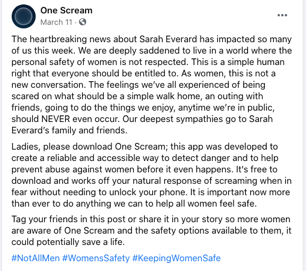
Available for Android and iOS devices, OS claims to detect and be triggered by a woman’s (true) “panic scream,” and, after 20 seconds and unless the alarm is cancelled, it will send both a text message to the user’s chosen contacts and an automated call with the location to a nominated contact. The app is meant to help women in situations where dialing 999, (assumed to be the natural and preferred response to danger), is not viable for the user and, in the ideal embodiment, this nominated contact, “the helper,” is the police. OS did automatically contact police (and required a paid subscription) in 2016, but it did not work out well and by 2018, was declared a work in progress: “What we really want is for the app to dial 999 when it detects a panic scream, but first, we need to prove how accurate it is. That’s where you come in. . .” OS is currently in beta and free (while in beta). It is unclear whether the developers have given up with that utmost expression of OS.
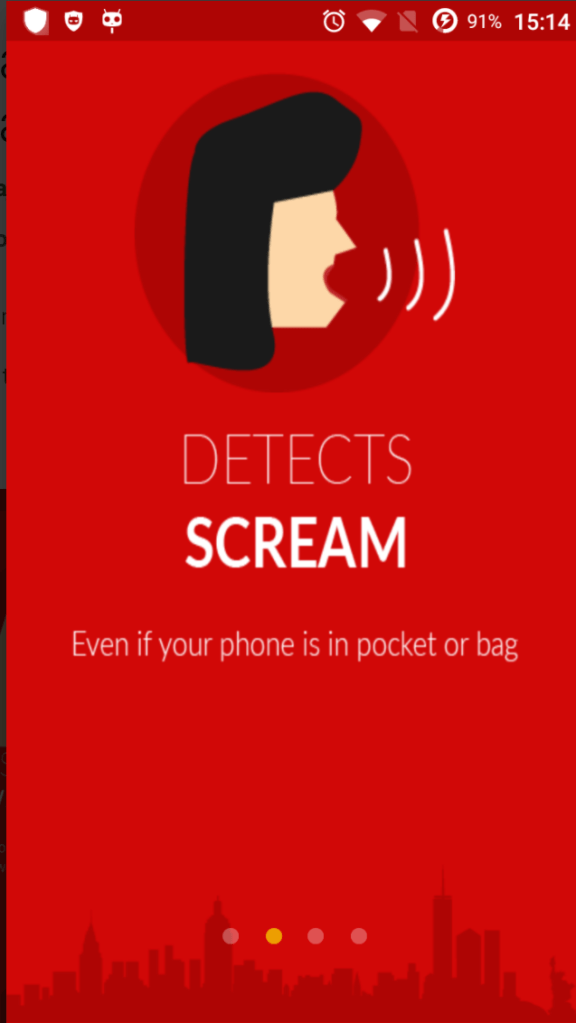
OS is based on the premise that men fight and women scream —“It is an innate response for females in danger to scream for help”—and its correct functioning requires its users to be ready to do so, even if such an innate and instinctive response doesn’t come naturally to them: “If you do not scream, the app will not be able to detect you.” However, there are two discriminations in terms of scream analysis, in how the app discriminates while listening for and to screams, and in failing to detect or respond to them. The first has to do with who can use the app (i.e., whose panicked screams are able to trigger it) in the first place. This is presented in terms of gender and age—for the moment, OS can listen to “girls aged 14+ and women under 60,” where cisgender, as in anything OS, is taken for granted. It is, however, a matter of acoustic parameters set by the developers (notably, of reaching a certain high pitch and loudness threshold). Which is why the app was implemented to include a “screamometer” for potential users to scream, hard, figure out, and see whether they can reach “the intensity that is needed to set it off” (confetti means they do). The second one discriminates true panicked screams from other types of screams (e.g., happiness, untrue panic). As presented by the developers, both discriminations are problematic and misleading, and so is “the science behind screaming” One Scream‘s website boasts of.
The app does not quite distinguish true from fake screams, nor joy from panic for that matter. Instead, One Scream listens for “roughness,” which a team of scream researchers—it truly is a “tiny science lesson” —has identified as scream’s “privileged acoustic niche” for communicating alarm. According to this 2015 study in Current Biology, “roughness” is the distinctive quality of effective, compelling human screams (and of artificial alarms) in terms of their ability to trigger listeners and in terms of perceived urgency. Abrupt increases in loudness and pitch are not unique to screams. The rougher the scream, then, the greater its perceived “alarmess” and its alarming effect. That’s why developers say OS “hears real distress,” essentially “just as your own ear.” However, other studies suggest your own ears might not be so great at distinguishing happiness from fear and scream research, and particularly the specific “bit” OS builds on, by and large assumes, relies on, and furthers the irrelevance of “real” on the scream vocalizer end.
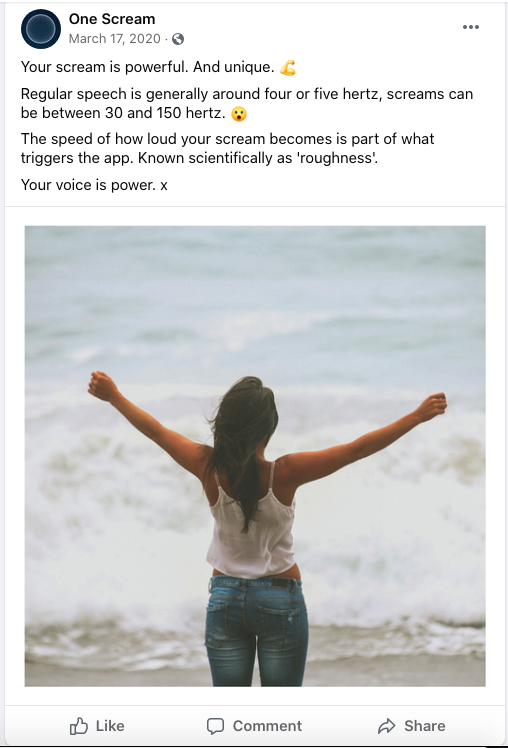
In OS’s pledge to its users, the app’s fine-tuning to its scream niche—i.e., to rough temporal modulations between 30 and 150Hz—is as important, as is the developers (flawed) insistence on the irredeemably uniqueness of true panic’s scream vocalizations, which they posit are instinctive and can’t be plotted or counterfeit: “Experience has shown that it is difficult for women to fake their scream.” Yet, current scream analysis and research primarily and largely relies on screams delivered by human research subjects (often university students, ideally drama students) in response to prompts for the purposes of studying them as well as, especially, on screams extracted from commercial movies and sound effect libraries. The same applies to the other types of vocalizations (e.g., neutral and valenced speech, screamed sentences, laughter, etc.) produced or retrieved for the purposes of figuring out what it is that makes a scream a scream, and how to translate that into a set of quantifiable parameters to capitalize on that knowledge, regardless of the agenda.
Because of their interest for audio surveillance applications, screams are currently a contested object and a hot commodity. Much as is the case with other scream distinction/detection enterprises, the initial training of OS most likely involved that vast and available bank of crafted scream renditions—by professional actors, machines, combinations of those, by and for an industry otherwise partial to female non-speech sounds—conveniently the exact type of “thick with body” female voicings OS is also invested in. For some readers, myself included, this might come across as creepy and, science-wise, flimsy.
Scream research often relies on how human listeners recruited for the cause respond to audio samples. Apparently, whether the scream is “real,” acted, or post-produced is neither something study subjects necessarily distinguish nor a determining factor in how they rate and react. In terms of machines learning to scream-mine audio data, it is what it is: “natural corpora with extreme emotional manifestation and atypical sounds events for surveillance applications” are scarce, unreliable, and largely unavailable because of their private character. That is no longer the case for OS, which has been accruing, and machine-learning from, its beta-user screams as well as how users themselves monitor/rate their screams and the app’s sensibility. OS users’ screams might not be exactly ad lib, as users/vocalizers first practice with the “screamometer” to learn to scream for and as a means to interface with OS, but it’s as natural a corpora as it gets, and it’s free for the users of the screams. OS not only echoes “voice stress analysis” technologies invested in distinguishing true from fake or in ranking urgency, but, as part and parcel of a larger scream surveillance enterprise, also public surveillance technologies such as ShotSpotter, all of which Lawrence Abu Hamdan has brilliantly dissected in his essay on the recording of the police gunshots that killed Michael Brown in Ferguson, Missouri in 2014.
Chilla is a strikingly similar app developed and available in India—although there’s a nuanced difference in the developer’s rationale for Chilla, which in its pursuance of scream-activated personal safety also aims to compensate for the fact that many girls and women don’t call “parents or police” for help when harassed or in danger. As presented, Chilla responds both to assaults and to women’s ambivalence towards their guardians. The latter is, too, a manifestation of the breadth of gender-based violence as a socio-cultural problem, one that Chilla is trained to fail to listen to and one that, because of OS’s particular niche user market, is simply out of the purview of its UK counterpart.
That problem–and that failure–is neither exclusive to India nor to scream-activated personal safety apps. Calling 999 in the UK, 911 in the US, or 091 in Spain, where I am writing, doesn’t come naturally to many targets of sexual and gender-based violence because they don’t conceive police as a help or because, directly, they see it as a risk—to themselves and/or to others. As Angela Ritchie has copiously documented in Invisible No More: Police Violence Against Black Women and Women of Color, women of color and Black women in particular are at extremely high risk for rape and sexual abuse by police officers, as high as 1 in 5 women in New York City alone.
OS, then, is framed as a pragmatic, partial answer to a problem it doesn’t solve: “We should never have to dress in a certain way…but we do.” The specifics of how OS would actually “save” or even has saved its users in particular scenarios go unexplained, because OS is meant to help with feeling safe; getting into the details, and the what ifs, compromises that service. This sense of safety has two components and is based on two promises: one, that OS will listen to your (panic) scream, and, two, as of now via the intermediacy of your contacts, the police will go save you. The second component and its assumed self-evidence speaks to the app’s whiteness and of its target market of white, securitized, cisgender female subjects.

Over and above its acoustic profiling, the app is simply not designed with every woman in mind. OS’s branding is about a certain lifestyle—of going for early runs and dates with cis-men, of taking time for yourself because you’re super busy at your white-collar job and going for night runs, of taking inspiration from “world” women and skipping if running isn’t for you. This lifestyle is also sold: sold as always under the threat of rape–despite its “rightfulness”–sold in a way that animates the feelings of insecurity and disempowerment that One Scream advertizes itself as capable of reversing. Safety, then, is sold as retrievable with OS.
Wearable or otherwise portable technologies to keep women “safe,” specifically from sexual assaults, are not new and are varied. These have been vigorously protested, particularly from feminist standpoints other than the white, securitized, capitalist brand OS professes—because, in (partly) delegating safety on technologies women then become personally responsible for, these technologies further “blame” women. For authorities and the patriarchy, this shift in blame is a relief. In discussing the racialized securitization of US university campuses, Kwame Holmes notes how despite “reactionary attacks” on campus feminism (e.g., so-called “snowflakes” complaining about bad sex) and authorities’ effective reluctance to acknowledge and challenge rape culture, anti-sexual assault technologies tend to be welcomed and accepted. As Holmes also notes, there’s no paradox in that. Those technologies flatten the discussion, deactivate more radical feminist critiques and potential strategies, and protect the status quo—not so much women and not those who, whenever an alarm sounds and especially when security forces respond, readily become insecure.
It is not a stretch to think that OS could potentially amplify the insecurities of Black and brown people subject to white panic (screams) and to its violence, something other audio surveillance technologies are already contributing to, at least it’s not a greater stretch than to entertain situations in which police would show up and save an OS user before it’s too late. Even if it’s never triggered, as developers seem to assume will be the case for the majority of installed units—”Many people have never faced a situation where they have had to panic scream”—it’s trapped in a securitization logic that ultimately relies on masculine authority, one that calls for the expansion of CCTV cameras, wherein women are never quite secure (see Sarah Everard’s vigil).
One Scream’s FAQs cover selected worries that users have or OS anticipates they might have. Among these, there are privacy concerns (i.e., does it listen to your conversations?) and the fear the alarm will activate “when it shouldn’t.” In the Apple Store user reviews, there’s a more popular type of concern: OS not responding to users’ screams. In other words, there’s simultaneously a worry about OS listening and detecting too much and about OS failing to listen “when it matters.” These anxieties around OS’s listening excesses and insufficiencies touch on (audio) surveillance paradoxical workings: does OS encroach on the everyday life of those within users’ cell phones’ earshot while not necessarily delivering on an otherwise modest promise of safety in highly specific scenarios? There’s a unified developer response to these concerns: OS “is trained to detect panic screams only.”
—
Featured Image: By Flicker User Dirk Haun. Image appears to be a woman screaming on a street corner, but is actually an advertisement on the window of a T-Mobile cell phone shop (CC BY 2.0)
—
María Edurne Zuazu works in music, sound, and media studies, and researches the intersections of material culture and sonic practices in relation to questions of cultural memory, social and environmental justice, and the production of knowledge (and of ignorance) in the West during the 20th and 21st centuries. María has presented on topics ranging from sound and multimedia art and obsolete musical instruments, to aircraft sound and popular music, and published articles on telenovela, weaponized uses of sound, music and historical memory, and music videos. She received her PhD in Music from The CUNY Graduate Center, and has been the recipient of Fulbright and Fundación La Caixa fellowships. She is a 2021-2022 Fellow at Cornell’s Society for the Humanities.
—

REWIND! . . .If you liked this post, you may also dig:
Flâneuse>La caminanta–Amanda Gutierrez
Echo and the Chorus of Female Machines—AO Roberts
Vocal Gender and the Gendered Soundscape: At the Intersection of Gender Studies and Sound Studies–Christine Ehrick
Share this:

Blank Space and “Asymmetries of Childhood Innocence”

In 2015 a video of a child in an Internet café in the Philippines began to trend on social media sites. Titled, Kanta ng isang Anak para sa kanyang inang OFW “Blank Space“ (“Song of a child for her overseas foreign worker mother”), the video shows a girl singing via Skype to her mother who is working in an unnamed location, presumably outside of the Philippines. “Ma kakantahan ulit kita ha?” (I’ll sing for you again mom), she says, and starts singing Taylor Swift’s “Blank Space”. Her mother attentively watches and listens to her song, soon beginning to cry in longing for a daughter she has not seen in a long time. The girl’s attention is divided between the screen that shows the lyrics, the camera that films her singing, and her mother who quietly observes. This video has over 110,000 views and is one of many archived messages from a child singing or speaking to their mother who labours transnationally. Despite the videos’ jittery framing and low quality, the intended message of shared longing across cyber and transnational borders is clear.
The Spanish-American war (1899-1902) resulted in the relinquishment of the colony of the Philippines from Spain to the United States. This transfer of power instituted the imperial specter that continues to grip the archipelago. The many performances of American pop music on Youtube and on stages throughout the Philippines are what Christine Bacareza Balance calls the “musical aftermath of US imperial cultures” (2016). Having amassed over 97 million YouTube views in the Philippines, Taylor Swift’s overwhelming popularity is evidence of this continued imperial presence. In the video, the young Filipinx girl sings lyrics written by Swift: “I’m dying to see how this one ends. Grab your passport and my hand.” When sung by this child these lyrics take on different meaning than Swift likely intended. Perhaps she is anticipating an end to the necessity of separation between mother and daughter.
Using song, the video provides evidence of what Hannah Dyer calls the ‘asymmetries of childhood innocence’ (2019), reminding its audience of the ways transnational labour and global capital impact children’s experiences of kinship and development. Dyer suggests that some children are withheld the protective hold of childhood innocence. She writes:
“Childhood innocence is a seemingly natural condition but its rhetorical maneuvers are permeated by its elisions and attempted disavowals along the lines of race, class, gender and sexuality. That is, despite the familiar rhetorical insistence that children are the future, some children are withheld the benefits of being assumed inculpable (2)”
Ascriptions of childhood innocence thus require a child to replicate social norms including the production of the nuclear family. In the Philippines, where the liberalization of international trade and high levels of unemployment have disproportionately impacted the labour migration of women, structures of the nuclear family are being re-organized (Parreñas 2005; Tungohan 2013). Women who work outside of the Philippines and away from their families are paradoxically celebrated for their “sacrifice” while also subject to disapproval over their absence (Tungohan 2013). When mothers leave the Philippines, the care-arrangements for children are shifted. There is a growing recognition of the changing nature of motherhood within transnational contexts and the concomitant emotional consequences of negotiating “long distance intimacy” (Parreñas 2005). The demands for transnational labour reconfigure Filipinx family formations and necessitate fraught intimacies between parent and child across borders. Cyber technologies like cell phones and the Internet initiate creative opportunities for children to be “virtually present” in the lives of their mothers and vice versa.

“Parenthood” by Flickr user Saúl Alejandro Preciado Farías, CC BY 2.0
Drawing from Dyer, we might think of children who live without the physical presence of their mothers as “queer” to normative theories of childhood development that affirm overwrought expectations of maternal presence. She suggests that discourses of childhood innocence intend to subjugate the queerness of childhood and that these elisions hold bio-political significance. Faced with social inequities, Dyer emphasizes the importance of a child’s symbolic expression. She argues that children express their psychic and social conflicts aesthetically. A child’s imagination elaborates resistances to the enclosure of childhood innocence as a barometer of value. In this way, this article suggests a child’s singing and dancing are aesthetic expressions that take notice of the entangled traces of colonialism and nation, while resisting hierarchal structures that deem some childhoods more valuable than others.
The child’s sonic performance in the YouTube video is a queer offering that creatively procures transnational connection. Her singing registers a queer frequency that destabilizes normative theories of child development that assume a mother’s physical presence as necessary to developmental success. The girl’s performance suggests that psychic and political reparations can occur in the sounds the child makes. The tactile, spatial and physical qualities of her voice forge a new relation to her mother. Her voice is affecting, seemingly moving her mother to tears and rousing the onlookers at the Internet café to reorganize their bodies and sing along. In this video, we are invited to witness a child whose world has been altered by globalization and the continued geo-political violence’s enacted by the American empire. Given these circumstances, her “creative re-interpretation[s] of kinship” serves as a reminder that the affective fortitude of her voice tests physical and emotional borders (Dyer 2019). The restraint of normative conceptions of family is ruptured when the child remakes her relation to her mother in ways that stir joy, collectivity, and pleasure.

Screenshot from “
By observing and listening to the child’s song more closely, we can listen for its potential to re-sound and re-imagine the parent-child relationship across borders. The sounds of “OFW Blank Space” linger after the clip has ended. By listening for what is in excess of the video’s content, we can consider the affective registers that enunciate alternative understandings of migration, family and belonging. There is a humming that is ubiquitous in the video. Perhaps, it is the sound of the electric fans that run to combat the tropical heat of the Philippines. Maybe it is the collective buzzing from the computers that have been set up to provide the Internet to its cybercafé patrons. The acoustics of the space are at once mundane and haphazard, and at the same time, cogent indicators of the geopolitical truths echoing throughout the scene. With limited access to Internet in the home, the cybercafé has been a site that children frequent to communicate with family working in another country. The convergence of sound, technology and diasporic subjectivity becomes audible when the practice of listening is attuned to these methods of transnational connection.
While listening to the pedagogical potential of the cybercafé more broadly, a focus on the vocal performance of the child reveals my investment in what the sound of her voice tells us. The video starts with greetings spoken in Tagalog, the primary language of the Philippines. When the backing track begins, the child makes a seamless transition into singing in English. In her vocal performance of the lyrics, her Filipino accent is almost undetectable. She sings with a dulcet tone that is clear and appealing. Her voice sounds well-trained and confident. If not for the video, one might believe the child to be a professional American performer. In this scene, it is her voice that is marked and constituted by a narrative of American imperial conquest and Filipino assimilation. But in a creative adaptation of American cultural production, the child re-writes this racialized script and uses American pop songs as a mechanism of care for both herself and her mother.
“Mother and daughter at home” by Flickr user Dejan Krsmanovic, CC-BY-2.0
The economic instability in the Philippines has created a state instituted transnational workforce. Women have been disproportionately affected by the demand for work in care industries such as nursing, childcare and care for the elderly (Francisco-Menchavez 2018). These gendered and racialized structures of employment privilege the presence of Filipinx women in families other than their own. The child is withheld a future that assures her the presence of her mother and their physical proximity is denied as a result of the demand for labour and capital exchange between nation-states. However, despite these circumstances, the child uses her voice to summon a beautiful intimacy, one that does not disavow the imperial history that marks its possibility, but instead uses loss as a resource to creatively mourn their separation. For the child, the act of singing is a replacement for her lost object, her mother. In the video we witness a child who is full of joy and whose strength of voice quells, if not, temporarily, whatever longing for her mother she might have. Relatedly, the child is also perceptive of her mother’s needs and uses music as a method of offering her care. Her performance creatively re-routes the presumed directionalities of care (from mother to child) which globalization has fundamentally altered.
—
Featured image: “Children” by Flickr user Clive Varley, CC-BY-2.0
—
Casey Mecija is an accomplished multi-disciplinary artist, primarily working in the fields of music and film. She played in Ohbijou, the Canadian orchestral pop band, and released her first solo album, entitled Psychic Materials, in 2016. Casey is also an award winning filmmaker whose work has screened internationally. She is completing a PhD at The University of Toronto, where she researches sound, performance studies and Filipinx Studies as they relate to queer diaspora.
—
 REWIND! . . .If you liked this post, you may also dig:
Relocating Soundscapes of Schooling: Learning to Listen to Children’s Lifeworlds-Cassie Brownell
Top 40 Democracy: Taylor Swift’s Election Day Victory-Eric Weisbard
Hearing “Media-Capitalism” in Egypt–Ziad Fahmy
Share this:


Current Top Posts





April 2021

January 2020

November 2019

October 2019

August 2019

April 2014

November 2017

March 2015

December 2017

October 2015
 Sounding Out!
Recent Comments