
Twitchy Ears: A Document of Protest Sound at a Distance


“Royal Thai consulate 351 E52 St jeh” on Wikimedia Commons, CC-1.0
“I compare New York to Bangkok all the time,” a young activist told me, just moments before he joined a small, media-ready protest at the Thai consulate in midtown Manhattan. On a pleasant day this past July, along a quiet side street lined with the gold plaques of consulates general, his comparison felt strained—Thailand is currently governed by a free speech-averse military junta that seized power last year, and mourning a deadly terror attack. In Thailand, the tension and fear are acute; in New York, the local delivery driver was whistling.
The young activist, an ocean removed from Bangkok, sought ways of speaking politically, knowing well that he could and would be heard across that ocean When he returns, if he returns, he may be imprisoned, intimidated, or injured. In front of the consulate in New York, those problems were imperceptible to the uninitiated. But they weighed heavily on all of us. Whenever the group chanted or sang, their voices rose through the low ambience like heavy weights, and stopping they fell away without receiving a response. There was a perverse aural disjuncture between the easy rhythms of the day and the harrowing risk that we knew was present in every utterance.
I had come to participate in the event, to speak against the military junta’s recent arrest of fourteen university students for protesting peacefully. I had also come to make a sound recording, and as usual to consider the odd phenomenon of protests staged to create media artifacts rather than to influence people in the flesh. The purpose of the protest was not to negotiate risk but to invite it. It barely mattered that New York City didn’t hear the protest as it occurred. Where it needed to sound potent, it would. Recorded sound surely renders all protest multi-sited; protest sound is a speech-act spatially and temporally deferred.

Picture of #FreeThe14 protest in New York City this past July. From Thai Students Center for Democracy (@TSCD_EN) tweet on July 7, 2015.
However, for protests staged at great physical distance from what’s being protested, the specter of comparison and difference between sites and movements can be profound. New York is in certain ways friendly to protest; the city is liberal with permits, and even unpopular opinions are expressible. Relative to most of Thailand, this is a welcome distinction. Of course, such freedom can blunt the acuity of dissenting speech — protests limited to a specific place and time, accompanied by two polite cops indifferent to the issue at hand, are easy to tune out. The United States has its own instruments of containing dissenting speech.
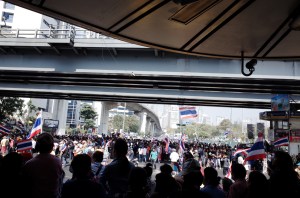
“Protests around Si Lom, Bangkok” by Flickr user
Anton Strogonoff, CC-BY-2.0
Furthermore, as responses to both Occupy Wall Street and the Black Lives Matter movement have shown, organizational structure and subjectivity make some actions more vulnerable to state violence than others. There are moments when a single word can provoke repression here in no less crude a fashion than the Thai junta prefers. But the game has wholly different rules, and these rules engender different strategic responses. Protesting at a distance is both a way of threading multiple sites together and of reflecting on how protesters in different places and movements choose to speak. In the mind of a young activist accustomed to Thailand’s particular labyrinth of political expression, the contrast with his own country can become a source of ideas.
“When I first came here,” the activist continued with a note of awe in his voice, “Occupy Wall Street just started, so it’s like, there is this obvious difference that really intrigued me in how people organize or react to causes. In Thailand we still kind of are using older ways to organize, kind of like really centralized, some figures pretty much
To develop a political movement in the United States is a different challenge than doing the same in Thailand, to put it mildly. In the United States the left risks triviality; in Thailand, it literally risks death. Thai communists were hunted by soldiers in the jungle in the twentieth century, and left-wing political parties are still forbidden today. Republicanism is treason. And with the ascent of the military junta, many trials are now held in secret, and intimidation of political critics is routine. A movement cannot attempt to run headlong toward whatever it wants to topple; circuitous end-runs are necessary. This explains the increased appeal of decentralized protest tactics to Thai activists. The young man I met was far from the first in his country who has espoused such an approach.
***

“Protest Music” by Flickr user killerturnip, CC BY-NC-ND 2.0
The protest began with one woman playing an acoustic guitar, leading the twenty of us assembled in a folk-style singalong. The sincere, uneven rendition of “Song of the Common Man,” currently popular among anti-junta protesters in Thailand, was followed by nervous laughter, and the honk of a nearby taxi. The lyrics are mild and the structure formulaic, but the song has caught on among the junta’s most outspoken critics – notably, one recording available online was made by a band whose songs are strident enough that they were pursued by the military, and forced to flee to Laos. The song lasted less than two minutes, and an American, who worked for a freedom-of-speech NGO in Southeast Asia, ensured that the group moved on to the next part of the tight half-hour schedule. Every moment was brief but assiduously documented.

Picture of #FreeThe14 protest in New York City this past July. From Thai Students Center for Democracy (@TSCD_EN) tweet on July 7, 2015.
We took selfies wearing masks shaped like the faces of the fourteen students who were set to appear before a military court that day. The Thai consulate employees watched with bemusement, and briefly chatted with us in the low, serious hush filled with polite participles that characterizes formal conversation in Thailand. The event ended, and the quiet side street remained undisturbed.
One moment was particularly chilling. The American was leading the group in a series of “what-do-we-want-when-do-we-want-it” chants, which though adapted to concerns of the anti-junta movement felt pro forma and out of place. That cadence and call-and-response pattern is almost never heard at protests in Thailand, and the protesters were not accustomed to it. When someone suggested chanting in Thai rather than English, the group naturally fell into a different rhythm. The repetition of Prayuth aawk bpai, an insulting demand that coup leader General Prayuth Chan-Ocha go away, was much sharper. The chant hearkened to protests of recent years against illegitimate Thai governments. A recording of it would, without doubt, be very risky once heard by the wrong ears in Thailand. Its potency was not only in its direct semantics, but in the connection it formed between the current protest and protests of the recent past. Protest in an age of ubiquitous media tends to form such links across boundaries of time and space.
But a curious thing happens when protest movements can readily observe one another. Comparisons are made all the time, but so are convergences. Rhetoric and strategy become cosmopolitan, not native to any place, and protests increasingly echo other protests. Contemporary Thai dissidents have been influenced by Argentinian horizontalism, and they swap documentaries about the Arab Spring online, for example. The watertight conditions of a geopolitical place have more leaks than was thought. And as ideas travel, the places themselves can become fertile grounds for the growth of those ideas in practice.

“Thailand” by Flickr user Marko Mikkonen, CC BY 2.0
Sound is vital to this process. Perhaps because it is often regarded as the most visceral expression of the body, sound has a special relationship to protest. Sound and self need not be romanticized as coterminous in order to appreciate that speech acts feel very close to the body. But listen again. Sound can both feel immediate and be radically disembodied. It can be a material for experimentation, for feeling out how to speak in the immediate present, and be by the same stroke a final product to be audited by the twitchy ears of the junta. The July protest was and will be both.
—
Benjamin Tausig is assistant professor of ethnomusicology at Stony Brook University, where he works on sound studies, music, and protest in Bangkok and other urban spaces. He is on Twitter @datageneral
—
Featured image: Picture of #FreeThe14 protest in New York City this past July. From Thai Students Center for Democracy(@TSCD_EN) tweet on July 7, 2015.
—
 REWIND! . . .If you liked this post, you may also dig:
SO! Amplifies: Cities and Memory-Stuart Fowkes
Toward A Civically Engaged Sound Studies, or ReSounding Binghamton–Jennifer Stoever
Share this:

The Eldritch Voice: H. P. Lovecraft’s Weird Phonography

 Welcome to the last installment of Sonic Shadows, Sounding Out!’s limited series pursuing the question of what it means to have a voice. In the most recent post, Dominic Pettman encountered several traumatized birds who acoustically and uncannily mirror the human, a feedback loop that composes what he called “the creaturely voice.” This week, James Steintrager investigates the strange meaning of a “metallic” voice in the stories of H.P. Lovecraft, showing how early sound recording technology exposed an alien potential lingering within the human voice. This alien voice – between human and machine – was fodder for techniques of defamiliarizing the world of the reader.
— Guest Editor Julie Beth Napolin
—
A decade after finding itself downsized to a dwarf planet, Pluto has managed to spark wonder in the summer of 2015 as pictures of its remarkable surface features and those of its moon are delivered to us by NASA’s New Horizons space probe. As scientists begin to tentatively name these features, they have drawn from speculative fiction for what they see on the moon Charon, giving craters names including Spock, Sulu, Uhuru, and—mixing franchises—Skywalker . From Doctor Who there will be a Tardis Chasma and a Gallifrey Macula. Pluto’s features stretch back a bit further, where there will also be a Cthulhu Regio, named after the unspeakable interstellar monster-cum-god invented by H. P. Lovecraft.
We can imagine that Lovecraft would have been thrilled, since back when Pluto was first discovered in early 1930 and was the evocative edge of the solar system, he had turned the planet into the putative home of secretive alien visitors to Earth in his short story “The Whisperer in Darkness.” First published in the pulp magazine Weird Tales in 1931, “The Whisperer in Darkness” features various media of communication—telegraphs, telephones, photographs, and newspapers—as well as the possibilities of their manipulation and misconstruing. The phonograph, however, plays the starring role in this tale about gathering and interpreting the eerie and otherworldly—the eldritch, in a word—signs of possible alien presence in backwoods Vermont.
In the story, Akeley, a farmer with a degree of erudition and curiosity, captures something strange on a record. This something, when played back by the protagonist Wilmarth, a folklorist at Lovecraft’s fictional Miskatonic University, goes like this:
Iä! Shub-Niggurath! The Black Goat of the Woods with a Thousand Young! (219)
The sinister resonance of a racial epithet in what appears to be a foreign or truly alien tongue notwithstanding, this story features none of the more obvious and problematic invocations of race and ethnicity—the primitive rituals in the swamps of Louisiana of “The Call of Cthulhu” or the anti-Catholic immigrant panic of “The Horror at Red Hook”—for which Lovecraft has achieved a degree of infamy. Moreover, the understandable concern with Lovecraft’s social Darwinism and bad biology in some ways tends to miss how for the author—and for us as well—power and otherness are bound up with technology.
 The transcription of these exclamations, recorded on a “blasphemous waxen cylinder,” is prefaced with an emphatic remark about their sonic character: “A BUZZING IMITATION OF HUMAN SPEECH” (219-220). The captured voice is further described as an “accursed buzzing which had no likeness to humanity despite the human words which it uttered in good English grammar and a scholarly accent” (218). It is glossed yet again as a “fiendish buzzing… like the drone of some loathsome, gigantic insect ponderously shaped into the articulate speech of an alien species” (220). If such a creature tried to utter our tongue and to do so in our manner—both of which would be alien to it—surely we might expect an indication of the difference in vocal apparatuses: a revelatory buzzing. Lovecraft’s story figures this “eldritch sound” as it is transduced through the corporeal: as the timbral indication of something off when the human voice is embodied in a fundamentally different sort of being. It is the sound that happens when a fungoid creature from Yuggoth—the supposedly native term for Pluto—speaks our tongue with its insectile mouthparts.
Yet, reading historically, we might understand this transduction as the sound of technical mediation itself: the brazen buzz of phonography, overlaying and, in a sense, inhabiting the human voice.
For listeners to early phonographic recordings, metallic sounds—inevitable given the materials used for styluses, tone arms, diaphragms, amplifying horns—were simply part of the experience. Far from capturing “the unimaginable real” or registering “acoustic events as such,” as media theorist Friedrich Kittler once put the case about Edison’s invention, which debuted in 1877, phonography was not only technically incapable of recording anything like an ambient soundscape but also drew attention to the very noise of itself (23).
For the first several decades of the medium’s existence, patent registers and admen’s pitches show that clean capture and reproduction were elusive rather than given. An account in the Literary Digest Advertiser of Valdemar Poulsen’s Telegraphone, explains the problem:
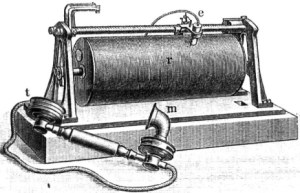 The talking-machine records sound by the action of a steel point upon some yielding substance like wax, and reproduces it by practically reversing the operation. The making of the record itself is accompanied by a necessary but disagreeably mechanical noise—that dominating drone—that ‘b-r-r-r-r’ that is never in the human voice, and always in its mechanical imitations. One hears metallic sounds from a brazen throat—uncanny and inhuman. The brittle cylinder drops on the floor, breaks—and the neighbors rejoice!
The Telegraphone, which recorded sounds “upon imperishable steel through the intangible but potent force of electromagnetism” such that no “foreign or mechanical noise is heard or is possible,” of course promised to make the neighbors happy not by breaking the cylinder but rather by taking the inhuman ‘b-r-r-r-r’ out of the phonographically reproduced voice. Nonetheless, etching sound on steel, the Telegraphone was still a metal machine and unlikely to overcome the buzz entirely.
In his account of “weird stories” and why the genre suited him best, Lovecraft explained that one of his “strongest and most persistent wishes” was “to achieve, momentarily, the illusion of some strange suspension or violation of the galling limitations of time, space, and natural law which forever imprison us and frustrate our curiosity about the infinite cosmic spaces beyond the radius of our sight and analysis.” In “The Whisperer in Darkness,” Lovecraft put to work a technology that was rapidly becoming commonplace to introduce a buzz into the fabric of the everyday. This is the eldritch effect of Lovecraft’s evocation of phonography. While we might wonder whether a photograph has been tampered with, who really sent a telegram, or with whom we are actually speaking over a telephone line—all examples from Lovecraft’s tale—the central, repeated conundrums for the scholar Wilmarth remain not only whose voice is captured on the recorded cylinder but also why it sounds that way.
 The phonograph transforms the human voice, engineers a cosmic transduction, suggesting that within our quotidian reality something strange might lurk. This juxtaposition and interplay of the increasingly ordinary and the eldritch is also glimpsed in an account of Charles Parson’s invention the Auxetophone, which used a column of pressurized air rather than the usual metallic diaphragm. Here is an account of the voice of the Auxetophone from the “Matters Musical” column of The Bystander Magazine from 1905: “Long ago reconciled to the weird workings of the phonograph, we had come to regard as inevitable the metallic nature of its inhuman voice.” The new invention might well upset our listening habits, for Mr. Parson’s invention “bids fair to modify, if not entirely to remove,” the phonograph’s “somewhat unpleasant timbre.”
What the phonograph does as a medium is to make weird. And what making weird means is that instead of merely reproducing the human voice—let alone rendering acoustic events as such—it transforms the latter into its own: an uncanny approximation, which fails to simulate perfectly with regard to timbre in particular. Phonography reveals that the materials of reproduction are not vocal chords, breath, labial and dental friction—not flesh and spirit, but vibrating metal.
Although we can only speculate in this regard, I would suggest that “The Whisperer in Darkness” was weirder for readers for whom phonographs still spoke with metallic timbre. The rasping whisper of the needle on cylinder created what the Russian Formalist Viktor Shklovsky was formulating at almost exactly the same time as the function of the literary tout court: defamiliarization or, better, estrangement. Nonetheless, leading the reader to infer an alien presence behind this voice was equally necessary for the effect. After all, if we are to take the Auxetophone as our example—an apparatus announced in 1905, a quarter of a decade before Lovecraft composed his tale, and that joined a marketplace burgeoning with metallic-voice reducing cabinets, styluses, dampers, and other devices—phonographic listeners had long since become habituated to the inhumanity of the medium. That inhumanity had to be recalled and reactivated in the context of Lovecraft’s story.
 To understand fully the nature of this reactivation, moreover, we need to know precisely what Lovecraft’s evocative phonograph was. When Akeley takes his phonograph into the woods, he adds that he brought “a dictaphone attachment and a wax blank” (209). Further, to play back the recording, Wilmarth must borrow the “commercial machine” from the college administration (217). The device most consistent with Lovecraft’s descriptions and terms is not a record player, as we might imagine, but Columbia Gramophone Company’s Dictaphone. By the time of the story’s setting, Edison Phonograph’s had long since switched to more durable celluloid cylinders (Blue Amberol Records; 1912-1929) in an effort to stave off competition from flat records. Only Dictaphones, aimed at businessmen rather than leisure listeners, still used wax cylinders, since recordings could be scraped off and the cylinder reused. The vinyl Dictabelt, which eventually replaced them, would not arrive until 1947.
Meanwhile, precisely when the events depicted in “The Whisperer in Darkness” are supposed to have taken place, phonography was experiencing a revolutionary transformation: electronic sound technologies developed by radio engineers were hybridizing the acoustic machines, and electro-acoustic phonographs were in fact becoming less metallic in tone. Yet circa 1930, as the buzz slipped toward silence, phonography was still the best means of figuring the sonic uncanny valley. It was a sort of return of the technologically repressed: a reminder of the original eeriness of sound reproduction—recalled from childhood or perhaps parental folklore—at the very moment that new technologies promised to hide such inhumanity from sensory perception. Crucially, in Lovecraft’s tale, estrangement is not merely a literary effect. Rather, the eldritch is what happens when the printed word at a given moment of technological history calls up and calls upon other media of communication, phonography not the least.
I have remarked the apparent absence of race as a concern in “The Whisperer in Darkness,” but something along the lines of class is subtly but insistently at work in the tale. The academic Wilmarth and his erudite interlocutor Akeley are set in contrast with the benighted, uncomprehending agrarians of rural Vermont. Both men also display a horrified fascination with the alien technology that will allow human brains to be fitted into hearing, seeing, and speaking machines for transportation to Yuggoth. These machines are compared to phonographs: cylinders for storing brains much like those for storing the human voice. In this regard, the fungoid creatures resemble not so much bourgeois users or consumers of technology as scientists and engineers. Moreover, they do so just as a discourse of technocracy—rule by a technologically savvy elite—was being articulated in the United States. Here we might see the discovery of Pluto as a pretext for exploring anxieties closer to home: how new technologies were redistributing power, how their improvement—the fading of the telltale buzz—was making it more difficult to determine where humanity stopped and technology began, and whether acquiescence in this changes was laudable or resistance feasible. As usual with Lovecraft, these topics are handled with disconcerting ambivalence.
—
James A. Steintrager is a professor of English, Comparative Literature, and European Languages and Studies at the University of California, Irvine. He writes on a variety of topics, including libertinism, world cinema, and auditory cultures. His translation of and introduction to Michel Chion’s Sound: An Acoulogical Treatise will be published by Duke University Press in fall of 2015.
—
Featured image: Taken from “Global Mosaic of Pluto in True Color” in NASA’s New Horizons Image Gallery, public domain. All other images courtesy of the author.
—
REWIND! . . .If you liked this post, you may also dig:
Sound and Sanity: Rallying Against “The Voice” — Mark Brantner
DIANE… The Personal Voice Recorder in Twin Peaks — Tom McEnaney
Reproducing Traces of War: Listening to Gas Shell Bombardment, 1918 — Brían Hanrahan
Share this:




Current Top Posts





April 2021

January 2020

November 2019

October 2019

August 2019

April 2014

November 2017

March 2015

December 2017

October 2015
 Sounding Out!
Recent Comments