
A Brief Review of Australian Radio Art

DOI: https://doi.org/10.59350/p0mna-scq06
Welcome to the second part of Radio Art Reflections, a series on radio art that brings together the thoughts of three practitioners who have been researching the field from Canada, Australia and the UK.
In the first part Canadian sound and radio artist Anna Friz discussed how transmission art has shaped her practice and how it has become an important current within the expanded territory of radio art. Following this, musician and sound artist Colin Black reflects on the particularities of Australia’s radio art history, analyzing the effects of ongoing cutbacks at the Australian Broadcasting Corporation. Black fears a distinctive Australian soundscape-based radio art is in danger of being lost, while identifying a current renaissance in narrative based radio features which currently shape ABC radio output, and considers the potential of ABC’s new Creative Audio Unit.
– Guest Editor Magz Hall
—
As an artist growing up in rural Australia, I was hugely influenced by how state-owned radio engaged with sound-based practitioners. For decades, radio not only gave voice to some of the more exploratory artists and their works, it allowed artists and audiences from all over this vast continent to find a space in which experimental works could, with financial support, gestate, be realized and propelled onto a world stage, often receiving international acclaim for their distinctive perspective.
In recent years I have come back to those works as a PhD researcher, interviewing thirty five international practitioners, theorists and producers on Australian radio art thereby gaining a new appreciation of its particular aesthetic practices and approaches. This article draws on some of these interviews to highlight national and international perceptions about where Australian radio art has been, while also demonstrating its potential to influence a new generation of artists to explore beyond mainstream media formats.

THE LISTENING ROOM
While there are a few early examples of Australian radio art, consistant programming and commissioning of radio art effectively commenced in the 1980s with the formation of the ABC Arts Unit during 1984-85 and the acoustic arts programme The Listening Room, which aired from 1988 to 2003. Although long-decommissioned, The Listening Room was still one of a very few signposts that my interviewees cited when trying to understand the properties of Australian radio art. The Listening Room’s founding executive producer Andrew McLennan, who expanded the boundaries of ABC radio from 1976 onwards, had a clear take on the aesthetic framework of the show, stating in one internal ABC report (c1990) that the programme was a:
… venue for the exploration, the cross-pollination of radio forms. … you can hear new radio plays, audio essays, acoustic features, sound documentaries, new music, sound-scapes and sculptures, audio installations, acoustic art forms …
This approach was broader than that of other international radio art programs. Here is a quote from the formative executive producer of Deutschlandradio Kultur, Götz Naleppa, who took a much more “aesthetic” approach for his well-known Klangkunst programmes in Germany:
The difference to other radio-art-forms like radio-play is simple: sound-composition [a term Naleppa prefers to radio art] shares with them the same elements: sound, text (voice) and music. But in radio-play text (dialogue) is in the foreground and the other elements SERVE it (often in an illustrative way). And in (radio)sound-composition we have the same elements – but they are EQUAL, they are simply MATERIAL in the hands of the composer [Götz Naleppa, e-mail message to author July 28, 2005].
Of the two, The Listening Room clearly had a wider scope. Thus a number of ABC works, like On the Raft, All at Sea (by Robyn Ravlich and Russell Stapleton), placed the text in the foreground as the narrative is primarily driven by the use of spoken dialogue and the other elements are used to serve the text in a chiefly illustrative fashion. By definition Naleppa would call this a “radio-play” and not necessarily neues hörspiel or radio art, and definitely not a radio “sound-composition.”
.
Extract from On the Raft, All at Sea (2002) by Robyn Ravlich and Russell Stapleton (courtesy Robyn Ravlich and ABC Radio)

“AUSTRALIAN” RADIO ART
Alongside this inclusiveness of a wide scope of work, my research uncovered a range of other ideas about the identifiable properties of Australian radio art. Austrian Elisabeth Zimmerman claims that with Australian work there is “a certain tradition” that favours the “use of environmental sounds … but in a very composed way.” Andrew McLennan supports Zimmerman’s viewpoint and states: “it’s always hard to say and it is probably a bit of a cliché … [however he] often think[s] of it as quite environmentally driven.” Douglas Kahn, an American, is more skeptical, observing that “The Australian stuff was much broader range … I don’t think you can say that there was an Australian aesthetic because there were so many different artists that were brought in to do things.” Although later Kahn does state that a common thread heard in Australian work was its “really high quality production values … really nice complex mixes … people playing the mixing board like it was a piano in a really sophisticated way.” Kaye Mortley from her Australian French background describes Australian work as “radiophonic art, of various sorts, more experimental in nature, some produced by composers.” While not a composer, Australian Virginia Madsen supports Mortley’s viewpoint when she describes her own work as “experimental … it combines music, theatre performance, and documentary really.” The common theme that emerges from my research is the openness and commitment to experimentation that exists alongside a highly professional approach to the art form within Australian radio art culture.
My interviews also indicated that radio art plays a role in the perceived amorphous and multi-faceted notion of national identity, while confirming Kahn and Nicholas Zurbrugg’s earlier observations that radio art has critically contributed to the overall arts ecology in Australia. As a practitioner, I would also describe my own work as having an experimental approach that is influenced by the high quality production levels of programs like The Listening Room. While much of my work is environmentally driven, my artistic focus is to create multi-faceted, intimate aural geographies in which human imprint is present.
.
Extract from Alien In The Landscape (2007) by Colin Black (courtesy DeutschlandRadio Kultur). This extract features synchronous field recordings made by a Rodes NT4, X-Y configured stereo microphone and Fender Stratocaster with additional strings attached as pictured below.

THE CREATIVE AUDIO UNIT AND AUSTRALIAN RADIO TODAY
When The Listening Room was decommissioned in 2003, explorative radio was forced in two directions: ABC Radio National programmed some word-based works, while ABC Classic FM aired another set of works that Kate Dundas (Director of ABC Radio) has called “Shorter-form pieces, maybe perhaps down the sound-based acoustic end or radiophonic end of the spectrum.”Budgets were dramatically reduced and diverted, resulting in the effective abandonment of regular commissions and airtime for long-form sound-based works. In 2012 ABC management decommissioned book readings and Creative Instinct (a “feature program that reflects and explores the creative world”) and The Night Air (described as “aural equivalents of the avant-garde cut-up: a montage of interviews, location sound, music and found audio”). Moreover management oversaw the dismantling of the Airplay programme, which included “hour-long dramatic fictions [sic] experiment with form” effectively ending an 80-year tradition of Australian radio drama. In replacing these programmes, the Creative Audio Unit (CAU) was planned and American-style low budget radio production techniques for dramatic short stories (as championed at the 2012 ABC run Radio Beyond Radio conference) were put on the table as the future of radio.
In 2013 the ABC recruited a whole new team (who collectively had very little direct engagement with prior radio drama and The Listening Room production budgets and procedures), to setup, oversee and run the CAU. This transition was so atypical of past ABC changes that it raises questions as to whether this was an orchestrated act of cultural amnesia. It is perhaps not surprising that one of the major challenges this new team faces is the lack of resources, which impedes the magnitude of new works commissioned. This also raises questions as to how the previous budgets from Airplay, The Night Air and Creative Instinct have been reassigned. Another challenge is this unit’s extremely wide area of responsibility (that was previously spread across a number of ABC Units) ranging from radio drama and essays on the Radiotonic programme (effectively replacing the entire radio drama department) to what it claims to be a “portal into radio art, performance, soundscapes and composed audio features” on its Soundproof programme.
While Soundproof makes gestures to re-stimulate radio art activities in Australia, in sampling its first twenty episodes it becomes apparent that a very large percentage of airtime is heavily driven by the spoken dialogue narrative, more in line with radio drama or documentary. Furthermore, the episodes that contain the more interesting sound works seem to be frequently interrupted by extended contextual dialogue and therefore, for the most part, present only extracts or shorter form radio art works. Therefore, as a practitioner who runs the risk of being excluded from future CAU activities, I would nevertheless argue that for the most part, the CAU is doubling up on its focus on radio drama and documentary style productions and has not to date reached its goal of fully exploring and presenting sound rich radio art features, as it claims (please see Soundproof episode mp3 downloads dated between 11 May to 21 September 2014). Moreover, Soundproof is much more constrained, even backward-looking, when compared to its predecessors and is therefore aiming to attract a much less adventurous radio audience. More glaringly, the first twenty episodes lack a strong presence for new Australian works when compared to The Listening Room that broadcast sixty-four Australian works with a total duration of fifty hours in its first year of operation. As an inquisitive listener it seems that, to date, Soundproof has forgotten its own lineage without offering anything new or innovative and in doing so, has also forgotten audience members like myself in Australia and throughout the world.
I sometimes wonder what the conclusions from my research study would be if it were only focused on current practice. Would today’s Australian radio art still play a role in the perceived multi-faceted notion of Australian national identity? Would it still be perceived to have an experimental approach with high quality production levels that favour the use of environmental sounds? Is it still a critical contributor to the overall arts ecology in Australia? Audience members who have little prior knowledge of Australian radio art, may think so or may not conceive of its potential to do so. However, given sustained support, the space for experimentation and a clear inventive vision for the future, building on the legacy of past achievements, Australian radio art clearly has the potential to regain its status on a world stage.
—
Featured Image: Beastman mural on Brisbane Radio by Flickr User JAM Project
—
Dr Colin Black is an internationally acclaimed composer/sound artist having won the 2003 Prix Italia Award and achieving the final round selection in the 2010 and 2011 Prix Phonurgia Nova for his creative feature length works. As a result of this acclaim, Black has received multiple national and international commissions to create innovative long-form works for broadcast across major Australian and European networks. Black’s curator credits include, international festival/showcases of award winning Australian acoustic art and radio art at London’s Resonance104.4fm, Kunstradio (ÖRF, Austria) and Toronto’s New Adventures In Sound Art. In 2013 he also curated the Australian Broadcasting Corporation’s Sound Fix: Your Weekly Dose of Transmitted Audible Art series. He is a PhD graduate of the Sydney Conservatorium of Music where he was a recipient of the University of Sydney Postgraduate Awards Scholarship. More recently Black has been engaged as an academic lecturing at the University Technology, Sydney; moreover he has authored a number of conference papers and peer reviewed journal articles including “An Overview of Spatialised Broadcasting Experiments With a Focus on Radio Art Practices” in Organised Sound. Black is also the founding member of The International Radio Art (and Creative Audio for Trans-media) Research Group. For more information see: www.colinblack.com.au
—

REWIND! . . .If you liked this post, you may also dig:
Unsettled Listening — Randolph Jordan
Radio Ambulante: A Radio that Listens — Carolina Guerrero
Everything Sounds Podcast — Craig Shank
—
Share this:

Look Who’s Talking, Y’all: Dr. Phil, Vocal Accent and the Politics of Sounding White
DOI: https://doi.org/10.59350/gn1jf-8h282
From the first time Phillip C. McGraw, Ph.D.—better known as “Dr. Phil”—appeared on the Oprah Winfrey Show in 1998, dropping lines like, “My dad used to say, boy, don’t let yer alligator mouth overload yer hummin’ bird ass,” I was hooked. That accent! That no-nonsense, Southern sauce! From what fount of otherworldly knowledge did Phil drink? An insecure teen, gnawing and thrashing my way through high school’s convoluted social milieu (not to mention the murky waters of multiraciality), Dr. Phil’s frank, accented approach to life’s difficulties appeared as a god-send. It didn’t matter much what Dr. Phil was actually saying or whether his words when strung together formed logical thoughts, it was more the way he said things that affected me so. His deep, sing-songy lilt—preachy and avuncular—brought to mind a grandpappy smoking a pipe, whose wisdom was drawn from a hard day’s farmin’, not a god-forsaken textbook.
With Oprah’s endorsement, the Cult of Phil grew fast and strong. Dr. Phil became a national figure–the corporate media’s version of a public intellectual and my own personal hero. His daytime talk show provided him with a regular platform from which to dispense more of that golden, “Texan-dipped” advice, as The New York Times put it. Selling over 2 million copies, his 2003 classic Self Matters began the onslaught of McGraw-family oeuvre, including several by his wife, Robin, and son, Jay–the face of Phil’s teen self-help brand. Not just a sage, Dr. Phil’s commitment to the McGraw family brand let us know he walked the walk. As evidenced by Dr. Phil’s opening credits, which feature behind-the-scenes glimpses of Mr. and Mrs. McGraw canoodling and his smiley next of kin, this family was for real. They loved and laughed together while cross-promoting each other’s book projects. Teenage Me wondered, did white people get better than this?

Today, Dr. Phil’s star, and my admiration for him, have faded significantly, but one thing remains the same. Ever since I can remember, my older sister and I have communicated almost exclusively via over-the-top, celebrity impersonations and Dr. Phil became a particular mainstay; even now, we religiously observe the maintenance of the Phil “voice.” Pre-Phil, I can recall my sister addressing me in a raspy, befuddled tone startlingly akin to the Keanu Reeves of yesteryear. Not soon after Bill and Ted’s Excellent Adventure became a permanent piece of our home VHS library, Reeves’ trademark method of delivering lines amidst staggered, nonsensical pauses became an obsessive, sisterly tick. “Dude, shut the door when you pee” she might say, staring blankly at me and cocking her head abruptly to the side.
The use of certain impersonations shifted with the ebb and flow of popular culture’s somewhat predictable tide, depending on whose video was “TRL’s” most requested or whose face most frequently graced the cover of TV Guide. I rehearsed George Herbert Walker Bush’s famous “thousand points of light” campaign ad in front of the stained glass mirror adjacent to the family room television; after that, it was all about Phil Hartman’s witty and endearing impersonation of Bill Clinton.
It went on that way until Dr. Phil’s shit blew up, and everything became solidified–as if, finally, my sister and I had found our one true voice. With age, I came to understand that Phil wasn’t the prophetic genius I’d hoped he was and that our compulsive Phil-talk was an oddity, to say the least. I began to wonder why, even as adults, we continued to embarrass ourselves in public and take such pains to text each other in mock-“Texan” (thank goodness for smart phones’ “add word” function).
It’s actually quite common for people to adopt alternate voices or speech patterns. Take, for example, child-directed speech (“babytalk”) or pet-directed speech. Both are customized forms of vocal communication or “prosodic modification,” which, while differing dramatically from normative adult speech in their intonation and grammatical structure, are considered customary forms of address. In fact, cross-linguistic studies show that babytalk and pet-directed speech are common across other European languages, Japanese and Mandarin Chinese. As such, parents and pet owners can rest well knowing that prosodic modification of the child and dog varieties are nearly universal human ticks. Unfortunately, research into child- and pet-directed speech didn’t provide much insight into the unique phenomenon of “Phil-talk.” I had hoped to find other accounts in the literature, a history of similar episodes that might lift the shroud of tomfoolery, explain it away as all too common or evidence of psychological disorder x, y or z, something treatable with an esoteric name.
While at this point in my life Phil-talk is more or less an asinine charade, it continues to function as a key component of our familiar vernacular. Interestingly, when re-visiting the many impersonations that have come to define our adolescent years (the Keanu years, the Bush Sr. years, the Phil years), one thing becomes clear: all the voices we’ve adopted have been those of white, male, cultural standard-bearers (Ironically, Keanu Reeves also happens to be Hapa, though I never knew as much. His breakout role as “Ted” helped to popularize the “California dude” archetype). Additionally, I should note, that at no time did any female impersonations enter my repertoire. If you’re going to gain a voice, better make it a male one, no? The racial and gender dissonance that Phil-talk begets drives the urge to perform it.
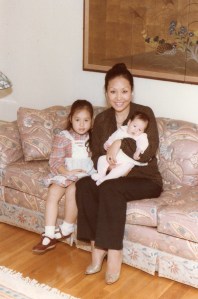
From an early age, my mother would tell me tales of her sacrifice—how hard she worked when she came to this country and how difficult life could be in 1960s post-war South Korea—all in a voice with barely a shred of mispronunciation or foreign intonation. My father, a second-generation Swiss-Italian American, scrupulously corrected her syntactical missteps and any other vocal nuances that sounded un-American. It was important to my mother to succeed as an American, and most importantly, that her children succeed too. The pressure I felt to make her content was borderline unbearable. When I started doing the voices, it made my mother happy. She sometimes tried joining in, attempting to mimic key Phil phrases like, “You have gawt to get reee-al,” but to no avail. “You do it better than me,” she’d say, “…my accent.”
When I was young, people looked at me and asked, “what are you?” OR “where are you from?” “America,” I would say. “I’m an American.” These questions were provoked by the racial ambiguity of my mixed-race heritage–the hint of Asianness that marked me as something else. I could not change the shape of my eyes, the contour of my cheeks or the fact that my mother was Korean. But, I could try my hardest to act and sound like an American. Phil-talk became a way to obscure the Asianness, to prove beyond a shadow of a doubt that I did, in fact, belong.
Rather than being merely a childhood performance of celebrity impersonations, I have come to think these various chapters were actually an attempt to perform sonic whiteness. Whether it was Keanu’s California dude cadence, George Bush Senior’s waspy nasality, or Phil’s prolonged Texan twang, I tried to perform in what Aja Martinez defines as “white voice” in her article “‘The American Way’: Resisting the Empire of Force and Color-Blind Racism” (593). She talks about Latino/a students using a “white voice” at school because they equate it with the voice of higher education, but I am really using it here as an explicit racial performance. As a a half Korean, half Euro-American teen girl (now woman) who decides to very literally adopt the voice of a White, 50-something, Texan, TV psychologist, “white voice” was the name of the game, and people loved it–especially my Korean immigrant mother.
For Asian Americans in particular, a people whose national belonging has been culturally questioned and legally denied, accents substantiate and make audible what the eye sees as un-American. In Shilpa Dave’s recently published Indian Accents: Brown Voice and Racial Performance in American Television and Film, she explores accents as they relate to cultural citizenship, national belonging and “the allocation of power.” Someone with an accent is “designated as an outsider to the dominant culture,” writes Dave. In contradistinction to “foreign” sounding accents, Southern accents are a classic symbol of American cultural belonging, like apple pie for the ears.
Would Phil’s wisdom sound as powerful or palatable without the accent? His appeal stems not only from his sometimes entertaining “Phil-isms” (e.g. “You can’t hide the sunrise from a rooster”), but from all that he and his voice signify. A white, male doctor giving advice on TV is hardly noteworthy, but Phil’s recognizably Southern accent separates him from the pack and softens the blow of his often severe advice.
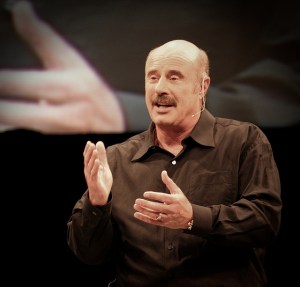
![Angela George [CC-BY-SA-3.0 (http://creativecommons.org/licenses/by-sa/3.0)], via Wikimedia Commons](https://soundstudiesblog.com/wp-content/uploads/2014/11/philmcgrawhwofmay2013.jpg?w=300)
Phil’s accent (and his ringing endorsement from Oprah, long a trendsetter for the white middle class) have a way of diminishing racial and class barriers and cleverly marketing his advice as “good ol’ common sense” that everyone can get behind. Though Southern African American vernacular is often represented, negatively, as “improper” or evidence of inferior educational attainment, a White doctor using many of the same linguistic nuances is considered “charming” and “folksy.” One of the reasons people listen(ed) to Phil is because he’s a good, moustachioed Southern doctor that’s gunna tell it to ya straight, ya’ll. This kind of cultural capital is hard to manufacture. This, I figured wrongly, was what I stood to gain, not considering for a moment all that might be lost.
Constantly searching for ways to be seen, heard, and accepted within an American system of racial binarism that privileges whiteness, denigrates blackness, and locates yellowness somewhere in a No Man’s Land of racial categorization, sound’s flexibility has always seemed to me like a means to belonging. Furthermore, as a multiracial, Korean/White woman, even no man’s land can seem out of reach. As Michael Omi notes in the Introduction to The Sum of Our Parts: Mixed-Heritage Asian Americans, within the historical and political context of the United States, (the “one-drop rule,” eugenic fears of racial intermixing, anti-miscegenation laws, etc.) multiracial identities have consistently been “contained, disregarded, [and] denied.” Multiraciality disorients and confuses insofar as it can discredit entrenched signifiers which make race perceptible to the eye and ear.
Previously on Sounding Out!, I discussed my identification with Nas and the rap world as both a move towards color and the formation of an authentic, multiracial self. A move in the opposite direction, experimenting with “white voice,” functions as another attempt to navigate America’s system of racial identification, albeit in a much more problematic vein. After years of Phil-talk and vocal impersonations of the white male variety, I am finally putting a stop to the charade. However earnest (or subconscious) an attempt to belong, the loss of time spent mimicking Phil represents an era of racial silencing that is somewhat difficult to stomach. Despite the amusement it has brought to friends and family, I am putting the voice to rest in service of getting real.
—
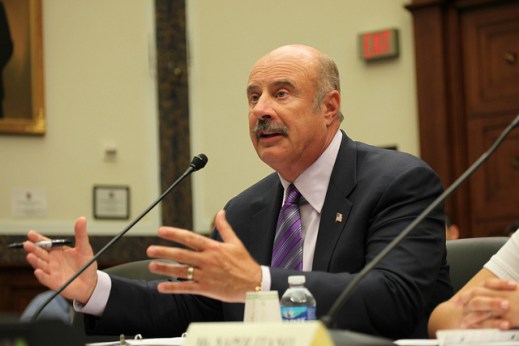
Featured image: “Dr. Phil” by Flickr user House Committee on Education and the Workforce Democrats, CC BY-NC-ND 2.0.
—
Christie Zwahlen is the Assistant Director at Binghamton University’s Center for Civic Engagement, where she has worked for four years to develop, expand and promote community engagement opportunities for students, faculty and staff. Previously, Christie worked for two years as an AmeriCorps VISTA, designing Service-Learning courses in conjunction with faculty at Thiel College and as the Coordinator of the Bridging the Digital Divide Program at Binghamton University. Christie earned her Master’s Degree in English and a Graduate Certificate in Asian & Asian American Studies from Binghamton University in 2009. She is currently enrolled in the English PhD program at Binghamton University.
—
Share this:




Current Top Posts





April 2021

January 2020

November 2019

October 2019

August 2019

April 2014

November 2017

March 2015

December 2017

October 2015


Recent Comments