
Play it Again (and Again), Sam: The Tape Recorder in Film (Part Three on the 1980s)

[If you missed the first two installments, hit “pause” and rewind to June’s piece on Noir, and July’s discussion of Walter Murch].
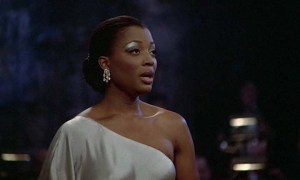
The Diva (Wilhelmenia Fernandez) Sings
At the center of this lust is the female voice, turned fetish in the 1980’s films Diva and Blow Out. Whether screaming in terror, singing the heights of the sublime, or confessing the depths of a passionate hatred, both movies construct women as emotive objects to be recorded, often against their will, and the recordists in these films clamor for and are repelled by the female sounds they capture. (For additional Sounding Out! of the “problem” of women’s voices in contemporary media culture see last week’s post, Liana Silva’s “Eye Candy” and Aaron Trammell’s recent “GLaDOS, the Voice of Postfeminist Control“). In fact, this series has traced the cultural construction of the “sound man”: how mainstream films naturalize recording as the province of men (and, with the exception of Touch of Evil, of white men). The tape recorder’s increasing accessibility should have meant that women were using the equipment in greater numbers, but according to Hollywood, tape recorders continued to mediate power relationships between (white) men. Think Walter Neff and Barton Keyes. Harry Caul and his anonymous boss. Ferris and Principal Rooney..
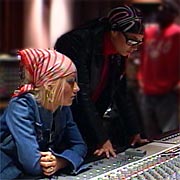
Christina Aguilera and Alicia Keys at the console recording "Impossible" (VH1)
With such a proliferation of representations of male recorders, it can be difficult to imagine a female hand twiddling the knobs, so much so that 95% of the professional recording industry is now male, according to the nonprofit organization Women’s Audio Mission, that works to increase the number of women behind the boards through youth outreach and training programs. While the sole responsibility for this chronic and widespread underrepresentation does not rest entirely on the shoulders of America’s dream factory—an NPR story from 2003 on Women Music Producersby Neda Ulaby discusses additional reasons “Why Female Producers Are a Rare Breed”—we must also acknowledge that cinematic images actively shape reality, they do not just passively reflect it. Representations limit our imaginations as much as as they embolden them. The images of recording in 1980s films remind us that the mere presence of women’s voices is not enough to enable gender equity in our increasingly mediated and technologized public sphere, women must also “man” recording equipment, structuring (and shifting) the conditions under which their voices are recorded, framed, heard, and remixed into public consciousness.
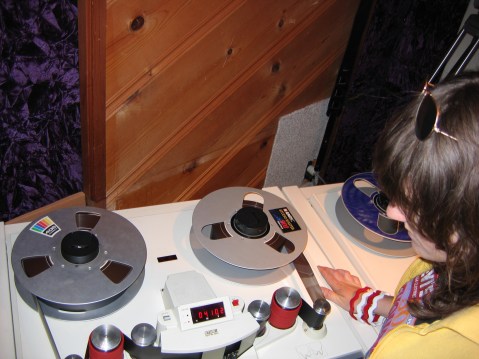
Changing the Face of Sound: Lauren Tabak Punches in (courtesy of Women's Audio Mission)
Okay, for all the completists out there, a quick recap, the first two films are: 1. Double Indemnity (1944) and 2. Blackboard Jungle (1955), with a little Mike Hammer for good measure: Kiss Me Deadly (1955). The second two are: 3. Touch of Evil (1958) and 4. The Conversation (1974), and a leap into the 1980s: Ferris Bueller’s Day Off (1986).
5. Diva (Les Films Galexie, 1981, Dir. Jean-Jacques Beineix):
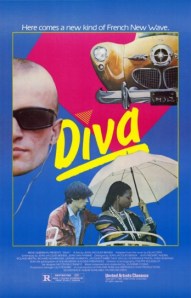 The global sex trade. Transatlantic circulation of music and capital. International piracy rings. The Vietnamese diaspora. Imperialist fetishizing of the bodies (and voices) of women of color. Taiwan as a rising force in the international economy. Police stings and gangland killings. Operatic performance and fan worship. Described by Frederic Jameson as “the first French postmodernist film” in Signatures of the Visible (1990), Diva is a rich, multilayered narrative that locates the tape recorder at the center of the vast cultural flows and postcolonial power struggles of late capitalism. As much fun Diva sometimes has with copies—there are duplicate cars, convenient doppelgangers, random mannequins, multiple decoy tapes—it also explores the melancholic cultural loss caused by a medium that holds out the promise of saving everyone, at the rate of 38.1 centimeters per second.
.
Well, it was secret. Until Jules lends it out to impress a preteen roller skating, record-stealing Vietnamese fashionista named Alba (Thuy An Luu) who plays it for the (way) older man she lives with in a creepy ambiguous arrangement, a fortysomething Zen Buddhist hipster tough guy named Gorodish (Richard Bohringer), who then tries to arrange a deal with two nameless, emotionless, mirrored-sunglass wearing, carbon copy Taiwanese business men (yellow peril much?) who are willing to pay top dollar for the tape. As Cynthia’s manager eventually warns her in the most realistic moment of an otherwise over-the-top film, “the quality of the recording is perfect. . .and Taiwan never signed any international copyright agreement!”
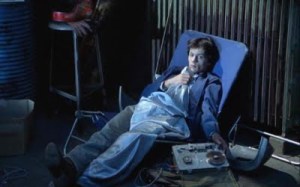
Jules (Frédéric Andréi) and his Nagra
Diva asks audiences to imagine that Cynthia has never been recorded—she wants to preserve the aura of her performances as “unique moments”—and she considers pirated recordings as akin to “theft, rape even.” The metaphor is uncomfortably extended by the sexualized recording sequence when Jules finally captures her voice, squirming and fiddling with his recorder, hidden underneath a jacket on his lap, as tears stream down his face. After the show, he steals the Diva’s dress and returns to his apartment to clutch it while listening, over and over, to her voice. Eventually even the illicit sonic reproduction cannot contain Jules’s desire to possess Cynthia; he tries to create a reproduction-in-the-flesh by seeking out a black prostitute and paying her to wear the stolen gown.
Through unsettling images such as these, Diva depicts the tape recorder as a technological phallus. It isn’t only that women are fetishized recording objects, but they are actively chased away from the machine.When an excited Alba reaches out to grab Jules’s Nagra, he pushes her away, barking “Don’t touch my stuff. It is precious. Don’t touch it. . .The levels were precisely set.” She backs off, sighing, “You and your Nagra,” in a tone that is both taunting and resigned. The only woman to make her own recording, Nadia, ends up dead, although grateful that her tape will at least allow her to “pick the time and place to die. There will be witnesses and evidence.” At least she hopes so.
.
6. Blow Out (MGM 1981, Directed by Brian DePalma):
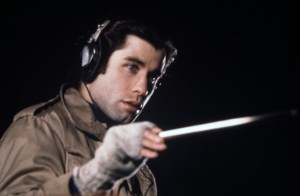
Jack Terry (John Travolta) and his shotgun mic
Fresh off the success of Grease and Urban Cowboy, 70s hearththrob John Travolta brings macho swagger to the role of Jack Terry, a burned out sound designer who is complacent about getting the “perfect” female scream for B-grade horror flicks. When his director busts his chops about finding some “new wind”—he had been squeaking by with library sounds—he finds himself doing some midnight lurking in a Philadelphia park. Armed with his trusty shotgun microphone, he is ready when an out-of-control car careens around a corner and plunges off a bridge. Instantly casting his equipment to the ground—oh! not The Nagra III!!!—he pulls a drowning woman from the car, the woefully vulnerable Sally (Nancy Allen). As if this isn’t bad ass enough to beef up the rep of “sound guys” for eternity, Jack cockily lets the investigating detective have it when he insinuates that Jack misheard what happened on the bridge: “I know what an echo sounds like, all right? I’m a sound man! The bang was before the blow out, all right?”
Carrying overtones of Chappaquiddick, the incident that Jack earwitnessed involved the death of a very prominent governor who was headed to the White House. The powers that be want to silence Sally and erase all traces of her presence in the passenger seat, so they turn a deaf ear toward Jack’s insistence that he has a tell-tale shot on tape that proves the “accident” was really murder. Ostensibly about the tenuous relationship between politics and “the truth,” Blow Out also asks audiences to press pause and consider the disposability of women in our contemporary culture–how their real lives are often mixed down, edited out, and even erased, while their recorded representations are hyperamplified and hungrily consumed.
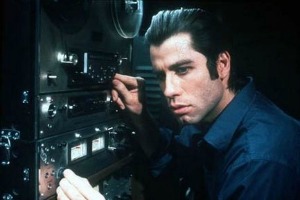
Terry, listening for the telltale shot
Inspired by The Conversation and Michelangelo Antonioni’s 1966 Blow Up—in which a swinging London photog enlarges a photo to reveal a killer—Blow Out depicts Jack on an obsessive rewind rampage, listening and re-living the incident on the bridge trying to prove the murder. The tape recorder is a both a necessary foundation of the film’s plot and a figurative device sparking audiences to listen again and to listen differently, to simultaneously question what they hear and to stake their lives on it. Interestingly, in a movie obsessed with sound and depictions of careful listening, audio itself cannot tell the whole story; it is only after Jack merges his soundtrack with a DIY film reconstructing the murder via newspaper photos that he feels his voice will finally be heard. Ultimately, however, the brash and principled sound man fails to find a listener. The haunting ending of the film, which I will not reveal, suggests that American culture mainly values “reality” and “truth” when it comes packaged as throwaway entertainment and that the female voice in terror is at the very heart of this titillating cycle of consumption.
.
And in a supporting role. . .
Real Genius (Tristar, 1986, Director Martha Coolidge. This film is notable for having five women on the sound team, editors Anna Boorstin, Virginia Cook-McGowan, Julia Evershade, Roxanne Jones, and assistant editor Christy Richmond).
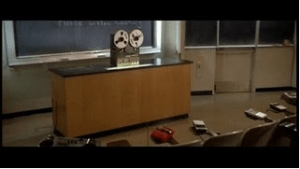
"Math on tape is hard to follow, so please listen carefully!"
The tape recorder slyly appears in the midst of this sarcastic blast to the late cold war that chronicles the revenge exacted by a band of brilliant college students (led by a young Val Kilmer) when they find out that the laser they developed for their university was intended for use by the U.S. government as an airborne weapon. Appearing in the first of two iconic 80s montages—this one set to the Comsat Angels’ “I’m Falling”—the vector-like proliferation of tape recorders silently communicates much anxiety about the technological landscape of the 1980s. When our irrepressible uber-nerd protagonist Mitch (Gabriel Jarrett) first begins his semester, he arrives at a full math lecture, barely noting the peppering of small personal recorders nudged to the corners of his classmate’s desks. As time passes, the camera revisits Mitch, still earnestly scribing notes alongside what is now only a handful of other students; he is surrounded by a sea of boom boxes the size of bread boxes and flat black slimline recorders, with a few candy apple red models thrown in for ‘80s hipness.
Finally, the earnest Mitch arrives alone, notebook in hand, only to find a completely empty lecture hall, save for the spinning spools of various tape recorders. The professor, too, has left the building—a reel to reel drones on at the head of the classroom, in front of a chalkboard that states, “Math on tape is hard to follow: so please listen carefully.” The pained look on Mitch’s face says it all: the meritocratic world of ideas that he once expected to inherit quite simply no longer exists, if it ever had. And, in a contemporary moment where online courses and “webinars” are the rule of the day and we stockpile podcasts like we have thousands of years to live, the humor of the tape-to-tape lecture cuts a little too closely. Suddenly I want to tap the mic and ask: “is this thing on? Bueller? . . .Bueller?”


Share this:

New Wave Saved My Life*
*The title of this piece is inspired by the short story, “Minnie Riperton Saved My Life,” by the poet & playwright, Luis Alfaro.
(Shuffle)
I watch you breathe,
I cannot sleep,
I touch your hair,
I kiss your skin,
And hope the morning sun won’t wake you too soon.
For when you wake,
and look at me,
You never know,
you just might see,
Another boy who crept in your room…
Take your time…(that’s what you told me),
Take your time…
But I fell head first, and I just don’t know what to do—“Nothing Looks the Same in the Light,” Wham!
I was a teenager in the 80’s. I grew up in South East Los Angeles, Huntington Park, to be exact, H.P. for short—home of the Huntington Park Senior High Spartans and the local after game hangout, Spartan Burgers. In those years, almost everyone in my school was Mexican and most kids were either preppy or cholos or Florentine Gardens disco-types—almost no one was “alternative.” That is, until we caught our first glimpse of Boy George on Video One with Richard Blade – that MTV style video show that came before MTV. If you remember, or have YouTubed it recently, a key scene in the video for Culture Club’s “Do You Really Want to Hurt Me?” begins with Boy George stepping out of a swimming pool, fully clothed and dry (a lo-tech effect even by 80’s standards), wearing a flowing tunic, white-boy dreadlocks, and expertly applied makeup. I remember being instantly fascinated watching him dance to a reggae beat and hearing him sing so longingly about a mysterious “you.” I had never seen anyone who looked or sounded like that before, and I went from listening to my brothers’ heavy metal records, my mom’s cumbias, and my grandpa’s Beethovens to listening to Culture Club, Eurythmics, Wham!, and Bow Wow Wow almost overnight.
Soon after, I started noticing in my neighborhood sprinklings of pink, purple and green hair, spikey egg white mohawks, brown boys in skirts and makeup, and the girls from St. Mathias High wearing black chunky combat boots with their proper, pleated, Catholic school uniforms–my personal favorite look. And when I bought my very own first pair of 8-hole lace-up Doc Marten’s, I was forever transformed. I sensed that crossing fashion lines somehow meant crossing other lines too, although, I was perhaps I bit too young to really cross anything. As a questioning adolescent, I embraced the freedom that music, fashion, and expression represented. It’s strange to think about how such a global phenomenon took shape in my little eastside town. That time of 80’s new wave, the “Second British Invasion,” told me something about who I would become. I learned fearlessness from the bold and transgressive acts of fashion and wit my favorite gender bending pop stars regularly deployed on American network TV. And I learned to “tune in” to the sexually ambiguous language of songs like “Time Clock of the Heart” or “Nothing Looks the Same in the Light.” All of those blurred lines felt “normal” to me. And it meant later on that I didn’t have to have an identity crisis when I was coming out. And I really didn’t. I didn’t really think about “identity” in this way again until much later.
(Shuffle)
I’m only sad in a natural way
And I enjoy sometimes feeling this way
The gift you gave is desire
The match that started my fire—“The Paris Match,” The Style Council
As I copy and sometimes re-purchase 25-year old lost albums for my new e-music library, I’ve started to wonder about some of my musical choices. Why did I still like what I liked? How do I trace my musical habitus? Culture Club, George Michael, The Style Council – they’re all on my iPod right now. And I ask myself, is my musical taste really so wrapped up in what I perceived to be my pop idols’ alternative sexuality so long ago? In this post-gender, post-queer, post-race (rhetorically speaking), trans-border era, is there even such a thing as “alternative” anymore?
Because when I listen to those old songs now, part of me still “hears” the skillful crossing of gender lines in every ambiguously phrased lyric, like the Pet Shop Boys’ clever line, “Which do you choose, a hard of soft option?” And I recall vivid images of Annie Lennox at once crossing and keeping those lines in the video for “Who’s That Girl?” which ends with an impossibly queer kiss. (She queered the Lacanian mirror long before Black Swan!) I still sense how all of these wildly public expressions of queer desire, with all of its spectacle and taboo, flowed into my childhood home through the sturdy Zenith television set that brought us together to “listen” to music anew. And this kind of hearing has to do with a particular way of remembering my adolescence – the memory of how felt for the first time to hear those songs and see the images of Boy George winking his long painted lashes at the video camera, seriously putting pressure on the word “Boy”; or seeing George Michael dancing with Andrew Ridgley in the macho ditty “Wham Rap”, their two beautiful and stylish female band mates conspicuously superfluous in that dance. And also remembering how the combined effect put something like the question about boys on hold for me in a really powerful way. There were options out there, is what I understood, and that was all I needed to survive – to save my queer soul.
(Shuffle)
Don’t make me feel any colder
Time is like a clock in my heart
Touch we touch, was the heat too much?
I felt I lost you from the start
In time it could have been so much more
The time is precious I know
In time it could have been so much more
The time has nothing to show because
Time won’t give me time
And time makes lovers feel like they’ve got something real
But you and me we know they’ve got nothing but time–“Time Clock of the Heart,” Culture Club
But I also detect another kind of crossing, or rather, multiple crossings in those same songs. Somewhere between the funk inspired bass line of “Nothing Looks the Same in the Light” and the soulful oohs and ahs of Helen Terry’s backup vocals in “Time Clock of the Heart,” I sense this music also crossed a race and a class line, however precariously treaded. From the perspective of a young, working class Chicana, quickly interested in all things British and gay, it seemed to me that these young white British boys took up a mic and pen and left their own working class accents behind for the promise of America. Clearly raised on a diet of soul and R&B, their eventual collaborations with Luther Vandross, Stevie Wonder, and Mary J. Blige – American musical royalty – seemed only natural on the Grammy stage. And I wondered in my youthful, pop star fantasies, how did they feel when they learned they could sing like that? What did it mean to be queer and black at the same time? Musically speaking. What was the bigger transgression? Because the 80’s were deadly years for many of us, on both sides of the Atlantic, who were confronted with the authority of the lines drawn by Reagan, Thatcher, and AIDS. Maybe the transgression is to survive. And to remember.
Listening as an adult now to George Michael’s greatest hits collection Twenty Five, it is easy to see that there is no longer any doubt about his sexual orientation. In songs like “An Easier Affair,” he celebrates that he’s “dancing with the freaks now/I’m having so much fun/I do my dance with everyone.” So I wonder, when your pop idols sex lives stop being curiosities or taboo, what still fascinates? Even their notorious falls from grace, and their celebrated “come backs” didn’t really provoke the public imagination in the same way again. But I detect there are still clues in the music. In his brilliant cover of “Feeling Good,” George Michael pays humble homage to Nina Simone saying: “It’s a new day, it’s a new dawn, it’s a new life, it’s a new low/Oh we all know it’s too much to expect a man, a white man, to do it like Nina” (my emphasis). That simple musical gesture, a crossing of many sorts, tells me something about what she means to him. And I think that it has ever been and ever will be music that will save our collective souls… I was seventeen when I left HP for a much larger Los Angeles. In some ways I was too young to leave home and sometimes I thought that I didn’t survive some things that came my way. But I always had a song to guide me and show me something new–a different way. I know I’ll never fully rebuild my archive on something like iTunes. But as I contemplate my growing digital library, I really do believe that new wave saved my life.
(Shuffle)


Share this:


Current Top Posts





April 2021

January 2020

November 2019

October 2019

August 2019

April 2014

November 2017

March 2015

December 2017

October 2015
 Sounding Out!
Recent Comments