
SO! Reads: Danielle Shlomit Sofer’s Sex Sounds: Vectors of Difference in Electronic Music

Distance, therefore, preserves a European austerity in recorded musical practices, and electroacoustic practice is no exception; it is perhaps even responsible for reinvigorating a colonial posterity in contemporary music as so many examples in this book follow this pattern–Danielle Shlomit Sofer, Sex Sounds, 14.

Sex Sounds: Vectors of Difference in Electronic Music (MIT Press, 2022) by Danielle Shlomit Sofer brings a complex analysis for contemporary de-colonial, queer and feminist readers. This book did its best to sustain an argument diving into eleven case studies and strongly problematising the Western white cis gaze. Sofer offers readers a new perspective in both the history of music and the decolonisation of that history.
In a moment when discussions of consent, censorship, pleasure, and surveillance are reshaping how we think about media, Sofer asks: What does sex sound like, and why does it matter? Their analysis cuts across high art and popular culture, from avant-garde compositions to pop music to porn, revealing how sonic expressions of sex are never neutral—they’re deeply entangled in gendered, racialized, and heteronormative structures. In doing so, Sex Sounds resonates with broader critical work on listening as a political act, aligning with ongoing conversations in sound studies about the ethics of hearing and the politics of voice, noise, and silence

The main focus of Sex Sounds is the historical loop of sexual themes in electronic music since the 1950s. Sofer writes from the perspective of a mixed-race, nonbinary Jewish scholar specializing in music theory and musicology. They argue that the way the Western world teaches music history involves hegemonic narratives. In other words, the author’s impetus is to highlight the construction of mythological figures such as Pierre Schaeffer in France and Karlheinz Stockhausen in Germany who represent the canon of the Eurocentric music phenomena.
Sex Sounds specifically follows the concept of “Electrosexual Music,” defined by Sofer as electroacoustic Sound and Music interacting with sex and eroticism as socialized aesthetics. The issue of representation in music is a key research focus navigating questions such as: “How does music present sex acts and who enacts them? ” as well as: “how does a composer represent sexuality? How does a performer convey sexuality? And how does a listener interpret sexuality?” (xxiv & xxix). Moreover, Sofer traces: “the threats of representation, namely exploitation and objectification” (xxxvii) as the result of white male privilege and the historical harm and violence this means (xiix & 271).
By exploring answers to these questions, Sofer successfully exposes how electroacoustic sexuality has historically operated as a constant presence in many music genres, as well as proving that music and sound did not begin in Europe nor belongs only to the Anglo-European provincial cosmos. Sex Sounds gives visibility to peripheral voices ignored by the Eurocentric canon, arguing for a new history of music where countries such as Egypt, Ghana, South Africa, Chile, Japan or Korea are central.
Sofer further vivisects the meaning of sexual sounds as not only Eurocentric and colonial but patriarchal and sexist. What is the history behind sex sounds in the electroacoustic music field? Can we find liberation in sex sounds or have they only reproduced dominance? Which role do sex sounds play in the territories of otherness and racial representation? Are there examples where minoritized people have reclaimed their voice? Sex is part of our humanity. But how do sex sounds dehumanize female subjects? These are more of the fundamental questions Sofer responds to in this study.

I aim, first and foremost, to show that electrosexual music is far representative a collection than the typically presented electroacoustic figures -supposedly disinterested, disembodied, and largely white cis men from Europe and North America –Sofer, Sex Sounds,(xvi).
The time frame of the study ranges from 1950 until 2012, analysing four case studies. Sofer divides the book in two parts: Part I: “Electroacoustics of the Feminized Voice” and Part II: “Electrosexual Disturbance.” The first part contextualizes “electrosexual” music within the dominant cis white racial frame. The main argument is to demonstrate how many canonic electroacoustic works in the history of Western sound have sustained an ongoing dominance as a historical habit locating the male gaze at the center as well as instrumentalizing the ‘feminized voice’ as mere object of desire without personification and recognition as fundamental actor in the compositions. Under such a premise, Sofer vivisects sound works such as “Erotica” by the father of Musique Concretè Pierre Schaffer and Pierre Henry (1950-1951), Luc Ferrari’s “les danses organiques” (1973) and Robert Normandeu’s “Jeu de Langues” (2009), among other pieces.
Luc Ferrrari’s work from 1973 is one of many examples in which Sofer makes evident the question of consent, since the women’s voices he includes were used in his work without their knowledge, a pattern of objectivation that mirrors structures of patriarchal domination. Sofer “defines and interrogates the assumed norms of electroacoustic sexual expression in works that represent women’s presumed sexual experience via masculinist heterosexual tropes, even when composed by women” (xivii-xiviii). Sofer emphasises the existence of “distance” as a gendered trope in which women’s audible sexual pleasure is presented as “evidence” in the form of sexualized and racialized intramusical tropes. Philosophically speaking, this phenomena, Sofer argues, goes back to Friedrich Nietzsche and his understanding of the “women’s curious silence” (xxvii). In other words, a woman can be curious but must remain silent and in the shadows.
This is the case in Schaeffer and Henry’s “Erotica” (1950-1951), one of the earliest colonial impetus to electrosexual music in which female voices are both present and erased, present in the recording but erased as subjects of sonic agency, since the composers did not credit the woman behind the voice recordings. She has no name nor authorship, but her sexualized voice is the main element in the composition. This paradox shows the issue of prioritising the ‘Western’ white European cis male gaze. This gaze uses women’s sexuality as a commerce where only the composer benefits from this use. This exposes the problem of labor and exploitation within electroacoustic practice historically dominated by white men.
“Erotica” stands out for its sensual tension, abstract eroticism, and experimental use of the body as both subject and instrument. This work belongs to the hegemonic narrative of electroacoustic music with the use of sex sounds as aesthetic objects that insinuate erotic arousal as a construct of the male gaze.
Through examples like “Erotica” Sofer strongly questions the exclusion of women as active agents of aesthetic sonic creation since: “electroacoustic spaces have long excluded women’s contributions as equal creators to men, who are more typically touted as composers and therefore compensated with prestige in the form of academic positions or board dominations” (xxxix). This book considers: “the threats of representation, namely exploitation and objectification” (xxxvii). Here we navigate the questions of how something is presented, by whom, and with which profit or intention. In other words, how sounds: “are created, for what purposes, and in turn, how sounds are interpreted and understood” (xxxiii).These are problems rooted in both patriarchy and capitalism.
This book is a strong contribution to decolonize the history of music as we know it, although the citations here could be richer, including studies by Rachel McCarthy (“Marking the ‘Unmarked’ Space: Gendered Vocal Construction in Female Electronic Artists” 2014), Tara Rodgers (“Tinkering with Cultural Memory: Gender and the Politics of Synthesizer Historiography” 2015), and the work of Louise Marshall and Holly Ingleton, who used intersectional feminist frameworks to analyze the work of marginalized composers (including women of color) and the curatorial practices that shape electronic music history. Also, not to forget: Chandra Mohanty’s “Under Western Eyes: Feminist Scholarship and Colonial Discourses” (1988).
Musical artist Sylvester
I argue that, although many composers of color work in electronic music, the search term ‘electroacoustic’ remains exclusionary because of who declares themselves as an advocate of this music, and not necessarily in how their music is made–Sofer, Sex Sounds, (xiv).
After a deep dive into the genealogy of the patriarchal practices in electroacoustic music understood as electrosexual works (hence: “Sex is only re-presented in music p. xxix), Sofer moves to the territory of feminist contra-narratives. In the second part of their study, Sofer offers sonic practices and concrete examples that: “break the electroacoustic mold either by consciously objecting to its narrow constraints or by emerging from, building on, and, in a sense, competing with a completely different historical trajectory” (xlvi). Contra-narratives from the racialized periphery and underground landscapes appear in this book as case studies to hold the argument and expand the homocentric and patriarchal telos found even in the sonic archives as well as the Western theoretical corpus. These ‘Others’ reclaim their voices going a step further and gaining recognition.
After examining examples of racialisation and objectification, Sofer selects some case studies from 1975 to 2013 in the second chapter of this section titled: “Electrosexual Disturbance.” In this section, Sofer also points to new forms of exclusion and instrumentalisation via “racial othering,” specifically in the context of popular music such as Disco where we find an emphasis on the feminized voice. Disco, as a genre rooted in Black, queer, and marginalized communities, inherently grappled with racial and gendered dynamics. Donna Summer’s “Love to Love You Baby” (1975) exemplifies this tension.
The track’s erotic vocal performance (23 simulated orgasms over 16 minutes) became emblematic of the hypersexualization of Black women in popular music. Summer’s persona as the “first lady of love” reinforced stereotypes of Black female sexuality as inherently exotic or excessive, a trope traced to racist and sexist historical narratives. Simultaneously, disco provided a space for liberation: Black and LGBTQ+ artists like Summer, Sylvester, and Gloria Gaynor used the genre to assert agency over their identities and bodies, challenging mainstream exclusion. The tropes of sex and race are a paradoxical combination bringing both oppression as well as liberation.
Sofer argues that Summers was commercially recognized but her figure as a composer was destroyed, creating consequently a hierarchy of labor. She was acknowledged for her amazing sexualized voice and performance on stage, but not recognized as a musician or equal to music producers. Here we see the practice of epistemological discrimination and extreme racial sexualisation. On the positive side, Summer became the Black Queen idol for gay liberation. Nevertheless, she remained as the sexualized and racial voice of the seventies.
Sofer also presents the case of ex-sex worker, sex-educator and radical ecosex-activist Annie Sprinkle collaborating in a post-porn art video with the legendary Texan and lesbian composer Pauline Oliveros. For Sprinkle and Oliveros, Sofer offers a different phenomena at work, since both queer-women/Lesbian-women collaborated from the point of feminist independence and sexual liberation coming together for educational purposes.

Sluts & Goddesses (1992) is a porn film with an Oliveros soundtrack, produced by radical women– with only women–in a self-determined frame. The movie offers an example of collaboration moving from avantgarde sound composition expertise to trashy whoring and interracial lesbian power. This example was rare, but inspiring for the coming generations. Two lesbian Titans united for electrosexual disturbance from the feminist gaze, Sprinkle and Oliveros were a duo that broke silence.
This book revisits the acousmatic in its electronic manifestations to examine and interrogate sexual and sexualized assumptions underwriting electroacoustic musical philosophies.–Sofer, Sex Sounds, (xxi)
Sofer’s Sex Sounds enters into a vital and still-emerging conversation about how sound—particularly sonic expressions of sex and eroticism—shapes, disrupts, and reinscribes power. At a time when sonic studies increasingly reckon with embodiment, affect, and intimacy, Sofer brings a feminist and queer critique to the center of how we listen to, interpret, and culturally regulate the sounds of sex. Their book invites us to reconsider not only what we hear in erotic audio, but how we’ve been taught—socially, politically, morally—to hear it.
This book doesn’t just fill a gap—it pushes the field toward a more nuanced, bodily-aware mode of scholarship. For SO! readers, Sex Sounds offers both a provocation and a methodology: it challenges us to hear differently, to ask how power works not only through what is seen or said, but through what is moaned, whispered, muffled, or made to be heard too loudly.
—
Featured Image: “Stamen,” by Flickr User Sharonolk, CC BY 2.0
—
Verónica Mota Galindo is an interdisciplinary researcher based in Berlin, where they study philosophy at the Freie Universität. Their work goes beyond the academic sphere, blending sound art, critical epistemology, and community engagement to make complex philosophical ideas accessible to broader audiences. As a dedicated educator and sound artist, Mota Galindo bridges the gap between academic research and lived material experience, inviting others to explore the transformative power of critical thought and creative expression. Committed to bringing philosophy to life outside traditional boundaries, they inspire new ways of thinking aimed at emancipation of the human and non-human for collective survival.
—

REWIND!…If you liked this post, check out:
Into the Woods: A Brief History of Wood Paneling on Synthesizers*–Tara Rodgers
Ritual, Noise, and the Cut-up: The Art of Tara Transitory—Justyna Stasiowska
SO! Reads: Zeynep Bulut’s Building a Voice: Sound, Surface, Skin –Enikő Deptuch Vághy
Share this:

SO! Amplifies: The Electric Golem (Trevor Pinch and James Spitznagel)

—
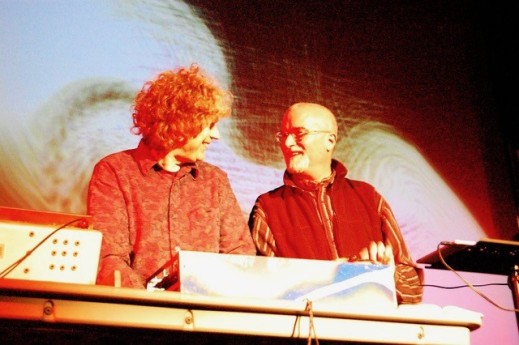
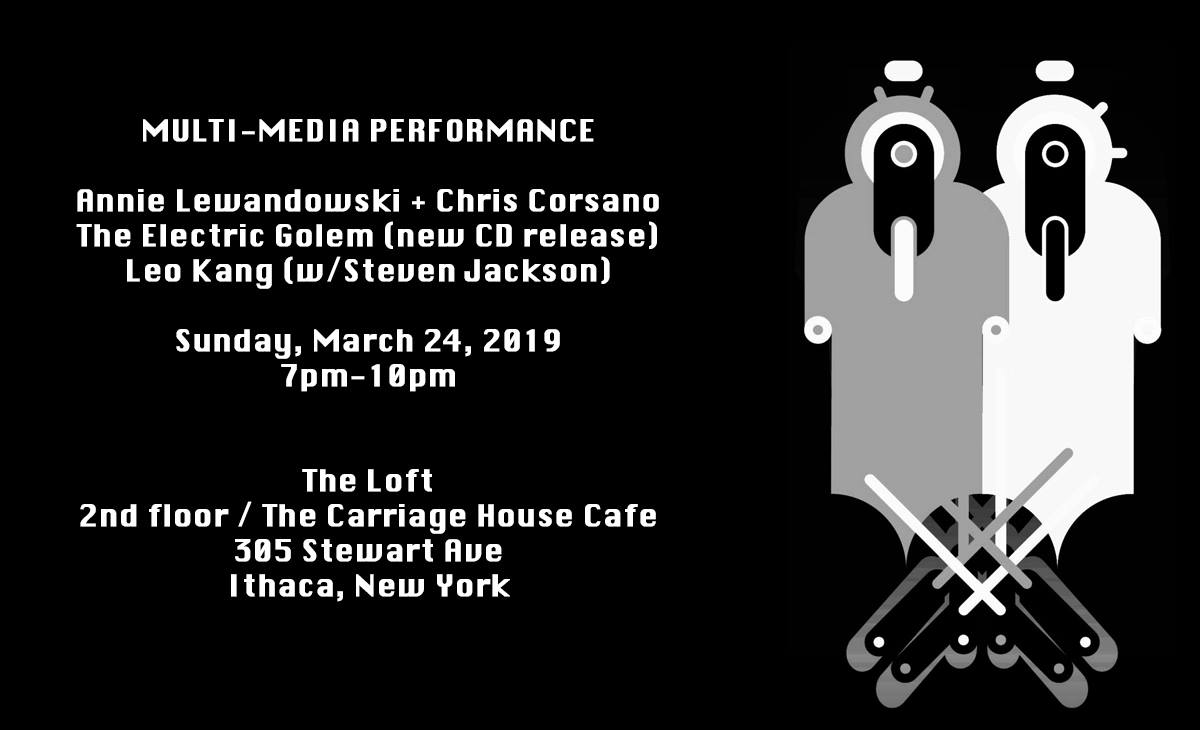
On March 24th, 2019 the record release party for The Electric Golem’s 6th CD Golemology was held at the Loft in Ithaca, New York. The Electric Golem is an avant-garde synthesizer duo featuring Trevor Pinch and James Spitznagel, that has been in existence for about ten years.
Trevor Pinch is a local sound artist and professor at Cornell University. He is an STS (Science and Technology Studies) and Sound Studies scholar. As a key thinker of STS, Trevor is the coproducer of theories about Sociology of Scientific Knowledge, Social Construction of Technology (SCOT), and the role of users in technological history and innovation. However, Trevor’s interest in dates back much farther; he built his first modular synthesizer when he was a physics student in London in the 1970s.
The other half of The Electric Golem, James Spitznagel, is a multi-media artist who uses the iPad as a musical instrument and to create digital paintings. While he has played many roles in the music and culture industries—guitarist in a rock band, record store owner, art gallery and guitar shop investor, and even business manager for the Andy Warhol Museum—he moved to Ithaca to focus on producing abstract art: digital paintings and experimental, improvisational music. Being an energetic and enthusiastic person who has unrestrained fantasies, James finds that everything around him can be his inspiration.
Pinch and Spitznagel formed the group after Spitznagel read Analog Days: The Invention and Impact of the Moog Synthesizer (by Trevor Pinch and Frank Trocco) and realized Pinch also lived in Ithaca. Spitznagel simply looked his name up in the phone book and called him up: “I go, ‘is this Trevor Pinch?’ He said, ‘yes.’ I said, ‘well, you don’t know me, but I just read your book and I love it.’” And then they got together for a beer and have been best friends and collaborators ever since. Once Spitznagel heard about Pinch’s homemade synthesizer, he asked Trevor to try to make something together and it turned out to be a fascinating mixture of analog–Trevor’s synth, Moog Prodigy, and a Minimoog–and James’s digital instruments.
Building from this first moment of discovery, The Electric Golem’s music is electronic, experimental, and totally improvised. Typically, the pieces of music last twenty minutes to half an hour and expresses their interaction with the machines and with each other in the studio. James is much more controlling of the tone and rhythm, and patches the sound as he goes along, whereas Trevor is much more about making spontaneous weird sounds. They complement each other and the creation process is usually by random and spontaneous, as Spitznagel describes: “I didn’t tell Trevor what to do or what to play, but I said, here’s the piece of music I’ve written. He just instinctively knew what add to it.” Reciprocally, “he might just play something that I go, oh, I can weave in and out of the ambient sound he’s putting there.”
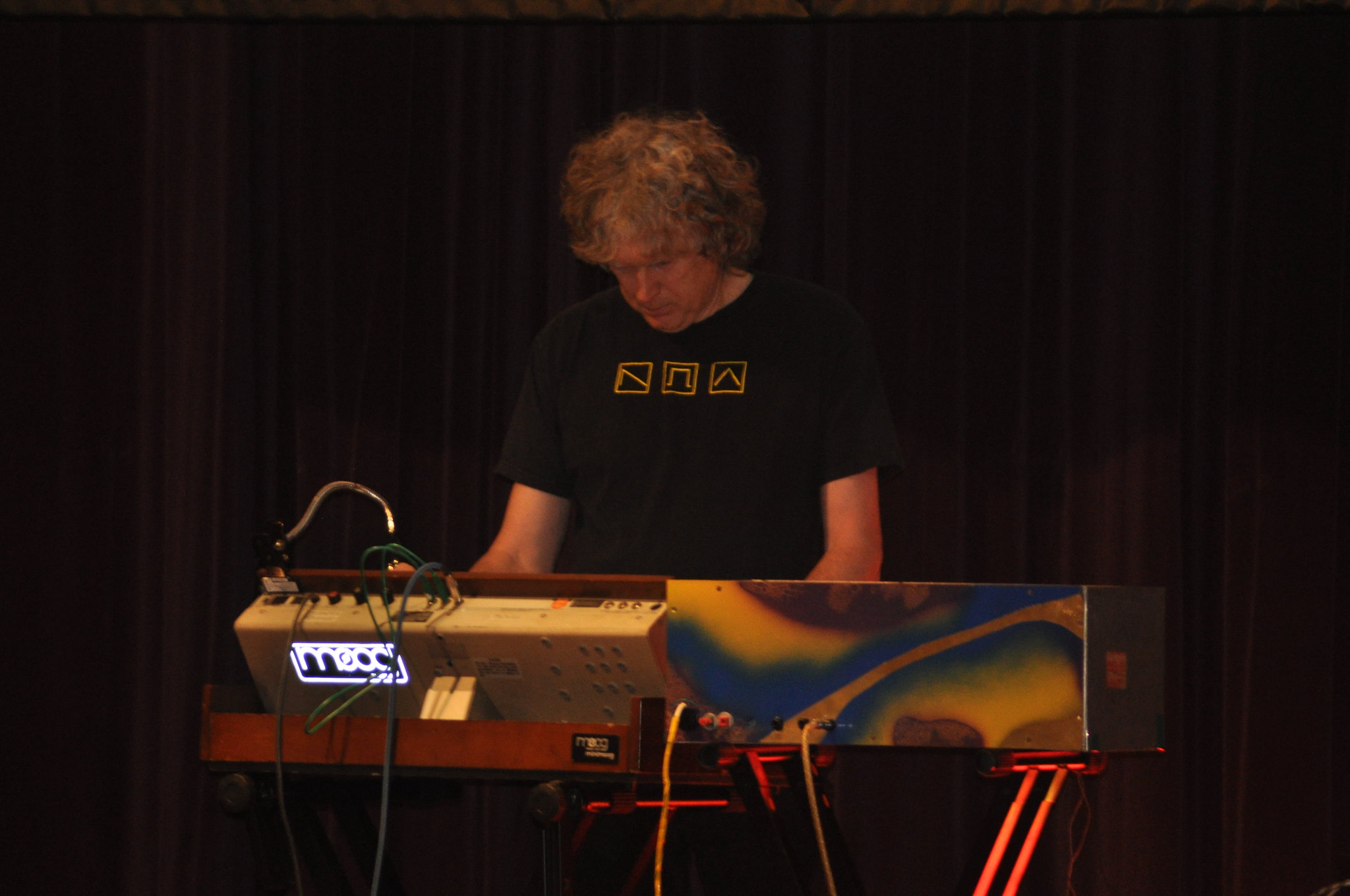
Trevor Pinch, Electric Golem at Elmira College, 2012
For the duo, the process of producing music becomes a shared experience with their listeners. The music is ever changing and evolving. In addition, unexpected drama adds vitality to the palette. “The iPad might freeze up or synthesizer might break somehow,” Spitznagel notes, “that’s happened to us, but we carry on. Like Trevor looks at me and says, it’s not working there. Or, I look at him and go, I have to reboot my computer, it’s not working. But, those times actually inspire us to try new things and go beyond what we are doing.” James explained. Their inspiration comes from the unknown, which just emerges from their practice. “Generally, this sort of music is completely unique to Electric Golem.” Trevor concluded.
The name “Electric Golem” comes from a series of books with Golem in the titles that Trevor collaborated on with his mentor Harry Collins. “The golem is a creature of Jewish mythology,” Pinch and Collins wrote in The Golem, What You Should Know about Science, “it is a humanoid made by man with clay and water, with incantations and spells. It is powerful, it grows a little more powerful every day. It will follow orders, do your work, and protect you from the ever threatening enemy. But it is clumsy and dangerous. Without control, a golem may destroy its masters with its flailing vigour” (1). Noting Trevor’s association with the concept of the Golem, Spitznagel added the “Electric” twist not just as a metaphor for their sound but also because “it’s kind of like a retro name.” The Electric Golem mushroomed from there, and in the past decade they have had many invitations and bookings to play out, receiving the first recording contract from the Ricochet Dream label, and have played with a bunch of notable musicians, such as Malcolm Cecil of Tonto’s Expanding Head Band, Simeon of Silver Apples, and “Future Man” (aka Roy Wooten), and they haven’t stopped there.
According to Pinch, the key feature of The Electric Golem’s music is its ability to encompass different moods. “I think Electric Golem has become good at one thing: its changing and transitioning from one sort of mood of music to another. And we have become quite good at those transitions. I think people would say that’s what they kind of like about us.” These sorts of slow transitions construct a unique texture of sound that can be quite cinematic, so much so that in 2012, the Electric Golem performed the accompaniment to the silent movie A Trip to the Moon, a special Cornell cinema event. Overall, as improvised experimental music, it is sometimes challenging to listen to, with no regular rhythm or reliable melody. Trevor produces warm, rich drones from the analog side that contrast with the sharper digital rhythms that James programs. In short, the Electric Golem varies between these two affects but the music goes far beyond the representation of emotional states; sometimes it conjures up the feeling of the vastness of space and time.
Experimental music, is a collaboration and negotiation process between instruments and their users. No matter if analog or digital, instruments have autonomy; they are non-human actors with their own agency to some extent. As Trevor Pinch intimates, “I understand the general sort of sound that can be produced, but the particular details of how it will work out, you don’t really know, that’s much more spontaneous, you have to react to that.” Instruments can often be uncontrollable–making their own sounds—so that Electric Golem must respond in kind. “So, it’s sort of like higher level meta-control versus actually doing what you’re doing in response to the instrument that combines together,” Trevor describes, “which I think is the secret to controlling these sorts of instruments.” It is incredible that Pinch and Spitznagel know each other so well—and each know their instruments so well–that they can improvise for long periods with no trouble. Trevor says: “Follow the use of these instruments! Follow the instruments! They are not essentialized. They are just stabilized temporarily.”
On the whole, The Electric Golem shows an artistic form which breaks the traditional paradigm, deconstructs and then reconstructs it, seeking to free sound from the instruments. Their music is beyond pure melody and rhythm, beyond the expression of existence, expressing more of an aesthetic state of transcendence. They challenge what music is, and what musical instruments are; they challenge divisions between the identities of engineer and musician. Electric Golem’s music co-constructs art and technology and binds them together; art, for them, is a mode of presenting technology, and vice versa, technology is a pathway through which art can flourish.
My favorite Electric Golem piece is called “Heart of the Golem.” What is the heart of the Golem? According to Pinch, “It is a mystery, a process of unfolding and discovery. It is somewhere where analog and digital sound meet, and an improvisation.” What the magic is remains unknown and unlimited, just like the future of the Electric Golem.
—
Featured Image: Courtesy of The Electric Golem
—
Qiushi Xu is a PhD candidate in the subject of Philosophy of Science and Technology in Tsinghua University, Beijing and in a joint PhD program in the Department of Science and Technology Studies in Cornell University, working with Prof. Trevor Pinch. Her research areas are Sound Studies, STS, Cultural Studies and Gender Studies. Her current research focuses on the sociology of piano sound and the negotiation and construction of piano sound in the recording studio (PhD dissertation), gender issues in recording industry, experimental music, auscultation and sound therapy. She holds an MA in Cultural and Creative Industries from King’s College London; a BA in Recording Arts and a BA in Journalism and Communication from the University of China, Beijing. She is also an amateur pianist, writer, and traditional Chinese painter. As a multiculturalist, she is am fascinated by different forms of art and culture in different cultural contexts.
Share this:


Current Top Posts





April 2021

January 2020

November 2019

October 2019

August 2019

April 2014

November 2017

March 2015

December 2017

October 2015
 Sounding Out!
Recent Comments