
Listening to Whisperers: Performance, ASMR Community and Fetish on YouTube
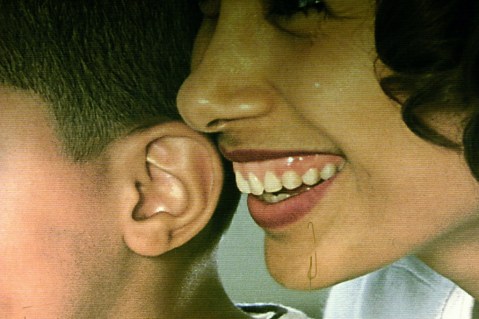
Imagine this, only virtual. Image borrowed from Genista @Flickr.
PercussiveThoughts is giving me a facial. The voice tells me about the “little scrubbies” in the exfoliant, and I begin to hear their delicate sibilance on my temples. If I’m lucky, a pleasurable, tingling sensation might begin somewhere on the back of my head and travel down my spine, turning my facial into something closer to a massage. The sole caveat is that I’m not really being touched at all.
This is ASMR, “Autonomous Sensory Meridian Response,” a pseudo-medical designation whose native soil is YouTube. The term pulls together a range of physiological and affective states: goosebumps, chills, relaxation, melting, tingles, and so forth. PercussiveThoughts and her fellow vloggers (I call them “Whisperers” here and explain why below) aim to trigger these frissons through a cornucopia of techniques. Sound is paramount; Whisperers scratch rough surfaces with their fingernails and percuss everyday objects with fingertip drum-rolls. And, of course, they whisper, sometimes using lozenges or gum to increase the opportunities for swallowing and lip-smacking.
What’s interesting about these videos is how they manage to traverse the gap between the sonic and the haptic. There is, of course, something familiar about this leap. Like the magician’s hat that produces rabbits and endless handkerchiefs, an audio speaker produces a volume and variety of sound out of proportion with its small, blank visage. In the case of Whispering, however, sound is transduced into touch, and the taut membranes of the listener’s headphones become coterminous with his own skin.
Apart from Steven Novella’s suggestion that ASMR might be a mild form of seizure, it does not yet appear to be a subject of scientific research. So Whisperers have taken on the role of amateur scientists themselves, with YouTube serving as a public petri dish. For this very reason, Novella has also cautioned against the assumption that ASMR is a real physiological phenomenon at all, since feedback loops of suggestion on the Internet might create “the cultural equivalent of pareidolia.”
Whisperers, however, have no doubts. And while the ASMR acronym is a recent development, many Whisperers say their first encounters with the phenomenon occurred sometime before their first exposure to the Internet and often before adulthood: during make-believe tea parties, while watching their classmates draw or braid each other’s hair, and, perhaps most commonly, while watching The Joy of Painting with Bob Ross.
The audience for Whispering is anyone who can have this experience, which apparently isn’t everyone. Contrary to the soporific themes of their videos, Whisperers and their fans identify themselves as having awakened to a special form of pleasure. Some have even made videos recounting their first experiences. The downside of this ability is the anxiety about its social acceptance. Whisperers sometimes opt for anonymity in their videos, revealing their faces only after much encouragement from fans. Rarely do they they let their family and friends in on the secret.
That this familiar, tingly feeling has assumed a pseudo-medical acronym is hardly coincidental. ASMR isn’t just pleasurable, it’s therapeutic. Hundreds of YouTube comments attest to the power of ASMR to help relieve them of insomnia, anxiety, and panic attacks. Nor has this dimension been overlooked by Whisperers themselves, who regularly perform as doctors or therapists in their roleplay videos. This is particularly interesting in light of recent scholarship on human/machine interactions. In Addiction By Design, Natasha Schüll shows how therapy for video-poker addiction can take the same format as the gambling itself, namely, “ongoing technological self-modulation to maintain equilibrium” (250).
Homemade Whisper videos, while habit-forming, are clearly not the sort of intricately-engineered machines that Schüll writes about. Nor do they wreack the same sort of havoc (depletion of one’s life-savings, deterioration of one’s physical health, etc.). And yet, both are arranged in problematic feedback loops of self-medication. The slow-paced, low-volume respite that Whisper videos offer is made all the more necessary by the fact that viewers must go online to watch them. This paradox is amplified by YouTube’s advertisements, which will sound especially abrasive because viewers tend to turn the volume up while listening to Whisper videos. That some of the more popular Whisperers earn money from their videos only complicates things further.
*
“No, we don’t get as many men here as women,” PercussiveThoughts says, as though responding to a question from me. Of course, I wouldn’t be so rude as to contradict her – I know better. To judge from the comments below, she gets plenty of male visitors. And her colleague ASMR Velous confided during an interview that around 70 percent of her viewers are men. For this reason, some Whisperers have made gender–neutral or male-oriented videos.
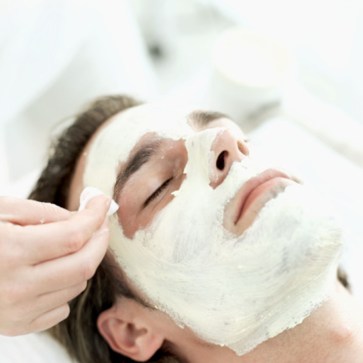
A man getting a facial. Borrowed from FoundryParkInn @Flickr.
Gender is a major, and sometimes contentious, topic of discussion in the Whisper Community. In the YouWhisper web forum, the discussion topic “Gender Preference?,” has the greatest number of views (more than 170,000). In general, female Whisperers are more popular than their male counterparts. The three most popular male Whisperers that I could find–WhisperMister1, MaleSoothe, and TheLyricalWhispers–each have fewer than 5,000 subscribers and their per-video view-counts tend to peak around ten or twenty thousand.
Not long ago, GentleWhispering, one of the better-known names in the Whisper community, set off a series of heated back-and-forths with her ~FeminineGrace & Charmforsleep~ video. In it, she discusses universal traits of femininity while brushing her hair absent-mindedly. Whatever one might think of her opinions, the fact that GentleWhispering’s viewership dwarfs all other Whisperers to date suggests that something in her technique is working. My guess is that it has a great deal to do with her hands.
While giving Russian language lessons on a chalkboard, she points to a word with her middle, ring, and pinkie fingers while keeping the chalk poised delicately between her thumb and index finger. When she is about to touch the fabric of an armchair, her fingers arch back–rather than claw forward–as though to ensure that the contact is as light as possible. And, like so many other Whisperers, she takes any opportunity to tap hard objects with her well-kept fingernails.
The “femininity” of GentleWhispering’s hands is the performance of a soothing, caring touch, and her whispering voice is the transubstantiation of this touch through sound. Sometimes, she even short-circuits the analogy by massaging the microphone directly.
*
But even the performance of gendered touching does not quite explain how these sounds and images manage to reach through the speaker and screen. After a second glance at these videos, we might wonder if the preponderance of partial objects has something to do with it.
I’m talking about all of those disembodied hands stroking opposite hands or displaying objects detached from their collections. Often, for the sake of anonymity, the Whisperer’s eyes are kept out of frame, leaving only an expressive mouth, like CalmingEscape’s, with its signature tics and swallows. If even the mouth is too revealing, the camera gazes down at covered breasts, ”objects,” in a Freudian panoply of sexual cathexis (is it a coincidence that some Whisperers even roleplay as the viewer’s doting mother?). One has to wonder what effect is achieved by this strange summation of partials.
In spite of widespread insistence that these videos are not sexual, the comparison with sexual fetish is too obvious not to make. Sticking with Freud for a moment, the hyper-presence of the Whisperer would seem to disavow the separation implicit in internet communication. Her mouth speaks individually into each of the listener’s ears while also hovering on screen. Her hands animate dead objects through rappings and close-ups. In her omnipotence, she can even tell us what to do.
Fetish or not, the word “whisper” is a perfect synecdoche for this fragmentary whole, and that’s why I’ve used it instead of ASMR. A whisper is, by definition, “unvoiced.” The cheeks, mouth, teeth, and tongue accomplish the acoustic filtering that gives words their shapes, but the larynx produces noise rather than tones. Lacking pitch, a whisper might be called only a “part of speech.” And yet it speaks volumes by shifting the register of communication. Whatever is said in a whisper gains the aura of genuineness, honesty, and intimacy.
Of course, in a YouTube video, these qualities are suspect from the moment one clicks the play button. But perhaps this is what makes Whispering work. One hears in these videos, above all, the effort of performance. It is the performance of gender, as discussed above, but more generally the performance of interaction, intimacy, and proximity. What every Whisper video whispers is “Let’s pretend!” And nothing proves this better than the fact
that some popular Whisper videos contain rather unpleasant sounds. Consider TheWhiteRabbitASMR’s dentist appointment video. If one is willing to grit one’s teeth through the long sections of abrasive drilling, it’s because she so adeptly crafts the intimate space of fantasy in which it takes places.
The pleasure of pretending was made clear to me when ASMR Velous recounted her childhood tactic for inducing ASMR. “I would constantly trick people into pretending to do things. I had this little play kitchen set, and I would cook up imaginary food for people and make them pretend-eat it really slowly and make those eating sounds like [chewing sounds], and I would just sit there and be all tingly. And I just loved it….I made up this game with my friends, where we would basically mime a profession and the other person would have to guess the profession you were miming. That was another way for me to trick my friends into pretending to do stuff.”
*
PercussiveThoughts is wrapping things up. “That completes your facial… So you can sit up. Well, thank you. Thank you so much. I’m really glad you enjoyed it.”
I did enjoy it! But thank goodness it’s not really over; I can just hit the reload button. No matter how many times I do, I know that my pores won’t be any cleaner when I look in the mirror. But that’s not the point. Rather, Whisper fans take pleasure in the intimacy and complicity of pretending. That complicity applies even to the skin of the listener, a surface as vibrant as the skin of the speaker.
—
Share this:

The Victoria’s Secret Fashion Show and the Soundtrack of Desire

"Victoria's Secret Show 2008" by flickr user cattias.photos under Creative Commons license
As a consumer, you’ve experienced desire: that longing for someone, that appetite for something more, that expectation of pleasure and satisfaction that comes from getting what you want. Whether what you want ranges from an ideal body type, to a cool technological gadget, to fashionable clothes or new cars, someone beautiful is out there selling it to you—beautifully. If you’re like me then you’ve found yourself suddenly and inexplicably under the influence of desire, only later trying to understand where your money went. If you’re a lot like me then you’ll eventually realize that desire has this effect because of the way it looks and, perhaps more importantly, because of the way it sounds.
One of the more interesting snippets of what desire looks and sounds like right now is The Victoria’s Secret Fashion Show (VSFS), which aired on November 29th and rebroadcast on December 15th. Rappers and rock stars serenade the audience while Victoria’s Secret Angels don Swarovski crystal-encrusted lingerie and angel wings. The visual and aural cornucopias echo ideas of abundance and break down the boundary between public and private spaces by implying a type of intimacy—Victoria wants to share her secret fantasies (privately) with just us (in public). The intimacy implied is totally illusive, which makes it all the more desirable.
This illusiveness starts with the models, who enact intimacy and embody silence as the sound of desire. The VSFS’s onstage choreography fixes women squarely in the visual domain and undercuts their credibility in the sonic domain. Instead of raising their voices for self-empowerment while on the air the VSFS suggests that women should push up their breasts and show as much cleavage as possible, playing to audiences as seen and not heard.
Bernd Schmitt, David Rogers, and Karen Vrotsos explain what’s behind the VSFS’s strategy of strategic silence in their book, There’s No Business That’s Not Show Business: Marketing in an Experience Culture:
“Since 1995 Victoria’s Secret has gone from imitating marketing ideas of true luxury retailers to becoming the model for some of those retailers… Every step of this dramatic progression has been pure show business—pushing the boundaries of fashion and taste, engaging (and sometimes enraging audiences) and transforming the industry into re-imagining itself. Like a teenager wearing her first Wonderbra.”
Through a maelstrom of controversies and publicity over the lack of women’s voices represented in the fashion shows, the VSFS was re-imagined in the early 2000s and took on a (post-)feminist message of empowerment. Here’s the idea: VSFS models are “superheroines” because they brandish their assets on their own terms on the catwalk, in an emancipatory celebration. Silent, desired objects are glorified as consumers are bewitched.
The show facilitates desire by creating additional intimacy for consumers, incorporating an “All Access” website replete with revealing video clips and exclusive photos, biographical videos about the models. The actual broadcast now also airs backstage interviews in which models share their private thoughts about why the VSFS is more than a pornographic commercial or a fantastic rejection of old-school stereotypical bra-burning feminism. For example, during the show one model commented that she’s “living the American Dream.” Another said that she feels senses of accomplishment and growth because “It’s every girl’s dream to walk in VSFS… the minute I stood on the runway I felt like I became a woman.” Yet another model encouraged young female audience members to aspire to participating in a future VSFS, pronouncing that “someone that’s watching this will be an angel.”
Despite this backstage commentary much goes unsaid. Noticeably absent from the models’ remarks is any mention of how the opportunity to speak their minds is presented only to sell more merchandise that is not certified fair-trade. Then there’s the total silence around the privileging of light skin and thinness and their relations to higher levels of “erotic capital” in mainstream popular culture. Out of 10 models in the 2011 show, 3 appeared to be women of color (Asian-American and African-American or mixed race) and only 1 appeared to be a darker-skinned woman of color. No women of color contributed to VSFS’s on-air backstage footage. And, adding insult to representational injury, the women of color are hypersexualized even as they are muted. What’s more is that all models appeared to be under the size of the actual US female consumer (sizes 10-12), suggesting that most real women are still not considered the target audience for VSFS and thereby suffer a profound lack of agency in voicing images of desire for themselves.
The absence, and silence, of average women and women of color in desire industries has been noted by sociologist Siobhan Brooks in Unequal Desires: Race and Erotic Capital in the Stripping Industry. Brooks writes,
“Many feminists argue that women cannot assert agency within sexual economies; their belief is that women are victimized and/or controlled by heterosexual male desire that is not in the best interest of women. On the other side of the debate… contemporary feminists have focused on sexual agency and the empowerment of women within sexual economies as an expansion of women’s control of their bodies. However, within the debate… there remains a theoretical void in examining US-based racial and sexual hierarchies present within desire industries, and how these hierarchies mirror existing forms of racial stratification in US institutions.”
This racial stratification is stitched into the very soundtrack of the VSFS, which loudly reinforces women’s silence as the sound of desire. The VSFS soundtrack nourishes desire through presenting what Deanna Sellnow and Timothy Sellnow, in their article “The Illusion of Life Rhetorical Perspective: An Integrated Approach to the Study of Music as Communication”, call an “illusion of life—a dynamic interaction between virtual experience (lyrics) and virtual time (music).” Racial, gender and class differences produced virtual experience. Lyrics expressed these differences through some form of heterosexual, aspirational and consumptive desire—from getting one’s ideal sexual partner, to traveling to exotic locales, and enjoying celebrities’ exciting and extravagant lives. The pop and rap songs offered fast tempos, driving rhythms, loud dynamics and full instrumentation, representing intensity and power.
The VSFS’s performers show the gendered dimension of that “illusion of life.” Kanye West’s version of masculinity was on display as he flirted with each model strutting down the runway, making his voice the only one heard as models appeared. His famous line from “Stronger” (“I need you right now”), when coupled with the women’s silent sauntering, sounded as relevant as it was politically incorrect.
Maroon 5’s performance of “Moves Like Jagger” also addressed the theme of desire, especially when lead singer Adam Levine planted a kiss on the cheek of his girlfriend Anne Vyalitsyna (as she remained silent). Jay-Z and West’s show stopping performance of “Niggas in Paris,” in which the duo performed without any models on stage, highlighted the rappers’ “untouchable” status as rap gods and throne-dwellers. The live audience responded more emphatically to this male-only performance than it did to any other segment of the show.
Nicki Minaj was the only female to appear on stage in the role of non-model, performing “Super Bass” with a hint of Rob Base and DJ EZ Rock’s “It Takes Two.” Though her performance can be read as a subtle critique of the lack of authentic audience agency and absence of a womanist standpoint in VSFS, it sounded no less male-centered than any of the other performers’. For instance, the first line of “Super Bass” is directed at a male audience driven by consumption, “This one is for the boys with the booming system.” In this respect Minaj could be seen as The Female Voice of VSFS, as her rapping about self-image and relationships with men is consistent with sanctioned topic areas for women in general.
However, and in keeping with the show’s theme of women’s silence as the sound of desire, Minaj’s performance does offer a quiet critique of hegemonic images of desire and desirability. Unlike the male performers Minaj always stayed behind the models and in the background. Consequently, Minaj’s short stature, colored wig, thicker figure, sneakers, outlandish outfit, and darker skin were presented in sharp contrast with the tall, high-heeled, thin, lighter-skinned, scantily clad, and perfectly coiffed models who she stalked as they came down the runway. A scan through tweets posted as the show aired confirms that audiences got Minaj’s message even if they eventually turned it against themselves, revealing that desire can sometimes be displeasing and painfully restrictive. Take the following tweet from viewer @kelcicoffey: “Going on a diet after watching #VSFashionShow tonight XD.”
Though Minaj’s soundless critique speaks volumes, the VSFS soundscape ultimately seals the edges on a spectacle brimming with hegemonic impressions and sensations of desire. The end product is an illusion of life that is mostly white, nearly naked, always feminized and conspicuously silent.
***
Marcia Alesan Dawkins is an award-winning writer, speaker, educator and visiting scholar at Brown University. She is the author of Clearly Invisible: Racial Passing and the Color of Cultural Identity (Baylor UP, 2012) and Eminem: The Real Slim Shady (Praeger, 2013).
Marcia writes about racial passing, mixed race identities, media, popular culture, religion and politics for a variety of high-profile publications. She earned her PhD in communication from USC Annenberg, her master’s degrees in humanities from USC and NYU and her bachelor’s degrees in communication arts and honors from Villanova. Contact: www.marciadawkins.com
Share this:


Current Top Posts





April 2021

January 2020

November 2019

October 2019

August 2019

April 2014

November 2017

March 2015

December 2017

October 2015
 Sounding Out!
Recent Comments