
Como Now?: Marketing “Authentic” Black Music
With all the excitement over the new release of Mavis Staples’s You Are Not Alone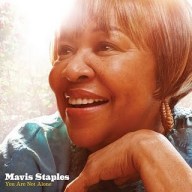 (Anti-, produced by Wilco’s Jeff Tweedy), I can’t help but be skeptical of the outpouring of Indie love for the album, even as I have been spinning (and enjoying) it myself. It isn’t the positive reaction to Staples’s talent that is surprising—at 70-plus years, Mavis has been exquisite for quite some time now—but rather the way in which critics have freighted her newest record with the “uplift” (AV Club) of a whole lot of souls that haven’t ever been to church (at least not in a good long while). Her voice is described as alternately “raw” (Paste) and full of a “depth, power, and warmth that seem increasingly rare in music today” (hear ya); Consequence of Sound, who cites Tweedy’s hand at the boards as the reason for all the current music blog attention, calls her voice “empathetic. . . powerful. . .soulful. . .touching” and “wise.” If the blogosphere is to be believed, Staples’s voice, “as authentic as it gets” (buzzine), could really save us all in these tough times. Come to think of it, the fervor of (white) faith in “authentic” black music shouldn’t be that surprising either, given the way in which race has always been entangled with popular music history in the United States.
Authenticity and the immediacy of experience it implies, have had a long history in the music industry—especially in reference to black artists—stemming back at least to the Fisk Jubilee Singers in the 1870s, an all-black acapella troupe celebrated for  powerful live performances whose breakthrough concert also happened to be for a crowd of hipsters: the wealthy congregants of Henry Ward Beecher’s Brooklyn church in 1871. Beecher gave the band his enthusiastic support, namely because he felt their sound gave listeners direct access to “the inner lives of slave hearts expressed in music” even after slavery had formally ended.
While the sound of You are Not Alone differs greatly from the Jubilee Singers, the reviews of the record belie and inflame a similar desire for unmediated access to the emotive qualities (a)historically associated with black life and sound in the U.S.: namely suffering, faith, and catharsis. And Staples’s record is indeed not alone in this. Many of the sentences from the Staples reviews could easily have been lifted from those of another recent gospel record to capture the indie imagination, Daptone Records’s 2008 release Como Now. Starkly different from the breezier, countrified sounds of You Are Not Alone, Como Now is an acapella gospel recording made in a small town in Panola County, Mississippi. The record was a risky release for Daptone, a Brooklyn-based label that has consistently produced new funk and soul records since its inception in 2002 by the likes of Sharon Jones and the Dap-Kings and The Budos Band. Although old school sound has always been a part of the label’s ethos—its engineers use primarily analog equipment, for example, a major reason Amy Winehouse recorded her throwback Back in Black album at Daptone studios in 2006—marketing stripped-down gospel to its audience of predominately white hipsters would nonetheless prove a daunting task. Treating Como Now as a labor of love and a paying of dues, Daptone attempted to spark interest in the release by relying on the familiar marketing strategies of immediacy, authenticity, and nostalgia.
 While Como Now’s tagline boldly proclaims that the music was “Recorded Live at Mt. Mariah Church on July 22, 2006”—and, thus, emphasizing the Now of the title—the cover’s vintage civil-rights era design evokes the Como of yesterday, or more accurately, encourages listeners to hear Como now and Como yesterday as one and the same through the vehicle of “raw gospel testimony.” Como Now’s depiction of the sounds of the past as echoes within the present is as ambiguous as it is uncanny, a sonic window thrown open to simpler times happening somewhere out there, “deep in the heart of Mississippi” right now.
The introductory promotional video from Como Now’s website (also uploaded on Youtube) represents the record as an aural time machine to a land and a people isolated from and largely unchanged by technology, modernity, and history.
Producer Michael Reilly’s voiceover locates rawness, emotional release, and “real religion” in the sound of black voices, in no small part because the video places his measured Yankee pacing in sonic tension with the song that accompanies it, Mary Moore singing “When the Gates Swing Open.” Over Moore’s impassioned singing, Reilly assures listeners in a muted deadpan that they will hear “no pretty piano playing or clever guitar picking, just voices. Pure soul stirring fire from the heart.” Reilly’s sentiments not only evoke the gushing Jubilee Singers’ press, but also the ethos of the infamous folklorist John Lomax, who made field recordings in Southern prisons in the 1930s because he sought “negro singers untainted by white musical conventions” (as he wrote in 1934’s “Sinful Songs of the Southern Negro”); singers in Como were actually recorded by John’s son Alan in the 1940s. Reilly’s voiceover goes on to frame the Como singers as practitioners of what the senior Lomax called “the real art of simplicity,” as stripped-down, natural singers who are artful mainly in their artlessness. While Reilly’s webcopy mentions how “children and grown folks alike have been living and breathing gospel for as long as they can remember,” for example, he fails to mention how the residents of Como have also been writing, rehearsing, and performing it.
Thus, Como Now’s marketing disavows the real artistry of the Como singers, even as it seeks to celebrate it. The simple, natural quality endowed to the singers of Como is visually accentuated by stark imagery representing the town as a down-at-the-heels, living museum of the black life of yesteryear. In the youtube clip, Moore’s soaring and spirited singing animates stills of blooming cotton fields, vintage RCA microphones, and splintering upright pianos.  Save for the album cover and one blurry still of a child, there are no shots of the people of Como in the introductory promo, effectively isolating Moore’s voice from her corporeal and historical body. This isolation allows listeners to supply their own fantastic imagery and forces them to rely on historical stereotypes about the naturally sonic qualities of black people. By choosing to disembody Como’s voices, the promotional video represents the album’s music as emanating from, and even haunting, Panola County’s lush green fields and battered strip-malls rather than showing it to be a hard-fought creation of the residents themselves. To quote Lomax again: “[The Negro’s] songs burst from him, when in his own environment, as naturally as those of a bird amid its native trees.”
Although the impulse to make the album reflects a progressive desire to respectfully pay tribute to the black gospel tradition in American popular music—and to provide quality artists like The Como Mamas with critical renown and monetary compensation—Como Now relies on well-worn racial tropes to do so. It also points to the continued presence in American culture of an essentialized “black voice” that is naturalized as more emotive, truthful, and soulful than other voices. While this phenomena is socially constructed and the sounds thought of as “black” have shifted considerably—when I play early recordings of the Jubilee Singers my students consistently tell me that they sound “white” like a “glee club”—I find it fascinating that the language used to describe them has largely remained the same. While Como Now’s producer at least acknowledges that, in Como, “no one has to pick up cotton anymore, thankfully,” the marketing trades on the possibility that, while slavery and sharecropping have ended, its sonic labors have not only endured, but are readily available for download.


Share this:

Ill Communication: Hip Hop Studies & Sound Studies @ Show And Prove
“The engaged voice must never be fixed and absolute but always changing, always evolving in dialogue with a world beyond itself” –bell hooks, quoted by d. Sabela Grimes at Show and Prove, 9.18.10
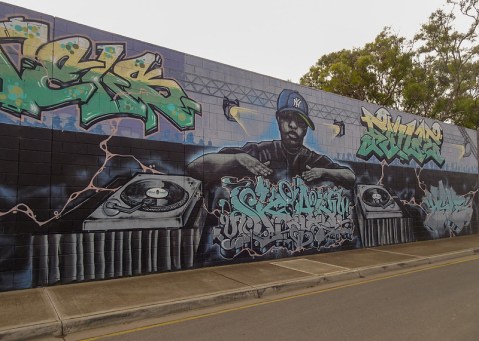
This past Saturday, I got up before dawn and bussed it into New York City to attend Show and Prove , a conference on “the tensions, contradictions, and possibilities of hip hop studies in practice,” organized by my friend and colleague, Imani Kai Johnson. The conference was excellent—intense, earnest, and busting at the seams with ideas—and was one of the few in recent memory that left me energized and ready to put pen to paper ASAP. In fact, I scratched out the rough draft of these lines in my notebook on the bus ride home, all Eminem 8 Mile-style. So embedded somewhere in my words will inevitably be the thick chug of the engine, the squeaky bounce-bounce of the shocks, the ocean-like roar of (the)17, and the steady tsk-tsk-tsk-tsk of hip hop pumping from my fellow commuter’s earbuds. Across the bus aisle, this secondhand beat called to me and challenged me to think about ways that sound studies can reach across the (inter)disciplinary aisle to hip hop (and vice versa). So that’s where my head’s at right now: what does sound studies bring to hip hop’s platform? And what does hip hop offer in return?
I should say first off that I don’t necessarily see an intellectual conflict between these two fields—although Norma Coates’ 2008 Cinema Journal piece, “Sound Studies: Missing the (Popular) Music for the Screens?” makes a compelling case for institutional turf wars on the horizon between sound studies, media studies, and popular music study writ large—I actually came to sound studies through hip hop, and obviously haven’t left hip hop behind (and neither has Sounding Out!: peep Liana Silva and Scott Poulson-Bryant’s recent posts). Among the many things that hip hop has done for me and to me—personally, socially, and politically—was to open my ears to all sorts of amazing and important sounds, which eventually translated academically into frustration with the limits of popular music study back in the early 2000s. I found many texts that deconstructed hip hop lyrics and visual imagery, parsed MC’s personas, dropped some socio-historical science, and traced capitalist networks like you wouldn’t believe, but when it came down to the constitutive element of the medium itself, the sonic art through which it devoted itself to moving heads, hearts, and butts simultaneously, there was silence (and not because Doug E. Fresh said so).
Outside of Tricia Rose’s landmark chapter on “flow, layering, and rupture” in 1994’s Black Noise, I found precious few texts that were willing or able to engage with the primary way in which hip hop put in work “if not in the word, in the sound” as Frederick Douglass once put it a long time ago. Hip hop was, true to its word, bringing the noise, and traditional music studies wasn’t making meaning of it in even part of the way that hip hop audiences were. To signify on Shante Smalls’s comment at Show and Prove in reference to trying to teach Murs’s “Dark Skinned White Girl” to an NYU class, hip hop sounded to popular music scholars just like a guy talking over some beats—all flattened out. So I strapped on my headphones night after night, trying to fill this void by listening and writing, writing and listening. You can read my early attempts in a discography of Los Angeles hip hop called “Audible Angels” I published online in 2004, in which I tried to capture the sonic signature of each artist I wrote about, integrating it with their vocal style, lyrical themes and historical and regional context. The fact that one of the artists in the discography sent me a remastered version of their record based on some of my commentary not only suggested that I did a halfway decent job, but also that the artists themselves are clamoring for scholars to take their sound as seriously as they do.
Because of the bus, my experience at the conference was shorter than I would have liked, so I can’t remotely claim full coverage (I am especially sorry to have missed Antonio T. Tiongson, Jr.’s talk on Filipino DJs and contemporary U.S. racial formations, which I know would have (re)mixed sound, race, and hip hop, hamster style), so I will have to sample the bits and bytes that I did hear.
In a panel on “Methodology, Pedagogy, and Educational Practice,” M.C. K-Swift talked about the sonic differences between standard English, Black English, and Hip Hop English and what it means to code switch between all three. Johan Söderman discussed similar issues about hip hop in Sweden, especially the way in which hip hop enables marginalized Swedish youth to sound and signify differently in the same language.
In the panel I moderated, “Aesthetic Dimensions of Hip Hop”—in which there were amazing papers by Naomi Bragin on popping in Northern California’s East Bay and Jessica Pabón on the “feminist masculinity” of female graffiti in Brasil, Mexico, and the US—sound was largely a shadow presence, animating limbs, accompanying film, and being punctuated by muscle pops and krylon hisses. Jens Althoff discussed 1970s samples briefly in his talk on the influence of blaxploitation cinema on hip hop but there was really only one paper that explicitly addressed sound, Joshua Bennett ’s “I Love it When You Call Me Big (Poppa).” Bennett used Barthes’ “The Grain of the Voice” to give an evocative and nuanced reading of the “palpable sense of surplus” in Notorious B.I.G’s voice, the way in which his heavy timbre comes together with his “wheezing undertone” to re-present his corporeal body as superabundant rather than substandard.
Finally, in the afternoon, I was fascinated by Nicole Hodges Persley’s exploration of the sound of cross-racial appropriation both in her paper, “People in Me” and in her performance, in which she used both voice and gesture to represent a white suburban teen, a young Asian graffiti writer from Silverlake, and a Senegalese student drawn to the U.S. by hip hop. Persley raised important questions about who has “the right to talk black” while addressing the pleasures and the politics of using the body as a remixing agent and translator of hip hop, accent, culture and immigrant experience.
So of course I came to Show and Prove eager to take in some talk about sound—and I wouldn’t say I was disappointed. Surprised (slightly) and challenged (totally), but not disappointed. Sound wasn’t as center stage as I expected, but it certainly wasn’t marginalized either. Instead, it was ubiquitous; sound in hip hop studies seems to be taken for granted in the same way that vision is just about everywhere else. Although hip hop is understood to be an audio-visual art, its organizing metaphors are sonic: remixing, sampling, scratching, and Dj-ing all describe sonic phenomena as well as aural frameworks for understanding the world. The way in which hip hop studies take sound for granted presents both a lesson and an opportunity for sound studies.
While I had been hoping to hear more papers that brought the conversation back around to the beat, I felt that all the papers spoke through it, even if the topic reached beyond it to bodily movement, visual culture, theatre, and pedagogy. And that is where I think hip hop studies asks sound studies to step up its game—to take seriously sound’s intersection with the other senses, using sound as a jumping off point and not always a final destination. In Jeff Chang ’s Total Chaos: The Art and Aesthetics of Hip Hop, dancer Rennie Harris described bodily movement as “just the last manifestation of sound,” which blew my mind, because even though sound and motion are so fluidly entangled, we usually talk about them as if they are separate entities.
On the flip side, one of the things that distinguishes sound studies from popular music study is its methodology—the way in which sound is treated as an active process, a way of thinking and being, rather than solely an object of study. And this methodology is what I think sound studies can offer hip hop studies—a sustained conversation on listening in a multiplicity of forms. Listening practices are what knits the different elements of hip hop together, what links artist to producer to audience, sometimes in the very same body at the very same time. What happens when we think of hip hop artists as listeners? What if we viewed them not only as producers of tracks but also of listening practices? Is there such a thing as hip hop listening? If so, what are its ethics and aesthetics? How might hip hop listening practices impact and feed into the various modes of hip-hop performance in music and beyond: dance, cinema, theatre, literature, graphic design?
So, while hip hop studies and sound studies have quite a bit to show and prove to each other, I can’t be the only one eager for the collabo.


—
Featured Image by Michael Coughlin, CC BY-SA 2.0 DEED
Share this:


Current Top Posts





April 2021

January 2020

November 2019

October 2019

August 2019

April 2014

November 2017

March 2015

December 2017

October 2015
 Sounding Out!
Recent Comments