
Musical Encounters and Acts of Audiencing: Listening Cultures in the American Antebellum

 Editor’s Note: Sound Studies is often accused of being a presentist enterprise, too fascinated with digital technologies and altogether too wed to the history of sound recording. Sounding Out!‘s last forum of 2013, “Sound in the Nineteenth Century,” addresses this critique by showcasing the cutting edge work of three scholars whose diverse, interdisciplinary research is located soundly in the era just before the advent of sound recording: Mary Caton Lingold (Duke), Caitlin Marshall (Berkeley), and Daniel Cavicchi (Rhode Island School of Design). In examining nineteenth century America’s musical practices, listening habits, and auditory desires through SO!‘s digital platform, Lingold, Marshall, and Cavicchi perform the rare task of showcasing how history’s sonics had a striking resonance long past their contemporary vibrations while performing the power of the digital medium as a tool through which to, as Early Modern scholar Bruce R. Smith dubs it, “unair” past auditory phenomena –all the while sharing unique methodologies that neither rely on recording nor bemoan their lack. The series began with Mary Caton Lingold‘s exploration of the materialities of Solomon Northup’s fiddling as self-represented in 12 Years a Slave. Last week, Caitlin Marshall treated us to a fascinating new take on Harriet Beecher Stowe’s listening practice and dubious rhetorical remixing of black sonic resistance with white conceptions of revolutionary independence. Daniel Cavicchi closes out “Sound in the Nineteenth Century” and 2013 with an excellent meditation on listening as vibrant and shifting historical entity. Enjoy! —Jennifer Stoever-Ackerman, Editor-in-Chief
—
“To listen” is straightforward enough verb, signifying a kind of hearing that is directed or attentive. Add an “er” suffix, however, and “listen” moves into a whole new realm: it is no longer something one does, an attentive response to stimuli, but rather something one is, a sustained role or occupation, even an identity. Everybody listens from time to time, but only some people adopt the distinct social category of “listener.”
And yet listeners have emerged in diverse historical and social contexts. Arnold Hunt, in his recent book The Art of Hearing, for example, points to the congregants of the Church of England in the late sixteenth and early seventeenth centuries, whose sermon-gadding and intense repetitive listening to preachers became a form of popular culture. Shane White and Graham White, in The Sounds of Slavery, argue that early nineteenth-century black slaves adopted listening, or “acting soundly,” as a way of being that gave everyday sounds—conversation, cries of exertion, hymns—multiple layers of meaning and a power unknown to white overseers. Jonathan Sterne, in The Audible Past, describes the post-Civil War culture of sound telegraphy, in which young working class men trained themselves to employ “audile technique” for bureaucratic purposes, rendering their hearing objective, standardized, and networked.

Physical manifestations of the growing standardization of listening, Dodge’s Institute of Telegraphy, circa 1910 – Valparaiso, Indiana, Image by Flickr User Mr. Shook
We might add our own contemporary iPod era to these examples. We live in a time, after all, when it entirely acceptable to appear alone in public, ears connected to an iPod, head bobbing to the grooves of a vast archive of recorded music. Sampling, playlists, streaming–thanks to playback technologies, the U.S. has become a nation of obsessive listeners, and the power to “capture” a sound and re-hear it, something that began with the phonograph, remains a time-bending drama that can awaken people to their own aurality. Technologized listening, in fact, has spawned many of the icons of music discourse in the past 100 years: Edison’s tone testers in 1910s, record-collecting jitterbugs in the 1930s, audiophiles of the Hi-Fidelity era in the 1950s, Beatles fans with their bedroom record players in the 1960s, the “chair guy” in Memorex’s famous ad campaign of 1980, dancing listeners silhouetted in iPod posters since 2003.
But I think also that phonograph-centric narratives have obscured earlier, equally powerful cultures of listeners. The focus of my recent research, for example, has been the world of antebellum concert audiences. Between 1830 and 1860, the United States developed concentrated population centers filled with boosters and recent migrants eager to embrace a life based on new kinds of economic opportunity. Shaping much of the urban experience was a growing commercialization of culture that generated new and multiple means of musical performance, including parades, museum exhibitions, pleasure gardens, band performances, and concerts. Together, these performances significantly enhanced the act of listening: for people used to having to make music for themselves in order to hear it, a condition common to most Americans before 1830, access to public performances by others provided an opportunity for working and middle-class whites (women, African Americans, and the poor were another matter) to stop worrying about making music and, with the purchase of a ticket, to solely, and at length, assume an audience role.
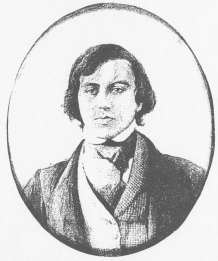
A young George Templeton Strong, Image from CUNY Baruch
The odd circumstance of purchasing the experience of listening provided class-striving urbanites with new possibilities for self-transformation. For many young, rural, white men, for example, arriving to the city for the first time to take clerking jobs in burgeoning merchant houses, being able to hear diverse performances of music was associated with a cosmopolitanism that brimmed with social possibility. Thus, for instance, Nathan Beekley, a young clerk, recently arrived in Philadelphia in 1849, found himself attending multiple performances of music several nights a week, including more and more appearances at the opera as a way to avoid “rowdies.” In New York City during the 1840s, George Templeton Strong, a young lawyer in Manhattan, derided his own musical abilities and instead attended every public musical event he could find, carefully chronicling his listening experiences and analyzing his reactions in a multi-volume journal. Walt Whitman, a young man on the make in Brooklyn and New York between 1838 and 1853, regularly attended every sound amusement he could, including the Bowery Theatre, dime museums, temperance lectures, political rallies, and opera, writing in Leaves of Grass, “I think I will do nothing for a long time but listen/And accrue what I hear into myself.”
This culture of listening was, in many ways, very much unlike ours. Despite an expanded access to performance, for instance, professional concerts before the mid-1850s were often understood as part of a wider ecology of sound. Very few listened to music in ways that we might expect today–focused on a “work,” in a concert hall, without distraction. Listening, in fact, was as much a matter of local happenstance as personal selection—a passing marching band, echoes of evening choir practice at a nearby church, an impromptu singing performance at a party. Such experiences were marked by the momentary thrill of spontaneity and discovery rather than the studied appreciation of familiarity; in any moment of hearing, it was difficult to know how long the encounter might be, or even what sounds, exactly, were being heard. Cities like Boston and New York were especially rich with such surprise encounters.
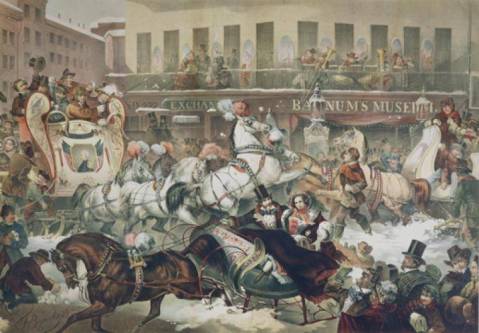
Thomas Benecke’s lithograph “Sleighing in New York” from 1855, which, among many other sounds, depicts musicians performing on the balcony of Barnum’s Museum on the corner of Broadway and Ann Street.
Francis Bennett, a young arrival to Boston in 1854, for example, encountered, in his first night in the city, a band concert and the “cries” from a “Negro meeting house,” and within weeks became enamored of fife and drum bands, often leaving work to follow one and then another as far as he dared. Young writer J. T. Trowbridge was more stationary but equally enthusiastic about what he heard from his New York rooming house in 1847: “The throngs of pedestrians mingled below, moving (marvelous to conceive) each to his or her ‘separate business and desire;’ the omnibuses and carriages rumbled and rattled past; while, over all, those strains of sonorous brass built their bridge of music, from the high café balcony to my still higher window ledge, spanning joy and woe, sin and sorrow, past and future….”
Music listeners were also often listeners of other forms of commercial sound, especially theater, oratory, and church services, which, together, comprised a complex sonic culture. This was especially reinforced by the physical spaces in which they shared such diverse aural experiences. In a rapidly-growing society, there often was not time or immediate resources to construct buildings dedicated to specific uses; instead, existing structures–typically a “hall” or “opera house”–served mixed uses.

Metropolitan Hall in New York City, where concert singer Elizabeth Taylor Greenfield debuted in 1853. It also hosted abolitionist meetings, talks on women’s rights, and various other activities.
As historian Jean Kilde noted in When Church Became Theater, evangelists in the Second Great Awakening often rented urban theaters for services; and congregations, in turn, rented churches to drama troupes, ventriloquists, and musicians to raise money. This “mixed-use” of buildings was reinforced by hearers, who often engaged in their own “mixed-use” understandings of what they heard. They evaluated sermons as they would a theatrical performance or found church choirs thrillingly entertaining rather than piously inspirational. Conversely, they listened to symphonic concerts with a religious solemnity.
This culture of antebellum, middle-class urban listeners didn’t last long, succumbing to the class sorting by post-Civil War social reformers, who mocked the indiscriminate over-exuberance of antebellum listeners as a kind of “mania” and a form of social disorder. As Lawrence Levine explains in Highbrow Lowbrow, over the course of the nineteenth century, developing a “musical ear” became increasingly paramount, reverence for great works of art shaped audience response, and listening became a specific skill to be learned. Music became something to appreciate not simply hear. By the 1890s, a true listener was someone who, in the words of critic Henry Edward Krehbiel (in his enormously popular How to Listen to Music, from 1897), “will bring his fancy into union with that of the composer” (51).

“Man With the Musical Ear.” Arthur’s Home Magazine (September 1853): 167.
In many ways, the controlled silent listening favored by reformers directly paved the way for music technologies, like the phonograph, that similarly sought to control and manipulate listening. But it was the urban music listeners of the 1840s and 1850s who were responsible, in the first place, for identifying and accentuating the joys and possibilities of “just listening.”
—
Featured Image: Etching of Jenny Lind Singing at Castle Garden in New York City, 1851
—
Daniel Cavicchi is Dean of Liberal Arts and Professor of History, Philosophy, and the Social Sciences at Rhode Island School of Design. He is author of Listening and Longing: Music Lovers in the Age of Barnum and Tramps Like Us: Music and Meaning Among Springsteen Fans, and co-editor of My Music: Explorations of Music in Daily Life. His public work has included Songs of Conscience, Sounds of Freedom, an inaugural exhibit for the Grammy Museum in Los Angeles; the curriculum accompanying Martin Scorcese’s The Blues film series; and other projects with the Public Broadcasting System and the National Park Service. He is currently the editor of the Music/Interview series from Wesleyan University Press and serves on the editorial boards of American Music and Participations: the Journal of Audience Research.
—
 REWIND! . . .If you liked this post, you may also dig:
“Como Now?: Marketing ‘Authentic’ Black Music,” –J. Stoever-Ackerman
Hearing the Tenor of the Vendler/Dove Conversation: Race, Listening, and the “Noise” of Texts –Christina Sharpe
How Svengali Lost His Jewish Accent––Gayle Wald
Share this:

Fade to Black, Old Sport: How Hip Hop Amplifies Baz Luhrmann’s The Great Gatsby
When I heard of people flocking to recreate “Gatsby Dress” costumes for Halloween 2013, I couldn’t help but ponder the seemingly-perpetual cultural allure of F. Scott Fitzgerald’s The Great Gatsby, particularly its latest cinematic incarnation in spectacular Baz Luhrmann-style. More than a little of the momentum of the recent revival, however, had everything to do with the film’s soundtrack–executive produced by Jay-Z (who also executive produced the film)–that drew heavily on hip-hop. This sonic move was not without controversy, however, sparking intense debate when the film was released in May 2013. Take this line from Vice Magazine’s UK music blog Noisey (from a post snarkily entitled “Who Let The Great Gatsby Soundtrack Happen?”) that describes Kanye West and Jay-Z’s Watch the Throne album, from which many of the film’s songs are taken, as “a record that couldn’t be further removed from West Egg than a pauper trying to gain access to a Gatsby soiree.” This statement reveals more about this particular listener than it does about either the record or the film, which are intimately connected through the labor of Jay-Z and what I theorize here as a “sonic hip hop cosmopolitanism.”
I’ll admit that when I was first hip to The Great Gatsby my junior year of high school, I thought it was boring and couldn’t stand Tom or Daisy Buchanan or their rich white folk problems. I rooted for Jay Gatsby but couldn’t for the life of me understand why he was so sprung over Daisy, who wanted her daughter to be a “beautiful little fool” (17). But as I got older, I found myself returning to the novel time and time again, coming back to Gatsby like a forlorn lover and reconsidering what Jay Gatsby’s character represents: unrequited love, American idealism, (capitalistic) hustle, and (white) masculine performance. However, I’ve always been part of the camp that secretly hoped Gatsby was a black man passing for white, yearning for a life – and a woman – out of his grasp no matter how much “new money” he acquired.
It was not until Baz Luhrmann’s film adaptation of Gatsby that I realized how hip (hop) Gatsby really could be.

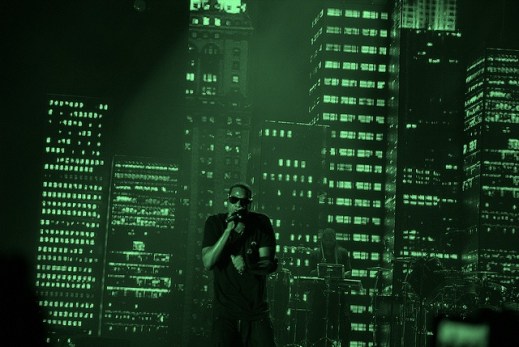
Image from Vulture’s “Quiz: Jay-Z Lyric or Line From The Great Gatsby?”
Luhrmann’s modernization of classic literary texts is not new; Romeo + Juliet (1996) got me through high school readings of Shakespeare’s play in ways Sparknotes could not. While Shakespeare’s words remained intact, the scenery and aura of the play burst to life on the big screen. Luhrmann uses in that film sonic cues of contemporary (youth) popular culture to make Shakespeare’s characters relatable. Verona is a hip, urban hub of violence that vibrates to grunge and pop artists such as Garbage, Everclear, and Quindon Tarver instead of mandolins and harps. The grittiness of grunge rock signifies the grittiness of Verona street life while Quindon Tarver’s angelic voice signifies the innocence and vulnerability of (first) love.
But Luhrmann’s Gatsby takes it up a notch, looking to hip hop culture as a bridge between the roar of the 1920s and the noise of the present. Aside from the literal presence of hip hop sound – mostly snippets from Jay-Z and West’s Watch the Throne – the materiality of hip hop sound also serves to update the Gatsby narrative. Consider how Gatsby’s parties are loud and bass-filled with a live jazz band. The loudness of the party and “surround sound” stereo sound of the film amplifies the vibrancy of the Jazz era while drawing in the audience with a contemporary interpretation of live parties seen and heard in contemporary hip hop culture. “The question for me in approaching Gatsby was how to elicit from our audience the same level of excitement and pop cultural immediacy toward the world that Fitzgerald did for his audience?” Luhrmann told Rolling Stone. “And in our age, the energy of jazz is caught in the energy of hip-hop.”
.
The film itself is stunning: vividly colored with panoramas and ground shots of New York City, Luhrmann’s film draws in an audience possibly unfamiliar with Fitzgerald’s novel. The film utilizes the more traditional jazz aesthetic that captures the novel’s initial element, but invokes hip hop to span a generational divide and update the (black) cool factor of the film. Indeed, both jazz and hip hop best signify black cool and its commodification into mainstream white America. For example, Norman Mailer’s discussion of the white hipster and Jazz aficionado as a “white Negro” is also tantalizingly useful in thinking of Gatsby as a black man passing for white. His affinity for Jazz and throwing jazzy parties incites the probability of Gatsby’s racial and social background. The film uses sound to create a hybrid of timeless black cool, while highlighting the presence of African Americans’ contributions to American culture. Hip hop’s birthplace and the portal for many immigrants into America, New York is arguably America’s most mythological city, grounded in both white and African American culture memory as such. Jay-Z’s own mythic rise to fame, wealth, and power in New York City–exemplified in some lines from 2009’s “Empire State of Mind,” “Yeah I’m out that Brooklyn, now I’m down in TriBeCa/ Right next to De Niro, but I’ll be hood forever/ I’m the new Sinatra, and since I made it here/I can make it anywhere, yeah, they love me everywhere”– grounds the film’s rags-to-riches mystique.
In addition to such extradiegetic associations, the film’s soundscape itself enthralls, with brassy, lively instrumented notes of jazz – which carried the sonic narrative of the 1920s – sounds of the hustle and bustle of urban spaces, particularly New York City, and hip hop. The film’s soundscape presents a hybrid of sonic black identities – jazz and hip hop – and uses their blended aesthetics to speak to the continued framework of black popular culture as a gauge of Americanism. In other words, the marginalized perspective is used to decide whether or not something is authentically American or not.
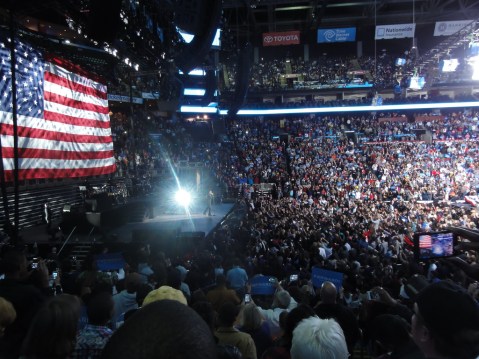
Jay-Z performs at Obama Pre-Election Rally 2012 in
Columbus, Ohio, w/ Bruce Springsteen, Image by Flickr User Becker1999
Hip hop aesthetics bridge old New York with the current New York as a foundation of Americanness. Gatsby bridges the old adage of New York as a space of opportunity with the familiar New York adage that Harlem-born and Mt.-Vernon-raised P. Diddy drops in Jermaine Dupri’s “Welcome to Atlanta,” “if you can make it here, you can make it anywhere,”a call back to Sinatra’s “New York, New York” that is also echoed by Jay-Z that forms a foundational trope of the film and the novel. A particular striking example of the merging of these adages is a scene in the novel where Nick and Gatsby are on their way to the city. They pass a car with black passengers and a white chauffeur:
As we crossed Blackwell’s Island a limousine passed us, driven by a white chauffeur in which sat three modish negroes, two bucks and a girl. I laughed aloud as the yolks of their eyeballs rolled toward us in haughty rivalry.
“Anything can happen now that we’ve slid over this bridge,” I thought; “Anything at all” (69).
While the novel does not describe a sonic accompaniment to Carraway’s observation of the black folks in the limousine, there is an inherent understanding of the “modish” fashion of the black folks as jazzy, as cool. In the film, there is an audible sound associated with the black folks. They are sipping champagne and listening to Watch the Throne. Although visibly symbolic of the 1920s – dressed in zoot suits and flapper dresses – the aural blackness associated with the scene suggests a merger of jazz and hip hop cool and cosmopolitanism.

Still from The Great Gatsby (2013)
In order to understand how hip hop updates the struggle for realness, entitlement, and respectability in the Gatsby film, it is important to return to the major sonic influence of the literal hip hop sound in the film: Jay-Z and Watch the Throne. Jay-Z’s work on the album raises questions of how hip hop culture impacts not only the American dream but the aspirations of mogul-dom seen and heard in the film and novel. Christopher Holmes Smith’s discussion of hip hop moguls in Social Text (Winter 2003) is particularly useful in teasing out the implications behind the hip hop mogul and such figures’ social-cultural responsibility to their respective communities. Holmes Smith argues:
The hip-hop mogul bears the stamp of American tradition, since the figure is typically male, entrepreneurial, and prestigious both in cultural influence and wealth. The hip-hop mogul is an icon, therefore, of mainstream power and consequently occupies a position of inclusion within many of the nation’s elite social networks and cosmopolitan cultural formations (69).
Jay-Z’s status as a hip hop mogul – serving both as a creative talent and corporate backer – lends credence to thinking about hip hop as a space of entitlement and a site of struggle to attain that entitlement. It is from this perspective that I think of Gatsby as a hip hop figure/mogul: his working class background, hyper-performance of white privilege, materialistic pursuit of wealth for visibility, and desperate need for approval as “authentic.” To borrow from rapper Drake, Gatsby “just wanna be successful.”
Mark Anthony Neal’s discussion of Jay-Z as a hip hop cosmopolitan figure in Looking for Leroy (2013) further enables an understanding of how Jay-Z lends his (sonic) hip hop cosmopolitanism to sonically navigate between hip hop’s working class aesthetics and his own sense of entitlement because of the way he mobilized those working class experiences to become wealthy. While the film does have performances by artists who are not considered hip hop – i.e. Lana Del Rey, Jack White, and Florence+the Machine – Jay-Z’s use of his own raps, including tracks from the Kanye West collaboration Watch the Throne suggests a “sonic hip hop cosmopolitanism” complements any sense of the film as a case study of white entitlement. Tracks like “100$ bill,” “No Church in the Wild,” and “Who Can Stop Me” both prop up and tear down Luhrmann’s visual rendition of Fitzgerald’s critique of the uppercrust of America as corruptibly entitled.
.
Baz Luhrmann’s adaptation of The Great Gatsby is an intriguing and useful tool through which to analyze the (in)consistencies of race and cultural authenticity in the United States. Both jazz and hip hop exist in the interstitial spaces that lie between black cultural expression and white entitlement to those expressions. Luhrmann uses hip hop’s sonic and cultural aesthetics to pump up the capitalistic and all-American narrative of “pull yourself up by the bootstraps” narrative in Gatsby by also declaring, “get yours by any means necessary.”
—
Featured Image adapted from Flickr User kata rokkar
—
Regina Bradley recently completed her PhD at Florida State University in African American Literature. Her dissertation is titled “Race to Post: White Hegemonic Capitalism and Black Empowerment in 21st Century Black Popular Culture and Literature.” She is a regular writer for Sounding Out!
—
 REWIND! . . .If you liked this post, you may also dig:
“‘I’m on my New York s**t’: Jean Grae’s Sonic Claims on the City”— Liana Silva
“I Like the Way You Rhyme, Boy: Hip Hop Sensibility and Racial Trauma in Django Unchained“– Regina Bradley
“The Victoria’s Secret Fashion Show and the Soundtrack of Desire“— Marcia Dawkins
Share this:


Current Top Posts





April 2021

January 2020

November 2019

October 2019

August 2019

April 2014

November 2017

March 2015

December 2017

October 2015
 Sounding Out!
Recent Comments