
Fear of a Black (In The) Suburb

 Editor’s Note: This month Sounding Out! is thrilled to bring you a collection of posts that will change the way you hear cities. The Sounds of the City series will prompt readers to think through ideas about urban space and sound. Are cities as noisy as we think they are? Why are cities described as “loud”? Who makes these decisions about nomenclature and why?
We kicked things off two weeks ago with my critical reading of sound in Lorraine Hansberry’s A Raisin in the Sun, a play about African Americans in Chicago that still rings/stings true today. Guest writer Linda O’ Keeffe took readers last week on a soundwalk of Smithfield Square in Dublin, Ireland and specifically of the Smithfield Horse Fair, in order to illustrate how urban renewal disrupts city soundscapes and how sound reclaims those spaces. Next week CFP winner Lilian Radovac will share with us a photoessay on the sound installation Megaphóne in Montreal.
Today’s post comes from regular writer Regina Bradley whose post reminds us of the recent verdict of the Michael Dunn case, the “loud music case” when he shot 17-year-old Jordan Davis at a gas station. She discusses the dichotomy of urban and suburban in the context of sound (noisy versus quiet) and hip hop.
Edited on Feb 17, 2014 at 9:35 am EST: the first published version of this post did not acknowledge Nina Sun Eidsheim as the coiner of the phrase “sonic blackness.” We have added a reference in the post to recognize the work Eidsheim has done in theorizing this concept.–Managing Editor Liana M. Silva-Ford
***
In a recent Chase credit card commercial a white woman pulls up to a gas station and pumps gas into her minivan while blasting loud music. Her windows rattle and the toys of her children vibrate to the beat. After pumping gas, the woman hops into her car, puts on a pair of shades, and bounces to the beat like a “cool mom.” In the context of the commercial, the white suburban mother is not threatening. The commercial reminds me that Jordan Davis’ life ended at a gas station in Jacksonville, Florida. His loud hip hop music was not cool; in fact, he and the music are perceived to be threatening.
The woman in the Chase commercial borrows what is instantly recognizable as sonic black (masculine) cool. Nina Sun Eidsheim, in her article “Marian Anderson and ‘Sonic Blackness’ in American Opera”, theorizes sonic blackness as the racialization of sounds that listeners perceive to be coming from a black body. Borrowing from her concept, I extend sonic blackness as the sound that are perceived as black that enter spaces where physical blackness could be readily refused. Of particular interest for this essay is the connection between black mobility, urban space, and sound. I focus particularly on hip hop as a mobile form of sonic blackness whose origins are based in the city. Hip hop reinforces conceptualizations of contemporary blackness as urban. In this context, sonic blackness collapses the absolute binaries in which blacks are frequently forced to exist, i.e. urban and rural, working class and middle class, silence and noise. Yet when it is situated in hip hop, sonic blackness can also be considered a disruption of suburbia, a dominant trope of white privilege at the end of the 20th century. Using examples from the contemporary cartoon show The Boondocks, I posit that the show’s use of hip hop underscores how the white suburban soundscape is constructed in contrast to black urban sounds.

Screen Shot Leave It to Beaver ending credits
America’s popular imagination portrays the suburbs as white, middle class, and quiet. Constructions of the suburbs in recent history have not strayed far from the idealistic neighborhoods of the 1950s and 1960s portrayed in shows like Leave It to Beaver. Take for example the inclusion of gated communities as the upper echelon of suburbs and white privilege seen in The Real Housewives of Orange County (which opens with the viewer ‘walking through’ opened gates into the Orange County community). I’d like to emphasize the connection between whiteness and quiet, as privilege in these types of spaces is present but often not visible or audible. Suburbs are the result of urban industrialism, anxiety of close association with an increasing minority community, and the need to sustain a romantic ideal of the American dream. A suburb’s physical parameter is a middle-class manifestation of manicured lawns, gates, and homeowner associations. At the level of sound, the suburbs’ class privilege is represented as the hum of lawn mowers, chirping birds, and screeching breaks of school buses. As Steve Macek points out in Urban Nightmares: The Media, The Right, And The Moral Panic Over The City, suburban sensibilities cling to an idealistic notion of a physically and sonically constructed white ambivalence to racial and class anxieties associated with cities. Any dysfunction associated with whiteness is quietly tucked away from public view.
White suburbia sustains its desirability because it is a physically and sonically segregated space. Yet white suburbia is also the site of black Americans’ most recent migratory efforts. In ways that northern cities signified opportunity for blacks in the early 20th century, the ideals of racial progress and class in the late 20th century have shifted to U.S. suburbs. Thoughts of the middle class in the black imagination amplify the suburb as a utopic space because of its initial lack of access. The suburb becomes the mountaintop of racial access and privilege.

“A Raisin in the Sun 1959 2” in the public domain via Wikimedia Commons
Consider the premise for Lorraine Hansberry’s 1959 play A Raisin in the Sun. Hansberry examines in the play the high stakes of home ownership in a ‘good neighborhood.’ The Lee family leaves the Southside for the opportunity at a better life and more space for their growing family. As Liana Silva-Ford pointed in her discussion of A Raisin in the Sun two weeks ago, the Lee family’s decision to move into the Clybourn Park neighborhood disrupts the suburb as a space of white privilege and annotates the cusp of the emerging Civil Rights Movement. Additionally, visual demonstrations of black protest that reach suburban areas are annotated by sonic markers of struggle i.e. the sound of attacking guard dogs, police officers screaming at protestors, spraying fire hoses, and screams and moans of black bodies under attack. The audio-visual representation of the struggle of integration collapses the notions of white suburbia as a site of ‘perfect peace.’ The above referenced sonic markers also destabilize classifications of black trauma as restricted to urban spaces like the inner city, which is believed to embody blacks’ realities.

“Damen – Boondocks” by Flickr user Ian Freimuth, CC BY-NC-ND 2.0
Where Hansberry’s interrogation of space and access in Raisin in the Sun is an initial foray into constructions of white privilege vis-à-vis suburban communities, Aaron McGruder’s 21st century suburban space of The Boondocks pivots on the romanticized ideas of blacks in middle class spaces derived from the 1950s and 1960s. The show introduces viewers to patriarch Robert (Grandad Freeman) and his two grandsons, Huey and Riley Freeman, who have left the south side of Chicago for the white suburb of Woodcrest. McGruder incorporates sonic markers of race and class that collapse suburbs as white only spaces. Aside from lighthearted lounge music style piano riffs during dialogues that indicate whiteness, McGruder incorporates sonic elements of hip hop that interrupt white suburbia. Elements of sonic registers of hip hop, like heavy bass kicks and songs like “Booty Butt Cheeks” or “Thuggin’ Love,” disrupt the quiet of the Woodcrest community.
The clash of hip hop’s loudness with Woodcrest’s quiet demeanor is best demonstrated in the episodes “The Story of Thugnificent” and “The Block is Hot.” In “The Story of Thugnificent,” rapper Thugnificent decides to move to Woodcrest. His presence is heard before it is seen, a caravan of cars with bass systems playing “Booty Butt Cheeks” before he actually appears on screen. Thugnificent’s arrival is striking as he introduces hip hop as a literal and sonically disruptive element of black working class cultural expression. The disruption is celebrated, however, because of Thugnificent’s allure as a rapper. He gets a pass that Grandad Freeman questions because he sees Thugnificient as a threat to what he perceives to be as a delicate existence of his blackness in a white community.
Grandad Freeman’s vehement opposition to embrace “the homie” Thugnificent destabilizes notions of policing as a one-sided scare tactic by whites. Yet to repel Thugnificent’s physical and sonic presence, Grandad resorts to hip hop and records a diss record that demands Thugnificent to leave Woodcrest. The diss record parodies the sonic notes of a rap battle: Grandad starts the track with ramblings of “yeah” and “uh.” Where these terms are used in a rap battle to try to “catch the beat,” Grandad’s use of these words is an offset attempt to try to find something to say. The result of Grandad and Thugnificent’s rap battle on wax is a rise in physical violence against senior citizens in Woodcrest. The awkwardness of Grandad’s diss track parallels not only a generational dismissal of hip hop as an outlet of protest but the sonic awkwardness of hip hop being the voice of protest for a suburban space.

“Fight the Power” single cover, by fair use under US copyright law
In the episode “Block is Hot,” a nod to rapper Lil Wayne’s same titled track (although he nor the song are mentioned anywhere in the show), Huey Freeman blasts rap group Public Enemy’s pro-black and anti-police brutality anthem “Fight the Power” to remind his neighborhood he is a black nationalist. He is also dressed in a black hoodie and black timberland boots. Huey is undeniably hip hop in a privileged white space. Huey’s physical apparel, a nod to the Black Panther party and the hip hop fashion affinity for wearing the color black is amplified by “Fight the Power.” Huey’s posturing can also be read as a homage to Radio Raheem from Spike Lee’s 1989 film Do the Right Thing because like Radio Raheem, Huey lugs around a large boombox to play “Fight the Power.” Particularly striking is the overlap of the urban hip hop masculinity Raheem signifies with Huey’s own hip hop posturing in Woodcrest. While Raheem remains in the ‘hood, Huey doubly signifies hip hop’s migration from the city into suburban areas as well as his own migration to Woodcrest from Chicago. Huey uses hip hop as a site of social-political resistance and as a way to remain attached to his urban roots. Blasting “Fight the Power” shows how Huey remains conscious of white privilege in Woodcrest. He recognizes the need to identify black agency – even if it is only emphasized through sound – while reflecting on the “new” suburb as a racially ambiguous space.
The most jarring use of sound to reflect on the racial politics of the new suburb is the shooting of Uncle Ruckus by police officers. The ricochet of the bullets can be heard against cars and other inanimate objects but the bullets miss their target, Ruckus. The gun shots mark an interruption of the suburban soundscape. Gun shots, sonic signifiers of power, death, and trauma, are also markers of black violence as an urban phenomenon. However, negotiations of power shift to speak to reclamation of white privilege in sonic and physical spaces . The gun shots inflicted upon black bodies in suburban spaces could also be read as a subversion of gun shots heard in hip hop. While the sound of a firing gun in the hip hop imagination is expected and acceptable, gun shots in white suburbia are disruptive and displaced because they contest its appearance as a quiet and respectable space. Further, the sonic significance of the bullets riddling everything around Ruckus is the messiness of the hit-or-miss surveillance of black bodies, particularly black men, as necessary in privileged white spaces.

“Jacksonville Florida Sheriff’s Office Impala” by Flickr user Dfirecop, CC BY-NC-ND 2.0
The policing of black bodies in suburban spaces, especially over the past two years, begs the question of how suburban soundscapes serve as backdrops of 21st century racial anxieties and whiteness. The centrality of sound in the deaths of Trayvon Martin, Renisha McBride, Jordan Davis, and Jonathan Ferrell,– i.e. 911 tapes and banging on house doors – is critical in identifying race and space. Sonic markers of racial anxiety in their deaths devastatingly reemphasize the connection of race and sound in white privilege spaces. For example, Davis’ killer Michael Dunn stated to his girlfriend that he “hate[d] that thug music.” Unlike the suburban mom in the Chase commercial, Dunn is threatened by the sonic blackness and hypermasculinity associated with loud [hip hop] music. The negative connotations of hip hop as “thug music” and Davis’ mere presence as a young black man trigger a devastating response to the disruption of white privileged space.
As I work through my visceral response to Michael Dunn’s not guilty verdict for the actual slaughter of Jordan Davis, I think about the frivolity of the suburban mom in the Chase commercial and her enjoyment of loud music. The overlap of her whiteness, gender, and status as a suburbanite protect her from any inclinations of being a menace. She uses loud music as a sense of liberation – a premise for the Chase Freedom card being promoted in the commercial. Unlike Chase’s suburban mom, Jordan Davis’ use of loud music is not freeing – it contextualizes him in a rigid space of hypermasculinity and pathology that is all too often associated with hip hop culture. As I discuss previously, the traumas associated with black bodies that cannot be literally articulated take place in nonliteral spaces like sound. Utilizing sound is particularly useful in situating blackness in privileged white spaces like suburbs that displace their agency and significance because of racial anxieties associated with space and class.
—
Regina Bradley recently completed her PhD at Florida State University in African American Literature. Her dissertation is titled “Race to Post: White Hegemonic Capitalism and Black Empowerment in 21st Century Black Popular Culture and Literature.” She is a regular writer for Sounding Out!
—
Featured image: “Dead End in the Burbs” by Flickr user Vox Efx, CC BY 2.0
—
 REWIND!…If you liked this post, you may also dig:
“Death Wish Mixtape: Sounding Trayvon Martin’s Death”-Regina Bradley
“From Illegitimate to Illmatic: On Tiger Mothers, Ethnoburbs, and Playing the Violin While Dreaming of Nas”-Christie Zwahlen
“Sound Off! // Comment Klatsch #7: #RachelJeantel asks: Are you Listening?”
Share this:

Listening to the A. D. White House: Cornell’s Society for the Humanities’ Year in Review
Today, Society for the Humanities Director Timothy Murray sings us back home with a meditation on the soundscapes of study at the A.D. White House this year, closing out our spring “Live from the SHC” series covering new research on “Sound: Culture, Theory, Practice, Politics.” The 2011-2012 Fellows have got to say goodbye for the summer–and sadly beyond–but we all hope that next years’ Fellows (2012-2013 Theme: Risk @ Humanities) enjoy all the good vibrations we will leave behind, and that you, Dear SO! readers, have enjoyed our broadcast! Our summer series, “Tuning In the Past,” on radio and legacy of broadcaster Norman Corwin, featuring Neil Verma, Shawn VanCour, and Alex Russo begins at the end of June. And, of course, every Monday in between and beyond, we’ll keep giving you something you can feel. –JSA, Editor in Chief (and 2011-2012 SHC Fellow)
—
Many thanks to Jennifer Stoever-Ackerman for hosting “Live from the SHC” on Sounding Out! What a fantastic experience it’s been to have Jennifer screening and tweaking Sounding Out! from her garret office overlooking the gardens behind the A.D. White House, the Cornell home of the Cornell’s Society for the Humanities. Readers of “Live from the SHC” have read various strains of this year’s focal theme, “Sound: Culture, Theory, Practice, Politics.” The aim of this year’s residential research project was to contemplate and analyze the resonance of historical and contemporary representations, movements, ideas, and negations of sound.
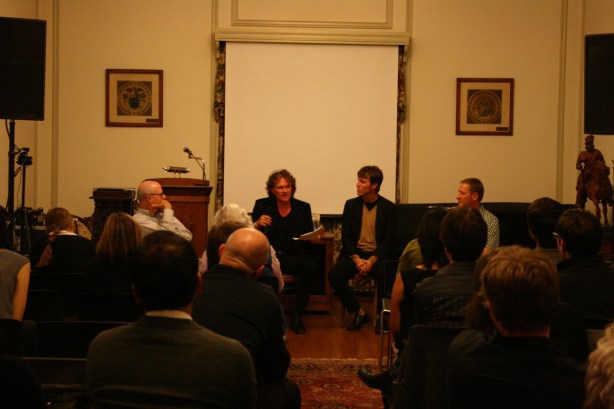
From Left: Tim Murray, Eric Lott, Tom McEnaney, and Marcus Boon, Image by Renate Ferro
Open to study of the broadest cross-cultural range of contexts and media that cross the boundaries of time and space–from East and West/South and North–the Fellows’ research delved into the complex ways that sound abounds in visual, textual, and aural realms. From “voicing” to “listening,” sound shaped the framework of our critical and philosophical analyses of the body, affect, and social publics. Sound came to be appreciated for its shaping of the parameters of psycho-cultural imaginaries, social practice, religious ritual, and political regulation throughout history and across the globe. Just as sound differs in the global context of capitalism and cosmopolitanism, not to mention the specificities of ethnic difference and cultural diversity, “voice,” “hearing,” and “listening” frame the humanities disciplines in relation to their aesthetic properties and political ramifications.

From Left: Eric Lott and Jennifer Stoever-Ackerman, Image by Jeanette Jouili
The Fellows found themselves reflecting on several key issues. Which criteria differentiates natural from artificial sounds? Does sound challenge disciplinary distinctions between the visual and the oral/aural/tactile? Can the loud noises of industrial culture be distinguished from the synthetic sounds of electronic music, the stammerings of performance and the vibrations of philosophical manifestos? It should come as no surprise to followers of Sounding Out! that sound marks the passage of time, the correlation of the aural to the movement of the body in dance and performance, the sonic promise of cartographic projects of social movements and migrations, and the cultural and ethnic specificities of acoustic fields and rhythms in the age of sampling and mixing, not to mention the gender, racial, and ethnic import of voice and spoken narrative.
Adding vibrant texture to our year-long discussions were the three weeks spent in extended dialogue with the Society’s Senior Invited Fellows. Emily Thompson (The Soundscape of Modernity) charted the histories of the architectonic sounds of cinema houses as well as the untraceable wealth of the historical sounds of New York City as its peripheries morphed from country estate to urban zone. Brandon LaBelle came from Norway to take us on a journey of artistic imagination and phenomenological hopefulness as he cruised his writings on Acoustic Territories and Site Specific Sound while sampling the background noises of his multimedia installations. Then Norie Neumark, fresh off the release of VOICE: Vocal Aesthetics in Digital Arts and Media (co-edited with Ross Gibson and Theo Van Leewen), arrived from Australia to follow up on our 2003 online seminar on Sound Cultures. She reminded us of the deep history of sound studies down under, while focusing our attention on voicings and her own multimedia art practice that blends spoken narrative, synthetic noise, mouthed breath, and shocks in the ear. [The “Live From the SHC” logo is a piece from Neumark and Maria Miranda’s “Shock in the Ear”–ED].
.
Various other visitors throughout the year included multimedia artists Mendi and Keith Obadike whose “not” Afrofuturism walked us through their exciting series of performance works,“Four Electric Ghosts,” Caitlin Marshall from Berkeley who brought cyborg speech to life with her prosthetic soundings, and renowned choreographer William Forsythe, whose four-hour choreography piece “Nowhere and Everywhere at the Same Time“–performed amidst amidst over 150 hanging pendulums–combined dance and environment as a means of physically manifesting the process of thought. Marjorie Garber from Harvard rode our acoustic wave to reflect on the future of the humanities while Norma Coates came down from Western Ontario to sensitize us to the mixes of pop sound and culture.

Brock Labrenz performs William Forsythe’s “Nowhere and Everywhere at the Same Time” at Cornell University’s Rand Hall on March 3, 2012. Image by William Staffeld / AAP
In listening back to the echoes of the year past, rather than here retracing the specific projects of our Fellows (you can consult the critical tales already Sound[ed] Out! by Damien Keane, Tom McEnaney, Nina Sun Eidsheim, Jonathan Skinner, Eric Lott, Jennifer Stoever-Ackerman, and Jeanette Jouili), I find myself sampling the sounds, noises, and glitches that provided unexpected reverbs for the academic writing happening behind closed office doors throughout the A. D. White House.
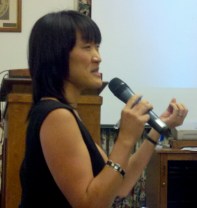
Nina Sun Eidsheim, Image by Renate Ferro
Sounds of glee, delight, and play first arrived on the scene at the end of August with gaggles of laughing and screaming kids running wild and climbing trees in the gardens, surrounded by bemused adults and envious dogs. Accompanying partners brought to the mix the diverse soundings of African film, suspicious packages, software beats, performance art, critical geography, and real estate hawking. No wonder the assembled Fellows strayed so readily, if not unconventionally, from the promised strictures of already exceptional research projects that brought to our weekly seminar table the street sounds of Egypt, Turkey, Korea, early modern Germany, contemporary Islam, American hip hop, contemporary art, circuit bending, gaming, German, Irish, U.S. and Latin American radio, voices of performers, animals, and posthumans, urban soundscapes, and, here making a loud call out to one Stoever-Ackerman, sonic color-lines.

Marcus Boon Rocks the Spring Workshop After Party–Image by JSA
Resounding throughout the year to give cadence and timbre to our serious ponderings were the spontaneous soundings that seemed always to give ample depth to the provocative interstices of intellectual life. There were the noises of glitch, circuit-bending, and Guitar Hero that stretched and extended the purpose of music and machinics. There were spontaneous voice lessons that turned anxious performers into wild choreographic objects. Singing above in the hidden alcoves–when not streaming through the high Victorian ceilings of the A. D. White House–were our flying mammal friends whose echolocation extended beyond the reach of our mere human ears. Then were the sudden noisy reminders of the vulnerability of our corporeal organs. Who could forget the reported imaginary of the crunch of human leg against car as two of our Fellows found themselves under assault from a crazed pizza delivery guy – luckily no lasting damage?
Our fellows will carry away the subliminal lacings of the lighter sounds of improvisation and camaraderie. There were the poundings of feet and slappings of bodies dancing late into the night after hours of laborious conferencing to the beats of DJs Marcus Boon, Art Jones, and Earmuffs.
.
At the end of the year, Fellows grooved to the beat of Tom McEnaney playing bass with The Vix Krater out at the Rongo in Trumansburg, NY (down the road from the home of Moog), before retreating to the bowels of the A. D. White House basement for another dusty, late night jam session with drums, synthesizer, guitars, bass, and various acoustics, led by the ultimate sound blogger herself, the guitar heroesse, Jenny S-A. [Well, I’m learning. So far I know E-Minor. It was Trevor that really broke my strings in! –ED].
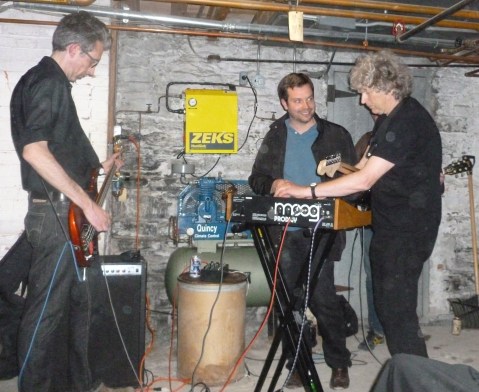
(From left) Damien Keane on bass, Michael Jonik, Trevor Pinch on Guitar and Moog, Image by JSA
And, yes, there was always the accompaniment of the clinks of glasses and bottles bearing the liquid life blood of any noisy crew.
The French philososopher, Jean-Luc Nancy, reminds us in Listening (2007) that the shared space of noise and sound entails “a totality of referrals: from a sign to a thing, from a state of things to a quality, from a subject to another subject or to itself, all simultaneously. Sound is also made of referrals: it spreads in space, where it resounds while still resounding ‘in me'” (7). What resounded and referred this year at the Society for the Humanities was the very immaterial and inchoate touch of sound, which is a-live in intensity and force. But who would have imagined the intensity of the noise of referral that remained so constant throughout the year to envelop the solid academic work of our Fellows in the wilding vibrations of jouissance? Indeed, perhaps the best lesson of the year, at a moment when the humanities finds itself threatened and in transition by the supposed certainty of metric and assessment, is that the Society’s scholarship in sound was driven by the relentless noise of referral and the unpredictable delight of the commune.

From Left: Renate Ferro, Ladi Dell’aira, Sarah Ensor, Jeanette Jouili, Nina Sun Eidsheim, Brian Hanrahan, and Norie Neumark, Image by JSA
—
Featured Image Credit: Brandon La Belle, Duck Duck Goose Installation, Ausland, Berlin
—
Timothy Murray is Professor of Comparative Literature and English and Curator of the Rose Goldsen Archive of New Media Art. He is the Cornell Principal Investigator of the Central Humanities Corridor, generously supported by a grant from the Andrew W. Mellon Foundation, and he sits on the International Advisory Board of the Consortium of the Humanities Centers and Institutes (CHCI) and the Steering Committee of the Humanities, Arts, Science, and Technology Advanced Collaboratory (HASTAC). He is Co-Moderator of the –empyre- new media listserv and the author of Digital Baroque: New Media Art and Cinematic Folds (Minnesota 2008); Zonas de Contacto: el arte en CD-ROM (Centro de la imagen, 1999); Drama Trauma: Specters of Race and Sexuality in Performance, Video, Art (Routledge, 1997); Like a Film: Ideological Fantasy on Screen, Camera, and Canvas (Routledge, 1993); Theatrical Legitimation: Allegories of Genius in XVIIth-Century England and France (Oxford, 1987). He is editor of Mimesis, Masochism & Mime: The Politics of Theatricality in Contemporary French Thought (Michigan, 1997) and, with Alan Smith, Repossessions: Psychoanalysis and the Phantasms of Early-Modern Culture (Minnesota, 1997). His curatorial projects include CTHEORY MULTIMEDIA and Contact Zones: The Art of the CD-Rom.
Share this:


Current Top Posts





April 2021

January 2020

November 2019

October 2019

August 2019

April 2014

November 2017

March 2015

December 2017

October 2015
 Sounding Out!
Recent Comments