
Top Ten Sounding Out! Posts of 2025!

.
16 years in, we’re still here, listening hard for each thump, rasp, and rattle of the drum to amplify for our readers. Keep the pressure coming louder and louder for us to propagate, and look out for our print edition, Power in Listening: The Sounding Out! Reader to drop in August 2026 from NYU Press! –JS, Ed-in-Chief
Here, beginning with number 10, are our Top 10 posts released in 2025 (as of 12/13/25)!
—

(10). The Sonic Rhetoric of Quincy Jones (feat. Nasir Jones)
By Jaquial Durham
“The passing of Quincy Jones has left a silence that feels almost impossible to fill. Every time I play Thriller at home now, it’s no longer just a celebration of his unparalleled artistry. It’s a ritual to sit with his legacy, listen more closely, and honor how his music shaped the sound of memory itself. With each spin of the record, my family and I find ourselves inside his arrangements, held by their richness, precision, and sense of story as though the music is breathing with us, speaking back across time. Jones’s work was never just production; it was communication. A language of sound connected us to melody and beat and the fuller spectrum of emotion, culture, and memory that lives in Black music.. .”
[Click here to read more]
—

(9). The Techno-Woman Warrior: K-pop and the Sound of Asian Futurism
By Hoon Lee
“As a ’90s kid, I remember too well us school kids singing and dancing to the songs at the top of the charts on music shows such as Ingigayo (인기가요) and Music Bank (뮤직뱅크). It was what one might call the “pre-K-pop” era: there were a lot of solo artists performing in various genres, and the notion of idol culture as we know it now was only fledgling. Without the mass production system or the global distribution that has come to be the norm in today’s K-pop, first generation idol groups around the new millennium—H.O.T., Fin.K.L, god, Sechs Kies, S.E.S.—not only set up these business models and standards, but also inspired the music and aesthetics of later generations. The group aespa’s cover of “Dreams Come True” by S.E.S. is an exemplar case, and NewJeans, with their unflinching Y2K aesthetics and sound, take us back to the millennial through and through. . .”
[Click here to read more]
—
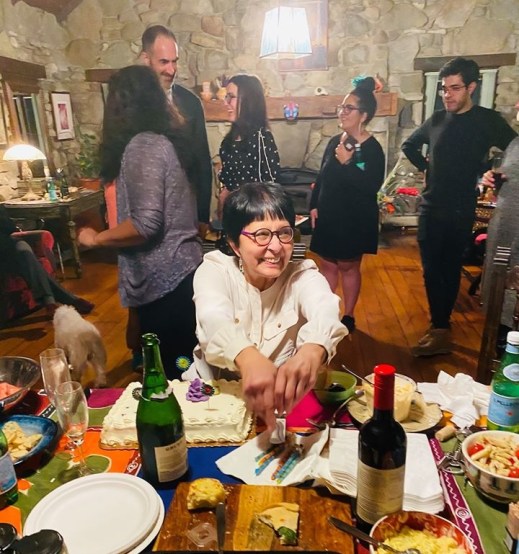
(8).Finding Resonance, Finding María Lugones
By Daimys García
“I am always listening for María: I find her most in the traces of words.
Trained as a literary scholar, I relish in the contours of stories; I savor the nuances found between crevices of language and the shades of implication when those languages are strung together. It is no surprise, then, that since the death of my friend and mentor María Lugones, I have turned to many books, particularly her book, Pilgrimages/Peregrinajes: Theorizing Coalition Against Multiple Oppression, to feel connected to her. I have struggled, though, to write about her, talk about her, even think about her for many years. It wasn’t until I found a passage about spirits and hauntings in Cuban-American writer and artist Ana Menéndez’s novel The Apartment that I found language to describe a way through the grief of the last five years. . .”
[Click here to read more]
——

(7). The Sounds of Equality: Reciting Resilience, Singing Revolutions
by Mukesh Kulriya
“When the pandemic hit the world in late 2019, the concept of lockdown ceased the social life of the people and their communities. In these unprecedented circumstances, a video from Italy took the internet. People in Italian towns such as Siena, Benevento, Turin, and Rome were singing from their windows and balconies, which raised morale. The song “Bella Ciao,” an old partisan Italian song, became an anthem of hope against adversity. This anti-fascist song was popularized during the mid-20th century across the globe as a part of progressive movements. Following this, people in many countries around the world created their renditions of “Bella Ciao” in Turkish, Arabic, Kurdish, Persian, French, Spanish, Armenian, German, Portuguese, Russian, and within India in languages such as Punjabi, Marathi, Bangla, and even in sign language renditions. It was such an apt moment that captured the idea of empathy, solidarity, and the human need for community. This moment was still resonating with me when I was approached by Goethe Institut, New Delhi, to work on music and protest, and create The Music Library. I knew what I needed to do. . . .”
[Click here to read more]
—

(6).SO! Reads: Zeynep Bulut’s Building a Voice: Sound, Surface, Skin
—by Enikő Deptuch Vághy
“Voice and sound theorist Zeynep Bulut’s Building a Voice: Sound, Surface, Skin (Goldsmiths Press, 2025) is a remarkable work that reconfigures the ways we define “voice.” The text is organized into three sections—Part 1: Plastic (Emergence of Voice as Skin), Part 2: Electric (Embodiment of Voice as Skin), and Part 3: Haptic (Mediation of Voice as Skin)—each articulating Bulut’s exploration of the simultaneously personal and collaborative ways voice evolves among various sonic entities and environments. Through analyses of several artistic works that experiment with sound, Bulut successfully highlights the social effects of these pieces and how they alter our expectations of what it means to communicate and be understood.”
[Click here to read more]
—
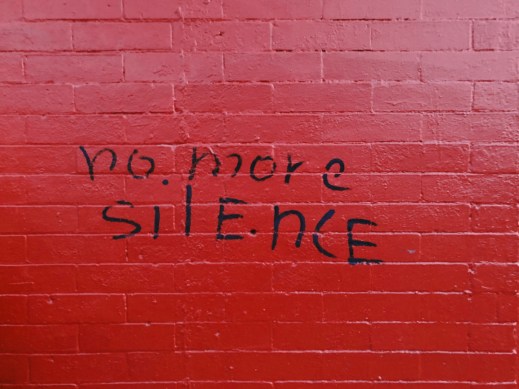
(5). Clapping Back: Responses from Sound Studies to Censorship & Silencing
by MLA Sound Studies Executive Forum
“The MS Sound Forum invites papers for a guaranteed session at the Modern Language Association’s annual conference in Toronto, Canada in January 2026. The session responds in part to the MLA Executive Council’s refusal to allow debate or a vote on Resolution 2025-1, which supported the international “Boycott, Divest, and Sanction” (BDS) Movement for Palestinian rights against the ongoing genocide in Gaza. In light of the Council’s suppression of debate, some of the Sound Forum Executive Committee members decided to resign in protest while others remained to hold the MLA accountable for its undemocratic procedures. To acknowledge and respect the decision of those who left, the remaining members chose not to immediately fill the vacancies to let the parting members’ silence speak.. . .”
[Click here to read more]
—

—(4). “Just for a Few Hours, We Was Free”: The Blues and Mapping Freedom in Sinners (2025)
by Juston Burton
“In the 2025 blockbuster Sinners, Ryan Coogler has a vampire story to tell. But before he can begin, he needs to tell another story—a blues one. Sinners opens with a voiceover thesis statement performed by Wunmi Mosaku (who plays Annie in the film—more on her below) about the work the blues can do, then rambles the narrative through and around 1932 Clarksdale, eventually settling into a juke joint outside of town. Here, the blues story builds to a frenzied climax, ultimately conjuring the vampires propelling the film’s second half. It’s those vampires that most immediately register as cinematic spectacle, but Coogler’s impetus to film in IMAX and leverage all of his professional relationships for the movie wasn’t the monsters—it was to showcase the blues at a scale the music deserves. In Sinners, the blues takes center stage as a generative sonic practice, sound that creates space to be and to know in the crevices of the material world, providing passage between oppression and freedom, life and death, past and future, and good and evil. . .”
[Click here to read more]
—

—(3). “Keep it Weird”: Listening with Jonathan Sterne (1970-2025)
by Benjamin Tausig
“Dr. Jonathan Sterne passed away earlier this year. He was, in many ways, a model scholar and colleague.
The intellectual ferment of the field now called “sound studies” is often traced to the sonic ecologists of the 1960s, but the theoretical energy of the early 2000s, generated by figures such as Ana Maria Ochoa, Alexander Weheliye, Emily Thompson, Trevor Pinch (1952-2021), and of course Jonathan Sterne, was necessary for the field to gain interdisciplinary traction in the twenty-first century. Sterne’s The Audible Past: Cultural Origins of Sound Reproduction (Duke University Press: 2003) was perhaps the single-most important book in this regard.
Trained in communications, and working in departments of communication, first at Pitt and later McGill, Sterne oriented his work toward media studies, and indeed, The Audible Past is principally about mediation. It poses questions about the role of sound in the history of mediation that earlier generations of sound studies had tended to elide, especially regarding the contingent and often cultural role of the human ear in reception. These questions opened the door for anthropologists, historians, communications scholars and ethnomusicologists in particular to think and even identify with sound studies, and many of us who were trained in the 2000s did so enthusiastically, with Sterne’s writing a lodestar.. . .”
[Click here to read more]
—

(2). Faithful Listening: Notes Toward a Latinx Listening Methodology
by Wanda Alarcón, Dolores Inés Casillas, Esther Díaz Martín, Sara Veronica Hinojos, Cloe Gentile Reyes
“For weeks, we have been inundated with executive orders (220 at last count), alarming budget cuts (from science and the arts to our national parks), stupendous tariff hikes, the defunding of DEI-anything, the banning of transgender troops, a Congressional renaming of the Gulf of Mexico, terrifying ICE raids, and sadly, a refreshed MAGA constituency with a reinvigorated anti-immigrant public sentiment. Worse, the handlers for the White House’s social media publish sinister MAGA-directed memes, GIFs across their social channels. These reputed Public Service Announcements (PSAs), under President Trump’s second term, ruthlessly go after immigrants.
It’s difficult to refuse to listen despite our best attempts.. . .”
[Click here to read more]
—
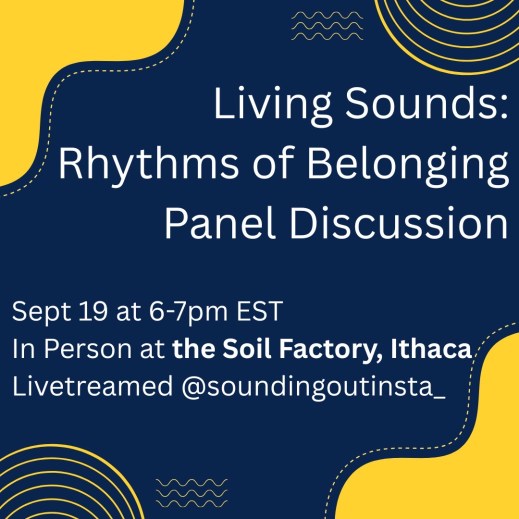
(1). SO! Podcast #82: Living Sounds: Rhythms of Belonging
“CLICK HERE TO DOWNLOAD: SO! Podcast #82: Living Sounds: Rhythms of Belonging
SUBSCRIBE TO THE SERIES VIA APPLE PODCASTS
FOR TRANSCRIPT: ACCESS EPISODE THROUGH APPLE PODCASTS , locate the episode and click on the three dots to the far right. Click on “view transcript.”
It’s been a minute for the SO! podcast but we are glad to be back–however intermittently–with a podcast episode that shares a discussion between women sound studies artists and scholars. The panel “Living Sounds: Rhythms of Belonging,” was held on September 19 at 6-7pm EDT at The Soil Factory arts space in Ithaca, New York. Moderator Jennifer Lynn Stoever, sound studies scholar and our Ed. in Chief, talks with four women sound artists about their praxis: Marlo de Lara, Bonnie Han Jones, Sarah Nance and Paulina Velazquez Solis.. . .”
[Click here to read more]
—
Featured Image: “microphone on the bass drum of the drummer for No Age” by Flickr User Dan MacHold CC BY-NC-SA 2.0
—

REWIND! . . .If you liked this post, you may also dig:
The Top Ten Sounding Out! Posts of 2024
The Top Ten Sounding Out! Posts of 2023!
The Top Ten Sounding Out! Posts of 2020-2022!
The Top Ten Sounding Out! Posts of 2019!
The Top Ten Sounding Out! Posts of 2018!
The Top Ten Sounding Out! Posts of 2017!
The Top Ten Sounding Out! Posts of 2016!
The Top Ten Sounding Out! Posts of 2015!
Share this:

“Just for a Few Hours, We Was Free”: The Blues and Mapping Freedom in Sinners (2025)
In the 2025 blockbuster Sinners, Ryan Coogler has a vampire story to tell. But before he can begin, he needs to tell another story—a blues one. Sinners opens with a voiceover thesis statement performed by Wunmi Mosaku (who plays Annie in the film—more on her below) about the work the blues can do, then rambles the narrative through and around 1932 Clarksdale, eventually settling into a juke joint outside of town. Here, the blues story builds to a frenzied climax, ultimately conjuring the vampires propelling the film’s second half. It’s those vampires that most immediately register as cinematic spectacle, but Coogler’s impetus to film in IMAX and leverage all of his professional relationships for the movie wasn’t the monsters—it was to showcase the blues at a scale the music deserves. In Sinners, the blues takes center stage as a generative sonic practice, sound that creates space to be and to know in the crevices of the material world, providing passage between oppression and freedom, life and death, past and future, and good and evil.
I’m not exaggerating in calling the opening voiceover a thesis. In a movie where Coogler trusts his audience with a great deal of interpretation, he puts an incredibly fine point on the role that blues performs here. We’re told that some musicians—be they Irish, West African, Native American, or southern US Black—are so skilled that they can pierce the veil separating the living from the dead, and while this piercing can help heal a community, it can also attract a certain evil that wants to exploit this rupture. The narrator doesn’t say “It’s the blues!” but the next visual information we get is that it’s Clarksdale, MS, in 1932, and an injured, blood-soaked Sammie (Miles Caton) is stumbling into his father’s church, clutching what’s left of the neck of a guitar. No one in Sinners says the word “crossroads,” but here we are, at the place where the blues meets the devil—where the end meets the beginning–and our young hero has a choice about which way he’s going to go.

If Coogler doesn’t fully trust his audience to know what to do with the blues without being told, it’s likely due to decades of commercialized attempts to defang the genre that have filtered out 21st century listeners’ ability to hear most of what makes the blues potent. Drawing on what Clyde Woods in Development Arrested (1998) has termed the “blues epistemology,” a blues way of knowing, B Brian Foster speaks with contemporary Black Clarksdalians in I Don’t Like the Blues (2020) to chart much of the current state of the blues. Pulling on one particular thread of Foster’s ethnography can help clarify what’s happening in Sinners, as he unpacks the many reasons why the blues don’t resonate quite like they used to.
In Woods’s framework, the blues is more than a musical genre; it’s a way of understanding and, crucially, reshaping one’s world. The blues, a genre arising in the late 19th century and reverberating through the 20th, functioned as epistemology in order to explore a way out from under plantation power after Reconstruction and through Jim Crow. Woods chronicles centuries of “plantation power” in the Delta and how that power reconfigures itself over and again through different eras of US history, always with the goal of extracting labor and life from Black Mississippians. The blues pushed against the edge of what was considered possible and sought to imagine and create a world that was free—not just from plantation power but from all the logics that support it or would circumscribe Black self-determination and autonomy. In I Don’t Like the Blues, Foster encapsulates the heart of blues epistemology with a flourish: “While many people hear the blues as performance and play, Black residents of Clarksdale knew it to be flesh and bone, a spirit in the dirt. Their blues was a conduit. A map. A method” (15-16). Throughout his book, Foster demonstrates that what the blues was is no longer what the blues is. One of those reasons is that resistance to plantation power (whether in the Delta or beyond) simply sounds different now, having worked its way through jazz and funk and soul and hip hop and trap.

In Sinners, Coogler starts by telling us what the blues could do, then he shows us that power in a climactic scene midway through the film, reminding his audience that a blues epistemology might not always sound the same, but it can still do the work of mapping out freedom. After the camera cuts away from Sammie at the crossroads in his church, we loop a bit back in time to meet Sammie’s cousins, the SmokeStack brothers (twins played by Michael B Jordan), who purchase the juke joint’s eventual location. The first half of the movie follows the brothers as they split up and get the band—and hospitality crew—together to open the venue that night. Sammie is new to this life, but a deeply gifted bluesman, and he receives counsel along the way about what the music is and how it works. Once the juke is packed, the booze is flowing, and the dancefloor is sweating, Delta Slim (Delroy Lindo) invites Sammie to take the stage and tell the people who he is and where he’s from. What follows is an ambitious narrative and technical feat that pays off the opening voiceover.
Sammie, also known as Preacher Boy, launches into a song called “I Lied to You,” addressed to his minister father (played by Saul Williams). It’s a confession that he’ll take the blues over the church any day. His singing pierces the veil, and we witness a litany of musicians joining the space from the past, present, and future: an Afrofuturist rock guitarist, hip hop DJs, breakers, twerkers, a ballerina, a Zaouli dancer, and Beijing opera performers, among others. Weaving in and out of Sammie’s blues, the sounds of each of these musicians layer and feed back into the mix to create a densely ecstatic sequence. This is the community healing piece of the voiceover thesis. The performers joining from far-flung places and times connect to an ancestral lineage of creative self-determination that runs through the patrons of the juke joint (Bo and Grace—played by Yao and Li Jun Li, respectively—are Chinese shop owners helping out at the juke joint and the presumed source of the Beijing opera performers).
Sinners’s musical conjuring isn’t an academic article, but it does have some musicological points to make. Audiences encounter musical styles uprooted from specific times and places, all mingling around this blues moment in 1932 Clarksdale. Coogler structures the scene by stacking out-of-time sound and movement, emphasizing the potency of a blues epistemology while also acknowledging that the blues’s power is situational. In its time—post-Reconstruction and Jim Crow—the blues could call in and draw on the fullness of diasporic music-making and world-mapping. But at other times, and in other places—say, a 2025 music venue—the blues is less likely to ignite such a moment as it is to show up as a participant, arriving as one of many in the musical ancestry to support the veil-piercers of the day. This phenomenon is the “changing same” of Black music, as Amiri Baraka put it in Blues People: “consistent attitudes with changed contexts” that explain why the sound changes over time (153). In Sinners, the immediate context is a community of Mississippi sharecroppers who seek healing, and the blues widens the frame so that the juke joint revelers can connect to and draw strength from a broader, deeper community beyond the edges of their material world.
As “I Lied to You” mingles with sounds past and future, the camera moves through the juke in a counterclockwise motion, grounding the scene further in diasporic ancestral practices. In Slave Culture (1987), Sterling Stuckey traces elements of Bakongo burial ceremonies throughout the New World, focusing especially on the ring shout, a sacred ceremony practiced by enslaved people in the United States involving a shuffling circular dance accompanied by song. Consistent across these traditions is counterclockwise movement:
Wherever in Africa the counterclockwise dance ceremony was performed—it is called the ring shout in North America—the dancing and singing were directed to the ancestors and gods, the tempo of the circle quickening during the course of movement. The ring in which the Africans danced and sang is the key to understanding the means by which they achieved oneness in America (12).
The counterclockwise circulation rehearses the life cycle, with the sun rising in the east (birth) and setting in the west (death), only to rise again (gesturing toward the connected nature of all life).
Stuckey draws on Robert Farris Thompson to note that special emphasis on counterclockwise motion would happen in Bakongo rituals that superimposed a cross on the circular movement, where the horizontal line represented the division between the living (above) and the dead (below). Here is the dividing line of Sinners, then: an ancestral ceremony with a crossroads superimposed on it, a blues invocation where the audience is propelled counterclockwise through the circle of juke joint dancers, where the dead and not yet alive join in the festivities.
The theme of lineage and ancestry courses through Coogler’s work. On the personal level, this may play out as a boxer sparring with his late father’s legacy. On a larger scale, Coogler often traverses the land of the Great Migration and the sea of the Middle Passage, tying back together the threads left dangling by the terrorisms of the transatlantic slave trade and Jim Crow. For a people whose lineage was savagely untethered by their ancestors’ enslavers, the power of a blues epistemology comes from its ability to tap into traditions and rituals that couldn’t be fully severed, restoring the “oneness” of those engaged in the dance and fueling their ability to imagine and create a path to freedom.
There is the other part of the voiceover’s thesis statement, though. When you pierce the veil, evil seeks to charge through. As the “I Lied to You” sequence hits peak intensity, Coogler treats movie audiences to another visual effect that the blues performers cannot see but feel; the juke joint appears to spontaneously combust and its roof is on fire (the roof, the roof. . .). Coogler metaphorically lets the motherfucker burn, down to the concrete foundation supporting the people as they continue to dance. At the edge of the dusty parking lot, the movie’s villain—an Irish vampire named Remmick—watches lustily while flanked by his latest converts. He wants Sammie; particularly what Sammie knows how to do.
Because Remmick hive-minds with whomever he turns into a vampire, taking on their memories and abilities, if he can get at Sammie, he’ll be able to pierce the veil, too, and commune once again with his long lost ancestors. We could read Remmick’s drive as an allegory about cultural appropriation, a white man who wants to steal the blues, and certainly there’s an element of that at play. But the “Killmonger was right” corollary of Coogler films suggests that villains are often more complex than they may at first seem. In Sinners, there’s a mob of Klansmen that function as the more straightforward baddies, but Coogler isn’t interested in giving them much screen time. Yet he lingers with Remmick just as he did with Killmonger and Namor in his two Black Panther installments. In each of these cases, Coogler explores different experiences of what it’s like when the boot of Empire is on your neck. Remmick, coming from Britain’s first colony, speaks of his home being taken and of religion being forced on him. He seems to hold genuine disdain for the Klan and notes that he’s happy to turn them all to prey, not because he wants what they have but because they deserve a gruesome death. He plays and dances to the music of his ancestors with care and devotion. And he argues that what he has to offer—community with his coven, the power to overtake the plantation class, eternal life—is better than what Smoke, Stack, Sammie, and the rest of the juke joint patrons currently have.

No one living trusts Remmick—in fact, Annie (Mosaku), the heart, brain, and wisdom of the movie, specifically distrusts him even before he reveals his true vampiric nature. And Coogler doesn’t position Remmick to be perceived as “good” in any sense of the word, except at playing that banjo. But, like Killmonger and Namor, Remmick gets to be right about some things. It appears in flickers of concession on characters’ faces when Remmick tells them they live in a place where they’ll always have to fight to even try to be truly free. It appears again when the juke joint protectors melt a bit during Remmick & Co’s performance of “Pick Poor Robin Clean,” a glimmer of a thought of “wait, should we let them come inside and play this absolute bop??” (for detailed historical context for this song see Daphne Brooks’s “See My Face on the Other Side” [2017]). Coogler’s villains ultimately suffer defeat, but before they do, he makes sure audiences glimpse how they’ve suffered under Empire, offering an understanding of their destructive actions as born of unhealed generational trauma.
Piercing the veil is tricky work. Dangerous work. In The Long Emancipation (2021), Rinaldo Walcott notes that “much of what we have come to call Black culture is a mode of living life within, against, and beyond plantation logics” (20), not only a rejection of logics of oppression but also a practice of creating and nurturing something else. To set about finding knowledge and being, as Sylvia Wynter puts it, “completely outside our present conception of what it is to be human” is to set off into the not-fully-known, where one may encounter a variety of ideas and beings who won’t ultimately lead you to freedom but who may offer you something a little better than what you’ve got (Wynter, 2000 interview with David Scott, 136). Walcott calls this the difference between emancipation and actual freedom. While emancipation is often mistaken for freedom, Walcott argues that “postemancipation acts of Black life have been consistently interdicted, thereby preempting and often violently preventing Black life from authorizing its own desires for bodily autonomy” (105), preventing Black life from being free.
In Sinners, Coogler shows us the way the blues could clear space for finding freedom, but none of the characters in the movie make it all the way there. It’s a movie situated in the long emancipation, where an imposed religion calls the blues the devil’s music, where plantation sharecropping and the Klan violently forestall Black freedom (but sometimes get what’s coming to them), and where various vampires carrying their own intergenerational trauma try to seduce Black people into accepting a different flavor of emancipation in place of the freedom the blues leads them toward. The map to freedom may not sound like the blues anymore, but Sinners reminds us the work isn’t done.
—
Featured images: Screen Capture by SO!: Sammie’s right hand clutching broken guitar neck, black cross in the background against white wall [2:10]
—
Justin Burton is a Professor of Music at Rider University, teaching primarily in the Music Production degree as well as in the Gender & Sexuality Studies program, and author of Posthuman Rap (Oxford, 2017) and co-editor of the Oxford Handbook of Hip Hop Music (Oxford, 2018).
—

REWIND! . . .If you liked this post, you may also dig:
They Can Hear Us: Surveillance and Race in “A Quiet Place”–Justin Burton
Can’t Nobody Tell Me Nothin: Respectability and The Produced Voice in Lil Nas X’s “Old Town Road”–Justin Burton
SO! Amplifies: The Blues and Jazz Dance Book Club–Chelsea Adams
“Music More Ancient than Words”: W.E.B. Du Bois’s Theories on Africana Aurality — Aaron Carter-Ényì
Music Meant to Make You Move: Considering the Aural Kinesthetic–Imani Kai Johnson
Share this:


Current Top Posts





April 2021

January 2020

November 2019

October 2019

August 2019

April 2014

November 2017

March 2015

December 2017

October 2015
 Sounding Out!
Recent Comments