
Six Years in Nodar: Sound Art in a Rural Context
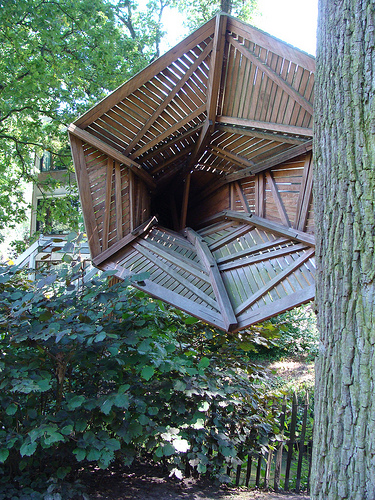
My family comes from a tiny village called Nodar in northern Portugal, part of the European Union-funded project “Tramontana” which focuses on preserving the immaterial heritage of mountain regions of southern Europe. In Nodar, centuries of isolation and self-sufficiency have created a unique blend of cultural expressions, ways of living, and inhabited landscapes. Like much of the Portuguese countryside, Nodar is undergoing a process of abandonment, which leaves rural communities with a weakened sense of identity. The agrarian paradigm, which has been central to the history and social fabric of rural communities, is arriving to an almost hopeless vanishing point, and the guardians of that memory are also disappearing. With this as formative part of my background, and considering my artistic interest in community-oriented projects, I felt almost a duty to direct much of my work to Nodar, a place that means so much to me and where I thought I could make a difference. In 2004 my brother Luis and I founded Binaural/Nodar, an arts collective based in the village and operating in the surrounding region of the Gralheira mountain range.
Since March 2006, the Nodar Rural Art Lab has invited both local and international artists who work in the areas of sound, video, and intermedia arts to address issues such as collective memory, identity, gender, age, life, death, geography, topography, music, sound heritage, landscape, vegetation, consumption and leisure dynamics, myths, traditions, crafts, agriculture, and shepherding. During their stay, the resident artists give public presentations in the region and are encouraged to establish interactions with the place and its inhabitants, geographic spaces, and social memory. Many of the artworks held in Nodar cross different artistic practices, often blending borders.
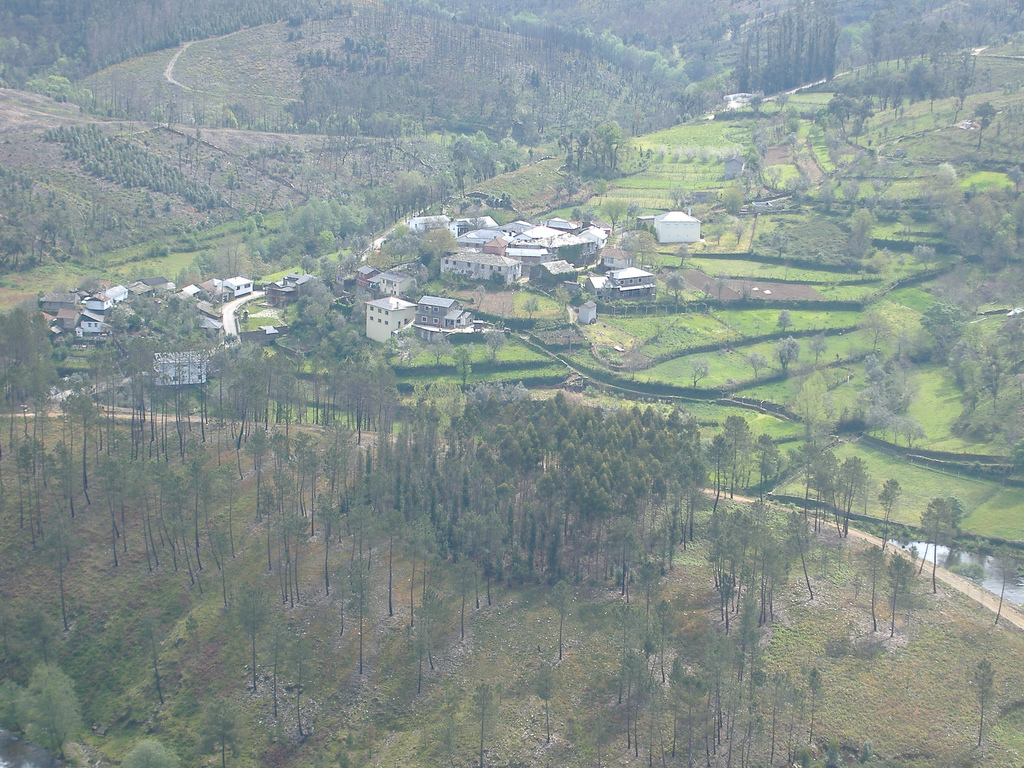
Nodar, Portugal. Photo by Carina Martins. All rights reserved by Binaural/Nodar
The decision to initiate an artist residency center in Nodar was motivated by my desire to deepen the investigation of exploratory artistic practices in close interaction with a specific rural context and its social and cultural possibilities. Throughout the year, the Nodar Rural Art Lab programs various residency modules in order to stimulate a collaborative environment between artists from different artistic fields and geographic origins. During the course of the residencies, several parallel activities are organized, such as conferences, lectures and educational activities, namely youth-oriented. At the end of each residency module, there is a public presentation organized in the village in which the art projects are presented and discussed by the artists and the organization.
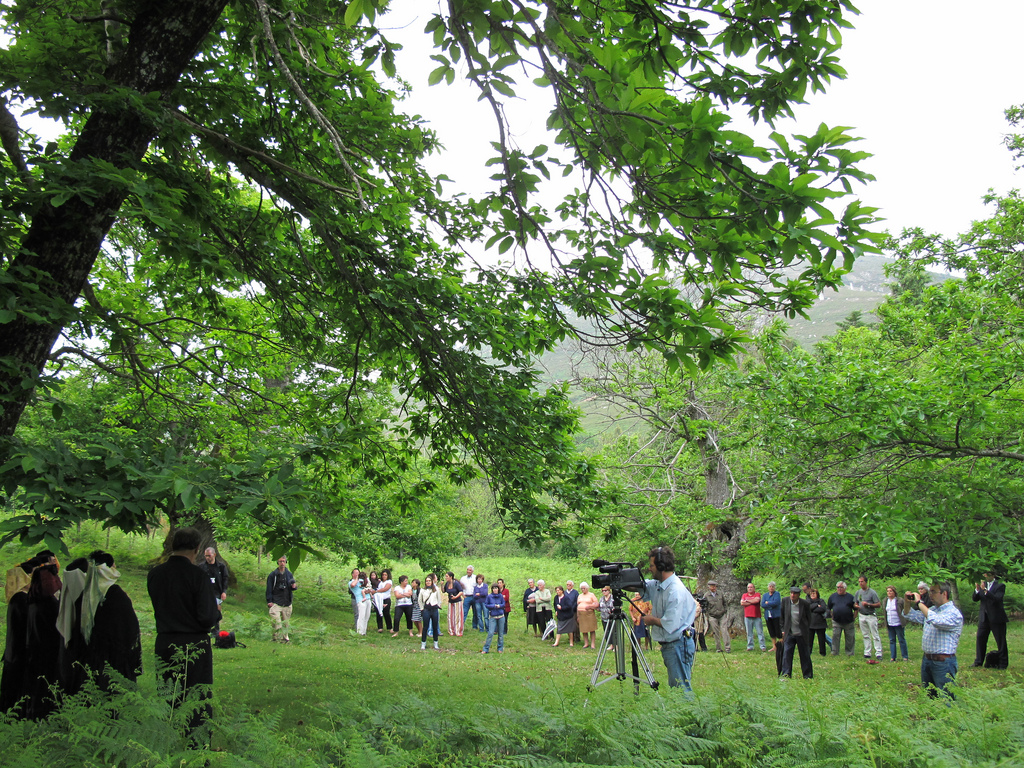
Public presentation of an art project in Nodar. Photo by Carina Martins. All rights reserved by Binaural/Nodar
The sonic dimension has a critical role in the model we have developed in Nodar, especially because it operates as a powerful metaphor for the intimate and personal discovery of a place. Artists have documented the area’s soundscapes and oral heritage in Nodar since 2006. There are three central lines of artistic interaction that converge here: Sound, Space and People:
SOUND (Interaction with the acoustic environment): Some sound artists, who work with the acoustic dimension in an experimental way, are part of the team that runs the Nodar Rural Art Lab. The Lab has always been active in the international theoretical and artistic domains of the so-called soundscapes, and it has hosted some of the most respected sound artists of today, who–using idiosyncratic techniques for sound capturing, editing and manipulation–have created works based on particular aspects of the local acoustic context.
One of our approaches is what we call “sound interventions,” where we use field recordings and performance in order to “activate the space” and establish a dialogical approach between what is activated and what just “is,” which can incorporate body, gesture, sound, object, space and voice in this process. An example of this approach was the “Revenant : Paiva” project, conceived in 2009 by Patrick McGinley, Marjia-Liisa Plats, Luís Costa and Tiago Carvalho, in which a series of performative actions were staged in a section of the river Paiva that crosses Nodar. Using materials found in-situ as instruments, in addition to the artists’ own voices, to generate sounds that interacted with the acoustic environment itself, all activity was purely acoustic, with no amplification. The resulting work was presented live with the artists and audience spread out across the space with no preferential “point of listening”, which created subtle overlaps between the artists’ work and the space.
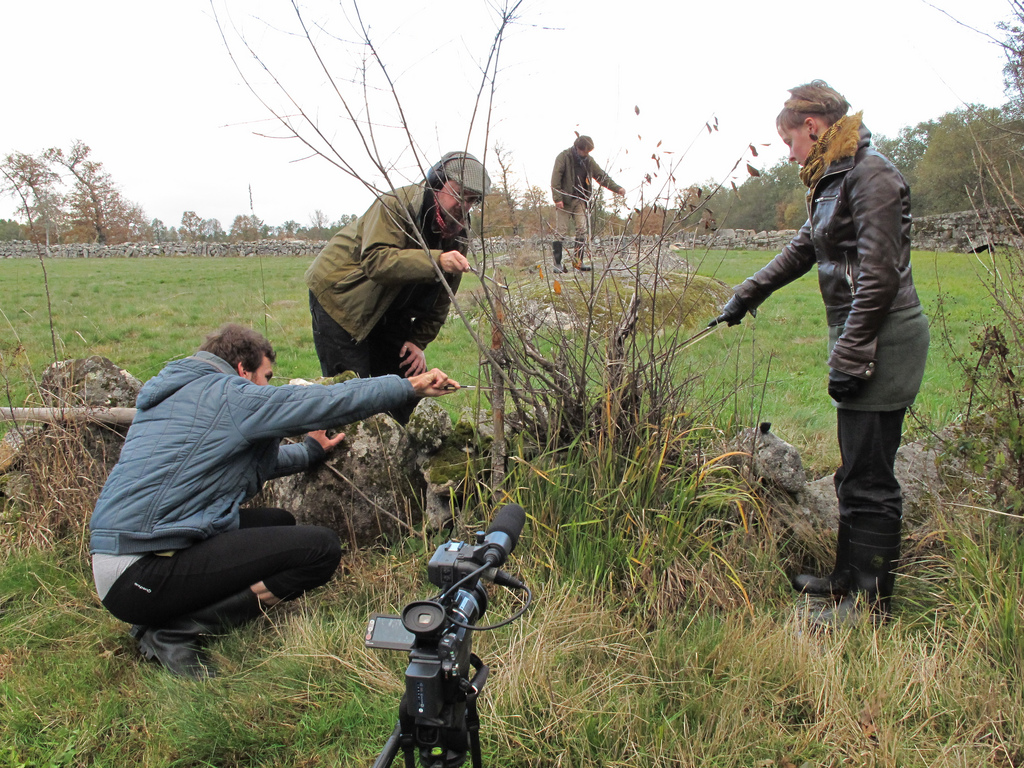
Working on “Revenant : Paiva.” Photo by Carina Martins. All rights reserved by Binaural/Nodar
SPACE: Interaction with the geographic space. The landscape surrounding Nodar is beautiful and diverse; there are mountains, rivers, caves, slate stone architecture, terraced fields, and so much more. Moreover, we are witnessing an irreversible process of transformation of rural space. These two elements form fertile ground for the creation of works within nature, which either capture the dreamlike and timeless aspects of the landscape or question possible future uses for the same landscape.
Of particular interest to us is the use of geography as a means for projecting sound in which specific variables of the territory, such as topography and meteorology, intersect with instrumental or subjective aspects of artistic creation, namely the position occupied in the space and the choice of sound recording and reproduction tools and techniques. A good example of this approach was Lisa Premke’s project “Aural Lookout,” developed in 2012, in which she built a canvas lookout on the top of a hill that allowed the visitors to be sheltered from the environment while listening to the nature sounds acoustically amplified, as if being inside a large drum.
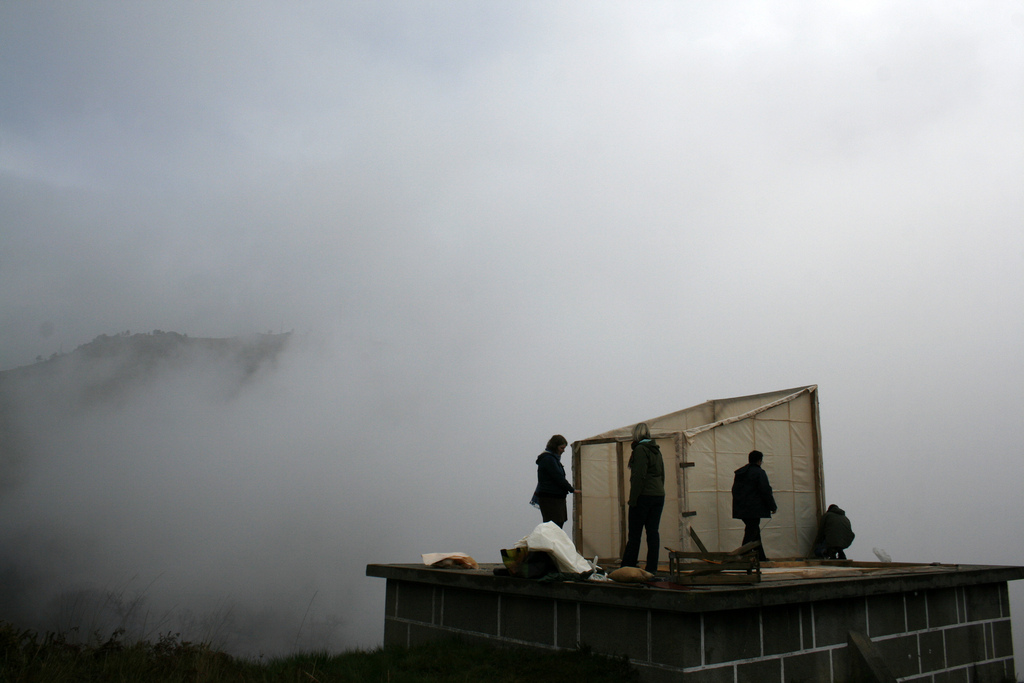
Working on “Aural Lookout.” Photo by Carina Martins. All rights reserved by Binaural/Nodar
PEOPLE: Interaction with local inhabitants. Since the beginning of our activities, we have been encouraging artists to interact, question and to some extent “provoke” local populations. As a result of these communication processes, various art projects have been developed reflecting and expressing aspects of the region’s collective memory and new habits and experiences.
Working on the subject of the anthropological voice may involve direct conversation with the local communities based on topics proposed by the artists and related to everyday life and local memory, as well as it may focus on linguistic aspects such as accents, musicality of the voice, etc. Maile Colbert’s “Over the Eyes,” created in 2007, was a very successful example of this sort of “conversational” project, where she organized a knitting circle with the village women, recorded the conversations with them, their songs and stories and incorporated them into the sound design of a multimedia installation, along with field recordings of the area, and text on physiological, biological, and psychological aspects to memory creation and destruction in humans. The projection screen was composed of raw wool and the knitted cloths made during the circle, which created an interesting dialogue with the immaterial nature of the audiovisual element of the piece.
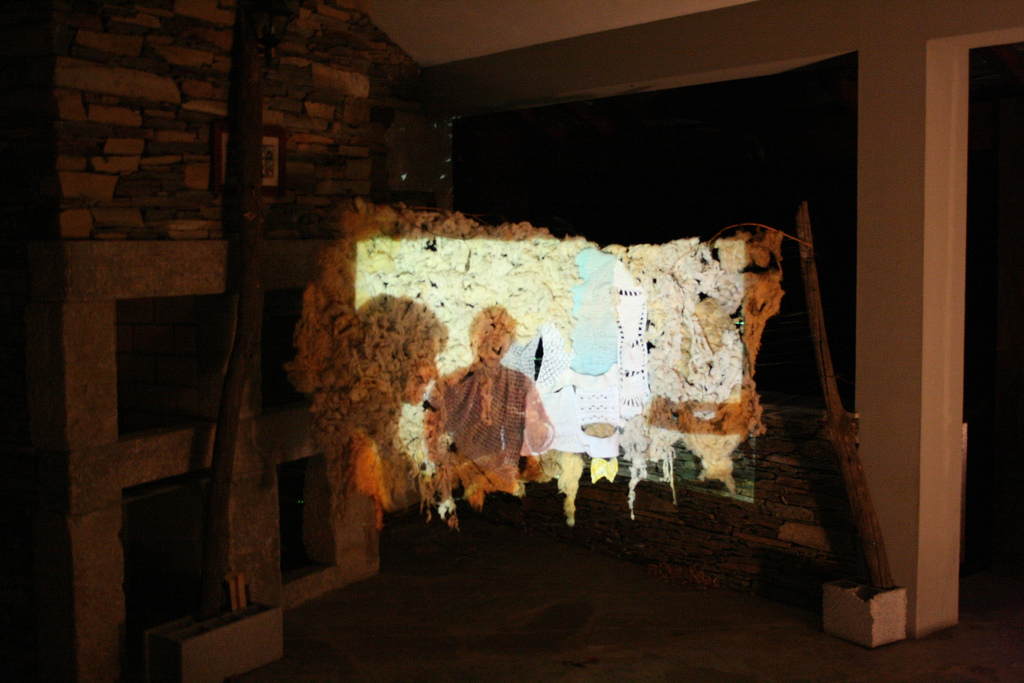
Maile Colbert’s “Over the Eyes.” Photo by Carina Martins. All rights reserved by Binaural/Nodar
We have always emphasized a type of sound art that enhances the context within which a specific sound work is produced, escaping a purely acoustic, or “sound-in-itself” approach. We believe that this emphasis on subjectivity and context is necessary, because sound–and the practice of field recording in particular—sometimes carries a burden of “objectivity” because it stems from the documentation of reality. The subjectivity inherent to the sound recollection –for instance, the choice of the point of listening and of the technological means of sound capturing–is often not sufficient to alleviate this burden.
When we host sound artists in Nodar, we always try to convey the idea that the region’s landscape is fundamentally an “inhabited landscape.” Trying to avoid the human presence in order to get “wilder and more natural” recordings is purely illusory. The landscape is inhabited in several simultaneous ways: by the marks of historical occupation of the territory, by the existence of vital spaces for each inhabitant–often lying far beyond the boundaries of the villages–by the very presence of the artists and by the audiences of the art works’ final presentations.
In summary, there are several methodological, instrumental and aesthetic approaches that Binaural/Nodar is working to further in the area of sound art. These approaches are anything but sealed; intersections, complementarities, unions and differences exist, which make each work of art unique.
—
Featured Image: “Oor van Noach” by Flickr user ines saraiva under Creative Commons 2.0 License.
—
Rui Costa is a sound artist from Lisbon, Portugal. He is a founding member and artistic director of Binaural/Nodar, an arts organization founded in 2004 and dedicated to the promotion of context-specific and participatory art projects in rural communities of the Gralheira mountain range, northern Portugal. Rui has been performing and exhibiting his work since 1998 in festivals, galleries and museums across Portugal, Spain, Italy and the United States and has been collaborating regularly with the Italian vocal performer Manuela Barile and the American intermedia artist Maile Colbert. Rui Costa is also a regular speaker in conferences and gives workshops dedicated to sound art. For more from Binaural/Nodar, please check out the organization’s soundcloud, vimeo, and flickr.
Share this:

Sound as Art as Anti-environment

When I performed at the 2012 Computers and Writing Conference in Raleigh, North Carolina, I looked around during my fairly abstract 10-minute long improvisation featuring feedback loops, glitches, silences, and circuit-bent instruments, and I noticed the audience’s sometimes visible restlessness, discomfort, and even anxiety. This is a fairly common occurrence when I perform experimental sound art, particularly in contexts in which audiences expect “music” (you can hear my work at 38:30 in the video below). However, for an experimental sound artist to take offense to such reactions is, in my estimation, missing the point of the exercise. That sound art disrupts, agitates, and even offends is a powerfully reaffirming reminder that sound art transcends music and sound; it is a method of revelation, an act that surpasses logical communication, instead challenging the very nature of sound and perception.
.
As an artist, scholar, and fan, I am drawn toward sound and music that lures me into a new world, an unfamiliar way of being and knowing. Like Lewis Carroll’s Alice, I learn that the rules of my world no longer apply. This happened when I heard J Dilla’s Donuts album, and when I heard Madlib’s Medicine Show #3: Beat Konducta in Africa, when I heard Miles Davis’ Bitches Brew. An artist that continually draws me down the rabbit hole is Walter Gross, an experimental sound/beat artist out of Los Angeles. His work changes the way I usually interact with sonic art, both in terms of his sound and in his approach to physical collage and handcrafted cassette packaging, Gross departs from the comfortable and familiar listening imparted by polished hi-fi 3-minute tracks with definitive beginnings and ends and discernible melodies. Gross instead propels listeners into very unusual (and pleasantly discomforting) soundscapes that demand attention. Almost counter-intuitively, Gross’s visual representations of his work intensify that experience. Consider his 2010 work, Dopamine:
Dopamine is likely a challenging piece for audiences, at least in terms of violating the dominant structures of music. The piece opens with disorienting use of panning, deliberately obscuring degraded audio, largely indiscernible movements and patterns, and so on. His video work likewise presents a fitting yet relatively unusual juxtaposition of youth and destruction, celebration and danger. In terms of both sound and sight, Gross’ work disrupts dominant musical sensibilities, challenging the very patterns and structures within which we can express ideas. He violates tradition, shakes off the canonical baggage carried by prevailing paradigms of Art and Music, and plunges audiences into unfamiliar sensory experiences that require metacognition, reflection, and examination of what sonic art is, and more importantly, what sonic art can be. Gross, in other words, seems to transcend the musician moniker and reach something else entirely. In what follows, I’d like to explore a (very brief) history of such artists, and begin to think about how to frame sonic art as immersion in what Marshall McLuhan called anti-environments: the unconscious environment as raised to conscious attention.
Sound as Art
There exists a strong tradition of experimental noise and sound art, particularly in 20th-century Western avant-garde movements. Futurists were arguably the first to consider noise as music in the European tradition, and were certainly influential in asking artists and audiences to become more aware of the changing social and sonic surroundings . In his 1913 manifesto-of-sorts titled “The Art of Noises,” Italian Futurist Luigi Russolo proposed an orchestral configuration that more aptly represented the range of sounds available to contemporary listeners, namely those sounds that accompanied industrialization and urbanization. The sounds of the Futurist orchestra would include “rumbles, roars, explosions, and crashes.” Russolo built devices called intonarumori to mechanically achieve and manipulate these sounds. His brother, Antonio Russolo, also enacted this new philosophy of modern found sound and composed Corale and Serenata.

Luigi Russolo and Ugo Piatti with the Intonarumori, 1913
Any inquiry of art as anti-environment would be incomplete without a discussion of the great anti-art movement, Dada. Like the Futurists before them, Dadaists used found sound and technology-as-art to violently disrupt conventions of art, beauty, and authorship within the white avant-garde community. Marcel Duchamp’s famous work, “Fountain,” is likely the most familiar Dadaist artifact to contemporary readers, yet the sound poetry of Kurt Schwitters and other Dadaist and Dada-inspired sound pieces such as Erwin Schulhoff’s 1922 work In Futurum (the middle movement of which contains only a rest and the notation “with feeling,” an undoubtable precursor to John Cage’s 4’33”, written 30 years later) created sonic spaces of innovation and strangeness that changed the way audiences listened to both voices and silences. The Russian Cubo-Futurists, especially zaumniks such as Alexei Kruchenykh, made similar ventures into anti-environments. Kruchenykh developed the sound art zaum, which he understood as a transrational language that undercut existing language systems in which the “word [had] been shackled…by its subordination to rational thought” (70). Zaum was a sort of linguistic anti-environment, one rooted in the notion that meaning resided first and foremost in the sound of a word rather than the denotative symbol system that emerged alongside the proliferation of print/visual culture. One could also not underemphasize the work of John Cage, from his prepared piano to his work with organic instruments.

John Cage and His “Prepared Piano,” Image courtesy of Flickr User William Cromar
The list of artists, genres, and movements engaged to some extent in the enterprise of anti-environment architecture could go on and be debated indefinitely: Free Jazz, Turntablism/Nu Jazz, Experimental Hip-Hop,Fluxus, Circuit Bending, Prepared Guitar, ProtoPunk, Punk, Post-Punk, New Wave, No Wave. . . in all of these diverse movements, the sonic artists share the tendency to create strange new worlds via sound; worlds that reveal social and technological environments that most people seem unaware of in the moment. This is why media theorist Marshall McLuhan called the artist “indispensible,” because the artist can tell us something about ourselves that we cannot know via ordinary means of perception. Sonic artists expose audiences to auditory phenomena, structures, juxtapositions, etc. that are to various extents hidden, obscured, or ignored as “noise.” The sonic artist is more than just a clever selector and (re)arranger of sound; s/he is a revelatory agent, exposing what is inaudible.
Art as Anti-environment
Anti-environments, however we might define and classify them, are vital not only to artistic communities themselves, but they are also vital to a society of fish in water. In his 1968 text, War and Peace in the Global Village, McLuhan asserts (among other things) that humans remain largely unaware of their new environments, likening them to fish in water: “one thing about which fish know exactly nothing is water, since they have no anti-environment which would enable them to perceive the element they live in” (175). In other words, humans seldom possess or practice a sense of awareness regarding their surroundings because there’s nothing against which surroundings may be contrasted. The “water” to McLuhan represented the various environments (physical, psychological, cultural) shaped by technological innovation, but we can—and should—extend the water metaphor to a range of hegemonic frameworks: constructions of gender, race, ability, and so on.
This essay is certainly not an attempt to generate some sort of evaluative rubric by which to judge artistic or sonic expression objectively. Rather, we might use the concept of anti-environments as a way to frame our subjective experiences and encounters with all sound, and begin listening to unfamiliar sounds as psychedelic (from Greek psyche- “mind” + deloun “reveal”) keys to illuminate the patterns and structures in which listeners exist. We must work to understand our environments and our place in them; if we are to engage critically with our culture, we must first understand existing (yet invisible) patterns and structures that surround us. And we are aided in this effort, in great part, by humanity’s great seekers of pattern recognition, the sonic-psychonautical messengers: the sonic artists.

Sound Artist Performing at Circuit Bending Workshop in Dayton, Ohio in 2009, Image Courtesy of Flickr User Vistavision
To return to the sound that inspired this meditation, Walter Gross (among others) is in many ways participating in and propelling the discourse of Leary and McLuhan, Schwitters and Schulhoff, Kruchenykh and Cage,Davis and Sun Ra, Madlib and J Dilla. Gross performs the sonic anti-environment, enacts the revelation of obscured sonic paradigms. For me, Gross can act as a sort of lens through which ordinary sonic patterns and structures become visible. I hear Flying Lotus, Bob Dylan, and The Minutemen differently after Gross. I hear my office, my home, my family’s voices differently after Gross. I hear patterns that weren’t audible before. After Gross, I become aware of how I am continuously trained to expect certain things from the sonic world: compartmentalized units of meaning, clearly stated origins of utterances, linear narratives, repeated/repeatable melodies, and so on.
Likewise, my own sonic art/scholarship approaches the use of sound to reveal the inaudible assumptions present in Western frameworks surrounding sonic production. I will conclude with an illustration of my own work and why sonic anti-environments are so central to my philosophy and method. One of my sonic works, “Toward an Object-Oriented Sonic Phenomenology,” was recently part of an exhibition titled Not For Human Consumption, curated by Julian Weaver of CRISAP in London. I recorded the sounds of a high mast lighting pole using contact microphones. Contact microphones do not “hear” like humans typically hear. Typical (dominant) notions of human hearing (and therefore of sound itself) involve the reception and interpretation of vibrations present in air. Contact microphones instead only interpret the vibrations in solid objects.
By listening through an object–through alien “ears,” so to speak– we can begin to critique the ways that we privilege listening via air, a listening that places humans at the center of the universe. We can consider the ways that sound has very real effects on humans with atypical hearing abilities and nonhuman objects. It is difficult to have such conversations if we never explore sonic anti-environments, if we never break through dominant epistemological models, if we never expose the limits of our own environments.
—
Featured Image: Beatrix*JAR in Dayton, Ohio, September 9, 2009, by Flickr User Vista Vision
—
Steven Hammer is a Ph.D. candidate in Rhetoric, Writing, and Culture at North Dakota State University in Fargo, ND, USA. His research deals with various aspects of sonic art, from exploring glitch and proto-glitch practices and theories (e.g., circuit bending), to understanding and producing sound from an object-oriented ontology (e.g., contact microphones). He also researches and facilitates trans-Atlantic translation collaborations between American, European, and African universities. He has multimedia publications with Enculturation, Sensory Studies, as well as forthcoming book chapters with Wiley/IEEE press, and IGI Global Publishing, and has performed creative and academic work at several conferences across North America, including the national Computers and Writing Conference and the Council for Programs in Technical and Scientific Communication. He performs experimental circuit-bent and sampler-based music under the moniker “patchbaydoor,” and has constructed and documented a number of hardware modification projects for his own artistic projects and for other artists in the upper Midwest United States. You can read/hear more atstevenrhammer.com
Share this:


Current Top Posts





April 2021

January 2020

November 2019

October 2019

August 2019

April 2014

November 2017

March 2015

December 2017

October 2015
 Sounding Out!

Recent Comments