
That Infernal Racket: Sound, Anxiety, and the IBM Computer in AMC’s Mad Men
[Warning: Spoilers Ahead for Folks Not Caught Up with Season 7, Episode 5!]
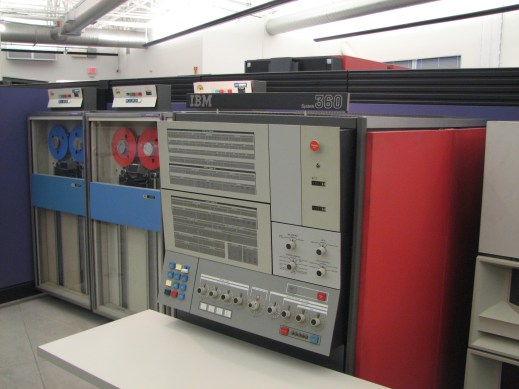
In one of the more memorable – and squirm-inducing – scenes of this season of AMC’s Mad Men, brilliant but eccentric copywriter Michael Ginsberg (Ben Feldman) presents his colleague, agency copy chief Peggy Olsen (Elisabeth Moss) with his own severed nipple, placed carefully in a gift box. Ginsberg explains to the understandably horrified Peggy that the gift is both a token of his affection and a means of relieving pressure caused by the arrival of Sterling, Cooper & Partners’ (SC&P) newest acquisition: a humming, room-sized IBM System/360 mainframe computer. Explaining his enmity for the machine and his increasingly erratic behavior, Ginsberg tells Peggy that the “waves of data” emanating from the computer were filling him up, and that the only solution was to “remove the pressure” by slicing off his “valve.”
The arrival of the IBM 360 in the idealized 1960s office space inhabited by Mad Men is obviously an unsettling presence – and not only for Ginsberg. Since its debut in Episode 4, commentators (e.g. WaPo’s Andrea Peterson, Slate’s Seth Stevenson) have meditated on the heavy-handed symbolism surrounding the machine – both in terms of its historical significance and its implications for plot and character development. Typically cued through noise (or lack thereof), it is worth reflecting upon the role of sound in establishing the computer as a source of disruption. Between the pounding and screeching of installation and the drone of the completed machine’s air conditioner and tape reels, the sonic motifs accompanying the computer underline tensions between (and roiling within) SC&P staffers grappling with the incipient digital age. Likewise, the infernal racket produced by the installation and operation of the IBM 360 adds an important dimension to the tensions resulting from its presence, which can be read as allegories for the complexities and contradictions of our relationship with technology.
.
The tone of the conflict is set even before we meet the IBM 360 toward the end of Episode 4: The Monolith – a reference to Kubrick’s 1968 classic 2001: A Space Odyssey (Slate’s Forrest Wickman ably discusses the references). Like the unnerving silence used with such great effect in that film, the absence of sound frames our first encounter with the computer – or at least its promise. Early in the episode, Don Draper (Jon Hamm), newly rehabilitated from his forced exile from the agency, arrives one morning at SC&P to find the office deserted. The ghostly sequence is clearly meant to symbolize Draper’s detachment from the firm. But as the episode progresses and tensions mount over the possibility that the IBM 360 will render jobs obsolete, the desolate office suggests a more ominous meaning – a once lively space muted by cold, impersonal automation.
In following scenes, successive stages of mainframe installation are marked by convergences of conflict and cacophony. First, there is the din of the creative team as they evacuate their beloved lounge – now earmarked as computer space – and during which a distraught Ginsberg projects his indignation onto art director Stan Rizzo, who appears more accepting. “They’re trying to erase us!” Ginsberg exclaims bitterly. Later, Draper lounges on his office couch as a clop clopping of hammers outside signifies tangible change. As if this weren’t enough of a distraction, two men in the corridor begin to chat loudly over the noise. Going out to investigate, Draper strikes up a conversation with one of the men, Lloyd Hawley, installation supervisor and founder of a small technology company competing with IBM. “Who’s winning?” Draper asks innocently, “who’s replacing more people?” Clearly irritated by Draper’s tone, Harry Crane – SC&P media director and the computer’s lead cheerleader – offers Draper a condescending apology for the loss of his “lunchroom,” assures him the change was “not symbolic.” “No, it’s quite literal,” Draper retorts. Unabated, the pounding and screeching of construction work emphasizes his point.
For the remainder of the episode, the raucous noise of construction acts as a leitmotif underscoring tensions between characters – between Peggy and Lou Avery (Draper’s priggish replacement at creative director), and between Draper and the interloper Lloyd. Finally, the end of construction is punctuated by a return to silence, as Peggy arrives one morning to see workers glide mainframe components noiselessly into the office.
Mad Men Logo. Used under the auspices of fair use for identification and critical commentary.
With this emphasis on technology as a source of symbolic, physical, and sonic disruption, Matthew Weiner and the creators of Mad Men draw upon a rich literary tradition. A relevant example contemporaneous with the show’s “present,” is literary critic Leo Marx’s 1964 text The Machine in the Garden, which examines the complicated relationships between a “pastoral ideal” and technological progress within American literature and popular imagination. Marx’s analysis reveals that sound is often used to convey the disruptive presence of technology within the bucolic landscape of the American continent. In Hawthorne’s Sleepy Hollow for example, it is the interrupting shriek of a locomotive whistle that breaks the author’s harmonious reverie: “Now tension replaces repose: the noise arouses a sense of dislocation, conflict, and anxiety” (15). In the decidedly un-pastoral modern office space, the noise of the computer installation nevertheless signifies a momentous social change and irrevocable loss. Picking out these tensions has always been one of the show’s strengths – whether it is the computer, Draper’s double identity, or the quiet endurance of women to the misogyny of midcentury work and domestic life.
Change, however, has significant consequences for Ginsberg, the young copywriter and Holocaust survivor who, as CBS’s Jessica Firger observes, has been deteriorating psychologically for some time. The proximity of the IBM 360, and the incessant drone of its mind-controlling waves eventually puts him over the edge. As Draper and Peggy enter the office early in Episode 5, Ginsberg glowers into the room housing the IBM 360. “Stop humming, you’re not happy!” he explodes. As Peggy attempts to soothe her colleague, our perspective shifts to look out at them from inside the glass-encased computer room. From here, the mainframe’s ambient noise muffles Peggy’s words, suggesting isolation between human and non-human. This play of speech and silence reoccurs later in the episode as Ginsberg, working alone on a Saturday with tissues wedged in his ears, spies Lou Avery and SC&P partner Jim Cutler inside the computer room, their voices made inaudible by the droning computer in a delicious homage to 2001 (see Vulture’s amusing gif). But the noise is clearly affecting Ginsberg. “It’s that hum at the office! It’s getting to me!” he tells Peggy later that evening. He even claims the computer has affected his sexuality.
Ginsberg’s noise complaints would have resonated in 1969 New York. In November of that year, the New York Times ran a feature on the city’s nerve-shattering noise pollution, calling it a “slow agent of death.” In addition to the myriad construction projects, subways, car horns, jet planes, and standing machinery populating the city soundscape, office workers found scant respite indoors where phones, air conditioners, “computers and typewriters and tabulators” whirred, whined, and clacked throughout the day. The article went on to report that scientists studying the impact of prolonged noise exposure on the human body had concluded a variety of ill effects on the heart and nervous system. Though no connection was made between computers and sexuality (as Ginsberg claimed), the article reported that laboratory rats under prolonged noise exposure had indeed “turned homosexual,” an opinion that underlined deterministic associations between sexuality, psychological disorder, and external stimuli.

An advertisement for the IBM 360. Borrowed from Wikimedia Commons.
As SO! editor Jennifer Stoever-Ackerman has argued, noise in midcentury New York also signified a sonic-racial politics, in which the mainstream “listening ear” recoiled at the “noise” created by Black and Puerto Rican others. In terms of Mad Men’s computer however, it is technology, economic anxiety, and mental illness, rather than ethnicity that frames sonic disruption. The basis of these tensions are similar however, and various interactions with SC&P’s IBM 360 demonstrate, as Stoever-Ackerman writes in SO!, “the ways in which Americans have been disciplined to consider some sounds as natural, normal, and desirable, while deeming alternate ways of listening and sounding as aberrant [and] dangerous.” Though similar, the conflict with technology on Mad Men does not suggest a clear us/them, or us/”it” binary. The banging of construction may be at first antagonistic, but it’s finite – eventually the computer is normalized within the SC&P office space to the extent that Peggy chides Ginsberg’s exasperation in Episode 5 by insisting “it’s just a computer!” Ginsberg’s reaction is more complex however, implicating a contradictory relationship with technology: once fully installed, has the droning computer become “natural, normal, and desirable” despite previous ambivalence? Is the keen awareness and anxiety towards technology symbolized through Ginsberg (albeit in a extreme form) suggested as the “aberrant” listening practice, or could it be Peggy’s apparent acceptance?
Like most cultural texts set in the past, it is possible to read Mad Men allegorically, as suggesting a certain ordering of meaning and values. From the perspective of those who have long since domesticated computers, the controversies and tropes activated by SC&P’s IBM 360 might strike us as familiar, even quaint. As the sociologist Bruno Latour has argued however, we would be wise to consider how technology exerts a kind of social agency that structures and impacts our daily lives. As historical symbolism, the sounds and noises of the IBM 360 on Mad Men should remind us that technological progress is not teleological, but a struggle over meaning in which anxieties (about jobs, mind-control, surveillance, subjectivity, etc.) may be variously accommodated, suppressed, or dismissed as irrational.
—
Featured image: An IBM 360 Mainframe. Borrowed from Wikimedia Commons CC 2.0
—
Andrew J. Salvati is a Media Studies Ph.D. candidate at Rutgers University. His interests include the history of television and media technologies, theory and philosophy of history, and representations of history in media contexts. Additional interests include play, authenticity, the sublime, and the absurd. Andrew has co-authored a book chapter with colleague Jonathan Bullinger titled “Selective Authenticity and the Playable Past” in the recent edited volume Playing With the Past (2013), and has written a recent blog post for Play the Past titled “The Play of History.”
—
 REWIND!…If you liked this post, you may also dig:
“DIY Histories: Podcasting the Past” -Andrew J. Salvati
“The Noise of SB 1070: Or Do I Sound Illegal to You?”– Jennifer Stoever-Ackerman
“DIANE… The Personal Voice Recorder in Twin Peaks” -Tom McEnaney
Share this:

SO! Reads: Susan Schmidt Horning’s Chasing Sound: Technology, Culture and the Art of Studio Recording from Edison to the LP

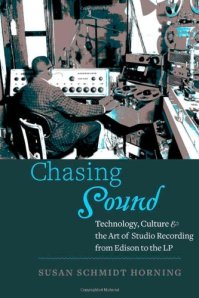
 The recently published Chasing Sound: Technology, Culture & the Art of Studio Recording from Edison to the LP (Johns Hopkins Press, 2013) is historian Susan Schmidt Horning’s first book. Veering away from the usual sound recording suspects (like the phonograph), Chasing Sound shows the studio and the audio engineer as central to the cultural and technological changes associated with the production and reproduction of sound.
According to Schmidt Horning, such changes were reflected in the shifting ideal of recorded music as a representation of live performance to the ideal of recorded music as a studio-engineered creation. Using the accounts of those responsible for recording sound, Schmidt Horning constructs a rich narrative that manages to be accessible while still focused on the highly technical work required of studio workers. That said, by focusing so heavily on user practices and anecdotes she misses an opportunity to engage with the theoretical implications of the ways audio engineers imagine and describe the actual space in which they work. Still, I contend that Chasing Sound represents an indispensable and critical approach for historians of sound, one that is unafraid of reconfiguring the central players in a narrative as big as the history of recorded music.
As a contribution to sound studies, Chasing Sound follows in the footsteps of Trevor Pinch’s Analog Days, the first work to explicitly apply Science and Technology Studies (STS) approaches to the history of a musical instrument. For Pinch, a critical understanding of sound requires examining the ways in which society and technology produce historical sites of change and stabilization. This approach focuses on understanding the ways people engage with technologies of sound, in order to interrogate their cultural and historical meanings. A historian of science and technology by training, Schmidt Horning has thus devoted much of her academic career to writing about the production and reproduction of sound through the practices and tacit knowledge of engineers, producers, musicians and technicians at music studios. By following the breadcrumbs dropped by these actors, Chasing Sound reveals the rich history of commercial studios and the cultural ideals cultivated therein.
 Methodologically, the author draws on a mixed bag of sources, which include oral histories from early recordists, interviews with more contemporary audio engineers, her own ethnomethodogical studio research, trade literature, and archival documents from big studios like EMI. The book proceeds in chronological order, with each chapter laying out changes in the physical and acoustic qualities of commercial studios as they shifted from bare-walled rooms with “the recording horn jutting through a wall at the far end of the room” (9) to multi-track studios complete with “Mission furniture, [and] hand-laid distressed wood floors.” (209) The author plots these changes alongside improvements in the science of acoustics, the importation of techniques and tools from the more well developed medium of radio broadcasting, the consolidation and growth of the recording industry, the rise of independent labels, the emergence of new attitudes and musical tastes, and the professionalization of audio engineering.
Chasing Sound, unlike many other books on the topic, places the studio in relation to a set of changing cultural expectations regarding recorded music. Where recordings were once understood as a reflection of live performance, they later were seen as a signature creation of music studios. Rather than focusing on the phonograph, gramophone, microphone, or magnetic tape, the author argues that the recording studio belongs at the center of recorded music because it was there that the ideal of music as a “technologically mediated art” was first engineered into cultural listening norms. Consequently the audio engineer, or recordist as he (or in rare cases, she) was known prior to the 1930s, must also be understood as central to narratives regarding recorded sound from its inception. In this way, Schmidt Horning aims to recontextualize and centralize the studio and its inhabitants within histories of the production and reproduction of sound.
Because the audio engineer represents an inextricable part of this history, each chapter devotes time to the technologies and practices cultivated by the amateur recordists and trusted professionals responsible for recording sound. Initially such practices formed the basis of their tacit knowledge regarding the proper “staging” of artists in relation to acoustic recording horns among other techniques, but by the 1950s, sound engineers were responsible not just for positioning artists, microphones, and the increasingly important work of “enhancing” recordings during post-production. The book concludes by charting the unfettered rise of independent studios as well as the consequent proliferation of (and backlash to) new sound manipulation technologies in the 1970s.
Throughout the text the author notes the ways in which audio engineers often lamented the increasing technological mediation involved in record production, even as it granted them more creative control and prestige.
 Schmidt Horning’s methodology represents Chasing Sound’s strongest quality. The rich narratives of the audio engineers allow the author to directly connect their technologically and culturally informed ideas about what constitutes good sound to the desires and expectations of listeners. In addition to this work, Schmidt Horning also highlights the ways in which advances in engineering technology did not necessarily overlap neatly with cultural norms. Throughout the text the author notes the ways in which audio engineers often lamented the increasing technological mediation involved in record production, even as it granted them more creative control and prestige. Such examples reveal the tightly knit relationship between ideas of liveness, talent, creativity, and authenticity. Chasing Sound is full of stories that detail the complex material, artistic, and ethical constraints around which recordists and engineers navigated in order to achieve the perfect sound.
The author’s methodological approach certainly helps to structure the narrative, but there are also ways in which it prevents her from digging in to important theoretical discourses regarding the studio. As Eliot Bates notes in his article, “What Studios Do,” the way audio engineers conceive of their workspaces is crucial for making sense of the power relations and social interactions that govern and are governed by studio spaces. Chasing Sound does not pursue these discourses. The author briefly mentions how the metaphor of flight is often used by sound engineers regarding the increasingly complex console controls of the 1950s and 60s but does not provide further elaboration on the implications of such a comparison. Even if the participants in her study did not reflect on their colloquial notes about the studio space, it would have been interesting to see Schmidt Horning consider what these metaphors reveal about the changing roles of the engineer.
These points aside, Chasing Sound is an important read both for those with a general interest in the history of sound production and reproduction as well as those scholars more specifically invested in understanding the role of recorded sound in society. Since I discussed the book’s limitations in “Making Music in Studio X,” Chasing Sound has become a foundational text in much of my research. Specifically, the author’s claim that the studio is (and has been) a critical site for examining broader industrial, technological, and cultural changes resonates deeply with me because it offers a critical methodology for considering issues of identity and power within studio spaces that are often neglected. In this regard, Chasing Sound is important not just for what it discusses, but also for what it does not. Noting the lack of female and black audio engineers discussed throughout the book, the author laments, “For the first century of sound recording, the field of audio engineering and recording studios in particular comprised a profoundly white male-centered culture that reflected corporate culture at large and technical professions in particular.” (9) The absence of these faces serves to remind us that while successfully “chasing sound” certainly relies on the cultivation of craft skill, and tacit knowledge, it also depends heavily on access.

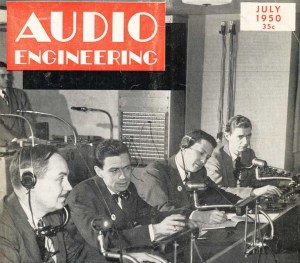
Reproduced under a Creative Commons Attribution license from Reel2ReelTexas.com
Chasing Sound stands out as the most exhaustive history of audio engineering available. Schmidt Horning’s user-focused narrative successfully ties together changes in studio configurations and audio engineering practices with cultural expectations regarding recorded music. This helps to show how the studio and audio engineer can easily be recognized as central figures in the history of sound reproduction. Chasing Sound’s intervention is necessary as the history of recording is often told through artifacts like the phonograph, microphone, and magnetic tape, not living spaces like the studio and its inhabitants. Schmidt Horning’s dedication to telling these neglected stories is what makes the book come to life. Her research promises to open up new avenues for others interested in these issues. For me, this means pursuing lines of inquiry related to the growing philanthropic interest in the recording studio as a site for engaging and “assisting” low-income communities. In this way Chasing Sound asks us to recognize the recording studio as a critical site for the production and reproduction of our assumptions about what counts as appropriate, good, or real in music and people.
—
Featured Image: My Recording Studio by Flickr User Fabio Dellutri
—
Enongo Lumumba-Kasongo is a PhD student in the Department of Science and Technology Studies at Cornell University. Since completing a senior thesis on digital music software, tacit knowledge, and gender under the guidance of Trevor Pinch, she has become interested in pursuing research in the emergent field of sound studies. She hopes to combine her passion for music with her academic interests in technological systems, bodies, politics and practices that construct and are constructed by sound. More specifically she would like to examine the politics surrounding low-income community studios, as well as the uses of sound in (or as) electronic games. In her free time she produces hip hop beats and raps under the moniker Sammus (based on the video game character, Samus Aran, from the popular Metroid franchise).
—
 REWIND! . . .If you liked this post, you may also dig:
Making Music at Studio X: The Identity Politics of Community Studios— Enongo Lumumba-Kasongo
SO! Reads: Japanoise: Music at the Edge of Circulation— Seth Mulliken
SO! Reads: Isaac Weiner’s Religion Out Loud: Religious Sound, Public Space, and American Pluralism— Jordan Musser
Share this:


Current Top Posts





April 2021

January 2020

November 2019

October 2019

August 2019

April 2014

November 2017

March 2015

December 2017

October 2015
 Sounding Out!
Recent Comments