
Sounding Out! Podcast Episode #4: Within a Grain of Sand

Borrowed from farm5.static.flickr.com .
Today’s entry in the Sounding Out! podcast series is a collection of interviews with sound artists from around the world. Compiled by Maile Colbert, these interviews show as much as they tell, often featuring the artists speaking in tandem with a recorded soundscape. At other moments, however; the soundscapes take on a life of their own as the artist pauses and the sonic landscape breathes. Although Maile had discussed some of these artists’ work previously in a blog post for Sounding Out! Within a Grain of Sand, this recording seeks to investigate their work in a unique and true-to-form manner. So, listen and learn – about the practice of creating sound art.
CLICK HERE TO DOWNLOAD: Within a Grain of Sand
SUBSCRIBE TO THE SERIES VIA ITUNES
Here are some brief biographic notes on the contributing artists:
“Under the Golden Gate”
Jen Boyd is a sound artist living in Northern CA. She spends time recording sounds in her environment and then arranges them into layered soundscapes. In these pieces, some sounds unfold naturally while others are processed. Although her work mostly relies on ‘natural’ sounds she uses a wide variety of sound sources to paint sonic pictures for the listener. Jen hopes to spark the interest in people of all ages to listen more closely to the environment they live in everyday. If you listen, you can hear some of her recordings on touchradio.org.
“Interview” (feat: recording artists from the World Listening Day)
Eric Leonardson is a Chicago-based composer, radio artist, sound designer, instrument inventor, improvisor, visual artist, and teacher. He has devoted a majority of his professional career to unorthodox approaches to sound and its instrumentation with a broad understanding of texture, atmosphere and microtones. If you are interested in learning more about Eric and his project, the World Listening Project, click this link.
Rui Costa is a sound artist from Lisbon, Portugal. He has been publicly presenting his work since 1998. He is a founding member and artistic director of Binaural. He has performed in many venues and sound art festivals in Portugal, Spain, Italy and the United States.
and the podcast producer, compiler, and contributing artist
“Debaixo da Ponte 25 de Abril”
—
Maile Colbert is an intermedia artist with a concentration on sound and video, relocated from Los Angeles and living and working between New York and Lisbon, Portugal, and teaching at Faculdade de Belas Artes da Universidade do Porto. She spent the last two years collaborating with the art organization Binaural, and is currently director of Cross the Pond, an organization based on arts and cultural exchange between the U.S. and Portugal. She holds a BFA in The Studio for Interrelated Media from Massachusetts College of Art, and MFA in Integrated Media/Film and Video from the California Institute of the Arts. She is currently in production on an interdisciplinary experimental opera based on Portuguese Maritime history, and will release two albums this year.
–
Share this:

Sounding Out! Podcast Episode #2: Building Intimate Performance Venues on the Internet
 The podcast is (or, can be) an intimate performance venue on the internet because it allows you to whisper into the ears of your fans. It allows you to grow close to communities of listeners. And podcasts also do one last thing, to be revealed at the end of this piece, after we’ve seen how far I can take you. For now, I will quote podcasters I admire to help explain these ideas in their own words. I also quote these podcasters in an audio format. I have recorded this essay as an episode of the Sounding Out! podcast. You can listen right here, and I suggest you do. Go ahead, press play:
The podcast is what’s happening if you’re listening to these words. Are you? Because remember: my central claim is that a podcast is an intimate performance venue on the internet. Keep that in mind.
I am a podcaster, musician, and assistant professor of Economics. I have released six episodes of my own podcast, The Lion in Tweed.

Me. (Photo by Hadassah Head)
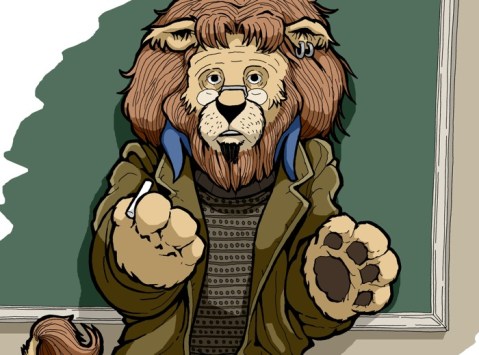
The Lion in Tweed. (Drawing by Winston Rowntree)
My podcast is primarily a narrative, with music and sound effects interwoven. It is about a character, The Lion in Tweed, and his experiences as a musician and professor of economics. He is also a lion. The second half of each podcast episode is a references section where I cite my sources and leave the fictional Tweedoverse canon to discuss real things.
I am not the first podcaster to remark on the ability of podcasts to traffic in intimacy. Chris Hardwick, of the Nerdist podcast, has claimed that, due to their intimacy, podcasts are the best medium going. He stressed: “you’re talking directly into the ears of your listeners.” There is no doubt that Hardwick was referring to those white iPod earbuds, which are a primary method of listening to podcasts. Part of a podcast’s intimacy comes from the closeness of the earbud to the membrane in the ear. Listening to earbuds evokes the intimate, and physical, closeness of someone whispering in your ear. Hardwick’s style of podcast is also intimate: vocal storytelling, mostly three comedians talking about the funniest things that have happened recently. The fact that it is not visual accentuates the intimacy of “whispering in your ears.” Although I would like to argue that the visual always reduces a sense of intimacy, I may simply prefer the sonic over the visual. Nevertheless, I believe that, the intimacy to which Hardwick is refers, is tied to the fact it is only sonic.

Chris Hardwick.

The Nerdist Podcast.
COMMUNITY
Podcasts as performance have a strange kind of liveness, episode-to-episode interactivity. By this I mean that they are not immediate; they lack the urgency of a theater-goer’s applause, or a heckler’s retort. Though not immediate, they are still dynamic, with their episodic pacing. And, unlike heckling, almost completely positive. This sense of long-term interactivity provides a foundation for understanding a second way that podcasts are intimate: they can cultivate intimate and interconnected communities of listeners.
They [Stop Podcasting Yourself, hosted by Graham Clark and Dave Shumka] have a really good community of people, community interaction: people send them stuff, sometimes people send them stuff unprompted. And they have a phone number [for people to call in messages that they play].
To illustrate how interconnected this community is, let me describe to you where this quote came from. It is a clip of Dan Sai, recorded by Davin Pavlas at MaxFunCon (the annual convention of the MaximumFun.org podcast label). I know Davin because of our mutual love of MaxFun podcasts. When I brought The Lion in Tweed into the world, I advertised it on podcasts in the MaxFun network. When Davin heard the description, he began to listen to my podcast. Now we are collaborating on an episode of The Lion in Tweed, which will quote these very words when it comes out two weeks from now. Similarly, UK resident Will Owens and I exchanged tweets after he started listening to my podcast and I found out he reviewed various narrative media on his website, and now he has written a review of my podcast, which we both promote. Ours is a community in which a feeling of value comes with a sense of connectedness. The podcasts give a shared culture.
SO IN PODCASTS, WE FIND A MEDIUM that is both sonic and vocal. They provide a platform for intimate and interconnected communities, which are rooted in an alternative kind of interactivity (long-term liveness), to grow. The whisper-in-the-ear quality of podcasts, as well as the feeling of community, all but completely explain why podcasts are so intimate.
AUTHENTICITY
Podcasts may be hip and modern, but they are not ironic. Podcasts represent a distillation of what the podcasters genuinely love, and in that they find their authenticity. According to Paul F. Tompkins, a comedian and podcaster:
It’s very freeing to be able to say: “Here are all the things that I like; I’m going to put them all into this [podcast].”
That was at minute 50:32 of Nerdist podcast ep 33 hosted by Chris Hardwick, with Paul F. Tompkins as a guest.

Paul F. Tompkins
The Pod F. Tompkast
Here is Jesse Thorn, mastermind behind the aforementioned MaximumFun.org, in an interview by Neiman Labs:
I can mostly just do things that I am interested in, and so I don’t have to do something that is false to me, and I can let my guiding light be, “Do I like this and think it’s worth doing?”

Jesse Thorn.

The Sound of Young America.
And we see that authenticity completes the puzzle: podcasts are intimate because they feel so real. In podcasts it feels like you are listening to a real person because you are listening to the things that a real person loves…and interacting with real people is much more intimate than feeling like you are interacting with a marketing department (as you may when listening to a CD, or radio-show).
This is how I construct intimate performance venues: Audio-only, voice/storytelling focused, in which I try to build and exploit supportive, interconnected communities of fans with a shared culture (the podcasts). And, in doing so, I try to remain true to what I truly love. This authenticity, I believe, deepens the intimacy.
.
In the background of this podcast episode, Andreas plays an instrumental cover of “Bound for Hell” by Love and Rockets.
Share this:


Current Top Posts





April 2021

January 2020

November 2019

October 2019

August 2019

April 2014

November 2017

March 2015

December 2017

October 2015
 Sounding Out!
Recent Comments