
Sound Designing Motherhood: Irene Lusztig & Maile Colbert Open The Motherhood Archives

A Conversation Article in Chat with Irene Lusztig, Director of The Motherhood Archives and Sound Designer Maile Colbert
In 2011 filmmaker Irene Lusztig contacted me about designing sound and composing for her film project, The Motherhood Archives.
Irene had spent several years buying discarded educational films on eBay and working in historical archives to amass an unusual and fascinating collection of archival films aimed at teaching women how to be pregnant, give birth, and look after babies. The Motherhood Archives uses this extraordinary archival treasure trove to form a lyrical essay film excavating hidden histories of childbirth in the twentieth century, illuminating our changing narratives of maternal success and failure, and raising questions about our social and historical constructions of motherhood.
I was immediately intrigued by her concept and construction process as well as her desire to work with sound design in a very collaborative manner at an earlier stage in the project than most filmmakers would. Geographically distant, Irene and I mostly worked by “satellite,” using email, chat, Skype, phone, and file sharing software to communicate and send files. We did manage to have a few production weeks in New York and Santa Cruz, but the majority of the work was woven back and forth across an ocean and continent…California to Lisbon, Portugal, West Coast to West Coast. Rather than hindering, this method lent itself to an exquisite corpse nature to the work. In the creation of this article we followed much the same process, using an initial Gmail chat.
Maile Colbert (MC): So, I’m both shy and excited about asking this… why me, Irene?
Irene Lusztig (IL): I had heard your work in both Adele Horne’s film [The Tailenders, 2005] and Rebecca Baron’s [How Little We Know of Our Neighbors, 2005], both films with beautiful sound.
.
The sound in How Little We Know of Our Neighbors in particular does something with natural / unnatural that I was really interested in – field recordings that somehow become other kinds of things as they are layered, transformed, and processed. I think of myself as a documentary maker / artist who is invested in actuality, but not very invested in traditional documentary form, and I think your sound has similar investments and disinvestments. It begins with the sounds of the real world but takes those sounds to very unexpected places that are often quite far from their original context.
.
MC: I love that you brought up the “natural/unnatural.” It not only really describes well my work and approach in general, but also the experience we get in your film with mediated motherhood. We would often talk about certain sections being very science fiction…then you think, wow, this really happened, this is part of a history that led up to our experience now, and one I’m currently having, having recently become pregnant for the first time!
IL: I think there is a lot to say about science fiction and sound! First, there is a great tradition of feminist science fiction that I feel like our work is very connected to: Margaret Atwood, Ursula Le Guin, and even stuff like Shulamith Firestone’s futuristic vision of external uteruses. A lot of that work has in common a willingness to “make strange” or denaturalize aspects of female reproduction and mothering in ways that feel radical.
MC: I’m not sure if I was able to contain my excitement when you first mentioned a section felt sci-fi to you. This is something that I think has a root back in my childhood. My father was and is an obsessive science fiction film watcher: I grew up with a soundtrack of The Day the Earth Stood Still and Lost in Space. These soundscapes that “weren’t” became such a part of what I wanted to listen to.
.
IL: I always thought I had no interest in science fiction when I was younger, but I think growing a human inside my own body probably shifted my relationship to that!
I think science fiction is almost always expressing our anxieties about the future, about our technologies, about things that we struggle to control. And of course questions and anxieties about trying and failing to control things are completely at the heart of our experiences with pregnancy, birth, and learning to be new mothers in the 21st century. As are questions around technological mediations that we feel ambivalent about, whether it’s fertility technologies, medicalized birth technologies, or things like baby monitors or worrying about whether the iPad is rewiring your baby’s brain. So science fiction feels like a sonic space that totally makes sense for negotiating these maternal anxieties.
MC: One of our biggest struggles was trying to make sure things weren’t too dark for the audience.
IL: People often respond with anxiety to the film and its sound design. I’ve never before made a film where the sound comes up so often in post-screening discussions, and generally the question is something like “why is the sound so dark / scary / anxiety-provoking?” It seems very specific to the subject of The Motherhood Archives – how anxious we are societally about the whole topic, and also how uncomfortable we are being open about these anxieties.
MC: I’m still shocked at how shocked I am when I realize how some people react to this film, how uncomfortable they are. U.S. society seems just as afraid of birth as death in this manner! We speak of each in such a similar way and we’re not allowed the complexity of, for example, being simultaneously anxious about how this will affect our careers and identity, and how in love we are when we hear that heartbeat!
IL: Do you think of yourself as a feminist artist? I ask because becoming a mother (and making art about motherhood) has made me much more aware of myself as a feminist artist.
MC: I absolutely consider myself a feminist– it’s woven into every part of my life and my work. I’m also beginning to feel this in a new way with the pregnancy: I recently lost a gig I was really looking forward to because there was an assumption that I couldn’t do it somehow because I was pregnant. A recent interviewer asked me about how I navigate motherhood and my work, and I couldn’t help consider that this question would never come up with a male artist.

My recent recordings of my future daughter growing and moving have been wonderful to listen to: watery and subdued, you still feel like you’re only getting a little of her sonic world, so mysterious. But it reminds me of when I was a child – in any body of water I loved to dive down to the bottom, let go of my breath and just rest there as long as I could…it was an ultimate peace. I loved the visual perspective of the world above me, but most loved the deep gentle filter of everything aural coming through this watery world. Some might argue that peace refers to our first soundscape experienced…and listening to my own active womb, it doesn’t seem far-fetched.
IL: There are a lot of watery sounds in the film! My friend Irene Gustafson made this great connection between all the water in the soundtrack and the voiceover passage in the twilight sleep section about how the “soothing sound of running water muffles newborn cries to prevent the formation of what are called islands of memory.” That description of water literally being used to erase memory allows all the water sounds throughout the film to become a metaphor for the erasure of historical memory… the fact that we no longer remember the historical moment where feminists were advocates for anesthetic drugs and medicalized childbirth, for instance…the many ways that the histories in the film are now forgotten.
.
MC: I think sounds are like cells in a way…they carry a memory, even though abstracted.
That’s why I love working with natural sources initially, something comes through from that palette, a shadow is carried from its initial source. As animals, we use sound for information, much processing and translation happens that we aren’t even aware of. So I do feel like when a sound is removed by processing, it still carries its source information with it, and we pick up on some of that.
IL: Talking about cellular memory makes me think about the section of the film that a friend described as “crispy cells:” the image is from a very early 20th century educational film about reproduction – sheep cells that are dividing and reproducing – and the sound is the sound of the magnetosphere, which I love!
.
MC: I find listening to the magnetosphere sort of grounds me. I use a VLF recorder very often when I travel. If there are lightening storms or space weather, like solar storms, you get these very beautiful and strange soundscapes. I often use the recordings in my work, but your film is the first that seemed to demand them as a sound source! That section just called out for them, in their “pure” form. When you placed them there and sent it to me, I was blown away…it seemed like that was the sound of the video itself somehow.
I’ve been collecting and working on my sound library for over a decade now, and I’ve never been in a situation where a client or collaborator was interested in it in such a hands-on way. It seemed so right to share it with you and build upon it together for this project. For each sound – some of them going way back – I still remember the source, recording conditions, what was surrounding it (or rather what it was surrounding usually!). They become symbols, but also memory triggers. Now some of them have changed and were saved with this project, so there are generations as well. And the historic archival sounds you added to it…they come with their own history and memory; your film and their use is then added to that.
IL: Speaking of archival sound, one of the most amazing (to me) moments in our collaboration was really close to the end when you sent me the end credit sound. We’ve actually never talked about this because as soon as you sent it I totally intuitively and immediately knew that it was perfect. The sound is a backwards transformation of the wax cylinder Chopin Waltz recording that is used earlier in the film during the pregnant ballet sequence. There’s something so brilliant about your instinct to bring back that very polite, restrained music at the end, but have it reversed – both because it turns something familiar and half-remembered on its head, but also because I think it says something about history that is so attuned to the way the film works. The film thinks about histories of childbirth, but the chronological structure is circular, not linear – which I think of as a kind of challenge to the conventional forward-marching progress narrative. History is always haunting the present, and history is always circular. It makes amazing and beautiful sense that this music that we’ve heard before returns at the end in this uncanny backwards form.
—
Maile Colbert is a multi-media artist with a concentration on sound and video who relocated from Los Angeles, US to Lisbon, Portugal. She is a regular writer for Sounding Out!
—
 REWIND! . . .If you liked this post, you may also dig:
Wayback Sound Machine: Sound Through Time, Space, and Place— Maile Colbert
Sounds Like a Baby— Liana Silva-Ford
Playing with Bits, Pieces, and Lightning Bolts: An Interview with Sound Artist Andrea Parkins— Maile Colbert
Share this:

(Sound)Walking Through Smithfield Square in Dublin

 Editor’s Note: This month Sounding Out! is thrilled to bring you a collection of posts that will change the way you hear cities. The Sounds of the City series will prompt readers to think through ideas about urban space and sound. Are cities as noisy as we think they are? Why are cities described as “loud”? Who makes these decisions about nomenclature and why?
We kicked things off last week with my critical reading of sound in Lorraine Hansberry’s A Raisin in the Sun, a play about African Americans in Chicago that still rings/stings true today. Regular writer Regina Bradley will discuss the dichotomy of urban and suburban in the context of sound (noisy versus quiet, respectively), and CFP winner Lilian Radovac will share with us a photoessay on the sound installation Megaphóne in Montreal. Today, guest writer Linda O’ Keeffe takes readers on a soundwalk of Smithfield Square in Dublin, Ireland and specifically of the Smithfield Horse Fair, in order to illustrate how urban renewal disrupts city soundscapes and how sound reclaims those spaces.–Managing Editor Liana M. Silva-Ford
—
Since 2010, as part of my PhD research, I have conducted over two dozen sound walks through the Smithfield Square and its environs, in Dublin’s North Inner city; with teenagers, by myself and through organising deep listening group walks as part of World Listening Day. These walks were designed to encourage the participating walkers to listen intently to this space and compare it to other spaces on the north side of Dublin city. The walks were also designed to examine the changing use and design of the Smithfield space over the past four years. This essay is drawn from the findings of this research, which explored the co-production of space and soundscapes with 84 teenagers (43 girls and 41 boys) from Dublin, Ireland. I include some of their observations of Smithfield Square here.
The Smithfield Square’s redesign began in 1996 as part of an urban regeneration project, and was completed in May of 2013. Smithfield is a traditional working class area, historically connected to wholesale markets, and in recent years it has gone through many iterations. In a push towards gentrification, the Smithfield Square space was ripped up, rebuilt, re-imagined and ripped up again because each iteration of its design proved unattractive to potential visitors/users of this space. According to the Royal Institute of the Architects of Ireland (1991), Dublin City Council considered these users were tourists and new middle class urbanites, not the locals.
Large-scale apartment complexes with business premises on the ground floor, tourist facilities, and an art house cinema were situated alongside smaller, older social housing, flat complexes and wholesale markets within the area. This reshaping of architecture impacts the diffusion of sound in space. It changes what Brandon LaBelle (2010) calls the acoustic territories that demarcate space where sound is no longer attributable to specific spaces or communities. Additionally, since the early 1990s, sounds within Smithfield began to change with the removal or downsizing of certain productive practices, such as the fish and fruit markets. This reduced the kind of traffic, both pedestrian and commercial, which would have moved and sounded through the area. The Smithfield Horse Fair disrupts the area’s soundscape and opens up the possibilities of the space of Smithfield Square for the broader community.
The design of the square, its restaurants, boutique shops and cafes, suggest that the soundscape designed for this space was meant to be a quiet and calm, recreating in the square what Karin Bijsterveld has defined in Mechanical Sound (2008) as the quiet of the middle classes. The sounds produced by the fair are then seen as counter to the types of sensory experiences that, Monica Montserrat Degen argues in her book Sensing Cities: Regenerating Public Life in Barcelona and Manchester (2008), are acceptable to the middle classes, who purchase a type of sensory/sonic experience. However, the soundwalks I describe contest what “quiet” means in the context of the square.
Listening to the Square
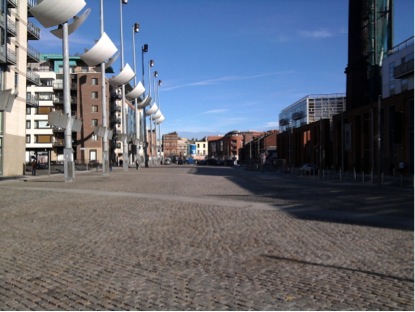
The Smithfield square in 2009. All pictures in this post come courtesy of the author, who holds the rights.

The Smithfield Square in 2009
In 2009 the Smithfield Square, which is laid with thousands of cobblestones, had placed around one side twelve 26.5 metre gas lighting masts, at one end of the square two lines of trees were planted with seating placed among them, and at the other end some large concrete plant pots. The seating located within the trees, attracted groups of homeless people and addicts. As a result, the dominant soundscape during the day was the sounds of men and women shouting obscenities at each other, with the susurration of trees rarely heard over this dominant sound. One of my teenage participants noted, “you always hear people screaming in the background” (Participant 2).

The Smithfield square in 2009
Aside from the shouting voices and loud reflections from singular sound sources within the Square such as the clatter of suitcase wheels across the cobblestones, seagulls screeching overhead, the beeping of trucks reversing and even the sounds of people talking at a distance, the teenagers who participated in the soundwalks defined the space as silent. Their use of the word silent did not mean the absence of sound, but rather an absence of activities, life, general sounds of community, consumption and production.
One sound that dominates the soundscape of Smithfield and its surroundings is the sound of the Luas tramline. The Luas line sits at one end of the Square and the sounds produced are distinctive: there is the whoosh as it passes, the ding a ling of its bells and the sounds of the doors opening and closing. The sound of the Luas echoes around the area from 6 in the morning till midnight. The sounds have become synonymous with that part of the city. The teenage participants defined these sounds as rhythmic, musical, “like a ballet.” For the teenager participants, the sounds of the Luas has been the only constant sound within Smithfield.

Public housing areas surrounding Smithfield
The sounds of children and teenagers were absent, even with the vast housing areas that surround Smithfield Square—some dating back to the 1940s. Within five minutes of the square are two primary schools and one all-boy’s secondary school. During the day, I would hear the children playing in the school grounds, and in flat complexes close to the Smithfield Square. Each of these spaces were gated and enclosed. Most of the teenage participants lived within such housing areas, and would often refer to the level of noise made by the children within their immediate housing areas. Yet, none of the teenagers, and no young children, used the Smithfield Square for “hanging out” or playing.

A primary school in Smithfield. The play area is on the school roof
The teenagers argued that the Smithfield Square had no point; it was too wide open and too quiet.
Group 11b: Although, there probably was sound for somebody who listened to it but because we were all coming down from the city, the space seemed to be nothing… it just seemed real quiet, empty.
Because of that, the teenagers felt they could not group together to chat. For them, it would be like situating themselves in the middle of a stage. Their sounds were amplified or reverberated, ironically creating a feeling of being surveilled. They felt more comfortable and safer in confined areas, such as street corners, laneways, and the archways of large buildings. Within these smaller spaces, the sounds produced have closer reflections. Teenagers often surround themselves with sounds by shouting, playing music, etc., creating what Barry Blesser and Linda-Ruth Salter in Spaces Speak, Are You Listening? (2009) call a sonic bubble. These “territorial bubbles appear as if by magic around a group of individuals if they begin to interact, and the group quickly acquires rights to the arena” (2009:34) thus creating a temporal space. They did not feel they could do so in such an open area.
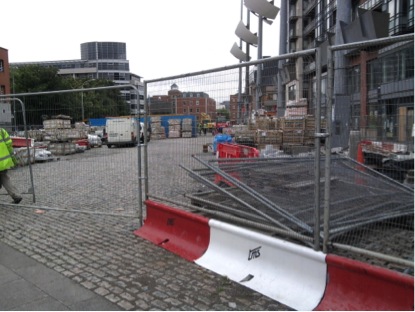
Smithfield Square by the summer of 2010

The Smithfield Square in 2011
Because of the poor planning and design of the Smithfield area, there are vast empty spaces surrounded by fencing or construction hoarding, numerous derelict buildings, and closed-down shops and restaurants. The Smithfield Square is no different, with numerous buildings left empty as a result of foreclosures or bankruptcy. The silence in this space is indicative of the loss of the social and economic processes. The vast square then takes on another level of silence, the loss of productive meaning, the presence of poverty, homelessness and unemployment.
On one walk with the teenagers I noted that they would group together in the square, even when they were told to walk around and record sounds within the space independently. Later, they said there were no sounds to record, so they just walked towards the closest sound source, a small shopping market in the square. I had noted numerous individual sounds, but they would have required standing in the middle of the square to record them. During focus group sessions after the soundwalks, the teenagers defined positive soundscapes as places with numerous loud sounds, the voices of hundreds within busy shopping streets, music coming from stores and traffic in the distance. These sounds defined a city, and made the teenagers feel safe and enclosed. Smithfield contained none of these kinds of sounds.
Soundwalking the Smithfield Horse Fair

Displaying horse carriages
There are a few events held regularly within the square since it re-opened in 2013. Some of these events are part of the Dublin City Council’s efforts to invigorate the space, such as food and art markets, as well as fairs for various seasons and holidays. One of the few public events that take place in Smithfield Square is the Smithfield Horse Fair, which happens on the first Sunday of every month. Having walked through this space repeatedly over a period of 3 years, it was only when I attended the horse fair that the space came alive, it had a purpose.
The horse fair has been a contentious event for both locals and city managers for the past two decades, with the horse dealers arguing that there is either a historical precedence for the horse fair or with the Dublin city councillors arguing that the land was historically used for the selling of cattle for market. The appearance within the Smithfield Square once a month of the horse fair brings with it a vast and lively, and sometimes, as defined by the media and Dublin City Council, a threatening soundscape/environment.
Some sounds defined as threatening are the loud whinnying of horses as they are jostled around the fair. The media has also reported, on several occasions, large-scale fights, which have broken out during the fair, leading to the presence of riot police. This eventually led to the gating of the fair and an extreme police presence as if these measures might reduce such sounds through the threat of arrest. For those living in the new apartment complexes, the sounds produced at the fair are amplified because of the design of the space, and possibly sound more threatening as a result.
During one walk of the Smithfield horse fair that I did in April 2013, some of the audible sounds were horses neighing and whinnying in panic, horse shoes on the cobblestones, traders shouting out their wares of horse paraphernalia, seats, stirrups etc., the voices of old men, which was the dominant background sound, and the sounds of traditional Irish music.
Outside of the gated fair were the sounds of large groups of teenagers, shouting and calling to each other. The space was alive with sound; the voices of teenagers merged with, or were lost within, the chaos of other sounds, becoming part of a larger soundscape. Because the space was busy with people, activities, music and even security there was a reason to use the square, even if you were not actively taking part in the event. The fair created a space for teenagers to engage with, and perhaps feel safe within the boundaries of its soundscape. Suddenly the square was as busy and as loud as the city centre.

Security at the horse fair
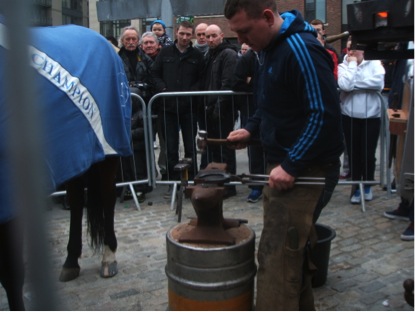
Smith hammering horse shoes at the horse fair
While walking through this soundscape, I encountered different kinds of soundmarks. For example, the banging of horseshoes was quite distinctive because it is, as Schafer would define, an archetypal sound, one that no longer belongs in the city. It felt like hearing a sound from the past. Yet this kind of sound creates a kind of historic continuity with the past (Barry Truax, Acoustic Communication, 2000). When discussing the cobblestones within Smithfield Square, most of the young female participants stated that it was not so much the look of the cobblestones that gave the space a sense of history but rather the sounds made when something moved over them. The lack of people and activities within the square meant that these sounds were rarely activated. The soundscape of the fair on those days transformed Smithfield, lifting it out of its everyday silences, which seemed to invite young people to participate. It was reactivated with life.
What was noticeable about the two fairs I visited was that by the second event in 2013, there were far fewer horses than at previous fairs. There were about 8 or 10 horses being paraded around the space by what looked like homeless people or addicts. There seemed to be no real horse-trading; the soundscape lacked the sounds of horses. Instead, the space had become a gathering space, with groups of tourists wandering around taking pictures of anything and everything.

Teenage boys outside the gates of the horse fair 2013

Teenage girls at the fair
Conclusion
This fair does not fit within the cultural ethos of regenerated urban spaces like Smithfield, where culture is defined as a consumerist process or part of the arts. However, the space takes on new potentialities as a result of the presence of people, sounds and activities, allowing the teenagers to view the possibilities of spatial use. Sounds can distinguish a space, as identified during the Smithfield horse fair. These sounds also remove focus from teenagers’ voices audible within the space, and transfer it to other sounds. The space was no longer a large fishbowl viewable from any angle; instead it had become a busy vibrant immersive soundscape.
—
Featured Image: “Smithfield Horse Fair, Dublin” by Flickr user Admanchester, CC BY-NC-ND 2.0
—
Linda O Keeffe is secretary to the Irish Sound Science and Technology Association and editor of the Interference Journal. Her practice is concerned with an exploration, both academic and creative, of the ways in which sound alters our experience of different spaces. Her art training was within the sculpture department of IADT under the tutelage of Finola Jones. She completed a Masters in Virtual Reality in NCAD with Kevin Atherton, and just finished a PhD in sociology in NUIM. Her research examined the urban of Dublin city soundscape as socially and technologically co-constructed. She has composed for dance, theatre, quartets, and new instrument performers, installed sound installations for commissions in Ireland, China and Holland, and has had radio works performed both nationally and internationally. In 2008 she was mentored under Eric Leonardson in Chicago, a sound artist and performer. More recently, she was commissioned by Resonance FM to create a work for radio for the 2013 Derry city of culture event. Current projects include a solo exhibition in November 2014 for the Limerick Sculpture Centre, which will be a creative realization of her PhD research. You can find her at www.lindaokeeffe.com.
—
 REWIND!…If you liked this post, you may also dig:
“Heard Any Good Games Lately?: Listening to the Sportscape”-Kaj Ahlsved
“Park Sounds: A Kansas City Soundwalk for Fall”-Liana Silva-Ford
“Sounding Out! Podcast Episode #7: Celebrate World Listening Day with the World Listening Project”
Share this:


Current Top Posts





April 2021

January 2020

November 2019

October 2019

August 2019

April 2014

November 2017

March 2015

December 2017

October 2015
 Sounding Out!
Recent Comments