
Future Memory: Womb Sound As Shared Experience Crossing Time and Space
This Month will feature a two-part post by SO! regular writer Maile Colbert. Look for Part Two on Monday, January 19th.
—
I was a child obsessed with time travel. Beyond favorites such as A Wrinkle in Time and Time Bandits, I perpetually daydreamed of the ability to pause, reverse, and fast-forward my life. I had a book on the “olden days” and it amazed me that my great-grandparents, whom I had the fortune to know, had lived them. I wanted to fast forward and see myself their current age, telling stories to the next generations of a good life lived. I used to entertain the thought that if I let my breath go and let myself sink to the bottom of a body of water, I could pause time, or at least slow it down, as the sound of the fluid world around me seemed to suggest. Whenever my family moved, I made a time capsule, and I always scanned the ocean for long lost bottled messages. These were the beginnings of my future in time-based media–both image and sound–my love for found footage, and my recent research and writing on sound back in time.
Now as a new mother, I am beginning to think about the future in a way I hadn’t before. I see my mother in my daughter, and I see her mother, and my partner’s mother. I recognize my grandfather’s eyebrow when furrowed, and her grandfather’s nose. My mouth when smiling, my partner’s mouth when in concentration.
And our ears. . .our very sensitive hearing, almost like a punch line. Our daughter is truly the daughter of sound artists. In this first post of a two part series on humans’ earliest interactions with sound, I document our work sounding and listening together, which began in a future-oriented past I am still learning about.
Womb
There was a study in which doctors gave babies only a day old pacifiers connected to tape recorders. Depending on the pattern of the new babies suck, the tape recorder would either switch on the sound of the mother’s voice, or a stranger’s.
“Within 10 to 20 minutes, the babies learned to adjust their sucking rate on the pacifier to turn on their own mother’s voice,” says the study’s coauthor William Fifer, Ph.D., an associate professor of psychiatry and pediatrics at Columbia University’s College of Physicians and Surgeons. “This not only points out a newborn’s innate love for his mother’s voice but also a baby’s unique ability to learn quickly.”
– “What Babies Learn in the Womb,” 2014, Lara Flynn Maccarthy, Parenting
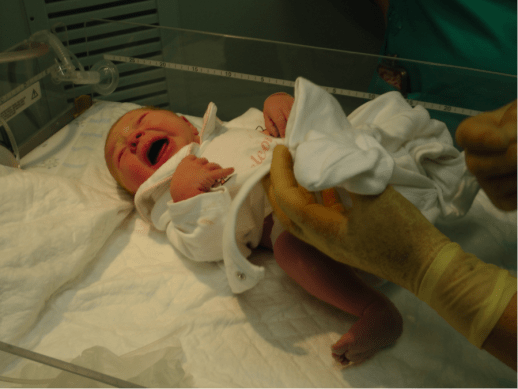
My daughter Odette knew my voice the moment she was born. In a strange, bright, cold new world, it seemed one constant she could rely upon. When she was first placed upon my chest, I started to sing to her, and she was calming, staring at me, as much as her newborn eyes would let her, with an expression of surprised recognition, as this familiar voice sang a familiar song, one I sang her often in the womb. One I knew by heart because my mother would sing it to me when I was a child.
Are you going to Scarborough Fair
Parsley, sage, rosemary and thyme
Remember me to the one who lives there
She once was a true love of mine. . .
The mother’s voice comes to the fetus not solely as ambient sound through the abdomen, as other external sounds and voices would, but also through the vocal cords’ internal vibration. There is a direct connection, a shared space. As early as the seventh month, a fetal heartbeat will slow and calm to the sound of the mother’s voice, and research has shown newborns even prefer a similar version of their mother’s voice to what they heard in the womb, muffled and low. When Odette suffered colic in her early months, one sure way to help comfort her was to sing to her while she was on my chest. Aside from the close contact of skin, the familiar smell, the warmth, it could be that hearing my voice also through the chest mimicked the womb filter.
In the tape recorder study, researchers also noted that newborns would suck more intensely to recordings of people speaking in the language of their mothers, most likely picking up on the melody and rhythm. We are beginning to understand that learning starts in the womb.
Fetal Soap Addiction
Carmen Bank found her 1985 pregnancy rather boring. So, to pass the time, she started doing something she would never have dreamed of: watching a soap opera.
Unexpectedly, she found herself hooked. And so she spent almost every morning in front of her television set, ready for the familiar theme of “Ryan’s Hope.” After Melissa was born that October, Bank bought a videocassette recorder so she could tape the show when she was too busy to watch.
Bank isn’t sure when she discovered the behavior, but, shortly after Melissa was born, Bank realized that the baby seemed to recognize the “Ryan’s Hope” theme and would stop fussing when the program began.
“She’d just sit there and watch the whole introduction and then she would start imitating what they do on the show,” Bank said. “This has been going on forever.”
-The Very Young and Restless, Do Soaps Hook the Unborn? June 28, 1988, Allan Parachini, The New York Times
My third trimester was a rough one. I was a walking swimming pool of about forty pounds of baby and amniotic fluid. My pelvis had gone completely out of line, making even that pregnancy waddle slow and difficult. Needless to say, I was less and less mobile. I was lucky that much of my remaining work was writing and studio based, but often found myself having to take mental breaks as well. My body/mind chemistry was working overtime. Something that happens with pregnancy when preparing mentally for your new, shared life is to think a lot about your own childhood. I was lucky to have a happy one, and so strong nostalgic feelings and memories would come up, particularly around the television show Dr. Who. I used to spend a happy hour with my father once a week watching reruns from the 70’s in the 80’s.
Dr. Who returned to broadcast in the 2000s, in a few new successful regenerations. The new iteration uses a lot of the classic themes, characters, and even remixes and re-masters the the original opening score written by Ron Grainer and realized by the great Delia Derbyshire for the BBC Radiophonic Workshop in 1963; the Dr. Who theme was one of the very first signature electronic music tunes, and performed well before commercial synthesizers were even available. Derbyshire used musique concrete techniques, cutting each note individually on analogue tape, speeding up and slowing down to create the notes from recordings of a single plucked string, white noise, and the simple harmonic waveforms of test-tone oscillators. (Grainer was famous for asking after hearing Derbyshire’s magic, “Did I write that?”. Derbyshire replied “Most of it.” The BBC, who kept members of the Radiophonic Workshop anonymous, prevented Grainer from giving Derbyshire a co-composer credit and a share of the royalties.)
It is a really, really catchy tune:
While Odette was in the womb, I watched all of those decades addictively, one after another. When I came across the soap opera study after she was born, I decided my obsessive Who-watching had set up a perfect laboratory to try it out myself. We started in 1963 and moved through time with the Doctor. Odette looked up in surprise and her brow furrowed in concentration. She looked around slowly at first, then faster and faster. She smiled; she cooed; she laughed. She started to flap her arms.
.
When I finally turned it off, she stopped everything and looked concerned. I turned it on again and we danced together in clear recognition of this already-shared future past sonic moment, one I had with my father and now with her. Now I understood that as I consumed Dr. Who, Odette was not only hearing, she was learning, and beginning the act of listening.
Sounds have a surprising impact upon the fetal heart rate: a five second stimulus can cause changes in heart rate and movement which last up to an hour. Some musical sounds can cause changes in metabolism. “Brahm’s Lullaby,” for example, played six times a day for five minutes in a premature baby nursery produced faster weight gain than voice sounds played on the same schedule (Chapman, 1975)
-The Fetal Sense, A Classical View, David B. Chamberlain, Birth Psychology
Wombscapes
Odette’s very first movements, her first “quickening”, was in response to David Bowie’s “Starman”. This was around 16 weeks, often the time for first movements in the fetus, and interestingly also the time when the hearing has developed. The fetus floats in a rich and complex soundscape; it is anything but quiet. The womb filter…amniotic fluid, embryonic membranes, uterus, the maternal abdomen-low frequencies, and blood in veins whooshing, then Mother’s voice and body noises such as hiccups and the gurgles of digestion and of course, the heartbeat. The Mother’s heartbeat can be as loud as a vacuum cleaner and ultra sounds as loud as a subway car arriving in a train station.We can try to mimic the womb-scape, imagining sounds being filtered through the body. We can use a hydrophone–a pressure microphone designed to be sensitive to soundwaves through fluid matter–on the abdomen to get an idea and sample for our womb-scape.
Perhaps it would sound something like this…
…reactive listening begins eight weeks before the ear is structurally complete at about 24 weeks. These findings indicate the complexity of hearing, lending support to the idea that receptive hearing begins with the skin and skeletal framework, skin being a multireceptor organ integrating input from vibrations, thermo receptors, and pain receptors. This primal listening system is then amplified with vestibular and cochlear information as it becomes available. With responsive listening proven at 16 weeks, hearing is clearly a major information channel operating for about 24 weeks before birth.
-The Fetal Sense, A classical view
Sound artist and Acoustic Ecologist Andrea Williams has been recently working on a composition for Bellybuds, for her yet born nephew. Bellybuds are “a specialized speaker system that gently adheres to your belly & safely plays memory-shaping sound directly to the womb.” Much of her work is composed with space in mind, using room sounds in a live performance situation. Williams told me it was interesting thinking about the womb as a new “venue,” with her little developing nephew as her audience. “What is he hearing?” she asked, “will he recognize me right away upon meeting him for the first time if he only hears the sound of my voice through the Bellybuds while he is a fetus?” I love the idea that she could send a “hello” from one place to her nephew in the womb in another.
The more we understand and realize about fetal hearing and processing sound, the more we understand how fetuses can detect subtle changes and process complex information. Memory starts to form around 30 weeks, and it’s possible early sound interventions at this time could help babies with detected abnormal development. Speaking and singing to the unborn fetus, allowing them to experience different soundscapes while still in the womb, helps shape their brains. This is probably why the urge to do so is there.
. . .Odette’s first dance. Odette’s first songs. . . transcending time and space.
—
dedicated to Odette Helen, and to the family, daughter, and memory of Steven Miller
—
Featured Image: Odette’s Birth Cry, photo credit Rui Costa
The album Future Memory, for Odette will be released in 2015 through Wild Silence. A dedication album to a newborn daughter…a mix of her parents’ recorded and shared sounds, memories, hopes, and dreams towards a future with her. Sounds of her womb-scape, birth, and first year…music in collaboration with friends and family across oceans and land…an album of lullabies for Odette.
—
Maile Colbert is a multi-media artist with a concentration on sound and video who relocated from Los Angeles, US to Lisbon, Portugal. She is a regular writer for Sounding Out!
—
 REWIND! . . .If you liked this post, you may also dig:
On Sound and Pleasure: Meditations on the Human Voice– Yvon Bonenfant
This Is Your Body on the Velvet Underground– Jacob Smith
Sound Designing Motherhood: Irene Lusztig & Maile Colbert Open The Motherhood Archives– Maile Colbert
Share this:

Sound at SEM 2014

Hot on the heels of the American Musicological Society and Society for Music Theory’s joint annual meeting in Milwaukee, the Society for Ethnomusicology will hold its 59th Annual Meeting in Pittsburgh, November 13-16, 2014, hosted by the University of Pittsburgh. SEM is arguably one of the conferences most hospitable to sound studies, and several panels feature strong papers.
On Wednesday, Nov. 12, the “Music and Labor” pre-conference symposium features some fascinating papers of interest to sound scholars and includes a keynote address by Dr. Marcus Rediker, Distinguished Professor of Atlantic History at the University of Pittsburgh. With panels titled “(Re) Conceptualizing Music and Labor,” “The Labor of Music in Transitioning Economies,” “Art as Work: Defying Capitalist Hegemony and National Narrative through Musical Activism and Creative Adaptation,” and “Transformation of Music Labor Regimes in Socialist and Post-Socialist Southeastern Europe,” even the papers that aren’t especially sound studies-related have the potential to demonstrate deft interdisciplinary approaches that would be applicable (and fruitful) in sound studies research.
One of the first sound studies events of the conference program is the annual meeting of the Sound Studies Special Interest Group. Dr. Allen Roda, Jane and Morgan Whitney Research Fellow at the Metropolitan Museum of Art in New York City, and I are currently co-chairs of the SIG; anyone interested in sound studies will not want to miss our meeting on Thursday, November 13 at 12:30-1:30 PM in the Duquesne Room. This year’s meeting will mark the SIG’s 6th anniversary since it was formed in 2009. The group now has over 100 members and is represented on several panels at the 2014 conference in Pittsburgh. One co-chair seat will become vacant this year, and the group will hold elections to fill this position at the meeting; we also plan to discuss plans for more visibility online and among the academic community.
Before the meeting, come early to the 8:00-10:30 AM session in that same room to catch Molly McBride’s paper, “The Sounds of Humor: Listening to Gender in Early Barn Dance Radio,” or see a whole sound studies panel titled “Auditory Histories of the Indian Ocean: Hearing the Soundworlds of the Past” in the Alleghany Room.
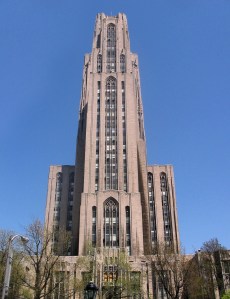
“The Cathedral of Learning at UPitt” by Flickr user Carlos Hernandez, CC BY-NC-SA 2.0
If you can’t make those early panels on the first day, the convention boasts numerous, high-quality sound studies sessions, many of which convene simultaneously. There have been several sound studies-related panels and individual papers at past meetings, but the number of high-quality papers is certainly trending in favor of more sound studies.
Also, the last several annual meetings have featured a soundwalk hosted by the Sound Studies SIG. This year is no different; however, rather than having a guided walk around the host city, this year’s soundwalk will be self-guided. Using the Twitter hashtag #semsoundwalk, participants will listen to Pittsburgh, the acoustic environment of the conference itself, the coffee shop where they stop for refreshment, or wherever they happen to find themselves between 1:15 – 6:00PM on Friday, Nov. 14. Be sure to follow the hashtag – even if you’re not in Pittsburgh – to “listen” along with conference participants.
I am delighted to see that this year’s conference unites the SEM’s commitment to the study of world musics and cultures and sound studies, particularly in panels such as “Auditory Histories of the Indian Ocean: Hearing the Soundworlds of the Past,” “Contemplating Voice in Cross-Cultural Perspective,” and “Regulating Space, Regulating Sound: Musical Practice and Institutional Mediation in São Paulo, Brazil.” This year also highlights the SEM’s strong interdisciplinary bent and makes even more room at the epistemological table for the examination of technoculture and its implications for sound studies and the larger ethnomusicological community.
Because of the sheer volume of sound studies activities, rather than listing my “picks” for the conference, I’ve listed most of the relevant papers and sessions, leaving the hard decision up to you. In fact, there are so many genuine sound studies panels and papers (or papers on closely related topics) its easy to see why the blurry line that demarcates “sound studies” from “music studies” seems blurriest at SEM. For those who cannot attend the conference, some of this year’s panels will be live-streamed. The Special Interest Groups for Sound Studies and Ecomusicology are also co-hosting a roundtable on Saturday morning. For more information about the conference and to catch the live-streamed sessions, visit the conference website at http://www.indiana.edu/~semhome/2014/.
—
Michael Austin is Assistant Professor of Media, Journalism, and Film and coordinator of the Interdisciplinary Studies Program in the School of Communications at Howard University where he teaches courses in music production, sound design for film and audio production. He holds a Ph.D. in Humanities – Aesthetic Studies (with a specialization in Arts and Technology) from the University of Texas at Dallas and music degrees from UT-San Antonio and UT-Austin. He is also affiliated with the Laboratoire Musique et Informatique de Marseille, an audio/music technology and informatics lab in Marseille, France, and is co-chair of the Society for Ethnomusiciology’s Special Interest Group for Sound Studies.
—
Featured image: “Musician” by Flickr user Joanna, CC BY-NC 2.0
—

“Cathedral of learning/Stephen Foster Memorial – Painted by Light” by Flickr user Sriram Bala, CC BY-NC 2.0
WEDNESDAY, November 12
8:00 am – 8:00 pm
Ballroom 3, Wyndham Grand Pittsburgh Downtown Hotel
Pre-Conference Symposium: “Music and Labor”
THURSDAY, November 13
8:30 – 10:30 am
Duquesne Room
“The Sounds of Humor: Listening to Gender on Early Barn Dance Radio,” Molly McBride, Memorial University of Newfoundland
Alleghany Room
Session: Auditory Histories of the Indian Ocean: Hearing the Soundworlds of the Past
“Wonders and Strange Things: Practices of Auditory History before Recorded Sound,” Katherine Butler Schofield, King’s College London
“Notes in the Margins: Sumatran Religious Hybridity and the Efficacy of Sound, “ Julia Byl, King’s College London
“Contact, Contestation and Compromise: Sound and Space in 19th-Century Singapore,” Jenny McCallum, King’s College London
“A ‘Wayang of the Orang Puteh’?: Theatres, Music Halls and Audiences in High-Imperial, Calcutta, Madras, Penang and Singapore,” David Lunn, King’s College London
10:45am -12:15 pm
Sterling 3 Room
“Sounding Neoliberalism in the Richmond City Jail,” Andrew C. McGraw, University of Richmond
Heinz Room
“The Color of Sound: Timbre in Ralph Ellison’s Invisible Man,” Sydney A. Boyd, Rice University
12:30 – 1:30 pm
Duquesne Room
Special Interest Group for Sound Studies
1:45 – 3:45 pm
Sterlings 1 Room
“Radio Archives and the Art of Persuasion: Preserving Social Hierarchies in the Airwaves of Lima” Carlos Odria, Florida State University
Ft. Pitt Room
Session: Mediated Musics, Mediated Lives
“Uploading Matepe: The Role of Online Learning Communities and the Desire to Connect to Northeastern Zimbabwe,” Jocelyn A. Moon, University of Washington; Zachary Moon, Independent Scholar
“Staging Overcoming: Disability, Meritocracy, and the Envoicing of Dreams,” William Cheng, Dartmouth University
“As Time Goes By: Car Radio and Spatiotemporal Manipulations of the Travel Experience in 20th-Century America,” Sarah Messbauer, University of California, Davis
“’How Can We Live in a Country Like This?’ Music, Talk Radio, and Moral Anxiety,” Karl Haas, Boston University
Sterling 3 Room
Session: Oxide and Memory: Tape Culture and the Communal Archive
Oxide and Memory: Tape Culture and the Communal Archive
“Magnetic Tape, Materiality, and the Interpretation of Non-Commercial Cassette and Reel-to-Reel Recordings from Quebec’s Gaspé Peninsula,” Laura Risk, McGill University
“Family Sense and Family Sound: Home Recordings and Greek-American Identity,” Panayotis League, Harvard University
“The Memory of Media: Autoarchivization and Empowerment in 1970s Jazz,” Michael C. Heller, University of Massachusetts, Boston
“Reimagining the Community Sound Archive: Cultural Memory and the Case for ‘Slow’ Archiving in a Gaspesian Village,” Glenn Patterson, Memorial University of Newfoundland
4:00 – 5:30 pm
Sterlings 1 Room
Panel: Contemplating Voice in Cross-Cultural Perspective
“The Gravest of Female Voices: Women and the Alto in Sacred Harp,” Sarah E. Kahre, Florida State University
“Re-sounding Waljinah: Aging and the Voice in Indonesia,” Russ P. Skelchy, University of California, Riverside
“Katajjaq: Between Vocal Games, Place and Identity,” Raj S. Singh, York University
Sterlings 3 Room
Session: Rumors, Sound Leakages and Individual Tales: Disruptive Listening in Zones of Conflict
“From the Struggle for Citizenship to the Fragmentation of Justice: Reflections on the Place of Dinka Songs in South Sudan’s Transitional Justice Process,” Angela Impey, School of Oriental and African Studies (SOAS), University of London
“Internet Rumors and the Changing Sounds of Uyghur Religiosity: The Case of the Snake Monkey Woman,” Rachel Harris, School of Oriental and African Studies (SOAS), University of London
“The Cantor and the Muezzin’s Duet at the Western Wall: Contesting Sound Spaces on the Frayed Seams of the Israel-Palestine Conflict,” Abigail Wood, University of Haifa
Heinz Room
Session: Historiography, Historicity, and Biography
“A Sonic Historiography of Early Sample-Based Hip-Hop Recordings,” Patrick Rivers, University of New Haven
“Biography as Methodology in the Study of Okinawan Folk Song,” Kirk A. King, University of British Columbia
“Sounding the Silent Image: Uilleann Piper as Ethnographic Object in Early Hollywood Film,” Ivan Goff, New York University
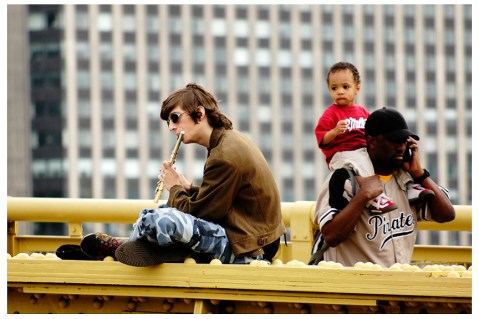
Untitled by Flickr user David Kent, CC BY-NC-ND 2.0
FRIDAY, November 14
7:00 – 8:00 am
Special Interest Group for Voice Studies
8:30 – 10:30 am
Commonwealth 1-2 Room, live streaming
Session: Sound Networks: Socio-Political Identity, Engagement, and Mobilization through Music in Cyberspace and Independent Media
*Sponsored by the Popular Music Section and Special Interest Group for Sound Studies
“Technological Factors Conditioning the Socio-Political Power of Music in Cyberspace,” Michael Frishkopf, University of Alberta
“Cyber-Mobilization, Informational Intimacy, and Musical Frames in Ukraine’s EuroMaidan Protests,” Adriana Helbig, University of Pittsburgh
“Countering Spirals of Silence: Protest Music and the Anonymity of Cyberspace in the Japanese Antinuclear Movement,” Noriko Manabe, Princeton University
“Living (and Dying) the Rock and Roll Dream: Alternative Media and the Politics of ‘Making It’ as an Iranian Underground Musician,” Farzaneh Hemmasi, University of Toronto
Sterling 1 Room
Session: Affective Environments and the Bioregional Soundscape
*Sponsored by the Special Interest Group for Ecomusicology
“’Landscape is Not Just What Your Eyes See’: Battery Radio, the Technological Soundscape, and Sonically Knowing the Battery, Kate Galloway, Memorial University of Newfoundland
“Re-sounding Caribou: Musical Posthumanism in Being Caribou,” Erin Scheffer, University of Toronto
“Cold, Crisp, and Dry: Inuit and Southern Concepts of the Northern Soundscape,” Jeffrey van den Scott, Northwestern University
Discussant, Nancy Guy, University of California, San Diego
Duquesne Room
“The Sound of Affective Fact,” Matthew Sumera, University of Minnesota
1:15 – 6:30 pm
Soundwalk: A Sonic Environmental Survey of the SEM Annual Meeting
*Sponsored by the Special Interest Groups for Sound Studies and Ecomusicology. Follow the walk on Twitter: #semsoundwalk
(Meet in Wyndham Grand main lobby at 1:15pm. Reconvene in lobby at 6:00)
1:45 – 3:45 pm
Smithfield Room
Session: Strident Voices: Material and Political Alignments
*Sponsored by the Special Interest Group for Voice Studies
“Registering Protest: Voice, Precarity, and Assertion in Crisis Portugal,”Lila Ellen Gray, University of Amsterdam
“Quiet, Racialized Vocality at Fisk University,” Marti Newland, Columbia University
“’The Rough Voice of Tenderness’: Chavela Vargas and Mexican Song,” Kelley Tatro, North Central College
Discussant: Amanda Weidman, Bryn Mawr College
4:00 – 5:30 pm
Heinz Room
Session: Celebratory Sounds and the Politics of Engagement
“Creating Zakopower in Postsocialist Poland,” Louise J. Wrazen, York University
“Merry-Making and Loyalty to the Movement: Conviviality as a Core Parameter of Traditionalism in Aysén, Chile,” Gregory J. Robinson, George Mason University
“Sounding the Carnivalesque: Changing Identities for a Sonic Icon of the Popular,” Michael S. O’Brien, College of Charleston

“Musical Mystery” by Flickr user Robert Wilhoit, CC BY-NC-SA 2.0
SATURDAY, November 15
8:30 – 10:30 am
Sterlings 1 Room
Roundtable: Sound Studies, Ecomusicology, and Post-Humanism In/For/With Ethnomusicology
*Sponsored by the Special Interests Groups for Ecomusicology and for Sound Studies
P. Allen Roda, The Metropolitan Museum of Art
Jennifer Post, University of Arizona
Mark Pedelty, University of Minnesota
Michael Silvers, University of Illinois at Urbana-Champaign
Ben Tausig, Stony Brook University
Zeynep Bulut, King’s College London
10:45 am – 12:15 pm
Benedum Room, live streaming
Musical Instruments, Material Cultures, and Sound Ecologies
“Bulgarian Acoustemological Tales: Narrativity, Agrarian Ecology, and the Kaval’s Voice,” Donna A. Buchanan, University of Illinois at Urbana-Champaign
Sterling 1 Room
Session: Theorizing Sound
“Water Sounds: Distance Swimmers and Ecomusicology,” Niko Higgins, Columbia University
“Telephone, Vacuum Cleaner, Couch: Senses and Sounds of the Everyday in Postwar Japan,” Miki Kaneda, Boston University
Discussant: Benjamin Tausig, Stony Brook University
SUNDAY, November 16
8:30 – 10:30 am
Birmingham Room
Session: Regulating Space, Regulating Sound: Musical Practice and Institutional Mediation in São Paulo, Brazil
*Sponsored by the Latin American and Caribbean Section
“Music under Control? São Paulo’s Anti-Noise Agency in Action,” Leonardo Cardoso, University of Texas at Austin
“Music Producers in São Paulo’s Cultural Policy Worlds,” Daniel Gough, University of Chicago
“’Small Universes’: The Creation of Social Intimacy through Aesthetic Infrastructures in São Paulo’s Underground,” Shannon Garland, Columbia University
Discussant, Morgan Lurker, Reed College
Heinz Room
“Hear What You Want: Sonic Politics, Blackness, and Racism-Canceling Headphones,” Alex Blue, University of California, Santa Barbara
Alleghany Room
“Sound and Silence in Festivals of the French Revolution: Sonic Analysis in History,” Rebecca D. Geoffroy-Schwinden, Duke University
10:45 am – 12:15 pm
Liberty Room
Session: Sounding Nations
“Building the Future through the Past: The Revival Movement in Iranian Classical Music and the Reconstruction of National Identity in the 1960s and the 1970s,” Hadi Milanloo, Memorial University of Newfoundland
“Sounding Citizenship in Southern Africa: Malawian Musicians and the Social Worlds of Recording Studios and Music Education Centers,” Richard M. Deja, University of Illinois
“Unity in (Spite of) Diversity: Tensions and Contradictions in Performing Surinamese National Identity,” Corinna S. Campbell, Williams College

“Music” by Flickr user Rich McPeek, CC BY-NC 2.0
Share this:


Current Top Posts





April 2021

January 2020

November 2019

October 2019

August 2019

April 2014

November 2017

March 2015

December 2017

October 2015
 Sounding Out!
Recent Comments