
Going Hard: Bassweight, Sonic Warfare, & the “Brostep” Aesthetic


[Editor’s Note 01/24/14 10:00 am: this post has been corrected. In response to a critique from DJ Rupture, the author has apologized for an initial misquoting of an article by Julianne Escobedo Shepherd, and edited the phrase in question. Please see Comments section for discussion]
Time to ring the bell: this year, Sounding Out! is opening a brand-new stream of content to run on Thursdays. Every few weeks, we’ll be bringing in a new Guest Editor to curate a series of posts on a particular theme that opens up new ground in areas of thought and practice where sound meets media. Most of our writers and editors will be new to the site, and many will be joining us from the ranks of the Sound Studies and Radio Studies Scholarly Interest Groups at the Society for Cinema and Media Studies, as well as from the Sound Studies Caucus from the American Studies Association. I’m overjoyed to come on board as SCMS/ASA Editor to help curate this material, working with my good friends here at SO!
For our first Guest series, let me welcome Justin Burton, Assistant Professor of Music at Rider University, where he teaches in the Popular Music and Culture program. Justin also serves on the executive committee of the International Association for the Study of Popular Music-US Branch. We’re honored to have Justin help us launch this new stream.
His series? He calls it The Wobble Continuum. Let’s follow him down into the low frequencies to learn more …
Neil Verma
—
Things have gotten wobbly. The cross-rhythms of low-frequency oscillations (LFO) pulsate through dance and pop music, bubbling up and dropping low across the radio dial. At its most extreme, the wobble both rends and sutures, tearing at the rhythmic and melodic fabric of a song at the same time that it holds it together on a structural level. In this three-part series, Mike D’Errico, Christina Giacona, and Justin D Burton listen to the wobble from a number of vantage points, from the user plugged into the Virtual Studio Technology (VST) of a Digital Audio Workstation (DAW) to the sounds of the songs themselves to the listeners awash in bass tremolos. In remixing these components—musician, music, audience—we trace the unlikely material activities of sounds and sounders.
In our first post, Mike will consider the ways a producer working with a VST is not simply inputting commands but is collaborating with an entire culture of maximalism, teasing out an ethics of brostep production outside the usual urge for transcendence. In the second post, Christina will listen to the song “Braves” by a Tribe Called Red (ATCR), which, through its play with racist signifiers, remixes performer and audience, placing ATCR and its listeners in an uncanny relationship. In the final post, Justin will work with Karen Barad’s theory of posthuman performativity to consider how the kind of hypermasculinist and racist signifiers discussed in Mike’s and Christina’s pieces embed themselves in listening bodies that become sounding bodies. In each instance, we wade into the wobble listening for the flow of activity among the entanglement of producer, sound, and listener while also keeping our ears peeled for the cross-rhythms of (hyper)masculinist and racist materials that course through and around the musical phenomena.
So hold on tight. It’s about to drop.
Justin Burton
—
As an electronic dance music DJ and producer, an avid video gamer, a cage fighting connoisseur, and a die-hard Dwayne “The Rock” Johnson fan, I’m no stranger to fist pumps, headshots, and what has become a general cultural sensibility of “hardness” associated with “bro” culture. But what broader affect lies behind this culture? Speaking specifically to recent trends in popular music, Simon Reynolds describes a “digital maximalism,” in which cultural practice involves “a hell of a lot of inputs, in terms of influences and sources, and a hell of a lot of outputs, in terms of density, scale, structural convolution, and sheer majesty” (“Maximal Nation”). We could broaden this concept of maximalism, both (1) to describe a wider variety of contemporary media (from film to video games and mobile media), and (2) to theorize it as a tool for transducing affect between various media, and among various industries within global capitalism. The goal of this essay is to tease out the ways in which maximalist techniques of one kind of digital media production—dubstep—become codified as broader social and political practices. Indeed, the proliferation of maximalism suggests that hypermediation and hypermasculinity have already become dominant aesthetic forms of digital entertainment.
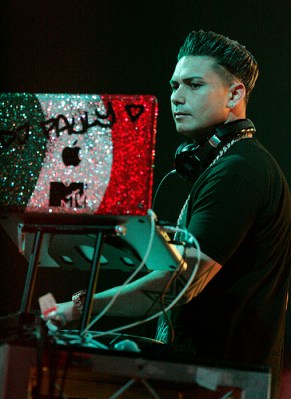
“DJ Pauly D” by Flickr user Eva Rinaldi, CC-BY-SA-2.0
More than any other electronic dance music (EDM) genre, dubstep—and the various hypermasculine cultures in which it has bound itself—has wholeheartedly embraced “digital maximalism” as its core aesthetic form. In recent years, the musical style has emerged as both the dominant idiom within EDM culture, as well as the soundtrack to various hypermasculine forms of entertainment, from sports such as football and professional wrestling to action movies and first-person shooter video games. As a result of the music’s widespread popularity within the specific cultural space of a post-Jersey Shore “bro” culture, the term “brostep” has emerged as an accepted title for the ultra-macho, adrenaline-pumping performances of masculinity that have defined contemporary forms of digital entertainment. This essay posits digital audio production practices in “brostep” as hypermediated forms of masculinity that exist as part of a broader cultural and aesthetic web of media convergence in the digital age.
CONVERGENCE CULTURES
Media theorist Henry Jenkins defines “convergence culture” as “the flow of content across multiple media platforms, the cooperation between multiple media industries, and the migratory behavior of media audiences who will go almost anywhere in search of the kinds of entertainment experiences they want” (Convergence Culture, 2). The most prominent use of “brostep” as a transmedial form comes from video game and movie trailers. From the fast-paced, neo-cyborg and alien action thrillers such as Transformers (2007-present), Cowboys & Aliens (2011), and G.I. Joe (2012), to dystopian first-person shooter video games such as Borderlands (2012), Far Cry 3 (2012), and Call of Duty: Black Ops 2 (2012), modulated oscillator wobbles and bass portamento drops consistently serve as sonic amplifiers of the male action hero at the edge.
Assault rifle barrages are echoed by quick rhythmic bass and percussion chops, while the visceral contact of pistol whips and lobbed grenades marks ruptures in time and space as slow motion frame rates mirror bass “drops” in sonic texture and rhythmic pacing. “Hardness” is the overriding affect here; compressed, gated kick and snare drum samples combine with coagulated, “overproduced” basslines made up of multiple oscillators vibrating at broad frequency ranges, colonizing the soundscape by filling every chasm of the frequency spectrum. The music—and the media forms with which it has become entwined—has served as the affective catalyst and effective backdrop for the emergence of an unabashedly assertive, physically domineering, and adrenaline-addicted “bro” culture.
Film theorist Lorrie Palmer argues for a relational link among gender, technology, and modes of production through hypermasculinity in these types of films and video games. Some definitive features of this convergence of hypermediation and hypermasculinity include an emphasis on “excess and spectacle, the centrality of surface over substance… ADHD cinema… transitory kinetic sensations that decenter spatial legibility… an impact aesthetic, [and] an ear-splitting, frenetic style” (“Cranked Masculinity,” 7). Both Robin James and Steven Shaviro have defined the overall aesthetic of these practices as “post-cinematic”: a regime “centered on computer games” and emphasizing “the logic of control and gamespace, which is the dominant logic of entertainment programming today.” On a sonic level, “brostep” aligns itself with many of these cinematic descriptions. Julianne Escobedo Shepherd describes the style of Borgore, one particular dubstep DJ and producer, as “misogy blow-job beats.” Other commenters have made more obvious semiotic connections between filmic imagery and the music, as Nitsuh Abebe describes brostep basslines as conjuring “obviously cool images like being inside the gleaming metal torso of a planet-sized robot while it punches an even bigger robot.”

“Ultra Music Festival 2013″ by Wikimedia user Vinch, CC-BY-SA-3.0
MASCULINITY AND DIGITAL AUDIO PRODUCTION
While the sound has developed gradually over at least the past decade, the ubiquity of the distinctive mid-range “brostep” wobble bass can fundamentally be attributed to a single instrument. Massive, a software synthesizer developed by the Berlin and Los Angeles-based Native Instruments, combines the precise timbral shaping capabilities of modular synthesizers with the real-time automation capabilities of digital waveform editors. As a VST (Virtual Studio Technology) plug-in, the device exemplifies the inherently transmedial nature of many digital tools, bridging studio techniques between digital audio workstations and analog synthesis, and acting as just one of many control signals within the multi-windowed world of digital audio production. In this way, Massive may be characterized as an intersonic control network in which sounds are controlled and modulated by other sounds through constantly shifting software algorithms. Through analysis of the intersubjective control network of a program such as Massive we are able to hear the convergence of hypermediation and hypermasculinity as aesthetic forms.

“Massive:Electronica” by Flickr user matt.searles, CC-BY-NC-SA-2.0
Media theorist Mara Mills details the notion of technical “scripts” embedded both within technological devices as well as user experiences. According to Mills, scripts are best defined as “the representation of users embedded within technology… Designers do not simply ‘project’ users into [technological devices]; these devices are inscribed with the competencies, tolerances, desires, and psychoacoustics of users” (“Do Signals Have Politics?” 338). In short, electroacoustic objects have politics, and in the case of Massive, the politics of the script are quite conventional and historically familiar. The rhythmic and timbral control network of the software aligns itself with what Tara Rodgers describes as a long history of violent masculinist control logics in electronic music, from DJs “battling” to producers “triggering” a sample with a “controller” or “executing” a programming “command” or typing a “bang” to send a signal” (“Towards a Feminist Historiography of Electronic Music,” 476).
In Massive, the primary control mechanism is the LFO (low frequency oscillator), an infrasonic electronic signal whose primary purpose is to modulate various parameters of a synthesizer tone. Dubstep artists most frequently apply the LFO to a low-pass filter, generating a control algorithm in which an LFO filters and masks specific frequencies at a periodic rate (thus creating a “wobbling” frequency effect), which, in turn, modulates the cutoff frequency of up to three oscillating frequencies at a time (maximizing the “wobble”). When this process is applied to multiple oscillators simultaneously—each operating at disparate levels of the frequency spectrum—the effect is akin to a spectral and spatial form of what Julian Henriques calls “sonic dominance.” Massive allows the user to record “automations” on the rhythm, tempo, and quantization level of the bass wobble, effectively turning the physical gestures initially required to create and modulate synthesizer sounds—such as knob-turning and fader-sliding—into digitally-inscribed algorithms.
SONIC WARFARE AND THE ETHICS OF VIRTUALITY
By positing the logic of digital audio production within a broader network of control mechanisms in digital culture, I am not simply presenting a hermeneutic metaphor. Convergence media has not only shaped the content of various multimedia but has redefined digital form, allowing us to witness a clear—and potentially dangerous—virtual politics of viral capitalism. The emergence of a Military Entertainment Complex (MEC) is the most recent instance of this virtual politics of convergence, as it encompasses broad phenomena including the use of music as torture, the design of video games for military training (and increasing collaboration between military personnel and video game designers in general), and drone warfare. The defining characteristic of this political and virtual space is a desire to simultaneously redefine the limits of the physical body and overcome those very limitations. The MEC, as well as broader digital convergence cultures, has molded this desire into a coherent hegemonic aesthetic form.
Following videogame theorist Jane McGonigal, virtual environments push the individual to “work at the very limits of their ability” in a state of infinite self-transition (Reality is Broken, 24). Yet, automation and modular control networks in the virtual environments of digital audio production continue to encourage the historical masculinist trope of “mastery,” thus further solidifying the connection between music and military technologies sounded in the examples above. In detailing hypermediation and hypermasculinity as dominant aesthetic forms of digital entertainment, it is not my goal to simply reiterate the Adornian nightmare of “rhythm as coercion,” or the more recent Congressional fears over the potential for video games and other media to cause violence. The fact that music and video games in the MEC are simultaneously being used to reinscribe the systemic violence of the Military Industrial Complex, as well as to create virtual and actual communities (DJ culture and the proliferation of online music and gaming communities), pinpoints precisely its hegemonic capabilities.

“Gear porn” by Flickr user Matthew Trentacoste, CC-BY-NC-ND-2.0
In the face of the perennial “mastery” trope, I propose that we must develop a relational ethics of virtuality. While it seems to offer the virtue of a limitless infinity for the autonomous (often male) individual, technological interfaces form the skin of the ethical subject, establishing the boundaries of a body both corporeal and virtual. In the context of digital audio production, then, the producer is not struggling against the technical limitations of the material interface, but rather emerging from the multiple relationships forming at the interface between one’s actual and virtual self and embracing a contingent and liminal identity; to quote philosopher Adriana Cavarero, “a fragile and unmasterable self” (Relating Narratives, 84).
—
Featured Image: Skrillex – Hovefestivalen 2012 by Flickr User NRK P3
—
Mike D’Errico is a PhD student in the UCLA Department of Musicology and a researcher at the Center for Digital Humanities. His research interests and performance activities include hip-hop, electronic dance music, and sound design for software applications. He is currently working on a dissertation that deals with digital audio production across media, from electronic dance music to video games and mobile media. Mike is the web editor and social media manager for the US branch of the International Association for the Study of Popular Music, as well as two UCLA music journals, Echo: a music-centered journal and Ethnomusicology Review.
—
 REWIND! . . .If you liked this post, you may also dig:
Toward a Practical Language for Live Electronic Performance-Primus Luta
Music Meant to Make You Move: Considering the Aural Kinesthetic-Dr. Imani Kai Johnson
Listening to Robots Sing: GarageBand on the iPad-Aaron Trammell
Share this:

Fiddling With Freedom: Solomon Northup’s Musical Trade in 12 Years a Slave

 Editor’s Note: Sound Studies is often accused of being a presentist enterprise, too fascinated with digital technologies and altogether too wed to the history of sound recording. Sounding Out!‘s last forum of 2013, “Sound in the Nineteenth Century,” addresses this critique by showcasing the cutting edge work of three scholars whose diverse, interdisciplinary research is located soundly in the era just before the advent of sound recording: Mary Caton Lingold (Duke), Caitlin Marshall (Berkeley), and Daniel Cavicchi (Rhode Island School of Design). In examining nineteenth century America’s musical practices, listening habits, and auditory desires through SO!‘s digital platform, Lingold, Marshall, and Cavicchi perform the rare task of showcasing how history’s sonics had a striking resonance long past their contemporary vibrations while performing the power of the digital medium as a tool through which to, as Early Modern scholar Bruce R. Smith dubs it, “unair” past auditory phenomena –all the while sharing unique methodologies that neither rely on recording nor bemoan their lack. Today, the series kicks off with Mary Caton Lingold‘s exploration of the materialities of Solomon Northup’s fiddling as represented through sheet music embedded in his 1853 narrative, amplifying a sound that was key to both his freedom and his enslavement.—Jennifer Stoever-Ackerman, Editor-in-Chief
—
Steve McQueen’s recent film Twelve Years a Slave has renewed interest in the original 1853 narrative, which has long been a valued resource for historians of nineteenth-century slavery, literature, and music. Because Solomon Northup was a highly-skilled fiddler and a keen observer of plantation culture, his autobiography is one of the most substantive accounts of musical life during slavery and, to my knowledge, the only slave narrative that includes sheet music in its text. As such, it preserves in audible form a precious record of Northup’s musical artistry and facilitates a sound-based study of nineteenth-century black fiddling, a tradition that was flourishing during Northup’s lifetime.
Uncovering the sounds of vernacular music of the pre-recorded era can be incredibly challenging. For this reason, Northup’s descriptions, when coupled with musical notation, make it possible for us to hear something historically significant. Although “slave music” was all the rage in the 1850s due to the widespread popularity of blackface minstrelsy, print-based compositions by enslaved (or free) musicians are difficult to come by and even more challenging to verify. The tune presented in Northup’s memoir has its own complex relationship to the minstrelsy genre, but it remains a unique sample of African-American music that warrants close-listening.

“Roaring River.” In Twelve Years a Slave: Narrative of Solomon Northup, by Solomon Northup, 322. Auburn, NY: Miller, Orton & Mulligan, 1854. Courtesy of the David M. Rubenstein Rare Book & Manuscript Library, Duke University
I use performance as a research method for exploring historical vernacular music, offering here my interpretation of “Roaring River: A Refrain of the Red River Plantation.” As I discuss in an essay titled “Listening to the Past,” the process of performance illuminates the subtleties of musical expression. (Do I play it like this or like that? At what tempo?) The aim of such exercises is not historical accuracy, but rather, an attunement to the sonic possibilities of a given piece. These possibilities cannot tell me how Northup would have played the song or what it meant to him, but they allow me to consider the kinds of choices that he would have had to make as a performer, thus illustrating the intellectual and sensorial richness of his music-making. Rather than simply presenting and describing the sheet music, I aim to make it possible for people to hear what would otherwise sit silently on the page.
In the first recording I play Northup’s melody solo to give you a sense of the tune.
In the second, I am joined by guitar.
The use of guitar accompaniment would have been highly unlikely during the period, but it helps to support my amateur playing by providing a livelier, fuller feeling. Northup connected with banjoists, percussionists and dancers as an enslaved and free musician and it’s interesting to imagine how a single song like this would have been transformed according to the talents, desires, and constraints of the performers assembled. It is unclear from the narrative whether or not the tune is an original composition or something Northup learned while living along the Red River, where he was enslaved in Louisiana. One also wonders how many nineteenth-century readers would have plucked the melody at a keyboard or bowed it on a family fiddle. What might their motivations have been?
Though Northup does not discuss the fiddle tune in the text, he does describe the lyrics below it, remarking that they were accompanied by a percussion technique called “patting” among his fellow slaves. He describes this widely documented practice as follows: “The patting is performed by striking the hands on the knees, then striking the hands together, then striking the right shoulder with one hand, the left with the other—all the while keeping time with the feet, and singing” (219). According to Northup, the lyrics that accompanied patting were often nonsensical because they were made to conform to the tonal and rhythmic pattern being patted. He offers “Harper’s Creek” as suitable for the practice but it’s worth noting that the lyrics voice a presumably white man’s desires to own a piece of land and a slave. Though presented below the sheet music at the end of the book, the lyrics are ill-fitting for the fiddle tune provided, which seems more likely to have been played without vocal accompaniment. In light of Northup’s descriptions, the sheet music creates an interesting blend of various performance modes, from popular folksy vocal diddy (with possible origins in minstrelsy), to patting, and fiddling. Here you can see a wonderful example of patting accompanying a nineteenth-century fiddle tune as performed by the Carolina Chocolate Drops and guest Danny Barber (Intricate patting begins at 1:22).
In addition to serving as auditory artifact, the presence of sheet music in the narrative relates to the way Northup’s musicality was commodified within the aesthetic economy of slavery during and after his captivity. After regaining freedom, his talents are presented for sale in the book presumably to appeal to the sort of audiences who would also have coveted the sheet music of minstrelsy, which caricatured and lampooned black performances. Popular appetites for representations of plantation culture left an imprint on Northup’s autobiography as well as other abolitionist publications, like Uncle Tom’s Cabin.

“Jumbo Jum,” Courtesy of the Newberry Library, Chicago. J.F. Driscoll Collection of American Sheet Music, Box 307a.
Music-making was both labor and leisure for Solomon Northup and it profoundly influenced his experiences as a slave. His narrative also illuminates the far-reaching impact that he and other black musicians had on their communities as well as nineteenth century music.
Alas! had it not been for my beloved violin, I scarcely can conceive how I could have endured the long years of bondage. It introduced me to great houses —relieved me of many days’ labor in the field—supplied me with conveniences for my cabin—with pipes and tobacco, and extra pairs of shoes, and oftentimes led me away from the presence of a hard master, to witness scenes of jollity and mirth. It was my companion—the friend of my bosom triumphing loudly when I was joyful, and uttering its soft, melodious consolations when I was sad. (217)
Solomon Northup’s biography is highly atypical of slave narratives because he is a free man who is sold into slavery. Some have criticized the popularization of his circumstances, arguing that because he conforms to modes of respectability as a literate, propertied black man, he serves as an ideal hero for white audiences while inadequately representing the experience of slavery. Though many aspects of Northup’s biography are unusual, his status as a highly sought-after musician is emblematic of a legion of black fiddlers who dominated music scenes North and South, from ballrooms to barns, beginning as early as the late seventeenth-century, as Dena Epstein explains in her indispensable study, Sinful Tunes and Spirituals: Black Music to the Civil War (1977).
Prior to enslavement, fiddling, “the passion of [his] youth,” provides Northup with supplemental income that helps to sustain his family during periods of insufficient employment in agriculture and carpentry. Music was an ideal side-career for someone in such circumstances, though, as Northup’s story shows, it did not protect him from the dangers of being black in the United States. He is captured and enslaved while touring as a circus musician. Ferrying South toward the Louisiana plantations that would become his deplorable home, Northup’s freedoms are violently stripped away. But his talent as a first-rate fiddler travels with him, becoming a defining element of his experience of slavery.
Fiddles were extraordinarily popular instruments during the era. Lightweight, portable, and increasing in mass production during the nineteenth-century, a single fiddle could service a large dance if need be. As such, slaves were encouraged (or forced) to take up the instrument and musical ability was considered a highly prized skill. Fiddling granted (primarily male) slaves an unusual degree of mobility as well as opportunities for economic advancement. The fact that numerous runaway slave ads note that the sought-after individuals were fiddlers or had in their possession a violin suggests that the increased mobility and access to income may have facilitated escape for some. For more information about these trends and their eighteenth-century origins, I highly recommend Richard Cullen Rath’s How Early America Sounded (2003), an excellent cultural history of sound.

Etching of Solomon Northup “in his Plantation Suit” accompanying his 1853 Narrative
Just before being sold at market to his first master, Northup encounters an enslaved young man in possession of a fiddle and sizes him up by asking if he could play the “Virginia Reel,” a popular dance. The young man cannot and so Northup takes the instrument from him, boldly showing off his more substantial repertoire and ability, much to the delight of those around him. Though about to be sold into an unknown and terrifying fate, this seemingly mundane interaction underscores how important musicianship is to Northup’s identity and also how significant it was to the societies through which he was forced to move. Whether in New York State, a New Orleans slave market, or a backwoods swamp plantation, fiddling was a thoroughly popular form of entertainment, widely enjoyed by Americans, slave and free, rich and poor, native and immigrant.
Northup expresses pride in the fame he earns in the Red River region, noting that he was known widely as the “Ole Bull of Bayou Boeuf.” Ole Bull was a famous Norwegian violinist, who was one of the first musicians to professionally tour the United States in the 1850s; he became a widely-known celebrity. Because of Northrup’s sought-after talents, his masters hired him out extensively to play at the fashionable balls of nearby plantations as well as the Christmas dances held yearly for slaves. At one ball, he was tipped seventeen dollars, an extraordinary amount that he used to furnish his cabin with bare necessities. In contrast to these more favorable gigs, Northup was also forced to perform during his savage Master Epps’ alcoholic binges. These events were held for hours on end in the middle of the night as Northup’s fellow slaves were commanded to dance. The violent, dreaded affairs interrupted precious sleep and were utterly humiliating for the participants. Depicted memorably in both the memoir and the recent film, the horrifying scenario shows the way slavery degrades Northup’s musicianship and his peers’ dancing, turning these arts into yet one more thing that the master possesses. For Master Epps, Northup is a mere musical device, a kind of proto-phonograph, full of tunes that can be made to play on command. Northup’s “passion” and economic livelihood are thus converted into a mechanized musical labor commodity under slavery.
Through Northup, we can see how before the eras of sound reproduction and broadcast, the circulation of music across North America was greatly facilitated by the forced migration of enslaved people. At the time of Northup’s capture, large numbers of mid-Atlantic slaves were being sold South to the booming plantations along the frontier of Louisiana and Texas. Northup brought a unique repertoire on his journey and he also learned new music that he transported back to the New York publishers of his autobiography. Afro-diasporic musicians began revolutionizing Western music centuries before Northup was born, and as we can see, continued to do so in profoundly significant ways in the Antebellum era both in spite of and due to the harsh conditions of their enslavement.
—
I’d like to thank the students in my course “Sounds of the South” for their lively discussion and excellent essays regarding music in Solomon Northup’s Narrative. I’m also deeply grateful to my musical collaborator, Eric Olsten.
—
Featured Image by Flickr User kubotake
—
Mary Caton Lingold is a doctoral candidate in English at Duke University researching early Afro-Atlantic literature, music, and sound. She leads a collaborative experiment called the Sonic Dictionary at Duke’s Audiovisualities Lab and co-directs Soundbox, a project dedicated to enhancing the practice of using sound in digital scholarship.
—
 REWIND! . . .If you liked this post, you may also dig:
“Como Now?: Marketing ‘Authentic’ Black Music,” –J. Stoever-Ackerman
Hearing the Tenor of the Vendler/Dove Conversation: Race, Listening, and the “Noise” of Texts –Christina Sharpe
How Svengali Lost His Jewish Accent––Gayle Wald
Share this:




Current Top Posts





April 2021

January 2020

November 2019

October 2019

August 2019

April 2014

November 2017

March 2015

December 2017

October 2015
 Sounding Out!
Recent Comments