
The Specialty Record Shop

Harold Kelley holds "Blue Danube," a 78 record. Single 78s are visible on the rack below. Behind him is the store's soundproof listening booth. Circa 1949.
In 1947, my grandparents converted a room connected to their small home in downtown Richmond, Indiana, into a record shop. According to my grandmother, my grandfather—perhaps enamored with the family’s new “Airline” table model automatic phonograph (purchased from Montgomery Ward the year before)—somehow managed to persuade her, my great aunt Ina, and my great uncle Henry to embark on the venture. On May 12, 1947, the Monday after Mother’s Day, the Specialty Record Shop opened its doors. It would become the first black owned and operated retail establishment in the area to serve both black and white customers. (The store closed in 1980.)
Many years later, so many things strike me about this ambitious undertaking. Mostly, I realize that their actions were, particularly at that time, a very bold step across a profoundly demarcated color line in American life and music, even in Richmond, which was, with its Quaker history, somewhat more tolerant of African Americans. While Richmond’s public schools had been integrated by 1947, official segregation in the City of Richmond didn’t end until 1965. Long after my mother graduated from high school (1957), blacks and whites lived mostly separate lives—and listened to different music.

The shop's second location on Main Street in Richmond, Indiana, circa 1955.
This seems especially true in the early days of the shop, although among the nearly 100 78 rpm, ten-inch breakable shellac records that comprised the store’s first inventory were records by Nat King Cole, who by 1947 had himself made it across the color line into popular music. For the week ending January 3, 1947, King Cole’s “I Love You (For Sentimental Reasons)” was among Billboard’s top ten “Honor Roll of Hits,” a tabulation of the most popular tunes in the nation. Other popular songs carried by the shop on opening day were Alvino Rey’s “Near You” and Tex Williams’s “Smoke! Smoke! Smoke! (That Cigarette).”
.
Specialty would come to distinguish itself from its five Richmond competitors by carrying all kinds of music and special ordering any sound a customer wanted: classical, country and western, bluegrass, jazz, R&B, spiritual, folk. Music that other stores didn’t stock, Specialty carried, and its inventory eventually included more than 400 different labels. White customers who listened to sounds outside of mainstream popular music of the day found a home at Specialty, but on occasion would still feel the need to discreetly whisper their requests for the latest country and western or bluegrass hit, as if embarrassed by their own musical tastes. Such was the climate in those early days.
.In the 1950s, the Specialty Record Shop, which had from its inception boasted the “Greatest Variety in Recordings,” was in its advertisements not only marketing all genres of music but also both white and black musicians. A November 24, 1954, advertisement, for example, promotes Specialty’s wide variety of “albums and single records of popular, children’s, classical, religious, western, rhythm and blues, and jazz.” And an earlier advertisement from May 19, 1954, for example, promotes Tommy Dorsey (“Little White Lies”), Artie Shaw (“Special Delivery Stomp”), Fats Waller (“Honeysuckle Rose”), Duke Ellington (“Solitude”), Jimmie Lunceford (“Jazznocracy”), and Coleman Hawkins (“Body and Soul”).

A "Tips on Tops" Specialty advertisement promoting music by Perez Prado, Sarah Vaughn and Dinah Shore, Johnny Desmond, Les Baxter and Roy Hamilton, and Sauter-Finegan. This ad also features Specialty's outlet store in Connersville, Indiana. Richmond Palladium-Item, May 11, 1955.
Still, what’s painfully clear from the majority of advertising during that time is that mainstream music of the day reflected “popular” (that is, white) tastes. While black teenagers like my mother listened to “Ain’t That a Shame” by Fats Domino, her white counterparts listened to “Ain’t That a Shame” by Pat Boone. On and on, two versions of records—black and white—and two audiences: Among black songs covered by white artists that my mother remembers from her youth (most certainly carried in my grandparents’ store in both incarnations) are “Fever” by Little Willie John and “Fever” by Peggy Lee, “Long Tall Sally” by Little Richard and “Long Tall Sally” by Pat Boone, “Good Night, Irene” by Leadbelly and “Good Night, Irene” by the Weavers, and “Hound Dog” by Big Mama Thornton and “Hound Dog” by Elvis Presley.
.
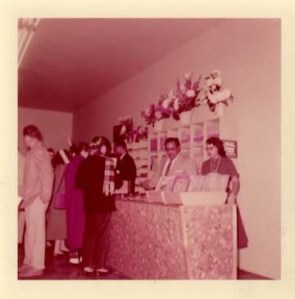
Marilyn Kelley, fifteen, helping customers with Henry Bass and Harold Kelley at the Main Street shop, 1955.
The R & B sounds that my mother, Marilyn Kelley, favored in musical artists in the 1950s were the familiar sounds of (or “sepia” as it was called early on), gutbucket, and melisma—black musical sounds and pronunciation not acceptable to the parents of white teenagers (although white youth were of course becoming familiar with these sounds). Covers changed that sound and made popular rhythm and dance music acceptable to white parents while satisfying white teens and keeping them “inside the fold.” White people (and black people) regularly heard and saw Dinah Shore, Peggy Lee, Pat Boone, Elvis Presley, and other white performers on radio and television, as the record companies heavily promoted these artists and their versions of popular songs. Black performers, on the other hand, were much harder for black people (or everybody else, for that matter) to discover. In the Midwest you had to catch Randy, a white disc jockey out of Nashville, who played black performers’ records and sold them through mail order (see WLAC—Radio). My mother listened to Randy’s show from her bedroom nearly every Saturday night.
.
I had never heard of Little Willie John or his version of “Fever” until my mother mentioned it, but when I listened to his voice for the first time I immediately understood what compelled my parents as teenagers to desire this song, even without lots of radio play or the benefit of television. When I sent my mother a link to Gayle Wald‘s review of a book about the musician (Fever: Little Willie John: A Fast Life, Mysterious Death and the Birth of Soul), she remarked that as a young girl in the rural Midwest she knew not a single thing about him except for the sound of his voice on that one song, which has stuck in her memory all these years. Few people in rural America knew what budding black artists looked like in those days. For listeners like my mother it was all about sound because there was practically nothing else. Pure sound drove her to enjoy these artists and made her want to hear their music again and again.
Into this world jumped two ordinary black couples, moved by their own phonograph player and records to turn a space they had leased to a succession of black beauty parlor operators into a small storefront: Harold Kelley, my grandfather, a carpenter by training who tended as carefully to the foundations of the store as to its customers; my grandmother, Elizabeth, who handled the register and advertising; my great aunt Ina, who mostly worked behind the scenes as the bookkeeper; and my great uncle, Henry Bass, known among the family as “the promoter,” likely as much for his knowledge of music, particularly jazz, as for a habit of walking up and down the street talking to people (a young African-American man named John would join the four after first lingering in the shop as a customer, then helping as a volunteer, until finally becoming an invaluable employee in 1955.)

Kelleys and Basses: Left to right: Henry Bass, Mary Ina Bass, Elizabeth Kelley, and Harold Kelley, co-owners of the Specialty Record Shop, circa 1963.
Benefiting first from their proximity to downtown at 611 South A Street, beneath a rose-colored neon sign, and later in the more spacious Main Street shop—with its “high fidelity” room in the basement—that I remember, the Kelleys and Basses managed to put several other record stores out of business, but more significantly they forged a small community—white and black—around music at the heyday of a vast industry and at one of the peaks of cultural segregation, which even now, so many decades later, seems like no small accomplishment.
Last year, my mother and I traveled to Richmond to visit both Specialty locations, maybe thinking that in all their metaphorical glory they would inspire us to write down what we remember. We went first to the storefront on Main Street, the place that I knew, and then to the small frame house on South A Street, the early shop and my mother’s childhood home. The drabness of the place knocked any hint of nostalgia out of both of us: The bushes and flowerbeds were gone, and the building looked cold and empty, slightly seedy, and a little miserable—these days no doubt valued more for the land it sits on than for the property itself. Thinking now of how my mother must have felt to see her childhood home diminished so mercilessly by time and progress still pains me.
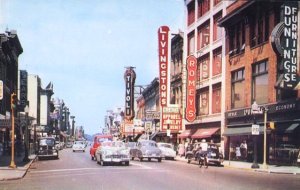
Main Street, Richmond, Indiana in the 1950s
She said then and I write with certainty now that it was more than it looked, which brings me back to what Specialty was, which must be something larger than what stands in our memories or I would not be writing this. It is difficult to attach particular significance to the place in a simple essay about music except to say that as with sound with Specialty meaning was everywhere, and as with music, Specialty reached everyone, at least in Richmond. Its soundproof booth, five-by-five feet square, drew high-fidelity enthusiasts to listen longer than perhaps should have been allowed. A single door connecting the store to my grandparents’ home, sometimes left open by chance, invited curiosity and even boldness from some customers who, stumbling upon the family’s dining room table with its treasure trove of uncataloged records may well have lingered too long in a private space but were never scolded or turned away. The record company representatives who, swept up in the excitement of Specialty’s open house in 1955, began helping customers buy any record, regardless of its label. Taken together, these shared experiences become a narrative of human experience as intricate and complicated as music itself, not so unlike the tapestry of sound that compelled my mother to listen to the magnetic voice of Little Willie John.
In the musical amalgam of today, it is at times difficult to imagine an America so rural, isolated, and segregated, at least in these particular ways. These days “black” music—that is, music by African-American performers—is likely more accepted by and certainly more fully integrated into mainstream America than is the black population itself. Virtual musical communities like turntable, Spotify, Grooveshark, and Pandora are as much growing purveyors of music as are iTunes and Amazon, the new corner record stores, and as such hold much promise for unprecedented global musical cross-pollination and exchange.
 As we may rightly celebrate the cultural integration of more sounds into a larger and perhaps more democratic musical landscape, it is also appropriate to mourn the passing of brick and mortar record stores (and bookstores and libraries, too, I might add) like Specialty, as much for their fidelity as for the ephemeral things these spaces once contained: qualities that bring kinship and serendipity to human experience—sound, yes, but also light, smell, touch, and color, with all its complications.
—
Jacqueline Dowdell received a B.A. from the University of Michigan and an M.F.A. from Cornell University. She is a communications coordinator at Cornell Law School. Thanks to her mother’s memories, her grandmother’s meticulous archive of Specialty history, and a newfound enthusiasm for sound, she is working on a memoir about the Specialty Record Shop.
.
Share this:

The Victoria’s Secret Fashion Show and the Soundtrack of Desire

"Victoria's Secret Show 2008" by flickr user cattias.photos under Creative Commons license
As a consumer, you’ve experienced desire: that longing for someone, that appetite for something more, that expectation of pleasure and satisfaction that comes from getting what you want. Whether what you want ranges from an ideal body type, to a cool technological gadget, to fashionable clothes or new cars, someone beautiful is out there selling it to you—beautifully. If you’re like me then you’ve found yourself suddenly and inexplicably under the influence of desire, only later trying to understand where your money went. If you’re a lot like me then you’ll eventually realize that desire has this effect because of the way it looks and, perhaps more importantly, because of the way it sounds.
One of the more interesting snippets of what desire looks and sounds like right now is The Victoria’s Secret Fashion Show (VSFS), which aired on November 29th and rebroadcast on December 15th. Rappers and rock stars serenade the audience while Victoria’s Secret Angels don Swarovski crystal-encrusted lingerie and angel wings. The visual and aural cornucopias echo ideas of abundance and break down the boundary between public and private spaces by implying a type of intimacy—Victoria wants to share her secret fantasies (privately) with just us (in public). The intimacy implied is totally illusive, which makes it all the more desirable.
This illusiveness starts with the models, who enact intimacy and embody silence as the sound of desire. The VSFS’s onstage choreography fixes women squarely in the visual domain and undercuts their credibility in the sonic domain. Instead of raising their voices for self-empowerment while on the air the VSFS suggests that women should push up their breasts and show as much cleavage as possible, playing to audiences as seen and not heard.
Bernd Schmitt, David Rogers, and Karen Vrotsos explain what’s behind the VSFS’s strategy of strategic silence in their book, There’s No Business That’s Not Show Business: Marketing in an Experience Culture:
“Since 1995 Victoria’s Secret has gone from imitating marketing ideas of true luxury retailers to becoming the model for some of those retailers… Every step of this dramatic progression has been pure show business—pushing the boundaries of fashion and taste, engaging (and sometimes enraging audiences) and transforming the industry into re-imagining itself. Like a teenager wearing her first Wonderbra.”
Through a maelstrom of controversies and publicity over the lack of women’s voices represented in the fashion shows, the VSFS was re-imagined in the early 2000s and took on a (post-)feminist message of empowerment. Here’s the idea: VSFS models are “superheroines” because they brandish their assets on their own terms on the catwalk, in an emancipatory celebration. Silent, desired objects are glorified as consumers are bewitched.
The show facilitates desire by creating additional intimacy for consumers, incorporating an “All Access” website replete with revealing video clips and exclusive photos, biographical videos about the models. The actual broadcast now also airs backstage interviews in which models share their private thoughts about why the VSFS is more than a pornographic commercial or a fantastic rejection of old-school stereotypical bra-burning feminism. For example, during the show one model commented that she’s “living the American Dream.” Another said that she feels senses of accomplishment and growth because “It’s every girl’s dream to walk in VSFS… the minute I stood on the runway I felt like I became a woman.” Yet another model encouraged young female audience members to aspire to participating in a future VSFS, pronouncing that “someone that’s watching this will be an angel.”
Despite this backstage commentary much goes unsaid. Noticeably absent from the models’ remarks is any mention of how the opportunity to speak their minds is presented only to sell more merchandise that is not certified fair-trade. Then there’s the total silence around the privileging of light skin and thinness and their relations to higher levels of “erotic capital” in mainstream popular culture. Out of 10 models in the 2011 show, 3 appeared to be women of color (Asian-American and African-American or mixed race) and only 1 appeared to be a darker-skinned woman of color. No women of color contributed to VSFS’s on-air backstage footage. And, adding insult to representational injury, the women of color are hypersexualized even as they are muted. What’s more is that all models appeared to be under the size of the actual US female consumer (sizes 10-12), suggesting that most real women are still not considered the target audience for VSFS and thereby suffer a profound lack of agency in voicing images of desire for themselves.
The absence, and silence, of average women and women of color in desire industries has been noted by sociologist Siobhan Brooks in Unequal Desires: Race and Erotic Capital in the Stripping Industry. Brooks writes,
“Many feminists argue that women cannot assert agency within sexual economies; their belief is that women are victimized and/or controlled by heterosexual male desire that is not in the best interest of women. On the other side of the debate… contemporary feminists have focused on sexual agency and the empowerment of women within sexual economies as an expansion of women’s control of their bodies. However, within the debate… there remains a theoretical void in examining US-based racial and sexual hierarchies present within desire industries, and how these hierarchies mirror existing forms of racial stratification in US institutions.”
This racial stratification is stitched into the very soundtrack of the VSFS, which loudly reinforces women’s silence as the sound of desire. The VSFS soundtrack nourishes desire through presenting what Deanna Sellnow and Timothy Sellnow, in their article “The Illusion of Life Rhetorical Perspective: An Integrated Approach to the Study of Music as Communication”, call an “illusion of life—a dynamic interaction between virtual experience (lyrics) and virtual time (music).” Racial, gender and class differences produced virtual experience. Lyrics expressed these differences through some form of heterosexual, aspirational and consumptive desire—from getting one’s ideal sexual partner, to traveling to exotic locales, and enjoying celebrities’ exciting and extravagant lives. The pop and rap songs offered fast tempos, driving rhythms, loud dynamics and full instrumentation, representing intensity and power.
The VSFS’s performers show the gendered dimension of that “illusion of life.” Kanye West’s version of masculinity was on display as he flirted with each model strutting down the runway, making his voice the only one heard as models appeared. His famous line from “Stronger” (“I need you right now”), when coupled with the women’s silent sauntering, sounded as relevant as it was politically incorrect.
Maroon 5’s performance of “Moves Like Jagger” also addressed the theme of desire, especially when lead singer Adam Levine planted a kiss on the cheek of his girlfriend Anne Vyalitsyna (as she remained silent). Jay-Z and West’s show stopping performance of “Niggas in Paris,” in which the duo performed without any models on stage, highlighted the rappers’ “untouchable” status as rap gods and throne-dwellers. The live audience responded more emphatically to this male-only performance than it did to any other segment of the show.
Nicki Minaj was the only female to appear on stage in the role of non-model, performing “Super Bass” with a hint of Rob Base and DJ EZ Rock’s “It Takes Two.” Though her performance can be read as a subtle critique of the lack of authentic audience agency and absence of a womanist standpoint in VSFS, it sounded no less male-centered than any of the other performers’. For instance, the first line of “Super Bass” is directed at a male audience driven by consumption, “This one is for the boys with the booming system.” In this respect Minaj could be seen as The Female Voice of VSFS, as her rapping about self-image and relationships with men is consistent with sanctioned topic areas for women in general.
However, and in keeping with the show’s theme of women’s silence as the sound of desire, Minaj’s performance does offer a quiet critique of hegemonic images of desire and desirability. Unlike the male performers Minaj always stayed behind the models and in the background. Consequently, Minaj’s short stature, colored wig, thicker figure, sneakers, outlandish outfit, and darker skin were presented in sharp contrast with the tall, high-heeled, thin, lighter-skinned, scantily clad, and perfectly coiffed models who she stalked as they came down the runway. A scan through tweets posted as the show aired confirms that audiences got Minaj’s message even if they eventually turned it against themselves, revealing that desire can sometimes be displeasing and painfully restrictive. Take the following tweet from viewer @kelcicoffey: “Going on a diet after watching #VSFashionShow tonight XD.”
Though Minaj’s soundless critique speaks volumes, the VSFS soundscape ultimately seals the edges on a spectacle brimming with hegemonic impressions and sensations of desire. The end product is an illusion of life that is mostly white, nearly naked, always feminized and conspicuously silent.
***
Marcia Alesan Dawkins is an award-winning writer, speaker, educator and visiting scholar at Brown University. She is the author of Clearly Invisible: Racial Passing and the Color of Cultural Identity (Baylor UP, 2012) and Eminem: The Real Slim Shady (Praeger, 2013).
Marcia writes about racial passing, mixed race identities, media, popular culture, religion and politics for a variety of high-profile publications. She earned her PhD in communication from USC Annenberg, her master’s degrees in humanities from USC and NYU and her bachelor’s degrees in communication arts and honors from Villanova. Contact: www.marciadawkins.com
Share this:


Current Top Posts





April 2021

January 2020

November 2019

October 2019

August 2019

April 2014

November 2017

March 2015

December 2017

October 2015
 Sounding Out!
Recent Comments