
A Manifesto, or Sounding Out!’s 51st Podcast!!!

DOI: https://doi.org/10.59350/a89ek-90e31
This week, Sounding Out! dropped its 51st podcast episode. As the curator and producer, I thought it necessary to commemorate the occasion with some fanfare. I want to shout from the hilltops about how proud I am that our little podcast has turned 51!
Erm…at least I’m posting about it.
Also, I want to clear the air a little about what it is that we do. I’ve received feedback here and there over the years about the sound of our podcasts, that we sound “different” and/or “inconsistent,” that we need to normalize the sound a bit: hello out there, audiophiles! Today, I want to say, once and for all, that our sound is intentional and that we are proud of it, hiss, distortion, and all! We think what some hear as “imperfections” are all part of what sets us apart from the ever-growing pack of podcasters. SO!’s podcast has sounded different since we MacGyvered our first episode from an epic talk, a few great ideas, and a rogue tape recorder at River Read Books in Binghamton, NY in April, 2011.
The Sounding Out! Podcast began as a series of conversations within the editorial team back in 2011. We knew that the blog was “talking the talk” in new, excellent, and often provocative ways, but that something was missing to keep pushing the form into the red, not just the content. We knew we needed something more—a little snap, crackle, and pop, if you will—a way to show how Sounding Out! was always listening, and a way for thinkers, artists, provocateurs, and more to engage with sound more directly. In 2011, podcasts were accumulating in the shadows waiting to lunge forth to center stage. They seemed really cool, but there were relatively few, and fewer still (if any at all) on the topic of sound studies. Even though we knew that podcasts were going to be a big thing eventually, we had no idea that they would blow up so quickly.
While we flipped around many ideas, we decided to put our energies behind what was then an occasional series of podcasts that allowed us to capture important yet fleeting moments—too quick and dirty to really transcribe. While our our initial vision for the podcast was to capture these rare and powerful moments, over the past 5 years we have kept this mission consistent while evolving to better accommodate artists and theorists alike. During that time we have hosted mystics and librarians, shared fieldwork from São Paolo, Brazil to Lodi, Ohio, interviewed theremin players and visionaries. See the full list of episodes here. Even though our content has been wide ranging and eclectic, we’ve made it a point to privilege access and immediacy in all of our episodes.
As I listen back to the past five years, I realize that our contribution to the fields of sound studies and podcasting has not just been in terms of who we broadcast and what we amplify, but through the sound of our podcasts themselves. Our podcasts don’t sound perfect. They’re spiritually aligned by the raw production ethic of bands like The Minutemen, who always privileged the emotive qualities of immediacy, access, and intimacy over the brooding qualities of studio production. Particularly because we founded the podcast upon these same principles, I have strived to prioritize radical visions and ideas and to amplify new voices above all else. I want each podcast to arrive in your queue like a wrapped gift—topic, content, production, and sound all equally mysterious. Some of our podcasts were recorded on cellphones and others were recorded in high-end studios and recording booths. Our 51st anniversary isn’t the perfect occasion, either. But, hey, we’re proud of these audible distortions.
“The Minutemen: #1 Hit Song”
So what do I mean that our podcast sounds different? Well, I mean two things: First, we sound different than what episodic radio sounds like. Our DIY—or, more accurately, we will help you “Do It Yourself”—ethics deliberately dial back radio’s genre conventions: smooth identifiable hosts, heavy compression, sound-proof rooms with the latest in equipment. We encourage and construct our podcast with a deliberate sonic diversity, providing little sonic consistency from episode to episode in order to challenge regimes of production that threaten to make all recordings sound the same. We have many many different announcers and hosts; for this podcast to be the space of radical discourse that we intend, it’s important to cast our net wide. This isn’t to say that we don’t care about “quality,” but rather that we define quality differently. Rather than an audiophilic emphasis on the sorts of tone found most frequently in microphone technique, sound booths, and—when all else fails—postproduction, we believe that a “quality” podcast—particularly one about sound—should explore sounds that we rarely hear and allow its artists freedom over how they present their work.
I curate our podcast as a sonic refuge from the invisible regime of auditory production that has slowly constricted and strangled radio this past century. And I’m proud to share podcasts that have been recorded on in impromptu circumstances, Episode XXXIX: Soundwalking Davis, CA and New Brunswick, NJ, for example. We want artists to show more than they tell; Episode XII: Animal Transcriptions, Listening to the Lab of Ornathology is a perfect example of this. Here Jonathan Skinner’s brilliant exploration of animal sounds perfectly balances sound and interview and invites listeners to compare sounds to speech, and vice versa. Another example of this ethic is film professor Monteith Mccollum’s remix of the original War of the Worlds broadcast. Although Mccollum offers some commentary at the start of the recording, what follows is a unique and dazzling sonic experience. Giving radical ideas both the space and platform to be heard is this podcast’s mission. So far, so good!
The second way our podcast sounds different has to do with our deliberate curatorial resistance to consistency between our episodes. When programs bend to the whims of genre conventions, creativity is all but snuffed out. For our podcast to excel as a form for sharing visions, ideas, and experiments, we must allow our composers, authors, and auditors the freedom to explore sonic space. We celebrate Sounding Out!’s anniversary annually with a series of mixes hand-picked by our stable of authors (Listen to years 1, 2, 3, 4, 5, and 6 here!), we’ve entertained interviews, panels, and sound art alike. You may have missed it, but we even have an episode diving into the work of ambient sound in a Dungeons and Dragons game.
While I do think about the sound of our podcast aesthetically—I used to run a music production studio out from the trunk of my car—we do not cultivate a DIY anything-goes ethic strictly for a “cool factor” or just for its own sake. Rather, we have calibrated our different sonic approach in deliberate defiance of styles of production which are all too frequently celebrated within the cultures of straight white men. (Check out SO! Editor-in-Chief Jennifer Lynn Stoever’s epic three-part treatise on the tape recorder in popular film to glean some sense of the tape-recorder’s role as an instrument of masculine control. Part 1, Part 2, Part 3). The standards of taste which have long governed the domain of radio production (and audio production, as a whole) are historically connected to the communities of practice which have occupied invisible yet powerful roles as audio producers, engineers, critics, and marketers.
As Jonathan Sterne explains in MP3, the science of audio fidelity has historical roots within a corporate logic that privileges sounds that are easily shared through telephone cables. “AT&T encountered hearing as an economic problem once its options for extracting additional profit through price were limited,” Sterne says, “Among other strategies, it sought to learn which frequencies could be excluded from the market for telephone signals” (14). In other words, the entire craft of audio engineering has historical roots in privileging sounds that make money above all else. Not only this, but the standards of fidelity cultivated by engineers allow them to gatekeep and demand money at the outset, blocking access to the means of production. These standards are more often than not embedded within the cultures of listening and sales fostered by the radio industry. Fortunately, podcasts have been able to challenge many of these genre tropes, We’re proud to contribute to this momentum and to propel it forward as we continue our series. And we’re not stopping! Up on deck in 2016 we have some amazing compositional sound art, more from Marcella Ernest’s trek to uncover lost sounds, and some notes on a forthcoming project in archiving one city’s local music scene.
So, in the spirit of Sounding Out!’s annual blog-o-versary we’re popping the cork for our podcast’s 50th episode with a few of the milestones we hit this past five years.
We found a theme song. This was a small but important step in our development. What would a podcast about sound be without some kind of awesome anthem representing it? (Nothing, that’s what!) We need to officially thank the members of Hunchback (Miranda, Mike, Jay, and Craig) for donating their song “Feeling Blind” to our podcast. Hunchback was a legendary horror-surf band from the NJ basement scene who endeavored to produce highly visceral sonic experiences of the highest caliber in their songwriting. You can still find a ton of their recordings on the internet. Thanks, crew!

We got listed on iTunes and Stitcher. It bears mentioning that quite a bit of technical muscle is involved in establishing a podcast. We would have gotten nowhere without Andreas Duus Pape’s help and guidance during our earliest moments. Andreas was instrumental in opening up the hood of the podcast and making it purr. Not only did he donate his time to plug us into iTunes’ network of podcasts, but he also shared some excellent philosophical thoughts on the topic. You can listen here and read them here.
We went monthly. Originally we had conceived the podcast as more a haphazard, occasional treat for our readers. Slowly but surely as demand and interest grew, we began to carve out a more regular calendar space for our podcast. First we switched to a bi-monthly format, and then we started with monthly broadcasts. Can’t slow this beat down.
We are the sonic archive of a sound art conference. That’s right, we featured sonic mixdowns of the entire Tuned City of Brussels sound art festival. Over the course of the festivals three days, we featured daily mixdowns of the prior day’s key sounds and moments. Each mixdown is brilliant and a testiment to the raw passion of our podcast contributors. They worked round the clock to produce such an amazing series. Check out the night before, and days 1, 2, and 3.

We produced a LOT of soundwalks. If you’re a listener you know that we love our soundwalks. We’re proud to be host to play host to a variety of soundwalks from cities around the world. Last month’s Yoshiwara soundwalk by Gretchen Ju challenged listeners to critically engage with the city’s fraught history of sex work. Other contributors in our soundwalk series like James Hodges have considered how the ambient music of big box stores and shopping malls are part of the architecture of commerce. Finally others like Frank Bridges have taken us to the edge of history and soundwalked the grounds of Thomas Edison’s workshop in Edison, NJ. No matter what the locale, our soundwalks are part of our podcast’s signature.
We found a regular contributor. Regular contributors are the heart and soul of Sounding Out! They lead the conversation on sound and work to bring you the best, most interesting content. For these reasons we’re proud to announce that Marcella Ernest will be joining our podcast as a regular contributor with her series “Searching for Lost Sounds.” Marcella will be interviewing a variety of sonic practitioners in an effort to give voice to the voiceless. Her most recent entry in the series was posted last Thursday. You can listen here.
We’re going to keep it coming. That’s our promise to you! We’ll be producing great content as long as you’re listening. Take a moment to subscribe to our iTunes or Stitcher accounts and also explore our Episode Guide to see if you missed anything this past 5 years. It’s been a rewarding adventure so far and we guarantee that we’ve already got some great content lined up in the coming months.
–
Aaron Trammell is a Provost’s Postdoctoral Scholar for Faculty Diversity in Informatics and Digital Knowledge at the Annenberg School for Communication and Journalism at the University of Southern California. He earned his doctorate from the Rutgers University School of Communication and Information in 2015. Aaron’s research is focused on revealing historical connections between games, play, and the United States military-industrial complex. He is interested in how military ideologies become integrated into game design and how these perspectives are negotiated within the imaginations of players. He is the Co-Editor-in-Chief of the journal Analog Game Studies and the Multimedia Editor of Sounding Out!
–
Featured image is “Roscoe Considers Recording a Podcast” by zoomar @Flickr CC BY-NC.
—

REWIND! . . .If you liked this post, you may also dig:
Sounding Out! Podcast #1: Peter DiCola at River Read Books – Peter DiCola
It’s Our Blog-O-Versary — Jennifer Lynn Stoever
Sounding Out! Podcast #51: Creating New Words from Old Sounds – Marcella Ernest
—
Share this:

SO! Amplifies: Sounding Board Curated by Leonardo Cardoso
DOI: https://doi.org/10.59350/0thrb-wyd33
—

SO! Amplifies. . .a highly-curated, rolling mini-post series by which we editors hip you to cultural makers and organizations doing work we really really dig. You’re welcome!
—
The first annual Sounding Board sound exhibit was held at The Companion Gallery in Austin, Texas on December 3 – 6, 2015, as part of the 60th anniversary meeting of the Society of Ethnomusicology (SEM). In the promotional literature for the show, the curator, Leonardo Cardoso (Texas A&M), described its objective: to give students, ethnographers, ethnomusicologists, and any “sound-minded” people an opportunity to share research and contemplate fieldwork from different perspectives. Cardoso hoped that SEM Sounding Board would “stimulate dialogue between ethnomusicology and other fields, especially sound studies, sound art, ecomusicology, anthropology, and media studies.” He also sought to facilitate interaction between the local community in Austin and SEM scholars who traveled to attend the conference.
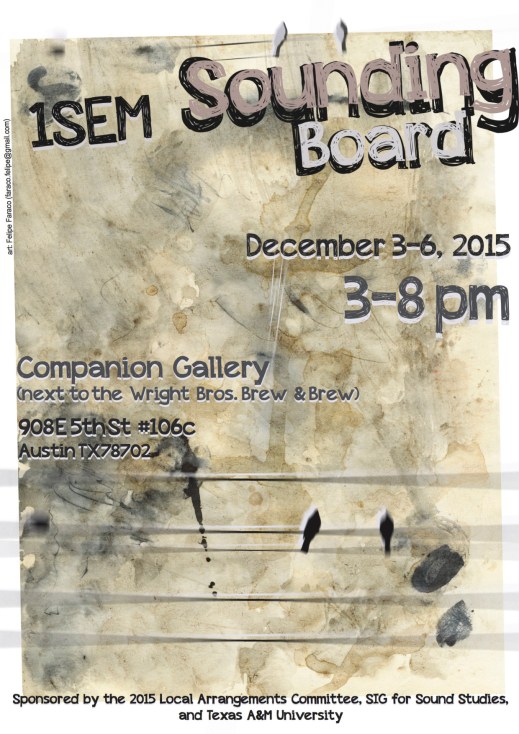
I spoke with Cardoso about this exhibit on several occasions. When I asked him why name the exhibit “Sounding Board”?, he told me that Veit Erlmann (University of Texas Austin), described once described his role as a mentor as someone to bounce ideas off of, like a sounding board. In a similar way, Cardoso’s vision for the first annual SEM sound art exhibit was to create opportunities for scholars and local people to meet and discuss sound, ethnography, art, and fieldwork in an open context, and learn from each other while interacting in that space. He designed Sounding Board as a place where “ideas are amplified” and scholars and community members can make fruitful connections because they have an opportunity to reflect and discuss research with people from different backgrounds.
In his invitation to SEM attendees, Cardoso described Sounding Board as
[eight] sound works that probe into sonic in-placements (water and wind), sonic displacements (the telephone, the radio, and the microphone), sonic emplacements (the acoustic territories of urban Taiwan, the Brazilian hinterlands, and West Texas), and sonic mix-placements (in Mexico City).
This collective sound exhibit showcases the creative work of scholars attentive to the spatial, acoustemological, and ethnographic potential of sound. SEM SOUNDING BOARD challenges distinctions between sound-as-episteme and sound-as-performance, sound-as-ethnography and sound-as-art.
Interactive, Immersive, Ethnographic Sound Art
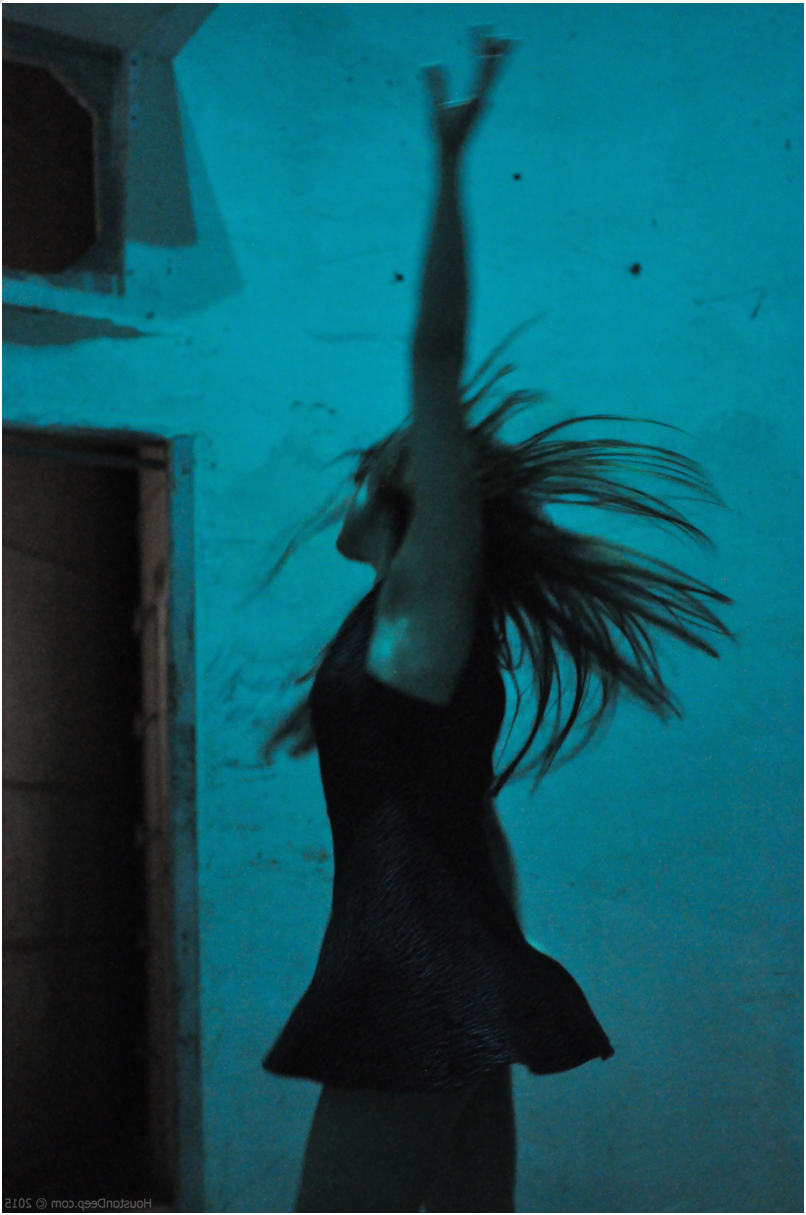
The playfully engaging work, Pool of Sound, welcomed me to the interactive SEM Sounding Board exhibit. As soon as I walked into The Companion Gallery, I noticed the eye catching 1st Annual SEM Sounding Board poster near a studio monitor on a stand, facing another monitor, placed directly across from it, about 20 feet away. A large illuminated circular area gleamed in between the silent speakers. When I moved into the light, I suddenly heard the clear sounds of gently rushing water, but only for an instant, then there was silence again, as soon as I stood still. As I turned and stepped towards one of the speakers I heard the rushing water return. The gurgling sound mirrored my movement and when I stopped, the sound of the water stopped.
Lina Dib (Rice University) created the piece, with an
enchanted zone [that] literally becomes a pool of sound where sound becomes substance, something to be physically and playfully encountered. In other words, sound with this installation becomes palpable, sound is made (in)to matter. The larger the visitors’ gestures, the louder and stronger the sound of water becomes.
Dib cites Jean-Luc Nancy in her work’s description, understanding her piece as an embodiment of Nancy’s observation in Listening that sound envelops the listener: “Sound has no hidden face; it is all in front, in back, and outside inside, inside-out.”
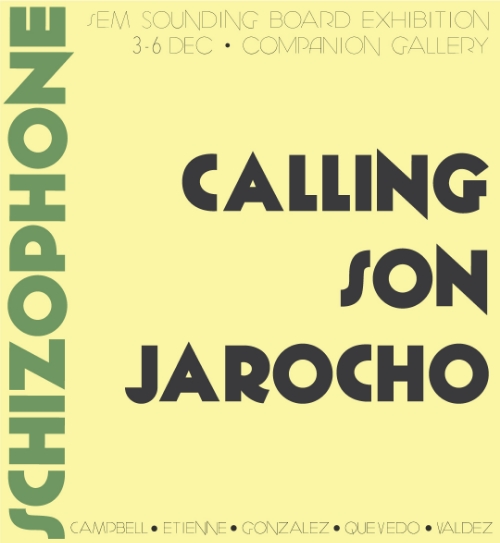
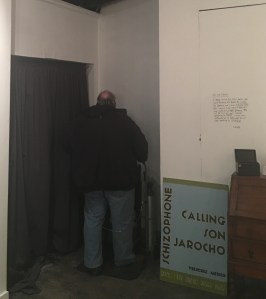
While experimenting with the intersections of sound and gesture in Dib’s Pool of Sound, I noticed someone sit down at an antique-looking wooden desk across the gallery, pick up an old school, land line telephone, dial a number, and start writing on a notecard. The person at the desk was experiencing Schizophone, Calling Son Jarocho, a installation by Craig Campbell (University of Texas Austin) and collaborators, Julian Etienne, Juan-Pablo Gonzalez, and Cameron Quevedo. When the person hung up and left, I sat down, braced the phone between my ear and shoulder and listened to a dial tone.

I dialed a few numbers and started to hear a conversation through the receiver: musicians were speaking in Spanish, discussing certain subtleties of a Son Jarocho performance. I felt like I was eavesdropping. I dialed another number and the sounds of Son Jarocho music flooded my ear. This installation provides numerous sound bytes of field recordings related to Son Jarocho music of Mexico. Each recording is described on a notecard that gives ethnographic descriptions of the situation. Campbell also asks the listener to participate in the piece by filling out a card to leave a record of their experience. The artist says that his “work builds on R. Murray Schafer’s ‘schizophonia’ to signal the profound but also banal experience of listening to recorded sound. The schizophone recruits the telephone–a mundane, though now largely residual technology–to frame and structure an encounter with archival recordings.”
A few feet away from the Schizophone desk, a poster stand held a flyer for the piece Wind Noise by Marina Peterson (Ohio University). A pair of headphones clung to the stand.
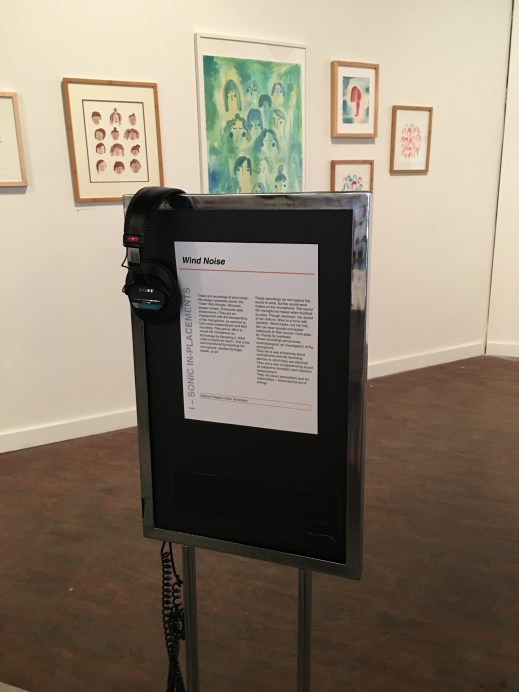
When I put the headphones on I expected to hear some cinematic blowing, or the soft sound of a summer breeze. Instead, I heard a familiar, dreaded, thumping noise. Peterson’s work indulges in a recording taboo: the clipping, dull thud of wind hitting an unprotected microphone.
As I listened, I thought about noise and how to define it. Usually, this thudding sound would bother me and I would cut out chunks of recordings to get rid of it. But in the context of a sound art exhibit, I found myself examining this noise, and listening to it as art. This reinterpretation of sound in relation to space reminded me of David Novak’s discussion of “Noise” as a genre in the context of Japanese music coffeehouses in his article, “2.5 meters of space: Japanese music coffeehouses and experimental practices of listening.” Peterson discusses her work as an exploration of technology, mediation, and the microphone. She describes these recordings as
an effort to reveal the microphone as technology by disrupting it. Wind noise is sound as touch – this is the sound produced by touching the microphone, whether by finger, breath, or air. These recordings do not capture the sound of wind, but the sound wind makes on the microphone. The sound the microphone makes when touched by wind.
In a recessed corner of the gallery I saw a music stand with a piece of paper on it. I didn’t know if it was part of the Sounding Board installation, or just a piece of equipment, set aside. As I stepped up to the stand to read the paper, I unexpectedly stepped into a chamber of sound. A Holosonics AudioSpotlight AS-24i directional speaker, mounted on the ceiling, beamed a column of music into that area, which a listener can hear only when directly below the speaker.
The piece is called Resting Place, by Michael Austin (Howard University). In the description of this work Austin states:
Resting Place is based on the old cowboy song ‘Bury Me Not on the Lone Prairie.’ Not only does this work confront listeners with thoughts of mortality and final resting places, it embodies the wide open spaces of my childhood home and serves as a place of peace and relief for the here and now.
Austin grew up in the countryside of the Texas Panhandle, and his work intends to bring a piece of that Texan soundscape to a corner of the gallery. I could hear the sounds of birds, wind, and water combined with chant and meditative, drone music; they were all sounds that would usually communicate rest and peace. Unfortunately, I had a difficult time entering that relaxed frame of mind because the recording of the Texan soundscape often clipped, which disrupted my concentration on the calming aspects of the field recording. Composers such as Annea Lockwood and Janet Cardiff use binaural microphones to capture nature sounds up close and create an intimate surround sound experience for the listener; although I am fascinated by the concept of creating a “soundscape chamber” by using a hyper directional speaker, I would love to hear the details of Austin’s field recordings through a nice pair of headphones.
Resting Place and Wind Noise invite contemplation as the listener receives sound. In contrast, the broadcasting sound piece by Tom Miller (Berkeley College) is intensely interactive. In Radio Texas International, a Micro Radio Station in the Austin Wavescape, Miller creates an experience where it is possible to broadcast sound and listen to recordings.
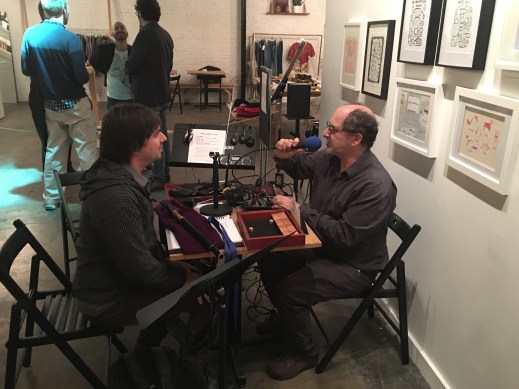
Resting Place and Wind Noise invite contemplation as the listener passively receives sound. In contrast, the broadcasting sound piece by Tom Miller (Berkeley College) is intensely interactive. In Radio Texas International, a Micro Radio Station in the Austin Wavescape, Miller creates an experience where it is possible to broadcast sound and listen to recordings. Miller explains that for this piece he
operate[s] a low power Mini FM Micro Radio station in the gallery… Tuning to open frequencies, a legal micro power transmitter broadcast[s] to receivers distributed within a 200-foot radius as a hyperlocal, pop-up intervention into the FM band. Using headsets, listeners will tune the radio dials seeking to locate the signal interspersed with the music, religious broadcasts, news, foreign language programming and static of the local radio wavescape.
In the video of his work you can hear several different ethnographic recordings that are broadcasted by Miller in the gallery, and at the same time intertwine with the sounds of local radio stations in Austin. Besides broadcasting field recordings, Miller also aired live interviews and music throughout the three-day exhibit. I was delighted to have the chance to play some traditional Irish music on the air for Radio Texas International.
雜 (dza) is a piece by Yun Emily Wang (University of Toronto) and Wendy Hsu (Dept. of Cultural Affairs, City of Los Angeles), who created a work that inhabits a cardboard box. The artist Zimoun often uses percussive elements to explore acoustics and cardboard, but in 雜 (dza), Wang and Hsu employ the box as a resonator to amplify and combine sounds emitted from headphones playing loops. The listener is asked to put their head in the box to hear a cacophony of intermingled field recordings that create a decontextualized soundscape of Taiwan.
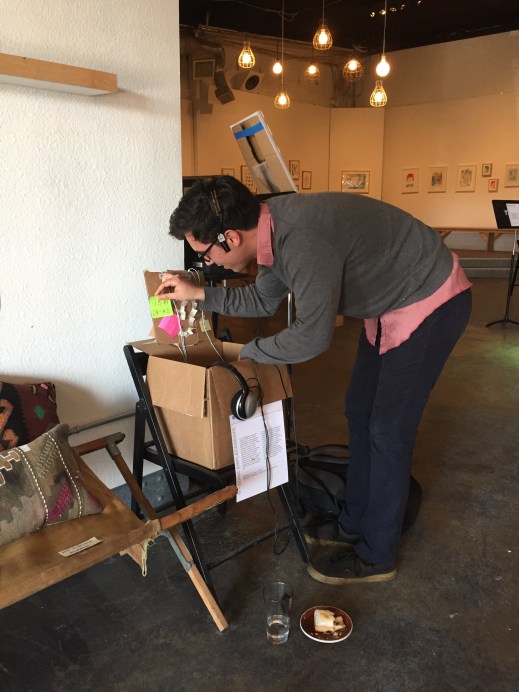
The artists explain that “These composed loops recontextualize the sonic materiality of the informal economy and quotidian life exemplified at a Taiwanese night market, and interact with the spatial and sonic elements of the venue and its role within the emerging art-as-enterprise share economy.
There were two pieces of interactive, ethnographic sound art that integrated both audio and visual elements of fieldwork in Mexico City, and Brazil. Dry Signals by Michael Silvers (University of Illinois Urbana – Champaign) invites the auditor to “touch the screen” and listen to field recordings. The touchscreen of the laptop displays an image of a painting of a small town surrounded by mountains, near water.

I put the headphones on and touched a part of the image of the town that caught my attention: a traditional forró trio standing on the porch of small pink house (no.8). In the headphones I immediately heard the rhythmic music produced by the musicians playing the drum, the accordion, and a triangle.
Silvers describes the inspiration for Dry Signals as an exploration of
the sounds of drought in northeastern Brazil. From trickling reservoir spillways… to the music and shuffling feet of dance parties in dusty fields, these sounds tell stories of labor, birds, politics, agriculture, plants, mass media, corruption, water, and the quotidian experience of life in the semi-arid Brazilian hinterlands.
The artists take advantage of touchscreen technology to give the viewer a chance to curate their own soundtrack of their experience of the painting. There is no lag in the experience of touching, listening and viewing the village and surrounding landscape. Even though the field recordings are not uniform in sound quality, I enjoyed the experience of hearing an ethnographic audio record of a small town in northeastern Brazil, by touching an image of it.
Anthony Rasmussen (UC Riverside) provides an opportunity to peek in on urban street scenes filmed throughout Mexico City in his work, El Caracol: A Stroll through Space and Time in Mexico City.
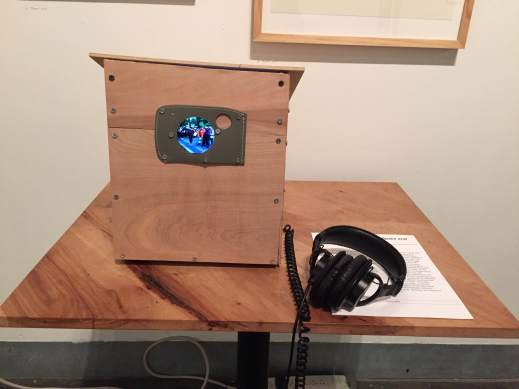
Some of the most compelling scenes in the 20 minute loop of video and audio depict street protests in Mexico City which are accompanied by ambient sounds from the field recording, combined with subtle music, and seemingly unconnected background conversation.
The artist explains that
the video element consists of footage captured while walking through various sites in Mexico City and represents the phenomenological ‘present’. The audio element provides a counterpoint to the visual; as the loop begins the audio corresponds to the action on screen, but with increasing frequency (based on the ‘Fibonacci Spiral’) the contemporary sounds will be ‘ruptured’ by historical recordings of Mexico City that drift further back in time.
I particularly enjoyed the sections where the connection between the audio and the video was unclear. Toby Butler’s article “A walk of art: the potential of the sound walk,” traces the efforts of different artists and their uses of the sound walk in their work, but he does not describe any endeavors like Rasmussen’s, where ethnographic footage is the prime source of the walk. I wondered about the position of peering through the hole to watch Rasmussen’s field recording of Mexico City, and I realized that at times, gazing through the hole gave me the sense that I was the ethnographer gathering footage.
“always more sound to experience”
I visited the Sounding Board exhibit several times while attending the SEM conference. Every time I left I felt like there was always more sound to experience. I wanted to hear all of the numerous field recording of Son Jarocho material presented by Campbell’s Schizophone; Miller’s Radio Texas International changed every time I listened and I wondered what ethnographic material I might encounter the next time I tuned in. I never tired of Lina Dib’s Pool of Sound because it gave me the chance to perform the gurgling of water, using gesture. Apart from the evocative expressions of ethnology as art, Sounding Board converted The Companion Gallery into an interactive playground of sound.

The live performances in the gallery on Friday night brought the ethnographic sound art to life. When I listened to at least twenty members of the Comunidad Fandango of Austin perform and dance Son Jarocho music in the gallery on Friday evening, I began to make connections to the field recordings that I heard in Schizophone. When Bruno Vinezof and Forró de Quintal took the stage to play forró music from northeastern Brazil, I could feel the groove of the drum that was merely suggested in the field recording that I had listened to in Dry Signals. It was a unique pleasure to observe and participate in these musical traditions with my body, after having encountered them earlier through headphones as sound art.
When I spoke with Cardoso he was especially grateful to the Son Jarocho community of Austin, who volunteered to participate in the show by gathering in The Companion Gallery for a Fandango. He emphasized the grassroots aspect of this community music making event which came about because Cardoso knows the group and their passion for Son Jarocho music.
Cardoso plans to expand the variety of works and disciplines involved in next year’s Sounding Board to include media studies, literature, film, and the visual arts. As SEM 2016 will be meeting in Washington DC and co-hosted by Smithsonian Folkways Recordings (and George Washington University), this should not only be possible, but especially exciting.
—
Featured image: Lina Dib’s “Pool of Sound” by Matt Morris
—
Jay Loomis is a composer, a performer, and a graduate student in ethnomusicology at Stony Brook University with a particular interest in transnationalism, soundscapes, improvisation, wind instruments, and electronic music. He hosts a radio show called “Face the Music,” and recently curated a sound installation called “SOUNDREAMS” at Stony Brook University, which used geo-located sounds and music strategically placed around the university campus which people heard by using a smart phone app called Recho. Jay hand crafts Native American and other kinds of flutes, and leads flute making workshops in local libraries and schools. He plays a variety of wind instruments from around the world. He recently led workshops in a contemporary music festival in Cuenca, Ecuador (FIMAC: Festival Internacional de Musica Academica Contemporanea). Participants in Jay’s workshops arranged music and created flutes as a practical way to examine how indigenous music making practices and pre colonial instruments can contribute to the world of contemporary academic music.
—

REWIND!…If you liked this post, you may also dig:
Sound and Curation; or, Cruisin’ through the galleries, posing as an audiophiliac–reina alejandra prado
SO! Amplifies: Shizu Saldamando’s OUROBOROS–J.L. Stoever
SO! Amplifies: Mendi+Keith Obadike and Sounding Race in America–Mendi + Keith Obadike
—
Share this:




Current Top Posts





April 2021

January 2020

November 2019

October 2019

August 2019

April 2014

November 2017

March 2015

December 2017

October 2015


Recent Comments