
Aural Guidings: The Scores of Ana Carvalho and Live Video’s Relation to Sound
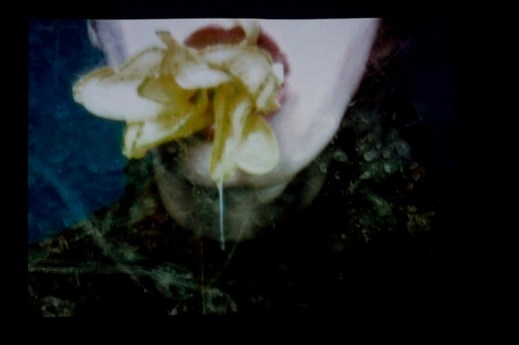
If you were to choose to watch live video composer and performer Ana Carvalho’s work silent, your brain would be easily guided into a synesthetic experience, assigning sounds to each rhythmic change in color, pace, frame. Her images oscillate…they dance, they breathe. As you experience this, there might be a sense that you have lost your ability to hear the outside world, as these images are clearly attached to, woven with, a part of sound.
There is a history of composers such as Iannis Xenaxis and Cornelius Cardew using graphic scores and notation in place of traditional methods and symbols, as a way to reach a deeper expression through allowing greater interpretation, chance, and improvisation with their musicians. They concentrate more on conveying information on how a work is played, rather then what notes to play when. Carvalho uses the graphic score much in the same way, but also as a method of communication between live audio and live video performances, instructing a dialog between two disciplines that are often side-by-side or leaning on each other, but rarely woven together in the manner I have experienced both as audience, and as an audio composer, with her work.
The following interview has been edited for style.
Maile Colbert: Hi Ana, how are you today? And what are you working on currently?
Ana Carvalho: I am good. I’m working on a performance to present at the solstice, with Neil Leonard, and a text about the possibility of expansion of the mind through performing and fruition of being in an audiovisual performance.
At the moment the performance is still involved into misty possibilities of what we know of each other’s work, and what we have been developing individually and talking about. There will be saxophone, electronics, and visuals made of strange landscapes.
MC: At this stage in the process, when working with a sound maker such as Leonard, how do you think about the images’ relationship with the sound?
AC: Images come to be as they appear on the screen in two ways: first there is the introspection about what have I learned from the previous performances, what I want to explore further and what I don’t want to repeat. Secondly, there is the encounter with the other person and his or her work and how do I translate their sound into moving image. At some point my ideas change through the exchange and becomes something else, a visual performance that could only be presented with that sound, with that person, at that place and time.
Regarding the sound in particular, sometimes I propose a structure, or a score, to be followed by sound and image. Other times it is improvised. As I enjoy very much the process, I tend to like to make structures for the performances, which develop along drawings and texts.
MC:  Your scores of text and image are quite beautiful, and of course I am personally lucky to both have some of the published ones, and have had a chance to work with them as well.
As a sound maker, I find they have a flow and almost narrative that feels both intentional and intuitive, no matter how abstract. When you make these, how much of a clear idea of how the audio would sound in relation to the images is in your mind? Do your images always or often follow the same score? Do the results surprise you?
AC: My state of arriving at the point of starting to make a composition is very much the same I described about working with a sound artist towards the presentation of a performance, that is, what do I want to develop further and what I want to leave behind? Then, what is particular to this new situation/performance/collaboration? The composition is a sort of a vehicle that connects process and performance, and that connects sound and image.
The composition is for the two mediums, sound and image, and they are considered in terms of composition as a unity made of two parts. They have to work in a conversational way. Imagine two close friends and how they would be talking to each other. I have in my imagination how it would be ideally two people in that position. That is how sound and image relate on the composition. I think in the most generic terms, more of intensity and flow rather than sonic results. For this reason any musician, with any possible (or invented) instrument, with whichever image or sound database, is able to play a score. It’s required though that the performers take time to reflect, that the composition is understood and incorporated in the way each one plays their instrument. The results are always a surprise.
MC: What inspired you to start working in this way with the scores, and when?
AC: My interest in making compositional scores, and from them documents related to my performance, has been inspired by conceptual and process based art and by my research on documentation of the ephemeral. The focus on the process highlights the need for other representations that are not the finished art object per se. These other ways of representation use available media to describe the making and the reflection while making. Mary Kelly’s Post-Partum Document (1973-79) is a very interesting example of what I am describing. She is expressing her feelings, the growing process of a child and an external perspective through visual objects displayed both as an exhibition and in book formats. Within audiovisual practice, I have been researching for the past five years on creative ways to make documents of the process. My attention was directed to composition in music. The influence of the composer Cornelius Cardew has been great, especially his work Treatise and his idea of directed improvisation. John Cage was also very important for his structures (in talks, texts and music), the use of the I Ching, and for bringing chance into composition.
Simultaneously, while studying and reflecting on these and other subjects, I realized that intuitively I make drawings, texts, and take photographs as a way to detach from the everyday and immerge into a creative process which eventually will lead to the concept and content of a performance.
 Systematic Illusion – The Subtle Technique in an Earthquake Detector Construction has been so far the most complex project to include a score, as well as a series of photographs and the performance. It was presented in its complete form just once in the curatorial project Decalcomania. Organizing these elements as composition, creating a score, and from all this to make little books has been a way of putting into practice my research interests.
A result from the construction of the score has been that the process doesn’t stop with one performance, as I then use the same scores to perform with different artists. For example with the score from this project I created the Earthquake Detector performance series within which we presented the performance together in São Paulo in 2013 at the event Arranjos Experimentais.
MC: As you speak about your work, I keep thinking about Robert Bresson’s Notes on Sound and how most of his notes refer to variations of not letting sound or image take over each other, but to weave them together within the composition. In his Notes on the Cinematographer, he also wrote number “10. not to use two violins when one is enough”. What might this mean to you in relation to your collaborations?
AC: One very inspiring event in the attempts I make to construct a formal grammar and way for me to address collaborations has been to see the film Passage Through: A Ritual by Stan Brakhage. The film was screened at Serralves Museum, here in Porto, Portugal, in June 2011. The event addressed the collaboration and improvisation of music in relationship with cinema from the work of the composers Malcolm Goldstein and Philip Corner and their music in the film work of Daïchi Saïto and Stan Brakhage.
The most amazing thing in Passage Through: A Ritual was to watch such a beautiful film made of an abundance of black screen, that is, an absence of visual form, of light and movement. Each appearance of image was a precious moment. What I learned is that the visual emptiness, and sonic as well, contains information when stimulated through glimpses of image, making the experience of seeing and listening very deep. (In his Notes), Bresson sums up this appropriateness of means and complex connections in a simple and clear sentence.
On the scores I make most of the information can be used for both sound and image. On the Refractive Composition, the scale of greys is for image. That was its purpose when the score was performed the first time. But if someone decides to play from the score without knowing anything about it beforehand, and lacking this intention (which was relevant when it was made, but afterwards there was the decision to not leave it as a declared instruction), that person can also interpret the same information as sound.
MC: Alchemy has been described as: “…the chemistry of the subtlest kind which allows one to observe extraordinary chemical operations at a more rapid pace; ones that require a long time for nature to produce” (Paul-Jacques Malouin, Alchimie). Looking from a history of cinema, there is a tradition and pattern of picture coming before sound, a hierarchy that is both in process and production. You often feel this as an audience. Your work and collaboration have a quality of sound and image having been born together. Having worked with you using your scores, I was likening it to being given a recipe where you have before you ingredients and suggestions, but there is room for your own improvisations and reading. Perhaps that is where that feeling of both disciplines coming together in a manner that feels like they are one part of a whole, rather then separate but leaning on each other, comes from.
Is there an alchemical element to this work, or are you seeking one out? And in that regard, are your scores like a recipe?
AC: What I am seeking with my work can relate to alchemy as experiments and attempts in the quest for depth in all things at the point where differences and frontiers become undefined and irrelevant (in communication between beings, in areas of knowledge, between matter and energy). This quest for depth is based on stubborn curiosity towards evolution as a person, and as part of the world. Perhaps there isn’t an alchemical element to the work, but rather a connection with alchemy, in the ways scores relate to the experiments as recipes to be shared with others in construction and change. This takes me to another aspect of composition. It is difficult for me to understand live image as just accompaniment to a music performance, and vice versa. This is perhaps central to my composition, and the reason why I am doing it for sound and image, to be able to perform that intertwined.
If we look at compositions as recipes, it aim will be to set the performers in tune with each other in the construction of a performance, to set sound and image in dialogue, and to permit a multisensory experience. I have been trying to get other artists interested in performing my scores. To perform from another artist’s score may be very common in music but is unheard of in live visuals. I have as an objective to make a change in that, but for now I perform the scores with sound artists. With the Earthquake Detector series I asked sound artists to read from the score and perform with me. So far, I have presented this as performance with Jeremy Slater, Ben Owen, and with you. Because each artist has a very different approach to the score and reads it in its own way, the processes have been very different. For example, Ben Owen made visual reinterpretations of the structure, and you experimented with and without voice (reading of the text in the score), the results are therefore equally different.
MC: Aside from your scores, you could speak about your relationship to the sound you work with, and sound makers you work with, in the live moment of performance?
AC: Looking for a sound artist to work together on a specific piece or to interpret with me a composition comes from a need to transcend my individual perception of the world and to perceive it with others. It is, again, the curiosity to know the world. The only time I made a complete sound piece on my own was for the performance Vista II – Montanha presented last May (as part of Semana Andrómeda, in Maus Hábitos, Porto). Aside from this really interesting experience, each collaboration is different, every process is different, because each musician is a different person with different skills and sees the relationship between sound and image in different ways.
I am very thankful for everything I have learned with each collaboration and all the intensity with each performance but, as always, it’s the curiosity and the need to explore new frontiers that makes me move from previous project to next project. It is also the possibilities that intuitively present themselves as challenges and the “what if…” in variations.
—
Ana Carvalho is a live video composer and performer, and writes on subjects related to live audiovisual performance. She is a doctor of Communication and Digital Platforms from FLUP (Faculdade de Letras da Universidade do Porto). Her thesis is “Materiality and the Ephemeral: Identity and Performative Audiovisual Arts, its Documentation and Memory Construction.” Currently, she holds a position as invited lecturer at the ISMAI (Instituto Universitário da Maia). For more on her work, visit: http://cargocollective.com/visual-agency/About.
—
Maile Colbert is a multi-media artist with a concentration on sound and video who relocated from Los Angeles, US to Lisbon, Portugal. She is a regular writer for Sounding Out!
—
All images courtesy of the author.
—
 REWIND! . . .If you liked this post, you may also dig:
Playing with Bits, Pieces, and Lightning Bolts: An Interview with Sound Artist Andrea Parkins — Maile Colbert
Sound as Art as Anti-environment — Steven Hammer
Live Electronic Performance: Theory and Practice — Primus Luta
Share this:

Black Mourning, Black Movement(s): Savion Glover’s Dance for Amiri Baraka
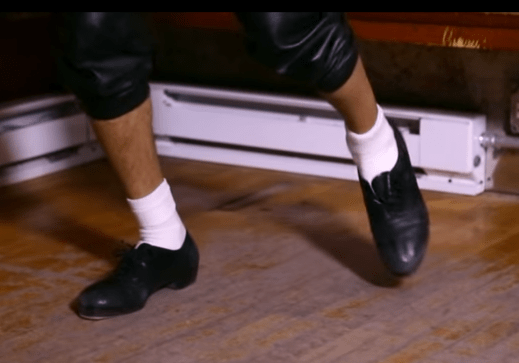
I don’t worry about the look of it so much. Choreography comes later, when I’m putting together a piece. I’m into the sound; for me, when I’m hittin’, layin’ it down, it’s all about the sound. –Savion Glover, My Life in Tap
It has been a little over a year since Amiri Baraka passed, and still I hear the echoes of his presence. I am especially attentive to the ways his work has been carried on by those involved in recent black uprisings in Ferguson, New York City, and Baltimore. Powerful political poetics that have emerged from these events include work by Danez Smith, Claudia Rankine and the many contributors to blackpoetsspeakouttumblr.com.
And yet, part of what I’ve witnessed in the streets, actual physical spaces of public protest against police violence and systemic racial oppression, is an example of what Thomas DeFrantz has termed “corporeal orature,” or the ability of bodies to resonate throughout public space and shift political discourse. In these moments, the body talk of protesters is not simply the sound of clattering feet through city streets, but a commitment to the ways in which physical gestures can speak truth to power. I am especially interested in connecting Baraka’s legacy to the larger conversation about the aural kinesthetic that Imani Kai Johnson has proposed, and in teasing out the various dimensions and potentials embedded in that category.
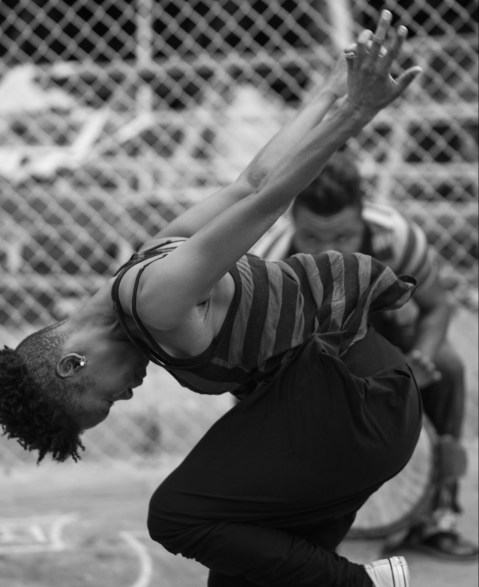
Dance at Ferguson Protests, 2014, Image by Shawn Semmler
For me, Savion Glover exemplified the lingering sound of Baraka’s spirit in his tap dance at his memorial service. Whenever I listen to the recording—which still brings tears to my eyes—I am reminded of the abundant sense of joy, sadness, and love that characterized Baraka’s service. Listening to Glover’s dance is an aural kinesthetic experience, like watching a comet pass across the night’s sky. I am reminded, too, of the way I clamored to record that moment, to keep a piece of the poet alive on my iPhone even after his public passing. And indeed, that performative sound of feet tapping, that measured excess of the body produced through movement, has kept Baraka alive for me; like his groundbreaking work, it is powerfully resistant to the proper rubrics of any one discipline except, perhaps for the study of sound itself.
So, this post then, is about tap dance and its ability to sound out Baraka’s name and life. But in a larger context, the intricate vibrations of Glover’s performance facilitate a deeper understanding of the relationship between sound and mourning, and a kind of mourning that is particularly African American, that is to say, American. It is a mourning that exists beyond the word, written text, or image and a sound practice that enables the bereaved to make a joyful noise and a mournful one at the very same time. So I ask, how do you write a eulogy with the body? How do you perform an embodied love? What does Black love and a reverence for Black life sound like? Sometimes, the answer is tap.
Audio Clip of Savion Glover’s Dance at Amiri Baraka’s Funeral, 18 Jan 2014
The dance explodes on stage like a burst of light. It begins with something approximating a drum roll – and then hard slow taps, hammering away like someone at a typewriter, I imagine, or a train gaining steam.
It is coming.
Slow, insistent and strong, with a little riff now and then, a little picking up of speed here and there. It is coming on louder now, that explosive thing, the tension you are noticing. He is doing the thing. And then there is that skillful, smooth, strong tap. Glover is at work, y’all.

Savion Glover at Work, Image by Flickr Users Raquel and Soren
As a tribute to Baraka, Glover’s dance bears numerous stylistic implications. Among them, I understand the rhythm of Glover’s tap as the rhythm of writing, an aesthetic that complicates the way his dance can be understood as a manifestation of the black vernacular. Sketching out the early connections between her son’s artistry and the percussive taps of the keyboard, Yvette Glover says. “‘I was working for a judge, as an assistant, when I was pregnant with Savion…And when I would type, and the carriage would automatically return, he’d walk, he’d follow it, in my stomach. You could see him move” (39). He does it still. In the audio clip, Glover’s footwork evokes the dexterity of Baraka’s language, all the while telling a story of its own.
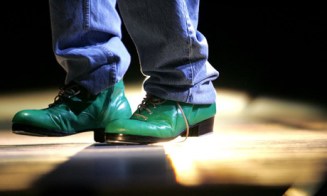
Savion Glover’s Shoes, Sadler’s Wells, 2007, Image by Tristram Kenton
But what about the intensity of the dance, its crescendo toward the end of the service, a flurry of percussive steps beside Baraka’s coffin? Baraka himself reminds us this particular musicality is so necessary here. In his discussion of “Afro-Christian Music and Religion” in Blues People, Baraka notes that in Black diasporic religious services, “the spirit will not descend without a song” (41). Glover’s dance takes place at a moment in the service when emotion exceeds the power of language, but not sound. He uses his body as an instrument of sound in its fullest sense. His performance is a choreography of embodied sound: full-on and at-once body poetry, mourning and tribute.
Elucidating the use of his body as an instrument of sound, Glover declares:
It’s like my feet are the drums and my shoes are the sticks[…]My left heel is stronger, for some reason, than my right; it’s my bass drum. My right heel is like the floor tom-tom. I can get a snare out of my right toe, a whip sound, not putting it down on the floor hard, but kind of whipping the floor with it. It get the sounds of a top tom-tom from the balls of my feet. The hi-hat is a sneaky one. I do it with a slight toe lift, either foot, so like a drummer, I can slip it in there anytime. And if I want cymbals, crash crash, that’s landing flat, both feet, full strength on the floor, full weight on both feet. That’s the cymbals. So I’ve got a whole drum set down there (19).
Combining his body’s drumbeat with the tic of Baraka’s keystrokes, Glover embeds the pattern of Baraka’s life in this tap dance, communicating it with the kind of deep and reverential love you are taught to have for your elders when you are young, appropriate and deep.
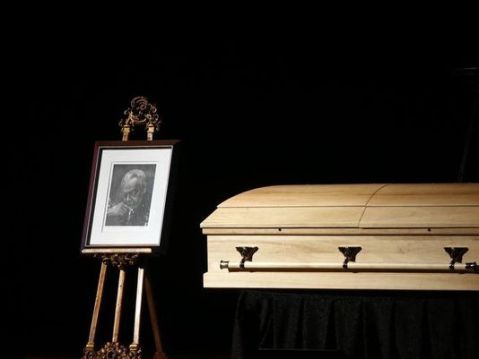 But as powerful as his body-poetry is, Glover’s silences are also key. In those inaudible spaces, Glover spreads out his arms, offering up the dance in a gesture of expansive love; the immensity of the silent gestures mirroring the immensity of Baraka’s life. He holds it out as a gift towards the audience, bows his head, too.
In moments of sound and silence, the audience calls out to Glover the way they would a preacher. At these moments, the dance becomes a call and response akin to the way Baraka’s life’s work was a call and response. A call to respond. A call to take what was given to you and make it mean. Listeners to the dance are called up out of themselves. We are changed by the dance and by the listening.
Tap tap tap.
Glover’s performance shows us how his specific blend of African and European dance traditions exists in a spiritual and artistic dimension. There is a religious explanation for this, too. In African Dance, Kariamu Welsh-Asante explains the function of the African funeral dance in definite terms:
All African dances can be used for transcendence and transformational purposes. Transcendence is the term usually associated with possession and trance. Dance is the conduit for transcendent activities. Dance enables an initiate or practitioner to progress or travel through several altered states, thereby achieving communication with an ancestor to deity and receiving valuable information that he/she can relate back to the community. Repetition is key to this process as it guides the initiates, or dancers, through the process of the ceremony. The more a movement is repeated, the greater the level of intensity and the closer a dancer gets to the designated deity or ancestor. Transformation means to change from one state, or phase, to another (16).
Glover certainly brought us close to Baraka. And yet, I would go a step further to suggest that this is, above all, blues dance. As such, it reveals continuing relevance of social dance and movement to Baraka’s political legacy. Baraka and Glover work directs us towards the propulsive nature of black social/percussive dance forms. These sonic gestures clarify the ways black life matters, impacts the public sphere and policy. The politicized nature of Black Arts Movement performances and the performative elements of contemporary Black protest are still linked through sound. Politicized Black aesthetics continue to offer us multiple opportunities to witness the convergence of sound and movement. Ras Baraka, affirms this in his own eulogy for his father:
Have you seen black fire it burns deep it never goes out you can try and extinguish it but it never goes out it never goes out it never goes out only up or out as in broad as in multiply as in blues black base of the fire dancing flickering at times but never all the way gone dancing flickering at times but never all the way gone…
The power of the dance, of the Black Movement to move is still with us.

Protestors dance to a community band, Baltimore, MD, 28 April 2015, Photo by Adrees Latif/Reuters
—
Featured Image, Screen Capture of Savion Glover dancing by JS
—
Kristin Moriah is the editor of Black Writers and the Left (Cambridge Scholars Press, 2013) and the co-editor of Adrienne Rich: Teaching at CUNY, 1968-1974 (Lost & Found: The CUNY Poetics Document Initiative, 2014). Her critical work can be found in Callaloo, Theater Journal, TDR and Understanding Blackness Through Performance (Palgrave Macmillan, 2013). Moriah is completing a dissertation on African American literature and performance in transnational contexts at the CUNY Graduate Center. Her research has been funded through grants from the Social Science and Humanities Council of Canada, the Freie Universität Berlin and the Graduate Center’s Advanced Research Collaborative. She is a 2014-15 @IRADAC_GC Archival Dissertation Fellow and spring 2015 Scholar-in-Residence at the NYPL Schomburg Center for Research in Black Culture. Sometimes she tweets via @moriahgirl.
—
 REWIND! . . .If you liked this post, you may also dig:
“HOW YOU SOUND??”: The Poet’s Voice, Aura, and the Challenge of Listening to Poetry-John Hyland
Pretty, Fast, and Loud: The Audible Ali–Tara Betts
The Sounds of Anti-Anti-Essentialism: Listening to Black Consciousness in the Classroom-Carter Mathes
Share this:


Current Top Posts





April 2021

January 2020

November 2019

October 2019

August 2019

April 2014

November 2017

March 2015

December 2017

October 2015
 Sounding Out!
Recent Comments