
Listen to yourself!: Spotify, Ancestry DNA, and the Fortunes of Race Science in the Twenty-First Century

If you could listen to your DNA, what would it sound like? A few answers, at random: In 1986, the biologist and amateur musician Susumo Ohno assigned pitches to the nucleotides that make up the DNA sequence of the protein immunoglobulin, and played them in order. The gene, to his surprise, sounded like Chopin.
With the advent of personalized DNA sequencing, a British composition studio will do one better, offering a bespoke three-minute suite based on your DNA’s unique signature, recorded by professional soloists—for a 300GBP basic package; or 399GBP for a full orchestral arrangement.
But the most recent answer to this question comes from the genealogy website Ancestry.com, which in Fall 2018 partnered with Spotify to offer personalized playlists built from your DNA’s regional makeup. For a comparatively meager $99 (and a small bottle’s worth of saliva) you can now not only know your heritage, but, in the words of Ancestry executive Vineet Mehra, “experience” it. Music becomes you, and through music, you can become yourself.

screencap by SO! ed JS
As someone who researches for a living the history of connections between music and genetics I am perhaps not the target audience for this collaboration. My instinct is to look past the ways it might seem innocuous, or even comical—especially when cast against the troubling history of the use of music in the rhetoric of American eugenics, and the darker ways that the specter of debunked race science has recently returned to influence our contemporary politics.
During the launch window of the Spotify collaboration, the purchase of a DNA kit was not required, so in the spirit of due diligence I handed over to Spotify what I know of my background: English, Scottish, a little Swedish, a color chart of whites of various shade. (This trial period has since ended, so I have not been able to replicate these results—however, some sample “regional” playlists can be found on the collaboration homepage).

screen capture by SO! editor JLS
While I mentally prepared myself to experience the sounds of my own extreme whiteness, Ancestry and Spotify avoid the trap of overtly racialized categories. In my playlist, Grime artist Wiley is accorded the same Englishness as the Cure. And ‘Scottish-Irish’, still often a lazy shorthand for ‘White’, boasted more artists of color than any other category. Following how the genetic tests themselves work, geography, rather than ethnicity, guides the algorithm’s hand.
As might be expected, the playlists lean toward Spotify’s most popular sounds: “song machine” pop, and hip-hop. But in smaller regions with less music in Spotify’s catalog, the results were more eclectic—one of the few entries of Swedish music in my playlist was an album of Duke Ellington covers from a Stockholm-based big band, hardly a Swedish “national sound.” Instead, the music’s national identity is located outside of the sounding object, in the information surrounding it, namely the location tag associated with the recording. In other words: this is a nationalism of metadata.
One of the common responses to the Ancestry-Spotify partnership was, as, succinctly expressed by Sarah Zhang at The Atlantic: ‘Your DNA is not your culture’. But because of the muting of musical sound in favor of metadata, we might go further: in Spotify’s catalog, your culture is not even your culture. The collaboration works because of two abstractions—the first, from DNA, to a statistical expression of probable geographic origin; and second from musical sound and style characteristics, to metadata tags for a particular artist’s location. In both of these moves, traditional sites of social meaning—sounding music, and regional or familial cultural practice—are vacated.

Synthetic Memetic / Matthew Gardiner (AU): Gardiner composed a DNA sequence in such a way that the series of nucleotide bases in it correspond to the letters of the song title “Never Gonna Give You Up” by Rick Astley, and then integrated them symbolically into a pistol. Credit: Sergio Redruello / LABoral Attribution-NonCommercial-NoDerivs 2.0 Generic (CC BY-NC-ND 2.0)
There is a way in which this model could come across as subversive (which has not gone unnoticed by Ancestry’s advertising team). Hijacking the presumed whiteness of a Scotland or a Sweden to introduce new music by communities previously barred from the possibility of ‘Scotishness’ or ‘Swedishness’ could be a tremendously powerful way of building empathy. It could rebut the very possibility of an ethno-state. But the history of music and genetics suggests we might have less cause for optimism.
In the 1860s, Francis Galton, coiner of the word ‘eugenics’, turned to music to back up his nascent theory of ‘hereditary genius’—that artistic talent, alongside intelligence, madness, and other qualities were inherited, not acquired. In Galton’s view, musical ability was the surest proof that talents were inherited, not learned, for how else could child prodigies stir the soul in ways that seem beyond their years? The fact of music’s irreducibility, its romantic quality of transcendence, was for Galton what made it the surest form of scientific proof.
Galton’s ideas flourished in America in the first decades of the twentieth century. And while American eugenics is rightly remembered for its violence—from a sequence of forced sterilization laws beginning with Indiana in 1907, to ever-tightening restrictions on immigration, and scientific propaganda against “miscegenation” under Jim Crow—its impact was felt in every area of life, including music. The Eugenics Record Office, the country’s leading eugenic research institution, mounted multiple studies on the inheritance of musical talent, following Galton’s idea that musical ability offered an especially persuasive test-case for the broader theory of heritability. For 10 years the Eastman School of Music experimented on its newly admitted students using a newly-developed kind of “musical IQ test”, psychologist Carl Seashore’s “Measures of Musical Talent”, and Seashore himself presented results from his tests at the Second International Congress of Eugenics in New York in 1923, the largest gathering of the global eugenics movement ever to take place. His conclusion: that musical ability was innate and inherited—and if this was true for music, why not for criminality, or degeneracy, or any other social ill?

From “The Measurement of Musical Talent,” Carl E. Seashore, The Musical Quarterly Vol. 1, No. 1 (Jan., 1915), p. 125.
Next to the tragedy of the early twentieth century, Spotify and Ancestry teaming up seems more like a farce. But scientific racism is making a comeback. Bell Curve author Charles Murray’s career is enjoying a second wind. Border patrol agents hunt “fraudulent families” based on DNA swabs, and the FBI searches consumer DNA databases without customer’s knowledge. ‘Unite the Right’ rally organizer Jason Kessler ranked races by IQ, live on NPR.. And, while Ancestry sells itself on liberal values, many white supremacists have gone after ‘scientific’ confirmation for their sense of superiority, and consumer DNA testing has given them the answers they sought (though, often, not the answers they wanted.)
As consumer genetics gives new life to the assumptions of an earlier era of race science, the Spotify-Ancestry collaboration is at once a silly marketing trick, and a tie, whether witting or unwitting, to centuries of hereditarian thought. It reminds us that, where musical eugenics afforded a legitimizing glow to the violence of forced sterilization, the Immigration Acts, and Jim Crow, Spotify and Ancestry can be seen as sweeteners to modern-day race science: to DNA tests at the border, to algorithmic policing, and to “race realists” in political office. That the appeal of these abstractions—from music to metadata, from culture to geography, from human beings to genetic material—is also their danger. And finally, that if we really want to hear our heritage, listening, rather than spitting in a bottle, might be the best place to start.
—
Featured Image: “DNA MUSIC” Creative Commons Attribution-Share Alike 4.0 International
—
Alexander Cowan is a PhD candidate in Historical Musicology at Harvard University. He holds an MMus from King’s College, London, and a BA in Music from the University of Oxford. His dissertation, “Unsound: A Cultural History of Music and Eugenics,” explores how ideas about music and musicality were weaponized in British and US-American eugenics movements in the first half of the twentieth century, and how ideas from this period survive in both modern music science, and the rhetoric of the contemporary far right.
—
 REWIND! . . .If you liked this post, you may also dig:
Hearing Eugenics–Vibrant Lives
In Search of Politics Itself, or What We Mean When We Say Music (and Music Writing) is “Too Political”–Elizabeth Newton
Poptimism and Popular Feminism–Robin James
Straight Leanin’: Sounding Black Life at the Intersection of Hip-hop and Big Pharma–Kemi Adeyemi
Share this:

Contemporary Television’s Construction of Sonic New Jersey

At the start of The Soprano’s sixth season, in the wake of being accidentally shot by his dementia-suffering uncle, New Jersey mob boss Tony Soprano enters a coma-induced dreamstate in which he reimagines his life as a successful precision optics salesman. A show interested in Freudian psychology, The Sopranos is full of dream sequences, but this one stands out as the longest and most frustrating, as first-time viewers must watch as the hour-long plotline follows Tony’s convoluted dream while his family waits in agony at his hospital bedside. Within the dream sequence, Tony awakens to find himself at a sales conference, where he has mistakenly taken someone else’s briefcase, and he attempts to find its rightful owner. Despite the frustrating circumstances, Tony has lost his tough, mob boss demeanor: instead, he’s professional, polite, and patient, qualities that the former Tony rarely exhibits throughout the show’s six seasons.

Screenshot from YouTube video “The Sopranos – Join The Club /When It’s Cold I’d Like to Die 720p”
But what immediately strikes me about this dream sequence is the sudden loss of Tony’s thick Jersey accent. Gone is the fast-paced speech filled with dropped ‘r’s’ and long ‘a’s’ and ‘o’s’. Instead, Tony’s way of speaking is relatively accentless, aligning with what is considered a neutral North American accent. By dreaming of himself as an upwardly mobile, white-collar worker, Tony has not only imagined a new career, he’s also imagined a new way of speaking, one that lacks any clear markers of region, class, or ethnicity. This transformation ultimately tethers Tony’s New Jersey accent to his identity as an Italian American mobster with working-class roots, and it reinforces the idea that speech is indicative of one’s class. The dream sequence is one instance in which television constructs the New Jersey accent as signifying a certain brand of whiteness—not quite white trash, but perhaps one step above it, a form of whiteness lacking sophistication, riddled with ignorance and superficial wealth.
Here I examine contemporary television’s construction and performance of the Jersey accent in order to understand what it confers about class status and ethnic identity. As others have argued, New Jersey dialects are actually quite eclectic, though contemporary television tends to represent the state’s accent as defined by long vowels and quick, poorly articulated speech:
I’m interested in how television shows such as The Sopranos, Jersey Shore, and Real Housewives of New Jersey, among others, construct the Jersey accent as a homogenous indicator of ethnicity and social class. Within these predominantly white shows, the Jersey accent is associated with whiteness, situating characters at a distance from dialects susceptible to scrutiny and violence, such as nonwhite immigrant accents or who embody what Nina Sun Eidsheim calls sonic blackness, but it also signifies that these characters do not come from respectable backgrounds or generational wealth.

Screenshot from Season 1 Episode 1 of MTV’s Jersey Shore
New Jersey has served as a popular setting for contemporary television, and reality television in particular has capitalized on the state’s materialistic and ostentatious reputation. As Alisha Gaines argues, reality television has a “full-blown crush” on the state, as its geography serves as “a stage for class and social passing, a late capital playground of ethnic representation.” MTV’s Jersey Shore is the most well-known reality TV show to emerge out of New Jersey. Although only a few of the show’s main characters originate from the state, they all embrace a stereotypical Jersey aesthetic: the big hair, the tanned bodies, and yes, the accent. Like The Sopranos, Jersey Shore’s Italian American characters claim to have a complicated relationship to whiteness. The characters attempt to reclaim the derogatory term “guido” (or “guidette,” in the case of the show’s female characters) and admit to not fully identifying as white: “I’m not white,” the show’s Nicole Polizzi (Snooki) says at one point. “I’m tan. That’s what I am.”
In Episode 7 of the show’s first season, Snooki meets Keith, a man she’s surprised to have hit it off with not only because he’s not Italian, but also because “he talks like a cowboy.” Yet Keith does not have a Southern accent, as one might expect, but instead speaks in a standard North American accent. Snooki’s assertion that he speaks “like a cowboy,” then, points to not only how accents are perceived (in the eye of the beholder), it also centers and normalizes the characters’ Jersey accents and calls into question how American television audiences have been trained to experience and think about accented subjects.
Predictably, within New Jersey shows, accents and “improper” ways of speaking often become the butt of the joke. For instance, in The Sopranos episode “Cold Stones,” Tony gifts his wife Carmela a Louis Vuitton wallet containing thirty grand in cash. “This is the real Louis Vee-toon,” he assures her, butchering the pronunciation of the French designer’s name. Tony may be able to afford the “real thing” (and then some), but his inability to sonically perform it gives him away: this is not a lifestyle he inherited or was born into; it does not come natural to him.
In a similar vein, Bravo produces blooper reels of the New Jersey Real Housewives mispronouncing common words (skooers instead of skewers, lopter instead of lobster, bought instead of brought, for instance).
Here, these characters’ mispronunciations are intended to indicate their ignorance and lack of education, echoing the show’s hints that their female characters have mob affiliations and primarily live off their husbands’ money. Within the Real Housewives of New Jersey and other Jersey-based shows, commenting on the state’s accent often functions as a way of implying that their characters are not to be taken too seriously, thereby influencing how audiences perceive this way of speaking beyond these shows (see, for instance, this Reddit thread).
As it pertains to whiteness and class, the privilege that the Jersey accent does or does not confer is difficult to unpack. Scholars such as Jennifer Stoever and Shilpa Davé have shown how nonwhite accents are subject to surveillance and violence in ways that white accents are not. Similarly, Christie Zwahlen argues in her Sounding Out! post “Look Who’s Talking, Y’all” that “In contradistinction to ‘foreign’ sounding accents, Southern accents are a classic symbol of American cultural belonging, like apple pie for the ears.” But what version of whiteness, and more specifically, Americannes, does the Jersey accent connote? While within the shows examined here, the accent is spoken primarily by characters belonging to immigrant groups that have been encompassed within the category of whiteness (often Italian and Jewish Americans), the legitimacy of these characters’ social class and education level is often under scrutiny. These characters’ interest in flashy outfits, gold jewelry, and French Chateau style decor (you know it when you see it) is represented as trashy and artificial, a performance of wealth rather than the actual embodiment of it.
In many ways, the “improperness” of the Jersey accent becomes another way of indicating that these characters are not highly educated and therefore their words, thoughts, and even their wealth, are deserving of suspicion. And a show like The Sopranos, in which most characters have organized crime affiliations, confirms that this suspicion is well-warranted. Indeed, this is not the whiteness or social status assumed to accompany standard English or American accents.
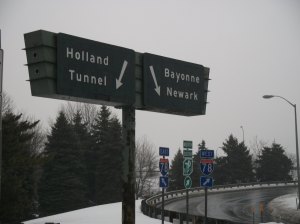
“New Jersey” by Flickr user Doug Kerr, CC BY-SA 2.0
Unsurprisingly, these shows’ centering of middle-class whiteness and its sonic registers ignores the disparity that exists across New Jersey’s geographies. While the state is one of the nation’s wealthiest, it’s also home to poorer cities of color that continue to suffer from the effects of suburbanization and neoliberal urban development. For example, scholars such as Kevin Mumford and Ana Y. Ramos-Zayas show how a city like Newark (a frequent setting on The Sopranos) has been heavily shaped by inequitable and volatile racial politics. And yet, the shows examined here eschew these socioeconomic and racial differences, erasing New Jersey’s communities of color from the state’s cultural discourses.
In an episode of HBO’s Boardwalk Empire, set in Atlantic City during Prohibition, Irish immigrant Margaret Schroeder expresses her fear that her Irish accent makes her “sound like an immigrant,” to which city treasurer Nucky Thompson responds, “But we’re all immigrants, are we not?” While his response echoes the assimilationist myth of the U.S.-as-melting-pot, it hits on something precise about New Jersey: as the state with the third-largest immigrant population, the homogeneity of the region’s accent is largely a construct. While contemporary television presents audiences with an all-encompassing Jersey accent, in actuality, the state’s diversity makes it nearly impossible to pin down exactly what New Jersey “sounds like.” Examining New Jersey’s representations in popular television reveals how the accent has become one of the state’s most prominent and recognizable features, and shows how these representations have the potential to reductively categorize an entire population.
—
Featured image: “Memorial Day Weekend” by Flickr user SurFeRGiRL30, CC-BY-2.0
—
Shannon Mooney is a PhD student in English and American Studies at the University of Massachusetts Amherst. She received her M.A. in English from the University of Connecticut in 2018. Shannon studies contemporary multi-ethnic U.S. literature, television, and film, with a focus on cultural geography and critical race theory. Her work examines how multi-ethnic writers and artists from New Jersey engage with the state’s natural and industrial landscapes to make sense of their positions as political and historical subjects. Shannon is also the Creative Director of Paperbark Literary Magazine, a publication rooted in sustainability and environmental justice.
—
 REWIND! . . .If you liked this post, you may also dig:
Teach Me How to Dougie Like A Mediocre White Man-Justin Burton
Speaking American-Leslie McMurtry
Vocal Gender and the Gendered Soundscape: At the Intersection of Gender Studies and Sound Studies — Christine Ehrick
Share this:


Current Top Posts





April 2021

January 2020

November 2019

October 2019

August 2019

April 2014

November 2017

March 2015

December 2017

October 2015
 Sounding Out!
Recent Comments