
The Blue Notes of Sampling

 This is article 2.0 in Sounding Out!‘s April Forum on “Sound and Technology.” Every Monday this month, you’ll be hearing new insights on this age-old pairing from the likes of Sounding Out! veterano Aaron Trammell along with new voices Andrew Salvati and Owen Marshall. These fast-forward folks will share their thinking about everything from Auto-tune to techie manifestos. So, turn on your quantizing for Sounding Out! and enjoy today’s supersonic in-depth look at sampling from from SO! Regular Writer Primus Luta. –JS, Editor-in-Chief
—
My favorite sample-based composition? No question about it: “Stroke of Death” by Ghostface and produced by The RZA.
.
Supposedly the story goes, RZA was playing records in the studio when he put on the Harlem Underground Band’s album. It is a go-to album in a sample-based composer collection, because of the open drum breaks. One such break appears in the cover of Bill Wither’s “Ain’t No Sunshine”, notably used by A Tribe Called Quest on “Everything is Fair.”
.
RZA, a known break beat head, listened as the song approached the open drums, when the unthinkable happened: a scratch in his copy of the record. Suddenly, right before the open drums dropped, the vinyl created its own loop, one that caught RZA’s ear. He recorded it right there and started crafting the beat.
This sample is the only source material for the track. RZA throws a slight turntable backspin in for emphasis, adding to the jarring feel that drives the beat. That backspin provides a pitch shift for the horn that dominates the sample, changing it from a single sound into a three-note melody. RZA also captures some of the open drums so that the track can breathe a bit before coming back to the jarring loop. As accidental as the discovery may have been, it is a very precisely arranged track, tailor-made for the attacking vocals of Ghostface, Solomon Childs, and the RZA himself.

“How to: fix a scratched record” by Flickr user Fred Scharmen, CC BY-NC-SA 2.0
“Stroke of Death” exemplifies how transformative sample-based composition can be. Other than by knowing the source material, the sample is hard to identify. You cannot figure out that the original composition is Wither’s “Ain’t No Sunshine” from the one note RZA sampled, especially considering the note has been manipulated into a three-note melody that appears nowhere in either rendition of the composition. It is sample based, yes, but also completely original.
Classifying a composition like this as a ‘happy accident’ downplays just how important the ear is in sample-based composition, particularly on the transformative end of the spectrum. J Dilla once said finding the mistakes in a record excited him and that it was often those mistakes he would try to capture in his production style. Working with vinyl as a source went a long way in that regard, as each piece of vinyl had the potential to have its own physical characteristics that affected what one heard. It’s hard to imagine “Stroke of Death” being inspired from a digital source. While digital files can have their own glitches, one that would create an internal loop on playback would be rare.
*****

“Unpacking of the Proteus 2000” by Flickr user Anders Dahnielson, CC BY-NC-SA 2.0
There has been a change in the sound of sampling over the past few decades. It is subtle but still perceptible; one can hear it even if a person does not know what it is they are hearing. It is akin to the difference between hearing a blues man play and hearing a music student play the blues. They technically are both still the blues, but the music student misses all of the blue notes.
The ‘blue notes’ of the blues were those aspects of the music that could not be transcribed yet were directly related to how the song conveyed emotion. It might be the fact that the instrument was not fully in tune, or the way certain notes were bent but others were not, it could even be the way a finger hit the body of a guitar right after the string was strummed. It goes back farther than the blues and ultimately is not exclusive to the African American tradition from which the phrase derives; most folk music traditions around the world have parallels. “The Rite of Spring” can be understood as Stravinsky ‘sampling’ the blue notes of Transylvanian folk music. In many regards sample-based composing is a modern folk tradition, so it should come as no surprise that it has its own blue notes.
The sample-based composition work of today is still sampling, but much of it lacks the blue notes that helped define the golden era of the art. I attribute this discrepancy to the evolution of technology over the last two decades. Many of the things that could be understood as the blue notes of sampling were merely ways around the limits of the technology. In the same way, the blue notes of most folk music happened when the emotion went beyond the standards of the instrument (or alternately the limits imposed upon it by the literal analysis of western theory). By looking at how the technology has evolved we can see how blue notes of sampling are being lost as key limitations are being overcome by “advances.”
 First, let’s consider the E-Mu SP-1200, which is still thought to be the most definitive sounding sampler for hip-hop styled sample-based compositions, particularly related to drums. The primary reason for this is its low-resolution sampling and conversion rates. For the SP-1200 the Analog to Digital (A/D) and Digital to Analog (D/A) converters were 12-bit at a sample rate of 26.04 kHz (CD quality is 16-bit 44.1 kHz). No matter what quality the source material, there would be a loss in quality once it was sampled into and played out of the SP-1200. This loss proved desirable for drum sounds particularly when combined with the analog filtering available in the unit, giving them a grit that reflected the environments from which the music was emerging.
 On top of this, individual samples could only be 2.5 seconds long, with a total available sample time of only 10 seconds. While the sample and conversion rates directly affected the sound of the samples, the time limits drove the way that composers sampled. Instead of finding loops, beatmakers focused on individual sounds or phrases, using the sequencer to arrange those elements into loops. There were workarounds for the sample time constraints; for example, playing a 33-rpm record at 45 rpm to sample, then pitching it back down post sampling was a quick way to increase the sample time. Doing this would further reduce the sample rate, but again, that could be sonically appealing.
An under appreciated limitation of the SP-1200 however, was the visual feedback for editing samples. The display of the SP-1200 was completely alpha numeric; there were no visual representations of the sample other than numbers that were controlled by the faders on the interface. The composer had to find the start and end points of the sample solely by ear. Two producers might edit the exact same kick drum with start times 100 samples (a fraction of a millisecond) apart. Were one of the composers to have recorded the kick at 45 rpm and pitched it down, the actual resolution for the start and end times would be different. When played in a sequence, these 100 samples affect the groove, contributing directly to the feel of the composition. The timing of when the sample starts playback is combined with the quantization setting and the swing percentage of the sequencer. That difference of 100 samples in the edit further offsets the trigger times, which even with quantization turned off fit into the 24 parts per quarter grid limitations of the machine.
 Akai’s MPC-60 was the next evolution in sampling technology. It raised the sample and conversion rates to 16-bit and 40 kHz. Sample time increased to a total of 13.1 seconds (upgradable to 26.2). Sequencing resolution increased to 96 parts per quarter. Gone was the crunch of the SP-1200, but the precision went up both in sampling and in sequencing. The main trademark of the MPC series was the swing and groove that came to Akai from Roger Linn’s Linn Drum. For years shrouded in mystery and considered a myth by many, in truth there was a timing difference that Linn says was achieved by delaying certain notes by samples. Combined with the greater PPQ resolution in unquantized mode, even with more precision than the SP-1200, the MPC lent itself to capturing user variation.
Despite these technological advances, sample time and editing limitations, combined with the fact that the higher resolution sampling lacked the character of the SP-1200, kept the MPC from being the complete package sample composers desired. For this reason it was often paired with Akai’s S-950 rack sampler. The S-950 was a 12-bit sampler but had a variable sample rate between 7.5 kHz and 40 kHz. The stock memory could hold 750 KB of samples which at the lowest sample rate could garner upwards of 60 seconds of sampling and at the higher sample rates around 10 seconds. This was expandable to up to 2.5 MB of sample memory.
 .
.
The editing capabilities made the S-950 such a powerful sampler. Being able to create internal sample loops, key map samples to a keyboard, modify envelopes for playback, and take advantage of early time stretching (which would come of age with the S-1000)—not to mention the filter on the unit—helped take sampling deeper into the sound design territory. This again increased the variable possibilities from composer to composer even when working from the same source material. Often combined with the MPC for sequencing, composers had the ultimate sample-based composition workstation.
Today, there are literally no limitations for sampling. Perhaps the subtlest advances have developed the precision with which samples can be edited. With these advances, the biggest shift has been the reduction of the reliance on ears. Recycle was an early software program that started to replace the ears in the editing process. With Recycle an audio file could be loaded, and the software would chop the sample into component parts by searching for the transients. Utilizing Recycle on the same source, it was more likely two different composers could arrive at a kick sample that was truncated identically.
 Another factor has been the waveform visualization of samples for editing. Some earlier hardware samplers featured the waveform display for truncating samples, but the graphic resolution within the computer made this even more precise. By looking at the waveform you are able to edit samples at the point where a waveform crosses the middle point between the negative and positive side of the signal, known as the zero-crossing. The advantage of zero-crossing sampling is that it prevents errors that happen when playback goes from either side of the zero point to another point in one sample, which can make the edit point audible because of the break in the waveform. The end result of zero-crossing edited samples is a seamlessness that makes samples sound like they naturally fit into a sequence without audible errors. In many audio applications snap-to settings mean that edits automatically snap to zero-crossing—no ears needed to get a “perfect” sounding sample.
It is interesting to note that with digital files it’s not about recording the sample, but editing it out of the original file. It is much different from having to put the turntable on 45 rpm to fit a sample into 2.5 seconds. Another differentiation between digital sample sources is the quality of the files, whether original digital files (CD quality or higher), lossless compression (FLAC), lossy compressed (MP3, AAC) or the least desirable though most accessible, transcoded (lossy compression recompressed such as YouTube rips). These all result in a different degradation of quality than the SP-1200. Where the SP-1200’s downsampling often led to fatter sounds, these forms of compression trend toward thinner-sounding samples.
 .
.
Some producers have created their own sound using thinned out samples with the same level of sonic intent as The RZA’s on “Stroke of Death.” The lo-fi aesthetic is often an attempt to capture a sound to parallel the golden era of hardware-based sampling. Some software-based samplers by example will have an SP-1200 emulation button that reduces bit rates to 12-bit. Most of software sequencers have groove templates that allow for the sequencers to emulate grooves like the MPC timing.
Perhaps the most important part of the sample-based composition process however, cannot be emulated: the ear. The ear in this case is not so much about the identification of the hot sample. Decades of history should tell us that the hot sample is truly a dime a dozen. It takes a keen composer’s ear to hear how to manipulate those sounds into something uniquely theirs. Being able to listen for that and then create that unique sound—utilizing whatever tools— that is the blue note of sampling. And there is simply no way to automate that process.
—
Featured image: “Blue note inverted” by Flickr user Tim, CC BY-ND 2.0
—
Primus Luta is a husband and father of three. He is a writer and an artist exploring the intersection of technology and art, and their philosophical implications. He maintains his own AvantUrb site. Luta was a regular presenter for Rhythm Incursions. As an artist, he is a founding member of the collective Concrète Sound System, which spun off into a record label for the exploratory realms of sound in 2012. Recently Concréte released the second part of their Ultimate Break Beats series for Shocklee.
—
 REWIND!…If you liked this post, you may also dig:
“SO! Reads: Jonathan Sterne’s MP3: The Meaning of a Format”-Aaron Trammell
“Remixing Girl Talk: The Poetics and Aesthetics of Mashups”-Aram Sinnreich
“Sound as Art as Anti-environment”-Steven Hammer
Share this:

This Is How You Listen: Reading Critically Junot Díaz’s Audiobook
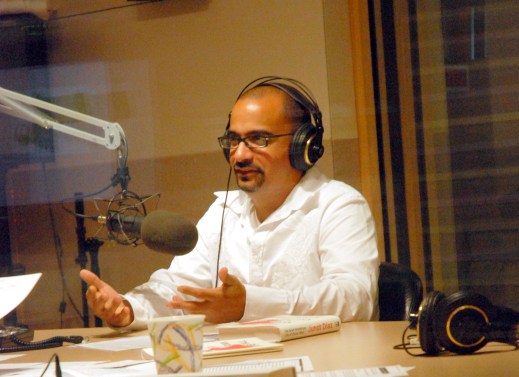
Last month, T.M. Luhrmann compared the experience of reading a written book versus listening to books in the New York Times article “Audiobooks and the Return of Storytelling.” Lurhmann points out how audiobook sales jumped 20% in 2012, whereas total industry book sales went down 1%. From the looks of it, books have benefited from audiobook sales, but in literary studies, print remains the primary vehicle for analysis. Might listening to an audiobook actually change how we critically read a text?
As I listened to Junot Díaz narrate This Is How You Lose Her (2012), the first book Díaz has read as an audiobook and the first book of short stories the author has published since 1996’s Drown, I wondered how his reading influenced how I interpreted the text. Díaz’s reading sounds less like regular speech and more like a performance, with its own cadence and rhythm:
This post approaches the audiobook as a text in itself, coming from a sound studies perspective. I attempt to conceptualize the idea of “close listening” as a methodology akin to “close reading” in literary studies. I listen for how Diaz reads the text but more specifically how the reading itself becomes a way of authoring the text. Ultimately, I argue that Díaz’s reading becomes a re-authoring the text—re-writing the text sonically. On a broader level, I hope to add to the conversation of what it means to read an audiobook, as Birgitte Stougaard Pederson and Ibsen Have brought up in “Conceptualising the Audiobook Experience.” Using This Is How You Lose Her, I show that reading an audiobook means engaging with the text from the angle of the ear, and that close listening can become an aural reading practice that relies not so much on the visual texts, but on aural cues from the narrator.
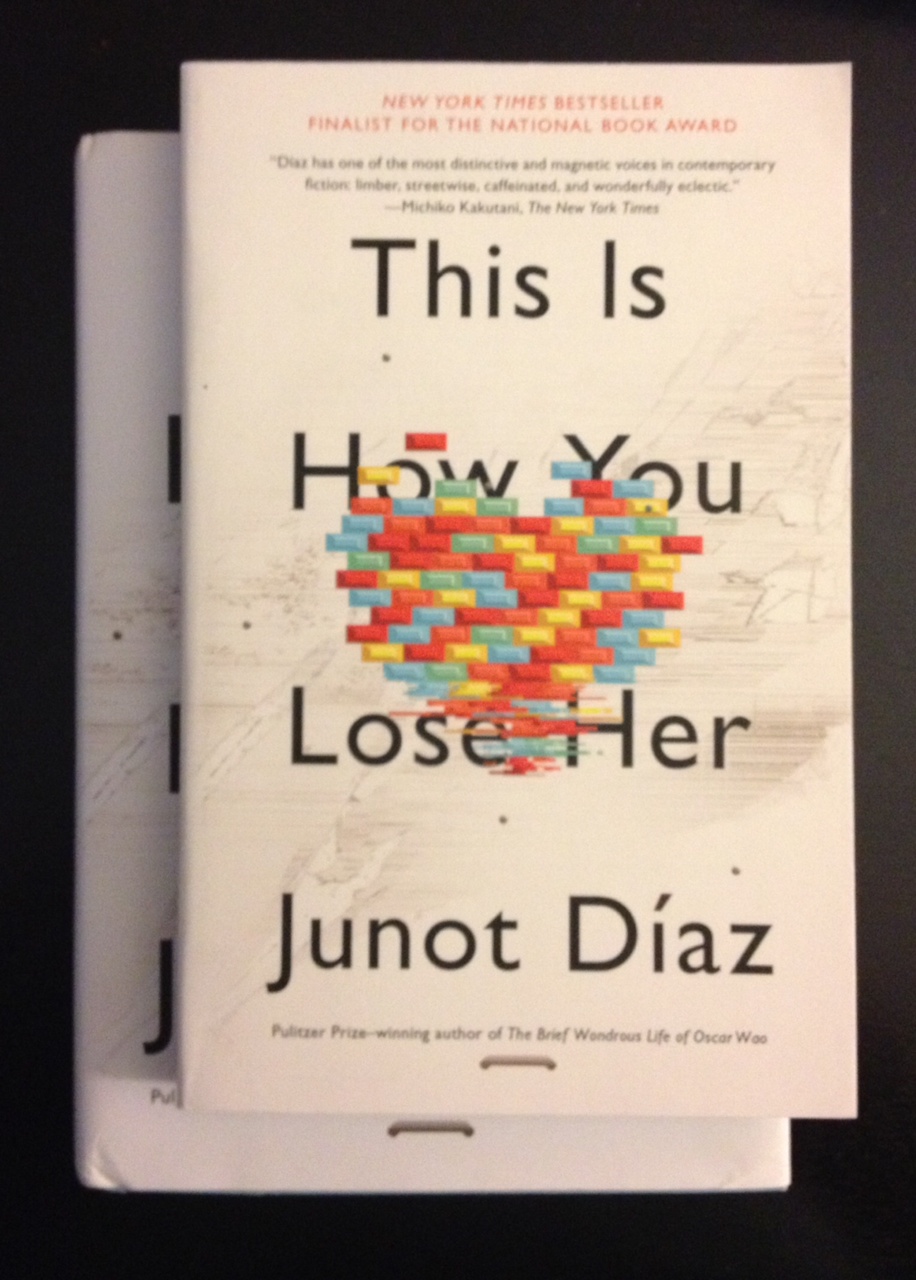
Not one but two (!) copies of This Is How You Lose Her
This Is How You Lose Her revolves around Yunior, a young Dominican immigrant who grows up in New Jersey and who ends up as a professor in Boston, and the many loves he has had or that he has encountered growing up. The stories trace his progress from a young, recently arrived Yunior, to a tenured, mature Yunior, showcasing certain relationships that influence how he relates to women—in sum, illustrating how he loses the women he loves. Throughout the short story collection, Díaz also calls attention to other relationships that may influence Yunior’s perspective, for example, his brother’s attachments with women, especially toward the end of his young life as he battled cancer, and his father’s relationship with his mistress, a Dominican woman who lived in New Jersey. At the end, Díaz illuminates how a mujeriego (womanizer) like Yunior comes to be; the short stories indicate that Yunior is as much a product of his environment as he is a seller of the merchandise.
Díaz is not a professional audiobook narrator. Although Díaz has done live readings, reading the full-length version of a book one has written is a different exercise. The Penguin Audio version of the collection is based on the actual short story collection (in other words, unabridged), so it does not contain additional stories or behind the scenes interviews. Technically, it is no different than the print version.
Listening to authors read their own work has value beyond the pleasure of hearing them read their text. Scholarly writing on audiobooks has emphasized the experience of listening to an audiobook for pleasure (like Deborah Phillips’ “Talking Books: The Encounter of Literature and Technology in the Audiobook” and James Shokoff’s “What Is An Audiobook?”), but it wasn’t until the 2011 edited collection Audiobooks, Literature, and Sound Studies that audiobooks were considered on their own instead of as extensions of the literature they were based on. The allure of doing this scholarly exercise with the audiobook version of This Is How You Lose Her is that Díaz’s delivery of the text is uncommon at the least.
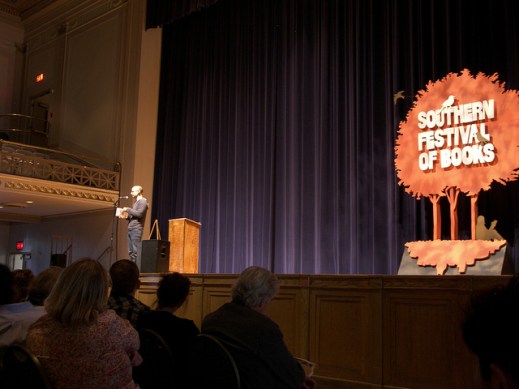
“Junot Diaz at the Southern Festival of Books” by Flickr user Stacey Kizer, CC BY-NC 2.0
Talking about Junot Díaz’s readerly voice requires to tune into conversations about his writerly voice. In many reviews of Díaz’s books, writers discuss how Díaz deftly conveys a writer’s voice in his text, indicating that his success is that his characters have a very clear voice—or at least Yunior does. Michiko Kakutani, for example, points out how “Junot Díaz has one of the most distinctive and magnetic voices in contemporary fiction: limber, streetwise, caffeinated and wonderfully eclectic, capable of conjuring for the reader everything from the sorrows of Dominican history to the banalities of life in New Jersey.” Although this quotation is in reference to Díaz’s second book, The Brief Wondrous Life of Oscar Wao, it describes Díaz’s writing in terms of his voice instead of, for instance, in terms of his use of metaphors or choice of subject.
Richard Wolinsky, in his Guernica interview with Díaz, sees an overlap between Yunior and Díaz: “He’s [Yunior] got a very distinct voice, and it’s a voice that’s informed by [Diaz’s] own reading, particularly science fiction and fantasy.” Although Díaz has pointed out that Yunior is loosely based on events that have happened to him, Wolinsky “hears” Díaz in his main character. The tone and the language Yunior uses is read as a reflection of Díaz.
Conversations about the voice of the writer point to a sensibility about sound, but are often limited to a written text. Anna Barnet, in an interview with Junot Díaz, states “His two principal linguistic registers (‘this kind of crazy Caribbean language and music’ and ‘this sort of African-American-infused American vernacular’) grind against each other along with the many other voices he ventriloquizes in his writing.” Barnet reminds readers that Díaz’s writing style is based in spoken language—particularly Díaz’s spoken language. This language of “voice” to describe a writer’s style (or, specifically, a writer’s ability to convey a clear sense of who the character is and/or their views) is commonplace but gives the impression that there is a sonic aspect to an author’s work, when in reality it is but a metaphor for something that occurs at the level of text.
A critical reading of a text that includes the audiobook rendition allows critics to add substance to those references to “voice.” In Junot Díaz’s case, it is possible that readers encounter him first through written text, and so have an expectation of what Díaz (or Yunior) would sound like live. In my textual analysis of eight audiobook reviews (and one book review that included a mention of the narration in the audiobook) most listeners showed some sort of discomfort with Díaz’s narration. One reviewer, for example, had issue with the “smoothness” of Díaz’s narration: “At times the reading was a little shaky and uneven”. Another reviewer stated “at times his cadence is choppy, with odd pauses and emphasis on strange words that detract from the overall experience.” Reviewers also had an issue with Díaz’s pace, which is characterized by pauses in places that many not seem normal in casual American speech. These statements hint at a “weird” quality in Díaz’s speech, something that does not come through when Díaz has a casual conversation. (Listen to this podcast episode of NPR’s Alt. Latino guest-starring Díaz and compare with this video of him reading part of This Is How You Lose Her.) Although one blogger pointed out that Díaz sounded “professorial” in the reading, others used the words “native,” “authenticity,” “Dominican” and even “Jersey accent” to describe how Díaz sounded. It is unclear how these reviewers define “native” or “authentic.”

“Junot Diaz” by Flickr user ALA The American Library Association, CC BY-NC-SA 2.0
Connecting sound to authenticity implies that Dominicans can only sound a certain way, or that the audio narration is lacking when it does not represent a “typical” Dominican voice. To the extent that Díaz is Dominican, his voice is of a Dominican male who has grown up in the Northeastern United States. His uneven audio narration creates a feeling of sonic unintelligibility in the listener, similar to the effect of including Spanish words in the written text. Díaz-as-narrator can make a listener uncomfortable, and by extension forces that reader to listen.
The sonic unintelligibility also relies on the text, on how Díaz plays with language by switching back and forth from English to Spanish. Díaz mentions in an interview with Marva Hinton that some readers are not happy with his choice of Spanglish in his writing: “There [are] folks who hear one Spanish word, and they’re convinced this is some sort of immigrant conspiracy” Farther down, in the same article, Díaz refers to his mix of Spanish and English (and a particular kind of Spanish and English at that, since he moves among Standard American English, African American Vernacular English, and Dominican Spanish) as “opaque language.” There’s a connection between the kind of “opaqueness” that Spanish gives and the unintelligible effect of Díaz read his work.
An example of how sonic unintelligibility operates in the audiobook is the first story, “The Sun, The Moon, The Stars.” This opener, told in first person, revolves about one of Yunior’s break-ups; Yunior and his girlfriend Magdalena, on whom he cheated, go to the Dominican Republic on a trip they had planned before she found out about the affair. It frames the book as being an in-depth analysis of loves lost, from the man who keeps losing them. It also sets the tone sonically for the audiobook reading: after the introduction of the book, a snippet of bachata music comes on, and then makes way for Díaz, who reads the title of the story. This is the pattern of the book: slices of bachata, followed by Díaz’s narration.
His voice is characterized by a slight sing-song cadence that is reminiscent of Dominican Spanish accent. If this were in Spanish, it might be easier to lose track of the cadence, but in English it sounds like a disembodied accent. I showcase the swing in Díaz’s narration by alternating capital letters and lower-case letters: “Her FAther, who usually would treat me like his HIjo, CALLS me an ASShole on the PHONE, SOUNDS like he’s STRANgling himself with the cord.” The voice seems to float for a while until Díaz arrives to the end of a paragraph or a series of sentences, and then it sinks. Moreover, this pattern does not change when Díaz switches characters: it’s hard to tell Yunior apart from Magdalena unless the reader pays close attention to when the narrator is switching characters and/or when the narrator uses a pronoun. The same effect comes from the odd pauses in the author’s narration: “Oh God, she wailed. Oh. My God.”
The choppiness and the emphasis in the reading are a way to dislocate the listener, in a similar way that Spanish phrases or lack of quotation marks in the text dislocate a reader who does not understand Spanish or who depends on the quotation marks to make sense of the prose. Also, this story focuses on Magdalena withdrawing from Yunior and not communicating with him. The tone, cadence, and sound of Díaz’s voice can be read to mirror the relationship between Yunior and Magdalena (and the other women in the text): the sonic unintelligibility is manifest at the level of plot through Yunior’s relationships.
Although many audiobook reviewers may consider the plot in their reviews, part of what makes an audiobook stand out is the performance of the text. I take my cues from audiobook reviewers and consider critically my listening experience of This Is How You Lose Her and how this can become the basis for a critical interpretation of the text. My analysis underscores that having an author read a text can provide a different way into analyzing the text and prompts readers to pay attention to sound. If, like Shokoff asserts, most audiobook readers listen to an audiobook while doing something else, Díaz shows that listening closely to the audio text can be as rewarding as reading a book.
—
Featured Image: “Junot Diaz” by WBUR Boston’s NPR News Station, Attribution-NonCommercial-NoDerivs License
—
Liana Silva-Ford is co-founder and Managing Editor of Sounding Out!.
—
 REWIND! . . .If you liked this post, you may also dig:
“‘Or Does It Explode?’ Sounding Out the U.S. Metropolis in Hansberry’s A Raisin in the Sun“-Liana Silva-Ford
“‘HOW YOU SOUND??’: The Poet’s Voice, Aura, and the Challenge of Listening to Poetry”-John Hyland
“Fade to Black, Old Sport: How Hip-Hop Amplifies Baz Luhrmann’s The Great Gatsby“-Regina Bradley
Share this:


Current Top Posts





April 2021

January 2020

November 2019

October 2019

August 2019

April 2014

November 2017

March 2015

December 2017

October 2015
 Sounding Out!
Recent Comments