
Fade to Black, Old Sport: How Hip Hop Amplifies Baz Luhrmann’s The Great Gatsby
When I heard of people flocking to recreate “Gatsby Dress” costumes for Halloween 2013, I couldn’t help but ponder the seemingly-perpetual cultural allure of F. Scott Fitzgerald’s The Great Gatsby, particularly its latest cinematic incarnation in spectacular Baz Luhrmann-style. More than a little of the momentum of the recent revival, however, had everything to do with the film’s soundtrack–executive produced by Jay-Z (who also executive produced the film)–that drew heavily on hip-hop. This sonic move was not without controversy, however, sparking intense debate when the film was released in May 2013. Take this line from Vice Magazine’s UK music blog Noisey (from a post snarkily entitled “Who Let The Great Gatsby Soundtrack Happen?”) that describes Kanye West and Jay-Z’s Watch the Throne album, from which many of the film’s songs are taken, as “a record that couldn’t be further removed from West Egg than a pauper trying to gain access to a Gatsby soiree.” This statement reveals more about this particular listener than it does about either the record or the film, which are intimately connected through the labor of Jay-Z and what I theorize here as a “sonic hip hop cosmopolitanism.”
I’ll admit that when I was first hip to The Great Gatsby my junior year of high school, I thought it was boring and couldn’t stand Tom or Daisy Buchanan or their rich white folk problems. I rooted for Jay Gatsby but couldn’t for the life of me understand why he was so sprung over Daisy, who wanted her daughter to be a “beautiful little fool” (17). But as I got older, I found myself returning to the novel time and time again, coming back to Gatsby like a forlorn lover and reconsidering what Jay Gatsby’s character represents: unrequited love, American idealism, (capitalistic) hustle, and (white) masculine performance. However, I’ve always been part of the camp that secretly hoped Gatsby was a black man passing for white, yearning for a life – and a woman – out of his grasp no matter how much “new money” he acquired.
It was not until Baz Luhrmann’s film adaptation of Gatsby that I realized how hip (hop) Gatsby really could be.

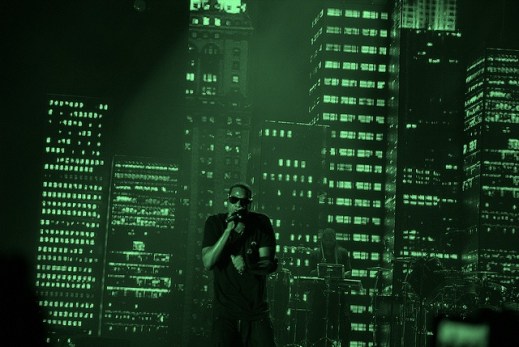
Image from Vulture’s “Quiz: Jay-Z Lyric or Line From The Great Gatsby?”
Luhrmann’s modernization of classic literary texts is not new; Romeo + Juliet (1996) got me through high school readings of Shakespeare’s play in ways Sparknotes could not. While Shakespeare’s words remained intact, the scenery and aura of the play burst to life on the big screen. Luhrmann uses in that film sonic cues of contemporary (youth) popular culture to make Shakespeare’s characters relatable. Verona is a hip, urban hub of violence that vibrates to grunge and pop artists such as Garbage, Everclear, and Quindon Tarver instead of mandolins and harps. The grittiness of grunge rock signifies the grittiness of Verona street life while Quindon Tarver’s angelic voice signifies the innocence and vulnerability of (first) love.
But Luhrmann’s Gatsby takes it up a notch, looking to hip hop culture as a bridge between the roar of the 1920s and the noise of the present. Aside from the literal presence of hip hop sound – mostly snippets from Jay-Z and West’s Watch the Throne – the materiality of hip hop sound also serves to update the Gatsby narrative. Consider how Gatsby’s parties are loud and bass-filled with a live jazz band. The loudness of the party and “surround sound” stereo sound of the film amplifies the vibrancy of the Jazz era while drawing in the audience with a contemporary interpretation of live parties seen and heard in contemporary hip hop culture. “The question for me in approaching Gatsby was how to elicit from our audience the same level of excitement and pop cultural immediacy toward the world that Fitzgerald did for his audience?” Luhrmann told Rolling Stone. “And in our age, the energy of jazz is caught in the energy of hip-hop.”
.
The film itself is stunning: vividly colored with panoramas and ground shots of New York City, Luhrmann’s film draws in an audience possibly unfamiliar with Fitzgerald’s novel. The film utilizes the more traditional jazz aesthetic that captures the novel’s initial element, but invokes hip hop to span a generational divide and update the (black) cool factor of the film. Indeed, both jazz and hip hop best signify black cool and its commodification into mainstream white America. For example, Norman Mailer’s discussion of the white hipster and Jazz aficionado as a “white Negro” is also tantalizingly useful in thinking of Gatsby as a black man passing for white. His affinity for Jazz and throwing jazzy parties incites the probability of Gatsby’s racial and social background. The film uses sound to create a hybrid of timeless black cool, while highlighting the presence of African Americans’ contributions to American culture. Hip hop’s birthplace and the portal for many immigrants into America, New York is arguably America’s most mythological city, grounded in both white and African American culture memory as such. Jay-Z’s own mythic rise to fame, wealth, and power in New York City–exemplified in some lines from 2009’s “Empire State of Mind,” “Yeah I’m out that Brooklyn, now I’m down in TriBeCa/ Right next to De Niro, but I’ll be hood forever/ I’m the new Sinatra, and since I made it here/I can make it anywhere, yeah, they love me everywhere”– grounds the film’s rags-to-riches mystique.
In addition to such extradiegetic associations, the film’s soundscape itself enthralls, with brassy, lively instrumented notes of jazz – which carried the sonic narrative of the 1920s – sounds of the hustle and bustle of urban spaces, particularly New York City, and hip hop. The film’s soundscape presents a hybrid of sonic black identities – jazz and hip hop – and uses their blended aesthetics to speak to the continued framework of black popular culture as a gauge of Americanism. In other words, the marginalized perspective is used to decide whether or not something is authentically American or not.
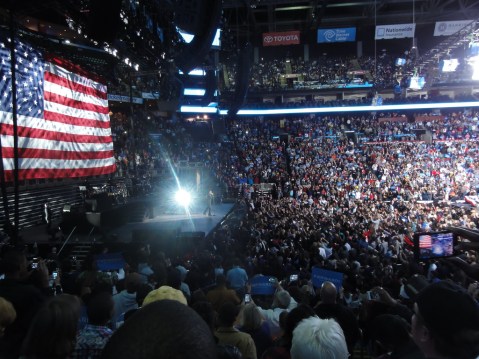
Jay-Z performs at Obama Pre-Election Rally 2012 in
Columbus, Ohio, w/ Bruce Springsteen, Image by Flickr User Becker1999
Hip hop aesthetics bridge old New York with the current New York as a foundation of Americanness. Gatsby bridges the old adage of New York as a space of opportunity with the familiar New York adage that Harlem-born and Mt.-Vernon-raised P. Diddy drops in Jermaine Dupri’s “Welcome to Atlanta,” “if you can make it here, you can make it anywhere,”a call back to Sinatra’s “New York, New York” that is also echoed by Jay-Z that forms a foundational trope of the film and the novel. A particular striking example of the merging of these adages is a scene in the novel where Nick and Gatsby are on their way to the city. They pass a car with black passengers and a white chauffeur:
As we crossed Blackwell’s Island a limousine passed us, driven by a white chauffeur in which sat three modish negroes, two bucks and a girl. I laughed aloud as the yolks of their eyeballs rolled toward us in haughty rivalry.
“Anything can happen now that we’ve slid over this bridge,” I thought; “Anything at all” (69).
While the novel does not describe a sonic accompaniment to Carraway’s observation of the black folks in the limousine, there is an inherent understanding of the “modish” fashion of the black folks as jazzy, as cool. In the film, there is an audible sound associated with the black folks. They are sipping champagne and listening to Watch the Throne. Although visibly symbolic of the 1920s – dressed in zoot suits and flapper dresses – the aural blackness associated with the scene suggests a merger of jazz and hip hop cool and cosmopolitanism.

Still from The Great Gatsby (2013)
In order to understand how hip hop updates the struggle for realness, entitlement, and respectability in the Gatsby film, it is important to return to the major sonic influence of the literal hip hop sound in the film: Jay-Z and Watch the Throne. Jay-Z’s work on the album raises questions of how hip hop culture impacts not only the American dream but the aspirations of mogul-dom seen and heard in the film and novel. Christopher Holmes Smith’s discussion of hip hop moguls in Social Text (Winter 2003) is particularly useful in teasing out the implications behind the hip hop mogul and such figures’ social-cultural responsibility to their respective communities. Holmes Smith argues:
The hip-hop mogul bears the stamp of American tradition, since the figure is typically male, entrepreneurial, and prestigious both in cultural influence and wealth. The hip-hop mogul is an icon, therefore, of mainstream power and consequently occupies a position of inclusion within many of the nation’s elite social networks and cosmopolitan cultural formations (69).
Jay-Z’s status as a hip hop mogul – serving both as a creative talent and corporate backer – lends credence to thinking about hip hop as a space of entitlement and a site of struggle to attain that entitlement. It is from this perspective that I think of Gatsby as a hip hop figure/mogul: his working class background, hyper-performance of white privilege, materialistic pursuit of wealth for visibility, and desperate need for approval as “authentic.” To borrow from rapper Drake, Gatsby “just wanna be successful.”
Mark Anthony Neal’s discussion of Jay-Z as a hip hop cosmopolitan figure in Looking for Leroy (2013) further enables an understanding of how Jay-Z lends his (sonic) hip hop cosmopolitanism to sonically navigate between hip hop’s working class aesthetics and his own sense of entitlement because of the way he mobilized those working class experiences to become wealthy. While the film does have performances by artists who are not considered hip hop – i.e. Lana Del Rey, Jack White, and Florence+the Machine – Jay-Z’s use of his own raps, including tracks from the Kanye West collaboration Watch the Throne suggests a “sonic hip hop cosmopolitanism” complements any sense of the film as a case study of white entitlement. Tracks like “100$ bill,” “No Church in the Wild,” and “Who Can Stop Me” both prop up and tear down Luhrmann’s visual rendition of Fitzgerald’s critique of the uppercrust of America as corruptibly entitled.
.
Baz Luhrmann’s adaptation of The Great Gatsby is an intriguing and useful tool through which to analyze the (in)consistencies of race and cultural authenticity in the United States. Both jazz and hip hop exist in the interstitial spaces that lie between black cultural expression and white entitlement to those expressions. Luhrmann uses hip hop’s sonic and cultural aesthetics to pump up the capitalistic and all-American narrative of “pull yourself up by the bootstraps” narrative in Gatsby by also declaring, “get yours by any means necessary.”
—
Featured Image adapted from Flickr User kata rokkar
—
Regina Bradley recently completed her PhD at Florida State University in African American Literature. Her dissertation is titled “Race to Post: White Hegemonic Capitalism and Black Empowerment in 21st Century Black Popular Culture and Literature.” She is a regular writer for Sounding Out!
—
 REWIND! . . .If you liked this post, you may also dig:
“‘I’m on my New York s**t’: Jean Grae’s Sonic Claims on the City”— Liana Silva
“I Like the Way You Rhyme, Boy: Hip Hop Sensibility and Racial Trauma in Django Unchained“– Regina Bradley
“The Victoria’s Secret Fashion Show and the Soundtrack of Desire“— Marcia Dawkins
Share this:

Experiments in Aural Resistance: Nordic Role-Playing, Community, and Sound

 Editor’s Note: Welcome to Sounding Out!‘s fall series titled “Sound and Play,” where we ask how sound studies, as a discipline, can help us to think through several canonical perspectives on play. While Johan Huizinga had once argued that play is the primeval foundation from which all culture has sprung, it is important to ask where sound fits into this construction of culture; does it too have the potential to liberate or re-entrench our social worlds? SO!’s Multimedia editor Aaron Trammell reflects upon using sound in role-playing games as a form of resistance. Ready, players?
—
When we play with sound, how does it influence the ways in which we understand, configure, and experience the world? I have already argued that non-diegetic sound can produce a visceral and emotive effect when connected to player interaction within a game world, that sounds are often structured within games to construct a sort of feedback between player and system, and that often within this feedback loop the narrative voice perpetuates problematic tropes of sexism and racism through its scripting. While I focused on the often dystopic production efforts of large and middle sized game companies in those prior essays, here I will be focusing on autonomous and grassroots examples of how sound is used as a way to stage social experiments which resist these often hegemonic ways that these dominant narratives constrict our views of the world.
Role-playing games, the focus of my post today, offer a more viable path of social resistance than better-known video games. Nordic larp style-games, for example, are written and played within not-for-profit communities, and they utilize themes of social inequality, transformation, and activism within their very scripts. Second, role-playing games, unlike computer games, do not require that their developers are able to code. Instead, games are often circulated by word-of-mouth, or in script format through player communities. In this sense, the genre itself is untethered from many of the problems of consumer capitalism. Many underground role-playing games are designed both around social issues and for local community needs as opposed to the market demands that necessitate big budgets, big programming teams, and few risks in the video game industry today. Finally, because role-playing games necessitate neither big budgets, the ability to code, nor mass audiences, they are an ideal site wherein game designers and referees can stage social experiments that speak to the unique wants and desires of the communities within which they are run.
In The Larpfactory Book Project, a forthcoming book containing several ready to play examples of Nordic larp (a big shout out to Lizzie Stark for hooking me up with an advance copy of this portion of the manuscript!), larpwrights Matthijs Holter and Fredrik Hossmann propose a game entitled “Before and After Silence,” focused on thinking through the collective experience of silence. From the game description:
In a world of more and more sound, silence is becoming more valuable. Before and After Silence is about limitations and listening, and about doing almost nothing. It is non-verbal and uses silence as its starting point. It is about shifting the point of view from “what is” to “what is not,” about shifting the focus from “the sounds” to “the spaces between the sounds,” from “the actions” to what is “between the actions,” and to “what is not done.” Rather than playing characters, we examine how we look at ourselves and how different filters can change how we see ourselves and others.
The game is structured as a social experiment for five to twelve players who are made to select two cards, one of which prompts players with an action they must complete only once during the hour of silence (one example reads “Go over to someone and whisper something in a language you don’t know”), and another which prompts players with a setting through which they should interpret the actions of the other players in the room (one example suggests a player imagine themselves in a community of prisoners, another makes a player imagine themselves as one in a society of telepaths). Before the game there are a set of workshops aimed at orienting players to the scope and silence of the game, and afterward there is a debriefing session where players compare their experiences of silence during the game.

Tons of great examples of work in the Nordic larp genre are in this book. Image borrowed from FransBadger @Flickr.
Unlike American larps, which often take place in high-fantasy settings and direct their action around combat scenarios, Nordic larps often focus on the everyday and comparatively mundane, and as such tend to be more concerned the problems of the everyday as well. Even those that take place in more exotic environments, such as System Danmarc, a game set in the cyberpunk future of Copenhagen, engage players in real issues regarding class and poverty. After living in a shanty-town simulating the future streets of Copenhagen for a week of game-time (In Nordic-style larps, game-time is often equivalent to real time, and so a week in-game is equivalent to a week out of game) players are shown a documentary about the actual slums of Copenhagen where they realize that their experience within the space of play was made to mirror the experience of those struggling with the these very issues in the real world.
In the case of “Before and After Silence,” it is interesting to consider the ways in which the game designers here play with sound, and how these experiments in sonic game design might provoke new modes of subjectivity. As described earlier, players are both given a particular action and or noise to perform, but also are prompted with a way to imagine the actions that the rest of the players in the room are performing. The resulting group performance is an acid dream of sorts wherein each player is made to imagine the room’s soundscape in a very different way. Is the setting a long-lost silent film, or are you drifting through an ether of emotions and past romances? The game focuses on playing with silence in a way that makes the din of communication an unfamiliar and distant memory. The game affords players an opportunity to imagine the world sound. In doing this, “Before and After Silence” displaces the dominance of the voice as a mode of communication and through this questions the ways in which we imagine the world.
Not all is perfect, however, in this utopia of resistance. As Lisa Blackman (2009) argues in her essay “Embodying Affect: Voice-hearing, Telepathy, Suggestion and Modelling the Non-Conscious,” play with the exchange of subjectivities and sound marks an ontological shift from a praxiology of what bodies are to what bodies can do (p. 170). Moving forward from her work in understanding the ritual practices of voice-hearing communities, Blackman explains that similar forms of sonic play (including play with silence) allow for the experience, embodiment, and trade of desire, fear, and trauma. In the context of “Before and After Silence,” this means that as players sculpt and adjust the sonic space of the room, they run the risk of also shaping and altering each others psychic conditions, in unpredictable and perhaps dangerous ways.
The conflation which occurs between these spaces of real emotion and play emotion is, in fact, well documented, and referred to in larp communities as “bleed.” As role-playing scholar Sarah Bowman (2013), explains in her essay “Social Conflict in Role-Playing Communities: An Exploratory Qualitative Study,” even though bleed does occasionally create rifts in relationships (some participants that she has interviewed reported in-game events disturbing their out of game relationships), others seek it out as a form of extreme play. For this reason Nordic larps require ethical behavior on the parts of their players, and because of the nature of the psychic and social sculpting which can occur within the play spaces of the game, the possibility exists that a single unethical player could create a negative and perhaps concerning experience for many others. That said, there are several ways the community mitigates the possibility of this problem including meticulous casting processes, before-game workshops, after-game debrief sessions, and safe words for use during play.

Players debrief after a game. Image borrowed from Fiezi @Flickr.
“Before and After Silence” is a valuable cultural artifact that lies at the intersection of scholarship on sound studies and serious play. At the same time that it promises several new ways to think through how sound, communication, and silence influence the how we frame and approach the world, it also raises deeper questions regarding the nature of social control and the viability of autonomous modes of organization. As silence allows players to explore and interact with a world where the soundscape takes on an increased prominence, do sexist, racist, and homophobic modes of socialization still manage to creep into the play space? And does the voice, along with its physiological and cultural embodiment of race, class, and gender, offer an escape from these experiments in silence if and when they turn dystopic?
—
Featured image: “Larp” by Flickr user marten vaher, CC-BY-NC-SA 2.0
—
Aaron Trammell is co-founder and Multimedia Editor of Sounding Out! He is also a Media Studies PhD candidate at Rutgers University. His dissertation explores the fanzines and politics of underground wargame communities in Cold War America. You can learn more about his work at aarontrammell.com.
—
REWIND! . . .If you liked this post, you may also dig:
Goalball: Sport, Silence, and Spectatorship— Melissa Helquist
GLaDOS, The Voice of Postfeminist Control— Aaron Trammell
Video Gaming and the Sonic Feedback of Surviellance: Bastion and the Stanley Parable— Aaron Trammell
Share this:


Current Top Posts





April 2021

January 2020

November 2019

October 2019

August 2019

April 2014

November 2017

March 2015

December 2017

October 2015
 Sounding Out!
Recent Comments