
Won’t Back Down: Tom Petty, Jason Aldean and Masculine Vulnerability

DOI: https://doi.org/10.59350/efhba-3h796
October 2017: a week after a Las Vegas gunman killed 58 people at an outdoor festival during a Jason Aldean set, Aldean squared up to the Saturday Night Live mic and soldiered through then-recently deceased Tom Petty’s “I Won’t Back Down.” In a short statement before the song, Aldean mentioned that he was “strugglin to understand what happened that night,” and he reiterated this general sense of confusion about what to make of everything in ensuing interviews. It’s unsurprising that Aldean struggled to make sense of the shooting; traumatic experiences like the one he and his audience endured often don’t fit into any ready-made understanding we have about the world. But Aldean, who seemed uncomfortable publicly displaying the kind of emotional vulnerability the trauma produced in him, was eager to resolve the dissonance: with platitudes like “be louder than the bad guys,” with assurances that “when America is at its best, our bond and our spirit – it’s unbreakable,” with an admission of his own hurt only as an empathic response to others’ rather than as his own, and with a cover song borrowed from one of his idols. Here, I’m listening to the compensatory work the cover of “I Won’t Back Down” performs in the face of the kind of vulnerability Aldean wrestles with in the wake of violence. To hear this as clearly as possible, I’ll contextualize Aldean’s performance by comparing it to a similar use of the song by Tom Petty 16 years earlier, then contrast it with Ariana Grande’s performance of “One More Time” at her One Love Manchester benefit a few months before the Las Vegas shooting.

Though the song’s titular line, “I won’t back down,” is a fairly direct lyrical idea about maintaining one’s resolve, the rest of the song still manages to paint a rather vague picture. The singer isn’t backing down, sure, but beyond “a world that keeps on pushin [him] around,” there aren’t many specifics about what he’s not backing down from. This is a kind of pop genius: capture a core sentiment that registers with a large audience, then present it in ambiguous enough terms that listeners can fill in the blanks with their own very personal experiences. So, despite Petty’s own analysis that he “laid [the song] out, you know, with no ambiguity at all,” “I Won’t Back Down”’s lyrics are incredibly broad, leaving space for practically anyone to insert themselves into the role of protagonist. Your boss might be a jerk, but you won’t back down. Your employee might think you’re a jerk, but you won’t back down.
Moreover, the sound of the song undermines even its most resolute lyrics. When Petty sings “I won’t back down,” which he does often in the verses and the hook, he scoops all around the pitches of “won’t,” “back,” and “down” so that they sound more interrogative than declarative. Rhythmically, these words sit on weak beats and upbeats in the verses, and in the chorus, the final word, “down,” comes just before – not on – a strong downbeat (see figure below). The effect of the syncopation is similar to the effect of Petty’s pitch bends; lyrical resolve becomes musical uncertainty. Finally, George Harrison’s guitar solo – as George Harrison guitar solos tend to do – plays pensively with the song’s forward momentum, again reining in the lyrics’ more direct message. In all, “I Won’t Back Down” works in a good deal of uncertainty that makes it unclear exactly what the threat is and whether the singer really is as resolute as he’d like us to believe.
| + | 1 | + | 2 | + | 3 | + | 4 | + | |
| verse | I | won’t | back | down | |||||
| hook | I | won’t | back | down |
What a song means or how it works changes with the times, though, and the defiance lurking in the lyrics of “I Won’t Back Down” crystallized after the destruction of the Twin Towers on September 11, 2001. When Petty performed “I Won’t Back Down” at the benefit concert America: A Tribute to Heroes on September 21, the context of a nation rallying around itself to defeat some yet-unknown foreign enemy overwhelmed any of the sonic signifiers that might otherwise temper the song’s resolve. This concert, which was aired virtually on every channel to a country still reeling from a collective trauma, subsumed Petty’s vocal scoops, the lyrics’ offbeat kilter, and the guitar’s sanguine solo under the clarity of a lyrical sentiment that aligned neatly with the politics of the moment: the US won’t back down. The shift in focus in “I Won’t Back Down” just after September 11 is similar to a dolly zoom effect: the threat referenced by the song’s lyrics feels as if it comes nearer and into sharper focus even as the protagonist broadens from an individual to a collective identity.
This sort of shift in the song’s narrative tracks with Christine Muller’s account of the overarching changes in cultural narratives that happened in the wake of the Twin Towers’ destruction. In September 11, 2001 as Cultural Trauma (2017), Muller argues that the broad perception of the fracture of the “American Dream” – “good things happen to good people, and bad things happen to bad people…come to the United States, and you will have opportunity; work hard, and you will succeed; follow the rules, and you will be rewarded” – harkened the rise of cultural media focused on “no-win scenarios…a fascination with anti-heroes who do the wrong things for the right reasons” (9-10). In the case of “I Won’t Back Down,” a song that was once broadly resolute and unfocused on any particular foe, sung by an artist who sent a “Cease and Desist” letter to George W. Bush when the then-candidate used the song for his presidential campaign morphed into an anthem that became narrowly resolute in the face of a named threat (“terror”), woven into a larger political tapestry that aided in the demonization of Muslims and the Islamic countries targeted by the “global war on terror” – an interminable war fought for vaguely defined reasons started at multiple sites by the same Bush Petty had previously defied.
Aldean’s Saturday Night Live performance 16 years later would emulate Petty’s, as faithful a cover as Aldean and his band could do. Though his vocals lack Petty’s high-end nasal clarity, Aldean dutifully hits all the scoops, honors the syncopations, and even yields to a guitar solo that follows George Harrison’s lead from decades previous. For Aldean, who was 40 at the time, and many millennials, the SNL performance would likely resonate with Petty’s iconic Tribute performance. And in the space of those 16 years, another frequently repeated line in the song would take on a political life of its own, recognizable to younger listeners who may not have immediately registered the post-9/11 context of “I Won’t Back Down.” While “I’ll stand my ground” would’ve been as broadly meaningful as “I won’t back down” when Petty released the song in 1989, the 2012 murder of Trayvon Martin pushed the idea of Stand Your Ground laws into public consciousness. These laws nullify one’s “duty to retreat,” to avoid violence if a safe passage away from a threat is reasonably available, instead allowing a person who feels threatened to use violence against their perceived threat. Research shows that Stand Your Ground laws tend to protect white people and endanger Black people, holding up long-standing social norms that cast Blacks as always already violent. So by the time Aldean sang “I’ll stand my ground, and I won’t back down” in 2017, the song had passed through social and political filters that gave its lyrics an anti-Muslim and anti-Black edge.

At first blush, all this context makes “I Won’t Back Down” a bizarre choice for Aldean to sing in response to the Las Vegas shooting. The identity of the gunman – a white man around retirement age – made him only a bit older than the demographic most responsible for mass shootings in the US. Instead of addressing the fact that mass shootings are a distinctly USAmerican problem, or that country music fosters a close and financial relationship with the NRA (which lobbies against the sorts of regulations that would curb mass shootings), Aldean remained unwilling to offer any thoughts on guns and gun control, even after experiencing the shooting firsthand. While we might reasonably excuse the singer’s lack of reflection on social and political problems in recognition that Aldean was surely traumatized himself, the singer’s performance of “I Won’t Back Down” still performs a specific kind of rhetorical work that relies on Petty’s performance at America: A Tribute to Heroes 16 years earlier. Specifically, Aldean’s rendition of “I Won’t Back Down” places the Vegas shooting in the same political arena used to demonize Muslims after September 11 and to criminalize Black people in political discourse surrounding Stand Your Ground laws. As I mentioned at the top of the essay, Aldean admitted and demonstrated his discomfort with the emotional vulnerability the shooting provoked in him, and I hear his performance of “I Won’t Back Down” as an effort to compensate for that public vulnerability by providing a retreat to a more familiar masculine pose: protective, resolute, stoic.

I published a piece that revolves around the idea of self-care with Sounding Out! in 2017, and one of the two central musical examples I consider there is Ariana Grande’s performance of “One More Time” at the One Love Manchester benefit concert just after the Manchester bombing. Grande’s circumstances run parallel to what Aldean would face a few months later: a traumatic act of violence that disrupted, injured, and killed the artist’s fans as the terror of the event rippled through the community. The two performances are gendered completely differently, however. Grande sings “One Last Time” surrounded by other musicians she invited to participate in the benefit concert. She frequently chokes up and relies on her fans to carry the song forward. She offers no answers or solutions beyond sentiments of love and the need to hold one another close in times of crisis. Grande’s is a performance of feminized care that contrasts sharply with Aldean’s masculinized resolve. Unwilling to publicly grapple with the emotional vulnerability created by the Vegas shooting, Aldean retreats from any public displays of grief and settles into an expression of care rooted in aggressive defense. His performance of “I Won’t Back Down” compensates for the feminized vulnerability triggered by the gunman and provides a masculine space for defiance that shifts attention away from white criminality and toward the US’s usual suspects: Black people and Muslims.

Saturday Night Live has scrubbed the internet of any full videos of the performance (the single is available on Spotify), but we can see and hear Aldean running through the same rendition a couple weeks later at the Louisville Yum! Center. It’s worth noting how Aldean embodies the resolve of the song’s lyrics. While Petty always approached a microphone like he was going to whisper something in its ear, his shoulders slouched and knees bobbing to the beat, Aldean squares his shoulders, plants his feet to form a broad base, and confronts the mic straight on. Some of this boils down to style. Jason Aldean’s stage presence is different from Tom Petty’s. But it also captures the distance “I Won’t Back Down” has traveled since the late 1980s, from a largely empty signifier that listeners could fill with their own meaning to an anthem used for rallying listeners in the wake of mass violence. Here, feminized vulnerability and trauma are recast as masculinized aggression and resolve until the song fills with the politics of the moment: the US’s anti-Black, anti-Muslim refusal to back down from standing its ground.
_
Featured Image: “Tom Petty & The Heartbreakers, Oracle Appreciate Event “Legendary”, JavaOne 2011 San Francisco” by Flickr user Yuichi Sakuraba, CC BY-NC 2.0
_
Justin Adams Burton is Assistant Professor of Music at Rider University. His research revolves around critical race and gender theory in hip hop and pop, and his book, Posthuman Rap, is available now. He is also co-editing the forthcoming (2018) Oxford Handbook of Hip Hop Music Studies. You can catch him at justindburton.com and on Twitter @j_adams_burton. His favorite rapper is one or two of the Fat Boys.
_

REWIND! . . .If you liked this post, you may also dig:
SO! Reads: Hiromu Nagahara’s Tokyo Boogie-Woogie: Japan’s Pop Era and Its Discontents – Shawn Higgins
Spaces of Sound: The Peoples of the African Diaspora and Protest in the United States – Vanessa K. Valdés
SO! Reads: Shana Redmond’s Anthem: Social Movements and the Sound of Solidarity in the African Diaspora – Ashon Crawley
—
Share this:

Sonic Salvation: A Story of How Listening Can Change Over A Lifetime
DOI: https://doi.org/10.59350/f85hy-fak26
By the age of six, I could circumscribe my world in song. I was not particularly precocious — my world was just small. Ultimately, it would be fractured by its own rebellious genesis.
Two genres of folk music marked out the poles of my preciously tiny planet. Heaven’s jubilee rang in one ear: a cappella gospel, sturdily founded upon the biblical injunction to make melody in the heart. In the other ear, however, was the music of the devil himself: alcohol-drenched, two-stepping, hell-raising honky-tonk, enticing one to sin not just in the heart, but with the entire body. Together, they formed an eternally reciprocal refrain: Saturday night sin prompted Sunday morning renewal. There was little room for anything else, particularly dissent.
Sunday morning resounded with four-part harmony based on a shape-note system of musical notation, widely referred to as Sacred Harp. We sang again at our Sunday evening and mid-week services. Throughout the year, we also hosted regional “singings,” bringing together folks from other congregations, swelling our own sound by double. It was an easy form of music to learn by design, with its origins in early 19th-century America. Its strongest base was in the American South, and I inherited at least two generations’ worth of experience. It set the tone for my interactions with the world for the first three decades of my life.
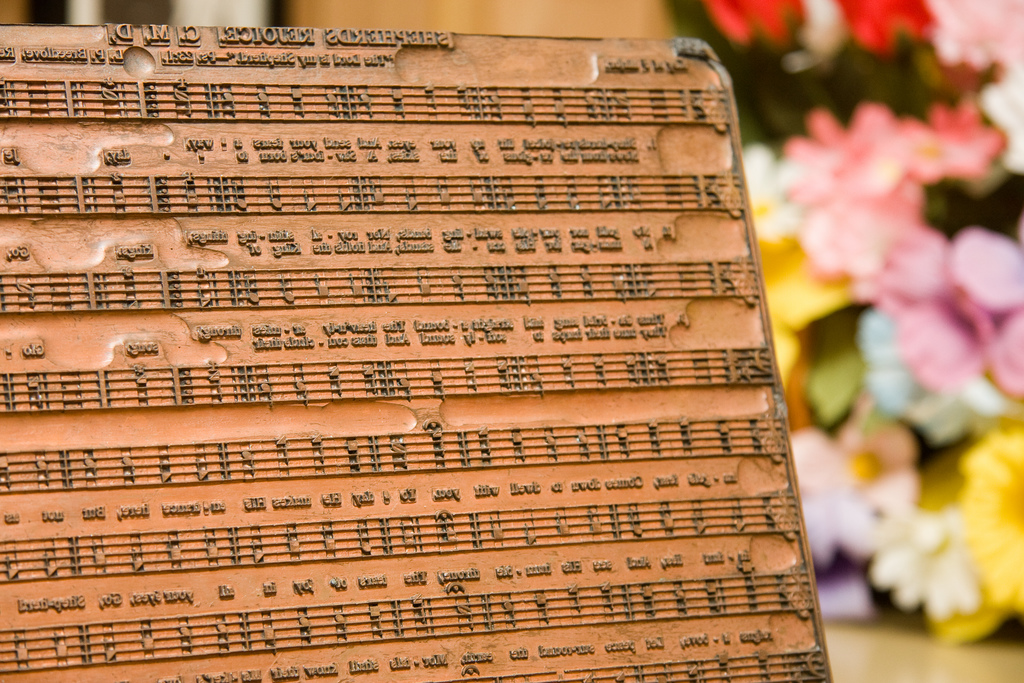
Musicologists have documented and analyzed Sacred Harp thoroughly, with Alan Lomax having had a particular fascination for it. He considered it as not only an extension of four-square Anglo forms but also as the crossroads where the Reformation met the Democratic Experiment. In Lomax’s view—expressed in a 1982 interview at the Sacred Harp Convention at Holly Spring, Georgia—European migration to colonize America broke the established authority of the church, leaving every person to forge a singular relationship with God. This supposition harmonizes perfectly with the views of the congregational church I attended. We had no hierarchy, no choir, no piano. Every man, woman, and child added their voice, as best they knew how, to raise an egalitarian song of praise. Songs such as “This World is Not My Home,” “The Glory Land Way,” and “Blessed Assurance” exemplify the form: simple rhyme schemes; closely-yoked shifts in harmony and rhythm; and southern gospel’s initial shunning of poly-rhythms or syncopation.
For me, Sacred Harp music created an immersive and experiential soundscape; emotionally and spiritually motivating, it was the sound of temporal and eternal life. Like our singing style, our church service presented a model for our lives outside the sanctuary. “Trust and Obey” was a frequently sung hymn—and it summed up our approach to life in all matters. Obedience was expected, deviation discouraged.
Worlds away from my sheltered existence, leaders of the Civil Rights Movement embraced a cappella singing as a powerful means to encourage, motivate, and activate. In the 2009 documentary Soundtrack for a Revolution, U.S. Representative and civil rights icon John Lewis said, “It was the music that created a sense of solidarity.” His a cappella community was connected to the church and the streets, challenging the status quo, and seeking greater brotherhood. Mine was by the book, increasingly authoritarian, very narrow in scope and population.

To us, the New Testament authorized one and only one instrument for offering songs to God: the unaccompanied human voice. The root of this belief was a concise motto coined in the early 1800s by Alexander Campbell, a leader in the Second Great Awakening: “Where the Scriptures speak, we speak; where the Scriptures are silent, we are silent.” Applying this principle, then, the apostle Paul, in his epistles to the Ephesians and the Colossians, encouraged Christians to sing. But nowhere did he or another New Testament writer suggest using an instrument. This silence equals prohibition. It sets its own reality, ignoring abundant biblical evidence to the contrary: the Old Testament presents many examples of instruments used in worship, as does the New Testament’s Book of Revelations.
Our a cappella song service was, therefore, more than a sound—it was a belief system, a worldview in which other sounds or ideas were alien. We applied Campbell’s principle across-the-board, backing ourselves into corners: slaves were to obey their masters; wives were to submit to their husbands; children were to be fully subject to their parents. Questioning authority, let alone defying it, was strongly condemned by Paul in his letter to Christians in Rome: “Let every soul be subject unto the higher powers. For there is no power but of God: the powers that be are ordained of God. Whosoever therefore resisteth the power, resisteth the ordinance of God: and they that resist shall receive to themselves damnation.”
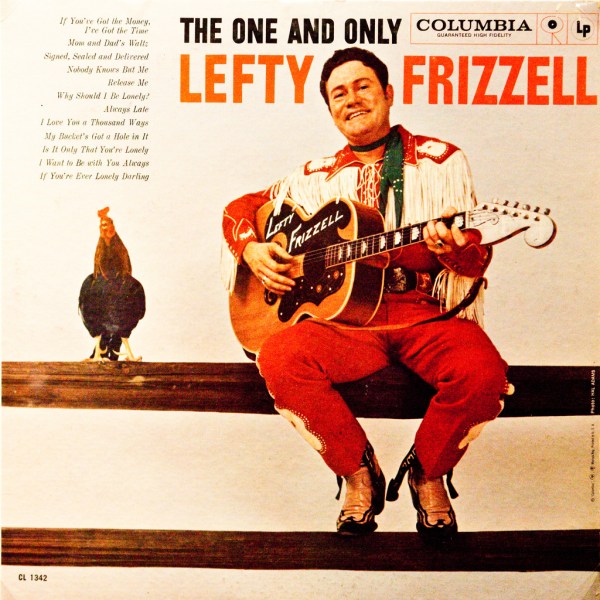
Alternately, classic honky-tonk’s twangy resistance seemed to defy the innovations and complexity of modern life. As I was growing up, the sinful songs of Ray Price, Lefty Frizzell, Webb Pierce, and George Jones flowed like wine from my family’s record collection and radio settings. Songs of murder, drunkenness, alienation, revenge, adultery, and the workingman’s blues are staples of the honky-tonk catalog. Its celebrated ethic of “three chords and the truth” favored a rural do-it-yourself ethic. My church’s music was both challenged and validated by this unlikely and unruly roommate; honky-tonk was a matched bookend for Sacred Harp.
For in the background of many of those honky-tonk sounds, whether they were about larceny, war, or revenge on the boss, I heard the same harmony that filled my church. In the 1950s or so, southern gospel groups such as the Jordanaires, Blackwood Brothers, and the Statler Brothers, began backing country music artists including Johnny Cash, George Jones, Tammy Wynette, and Gary Stewart. Their sonic presence lent an almost holy sanction to the commission of sin, as if Jesus and Satan met after-hours to share a drink and balance the books.
This sonic emulsification of sin and salvation formed my youthful identity and bracketed a very small existence. My world consisted of very gendered personal struggles: man vs. temptation; man vs. alcohol; man vs. boss; woman vs. womanizer. The solution provided for these struggles was always the same: the efficacious grace of God. All failings and victories were personal, not structural or systemic. The fight against personal sin was the only fight.
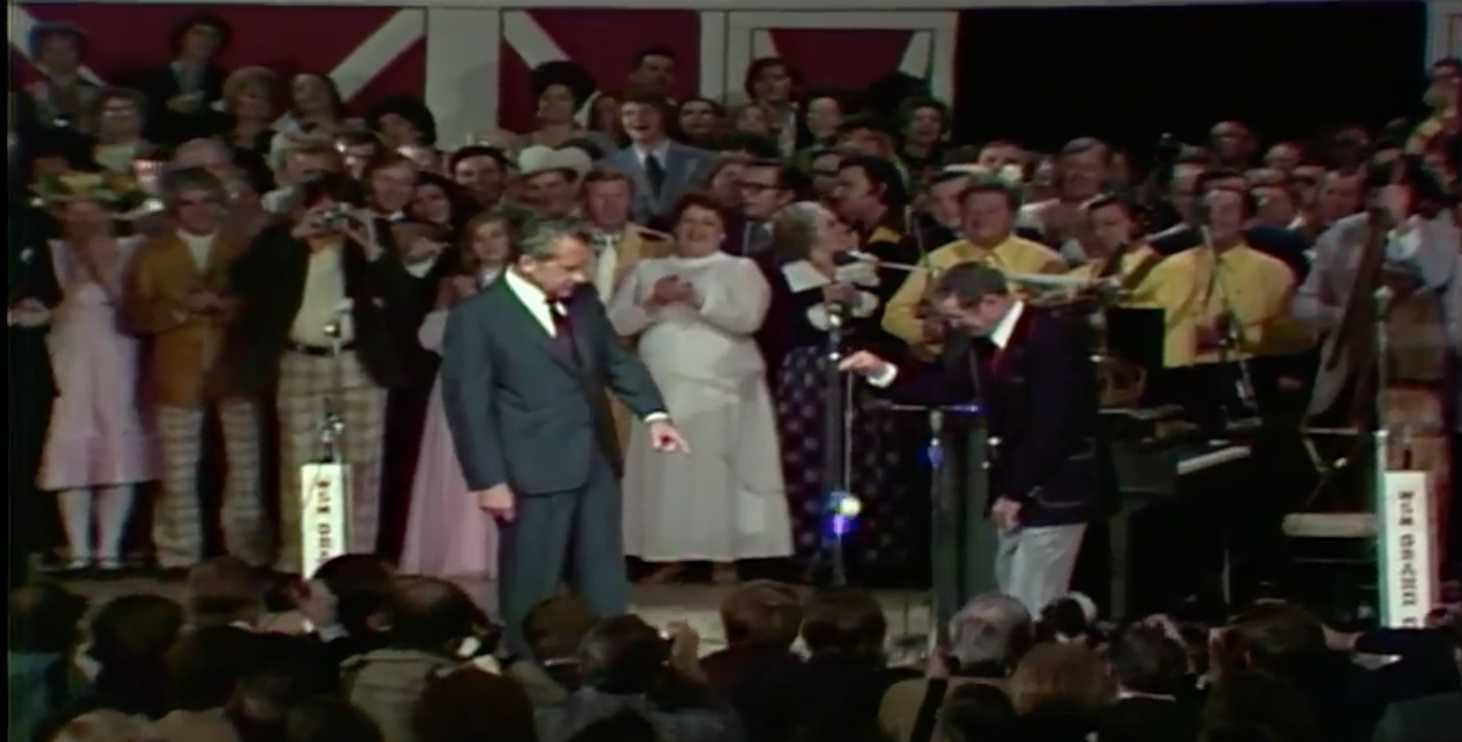
Southern gospel music and honky-tonk have enjoyed an institutional relationship since the founding of the Grand Ole Opry in 1920s, sanctioning the blending of reprobation and redemption. Though initially politically ambivalent, the Opry listed towards social conservatism during the 1960s—Johnny Cash’s nascent social awareness notwithstanding. In 1970, however, the Opry and the industry it represented found itself an unlikely accessory to Richard Nixon’s “southern strategy.” He declared October 1970 to be Country Music Month, and a few years later blessed the Grand Ole Opry with its first presidential visit.
Politically conservative messages had entered country airwaves during the late 1960s, epitomized, if not pioneered, by Bakersfield stalwart Merle Haggard. His “Okie From Muskogee” ridiculed hippies, dope smokers, draft dodgers, long-hairs, flag burners, and college activists, all within a 3-minute single format. Though ostensibly written as a joke, it struck a chord among conservative, Christian, country music fans. Sensing a market, Haggard followed up with the flag-waving “Fightin’ Side of Me,” wherein he further shames pacifists.
These songs contained the truth as I believed it in grammar school: protestors, adulterers, and dope smokers were all in defiance of God. Haggard’s refrain in “Fightin’ Side”—“if you don’t love it, leave it”—made sense to me, and was safely non-challenging. Conveniently, the religious body of which I was a member had, a generation prior to me, actively opposed pacifism.
A world composed only of personal demons, however, leaves little room for social issues. Being so long accustomed to seeing the sin in man left me unable to recognize the sin in the system. Sam Cooke’s great risk in recording “A Change is Gonna Come,” for example, was lost on me, even though we both shared a battle between religious and secular personas.
I never heard his call to address greater systemic problems such as racism, audibly or socially. Even as I entered my 20s, my white patriarchal religious sonic defense system kept the freedom struggles of people of color at bay. Even if dissenting sounds managed to sneak through–Marvin Gaye’s struggles in “Inner City Blues” for example—I quickly dismissed them as exaggeration or the natural outcome of personal sin. I could not process a sound which conflicted with my God-given world view. I saw only men and women avoiding their duty and surrendering to temptation.
My mother frequently said that the lives portrayed in honky-tonk songs were not her life. But in another sense, those desperate lives, and the more hopeful ones portrayed in gospel music, were our lives collectively. We were part of a greater social identity: Southern, white, Fundamentalist, change-averse, full of latent conflicts. Those sounds, rich with heritage and lived-in context, formed us. In other words, our vernacular limited our hearing. Our world was formed within a fixed sonic boundary, and we ignored, resisted and sometimes even combatted discordant sounds.
Within this soundscape, I had never heard of any march from Selma to Montgomery, not from church, family, the radio, or, sadly, even school. The larger movement of which it was a part—perhaps the biggest social movement of the 20th century—was inaudible and therefore irrelevant to me. When I did begin to hear of protests against white racial violence, I could only condemn anyone who defied authority. I did not know what to say about authority which abused the people. Raised to function in a law-and-order world, I could only repeat the Apostle Paul’s instruction that we all must obey authority or incur the wrath of God.

But thankfully, sound travels in subversive ways, such as through the transmitters of listener-supported community radio.
I found Dallas’ KNON completely by chance. Commuting to work through the city’s legendary rush hour, I’d get fidgety. While searching the dial, I heard a familiar song in an unfamiliar arrangement. I don’t recall the song now, but do remember its force: a honky-tonk classic played through a stack of Marshall amps, turned up to the proverbial ’11.’ Perhaps it was Leon Payne’s Lost Highway as rendered by Jason and the Scorchers—anarchistic, upending, challenging, it still carried enough familiarity to keep me listening. I stayed tuned in for the next song, then another. When the DJ, Nancy “Shaggy” Moore, signed off her show, I gave a listen to the next show—at least until they said something a bit too dissonant.
But the next day, I tuned in to Shaggy again. And I listened a bit longer when the next show came on. And even longer the day after that. Dallas at that time was wracked by racial strife, some of it focused on the politicized deaths of two police officers, one white and one black, in separate incidents. I had tuned out the duplicity, but KNON gave me reason to reconsider. City council member Diane Ragsdale, an African-American woman representing one of the city’s most trod-upon districts, refused to let the issue go. KNON provided the venue for her to express her outrage unmitigated, and to explain the inconsistencies in a way that an entitled white male suburbanite, such as I, could understand.
Tim Rice suggests that we are not free agents in the creation of our identities—but given the right stimuli, we will resist, to the point of rebellion, the personhood prepared for us. The latent heretical ethics of Sacred Harp and Honky-tonk finally responded to the sonic stimuli flowing through the breach, triggering an insatiable devil’s advocacy: “Prove yourself to me,” I said to everything I had once believed, religious faith included. St. John wrote in his First Epistle: “Beloved, believe not every spirit, but try the spirits whether they are of God.” This was to be the last biblical directive I would follow.
My radical shift in musical listening also greatly impacted my political, and cultural beliefs and listening practices, something which continued throughout my life. For example, I ended my professional career as well, having understood the devastating effects that high tech industries have on the environment and workforce. I traded a six-figure salary for minimum wage in foodservice. Not once have I looked back.
Kitchen work comes with immersive sound: machines hum and sometimes roar; the radio blasts through the static; humans must shout to be heard. Working throughout the western US, in a variety of independent restaurants, I learned to understand and speak Spanish. I participated in defying a language ban placed on my colleagues by an overbearing owner: I noted that she forbade speaking in Spanish, but not singing in Spanish. So sing we did, about needing a potato peeler, taking out the trash, and what we were going to do over the weekend.
As I worked my way up the ranks and crossed the country from California to Manhattan, I listened to the stories told me by immigrants from Mexico, Guatemala, Dominica, Morocco, South Africa. They shared their music with me, via radio, iPod, cassette, or any object we could plug into an overcooked boom box. Every song and conversation has pulled me into greater participation in their lives and the systemic issues faced by most of the world around me.
Dismantling one’s identity, regardless of how deliberately it is done, happens amidst lots of noise: illusions shatter, idols crash to the ground, walls tumble into rubble. Dissent comes in myriad expressions, and for me, it has come via my own three-chords-and-the-truth and through a multimedia socially-progressive dining event which I call Peace Meal Supper Club. Its very raison d’etre is to illuminate dissonance on issues such as the right to sanctuary, our diminishing seed supply, the plight of the rural poor, and other devastating threads of intersectionality. Music is a critical component of each event, as Otis Taylor, Lila Downs, and Caetano Veloso share playlist space with Manecas Costa and Majida El Roumi Baradhy. Old favorites like “Sixteen Tons” get their say, as well—for behind that song’s well-earned swagger is a system of devastating intersectional oppression that demands our action.
_
Featured Image: Image of a Stained Glass Crosley Cathedral, Image by Tubular Bob
Kevin Archer is a multi-media artist who left corporate security for a DIY life as a farmer, activist, educator, and chef. He’s planted gardens coast-to-coast, and washed his own sauté pans from Denver to Mendocino, Santa Fe to NYC, and random locations in between. Kevin’s current project is Peace Meal Supper Club, a series of immersive dining events which explore ecojustice, human rights, the capitalistic conquest of the seed and soil, and the power of progressive movements. He has written for Civil Eats, No Depression, Secular Web, and the Museum of Animals & Society. He has spoken on the intersection of food and social issues at numerous conferences within the Eastern US.
_

REWIND! . . .If you liked this post, you may also dig:
What is a Voice? – Alexis Deighton MacIntyre
“HOW YOU SOUND??:” The Poet’s Voice, Aura, and the Challenge of Listening to Poetry – John Hyland
The Sounds of Anti-Anti-Essentialism: Listening to Black Consciousness in the Classroom – Carter Mathes
The Listening Body in Death – Denise Gill
—
Share this:




Current Top Posts





April 2021

January 2020

November 2019

October 2019

August 2019

April 2014

November 2017

March 2015

December 2017

October 2015


Recent Comments