
The Magical Post-Horn: A Trip to the BBC Archive Centre in Perivale

Suddenly we heard a Tereng! tereng! teng! teng! We looked round, and now found the reason why the postilion had not been able to sound his horn: his tunes were frozen up in the horn, and came out now by thawing, plain enough, and much to the credit of the driver. —The Adventures of Baron Munchausen, 1865
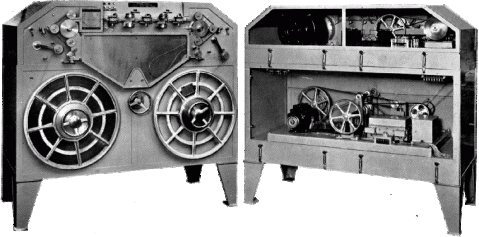
At the BBC Archive Centre in Perivale, London, the proverbial “weight of the past” becomes literal for researchers of sound history. Housed in a massive, unattractive hangar-like building in an industrial park to the northwest of London, the archives suit their environment, one which speaks of practical and solid shapes far more than the lyrical, dainty ivory tower. And by weight, I mean by serious, and sometimes dangerous, poundage: the very first machine created to record off of radio, invented around 1930, was a steel pedestal with bus wheel-sized reels on either side. Audio Coordinator of the BBC Archives, John Dell, explained that not only was this machine laborious to load, but it used magnetic steel tape as its recording surface, which could come free from the reels and lacerate incautious operators as it unspooled and bunched.
The weight of these objects, however, is also metaphoric. The earliest recording in my personal audio drama library, sourced off the invaluable Archive.org, is a 1933 episode of Front Page Drama, a dramatized version of an American Weekly Hearst publication. The past stands monumentally huge if this type of machine, the Marconi-Stille Wire Recorder, was the apparatus that allowed those 15 minutes of 1933 to be captured and, eventually, fed into my 2015 headphones as an MP3.
I listen to much of my audio drama, whether old and crackling like Front Page Drama, or new and podcast-y, while commuting, usually on the London Underground. The episode of Front Page Drama in question I heard during a marathon session when I knew very little could or would interrupt me: on an twelve-hour transatlantic plane ride. I quite like the audio-visual play between listening to audio drama that is new to me versus the familiar but never identical sights of the commute; as Primus Luta remarked in 2012, it’s rare for us to engage our full attention on the aural medium.
While listening to Front Page Drama and episodes of Lum and Abner on that flight, I had to wonder how I was prioritizing my listening time. Who had recorded these episodes from the 1930s? Who had later taken the trouble to digitize them and upload them to Archive.org? Why, for example, were these particular recordings freely available yet I couldn’t find an MP3 anywhere of texts I wanted to share more widely, such as Don Haworth’s On a Summer’s Day in a Garden (1975) or Angela Carter’s Come Unto These Yellow Sands (1978)? Both of these recordings are in the BBC back catalogue; I know, because the BBC supplied them to me—but only the basis of a visit to the archive.
Archive.org is bountiful and accessible, the Perivale archives much more exclusive, but both seem to lack curation. The only hope for accessing things like Haworth or Carter outside the British Library’s Sound and Moving Image Archives is that someday a rogue MP3 or BitTorrent will show up online. The archive does seem, in Neil Verma’s words, then, “transformed before dispersing in space, plucked from the air and mineralized like fossils” (Theater of the Mind, 227); like Primus Luta’s weighty but playful experiment, Schrödinger’s Cassette, which suspended music in concrete to be risked, or remain aurally untouched forever. This seems too often to be the impossible choice.
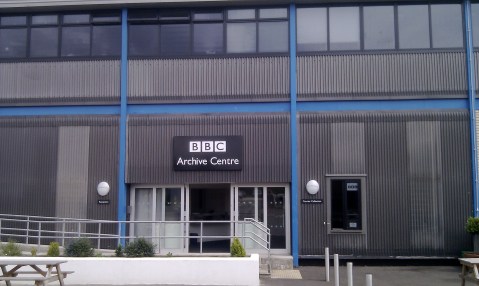
BBC Perivale Field Trip, Image by Flickr User Hatters! (CC BY-NC 2.0)
The BBC archive storage is eclectic and generally arranged for access by BBC staff rather than for researchers. The BBC Written Archives at Caversham are restricted to academics, and likewise, the speed of gaining access to sound files from Perivale is predicated on the amount of time BBC staff have to devote to it—naturally, the BBC’s own departments have priority, such as BBC Radio 4 Extra, the archival digital radio station, whose backlog of requests for digitised material from the Perivale archive apparently covers 20 pages. The sound collections consist of commercial recordings on shellac (90 RPM records) and vinyl (78 RPMs) as well as impressively dinner-plate sized compilation transcriptions which require a special turn-table on which to play and digitize them. The BBC Sheet Music archive is in Perivale, as well, with original handwritten scores filling shelves.
The second half of the British and Irish Sound Archives conference 2015 afforded a privileged glimpse of the archive storage and technical facilities housed on site. Most of my fellow attendees were archivists of one sort or another, asking detailed questions about transcription devices, fidelity, and storage. Having recently completed my PhD from Swansea University in English in radio drama, I had made countless requests to this very facility through the British Library’s Sound and Moving Image request service; now I, at long last, hoped to see where my digitised sound files were coming from. However, we weren’t shown any recordings made on tape cassette or CD but instead Betamax audio-only. Unseen, too, were the data banks holding all the digitised content, but what myself and my fellow archivists had mainly come to see were the tangible objects making this content possible.

78s at BBC Perivale, Image by Flicker User Hatters! CC BY-NC 2.0
In the physical copies of the Radio Times of the 1940s and ‘50s, also housed at the British Library at St Pancras (and now available, like all of the Radio Times up to 2009, on BBC Genome), there can be found a little asterisk in the listings for drama, which signifies that the drama was broadcast from a recording, rather than live. The later recording machines of the ‘30s through ‘50s, upon which these recordings would have been made, did not decrease appreciably in size, though perhaps in weight. “If I were to drop this,” Dell told us as he carefully handled a dark blue celluloid tube, about the size and circumference of a toilet paper roll, “it would bounce. I’m not going to drop it,” he added. Then the magic began: via a custom-made device, we heard a few bars of a music hall song from circa 1900. The recording was surprisingly clear. It was agonizing when Dell turned it off after only a few seconds.
There is something incredibly seductive about old recordings. In “The Recording that Never Wanted to Be Heard and Other Stories of Sonification,” from The Oxford Handbook of Sound Studies, Jonathan Sterne and Mitchell Akiyama question the desire for “sonification” of ever-older recordings, especially when such desires manifest in the creation of a digital sound file in 2008 for “the world’s oldest recording,” a phonoautogram from 1860, which was nevertheless never intended to be played back—the phonoautograph was intended as a device to make the aural visual (555). Radio drama writer Mike Walker really summed up the seduction of old recordings for me in his 2013 BBC Radio 4 ghost story The Edison Cylinders, with a character who is seduced as a scholar and as a participant in a time-traveling mystery by old recordings: a sound engineer in need of money, she agrees to digitize what seem like boring diary entries from a British imperialist, only to be intrigued by his Victorian domain beyond her rather empty modern existence. Unfortunately for her, these particular recordings are reaching beyond the grave to try to kill her.

Edison Cylinder Exposed, by Flickr User fouro boros, CC BY-NC 2.0
Although they do reach out from the grave, most early sound recordings aren’t out to kill you. They do however, present common and vexing issues of authenticity. By this, I mean specifically the provenance of the recording—is the recording of who or what it says it is? On the first day of the conference, Dell regaled us with tales of two cylinder recordings surfacing in the mid-twentieth century, of William Gladstone giving a speech. The words of the speech were identical, but the voices were completely different. Who was the real Gladstone? How could you authenticate the voice of a dead person? Dell further deepened the mystery by telling us the tale of two boxes of wax cylinder recordings in the Perivale archive, whose provenance is torturously (and tantalizingly) unclear. We glimpsed these mysterious, yellow-cream-colored cylinders, somewhat wider and fatter than the celluloid tubes, in situ, but were they original Edison cylinders from the 1880s? The piercing desire to believe these cylinders might contain the voices of Gladstone, the future Edward VIII, or even Henry Irving, are potentially “perils of over-optimism,” as Dell puts it.
All the archivists at this event referred to the serendipity of discovering surprises on recordings. Simon Elmes, whose official title reads “Radio Documentarist, Creative Consultant, and Former Creative Director, BBC Radio Documentaries,” made this manifest as he discussed a subject treated in his documentary from 2005, Ambridge in the Decade of Love. The Archers—an exceptionally long-running BBC radio soap which conjures up visions of rural Englishness and persists among a very dedicated, though mostly older, fan base—like much radio drama and emblematic of gendered attitude toward radio soaps, was not recorded in its first few decades.

Empty Shelves at BBC Perivale, Image by Flickr User Bill Thompson, Image cropped by SO!, (CC BY-NC-ND 2.0)
Likewise, anyone researching radio drama before the 1930s is playing a game of roulette; whether any scripts survive will depend entirely on the literary reputation of the author who may have had enough clout to publish them in book form. Even in the case of Lance Sieveking, the acknowledged creative aesthete behind early BBC radio drama, we lack concrete evidence of his most important work, The End of Savoy Hill (1932). And The Truth About Father Christmas (1923), the first original drama written specifically for British radio? Forget about it—it was made for children’s radio.
To return to The Archers, though daily 15-minute scripts were being churned out by Ted Kavanagh from the first years of the 1950s, the broadcasts themselves went missing into the ether (after all, no one suspected the show would still be going after sixty years). Transcription discs, meant for an overseas market, were found in a box in the BBC Archives, giving a reasonably complete overview of The Archers during the 1950s and ‘60s. Elmes was ebullient about this discovery.
While I got the general sense that the other archivists at the conference were amused but indifferent toward this particular trove, to me it was inspiring. I believe the future of audio drama will rely more and more on serials, so the rediscovery of these Archers episodes epitomizes to me the past, present, and future of audio drama in that it speaks of audience involvement and even audience interaction or co-production, which seems key for audio drama going forward, and the aspect of serialization which has vastly overtaken the single drama on television if not on radio.

Harry Oakes as Dan Archer and Gwen Berryman as Doris Archer, 1955.
Nevertheless, even if pursuit of these aural rainbows is a foolish one, such desire also enables scholarship. The hope of finding “originals” inspired me personally to discover the birth of what can conceivably called audio drama. Having researched audio drama from the first known broadcast dramas in English (the adaptations: 2LO London’s Five Birds in a Cage in 1922, WGY Schenectady’s The Wolf in 1922, British Broadcasting Company’s Twelfth Night in 1923; original drama: WLW Cincinnati’s When Love Awakens in 1923, British Broadcasting Company’s Danger in 1924), I was astounded to learn that listeners from World War I might have enjoyed short, dramatized stories on the celluloid tubes (according to Tim Crook, the first audio drama of this nature is a war drama from 1917). While archives such as the Cylinder Preservation and Digitization Project of the University of California at Santa Barbara care for these recordings in the same way they do for musical and speech recordings, there is a significant lack of scholarship on them.
If commentary on specific pre-radio audio drama is scarce, it is heartening to read dissections of the performative aspects of “actuality,” such as Brian Hanrahan’s anatomy of Gas Shell Bombardment, 1918. Wonderfully, in discussing the “staging” of this war-time recording, Hanrahan brings in traditions from theatre and silent film in addition to the phonograph. Professor David Hendy has persuasively argued that some of the organizing tenets behind the British Broadcasting Corporation, whose management was by and large made up of ex-soldiers, was predicated on a desire for silence and calm, ordered, managed sound after the cacophony of war. Perhaps “cylinder” drama, then, is not really of its time and properly belongs to earlier, or later, cultural milieux.

Wax cylinder playback at BBC Perivale, Image by Flickr User Hatter! CC BY-NC 2.0
The ephemera of the medium presents a recurring problem in radio drama studies, a weighty feeling of doom. With the future of the BBC’s existence currently perilous, one wonders what the consequences will be for archives like those housed at Perivale. If the internal function of the archives (for the BBC to make use during Radio 4 Extra broadcasts, for example) disappears, will the archives be opened to wider use? Or will material without commercial potential simply be discarded? Who would make the decision as to what was commercially viable and how would they make such decisions?
And the problem with the medium seemingly begins with wax cylinders. A beautiful, lyrical story from Baron Munchausen—alias Rudolph Erich Raspe, a German author who created a fictional travel writer and chronic teller of tall tales based on a real nobleman infamous for his boasting—cited by many of those fascinated with sound recordings is worth repeating here: the Baron is traveling in Russia in a snowy landscape and desires the postilion to blow his horn to alert other travellers that their sleigh will be coming around the bend. Unfortunately, the cold makes the horn incapable of any audible sound. Disappointed, they make their way to an inn. Diedre Loughridge and Thomas Patteson cite the “Frozen Horn” from their online Museum of Imaginary Instruments: “After we arrived at the end inn, my postilion and I refreshed ourselves: he hung his horn on a peg near the kitchen fire; I sat on the other side.” Warmed by the fire, the horn now begins to play its reserved tunes.
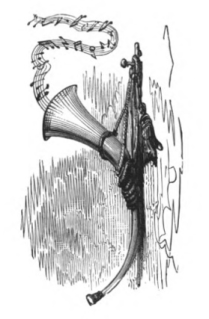
Illustration by Gustave Doré, 1865. Listen to ABC radio feature on the “Frozen Post Horn” and the Museum of Imaginary Instruments here
With a little leap of the imagination, it’s not difficult to see the parallels with the reality of sound recording limitation. The wax cylinders could only be played a few times before the sound degrades completely. Tin cylinders are not much better. This is the reason why the two Gladstone voices could be both “real” and “fake.” Celluloid is more durable, yet witness the reluctance of Dell to play one for longer than a few seconds, for preservation reasons.
Sound recordings are only as good as the medium on which they are recorded, a fact that surprisingly holds true even today. We were told by our BBC hosts that discs of shellac, vinyl, and acetate whose contents have already been digitised will not be discarded—digital recordings are ultimately taken from these physical originals.
In the future, we might invent means of reproduction and playback which could provide more fidelity to the original event lifted from the physical recording, in which case it will be the MP3s that will be redundant. There’s something both very modern and very old-fashioned about this. Once at a dinner party, I launched full-force into my postdoctoral rant about the eventual possible degradation of the MP3 as a recording format, that it was not infallible as we had been led to believe. I was surprised that I was wholly believed; furthermore, the older people participating in the conversation rued the disappearance of their CDs, tape cassettes and, vitally, their LPs, for the oft-cited reasons (which Primus Luta distills as the pricelessness of old recordings to one’s personal history, and the “fuller” sound ans weighty materiality, one resonating with one’s emotional past).

Vinyl at BBC Perivale, including a lot of John Peel’s old records. Image by Flickr User Hatter! (CC BY-NC 2.0)
I admit, before I came to the UK and experienced the never-perfect but always interesting presence of BBC Radio, I treated radio as a background medium. I suppose recorded sound had always interested me, and I had had a strong relationship with local, classical music radio (Classical KHFM Albuquerque). However, I could not have predicted ten years ago that I would become a passionate proponent of audio drama and sound studies more generally. I’m almost embarrassed now at my excessive love of audio drama; I make almost no distinctions between “high” art like Samuel Beckett and Tom Stoppard and fan fiction radio serials like Snape’s Diaries as produced by Misfits Audio: I listen to almost anything.
And, truly, the future of audio drama is only assured if people keep listening. The digitisation and availability of cylinder recordings makes study of them more accessible, so the way is paved for further studies of the earliest audio drama. It is imperative that researchers continue to request sound recordings from the BBC, even if they have to use the relatively inconvenient system currently available.
There are signs that things are improving and that more people than ever before want to access such materials. As Josh Shepperd puts it brilliantly, “Sound trails continue where paper trails end.” As Director of the Radio Preservation Task Force at the Library of Congress, his efforts have underlined the fact that often it is the local and the rural whose radio or audio history vanishes more quickly than the national or the metropolitan. This would historically be the case with the BBC as well, which for a long time privileged London sound above regionalism (and, some would argue, still does). Since 2015, the British Library (and the Heritage Lottery Fund) have invested significantly in the Save Our Sounds campaign, positing that within 15 years, worldwide sound recordings must be digitized before recordings degrade or we no longer have the means to play the material.
Out of curiosity, I downloaded the more than 600-page listing, the Directory of UK Sound Collections, assembled rather hastily through the Save Our Sounds project in 20 weeks, and comprising more than 3,000 collections and more than 1.9 million objects. This document makes for fascinating and eclectic reading, ranging as it does between a Sound Map of the English town of Harrogate to the archives of the Dog Rose Trust, which mainly provides recorded tours of English cathedrals for those who are blind. Undoubtedly, there are wodges of local or forgotten drama in these archives, too. The linking up of these archives and making them more widely accessible suggests how important sustained, collective effort is to unfreezing radio’s archival post-horn, delivering more of its unique tunes.
—
Featured Image: “The Route to Open Data” at BBC Perivale, Image by Flickr User Hatter! (CC BY-NC 2.0)
—
Leslie McMurtry has a PhD in English (radio drama) and an MA in Creative and Media Writing from Swansea University. Her work on audio drama has been published in The Journal of Popular Culture, The Journal of American Studies in Turkey, and Rádio-Leituras. Her radio drama The Mesmerist was produced by Camino Real Productions in 2010, and she writes about audio drama at It’s Great to Be a Radio Maniac.
—
 REWIND!…If you liked this post, you may also dig:
Only the Sound Itself?: Early Radio, Education, and Archives of “No-Sound”–Amanda Keeler
“Share your story” – but who will listen?–Fabiola Hanna
SO! Amplifies: Indie Preserves
The Sound of Radiolab: Exploring the “Corwinesque” in 21st Century–Alexander Russo
Share this:

Alan Lomax’s Southern Journey and the Sound of Authenticity

 Welcome back to 100 Years of Alan Lomax, Sounding Out!‘s series dedicated to remembering, rethinking and challenging our understanding of this crucial figure in folk music history.
In contrast to the first post in the series by Mark Davidson, which looked at how we have branded Alan Lomax, Parker Fishel‘s post considers how Alan Lomax fashioned himself—as both a collector and a publisher of other peoples’ music. The complexity of this task is inherent in the social and political ramifications of “saving” sound by making it “ours,” both in terms of singular ownership of singular recordings that had previously “belonged” to a community as well as the extent to which this practice brought these sounds to the wider culture.
Here, Fishel invites the reader to consider this complicated history that surrounds collecting and copyrighting folk music, what (and whom) the practice has excluded as well current performers who have been inspired by this preservation of our sound culture to perpetuate the practice: making it “theirs” and “ours” once again.
— Guest Editor Tanya Clement
—
The more one listens, views, and reads the work of pioneering folklorist Alan Lomax, the more inscrutable it becomes. Even if we set aside the sheer size and diversity of his collection, we are still left with a set of materials that eludes easy interpretation. Too mainstream for the academics and too academic for the mainstream, Lomax’s defiant, passionate quest to bridge the two worlds pioneered the study of sound as an embodiment of social and community dynamics. Yet in promoting American vernacular culture, Lomax also fashioned himself a folk hero, leaving us a legacy where the collector threatens to overshadow the collection. As arguably the world’s most famous folklorist, Lomax is responsible for much of the sound understood as authentic Americana.
Consider one vignette of many: the “Southern Journey,” a 1959-1960 recording trip that Alan Lomax undertook with Shirley Collins throughout Virginia, Kentucky, Tennessee, Arkansas, Mississippi, Alabama and Georgia. A world unto itself, the story of the Southern Journey reveals how these tensions shaped Lomax’s work and, to an extent, our understanding of a national cultural heritage.

“Radio Recording, Late 20th Century” by Flickr user Mike Licht, CC BY 2.0
To begin with, the Southern Journey sounded different than previous collecting trips due to the technological sophistication of the field recording set-up. Starting with a 1933 trip accompanying his father John A. Lomax, Alan Lomax’s previous recording expeditions in the South had relied first on Edison cylinders and then on disc-based recorders that had particular weaknesses in terms of fidelity. Surface noise obfuscated certain frequencies and reminded the listener that his or her experience was mediated. During the Southern Journey though, open reel magnetic tape, excellent microphones, and a mixer were employed to make what Lomax, in his tendency towards self-aggrandizement, claimed to be the “first” stereo field recordings in the South. Whatever the reality, the recordings were early efforts to use stereo in the service of field recording to capture more detail and nuance of a performance and its context.
Writing of the opportunity stereo presented for folklore, Lomax noted that “Folk music which, in its natural setting, is meant to be heard in the round, comes into its own with multi-dimensionality, for more than concert music, designed to project from the stage into an auditorium.” According to this reasoning, a good recording in stereo is more inclusive, grounding the listener’s position inside the soundscape of folklore’s community-based practice.
Yet, by nature folklore recordings have certain limitations. As jazz record producer Orrin Keepnews noted, “Our job is to create what is best described as ‘realism’ — the impression and effect of being real — which may be very different from plain unadorned reality.” This murky dividing line is problematic in the context of ethnographic documentation. In the case of Alan Lomax, it’s further complicated by multiple motivations and goals that transform this line into a shifting set of markers.

“30th January 2014” by Flickr user themostinept, CC BY-SA 2.0
Luckily, through diligent scholarship and Lomax’s own documentation, we are fairly aware of how this “realism” tension shaped his recordings in real-time performance and its public reception. Lomax sometimes auditioned performers when arriving in a new area; his book The Land Where The Blues Began (in part an reconstruction of the Southern Journey) was written 30-plus years after the fact from memory and a few scribbled notes on the back of tape boxes. However this knowledge impacts the supposed reality of the field recordings, it would be a mistake to reduce the extensive documentation of Lomax’s decision-making process to debunking. Rather, it is an aid for understanding what we’re hearing. By accounting for ethnographic and popularizing tendencies, what is really being developed is a guide for critical listening.
Part of that involved bringing in the recording industry. Starting with the 1939 Musicraft release of Leadbelly performances on 78-RPM discs, Lomax consistently used record companies as one means of bringing folklore to a wider audience. Commenting on the flurry of activity that accompanied Lomax’s 1959 return to the United States after nearly a decade abroad, noted folklorist Roger Abrahams commented, “To this writer it would appear that Mr. Lomax stayed up nights thinking of ways to sell folk-things to publishers, record companies, etc., ergo to the public.”
The Southern Journey was one such project, bankrolled by Atlantic Records. From nearly 80 hours of recorded material, Lomax curated two sets of releases in 1960, a seven LP Atlantic Records collection named the “Southern Folk Heritage Series” and the 12-LP “Southern Journey” series for Prestige International. In notes for reissues of the Atlantic set, Lomax admitted, “The set reflects, to some extent, what the Erteguns [Ahmet and Nesuhi, founders of Atlantic] felt might best reach their pop audience.” Examining how these recordings became canonical is to look at how new modes of cultural transmission affected folklore traditions.

Sales Fact Sheet for Atlantic’s “Southern Folk Heritage Series”
We can hear another tension being negotiated in the way Lomax celebrated performances, which today justly rank alongside those of the Great American Songbook. Yet, to see them that way negates the core strengths of folklore: flexibility to situation and contingency to community. In the field, Lomax asserted that “every performance is original, a fresh and intentionally varied re-creation or rearrangement of a piece.” At the same moment, however, Americanizing processes were transforming these flexible local improvisatory practices into fixed inscriptions of national character. With his public visibility and prestige, the pieces in Lomax’s books and records carried weight as definitive versions – claims Lomax perpetuated in order to unify some of his cultural theories. (It also didn’t hurt that the practice of early folklorists was to copyright these compositions, giving them a financial stake in perpetuating those performances as examples of exceptionalism.) As a result, the public adopted a set of arbitrary songs and sounds as markers of authenticity.
These concerns remain important in the music’s continuing, living traditions. Groups like the Carolina Chocolate Drops or The Ebony Hillbillies perform the full, eclectic spectrum of early African-American string and jug bands traditions. While Jerron ‘Blind Boy’ Paxton forges similar terrain using the African-American songster and blues singer as a model, Frank Fairfield addresses Anglo-American folk traditions. All of these projects remind listeners of the arbitrary divisions of authenticity forced on musicians practices by the race recording industry, which partitioned sounds as white and black and led to our modern taxonomy of genres. These performers use folklore to expose parts of the under-documented past, re-appropriating musical styles and often re-creating that world through the adoption of early 20th century language, clothes, and mannerisms.
Other contemporary performers handle these issues differently. Megafaun, Fight The Big Bull, and Justin Vernon (of Bon Iver) form the nucleus of Sounds of the South, a “loving reinterpretation of the sound, structure, lyrics, and spirit” of the Southern Journey recordings. Engaging both the African-American and Anglo-American traditions documented on that trip, the group finds its sound in their overlap. This a space shaped in part by the popularizing processes Lomax set in motion, a space where generations of listeners have been introduced to Mississippi Fred McDowell through a Rolling Stones cover. Approaching the music from this perspective and not from the background of a Forest City Joe or an Almeda Riddle, authenticity necessarily exists in a different realm: re-interpretation. The resulting arrangements, such as that of Estil C. Ball’s sacred composition “Tribulations,” give one illustration of how these dynamics play out sonically within the world of folklore and music that Lomax left behind.
For this particular piece, the words and melody of Ball’s “terrifying meditation on the end of days” are kept as links to the original recording. This frees the ensemble to follow its muse into the musical landscapes of the intervening 50-plus years, shaped as they were by the introduction of the vernacular into the mainstream (and vice versa). Ball’s melody evokes an archetype, the high lonesome sound of Appalachia; a trope it inspired in the first place. Yet, in this cultural confluence, there is also space for something like Matthew E. White’s soul-influenced electric guitar. In introducing of a style, tradition, and sound beyond the original recording, a color line is crossed that, while maybe not explicitly heard, was certainly present in the Jim Crow context of the Southern Journey. For Sounds of the South, authenticity exists beyond mere re-creation.
What might Lomax’s reaction to the Sounds of the South project be? Reflecting on the 1960s folk scene, Lomax wrote, “The American city folk singer, because he got his songs from books or other city singers, has generally not been aware of the singing style or the emotional content of the folk songs, as they exist in tradition.” On the other hand, Lomax might be heartened that many, whether cultural heritage institutions or record labels, are following in the footsteps of his own Association for Cultural Equity. Working on the scale that digital resources facilitate, these organizations are providing access to field recordings and their context in ways never before possible. (What remains to be seen is how this might impact the process of codification discussed above.)
In another way, the Sounds of the South marks a return to tradition. While the Southern Journey recordings are the primary inspiration, Sounds of the South member Joe Westerlund describes the project as something larger: “We wanted to include everything that we’re into, not just the traditional folk music that’s on this box set…We’re doing our whole experience as musicians.” That experience involves collaboration with folk artists like the Blind Boys of Alabama and Alice Gerrard, as well as investment in their local cultural communities of Durham, NC, Richmond, VA, and Eau Claire, WI.

Alan Lomax (left) with Richard Queen of Soco Junior Square Dance Team at the Mountain Music Festival, Asheville, North Carolina; via the Library of Congress Lomax Collection
Lomax’s pedagogy of folklore situates authenticity as a function of these very types of activities. “Folk song lives in a rather mysterious world close to the heart of the human community and it is only through extended and serious contact with living folk traditions that it can be understood.” The particular tradition in which one participates makes little difference; rather emphasis is on the process of engagement and contact, which replicate older patterns of folklore transmission. So even if Lomax may have claimed there was a bit too much bel canto to suit his tastes, one can imagine his appreciation for Sounds of the South’s dedication to the meaning and spirit of the music.
Considering Alan Lomax, his work, and his legacy is a complex and often frustrating enterprise. Yet amidst parts that give us pause, there remain bits of enduring wisdom. Addressing a gathering of folklorists, Lomax asserted that “Underneath we are all morally, emotionally and esthetically involved with our material, and so all of us are artists and cultural workers, and there is no escape from that.”
Few of us devote ourselves to this kind of music (or any kind of music for that matter) as a detached academic exercise. It can take an example of the living tradition like Sounds of the South looking backwards and forwards to remind us of the full scope of our responsibilities. I can’t think of any more fitting tribute on the occasion of his centenary than to re-commit ourselves not to Alan Lomax, but to what caught his ear in the first place: the transcendent experience of sound.
—
Parker Fishel is an archivist, writer, and researcher living in Brooklyn, New York. Presently he is the archivist at Grey Water Park Productions and an occasional DJ on WKCR-FM. As co-founder of Americana Music Productions, Parker is the producer of a forthcoming set of music, photographs, and scholarship documenting the 1969 Ann Arbor Blues Festival. He is also at work on Georgia Griot, a bio-discography of jazz musician Marion Brown. While getting an MSIS from the University of Texas at Austin, Parker worked with the UT Folklore Center Archives and the John Avery Lomax Family Papers at the Briscoe Center for American History.
—
Featured image: “This Machine Surrounds Hate and Forces It to Surrender” by Flickr user Bee Collins, CC BY-NC-SA 2.0
—
 REWIND! . . .If you liked this post, you may also dig:
“Ain’t Got the Same Soul” — Osvaldo Oyola
On the Lower Frequencies: Norman Corwin, Colorblindness, and the “Golden Age” of U.S. Radio — Jennifer Stoever
Six Years in Nodar: Sound Art in a Rural Context — Rui Costa
Share this:


Current Top Posts





April 2021

January 2020

November 2019

October 2019

August 2019

April 2014

November 2017

March 2015

December 2017

October 2015
 Sounding Out!

Recent Comments