
The Queer Sound of the Dandiya Queen, Falguni Pathak


co-edited by Praseeda Gopinath and Monika Mehta
Our listening practices are discursively constructed. In the sonic landscape of India, in particular, the way in which we listen and what we hear are often normative, produced within hegemonic discourses of gender, class, caste, region, and sexuality. . . This forum, Gendered Soundscapes of India, offers snapshots of sound at sites of trans/national production, marketing, filmic and musical texts. Complementing these posts, the accompanying photographs offer glimpses of gendered community formation, homosociality, the pervasiveness of sound technology in India, and the discordant stratified soundscapes of the city. This series opens up for us the question of other contexts in India where sound, gender, and technology might intersect, but, more broadly, it demands that we consider how sound exists differently in Pakistan, Sri Lanka, the Maldives, Bangladesh, Bhutan, Nepal, and Afghanistan. How might we imagine a sonic framework and South Asia from these locations? —Guest Editors Praseeda Gopinath and Monika Mehta
For the full introduction to the forum, click here.
To read all of the posts in the forum, click here.
—
The late 1990s was a pivotal time for activism around queerness in India. The violent response of the Hindu right to Deepa Mehta’s Fire (1998), a film portraying a romantic and sexual relationship between two women, prompted widespread debate on the question of censorship generally and of sexual-minority rights in particular. By rendering homosexuality explicit in its visuals and dialogues, and charting a linear trajectory of queerness—the protagonists move from unhappiness to happiness, denial to acceptance—Fire valorizes “coming out.” In the film, as in liberal strands of LGBT activism, it matters not only that one is out, but that one is seen as such. The premium placed on visibility in this formulation is undercut by the “queer” figure of Falguni Pathak. A tomboyish singer with a high-pitched voice, Pathak shot to fame with her debut album Yaad Piya Ki Aane Lage in the same year that Fire was released in India. Her performances mobilize disparate, even contradictory, signs of gender and sexuality at once, inviting us to examine the relationship between visuality and aurality in constructing queerness.
Falguni Pathak’s stardom is typically understood in the context of economic liberalization and the reconfiguration of Indian public culture that followed. The 1990s boom in the music industry was facilitated by the spread of satellite television, which gave non-film singers a new platform and a new set of audiences. Pathak’s “cute” and catchy love songs circulated endlessly on television countdown shows, turning her into an unlikely sensation. I say “unlikely” because Pathak’s apparent tomboyishness seemed at odds with the hyper-femininity and heteronormativity of the narratives in her music videos. Romantic quests, schoolgirls giddy with love, feminine bonding over make-up and men—these are standard features of Pathak’s videos, as is her own smiling presence as the singer-narrator. Through her gestures and lyrics, she comments on the lovesick teen’s plight and steps in occasionally to comfort or help the young girl, as in her first hit, “Chudi.”
For instance, in “Maine payal hai chhankai” (“The tinkling of my anklets,” 1999) she cheers on a group putting on a dance and puppet show for a school function. In songs like “Chudi/Yaad piya ki aane lagi” (“Bangles/I remember my lover,” 1998), “O piya” (“O beloved,” 2001), and “Rut ne jo bansi bajai” (“The music of the weather,” 2012) she is portrayed as a pop star.
The singer-as-pop-star was a common trope in early Indipop music videos (Kvetko). But Pathak dressed very differently than other pop stars. Whether on or off screen, she was (and is) always in men’s clothing, with a short, unfussy haircut and little make-up. Pathak’s style was mirrored on occasion by a minor character in her music videos. (“Chudi” includes a tomboyish school girl who struggles with the dance moves her friends choreograph.) Thus, Pathak’s visible presence in her videos brushed against the pitch, timbre, and style of her singing, which together articulated a hyper-feminine pop sensibility.
This sense of a “mismatch” (Fleeger) continues in Pathak’s contemporary performances. She is the most sought-after vocalist for Navratri festivities in Mumbai each year. On each night of this nine-day long Hindu festival, the “Queen of Dandiya” appears on stage dressed in a brightly colored kurta, vest, and trousers, and sings traditional Gujarati songs and hymns. The women in her audience dress more conventionally and more elaborately, in saris, salwaar kameez, and ghaghra-cholis. They dance in circles, performing recognizable garba moves. Meanwhile, Falguni Pathak saunters around the stage, engaging cheerfully with her fellow musicians and fans. Neither Pathak’s clothes nor her unfeminine dance moves bother the revelers as they dance the night away. For example, note how Pathak sways and rocks to the beat 34 seconds into this lively 2012 stage performance of Suneeta Rao’s hit song “Pari hun mein.”
Falguni Pathak’s temple performances at other times of the year are similar. They draw huge crowds unconcerned with the apparent mismatch between sound and image in her star persona. She tends to be as immersed in the devotional songs she sings as her audience. But her movements, plain clothes, and floppy hair-style make her look more like the male percussionists who accompany her, rocking and whipping their heads from side to side as they keep the beat, than the middle-class women clapping and singing along.
Performative traditions of mimicry and cross-dressing abound in India. But Pathak’s gender performance does not align with those religious, folk, and filmic traditions (and tropes) because it never registers as masquerade. The very casualness of her look, the fact that she dresses in t-shirt and trousers in all of her public appearances, suggests that this is not a temporary or theatrical adoption of a gender role. When asked in interviews why she eschews traditionally feminine clothing, Pathak always responds that she never has worn anything other than pants and t-shirts and is comfortable as she is. There were certainly other pop stars in the 1990s whose musical performances had masculine elements to them. Recall, for instance, Shweta Shettty’s suited look in “Johnny Joker” (1993). But none of Pathak’s peers sported a butch look as consistently and nonchalantly as she did—and none of them sang in as saccharine a voice. After six decades of Lata Mangeshkar’s vocal hegemony in Hindi cinema, such a “sweet,” contained, and unadorned voice has come to represent ideal Indian femininity. Pathak sounds charming and benign in her songs and interviews, but she does not dress the part.
 Pathak’s challenging of conventional gender norms through her appearance and through the fact that she has never been married raises the specter of queerness in public discourse. But even that is difficult to pin down. Popular commentators and fans sometimes suggest that she looks like Kiran Bedi, a high-ranking (retired) police officer who enjoys celebrity status, making it hard to read the masculine details of Pathak’s persona as “gay.” Even as she is a queer icon (Giani), Pathak never comments on her sexuality or love life. She either evades questions about relationships or simply states that she is single. Where some celebrities come out publicly or keep alive innuendoes about their sexuality (Singh), she treats it as a non-issue. All in all, what we get in Falguni Pathak’s music videos and star persona is a queerly gendered performance that seems both utterly “natural” (because it seems comfortable and casual) and profoundly mismatched.
To be clear, my argument is not so much that Falguni Pathak looks or sounds queer. The latter point is as hard to prove as the former is easy. If, for just a second, we manage to shut out of our mind’s eye the image of Pathak singing, her voice sounds thoroughly conventional. She sings in a traditional idiom, of traditional themes. No matter how intently I listen, no “queer timbre” (Bonenfant, Chaves Dasa), no “butch throat” (Glasberg) reaches out to touch me. Thus on the one hand, Pathak, like the other “mismatched women” Jennifer Fleeger writes about, confounds heteronormative expectations about gender and sexuality. On the other, her voice eludes “queer listening” (Bonenfant). What do we do with a queer figure who doesn’t sound queer? How might we understand her voice vis-à-vis queerness in Indian public culture? How do her live performances today continue to disrupt the emphasis on visibility in queer studies and politics—that is, the fixation on visual representations and “coming out” of the closet? Finally, how might Pathak’s “vocalic body” (Connor) help us conceive of the intersection of aurality and queerness in South Asian public culture?
Falguni Pathak intervened in a cultural field that was just beginning to deal with LGBT visibility. This becomes apparent when we remember that the 1990s was a period not just of economic liberalization but of vibrant queer activism as well. Pathak’s non-feminine image was startling for a pop star, but her voice was familiar and “good.” Her safe sound allowed her to push the boundaries of desire in televisual representations of the time. But it did more than that, too. The disjuncture between her feminine voice and butch look was critical to the complex landscape of desire her music videos evoked. It created space for ambiguity and incongruity amid charged debates about alternative sexual identities.
In “Main teri prem diwani/Indhana winva” (“I am madly in love with you,” 2001), Pathak stars as the neighbor to whom the protagonist turns for advice in matters of love. In an amazingly campy move, Pathak urges the young woman to seduce her lover by donning outfits inspired by Moulin Rouge (2001), specifically the song “Lady Marmalade” (00:36-00:55), and The Mummy Returns (2001) (1:59-2:03). Queerness is also writ large in “Meri chunnar udd udd jaye” (My scarf flies away, 2000), where Pathak appears as the beloved friend of a young girl in exile. The girl misses her friend intensely and attempts to recreate the dance moves and games she played with her older friend, this time with another mysterious woman who steps out of a painting.
Men’s roles in this and other Falguni Pathak music videos are ambiguous at best (Giani). Thus, despite the happy ending to the teen love stories, what lingers is Pathak’s simultaneous disruption and enabling of straight romance. This is why she is remembered fondly as a queer icon, even as the music scene in India has moved on from the “cuteness” of the 1990s. She offered LGBT audiences a way to read and revel in non-normative desires (Giani), without completely unseating “traditional” ways of living and loving.
The broader lesson in Falguni Pathak’s performances is that we cannot think of visuality apart from aurality, and vice versa. No matter how hard NBC’s “The Voice” tries to convince us (Tongson), we cannot in fact understand the sound of a singer’s voice as separate from the image of her as a performer and the contexts in which she emerges on the scene. It is not Pathak’s tomboyish appearance so much as the apparent disjuncture between that look and her voice that is key. What is queer about her voice is the look of it.
—
Featured Image: Falguni Pathak’s classic pose.
—
Pavitra Sundar is Assistant Professor of Literature at Hamilton College, where she teaches courses on global film and literature. Her scholarly interests span the fields of cinema studies, sound studies, postcolonial literary and cultural studies, and gender-sexuality studies. She is currently completing a book manuscript on the politics of Bollywood film sound and music. Her work has been published in journals such as Meridians, Jump Cut, South Asian Popular Culture, and Communication, Culture, and Critique, as well as in anthologies on South Asian and other cinematic traditions.
—
 REWIND!…If you liked this post, you may also dig:
Ritual, Noise, and the Cut-up: The Art of Tara Transitory—Justyna Stasiowska
Moonlight’s Orchestral Manoeuvers: A duet by Shakira Holt and Christopher Chien
If La Llorona Was a Punk Rocker: Detonguing The Off-Key Caos and Screams of Alice Bag–Marlen Rios-Hernández
Share this:

SO! Amplifies: Allison Smartt, Sound Designer of MOM BABY GOD and Mixed-Race Mixtape
 SO! Amplifies. . .a highly-curated, rolling mini-post series by which we editors hip you to cultural makers and organizations doing work we really really dig. You’re welcome!
—
Currently on the faculty and the associate technical director of California Institute of the Arts Sharon Lund Disney School of Dance, Allison Smartt worked for several years in Hampshire’s dance program as intern-turned-program assistant. A sound engineer, designer, producer, and educator for theater and dance, she has created designs seen and heard at La MaMa, The Yard, Arts In Odd Places Festival, Barrington Stage Company, the Five College Consortium, and other venues.

Allison Smartt
She is also the owner of Smartt Productions, a production company that develops and tours innovative performances about social justice. Its repertory includes the nationally acclaimed solo-show about reproductive rights, MOM BABY GOD, and the empowering, new hip-hop theatre performance, Mixed-Race Mixtape. Her productions have toured 17 U.S. cities and counting.
Ariel Taub is currently interning at Sounding Out! responsible for assisting with layout, scoping out talent and in the process uncovering articles that may relate to or reflect work being done in the field of Sound Studies. She is a Junior pursuing a degree in English and Sociology from Binghamton University.
__
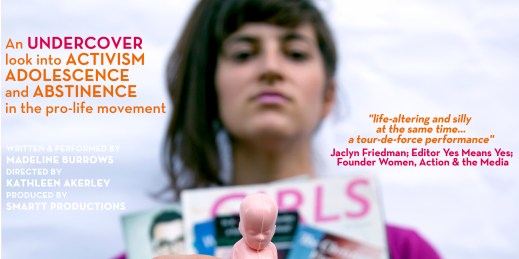
Recently turned on to several of the projects Allison Smartt has been involved in, I became especially fascinated with MOM BABY GOD 3.0, of which Smartt was sound designer and producer. The crew of MOM BABY GOD 3.o sets the stage for what to expect in a performance with the following introduction:
Take a cupcake, put on a name tag, and prepare to be thrown into the world of the Christian Right, where sexual purity workshops and anti-abortion rallies are sandwiched between karaoke sing-alongs, Christian EDM raves and pro-life slumber parties. An immersive dark comedy about American girl culture in the right-wing, written and performed by Madeline Burrows. One is thrown into the world of the Christian Right, where sexual purity workshops and anti-abortion rallies are sandwiched between karaoke sing-alongs, Christian EDM raves and pro-life slumber parties.
It’s 2018 and the anti-abortion movement has a new sense of urgency. Teens 4 Life is video-blogging live from the Students for Life of America Conference, and right-wing teenagers are vying for popularity while preparing for political battle. Our tour guide is fourteen-year-old Destinee Grace Ramsey, ascending to prominence as the new It-Girl of the Christian Right while struggling to contain her crush on John Paul, a flirtatious Christian boy with blossoming Youtube stardom and a purity ring.
MOM BABY GOD toured nationally to sold-out houses from 2013-2015 and was the subject of a national right-wing smear campaign. In a newly expanded and updated version premiering at Forum Theatre and Single Carrot Theatre in March 2017, MOM BABY GOD takes us inside the right-wing’s youth training ground at a more urgent time than ever.
I reached out to Smartt about these endeavors with some sound-specific questions. What follows is our April 2017 email exchange [edited for length].
Ariel Taub (AT): What do you think of the voices Madeline Burrows [the writer and solo actor of MOM BABY GOD] uses in the piece? How important is the role of sound in creating the characters?
Allison Smartt (AS): I want to accurately represent Burrows’s use of voice in the show. For those who haven’t seen it, she’s not an impersonator or impressionist conjuring up voices for solely comedy’s sake. Since she is a woman portraying a wide range of ages and genders on stage and voice is a tool in a toolbox she uses to indicate a character shift. Madeline has a great sense of people’s natural speaking rhythms and an ability to incorporate bits of others’ unique vocal elements into the characters she portrays. Physicality is another tool. Sound cues are yet another…lighting, costume, staging, and so on.
I do think there’s something subversive about a queer woman voicing ideology and portraying people that inherently aim to repress her existence/identity/reproductive rights.
Many times, when actors are learning accents they have a cue line that helps them jump into that accent. Something that they can’t help but say in a southern, or Irish, or Canadian accent. In MOM BABY GOD, I think of my sound design in a similar way. The “I’m a Pro-Life Teen” theme is the most obvious example. It’s short and sweet, with a homemade flair and most importantly: it’s catchy. The audience learns to immediately associate that riff with Destinee (the host of “I’m a Pro-Life Teen”), so much so that I stop playing the full theme almost immediately, yet it still commands the laugh and upbeat response from the audience.
AT: Does [the impersonation and transformation of people on the opposite side of a controversial issues into] characters [mark them as] inherently mockable? (I asked Smartt about this specifically because of the reaction the show elicited from some people in the Pro-Life group.)
AS: Definitely not. I think the context and intention of the show really humanizes the people and movement that Madeline portrays. The show isn’t cruel or demeaning towards the people or movement – if anything, our audience has a lot of fun. But it is essential that Madeline portray the type of leaders in the movement (in any movement really) in a realistic, yet theatrical way. It’s a difficult needle to thread and think she does it really well. A preacher has a certain cadence – it’s mesmerizing, it’s uplifting. A certain type of teen girl is bubbly, dynamic. How does a gruff (some may say manly), galvanizing leader speak? It’s important the audience feel the unique draw of each character – and their voices are a large part of that draw.
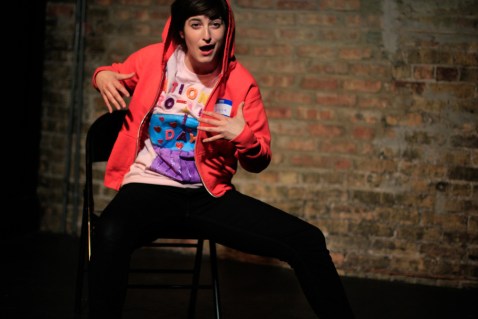
Madeline Burrows in character in MOM BABY GOD (National Tour 2013-2015). Photos by Jessica Neria
AT: What sounds [and sound production] were used to help carry the performance [of MOM BABY GOD]? What role does sound have in making plays [and any performance] cohesive?
AS: Sound designing for theatre is a mix of many elements, from pre-show music, sound effects and original music to reinforcement, writing cues, and sound system design. For a lot of projects, I’m also my own sound engineer so I also implement the system designs and make sure everything functions and sounds tip top.
Each design process is a little different. If it’s a new work in development, like MOM BABY GOD and Mixed-Race Mixtape, I am involved in a different way than if I’m designing for a completed work (and designing for dance is a whole other thing). There are constants, however. I’m always asking myself, “Are my ideas supporting the work and its intentions?” I always try to be cognizant of self-indulgence. I may make something really, really cool but that ultimately, after hearing it in context and conversations with the other artistic team members, is obviously doing too much more than supporting the work. A music journalism professor I had used to say, “You have to shoot that puppy.” Meaning, cut the cue you really love for the benefit of the overall piece.
I like to set myself limitations to work within when starting a design. I find that narrowing my focus to say…music only performed on harmonica or sound effects generated only from modes of transportation, help get my creative juices flowing (Sidenote: why is that a phrase? It give me the creeps)[. . .]I may relinquish these limitations later after they’ve helped me launch into creating a sonic character that feels complex, interesting, and fun.
AT: The show is described as being comprised of, “karaoke sing-alongs, Christian EDM raves and pro-life slumber parties,” each of these has its own distinct associations, how do “sing alongs” and “raves” and our connotations with those things add to the pieces?
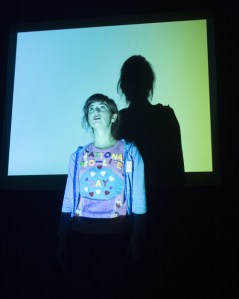
Madeline Burrows in character in MOM BABY GOD (National Tour 2013-2015). Photos by Jessica Neria
AS: Since sound is subjective, the associations that you make with karaoke sing-alongs are probably slightly different from what I associated with karaoke sing-alongs. You may think karaoke sing-along = a group of drunk BFFs belting Mariah Carey after a long day of work. I may think karaoke sing-alongs = middle aged men and women shoulder to shoulder in a dive bar singing “Friends In Low Places” while clinking their glasses of whiskey and draft beer. The similarity in those two scenarios is people singing along to something, but the character and feeling of each image is very different. You bring that context with you as you read the description of the show and given the challenging themes of the show, this is a real draw for people usually resistant to solo and/or political theatre. The way the description is written and what it highlights intentionally invites the audience to feel invited, excited, and maybe strangely upbeat about going to see a show about reproductive rights.
As a sound designer and theatre artist, one of my favorite moments is when the audience collectively readjusts their idea of a karaoke sing-along to the experience we create for them in the show. I feel everyone silently say, “Oh, this is not what I expected, but I love it,” or “This is exactly what I imagined!” or “I am so uncomfortable but I’m going with it.” I think the marketing of the show does a great job creating excited curiosity, and the show itself harnesses that and morphs it into confused excitement and surprise (reviewers articulate this phenomenon much better that I could).
AT: In this video the intentionally black screen feels like deep space. What sounds [and techniques] are being used? Are we on a train, a space ship, in a Church? What can you [tell us] about this piece?
AS: There are so many different elements in this cue…it’s one of my favorites. This cue is lead in and background to Destinee’s first experience with sexual pleasure. Not to give too much away: She falls asleep and has a sex dream about Justin Bieber. I compiled a bunch of sounds that are anticipatory: a rocket launch, a train pulling into a station, a remix/slowed down version of a Bieber track. These lead into sounds that feel more harsh: alarm clocks, crumpling paper…I also wanted to translate the feeling of being woken up abruptly from a really pleasant dream…like you were being ripped out of heaven or something. It was important to reassociate for Destinee and the audience, sounds that had previously brought joy with this very confusing and painful moment, so it ends with heartbeats and church bells.
I shoved the entire arc of the show into this one sound cue. And Madeline and Kathleen let me and I love them for that.
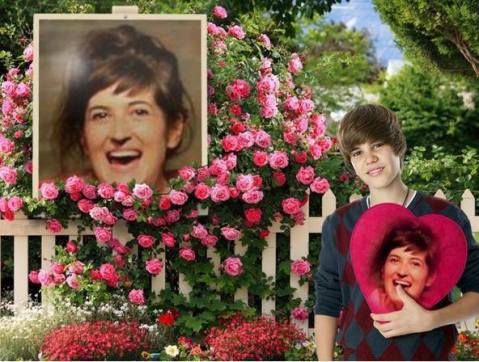
from madelineburrows.com
AT: What do individuals bring of themselves when they listen to music? How is music a way of entering conversations otherwise avoided?
AS: The answer to this question is deeper than I can articulate but I’ll try.
Talking about bias, race, class, even in MOM BABY GOD introducing a pro-life video blog – broaching these topics are made easier and more interesting through music. Why? I think it’s because you are giving the listener multiple threads from which to sew their own tapestry…their own understanding of the thing. The changing emotions in a score, multiplicity of lyrical meaning, tempo, stage presence, on and on. If you were to just present a lecture on any one of those topics, the messages feel too stark, too heavy to be absorbed (especially to be absorbed by people who don’t already agree with the lecture or are approaching that idea for the first time). Put them to music and suddenly you open up people’s hearts.
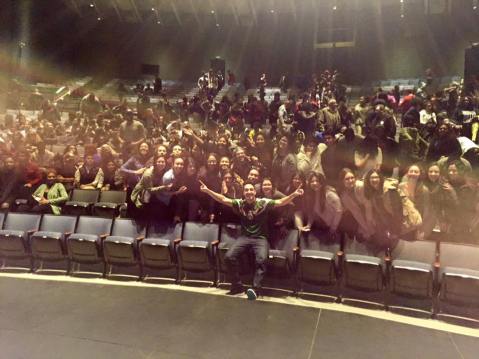
Post- Mixed-Race Mixtape love, William Paterson University, 2016 Photo credit: Allison Smartt
As a sound designer, I have to be conscious of what people bring to their listening experience, but can’t let this rule my every decision. The most obvious example is when faced with the request to use popular music. Take maybe one of the most overused classics of the 20th century, “Hallelujah” by Leonard Cohen. If you felt an urge just now to stop reading this interview because you really love that song and how dare I naysay “Hallelujah” – my point has been made. Songs can evoke strong reactions. If you heard “Hallelujah” for the first time while seeing the Northern Lights (which would arguably be pretty epic), then you associate that memory and those emotions with that song. When a designer uses popular music in their design, this is a reality you have to think hard about.

Cassette By David Millan on Flickr.
It’s similar with sound effects. For Mixed-Race Mixtape, Fig wanted to start the show with the sound of a cassette tape being loaded into a deck and played. While I understood why he wanted that sound cue, I had to disagree. Our target demographic are of an age where they may have never seen or used a cassette tape before – and using this sound effect wouldn’t elicit the nostalgic reaction he was hoping for.
Regarding how deeply the show moves people, I give all the credit to Fig’s lyrics and the entire casts’ performance, as well as the construction of the songs by the musicians and composers. As well as to Jorrell, our director, who has focused the intention of all these elements to coalesce very effectively. The cast puts a lot of emotion and energy into their performances and when people are genuine and earnest on stage, audiences can sense that and are deeply engaged.
I do a lot of work in the dance world and have come to understand how essential music and movement are to the human experience. We’ve always made music and moved our bodies and there is something deeply grounding and joining about collective listening and movement – even if it’s just tapping your fingers and toes.
AT: How did you and the other artists involved come up with the name/ idea for Mixed-Race Mixtape? How did the Mixed-Race Mixtape come about?
AS: Mixed-Race Mixtape is the brainchild of writer/performer Andrew “Fig” Figueroa. I’ll let him tell the story.
Andrew “Fig” Figueroa, Hip-Hop artist, theatre maker, and arts educator from Southern California
A mixtape is a collection of music from various artists and genres on one tape, CD or playlist. In Hip-Hop, a mixtape is a rapper’s first attempt to show the world there skills and who they are, more often than not, performing original lyrics over sampled/borrowed instrumentals that compliment their style and vision. The show is about “mixed” identity and I mean, I’m a rapper so thank God “Mixed-Race” rhymed with “Mixtape.”
The show grew from my desire to tell my story/help myself make sense of growing up in a confusing, ambiguous, and colorful culture. I began writing a series of raps and monologues about my family, community and youth and slowly it formed into something cohesive.

AT: I love the quote, “the conversation about race in America is one sided and missing discussions of how class and race are connected and how multiple identities can exist in one person,” how does Mixed-Race Mixtape fill in these gaps?
AS: Mixed-Race Mixtape is an alternative narrative that is complex, personal, and authentic. In America, our ideas about race largely oscillate between White and Black. MRMT is alternative because it tells the story of someone who sits in the grey area of Americans’ concept of race and dispels the racist subtext that middle class America belongs to White people. Because these grey areas are illuminated, I believe a wide variety of people are able to find connections with the story.
AT: In this video people discuss the connection they [felt to the music and performance] even if they weren’t expecting to. What do you think is responsible for sound connecting and moving people from different backgrounds? Why are there the assumptions about the event that there are, that they wouldn’t connect to the Hip Hop or that there would be “good vibes.”
AS: Some people do feel uncertain that they’d be able to connect with the show because it’s a “hip-hop” show. When they see it though, it’s obvious that it extends beyond the bounds of what they imagine a hip-hop show to be. And while I’ve never had someone say they were disappointed or unmoved by the show, I have had people say they couldn’t understand the words. And a lot of times they want to blame that on the reinforcement.
I’d argue that the people who don’t understand the lyrics of MRMT are often the same ones who were trepidatious to begin with, because I think hip-hop is not a genre they have practice listening to. I had to practice really actively listening to rap to train my brain to process words, word play, metaphor, etc. as fast as rap can transmit them. Fig, an experienced hip-hop listener and artist amazes me with how fast he can understand lyrics on the first listen. I’m still learning. And the fact is, it’s not a one and done thing. You have to listen to rap more than once to get all the nuances the artists wrote in. And this extends to hip-hop music, sans lyrics. I miss so many really clever, artful remixes, samples, and references on the first listen. This is one of the reasons we released an EP of some of the songs from the show (and are in the process of recording a full album).
.
The theatre experience obviously provides a tremendously moving experience for the audience, but there’s more to be extracted from the music and lyrics than can be transmitted in one live performance.
AT: What future plans do you have for projects? You mentioned utilizing sounds from protests? How is sound important in protest? What stands out to you about what you recorded?
AS: I have only the vaguest idea of a future project. I participate in a lot of rallies and marches for causes across the spectrum of human rights. At a really basic level, it feels really good to get together with like minded people and shout your frustrations, hopes, and fears into the world for others to hear. I’m interested in translating this catharsis to people who are wary of protests/hate them/don’t understand them. So I’ve started with my iPhone. I record clever chants I’ve never heard, or try to capture the inevitable moment in a large crowd when the front changes the chant and it works its way to the back.
.
I record marching through different spaces…how does it sound when we’re in a tunnel versus in a park or inside a building? I’m not sure where these recordings will lead me, but I felt it was important to take them.
—
REWIND! . . .If you liked this post, you may also dig:
Beyond the Grandiose and the Seductive: Marie Thompson on Noise
Moonlight’s Orchestral Manoeuvers: A duet by Shakira Holt and Christopher Chien
Aural Guidings: The Scores of Ana Carvalho and Live Video’s Relation to Sound
Share this:


Current Top Posts





April 2021

January 2020

November 2019

October 2019

August 2019

April 2014

November 2017

March 2015

December 2017

October 2015
 Sounding Out!
Recent Comments