
On Donuts, Sandwiches and Beattapes: Listening for J Dilla Six Years On

"J Dilla aka Jay Dee R.I.P." by Flickr user Ohm 17 under Creative Commons License
It has been six years this week since the passing of James “J Dilla” Yancey, considered by many in hip-hop as the quintessential producer’s producer. Over the course of his career the Detroit-born beatmaker garnered production credits with artists ranging from The Pharcyde to Janet Jackson. Since his passing there has been a substantial amount of posthumous output, including a Yancey Boys album with his brother Illa J, Ruff Draft, The Shining and Jay Stay Paid. There have also been the tons of unofficial releases by artists using material from his beattapes without prior permission. An unofficial discography of projects ‘featuring’ Dilla’s work could eclipse his official one.
Dilla’s beattapes, which he shared amongst friends and associates via CDs, eventually traveled the globe via message boards years prior to his passing. His legacy became what it is, at least in part, due to the reach of these CDs, but unfortunately it has also made monetizing the work after his passing a difficult task. There were early issues between Dilla’s family and the legal estate, but for the last couple of years there has been a process established which allows for the use of tracks from his vaults. They are currently set to release The Rebirth of Detroit, which boasts unheard Dilla beats featuring the Detroit artists he came up with:
In addition to posthumous releases under Dilla’s name the estate also licenses tracks for projects by other artists. With over 4000 tracks in their possession, it stands to reason there will be plenty more Dilla in the future. Yet still there is a sense that ‘new Dilla’ will never be new again, as in the future we will only be able to look at Dilla’s past. How would his process as an artist have grown? Surely whatever he was doing before he passed sounds nothing like what he would be doing in 2012.
Fortunately, the creativity of Dilla lives on through his influence on others. In the years since his passing, that influence has gone beyond hip-hop into jazz, indie rock, classical, and electronic music; some might argue Dilla’s influence has spawned new styles or even genres of music . The LA beat scene was seemingly born in homage to him; with its off kilter drums and wild sample chops, it extends beyond the initial influence, projecting into the future a lineage which will forever trace back to Dilla. Another of those lineages takes Dilla to perhaps the least likely place for a hip-hop producer: late-night television, through the figure of Ahmir “?uestlove” Thompson of The Roots.
At the end of the 90s until around 2001, Dilla was a member of The Soulquarians creative team that produced albums for Erykah Badu, D’Angelo, Common, and Bilal:
During this time Dilla worked closely with drummer, producer, and founding member of The Roots ?uestlove. There was a musical bond established over countless studio hours which allowed for a fusion of styles between them that carried Yancey from his Jay Dee period into his J Dilla period, and which ?uestlove continues to carry to this day.
Since Dilla’s passing, ?uest has been an instrumental voice in keeping Dilla’s legacy alive. He regularly DJ’s events celebrating Dilla’s work. On all of The Roots albums except for the most recent one, there have been musical dedications to Dilla. It is when ?uest goes into the studio with The Roots, however, that the living continuation of their musical fusion can be found.
The studio is where ?uest spends a lot of his time, rehearsing The Roots for their role as the house band on the Late Night with Jimmy Fallon show; ?uest records the sessions to listen back before and after the show. On Late Night The Roots play new songs in front of a live audience five nights a week. These songs only air for ten to twenty seconds going in and out of commercials. If you run to grab something from the refrigerator you might miss them. Or, coming back you might find your head nodding to them. Not only are they original works (other than walk on music for show guests, and musical performances), they are an insight into the creative process which shaped both ?uest and Dilla.
?uest names the tracks Sandwiches, a nod to his former collaborator’s Donuts. Donuts was the last official project that Dilla worked on, quite literally on his death bed, and is considered his instrumental opus. It opened up the notion of the short-form instrumental hip-hop work, which traces its own lineage to the history of beattapes. Today, a beattape is a collection of hip-hop instrumentals released as a product through distribution channels (free or paid). In the beginning however, beattapes were physical cassette tapes (and later CD-Rs) passed around from hand to hand. Tracks from beattapes were snippets of beats often recorded right after they were made so the producer could listen to them again outside of the studio setting. They were passed amongst friends and eventually within the industry as a means of selling the producer’s beats.
Early beattapes were not meant for public consumption or as cohesive projects. It’s important to remember that at the time you didn’t finish productions in a home or project studio. Artists, labels, producers etc. would listen to a beattape and select tracks to be purchased for a project. If a beat was bought, the producer would meet the artist in a large studio with an engineer, which is where the beat went into production. The beattape at the time was not considered a final anything, but a sketch of what could become a production.
In addition, beattapes had a secondary purpose as a measure of skill and technique. They became a format for rehearsal and practice. Where a traditional instrumentalist may practice chord changes on their instrument, a beat maker makes beats and records them for easy playback later. For example, a producer could decide to sample the same record as another producer to show how they would use the sample differently. There would be no intent to turn such a track into a full fledged song (though it could happen), instead it would be recorded so they could play it back to a friend or even the producer who originally used the sample for bragging rights.
Dilla was an active participant in this trade. His beat CDs became his calling card particularly for the techniques displayed on them. Donuts was his expansion of that beattape format. Rather than a display of short rough sketches that serve as indications of productions to come, Dilla produced intricate and layered flaunts of technique compacted into short sketches.
The most recognized technique from Donuts is the chop. The chop comes out of the stab line of techniques. A stab is a single instrumental hit played on a sampler. On the MPC line of samplers (which Dilla was famous for using), stabs could be spread across trigger pads pitch shifted chromatically allowing melodic sequences to be played using a single stab. The chop takes that a step further by using multiple samples from the same source (chops) to replace the chromatic stabs, and play melodically. What Dilla displayed on Donuts however, is not merely the chop but the variety of techniques available by which a producer can chop. Working outside the limitations of loops and stabs, new techniques like drum and instrument isolation, de-quantization, vocal stabs and more come at you, one layered technique after the other.
Many of these techniques have been canonized today, but some quality has been lost with that normalization. With de-quantization by example, overuse has practically rendered the technique cliché because its depth was reduced by its definition. De-quantization translates to simply turning off the preference in software programs or hardware beat machines that align all sound triggers to the grid of the tempo and time signature. That definition speaks nothing to what Dilla actually did with that preference off, which was impose his own humanized sense of timing onto the de-quantized patterns of the machine.
Of those that followed Dilla, most got the de-quantization part but missed his sense of time. While de-quantization has shown influence, outside of the ‘stock Dilla’ pattern, his sense of timing has been continued by only a few. At the top of that list is ?uestlove, as he is as responsible for the development of that sense of timing as Dilla is his own. The root of that development can be found in the The Soulquarians period, which can be marked as the time both artists came into their own by working together. That they would come together at all was quite serendipitous, as no player has a better sense of timing than a drummer. It was the mutual sense of timing between Dilla and ?uest that worked to produce the amazing material that resulted.
In The Soulquarians studio sessions ?uest and Dilla created a feedback loop between the drum machine and the drums. This pushed their sense of time as they fused a sonic texture for their drums, which can be heard between their productions. There is a shuffling urgency with a tick of hats between pulses that lead one into the other; the snare or clap crisp, never aggressively cracking, the kick big but not over dominant. It is sequence-based music turned into grooves that maintain the variable constraints of the sequence. They each took these elements with them in their post Soulquarians work, and after Dilla’s passing, you can frequently hear ?uest calling back to those days through his music.
Take a Sandwich like “Gross Understatement.” At the onset a drum loop with a prominent clap is layered into the snare on alternate hits, while a keyboard moves through presets until an organ sound is found. The bass noodles patiently until, with a chord, they meet. When ?uest comes in it takes a couple of bars of him pushing the drums to get everyone else to fall in on his time, but once it hits he can’t control himself, letting out a holler, “something flew out the gate.” What follows is three minutes of magic as the band jams to a grove that is the perfect cross between Dilla and ?uest.
Gross Understatement (G minor) #Sandwich 1397
Up until November 2011, by ?uest’s count, The Roots had created almost 1800 Sandwiches. He has released a stream of Sandwiches through his Swift FM account (the page is currently down until the site relaunches). By his own admission though, all of the Sandwiches aren’t as good as “Gross Understatement.” Out of the 2 to 23 they record each day, he says only about 1 in 19 are bangers. At 94 out of 1800 it isn’t a bad count, enough for nine albums. The only format in these tracks exist however, is as they appear on Late Night, on ?uest’s harddrive and whatever Sandwiches he decides to share. What would a studio project of this material sound like? As big of an audience as they receive on Late Nite, Sandwiches are buried in the mix of television things where it’s not easy to give them the musical attention they deserve. Perhaps in the future an official release of a project from this line will emerge. In the meantime catch them on NBC when you can and stay tuned to ?uest’s social stream.
—
Primus Luta is a husband and father of two (maybe three by the time this goes up). He is a writer and an artist exploring the intersection of technology and art, and their philosophical implications. He is a regular guest contributor to the Create Digital Music website, and maintains his own AvantUrb site. Luta is a regular presenter for the Rhythm Incursions Podcast series with his monthly show RIPL. As an artist he is a founding member of the live electronic music collective Concrète Sound System, which spins off into a record label for the exploratory realms of sound in 2012. Luta is currently working on completing his first book, BeatGenealogy: A History of the Electronic Beat From WWII to Now.
Share this:

Hearing the Tenor of the Vendler/Dove Conversation: Race, Listening, and the “Noise” of Texts
In the beginning there were no words. In the beginning was the sound and they all knew what the sound sounded like. –Toni Morrison, Beloved

How were Truth's words heard? By whom?
A conversation in my Black Feminist Theories class on the two versions of Sojourner Truth’s famous speech from the Ohio Women’s Convention—the one published in 1863 that renders her words in a black southern dialect or the 1851 version that does not—elicited the following story about listening. A black male student was student teaching/observing in a classroom — the teacher was white, the student teacher black. The exercise he observed involved transcribing speech and then reading it back. A black male student in the classroom spoke and the white teacher and black student teacher each transcribed the speech and read their transcriptions aloud. The white teacher’s transcription/recording was in dialect, the black student teacher’s was not. The student teacher maintained that what and how the white teacher heard the black student was not, in fact, either what or how the black student spoke.
Discussions like these have spurred me to meditate more deeply on sound. And now that I’ve really begun to consider it, texts have become much noisier places; the white spaces and black marks becoming places for reading and hearing. Thinking more deeply about sonic affinities and communities has helped me really begin to understand how sound shapes sight and sight shapes sound.
An example: Since reading Fred Moten’s In the Break, in particular “The Resistance of the Object,” it’s not only impossible for me to read the scene of Captain Anthony’s beating/rape of Aunt Hester in Frederick Douglass’s Narrative without hearing Abbey Lincoln’s hums, moans, and screams, it is not possible for me to read the entire text without populating it with sound, even as those sounds are, in my imagining of them, not always specific.
.
Perhaps it’s most accurate to say that I am aware that the world that the text references is a world filled with sounds peculiar to it, many of which may no longer be present in our contemporary world. At the same time, I try to bring at least some of those sounds—talking drums, field hollers, whips cracking, the sounds of chains, etc.—and approximations of sounds into the classroom when I teach Douglass’s Narrative and My Bondage and My Freedom (as well as when I teach other texts).
In “The Word and the Sound: Listening to the Sonic Colour-line in Frederick Douglass’s 1845 Narrative” (2011) Jennifer Stoever-Ackerman writes, “The emphasis Douglass places on divergent listening practices shows how they shape (and are shaped by) race, exposing and resisting the aural edge of the ostensibly visual culture of white supremacy, what I have termed the “sonic colour-line” (21). Stoever-Ackerman riffs on Elizabeth Alexander’s “Can you be BLACK and Look at This: Reading the Rodney King Video” (and Alexander riffs on Pat Ward Williams’s “Accused, Blowtorch, Padlock”) to ask, “Can you be WHITE and (really) LISTEN to this?” or alternatively, “Are you white because of HOW you listen to this?” (21).
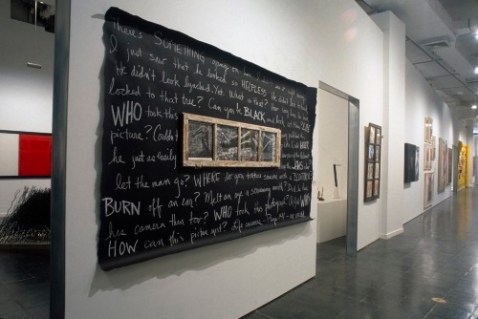
Pat Ward Williams's "Accused/Blowtorch/Padlock" (1986), Courtesy of the Artist and the New Museum, New York
.
In his review of Shane White and Graham White’s The Sounds of Slavery: Discovering African American History Through Songs, Sermons, and Speech (Beacon Press, 2005) in the July 2009 issue of the Journal of Urban History, Robert Desrochers contrasts the abolitionists who were attuned to how to make a white audience hear the sounds that surrounded and produced the (performances of the formerly) enslaved, to the “Virginia patriarch who failed to mention the singing of his slaves even once in a diary that ran to hundreds of manuscript pages” (754). Given these examples of the ways that many white ears had to be systematically attuned to hearing slavery’s sounds as well as the understanding that, “the very things that made slave sounds distinctive—chants, grunts, and groans; melismatic, repetitious, and improvisational lyric play; pitch and tonal inflections and cadences; timbral variations, polyrhythms, and heterophonic harmonies—struck whites mostly as strange, inappropriate, wrong” (754)—the answers to Stoever-Ackerman’s questions may be respectively “no” and “yes” (or several combinations of no and yes), particularly if we engage “whiteness” as an ideology and not simply (or not only) a “raced” description of those people constituted socially and legally as (presumably) white.
 It was with these kinds of questions of sound and sonic whiteness on my mind (especially this question of who hears, who doesn’t hear, and then again what is and isn’t heard) that I read and was brought up short by Helen Vendler’s recent November 24, 2011 New York Review of Books review of Rita Dove’s The Penguin Anthology of 20th Century American Poetry. In this piece, Vendler takes Dove to task for what she considers the anthology’s over-inclusiveness (“No century in the evolution of poetry in English ever had 175 poets worth reading”), the “accessibility” of the poems (“short poems of rather restricted vocabulary”), and the appearance of a large number of black and other non-white poets in the latter part of the twentieth-century. In short, from Vendler’s perspective, Dove is choosing “sociology” and complaint over artistry; mixing the wheat and the chaff.
Vendler writes, “Rita Dove, a recent poet laureate (1993–1995), has decided, in her new anthology of poetry of the past century, to shift the balance, introducing more black poets and giving them significant amounts of space, in some cases more space than is given to better-known authors. These writers are included in some cases for their representative themes rather than their style. Dove is at pains to include angry outbursts as well as artistically ambitious meditations.”
And Vendler on Dove on Hart Crane: “sometimes one wonders whether Dove is being hasty. She speaks, for instance, of ‘the cacophony of urban life on Hart Crane’s bridge.’ But the bridge in his ‘Proem’ exhibits no noisy ‘cacophony’; its panorama is a silent one. The seagull flies over it; the madman noiselessly leaps from ‘the speechless caravan’ into the water; its cables breathe the North Atlantic; the traffic lights condense eternity as they skim the bridge’s curve, which resembles a ‘sigh of stars’; the speaker watches in silence under the shadow of the pier; and the bridge vaults the sea. The automatic—and not apt—association of an urban scene with noise has generated Dove’s ‘cacophony.’”
Why does Vendler insist on silence where Dove joins sight and sound? That Vendler imagines silence and takes Dove to task for attaching cacophony to the city scene in the bridge poem is a struggle over meaning, over epistemology and ontology. How is Vendler registering not only the poem but also the entire text differently? This isn’t the only instance of Vendler’s insistent sonic “whiteness” whereby and wherein the reading of the poem, the anthology, and the anthologizer herself are disciplined.
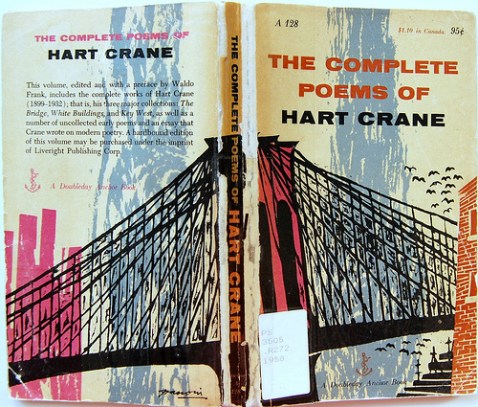
Can you hear these poems? Image by Crossett Library Bennington College
Speechlessness though, is not soundlessness, and it seems to me that Dove locates herself on the bridge (and in the soundscape of the contemporary written poem) such that she hears the water, the seagull, and the leap and curve and flap of gull and man. As Dove herself responded (also in the New York Review of Books), “A cursory sweep over just the section [Vendler] excerpted in my anthology yields a host of extraordinary sounds: what with trains whistling their “wail into distances,” chanting road gangs, papooses crying—even men crunching down on tobacco quid—my gasp of surprise at Vendler’s blunder can barely be heard.”
In Vendler’s remarks and Dove’s response we might read the kind of cultural dissonance that continues to both construct and give insight into how different communities of readers and listeners are formed and the ways they are and aren’t racialized. By the end of the review, Vendler wants to be heard by those whom she imagines as the anthology’s likely readers: she wants to turn to them and “say,” to “cry out,” that there are better poems than those included here. For the sounds that in this anthology that Vendler hears most often in the “minor” poems, in the “minority” poets, and the “minority” anthologizer, are simplicity, noise, and needless complaint. And Vendler and Dove have been here before – see Vendler on Dove and Delaney on Vendler and Dove.)
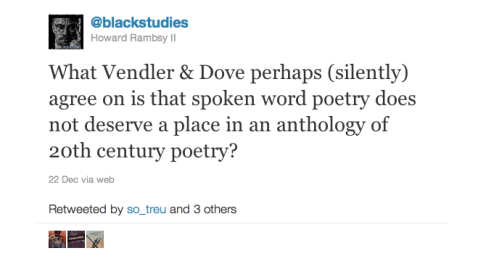
But despite the debate putting poetry front and center and enacting ways that it matters, Vendler’s critique and Dove’s response are each conservative, though in quite different ways. Neither Vendler nor Dove in the review, anthology, and defense of the anthology imagines the inclusion of spoken word, hip-hop (see Howard Rambsy II), and other forms of contemporary rhyme and verse that speak to a broad range of audiences across race, sex, and class. The inclusion of rap might further change the tenor of the conversation, opening up in important ways the debate over what counts as poetry, and expanding how black musical and poetic forms are heard and by whom.
—
Christina Sharpe is Associate Professor of English and American Studies at Tufts University where she also directs American Studies. Her book Monstrous Intimacies: Making Post-Slavery Subjects was published in 2010 by Duke University Press. Her current book project is Memory for Forgetting: Blackness, Whiteness, and Cultures of Surprise.
Share this:


Current Top Posts





April 2021

January 2020

November 2019

October 2019

August 2019

April 2014

November 2017

March 2015

December 2017

October 2015
 Sounding Out!
Recent Comments