
As Loud As I Want To Be: Gender, Loudness, and Respectability Politics


DOI: https://doi.org/10.59350/xex63-17v49
Editor’s Note: Here’s installment #2 of Sounding Out!‘s blog forum on gender and voice! Last week we hosted Christine Ehrick‘s selections from her forthcoming book; she introduced us to the idea of the gendered soundscape, which she uses in her analysis on women’s radio speech from the 1930s to the 1950s. In the next few weeks we’ll have SO regular writer Regina Bradley, with a look at how music is gendered in Shonda Rhimes’ hit show Scandal, A.O. Roberts with synthesized voices and gender, Art Blake with his reflections on how his experience shifting his voice from feminine to masculine as a transgender man intersects with his work on John Cage, and lastly Robin James with an analysis of how ideas of what women should sound like have roots in Greek philosophy.
As I planned for SO!’s February forum, I wondered about my own connection to the topic: how is the loudness of a voice gendered? Does it matter who we call “loud”? As a Latina, I’m familiar with the stereotypes of the loud Latina, and as a Puerto Rican I faced them at every gathering. So for this week I decided to reflect upon my experiences in a personal essay. Lean in, close your eyes, and don’t let the voices startle you.–Liana M. Silva, Managing Editor
—
I was 22 years old when someone called me deaf. I was finishing my bachelor’s degree at the University of Puerto Rico, Rio Piedras campus. After four years of living in San Juan, I still hadn’t gotten used to the class and race microaggressions I encountered regularly because I was a brown girl who grew up in the country and was going to school in the urban capital, el área metropolitana. These microaggressions were usually assumptions about who I was based on how I talked: I called pots a certain way, I referred to nickels in another way, and I couldn’t keep my voice down–all indications, according to my “urban” friends, that I grew up in the country. But being called “deaf” was a new one.
My boyfriend at the time had no cellphone, and his mother would call me regularly to see if he was on his way home from a gig or to ask him to run an errand. She and I were not close, but we were cordial. I always felt we didn’t click on some level. This particular weekend day, she had called to ask if he had left San Juan already to come visit her, and I told her I had just seen him that morning before he left. Somehow she and I went from small talk into a conversation.
In my head, I thought I was making headway with her and that this was a huge step forward in our relationship. We talked about his gig the night before, about how my family was doing, things like that. Then she asked me if my family had a medical history of people losing their hearing. “No? I don’t think so. Why do you ask?” I said in Spanish.
“Because you talk so loud, and so do your father and your sister. Your mom isn’t loud.”
That was over 10 years ago, but the comment still stings. I am certain that wasn’t the only time someone called me “loud” or pointed out the tone of my voice, but it’s the one time that still rings in my ears when I think about the intersection of gender and sound. It wasn’t just that I spoke at a high volume, it was that I was a woman who spoke at a high volume. I was the girlfriend who was loud.
Of course we’re not born loud- or soft-speakers – we learn to use the volume level that prevails in our culture, and then turn it up or lower it depending on our subculture and peer group.
-Anne Karpf, The Human Voice
What does “loud” mean, anyway? Denotations fade into connotations. As I write this, I struggle to think of how to describe loud in a way that doesn’t feel negative. Because every time I think of “loud” its negative connotations float up to the surface. Just take this Merriam-Webster online dictionary entry for “loud.” Aside from the reference to volume, “loud” also means sounds that are offensive, obtrusive—annoying.
To be fair, I’ve always been self-conscious of my voice, and not in the way most people hate the sound of their voice. I always felt my voice was not girly enough. I always felt as a teenager and a young adult not “pretty” enough, not thin enough, not “feminine” enough, so my insecurities also extended to my voice.
Growing up, I heard people tell me time and time again to keep my voice down, that I was talking too loud, that people next door could hear me, et cetera. Grandparents, cousins, parents, friends: I got it from every corner. Shush. But I don’t recall anybody saying that about the boys/men I hung out with. Add to that the comments I got about my appearance: “you’re too fat,” “your hair is too frizzy,” ‘you’re ugly.” I associated being loud with being unattractive. Just another flaw.
It’s no coincidence then that describing a woman as loud is almost never said as a compliment. Although a man can be loud—he might even be expected to have a deep, booming, commanding voice, as the above video describes—when a woman is described as loud, it’s almost never in a good light. Karpf mentions in The Human Voice: The Story of a Remarkable Talent that “Loudness certainly seems to be judged differently depending on the sex of the speaker. Talking loudly is considered an act of aggression in women, but in men as no more than they’re entitled to.” In other words, society deems men to be allowed to be loud, and by extension loudness comes off as a masculine feature. So loudness, something that at its base means high volume, ends up being constructed as more than just decibels. Women who are “loud” become noisy, rude, unapologetic, unbridled.
Mija pero que duro tu hablas.
In Puerto Rico, the word for “loud” was alto (high) but also duro (hard). I knew early on that when someone told me that I spoke duro they didn’t mean it in a kind way. The voice was described as hard, harsh, shards of glass. It hurt to be called loud. It hurt to be called hard. Especially when you understand that society accepts only certain ways of being a woman: soft, delicate, fragile, dainty. It was never meant as a compliment to have someone call your voice “hard.”
If I was listening to my mother and my aunts or cousins speaking, and then chimed in, I would get the “shhhh” or if they wanted to be discreet they would make a gesture with their hands to indicate to me that I should bring my voice down. I learned early on that a lower voice was more appealing than the loud voice hiding in my vocal box.

I am Puerto Rican, and even though I was born in New York City, I was raised in a small town on the western side of Puerto Rico. I was already well-aware of stereotypes and digs about my being born in New York, even at a young age. My cousins would tell me I was stuck up, I thought I was better than other people because I had cable, I only listened to music in English (I guess that was a bad thing to them). When I moved to San Juan, I was no longer a displaced Nuyorican but a country bumpkin. Peers, friends, and new acquaintances would not classify me as a Nuyorican but, because I was living in San Juan at the time, would categorize me as an islander, de la isla, which basically meant I was not from el “area metro.” I was, in short, a country bumpkin to them.
The loudness of my voice was not just a marker of where I came from (the country, with all of the classicism that the phrase entails) but for me became conflated with gender. I knew that even when I wasn’t living in the city, I had been called loud. It’s just that when my peers asked me to lower my voice or to not speak so “duro” it was also because they thought of me as jíbara, country.
Sometimes I would get carried away when I was telling a joke among my female roommates, or I’d be excited to share some news, and eventually someone would tell me to tone it down. Baja la voz. As I reflect upon my college years living with roommates in a crowded apartment in a crowded city, I remember that we often got together and laughed, talked over each other, shouted across the apartment. But I would get carried away and then someone would say something about it. Mira que nos van a mandar a callar. Someone’s gonna tell us to shut up.
It was in college, however, that I learned to modulate my voice. I am physically capable of whispering, but when I spoke in English in a classroom setting (I was an English major in a school whose language of instruction was Spanish) I felt even louder in English. So I made the effort to tone down my voice, literally. I equated English with career, and by extension with my professional persona.
Ultimately, English would be the language I spoke (and still speak) in academic circles; with the language came also the tone and the volume. Men in my classes seemed more often to initiate conversations in my classes, and sometimes even in the ones where they were a minority. Meanwhile, the driven graduate student that I was, I wanted to step in but not stand out because of my voice. I didn’t want to give them (or the professor for that matter) a chance to discount me because I was a loud Puerto Rican woman at an American school. Eventually I learned how to switch back and forth. So did my fellow female classmates.
I remember as a teacher modulating my voice so I would be less loud and less abrasive in a college classroom. I wanted to assert my authority. If some women resort to vocal fry in order to be taken seriously, as this 2014 article in The Atlantic (online) suggests, I resorted to modulating my voice. That was my way of passing: passing for creative elite, passing for feminine, passing for authoritative. I tried to assert my credibility as a burgeoning scholar and professor by tweaking my voice. I laughed a little softer, I spoke a little slower, I sounded a little lower. I teetered between trying to sound feminine and trying to downplay my femininity through my voice.
Was I trying to sound more like the stereotype of a woman so I could be more credible in the classroom? Was this my own version of respectability politics? “Don’t be so loud and they’ll listen to you”?
“White supremacy grants white people the ability to be understood as expressing a dynamic range; whites can legitimately shout because we hear them/ourselves as mainly normalized. At the same time, white supremacy paints black people as always-already too loud.”
-Robin James, “Some philosophical implications of the “loudness war” and its criticisms”
The negative rhetoric about women and loudness is also connected to respectability politics. Take for example the stereotype of the angry black woman (which is in the vicinity of the loud Latina). If women must be delicate and feminine, being loud would be unattractive, unseemly. Loud also means “not being silent,” in other words, speaking when not spoken to. Robin James touches upon “loudness” in contemporary music, and how the turn toward less loud tracks also has to do with racialized ideas about who can speak and who can be loud–in other words, what counts as noise and what counts as harmonious sound. She cites Goldie Taylor’s piece in The Daily Beast about how, regardless of how angry she felt about the racial injustices in the United States, she would never be able to scream and shout without consequences. Loudness is something racialized people cannot afford.
The stereotype of the angry woman points to how the notion of who is loud and what tone of voice is considered loud are constructed. Although there are studies that point out that the sound of one’s voice indicates to others that one is in a position of authority or that one’s voice can make or break one’s career, there is yet to be a study that shows how the biology of the body that produces the voice affects what one can or cannot do. In other words, the connection between voice and our abilities, or our social class, is constructed—in our heads.
Assertive, aggressive, leader: these descriptions benefit men, for the most part. Aggressiveness is seen as a masculine trait, and along with that a loud tone of voice is also seen as masculine. (This idea is also problematic, for it sets anything that isn’t aggressive and assertive as female, and therefore negative.) The opposite applies to women; the same way our society associates fragile delicate things with femininity, a fragile, soft, low tone of voice is the acceptable range for a woman. And James and Taylor’s comments point to how race also changes the equation. Damned if we speak, damned if we don’t.
***
Over the years, I’ve become more comfortable with the way I sound. I’ve also become more comfortable switching between my aural codes, like I do with English, Spanish, and Spanglish. I know that there’s a volume that I use in certain spaces. I also know that in other spaces I don’t have to watch over how loud I am. If I am in a familiar space, with people I am close to, I feel less inclined to watch myself. I feel safe, not judged. I can be as loud as I want to be. But loudness is also an accepted way of speaking around my family. If I spoke in a low tone, I’d probably be picked on for that. My father, for one, has a booming, deep, loud voice, and so do many of my family members.
For me, embracing my voice is also a kind of body acceptance. My body, plus-sized and all, takes up space. My voice takes up space too. As a teenager and an adult I was constantly shamed for the way I look (skin too brown, voice too loud, face too painted, hair too short), and for a time tweaking my voice became a way to try to fit in. But I later learned how to respond to the remarks. I learned to be sarcastic. I learned to make jokes. I learned to talk back. I didn’t find my voice; I embraced my voice.
Dear readers, let us know in the comments: have you been chastised for being loud? Or for not speaking loudly enough?
—
Featured image: property of the author.
—
Liana M. Silva is co-founder and Managing Editor of Sounding Out!.

—
REWIND! . . .If you liked this post, you may also dig:
I Been On: BaddieBey and Beyoncé’s Sonic Masculinity–Regina Bradley
Learning to Listen Beyond Our Ears: Reflecting Upon World Listening Day—Owen Marshall
An Ear-splitting Cry: Gender, Performance, and Representations of Zaghareet in the U.S.–Meghan Drury
Share this:

LMGM’s “Lost: Choirboy” & El Jefe’s “Muñoz & La Mission: A Sermon. . .” (in memoriam José Esteban Muñoz)

 Come, let us sing of great men. Well, just one man, not men—and masculine gender is not essential for our purposes. Come to think of it, his greatness isn’t nearly as important as his fierceness, his queer significance, his brown sensibility. But we’re still committed to singing—or at least to music—well, to sound and noise, in any case. José Esteban Muñoz often wrote about queer scenes where music and sound were central to participants’ world-making activities. His archives buzzed with the sounds of West Coast punk, vogue-ball house, cruisy toilets, genderqueer burlesque, and salsa echoing down the barrio streets. And so, for this Round Circle of Resonance, we at La Mission are here to make some noise about a badass thinker who deeply impacted the way we dance/sing/talk/write/sweat about dance music, identity, and politics.
And this is just the beginning of our cacophonous, four-part response to Muñoz’s intellectual holler. The first installment, written by La Mission’s resident essayist / deranged propagandist LMGM (Luis-Manuel Garcia) provides a brief introduction to our collective, some reflections on Muñoz’s relevance to our activities, and a frame for the next three missives from our fellow cultists. It is backed with a rousing sermon-cum-manifesto from our charismatic cult-leader/prophet, El Jefe (Pablo Roman-Alcalá). In the coming weeks, our Naked Mennonite/randy dramaturge (Mandie O’Connell) will prepare and film a urinary performance piece; and our saucy Choir Boy/Linguist (Johannes Brandis) will compose a dirge to our dearly departed José (August 9, 1967- December, 4, 2013).
LMGM a.k.a. Luis-Manuel Garcia
—

La Mission’s “(p/A)001: A non-Aristotelian Drama in Five Acts,” 2013, Image by Julien Barret
Lost: Choirboy (in memoriam José Esteban Muñoz)
La Mission
Named after San Francisco’s Latino barrio, La Mission is a satirical utopian doomsday cult, a music label, a queer situationist art-gang, a magazine, and a group of dancers with a very dirty sense of humor. We release music on vinyl, publish DIY ‘zines, and make performance art, aiming to re-politicize genres of dance music that have been important to queer people of color. La Mission’s identity is perhaps best summed up by cult-leader El Jefe’s manifesto-sermon, “The Sermon for the Steps of the Ziggurat in our Hearts,” published in our first La Mission magazine:
La Mission is a Community. La Mission is a Collective. La Mission is a Cult. La Mission is a Situationist Art Gang. La Mission is a Anarcho-Syndicalist terror cell. La Mission is a Family. La Mission is You. La Mission is Us. La Mission is gonna strip you butt nekkid, gonna check all your body cavities, gonna give you a shower, gonna give you a goodie bag, gonna give you a clean sheet and a towel. You at home with us now children, you understand me? You home with us now.

Founders Luis-Manuel, Pablo, and Mandie, caught on film at the performance for LM002, ‘a slow mutiny.'”
La Mission was first formed in 2012, in a small café in the Neukölln district of Berlin. The collective initially began with just three of us—Pablo Roman-Alcalá, Mandie O’Connell and Luis-Manuel Garcia—but like any good charismatic doomsday cult, it quickly expanded to include a broad network of lovers and collaborators, led by a core of four instigators (Johannes Brandis joined us later in the year). After a fundraising run in the fall of 2012 (witness our surrealist fundraising video here), we held our first two performances in the winter and spring of 2013, which involved experimental performance art pieces held in unusual spaces. The performances incorporated music and text from our vinyl EPs and their corresponding ‘zines, which were released at around the same time. These multi-channel productions were also conceptually coherent, with (kunst/WORK)001 introducing La Mission’s “mission” and (kunst/WORK)002 focusing on the relevance of utopianism to dance music. After a “quiet spell” where we released an out-of-series vinyl record of “lost remixes,” 2014 has been dedicated to preparing the next volume in the series (due in February 2015), which examines the depredations of capitalism, forced austerity, and false scarcity on music.
Hearing José
La Mission has no idols, but we do have influences—and José Esteban Muñoz is foremost among them. We share with Muñoz a focus on queer nightlife-worlds, a non-classical take on utopianism, a commitment to intellectual interventions outside of academic channels, and a certain brassy tone of voice. His revival of Ernst Bloch’s notion of a utopia based in real-life struggles was crucial in helping us reconcile revolutionary politics with dancefloor utopianism; or, put differently, Muñoz helped us find the critical politics latent in the queer, brown, sweaty gatherings that form the core of our scene of commitment. As “EDM” continues to blow up into a primarily white, hetero, cis, mainstream phenomenon, his insights have helped us maintain clarity and critical focus.
From the outset, we have also been profoundly influenced by Muñoz’s lifelong theorizations of brownness, affect, and (dis)identification. Since three of our four core members are Latina/os in varying states of stripped identity, we have been especially interested in Muñoz’s notion of the “brown commons,” as he was developing the concept in the last years of his life. In promotional texts that circulated ahead of his speaking engagements on the topic, he described brownness as “an expansive sense of the world, a feeling and being in common that surpasses the limits of the individual and the subject.” Notably, he understands brownness and the brown commons as being shaped not only by suffering and struggle, but also by thriving, providing a pool of resources for a better, more vibrant kind of life.
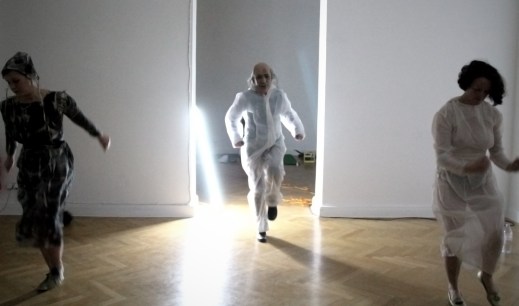
La Mission, (p/A)001: A non-Aristotelian Drama in Five Acts, 2013, Image by Julien Barret
The significance for La Mission’s project in dance music culture should be clear already, but we also take great inspiration in how Muñoz developed an expansive view of brownness and the brown commons, using Latina/o experience as an entry-point for “a vaster consideration of the ways in which people and things suffer and experience harm under the duress of local and global forces that attempt to diminish their vitality and degrade their value.” We here at La Mission are committed to exploring brownness for its potentials for lateral solidarities among people of color, who may have diverse cultural backgrounds but nonetheless share post-migrant experiences of struggle, devaluation, displacement, and inauthenticity. In fact, Muñoz’s work was a direct inspiration for the “Brown Corner” in our La Mission ‘zine (a parody of the “ladies’ corner” and “kid’s corner” of American mid-century lifestyle magazines). Published bilingually and featuring post-migrant authors, the Brown Corner reflects on aspects of brownness, as both specific to their contexts and generalizable to a wider “commons” of brown experience. In the process, we hope to highlight shared feelings, narratives, and resources for brown survival in a world of white supremacy.
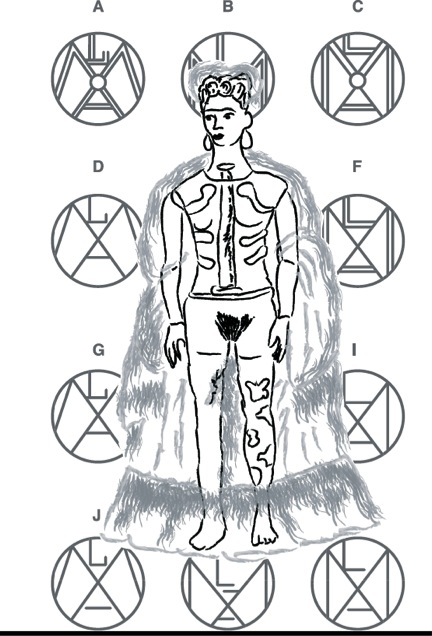
A hand-drawn re-working of Frieda Kahlo’s own self-portrait, part of the Brown Corner for issue 001 of the La Mission ‘zine.
Singing into the Horizon
Brother Muñoz, what are we supposed to do with the vinyl records, the zines, the performance videos we had been accumulating for you? We’re trying to sing our way into a queer utopian horizon, and we had been counting on your voice. We know you’re not coming back. As a radical lefty utopian doomsday cult, we’re not so invested in the afterlife, anyway. But it still sucks for us and everyone else you left behind, left in the “here and now” that we struggle to turn into something less suffocating. The party was just getting started, dammit. Besides, we had such a kickass choirboy outfit picked out for you.
—
LUIS-MANUEL GARCIA aka “LMGM”: LMGM/Luis-ManuelLMGM/Luis-Manuel is a Canadian of Peruvian-Colombian origins, currently an Assistant Professor in Popular Music at the University of Groningen (NL), after migrating between Toronto, Berlin, Chicago, and Paris. He has managed to turn his love of electronic dance music into a PhD in Ethnomusicology at the University of Chicago, and into post-doctoral fellowships at the Max Planck Institute for Human Development and the Freie Universität Berlin. On the side, he writes about food and dances every chance he gets.
—
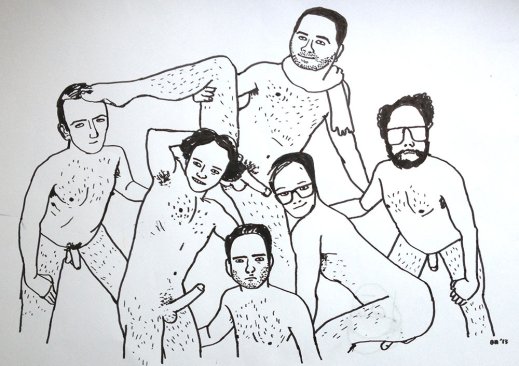
“Portrait of La Mission” by Ben Hammond, who has not seen any of its members naked
Muñoz & La Mission: A Sermon for the Imagined Sanctuary We Built Together
Welcome. La Mission is a family. A family of chosen comrades, chosen brethren, chosen hermanos, chosen сестры, chosen lovers, chosen students, chosen teachers, and chosen arms. Arms, linked and brandished through common thought, common feeling, common goals. It is with a heavy heart that we find ourselves here, remembering one of our family who (though never officially an acolyte or collaborator) was one who contributed to the ecstasy that we have felt and will feel for many years. José Esteban Muñoz was said to be a believer. Ernst Bloch and the New Revolutionary Epoch. Our utopias were described and imagined and realized and experienced. Rise up, my brown brethren, and let us celebrate Brother Muñoz’s legacy!

La Mission’s “(p/A)001: A non-Aristotelian Drama in Five Acts,” 2013, Image by Julien Barnet
The words and deeds of this fellow freedom-fighter, who infiltrated the bourgeois güero academy and infected it with a polylateral program for de- and reprogramming, has been our parallel and our inspiration. Colleague and comrade. A representative of our struggle. Not quite a patron saint—that honor we’ve reserved for communarde Louise Michel—but no less a visionary. As queers, as minorities stripped of identity, as angry and happy children in revolt for something better, we must all learn from each other as equals.
Brother Muñoz made utopia political again and located that utopianism in performance. La Mission’s performances bring forth utopias from our queer future through fleeting mindfuck happenings in the present. Through the work of Sister O’Connell and her band of terrorizing miscreants, we present a non-narrative and non-paternalistic path towards redemption, one of our own making. Can I get a “Fuck, yeah!”?

La Mission at Import Projects, 2013
Brother Muñoz loved music and dancing and life-worlds connected by the beat and said, “Take Ecstasy with Me.” He revealed to us the connections between collective dancing and feeling utopian. In his spirit, La Mission’s music strives to bring forth utopia through that ever-lasting beat. Through disassociation and reassociation, through transcendental repetition, and through getting the fuck down! Can I get a “Fuck, yeah!”?
Brother Muñoz believed in learning and critical thinking. Analysis and the great revolutionary trek through the jungle of our critically thinking minds. La Mission’s tracts enact utopia through a constant vomiting out of our recently digested learnings into the baby-bird mouths of those who read them. The brother was also a hilarious motherfucker, and from this we realize that it is not through the shrill screams of egoism disguised as activism that we will prevail. It is through the joy of laughter combined with thought that we will win our bread. Can I get a “Fuck, yeah!”?
Brother Muñoz loved fucking. La Mission’s fucking creates utopias through the ecstatic act in and of itself. If you aint fucking to make yourself a Temporary Autonomous Zone of happiness, then you aint doing it right. Can I get a copulatory “Fuck, yeah!”?
It is not all loss, though. The ideas live on. Caminamos juntos. On the dancefloor. In the reclaimed Torre David skyscraper and the Taller Tupac Amaru collective; in the informal classrooms and the sweaty bedrooms. Our hearts must burst after sagging, our heads must fill after hanging low, and our linked arms will raise! Oh honey, please don’t give your heart to a world system based on exploitation of the luckless, give your heart to US!
—

La Mission at Import Projects, Common Revilings Project, 2013, Image by Julien Barrat
—
All images courtesy of La Mission
—
PABLO ROMAN-ALCALA: Yo. I am Pablo aka “Beaner” aka “Skirtchaser” aka “El Frijolero” etc. I am an internationally working musician and dj who has enjoyed a modicum of success, but who doesn’t like what has happened to the musical landscape vis-a-vis “conservatism” in respect to both Money and Art. I mean the relationship of the two, okay? It sucks. And I want to change it.
—
REWIND!…If you liked this post, check out:
Karaoke and Ventriloquism: Echoes and Divergences–Karen Tongson and Sarah Kessler
Freedom Back: Sounding Black Feminist History, Courtesy the Artists– Tavia Nyong’o
“New Wave Saved My Life*”-Wanda Alarcon
Share this:




Current Top Posts





April 2021

January 2020

November 2019

October 2019

August 2019

April 2014

November 2017

March 2015

December 2017

October 2015
 Sounding Out!
Recent Comments