
Sound at ASA 2012

This year, #ASA2012 is being held in San Juan, Puerto Rico at the Puerto Rico Convention Center from November 15-18. San Juan provides a historic opportunity for the interdisciplinary scholars working under the banner of “American Studies” to ponder the theme, “Dimensions of Empire and Resistance: Past, Present, and Future,” from a site that has been an “unincorporated territory” of the United States since it was seized from Spain (its former imperial occupiers) after the Spanish American War in 1898. According to the U.S. Supreme Court’s Insular Cases an “unincorporated territory” is “a territory appurtenant and belonging to the United States, but not a part of the United States.” Puerto Ricans have been citizens of the United States since 1917, despite not having voting representatives in Washington D.C. and being unable to vote in mainland presidential elections. Just a few days ago, Puerto Ricans voted on yet another referendum to become a state—there have been 3 such votes, one in 1967, 1993, and 1998, but this is the first where statehood won a majority of the votes—an issue that both U.S. presidential candidates were all but silent on in their recent campaigns. This vote suggests a sea change in Puerto Rican-U.S. relations–what an exciting time to hold ASA in San Juan!–and I’d also like to think this particular meeting portends an exciting shift in sound studies as well.
For one thing, sound studies scholars in particular will be discussing power and imperialism loudly and clearly at this meeting. Sounding Out!’s Managing Editor, Liana Silva, will be participating in a roundtable at 8:00 a.m Sunday morning entitled “Doing Disciplinarity: Puerto Rican Studies is/as/with American Studies” where she, along with Marta S. Rivera Monclova (Framingham State College), Leonardo L. Flores Feliciano (University of Puerto Rico, Mayaguez), and Sara Poggio (University of Maryland, Baltimore County) will discuss the fraught relationship between the two fields of study, particularly in relation to America’s imperial history.
And then, the fully signed-sealed-and delivered ASA Sound Studies Caucus hosts two official panels that explicitly consider the politics of sound and listening. The first is on on Friday from 4:00-5:45: “Resisting Silences: Re-sounding Race, Gender, and Empire” chaired by Sherrie Tucker (University of Kansas) and featuring the research of Marci McMahon (University of Texas, Pan American), Genevieve Yue (University of Southern California and yours truly, Jennifer Stoever-Ackerman (SUNY Binghamton); and the second on Saturday from 4:00-5:45: “Sound and the State: The Politics of Acoustic Power” chaired by Jonathan Sterne (McGill University) and featuring the research of David Suisman (University of Delaware) and Peter Tschirhart (University of Virginia) with a comment by Mara Mills (New York University). From the racial dynamics of postwar New York City’s noise laws to “Noise Exposure Maps,” Sonic Booms to the technics of female silence, ASA’s sound studies scholars continue the sociopolitical interventions of last year’s “Sound Clash: Listening to America Studies” special issue of American Quarterly. This issue, edited by Josh Kun and Kara Keeling, explicitly focused on issues of race, gender, class sexuality, and nation (by the way, if you misplaced your copy, Johns Hopkins press has just released the issue in book volume form).
The Sound Studies Caucus also continues its very important organizational role this year by bringing scholars together for its second annual Sound Studies Caucus Meet-and-Greet, which will be co-hosted by none other than Sounding Out! !!! We have been thrilled to work with co-organizers Inés Casillas (UCSB), Roshanak Kheshti (UCSD) and Deb Vargas (UCR) to plan a get together at the District Bar of the nearby Sheraton (200 Convention Way, 787-993-3500, Map) where we will solicit volunteers and chat about the activities of the caucus this year and next. Sounding Out! will be officially welcoming the members of its new advisory board at the meet-and-greet, as well as sharing details about current and future Calls for Posts, and pumping up the crowd for what’s ahead in the blog for 2013. If you are in San Juan for the conference, please join us!

“Grupo Mania and My Puerto Rican Flag,” by Flickr User Photo Prodigy
Overall, while sound studies work is somewhat lighter than in years past—a trend I also noted at the Society for Cinema and Media Studies meeting earlier this year—the research on sound, listening, and aurality at this year’s #ASA2012 is, more than ever before, focused on questions of race, gender, and sexuality in ways that, as Keeling and Kun stated in their introduction to Sound Clash: “can enable an interdisciplinary American studies in which knowledges and insights that have not been perceptible to our dominant intellectual paradigms might be heard or heard anew” (453). I am particularly enthused about what promises to be excellent new research in African American Studies—especially the panels “Ask Your Mama: The Sound(ed) Poetics and Politics of Black Feminist Internationalism” (Saturday, 12:00-1:45) and “Blackness and the Sacred Performative” (Thursday 4:00-5:45, featuring SO! writer Ashon Crawley [Duke]—and Chican@/Latino Studies—notably roundtables on “The Talking Cure for Empire? Oral History and Testimonio in the Twenty-first Century” (Friday, 10:00-11:45) and “Subjectivity and Sound: Rethinking Genre in Chicano/a Music” (Friday, 2:00-3:45). There are also multiple panels that elicit transnational conversations about audio culture—“Resisting Silences: Re-sounding Race, Gender, and Empire” (Friday 4:00-5:45) and “Jazz and the Voices of Empire and Resistance” in particular (Saturday, 10:00-11:45)—and enable transmedia comparisons—especially “Terrains of Modernity, Aural Research, and Critique” (Sunday, 2:00-3:45).
Whereas the downturn in sound studies work at SCMS 2012 was due primarily to a scheduling snafu—doublebooked with the 2012 EMP—I think the ASA’s is perhaps due to the beginnings of a sea change (a new wave?) in sound studies. It is certainly not attributable to a lack of interest or scholarship—the emails I get for Sounding Out! alone can attest to growing numbers of truly enthusiastic scholars working on sound and listening—therefore, I put forth that sound studies is entering a moment of reflection. It is no longer enough to breathlessly sound out new sonic terrain; we are moving beyond the period when sound alone could be the binding theme in a conference panel. The work is getting more nuanced, robust sub-fields are developing—voice studies, for example—vocabularies are becoming shared, and more than ever, scholars are engaging with each other’s work on a deeper level, complicating and texturing the just-established histories, narratives, and canons of the field. Whereas Michele Hilmes’s foundational 2005 review essay in American Quarterly “Is there a Thing Called Sound Culture Studies? And Does it Matter?” noted that “various venues of academic work on sound phenomena so rarely speak to or take heed of each other” (252), I noted no fewer than twelve sound-related roundtables at #ASA2012 where scholars will be doing the difficult-but-rewarding work of acknowledging conflicts, hashing out shared interests, and forging what comes next. Please take good notes, sound studies folks, because ASA has enacted an official ban on recording:
The papers and commentaries presented during this meeting are intended solely for the hearing of those present and should not be tape-recorded, copied, or otherwise reproduced without the consent of the authors. Recording, copying, or reproducing a paper/presentation without the consent of the author(s) may be a violation of common law copyright and may result in legal difficulties for the person recording, copying, or reproducing (ASA Program PDF, 17).
Unfortunately, this means that the 2012 sound roundtables will be one-time-only, be-there-or-be-square affairs. But as we know from so much research in our vibrant field, even while the vocal grains and tones will fade away into the air of San Juan, these unscripted scholarly performances can’t help but have lasting reverberations.
The Liner Notes for the ASA Sound Studies Caucus “Cassette” Flyer. This and Featured Image by Frank Bridges, fbridges@eden.rutgers.edu
Scroll down for the sound-related conference listings. For the virtual experience, look for my live tweets via our Facebook and Twitter pages, Liana Silva’s live tweets (@literarychica) or on the official ASA backchannel: #ASA2012. Please comment to let SO! know what you think–both before and after ASA 2012. Finally, If I somehow missed you or your panel in this round up, please let me know!: jsa@soundingoutblog.com
—
Jennifer Stoever-Ackerman is co-founder, Editor-in-Chief and Guest Posts Editor for Sounding Out! She is also Assistant Professor of English at Binghamton University and a former Fellow at the Society for the Humanities at Cornell University (2011-2012).
—
Jump to THURSDAY, NOVEMBER 15, 2012
Jump to FRIDAY, NOVEMBER 16, 2012
Jump to SATURDAY, NOVEMBER 17, 2012
Jump to SUNDAY, NOVEMBER 18, 2012
Back to menu
THURSDAY, NOVEMBER 15, 2012
THURSDAY, November 15, 2012
10:00 am – 11:45 am
007. Crimson and Clover: Hope and Dread in the Musical Countercultures of the 1960s
Puerto Rico Convention Center 102C
CHAIR: Eric Avila, University of California, Los Angeles (CA)
PAPERS: Rachel Rubin, University of Massachusetts, Boston (MA), “I Think That Maybe I’m Dreaming: Music, Counterculture, and the Renaissance Pleasure Faire”
Andrew Green Hannon, Yale University (CT), “Huey Digs Bob Dylan: The Black Panthers, Highway 61 Revisited, and Making Revolutionary Meaning”
Jeffrey Melnick, University of Massachusetts, Boston (MA), “The Ballad of Terry Melcher: Famous and Rising Sons in the LA Counterculture”
Will Spires, Santa Rosa Junior College (CA), “The Musical Holdouts of Colby Street: Formation and Legacy of an Old Time Music Community”
COMMENT: Eric Avila, University of California, Los Angeles (CA)
INDIVIDUAL PAPERS:
Shane Vogel, Indiana University–Bloomington (IN), “Being a Fad: Black Performance and the Calypso Craze,” Puerto Rico Convention Center 104A
.
12:00 pm – 1:45 pm
031. Invisible Structures and the Experience of Music
Puerto Rico Convention Center 103B
CHAIR: Lisa Brawley, Vassar College (NY)
PAPERS: Carlo Rotella, Boston College (MA), “The Home of the Blues”
Eric Weisbard, University of Alabama, Birmingham (AL), “Structuring the Eclectic: Radio and Entertainment Formats (Not Genres)”
Hua Hsu, Vassar College (NY), “Sounds of Confusion: H. T. Tsiang and Ruth Crawford Seeger’s Protest Music”
COMMENT: Lisa Brawley, Vassar College (NY)
.
037. Blogging as Public Pedagogy: A Roundtable with GayProf, Historiann, Roxie, and Tenured Radical
Puerto Rico Convention Center 202B
CHAIR: Martha Nell Smith, University of Maryland, College Park (MD)
PANELISTS: Marilee Lindemann, University of Maryland, College Park (MD)
Ann Little, Colorado State University (CO)
Anthony Mora, University of Michigan, Ann Arbor (MI)
Claire Bond Potter, New School University (NY)
Martha Nell Smith, University of Maryland, College Park (MD)
INDIVIDUAL PAPERS:
Jack Hamilton, Harvard University (MA), “House Burning Down: Jimi Hendrix, Race, and the Limits of Sixties Music,” Puerto Rico Convention Center 104A
Mecca Jamilah Sullivan, University of Pennsylvania (PA), “Feeling Colors and Seeing Speech: Black Women’s Choreopoetic Diasporas of Difference,” Puerto Rico Convention Center 209C
2:00 pm – 3:45 pm
INDIVIDUAL PAPERS:
Nadja Millner-Larsen, “Black Synaesthesia: The Anarcho-Aesthetics of Black Mask,” Puerto Rico Convention Center 104B
Mary Beltrán, University of Texas, Austin (TX), “Blacking Up for Laughs: Televisual Blackface and ‘Post-Racial’ Cultural Memory,” Puerto Rico Convention Center 208B
4:00 pm – 5:45 pm
077. Blackness and the Sacred Performative
Puerto Rico Convention Center 104A
CHAIR: Michelle D. Commander, University of Tennessee, Knoxville (TN)
PAPERS: Amey Victoria Adkins, Duke University (NC), “‘Ain’t I A Woman’: Black Madonnas, Mammys, and the Performative Aesthetics of Darkness”
Ashon Crawley, Duke University (NC), “Breathing Towards Lynching Critique: Whooping in Black Pentecostal Praying and Preaching”
Terrion L. Williamson, Michigan State University (MI), “Black Sacred Dance and the Reverberations of Christian Sexuality”
COMMENT: Johari Jabir, University of Illinois, Chicago (IL)
.
INDIVIDUAL PAPERS:
Molly McGlennen, Vassar College (NY), “Re-imagining “Domestic Dependency”: The Transnational Motivations of Rebecca Belmore’s Sound Performances,” Puerto Rico Convention Center 209C
.
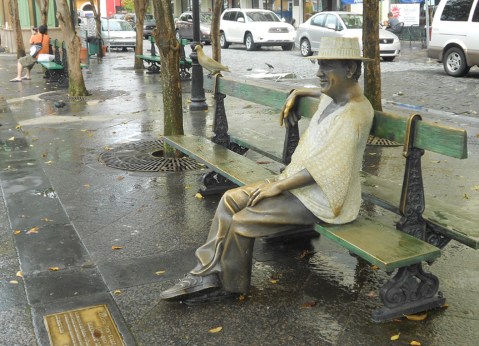
Memorial to Salsa Composer Catalino (Tite) Curet Alonso (1926-2003) in the Plaza de Armas, Image by Flickr User roger4336
Back to menu
FRIDAY, NOVEMBER 16, 2012
FRIDAY, NOVEMBER 16, 2012
8:00 am – 9:45 am
105. Mixtape Logics: Listening to Empire and Resistance
Puerto Rico Convention Center 104B
CHAIR: Matthew Carrillo-Vincent, University of Southern California (CA)
PANELISTS: Priya Jha, University of Redlands (CA)
Van Truong, Yale University (CT)
Chris Nielsen, University of Pittsburgh (PA)
COMMENT: Joshua Guild, Princeton University (NJ)
.
108. Caucus: Digital Humanities: What Can the Digital Humanities Bring to American Studies, and Vice Versa?
Puerto Rico Convention Center 202A
CHAIR: Susan Garfinkel, Library of Congress (DC)
PANELISTS: Natalia Cecire, Yale University (CT)
Alex Gil, University of Virginia (VA)
Matthew K. Gold, City University of New York, Graduate School (NY)
Kathleen Fitzpatrick, Modern Language Association (NY)
Lauren Klein, Georgia Institute of Technology (GA)
Miriam Posner, University of California, Los Angeles (CA)
.
117. Performance as Power and Critique: Social Change in African Diasporic Performance
Puerto Rico Convention Center 208C
CHAIR: Jennifer Devere Brody, Stanford University (CA)
PAPERS: Tisha Brooks, Tufts University (MA) ,“Performing Power and Privilege: The Spiritual Itinerant Practice of Amanda Berry Smith”
Shanesha R. F. Brooks-Tatum, Interdenominational Theological Center (GA), “Sonic Bridges: Conversion Narratives in Diasporic Christian Hip-Hop Performance”
Tanya Saunders, Lehigh University (PA), “Global Hip Hop, Black Feminism, and the Queer of Color Critique: An Analysis of Women-Centered Arts-Based Activism in Cuba and Brazil”
Lori Lynne Brooks, University of Michigan, Ann Arbor (MI), “It’s Empire Time!: Black Popular Performance and the Temporality of Imperialism”
.
10:00 am – 11:45 am
125. The Talking Cure for Empire? Oral History and Testimonio in the Twenty-first Century
Puerto Rico Convention Center 102B
CHAIR: Theresa Delgadillo, Ohio State University, Columbus (OH)
PANELISTS: Tami Albin, University of Kansas (KS)
Maylei Blackwell, University of California, Los Angeles (CA)
Thuy Vo Dang, University of California, Irvine (CA)
Theresa Delgadillo, Ohio State University, Columbus (OH)
Linda Garcia Merchant, Artist
Joseph Rodríguez, University of Wisconsin, Milwaukee (WI)
Sonia Saldívar-Hull, University of Texas, San Antonio (TX)
Janet Weaver, University of Iowa (IA)
.
127. ASA Program Committee: Dimensions of Empire and Resistance: Speculation, Futurity, New Materialisms
Puerto Rico Convention Center 103A
CHAIR: Tavia Nyong’o, New York University (NY)
PANELISTS: Jayna Brown, University of California, Riverside (CA)
Tavia Nyong’o, New York University (NY)
Dana Luciano, Georgetown University (DC)
José Esteban Muñoz, New York University (NY)
.
131. Caucus: Science and Technology: What is the Future of Technology in American Studies?: A Roundtable
Puerto Rico Convention Center 104C
CHAIR: Jason Weems, University of California, Riverside (CA)
PANELISTS: Carolyn de la Pena, University of California, Davis (CA)
Lisa Nakamura, University of Illinois, Urbana-Champaign (IL)
Joshua Shannon, University of Maryland, College Park (MD)
Elena Razlogova, Concordia University (Canada)
Joel Dinerstein, Tulane University (LA)
COMMENT: Jason Weems, University of California, Riverside (CA)
.
133. Caucus: Digital Humanities: Digital Shorts: New Platforms of Knowledge Production and Resistance
Puerto Rico Convention Center 202A
CHAIR: A. Joan Saab, University of Rochester (NY)
PANELISTS: Susan Smulyan, Brown University (RI)
Stewart Varner, Emory University (GA)
A. Joan Saab, University of Rochester (NY)
.
INDIVIDUAL PAPERS
Thomas George Sowders, Louisiana State University, Baton Rouge (LA), Puerto Rico Convention Center 208C, “Martin Delany’s Sonic Transnationalism: Genres of Poetry and Sound in Blake; or, the Huts of America”
12:00 pm – 1:45 pm
146. Ask Your Mama: The Sound(ed) Poetics and Politics of Black Feminist Internationalism
Puerto Rico Convention Center 101A
CHAIR: Farah Griffin, Columbia University (NY)
PAPERS: Daphne Ann Brooks, Princeton University (NJ), “‘A Woman is a Sometime Thing’: Leontyne and Sarah’s Sonic Temporalities’
Salamishah Tillet, University of Pennsylvania (PA), “Hush and Listen: Mama Africa and Nina Simone’s Global Civil Rights Sound”
Imani Perry, Princeton University (NJ), “Sounding Like a Movement: The Advance of Miriam Makeba’s Retreat Song”
COMMENT: Farah Griffin, Columbia University (NY)
12:00 pm – 1:45 pm
168. Business Meeting of the Digital Humanities Caucus
Puerto Rico Convention Center Foyer A
2:00 pm – 3:45 pm
182. ASA Committee on Graduate Education: Digital Dimensions of Graduate Education in American Studies (co-sponsored by the Digital Humanities Caucus and ASA Students’ Committee)
Puerto Rico Convention Center 202A
CHAIR: Robert W. Snyder, Rutgers University, Newark (NJ)
PANELISTS: Clarissa J. Ceglio, Brown University (RI)
Douglas Lambert, State University of New York, Buffalo (NY)
Sharon Leon, George Mason University (VA)
John Carlos Rowe, University of Southern California (CA)
Stephen Brier, City University of New York, Graduate School (NY)
187. Subjectivity and Sound: Rethinking Genre in Chicano/a Music
Puerto Rico Convention Center 208A
CHAIR: Tyina Steptoe, University of Washington, Seattle (WA)
PANELISTS: Anthony Macias, University of California, Riverside (CA)
Marie Miranda, University of Texas, San Antonio (TX)
Michelle Habell-Pallan, University of Washington, Seattle (WA)
INDIVIDUAL PAPERS
Marisol Negrón, University of Massachusetts, Boston (MA) “The Good, the Bad, and the Ugly: Fania Records, Intellectual Property Rights, and Royalties,” Puerto Rico Convention Center 104B
Isabel Porras, University of California, Davis (CA) “Hypersexual and Excessive: Carmen Miranda and Sofia Vergara and Performing Latinidad,” Puerto Rico Convention Center 203
4:00 pm – 5:45 pm
208. Caucus: Sound Studies: Resisting Silences: Re-sounding Race, Gender, and Empire
Puerto Rico Convention Center 204
CHAIR: Sherrie Tucker, University of Kansas (KS)
PAPERS: Marci McMahon, University of Texas, Pan American (TX), “Tanya Saracho’s El Nogalar: Staging Soundscapes of Silence and Imperialism”
Genevieve Yue, University of Southern California (CA), “Technics of Female Silence”
Jennifer Lynn Stoever-Ackerman, State University of New York, Binghamton (NY), “‘Just Be Quiet Pu-leeze’: New York’s Black Press Fights the Postwar ‘Campaign Against Noise’
COMMENT: Sherrie Tucker, University of Kansas (KS)
.
213. I’m a MuthaFking Monster: Alter Egos, New Media, and Black/Queer Performativity
Puerto Rico Convention Center 209B
CHAIR: Gabriel Peoples, University of Maryland, College Park (MD)
PAPERS: Treva Lindsey, University of Missouri, Columbia (MO), “I Am… Sasha Fierce: Resistive Alterity and African American Respectability Politics”
Uri McMillan, University of California, Los Angeles (CA), “Gone Campin’: The Campy Paradox of Nicki Minaj”
Kismet Nunez / Jessica Marie Johnson, University of Maryland, College Park (MD), “On Alter Egos and Infinite Literacies, Part 2 (An #AntiJemimas Imperative)”
.
INDIVIDUAL PAPERS:
Omi/Joni Jones, University of Texas, Austin (TX); Sharon Bridgforth, DePaul University (IL), “Conjuring Jazz”

Fiestas de la Calle San Sebastián, San Juan, Puerto Rico, by Flickr User Jorge Rodriquez
.
Back to menu
SATURDAY, NOVEMBER 17, 2012
SATURDAY, NOVEMBER 17, 2012
8:00 am – 9:45 am
237. Empires of Funk: U.S. Colonialism, Filipina/o Resistance, and Hip Hop
Puerto Rico Convention Center 202A
CHAIR: Victor Hugo Viesca, California State University, Los Angeles (CA)
PAPERS: Mark Villegas, University of California, Irvine (CA), “From Indios to Morenos: Exploring the Poetics and Memory of Postcolonial Racial Positioning”
Lorenzo Perillo, University of California, Los Angeles (CA), “Maganda at Malakas: Gendered Choreographies in Manila”
Roderick Labrador, University of Hawai‘i, Manoa, (HI) “Agitation Propaganda: Toward a Filipina/o Revolutionary Internationalism”
COMMENT: Brian Chung, University of Notre Dame (IN)
.
242. Aesthetics in the Belly of the Beast: Reading American Carceral Art
Puerto Rico Convention Center 208A
CHAIR: Doran Larson, Hamilton College (NY)
PAPERS: Alessandro Porco, State University of New York, Buffalo (NY), “The ‘And’ After Every Sentence: Hip-Hop, Incarceration, and Creativity”
Imani Kai Johnson, New York University (NY), “B-Boying Behind Bars: A Profile of Batch from The Bronx Boys Rocking Crew”
Marcella Runell Hall, New York University (NY), “Assessment Data on ‘Lyrics from Lockdown,’”
COMMENT: Doran Larson, Hamilton College (NY)
.
INDIVIDUAL PAPERS:
Sarah Perkins, Stanford University (CA), “‘Bound to trabble’: The Circulation of ‘Dixie,’ 1880–1910,” Puerto Rico Convention Center 201A
Nicholas Bauch, California State University, Los Angeles (CA), “Practicing Geography Through Art Performance: Urban Interventions and the Renaissance of the Vernacular,” Puerto Rico Convention Center 209B
.
10:00 am – 11:45 am
263. ASA Program Committee: Dimensions of Empire and Resistance: Language Ideologies, Spanish in the U.S., and Latinidad
Puerto Rico Convention Center 202B
CHAIR: Ana Celia Zentella, University of California, San Diego (CA)
PAPERS: Lourdes Maria Torres, DePaul University (IL), “Spanish in Chicago: Dialects in Contact”
Jonathan Daniel Rosa, University of Massachusetts, Amherst (MA), “Racializing Language, Regimenting Latinidad:Latina/o Ethnolinguistic Emblems in Diasporic Perspective”
Lillian Gorman, University of Illinois, Chicago (IL). “The (New) Mexican Familia: Ethnolinguistic Contact Zones in Northern New Mexico”
COMMENT: Ana Celia Zentella, University of California, San Diego (CA)
.
12:00 pm – 1:45 pm
278. Black Independent Cinema Before and After Pariah
Puerto Rico Convention Center 101B
CHAIR: Kara Keeling, University of Southern California (CA)
PANELISTS: Jennifer DeClue, University of Southern California (CA)
Yvonne Welbon, Bennett College (NC)
Jacqueline Najuma Stewart, Northwestern University (IL)
Roya Z. Rastegar, University of California, Los Angeles (CA)
Kara Keeling, University of Southern California (CA)
.
287. West Side Story: A Roundtable Discussion
Puerto Rico Convention Center 202A
CHAIR: Julia Foulkes, New School University (NY)
PANELISTS: Julia Foulkes, New School University (NY)
Alberto Sandoval-Sánchez, Mount Holyoke College (MA)
Deborah Paredez, University of Texas, Austin (TX)
Elizabeth Wells, Mt. Allison University (Canada)
Brian Eugenio Herrera, Princeton University (NJ)
.
INDIVIDUAL PAPERS:
Rashida K. Braggs, Williams College (MA), “From Limited to Alternate Citizenship: How Image and Song Perform Historical Resistance in Bayou,” Puerto Rico Convention Center 208A
.
2:00 pm – 3:45 pm
2nd Annual Sound Studies Meet and Greet! Co-Sponsored by the ASA Sound Studies Caucus and Sounding Out!: The Sound Studies Blog
The District Bar
SHERATON PUERTO RICO HOTEL & CASINO
200 Convention Center Boulevard, San Juan, PR 00907
Cash Bar
Appetizers! Drink Specials! VIP area!
303. Musical Movements
Puerto Rico Convention Center 102B
CHAIR: Ulrich Adelt, University of Wyoming (WY)
PAPERS: John Cline, University of Texas, Austin (TX), “Familiar Islands: The U.S., the Bahamas, and the Permeable Boundaries of ‘Folk’ Music”
Mikiko Tachi, Chiba University (Japan), “Folk Music and the Racial Imaginary in the U.S. and Japan”
Shana Goldin-Perschbacher, Stanford University (CA), “‘I need another world’: Queer Singer-Songwriters in Transnational Collaboration Post-9/11”
COMMENT: Ulrich Adelt, University of Wyoming (WY)
.
314. Re-thinking Red, Yellow, Black, and Chicana/o Power through Oral History
Puerto Rico Convention Center 204
CHAIR: Rhonda Williams, Case Western Reserve University(OH)
PAPERS: Lorena Oropeza, University of California, Davis (CA), “He Said, She Said, But Who’s Right?: Oral History Unlocks Anti-Colonialism in 1960s New Mexico”
May Fu, University of San Diego (CA), “Oral History and the Asian American Radical Tradition”
Elizabeth Castle, University of South Dakota (SD), “Talking Back: Native Women’s Oral Histories in the Red Power Movement”
Lauren Araiza, Denison University (OH), “Oral Histories and Multiracial Coalitions in the UFW and the Black Freedom Struggle”
COMMENT: Rhonda Williams, Case Western Reserve University, (OH)
.
INDIVIDUAL PAPERS
Rachel Donaldson, Vanderbilt University (TN), “Seeking the ‘Sensual’ and the ‘Significant’: Alan Lomax in Haiti”
.
4:00 pm – 5:45 pm
325. Chavela Vargas, La Bamba, and Morrissey: Mapping Queer Musical Diasporas and Desires
Puerto Rico Convention Center 102A
CHAIR: Stacy Macias, University of Texas, Austin (TX)
PAPERS: J. Frank Galarte, University of Arizona (AZ), “‘Que soy muy canalla dice la gente’: The Pleasure of Queer Love, Desire, and Dolor in Chavela Vargas’ Repertoire”
Micaela Díaz-Sánchez, Mount Holyoke College (MA), “Yo también quiero bailar la bamba”: The Policing of Gender in the Chicana/o Son Jarocho Diaspora”
Melissa Hidalgo, Pitzer College (CA), “Complicated Colonial Legacies: Mapping the Queer Chicano Contours of Morrissey’s Los Angeles Fanscape in “Gay Vatos in Love”
COMMENT: Stacy Macias, University of Texas, Austin (TX)
.
326. Marginal Digital Knowledges: A Workshop on Technology, Transformation, and Resistance
Puerto Rico Convention Center 102B
CHAIR: Tara McPherson, University of Southern California (CA)
PANELISTS: Simone A. Browne, University of Texas, Austin (TX)
Fiona Barnett, Duke University (NC)
Amanda Phillips, University of California, Santa Barbara (CA)
Tanner Higgin, University of California, Riverside (CA)
Moya Bailey, Emory University (GA)
Alexis Lothian, Indiana University of Pennsylvania (PA)
327. Caucus: Sound Studies: Sound and the State: The Politics of Acoustic Power
Puerto Rico Convention Center 102C
CHAIR: Jonathan Sterne, McGill University (Canada)
PAPERS: David Suisman, University of Delaware (DE), “Shock Wave Politics: The Battle Over Sonic Booms”
Peter Tschirhart, University of Virginia (VA), “Part 150 ‘Noise Exposure Maps’ and the Closing of the Acoustic Commons”
COMMENT: Mara Mills, New York University (NY)
.
329. Between Island and Diaspora: Locating, Creating, and Performing Afro–Puerto Rican Bomba
Puerto Rico Convention Center 104A
MODERATOR: Tamara Roberts, University of California, Berkeley (CA)
This roundtable brings together bomba practitioners, cultural workers, and scholars from Puerto Rico and California. Rafael Maya and Pablo Luis Rivera will discuss their work as the founders of Proyecto Unión and Restauración Cultural. Sarazeta Ragazzi, Tamara Roberts, and Denise Solis will detail their work in the all-women’s performance ensemble Las Bomberas de la Bahia (San Francisco Bay Area). And Jade Power Sotomayor will extend the discussion of cross-cultural connections byconsidering the large Chicano participation in the form in the U.S., underscoring the ways that Latinidad and more specifically, Afro-Latinidad are corporeally articulated through this embodied practice.
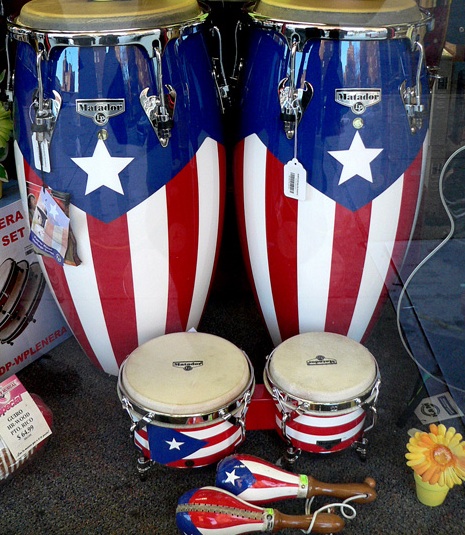
Congas, Image courtesy of Flickr User Richard Alexander Caraballo
.
Back to menu
SUNDAY, NOVEMBER 18, 2012
SUNDAY, NOVEMBER 18, 2012
8:00 am – 9:45 am
365. Doing Disciplinarity: Puerto Rican Studies is/as/withAmerican Studies
Puerto Rico Convention Center 204
CHAIR: Marta S. Rivera Monclova, Framingham State College (MA)
PANELISTS: Marta S. Rivera Monclova, Framingham State College (MA)
Liana Marie Silva, State University of New York, Binghamton (NY)
Leonardo L. Flores Feliciano, University of Puerto Rico, Mayaguez (PR)
Sara Poggio, University of Maryland, Baltimore County (MD)
INDIVIDUAL PAPERS
Nadia Ellis, University of California, Berkeley (CA), “Dancehall’s Urban Possessions,” Puerto Rico Convention Center 101A
.
10:00 am – 11:45 am
377. Jazz and the Voices of Empire and Resistance
Puerto Rico Convention Center 102A
CHAIR: John Gennari, University of Vermont (VT)
PAPERS: Daniel Stein, University of Goettingen (Germany), “Onkel Satchmo Behind the Iron Curtain: The Politics of Louis Armstrong’s Visit to East Germany”
Elliott H. Powell, New York University (NY), “Solidarity in Sound: John Coltrane, Indian Music, and Global Freedom Struggles”
Matthew B. Karush, George Mason University (VA), “Transnational Routes: Argentine Encounters with Jazz, 1959–1972”
COMMENT: John Gennari, University of Vermont (VT)
.
INDIVIDUAL PAPERS:
Daphne Lamothe, Smith College (MA), “Trauma, Silence, and the Language of Resistance in Danticat’s Brother, I’m Dying”
.
12:00 pm – 1:45 pm
INDIVIDUAL PAPERS:
Imani D. Owens, Columbia University (NY), “The Politics of Sound: Race, Space, and Cuban Identity in the Poetry of Nicolás Guillén,” Puerto Rico Convention Center 209A
.
2:00 pm – 3:45 pm
420. Terrains of Modernity, Aural Research, and Critique
Puerto Rico Convention Center 104C
CHAIR: Michele Hilmes, University of Wisconsin, Madison (WI)
PAPERS: Art Blake, Ryerson University (Canada), “John Cage’s Voice and New York’s Postwar Urban Sensorium”
Derek Vaillant, University of Michigan, Ann Arbor (MI), “The Power of Piaf: Racial Formation and Nostalgia in Postwar U.S.-France Aural Culture”
Jason Loviglio, University of Maryland, Baltimore County (MD), “Radio Localism 2.0”
Benjamin Aslinger, Bentley College (MA), “Listening In to Web 2.0: Subjectivity, Alterity, and Power”
COMMENT: Michele Hilmes, University of Wisconsin, Madison (WI)
.
423. Los Nombres: Puerto Rican Popular Music in Lorain, Ohio
Puerto Rico Convention Center 202C
CHAIR: Petra R. Rivera-Rideau, Virginia Polytechnic Institute and State University (VA)
PANELISTS: Petra R. Rivera-Rideau, Virginia Polytechnic Institute and State University (VA)
Eugene Rivera, Jr., Independent Scholar
José Pepe Rivera, Sr., Artist
..
INDIVIDUAL PAPERS:
Mike Amezcua, Northwestern University (IL), “Brown Bop: Mexican American Jazzmen, Race, and the Quest for a Transnational Jazz Movement”

San Juan, Puerto Rico, Image courtesy of Ricymar Fine Art Photography
Share this:

Could I Be Chicana Without Carlos Santana?
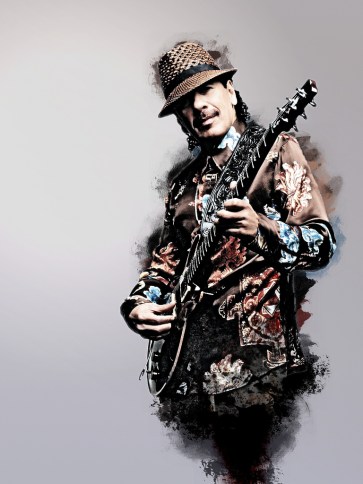
Carlos Santana by Flickr User Momez
This may be a given but I have to ask: Why is the music of Carlos Santana considered “Chicano music?”
It’s true; I am a fan. And as a fan I never question why I love the music, but I often ask myself what it is specifically about the music that resonates so strongly with me. I could say that I love Santana because I love a soulful electric guitar voice, because I admire the musicianship of the band, because I feel the “sabor” they sing about, because I’ve always loved Santana. But these parts surely do not make up a satisfying the “whole.” There is something else, something about listening to the music that amplifies my sense of identification as a Chicana with other Chicanos and Mexicanos. This happens whether I’m among raza, in the various communities I call home, or whether I find myself feeling very far from Aztlán. I’ve witnessed the effect of the music – maybe you have too – when it comes on the car radio, at backyard family BBQs, and friend’s living room dance floors, the music gets your body up and connects you to your Chicano roots.
In this sense, Santana is forever part of the Chicano sounded imaginary. For Chicanos, identifying with the music of Carlos Santana may have a special meaning that has something to do with a particular Chicano/Mexicano subjectivity. Yet, for non-Chicanos, Santana still retains their quintessential American rock band status. Most of their airplay is on mainstream radio, rarely if ever on Spanish-language stations. So Santana can be thought of at once as “puro” Chicano or “classic rock,” except that Santana is a straight up fusion band. This is why I have to ask, is the music of Santana “Chicano” music? And I further wonder, could I be Chicana without Carlos Santana?
…Oye Como Va…
Before the Rob Thomas & Carlos Santana collaboration on the Grammy award-winning album Supernatural (1999), before the phenomenon of “Smooth,” there was classic Santana. The Santana that produced the self-titled debut album Santana (1969) and Abraxas (1970). The songs “Evil Ways,” “Black Magic Woman,” and “Oye Como Va” from these two albums are on constant rotation on “classic rock” stations well after forty years since they first hit the airwaves. Even if you’re not a fan or a music connoisseur, when listening to “Oye Como Va” or “Smooth” it’s easy to recognize a distinct “Latin-ness” about them. In part, this is because of the fusion of Spanish and English lyrics with rock, blues, jazz, and Afro-Latin musical styles. For Chicanos, this particular fusion of language and sound might also resonate as something familiar and close to home – if sound can be a home. A quick search on YouTube will lead you to the classic 2000 Grammy Awards Performance of “Smooth” and a wealth of competing claims by fans (and foes) in the comments section.
Fan 1: “SANTANA ERES LO MAXIMO, VIVA MEXICO!!!!!!!!”
Fan 2: “Salsa baby, Oye Como Va is universal, Carlos is the man!!!!”
This was a special and high-profile performance so these comments are exceptionally spirited. But, YouTube is full of spontaneous, impassioned, (albeit anonymous) examples like this on any given day. I highlight these two as sort of placeholders for the idea of how sound and music mighty carry significant meaning toward subject formation in an everyday sense. These fans claim Santana both for Mexico and for the world, respectively, because they reflect a strong sense of Mexican or Chicano pride. In the first comment, the very enthusiastic fan could easily be a Mexico City native, maybe a Chicano wanting to sound like a Chilango –“ERES LO MAXIMO” is not a Chicano Spanish expression. The second fan’s comment is all in English and could be Chicano simply based on that—but those are slightly secondary points. As I suggested earlier, for Chicanos, Santana’s music has the potential to reflect a sense of ethnic history and culture. Sound can be a home. After all, the first comment claims Santana’s music for a whole country with “VIVA MEXICO!” helping to affirm the feeling that this fan and Carlos are Mexicanos together, across time and place.
When I was studying music in college, Mexican, Chicano, or Latino music was not part of the curriculum. Instead, in my private piano lessons, I would gravitate toward pieces by Spanish or Latin American composers as a sort of “good enough” way to stay in touch with my latinidad. This helped, but the fact is that Latin American art songs have much more in common with the Western musical canon than they do with my experiences and Chicana consciousness. In other words, it was a reach to identify with these composers solely because we shared a language. What would I miss in a too quick move to identify with the Latin-ness of Santana’s music this way? Would I hear only the Spanish spoken in the song? If so, then gaining a sense of my Chicana/o subjectivity by claiming “Oye Como Va” (for Aztlán?) relies on partially subsuming the specific Caribbean contexts and poetics of the song. Is this song originally Cuban, Puerto Rican? It’s really just a party song. “Oye como va, mi ritmo, bueno pa’ gozar, mulatta” Eso! Does it really matter now if Santana’s version has re-defined it for all time?
In a way, the second fan expresses a more complex desire: “Oye Como Va is universal.” Everyone knows that Carlos Santana is Mexican, some know that he is also an immigrant, and still others may have read that he grew up in Tijuana. As part of American rock music history, Santana’s roots are firmly planted in San Francisco and the Bay Area and it is well known that Santana played at the historic Woodstock Festival of 1969. Clearly, amongst other identities, Santana is a classic American rock band with long and wide appeal. But from the beginning, along with creative fusions of rock, jazz, blues, and salsa, it has been the distinctly Afro-Latino percussion core that defines their emblematic sound. And this is exactly how and why dwelling on these details in the sound of Santana matters. If Santana comes to mean or signify something like “pur0 Mexicano” or “pur0 Chicano” (in a brown pride or brown power sense) then that purity is already so productively and interestingly troubled because there is nothing remotely “pure” about Santana’s music.
Therefore, to identify with the music means confronting those complex fusions of language, race, and music that make up the Santana “sound.” To partly answer my earlier question, “Oye Como Va” is a composition by the renowned Puerto Rican timbalero and band leader Tito Puente, but the musical form, a basic cha-cha-cha, is Cuban. The song has other authors as well, that both Santana and Puente name. But ultimately, this song and indeed much of Santana’s music, comes in wake of much older histories of African diaspora, migration, colonization, artistry and spirituality.
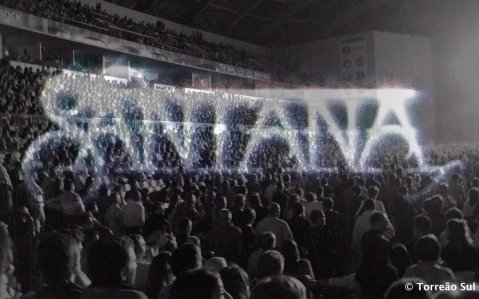
Santana fans. Image by Torreãu Sul.
…Sounding Home…
In a way, I’ve always felt that Santana’s music was making a black/brown connection, that racial boundaries were necessarily crossed or brought together because of the many histories that flow through the music. As a child of Mexican immigrant parents, I grew up listening to a wide repertoire of Afro-Latino music – elegant danzónes, romantic boleros, joyous cumbias, mad mambos, as well as more traditional Mexican music. Maybe that is also part of why listening to Santana reminds me of home. But this is perhaps too simple a response.
Santana’s music and popular image has been engaged in positive but also problematic ways in Chicana/o cultural production. Most recently, I noted this in a performance of the play New Fire, by Cherrie Moraga, in San Francisco. At a critical point in the drama, the evocative love song “Samba Pa’ Ti” is used to introduce a male character and a difficult, sexually violent scene. Moraga’s larger critique is of violent Chicano patriarchy and masculinity. The play is offered as a healing ceremony. But the association of this song, which features a famous guitar solo, with that specific scene is profoundly jarring. My sense was that Moraga selected Santana for the play’s soundscape it served as a shorthand for “Chicano.” Here, it was made to bear the history of violence of brown men against brown women and girls. This made it difficult for me to identify as a Chicana–queer and feminist–with Carlos Santana at that moment, and some time after. Surely this is also part of what “home” means.
Santana’s music interests me for these reasons, which go beyond the sounded Chicano imaginary in my headphones. What I find worthwhile in thinking further about Santana’s “sound” is how in the many acts of claiming Santana for oneself, one’s country, or one’s community, I can trace the way in which Chicano and Caribbean histories, both racialized and gendered, touch and cross in the music. That is, I see this as an invitation for the listener to reimagine notions of race, nation, gender, and sexuality even while dancing and singing along. In these ways, I see meaningful possibilities for imagining Chicana/o as a sounded subjectivity. I am certain that my sense of who I am, how I think, and how I walk in the world has been shaped by a life-long relationship with music and sound. And although being “Chicana” to me is not the same for anyone else, Santana’s music helps me to imagine a connection, a musical lineage I can trace and take part in. Santana is not my parent’s music. It’s not even my generation’s music. And, it’s not my only musical identity. But, even so, I couldn’t imagine being Chicana without Carlos Santana. Because when I listen, I do hear it, I hear how it all goes, together, and that is so, so good. “Give me your heart, make it real, or else forget about it!”
—
Wanda Alarcón is a PhD student in Ethnic Studies at UC Berkeley where her research involves reading Chicana and Caribbean “stories” together in a decolonial feminist vein. When she’s not living the glamorous grad student life she likes to make zines about po’try, learning new songs on her childhood piano, cooking for her loved ones, and exploring NorCal with her main squeeze. A native Los Angelena, she is beginning to appreciate thinking and writing about her beloved hometown from afar. Music helps bridge that distance. So do the trees and ocean breezes. She lives and loves kibbutz-style in Santa Cruz with her partner por vida, Cindy, their two sassy cats Lucy & Mona, and dear housemate, Ella.
Share this:


Current Top Posts





April 2021

January 2020

November 2019

October 2019

August 2019

April 2014

November 2017

March 2015

December 2017

October 2015
 Sounding Out!
Recent Comments