
Contra La Pared: Reggaetón and Dissonance in Naarm, Melbourne

 In “Asesina,” Darell opens the track shouting “Everybody go to the discotek,” a call for listeners to respond to the catchy beat and come dance. In this series on rap in Spanish and Sound Studies, we’re calling you out to the dance floor…and we have plenty to say about it. Your playlist will not sound the same after we’re through.
Throughout January, we will explore what Spanish rap has to say on the dance floor, in our cars, and through our headsets. We’ll read about trap in Cuba and about femme sexuality in Cardi B’s music. And because no forum on Spanish rap is complete without a mixtape, we’ll close out our forum with a free playlist for our readers. Today we continue No Pare, Sigue Sigue: Spanish Rap & Sound Studies with Lucreccia Quintanilla’s essay on reggaetón and Latinx identity in Australia.
Liana M. Silva, forum editor
—
The first time I heard Cypress Hill was at my fellow Salvadoran friend’s house in the outer suburbs of Brisbane, Australia. She was wearing big baggy clothes and announced that we needed to go in her room the very minute I arrived. So, we left our parents to talk in the lounge room and we sat on her bed and listened. Latin rap had arrived in my life! In the world of pop and the Latin American classics we kept hearing at quinceañeras, here was something new and energetic for us. It was our language, our people: in this way it provided a much needed connection to the outside world for us who existed in what was then quite a small and freshly arrived Latinx community. The place we found ourselves in was particularly racist, and for a moment we felt acknowledged and could just be proud of being who we were. The trumpets and snippets of familiar sounds mixed in with hip hop activated the familiar. But these Latinxs did not even try to be “good” migrants like we did. This was so refreshing to me.
It has been a long time since I was a fifteen-year-old, freshly arrived in Australia, in a classic story that involved fleeing from the Salvadoran Civil War and a period of migration to New York before finally landing in Australia. Pretty soon after arriving, I realised that Australia was not the place that I had seen in the documentary back in El Salvador about Indigenous people here. The one where thousands of years of culture were acknowledged and respected. Slowly, I came to the understanding that I too was a settler on this land at the expense of its indigenous people. Colonisation remains a continual process, and the effects of The White Australia Policy, which excluded non-European migrants until the late 1970s, is still clearly evident in the current political climate, epitomised by the treatment of asylum seekers coming from mainly Afghanistan, Iran, and Sri Lanka to these shores.
Because of Australia’s geographical and cultural disconnect it seemed rather difficult to find a space that was not an oversimplified or commodified version based on stereotypes of “Latinness” because of the relatively small communities where they played the old classics and followed traditions nostalgically closer than our relatives back home. As for me, back in El Salvador, I listened to the live music–which were mostly salsa and cumbias–playing in the party hall behind my house while I slept, which had an obvious and subliminal impact on me. I spent years humming Ivy Queen’s “Muchos Quieren Tumbarme” to myself until the day a decade later I sat down determined to find the original on Youtube. With all the might one has to muster to not be swept up by the broom of assimilation, I was exhausted and I had not found the time to listen to the music that was present in parts of my mind—and those parts were beginning to lose patience.
Until recently, World Music held Latin music as part of its domain at Multicultural events and festivals in mainstream Australia. Listen, there is nothing Latinxs love more than having our culture appreciated. We love it when non Latinxs also rush to the dance floor, liquid spilling out of their drink glasses, unable to keep up with the rush of the body that happens when Daddy Yankee’s “Gasolina” comes on. However, my focus here is to bring those who are ancestrally implicated in the music to the front. Music is where the multiplicity of Latinx cultural narratives converge, past, present and future all at once. This is what propelled me to finally take up DJing in my mid-twenties: I wanted to explore this way of telling stories at a time when I remembered how my body wanted to dance and I didn’t hear the right music for it around me. I spoke to some people who are engaging with and making space for themselves and others around reggaetón and Dembow. What follows are snippets of our online conversations.

“EDM / dance / festival” by Flickr user Patrick Savalle, CC BY-SA 2.0
In a place, haunted so actively by the cruelty of colonialism and so suspicious of difference it makes sense that music like reggaetón with its relentless beat becomes a disruption to a muffling veneer of politeness and civility. It is our punk! Peruvian– Australian writer, DJ and event producer Triana Hernandez aka Airhorn Mami sees a politics of disruption in the music she plays. In response to some questions I posed she writes:
Music has historically always been a healing and therapeutic experience, and this continues to be the case today. I think about how White Australia has a huge disease called National Amnesia, a mental illness mostly enforced by silencing and lacks of moments of self-expression I think perreo/dembow/etc. have a really Caribbean or sun-filled, upbeat mood and bass-heavy nature so it is somehow like feeding Vitamin D into people. It’s just really liberating and playful sounds.
For me, finding my own voice within the music of La Hill, Ivy Queen, and lately Tomasa del Real and Amara La Negra, amongst others has been a really exciting feminist moment. It is a feminism very far away from the offensive lyrics that have given the genre a bad name, but also from the prevailing privilege that infuses Western feminism here. Within a mainstream charged with expectations of emotional and sexual repression, music like reggaetón presents another possible way of existing as a woman: as one who tells it like it is, is proud of her sexuality and aware of her body, her community and her culture.
Argentinian/Australian community worker and DJ Rebeca Sacchero founder of Nuestro Planeta, a queer, feminist collective, describes her experience of navigating the contradictions that exist within reggaetón:
Eliza and I really wanted to make a femme-energy heavy party where people who are female, non-binary, trans, or queer would be able to feel welcome to enjoy music that isn’t always welcoming in its lyrical content or in the spaces it dominates. Being Latinx for me is fraught with contradictions, for example my staunch feminism and then deeply held cultural values which view gender and sexuality in ways which depart from western conditioning. I see these tensions and contradictions as beautiful yet difficult and I see the same things play out in the music I enjoy.
…That said, a lot of the music we love comes from unsafe spaces and is born from resilience and tension, so we appreciate and honour the magic that comes from having a diverse crowd and try to have patience and love for everyone and understand that knowledge about how to behave in a club space is a privilege. My work as a youth worker has also had a huge impact on Nuestro Planeta. I work in Fitzroy, running graffiti and djing programs mostly with young people from the housing estates in the city of Yarra and young people in and out of home care. Skating, graffiti, rap music, clubbing and art are all ways young people resist oppressive structures and I think that they are all beautiful and important, so my events need to be a space that offer an alternative to an oppressive structures not mimic one
On a more experimental front Galambo, the solo live project by Chilean-Australian Bryan Phillips who works with beats such as Dembow and Cumbia as well as experimental sound production, poetically describes the conversation that takes place as he performs:
Doing the Galambo is a process where composing and performing occur at the same time—specific to site, time and people. My joy is trying to join with people in an embodied experience—a sonic ritual—through electronic dance music. Electronica de raíz, embracing electronic music from its material roots.
Sound like river. Son las vertientes—the streams of altered states of consciousness, that meander and bifurcate and join waters. The main body being the sonido rajado—the torn sound of the Bailes Chinos of the southern Andes—el sonido originario. The loud and dissonant flutes or pifulcas that resonate through the valleys, from the highest altar¬—Andacollo. The Andean dissonance that resists and brings difference to the coloniser culture of taming the sound through equal tempered pitches and harmony itself. That performing involves everyone present, en el presente.
These are narratives articulated via sounds and fragments that activate memory while becoming new. Importantly, these sounds give voice to an ongoing mythology, to a landscape that has seen and interacted with generations of the artists’ ancestors to be transmitted via echoes across the ocean thousands of miles away and as Galambo puts it in the “present.”
There has been a surge of reggaetón and Latin trap on the mainstream charts all around the world; not only are these beats “spicy” and contagious but they are also a type of living cultural archive. Latinx people find ourselves there in the indigenous tempo, Africa via the Caribbean, the undeniable middle eastern presence via rhythms, and in there is also colonisation in the Spanish lyrics and the U.S. twangs amongst other things. We don’t need to read books for this. We know and feel these stories. There are more experimental artists working in the genre all over the world that want to highlight different aspects of this history, namely the indigenous and Afro-Latinx artists Kelman Duran and Resla, and Tayhana, and producers and DJs like Riobamba. Thank you, Soundcloud!
It has been hard over the years to imagine creatively generative discussions around reggaetón in Australia as community building that also acknowledges both its negative and productive aspects and that engage with ideas around gender and experimentation. Reggaetón is even entering the club scene being sprinkled over the techno sets of Melbourne. As an artist, it has been completely worth the wait because in an art world still largely focussed on an inclusion/exclusion binary, experiencing people creating space around culture via music is pretty exciting. By doing so, artists on the margins of a Western mainstream are not waiting to be let in but creating our own space on our own terms, outside of presenting generic stereotypes. Instead this is a dynamic alive and growing space. Bryan Phillips expands on his creative process and his role as creating music in Australia:
I converse in a process of embodiment of sound, en el presente, that allows for the voice to emerge, that sings in huaynos, punk rock and cantos a lo humano, somehow always in español. I speak with el Pueblo, through Violeta Parra and the lineages of poetas populares. La Nueva Poesía Chilena-La Nueva Canción. Cecilia Vicuña, shamana poeta, the songs that teach us so much. That teach us to care. That performing is a subversive political act in itself. That performing involves everyone present, en el presente. That it sings in a voice that is indígena and feminista.
Phillips is right, it is political and life-giving to play and dance to this music. Perhaps the misogynist ‘catch cry: ‘contra la pared’ – against the wall- can mean something new to the Latinx community in this far away diaspora. It can connote something of solidarity and identification with our siblings and cousins in Latin American and the U.S.A. who are enduring tougher times.
Editor’s note: tune in next week, when we will release a mixtape by Lucreccia Quintanilla to accompany this post.
—
Featured image: “DJ” by Flickr user Ray_LAC, CC BY 2.0
—
Lucreccia Quintanilla is an artist/DJ/writer and PhD candidate at Monash University in Naarm, Melbourne, Australia.
—
 REWIND!…If you liked this post, you may also dig:
Unapologetic Paisa Chingona-ness: Listening to Fans’ Sonic Identities–Yessica Garcia Hernandez
Share this:

Femmes Fucking the Camera: Listening to the Sonics of Boudoir Photography

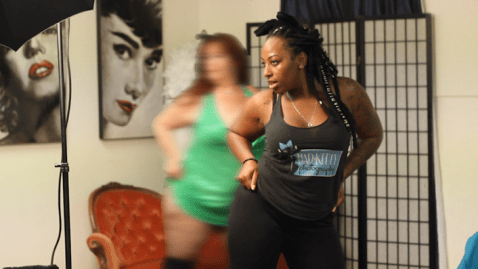
Pictured above areRaven Von Scrumptious (right) an Sepia Jewel (left), two burlesque dancers from San Diego, California. Raven and Sepia started “eye fucking” in burlesque classes with Coco L’Amour and later they transferred these gestures to the photo studio and the stage, gestures that as Juana Maria Rodriguez notes, “dance, flirt and fuck” (2014). “Eye fucking” is transmitting tease, a play with your audience that is coquettish. Eye fucking entails going beyond the gaze of the audience into a realm where you meet your inner erotic, your inner gaze. Eye fucking creates arousal, homosociality, agency, femme desire, confidence, and a queer space with a lot of glitter. As Smiley LaRose—the name I chose to take on as my student burlesque name—I have learned to “fuck the camera lens” from these two women and the burlesque community in San Diego, who encourage me to embrace what Celine Parreñas Shimizu calls “productive perversity.”
In this post, I reflect on the sonic intimacies between burlesque and boudoir photography. I am sharing part of a larger film project titled #GlitterBabes, where I tell a story of how burlesque as a recreational practice empowers women to engage their sensual selves. The film came about when I signed up for a Soloist Workshop and my burlesque stage persona Smiley LaRose was born. I tell this story through Glitter Tribe Studio, the first studio dedicated to the art of burlesque in San Diego.
In fact, both the dance and photography studios I write about here have an intimate relationship. The film starts with Smiley’s curiosity about how her classmates and teachers engaged the art of tease and navigated all the different aspects of it. As a fat performer, I was particularly interested in the way that my burlesque sisters and myself would navigate topics of body confidence, sensuality and stripping. As it turned out, these practices require a practice of listening to the details of our bodies and its engagement with musicality, the rhythm of our tease(s), and our awareness for how the camera can capture our corporeal erotic wavelengths both on and off stage.
In other words, I engage in ‘dirty listening’ to describe the sonics of boudoir photography and the erotic sounds that go into capturing sensuality in its most intimate ways. In their qualitative study of erotic photographers, Wentland and Muise found that in order to have a successful shoot it was crucial to create “relaxing and comfortable” spaces for femmes. A common practice among the photographers was to have “constant dialogue with their clients, both at the beginning and during the photo shoot, in order to help their clients relax.” They allowed femmes to have control over the shoot and explained every step along the way. In fact, as photo shoots progressed, several clients “requested shots that were more revealing than what they had initially discussed” (106). The findings by Wentland and Muise share many commonalities with the way photographers in San Diego also engage the practice of Boudoir, particularly the understanding that agency is experienced along a continuum and photographers support their clients by accommodating different techniques that can silence their negative self-talk.
At Bad Kitty Photography, where both Raven and Sepia had their shoots, a layer enabling femmes to get into an affective state of sensual comfort is music. To prepare for shoots, Bad Kitty asks their clients to think about their favorite music to set the mood. On their website, they list creating a music playlist as a recommendation to prepare for the shoot. This recommendation intrigued me and aroused an intellectual sonic orgasm. As a scholar of music, sound, and sexuality, their suggestion reminded me of a post by Robin James, where she argues that “we can understand the physical pleasures of listening to music, music making, and music performance as kinds of sexual pleasure.” In Modernity’s Ear: Listening to Race and Gender in World Music, Roshanak Khesti has described the erotic aspects of aurality, and has described the ear, as an ‘invaginated organ’ that penetrates the body with pleasure-in-listening. Here, music is consumed in a femme-centered space to get the model and its photographer to a state of intoxicating perversity.
Beyond the music recommendation, the photographer who worked with me also used sonic techniques to help me get relaxed and comfortable. Ashley Rae, aka “My Bomb Ass photographer,” no longer works at Bad Kitty, but her impact there particularly with other women of color clients is remembered. While we were choosing my outfits, I shared with Ashley, how nervous I was about not being able to make sexy faces. She looked at me and said, “It’s easy! All you have to do is pronounce ‘juice.’” She later asked me to look at the mirror while I practiced. The trick in the exercise was how slow I said “juice” the slowness and softness or my pronunciation created a shape in my lips that unconsciously also influenced the way my eyes moved. After juice she told me to pronounce “prune.” Ppppp-rrrr-uuuuuuu-nnnnnn—ee.
I look at my photos and I see the effect it created. “vocal utterances function as another kind of embodied gesture – opening the mouth and projecting sounds, words, and breath imprinted by the unique physical qualities of our inhabited bodily instruments,” as she points out in Sexual Futures, Queer Gestures, and other Latina Longings (124).

She spoke dirty to me and I liked it.

“Give me more bootyhole,” Ashley said.
Rodriguez asks, “what happens when I talk dirty to you? How does the address of speech transform the performative gesture of its utterance?” (125). Dirty talk– how my photographer engaged me in dialogue – contributed to my afloje (looseness) as the shoot progressed. The address of her speech, along with her gestures, made me get lost in her camera. Witnessing the way she touched herself–and the way she wanted me to touch my body–formed a collective vision of sensuality, one where all femmes of color could feel like goddesses. It was her dirty talk, the tone of her voice, and the power of her Black Femme gaze that helped me get there. Following Audre Lorde’s vision for the power of the erotics, we imaged a different world with her camera, a world where femmes eye fuck each other, and for each other, constantly displacing the male gaze. Her foreplay allowed me to listen to how my Eyes Talked, My Eyes Teased, My Eyes Fucked.
Beyond the shoot, the boudoir photos that she took of me would capture forever the fat perversity that she inspired in me. The energy we created inside that studio lingers in my skin. I remember her dirty talk and when we pose, my friends who have also gone through her spell also say, “give me more bootyhole” Like that, my remix yells “si, metete con mi Cucu!”


As a fat student of burlesque, my dirty talk, my dirty listening, is inspired by other women of color, fat performers, and porn stars. I gaze upon them for inspiration, guidance on eye fucking, and poses. On March 9, 2018, I participated in the second annual Plus Size Art Show at Meseeka Art studio in San Diego, California. I submitted 20 pieces of boudoir photography to the show that celebrated the bodies of five women of color plus-size burlesque performers from San Diego. They included Buttah Love, Raven VonScrumptious, Lucy May, Sepia Jewel and Smiley LaRose. The other art pieces in the show also centered fat perversity by presenting women in shibari, bikinis, nude, and boudoir.

Photographed by Ahnyung Nadine
The all-women DJ collective Chulita Vinyl Club de San Diego played at the show while people danced, drank, and viewed the live fat artwork in formation. Listening to the charlas in the room, you could hear fat women share the power they felt from seeing other fat women feeling sexy. One of the participants approached Sepia and Smiley to ask us if we were also exhibited in the artwork. We both pointed at our images, celebrating each other by complementing our sexy poses. She told us that it was her first time ever taking photos in lingerie, and that playing with the shoot was empowering. We both agreed, because as burlesque dancers and students, stripping to nakedness has had multiple effects on the way we viewed our bodies, and their sensuality. Can you listen to how we use boudoir, erotic art and burlesque to create a visual archive of fat-sex-positivity?
Although Raven was not able to attend the opening of the show, she saw it through Buttah’s Instagram story. When I texted Raven, she told me she almost cried from seeing her photos framed on the wall. Raven was art, a fat femme was art. But even though she was not there, her photos transmitted energy and a fat perversity: her fat eyes talked, her fat eyes teased, her fat eyes fucked us.

Prrruuuuuu-nnnnnnneeeeee
We moan.
—
All images courtesy of the author.
—
Yessica Garcia Hernandez is a doctoral candidate and filmmaker in the Department of Ethnic Studies at the University of California San Diego. Her scholarship bridges fan studies, sound studies, women of color feminisms, fat studies, girl studies, and sexuality/porn studies to think about intergenerational fans of Mexican regional music. Yessica earned her B.A. in Chicanx Studies from University of California, Riverside and an M.A. in Chicanx and Latinx Studies at California State University Los Angeles. She has published in the Journal of Popular Music, New American Notes Online, Imagining America, Journal of Ethnomusicology, and the Chicana/Latina Studies Journal. Her dissertation entitled, “Boobs and Booze: Jenni Rivera, the Erotics of Transnational Fandom, and Sonic Pedagogies” examines the ways in which Jenni Rivera fans reimagine age, gender, sexuality, motherhood, and class by listening to her music, engaging in fandom, and participating in web communities. She explores the social element of their gatherings, both inside and outside the concert space, and probe how these moments foreground transmissions of Latina power. Yessica’s broader research interests includes paisa party crews, Banda Sinaloense, Contestaciones, and Gordibuena/BBW erotics. She is a co-founder and member of the Rebel Quinceañera Collective, a project that utilizes art, music, photography, creative writing, filmmaking, and charlas to activate spaces for self-expression and radical education by and for youth of color in San Diego.
—
 REWIND!…If you liked this post, check out:
Unapologetic Paisa Chingona-ness: Listening to Fans’ Sonic Identities–Yessica Garcia Hernandez
Freedom Back: Sounding Black Feminist History, Courtesy the Artists– Tavia Nyong’o
Mediated Sexuality in ASMR Videos–Emma Leigh Waldron
Share this:


Current Top Posts





April 2021

January 2020

November 2019

October 2019

August 2019

April 2014

November 2017

March 2015

December 2017

October 2015
 Sounding Out!
Recent Comments