
The Noisiest City on Earth? or, What Can the 2012 Manhattan Noise Complaint Maps Really Tell Us?

“It’s a city, not a cemetery. You can’t tell everybody to go around wearing earplugs.”
Ex-New York City Parks Commissioner Henry J. Stern, quoted in “Many Pleas for Quiet, but City Still Thunders”
In 1905, a New York Times article declared New York City “the noisiest city on Earth.” More than a century later—this summer, to be exact—The New York Times ran a series on noise in New York City titled “What? The Long War on Loud” that proved that this city is still trying to figure out its relationship to sound. (One of the gems of that series? “New York’s War on Noise” timeline.) As a displaced New Yorker, some of my most vivid memories of the city are aural. Although New York City isn’t the only loud city out there, there are many reasons it’s called “The City That Never Sleeps”—and sound has a lot to do with it, depending on which neighborhood you call home.
Now you can see what neighborhoods are allegedly noisiest, and where all that noise comes from. Brooklyn designer Karl Sluis created the 2012 Manhattan Noise Complaints maps (click for full image), in which Sluis correlated the data on 311 noise complaints made during the year 2012 (40, 412 complaints, to be exact) that he obtained from the NYC Open Source site with Manhattan’s geographical coordinates. He used circles of various sizes to a) create an aural tracing of the island of Manhattan, sitting in a sea of turquoise blue b) showcase the number of complaints in an area. The bigger the circle, the larger the number of complaints.

Screen Capture of Karl Sluis’s 2012 Manhattan Noise Complaints maps (click for interactive image)
The maps Sluis has created are helpful for visualizing the complaints on a broad scale, but they paint an incomplete picture of what noise means in New York City. The demographics of each neighborhood are absent from each map, a slight that can perhaps be traced to the 311 data available, but in order to better understand how New Yorkers define “noise” those stats must be included. Both Sluis and John Metcalfe from The Atlantic Cities discuss notable findings, but neither takes into account the fact that some of the areas with a higher concentration of noise complaints are not just densely populated but densely populated with racial and ethnic minorities. Indeed, comparing the maps’ noisy hotspots to a map of Manhattan racial demographics reveal how urban racial dynamics intersect with ideas about sound and power: who can make sound, who must be chastised for making noise, who can complain and whose complaints are actually being heard.

“Unnecessary noise prohibited” by Flickr user Ricky Leong, CC BY-NC-SA 2.0
Mapping noise complaints gives a spatial dimension to noise, and it renders noise palpable, in a way. Sluis points out, “Noise complaints reveal the concentration of activity in the city as well as many smaller stories, such as the construction of the Second Avenue subway line, idling buses on the Upper East Side, and the homes of the loudest dogs (or the least patient neighbors).” He reminds us that the data comes from complaints and not necessarily decibels; in other words, it represents local ideas of what counts as sound and what counts as noise.
While Metcalfe correctly describes the thousands of 311 complaints about noise from 2012 as “the entire year’s expression of mass annoyance,” Sluis’s map does not go far enough toward figuring out whose annoyance, exactly. We must remember that annoyance oftentimes stems not just from physical reactions to noise but rather one’s perceptions about noise, what Jennifer Stoever-Ackerman deems “the listening ear.” How we hear others, Stoever-Ackerman argues, is not as natural as it seems. For example, whom we deem as noisy may stem from our community, our parents, and/or social conditioning. Accounting for race/ethnicity in noise maps will show how the listening ear conditions neighbors to categorize and react to certain sounds.
For the purpose of this analytic exercise, I compared Sluis’s maps and the Center for Urban Research, CUNY Graduate Center’s 2010 map of block-by-block demographic changes in New York City, in order to illustrate how population density and racial/ethnic demographics play a role in concentrated pockets of noise complaints. Drawn from 2010 census data, the CUNY map clearly delineates neighborhoods and color-codes the groups in each neighborhood per block: blue for whites, green for Latino, orange for black, purple for Asian, and grey for “Other.” Although the Center for Urban Research, CUNY Graduate Center’s maps cannot be superimposed on Sluis’s maps, they help give a general idea as to where neighborhoods are located in addition to racial demographics.
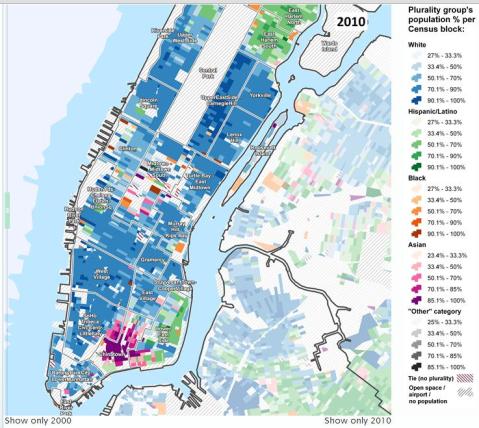
Manhattan below 110th Street in 2010, courtesy of the Center for Urban Research, CUNY Graduate Center

Manhattan above 110th Street 2010. Courtesy of the Center for Urban Research, CUNY Graduate Center
From the maps illustrating changing race/ethnicity patterns, I gathered what neighborhoods were predominantly white (West Village, Lincoln Square, Yorkville, Upper West Side), predominantly Latino (Washington Heights, East Harlem) predominantly black (Central Harlem, parts of Hamilton Heights), and predominantly Asian (Chinatown, blocks of the Lower East Side). When one compares Sluis’s overall noise map of Manhattan to the racial demographic maps of Manhattan, what stands out is that the major circles of noise complaints are also places where there are different racial and ethnic groups mingling (for example, Times Square) or places that are populated by mostly minorities (Hamilton Heights). Whereas Sluis flattens out the noise complaints, demographic stats point to the racial/ethnic contours of each neighborhood. Sluis’s maps focus on number of complaints; unfortunately this assumes everyone complaining is the same and that everyone making the noise is the same—a level aural playing field if you will. Bringing demographics into the equation underscores how not all complainers are equal and how not all complaints carry the same heft.
The city may be noisy, but “noisy” is relative. Sluis’s map shows some predictably noisy areas for those of us familiar with Manhattan’s soundscape (Union Square, Times Square) but it also draws attention to other areas not as predictable in the mainstream imagination (East Harlem South, Hamilton Heights). However, the maps by the Center for Urban Research, CUNY Graduate Center help us better understand the context for the high or low number of complaints in certain areas. For example, one of the biggest circles on Sluis’s general map of Manhattan is located in the Hamilton Heights/Washington Heights area; the Center for Urban Research, CUNY Graduate Center’s map of Manhattan above 110th Street show that these areas are densely populated by blacks and Latinos/as. This is key information because it reminds viewers that this neighborhood is a lot more ethnically diverse than other neighborhoods with a smaller number of complaints. It brings to mind: what role does race play in these complaints, in terms of those who complain and those who are the focus of the complaints? Although more people might mean more complaints, the prevalence of complaints like “loud talk” in East Harlem (Spanish Harlem) are nevertheless connected racialized ideas about people of color being “loud.” This doesn’t assume that the people complaining are white, but that they are complaining about groups that are characterized as loud, noisy, rowdy.

“Classic New York: noise, smoke” by Flickr user Will, CC BY-NC-ND 2.0
These noise maps, when put into conversation with demographic data, also indicate what areas are priorities in urban planning—the sounds of gentrification. The visualizations of the complaints by section (under the main map), combined with CUNY’s maps, are even more telling because they break down the number of complaints by category. The aforementioned northern tip of Manhattan, for example, is also where many of the complaints are concentrated. At a glance, loud parties, loud people, and loud car stereos seem to be the major complaints in those areas, according to Sluis’s visualizations. Meanwhile, noises of “urban growth,” such as construction and jackhammers, are less prevalent in these areas, whereas they are more prevalent below Central Park North, in now mostly-white neighborhoods.
Sluis’s maps of the 311 noise complaints data allow readers to see differences in terms of neighborhoods: who complains the most? what do they complain about? However, one thing to keep in mind is that first question: who makes the complaints. This is where the data falls short. Can it be assumed that those who are calling about the noise are mostly people who live in the neighborhood? Are Upper Manhattan neighbors less or more tolerant of noise? The answers to these questions, although they’re not found in Sluis’s map, point to how ideas of who is noisy or who can make noise are at play here.
I do not mean to downplay the usefulness of Sluis’s map. I instead call for the necessary addition of key missing factors to future noise maps in order to give us a more complex picture of noise complaints in Manhattan and elsewhere. Although it may not be possible to gather who the 311 callers are, including factors such as race and class may lead to very different noise maps. For example, what would a noise map of Manhattan look like if researchers brought income into the equation? Income inequality, especially in Manhattan where that imbalance is starkly on display, matters for the purpose of sound mapping. The more affluent neighborhoods are also the ones with less complaints and are the ones that are mostly inhabited by whites. Wealthier communities are more spread out and have more ability to couch themselves from noise, not to mention that it probably takes fewer complaints to get a response.

“Marcus Garvey Park Drum Circle, Harlem, NYC” by Flickr user j-No, CC BY-NC-ND 2.0
Gentrification is another factor: what kind of analysis could we do if we considered what neighborhoods have been gentrified in the past ten years? It is possible that as whites move into neighborhoods where people of color have historically lived, suddenly they find them noisy—hence, complaints. It is fitting to consider, for example, the tension between an established group of drummers in Marcus Garvey Park in Harlem and the inhabitants of a new highrise (characterized as “young white professionals”) who wanted the 30-years and running drum circle shut down, as reported in The New York Times in 2008. Moreover, if we accounted for the history of zoning in the neighborhoods that have the most or the least complaints it would add another layer of analysis to the data. Are some of these neighborhoods used as entertainment zones, for example? Is it easier to open up bars there than elsewhere in the city?
With these questions in mind, the maps go from beautiful renditions of data, to opening up a bigger conversation about the arbitrariness of noise. The demographical and sociological context of these noise complaints must accompany the raw data, especially when it comes to sound. The analysis also points to the source of the data: 311 calls. I wonder if this is the only way that people in Manhattan (and New York City at large) are dealing with noise. I’m sure that after a century of being “the noisiest city on Earth,” folks have gotten creative about it.
—
Featured image: ” Stranger 10/100 Johano” by Flickr user MichaelTapp, CC BY-ND 2.0
—
Liana M. Silva-Ford is co-founder and Managing Editor of Sounding Out! She is also known professionally as the Writer Whisperer.
—
 REWIND! . . .If you liked this post, you may also dig:
“I’m on my New York s**t”: Jean Grae’s Sonic Claims on the City -Liana Silva
The Noise You Make Should Be Your Own–Scott Poulson-Bryant
Sounding Out! Podcast Mini-Series (#16): Listening to The Tuned City of Brussels, Day 1: “Noise”
Share this:

To Sir, With Ratchety Love: Listening to the (Dis)Respectability Politics of Rachel Jeantel
 Editor’s Note: July 18th, 2013 has been designated as World Listening Day by the World Listening Project, a nonprofit organization founded in 2008 “devoted to understanding the world and its natural environment, societies and cultures through the practices of listening and field recording.” World Listening Day is a time to think about the impacts we have on our auditory environments and, in turn, its affects on us. Once again, Sounding Out! has decided to observe World Listening Day by planning a month-long special forum of posts exploring several different facets of listening such today’s offering by SO! regular Regina Bradley, questioning how American racial ideologies impact listening as a cultural, embodied act. Listen carefully, because we will be following Regina’s post with a special Sounding Out! Comment Klatsch on Wednesday, July 3rd that considers the consequences of racialized refusals to listen. What are the consequences of a listening that is interrupted? distorted? denied? perpetually deferred?—Editor-in-Chief, Jennifer Stoever-Ackerman
—
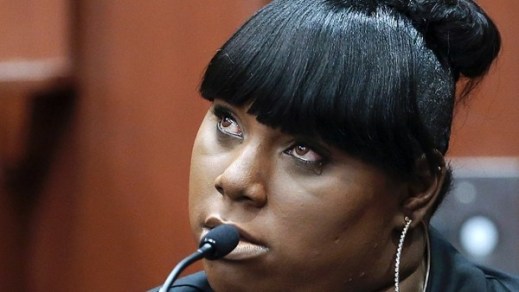
Rachel Jeantel gave me life with a curt “that’s real retarded, sir.” Responding to George Zimmerman’s attorney Don West’s suggestion that Trayvon Martin pursued and wanted to hurt Zimmerman, Jeantel undoubtedly lifted many eyebrows and possibly a few “hell naws” under the breaths of those watching her testify. Her response to West regarding his lack of understanding can be extended to assess the firestorm of controversy surrounding her testimony: questions of her literacy as oppositional to the prosecution’s hopes of conviction, surprise at her brashness and demonstrative gestures of irritation, and, worst of all, judgments about the literal and figurative fullness of her girlhood/womanhood and chocolate skin as signs to ring the alarm as grounds for dismissing justice for Trayvon Martin. Because her testimony operated outside of normal constructs of witness etiquette and respectability, it was greeted with a hailstorm of controversy paralleling the rawness of responses to scripted reality shows. The shallowness of “critique” of Jeantel—whom, it must be continually repeated, is not on trial—was disgusting.
But you don’t need me to tell you that, because if you were really listening to Rachel Jeantel, SHE told you. Jeantel’s delivery was particularly striking, offering her audience low timbred and often emphatic quips of “what?!” and “you ain’t get that from me” to indicate her irritation and frustration with West. Jeantel’s refusal and inability to conform to expected cultural and aural scripts of black womanhood within the confines of the courtroom – the epitome of a hyper-respectable space – destabilizes not only racial paradigms of black (southern) respectability but Americanized expectations of black women’s scripts of respectability. As Brittney Cooper points out, “Rachel Jeantel has her own particular, idiosyncratic black girl idiom, a mashup of her Haitian and Dominican working-class background, her U.S. Southern upbringing, and the three languages – Haitian Kreyol (or Creole), Spanish and English – that she speaks.” Her people ain’t from hea and because of her upbringing can’t be categorized like other black girls from hea. In this sense, Rachel Jeantel is ratchet.
As I previously define in an analysis of Beyonce’s “Bow Down,” [sonic] ratchetness is a means of navigating sliding representations of respectability within American popular culture. Jeantel’s testimony, however, thinly treads between ratchetness as performative discourse and lived experience. Her reference to the television show The First 48, during a line of questioning regarding how she knew the police would contact her, for example, signified to some that Jeantel was oblivious to the judicial process.
Upon closer examination, however, The First 48 is a touchstone in understanding her negotiation of the criminal justice system as a series of steps/performances surrounding the policing of black bodies from her native Miami (which, it seems, is always on the show). It provides a widely acknowledged– and commodified – representation of black trauma in relation to the U.S. justice system. Jeantel’s ratchetness, then, is a tragicomedic site of cultural and gendered trauma accessible to the national public. Her personal loss of a close friend is overshadowed by her performance of that grief in a space of hyper-respectability. Her emotionally charged question “are you listening?” jolted not only West but those watching the trial. Were we listening? What were we listening for?
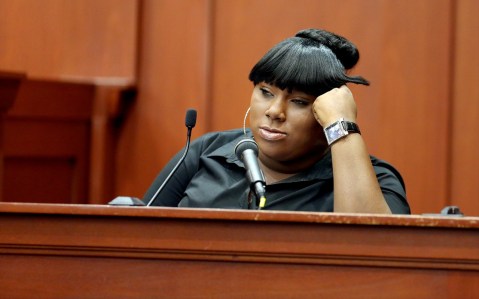
Jeantel’s performance of ratchetness both pointed out and disrupted America’s racialized and gendered listening practices. I’d like to suggest her two-fold performance of ratchetness – sonic and cultural, imposed and embodied –presented ratchetness outside of a strictly pop culture lens. Instead, Jeantel’s performance and lived experiences present ratchetness as an antithetical response to (hetero)normative politics of respectability currently in place in the black (diasporic) community.
The lightning-speed meme-ification of Jeantel invoked flatter, more familiarized representations of ratchet. Because of our inability to translate Jeantel’s grief as “respectable,” she bore the brunt of public scorn and attempts of humiliation. The idea that Jeantel signifies a real life Precious, for example—the main character of Lee Daniel’s Oscar-nominated 2009 film adaptation of Sapphire’s novel Push, played by Gabourey Sidibe—demonstrates increasingly blurred lines between black women’s performative and lived experiences. It should be noted that Sidibe herself was frequently attacked in the press and on the Internet, to the point where she told her co-star Mo’nique in Interview Magazine, “I try to stay off the Internet. Just because people hurt my feelings sometimes. . .a lot of people commented that I’m an incredible actress. But other opinions weren’t so nice, physically or whatever.” Jeantel-as-Precious inadvertently suggests Jeantel’s ratchetness is grounded in the sense that she is plus-sized, dark, “illiterate,” and from a working class background. Precious-as-Sidibe becomes the medium through which Jeantel’s (il)legible womanhood is comprehensive.
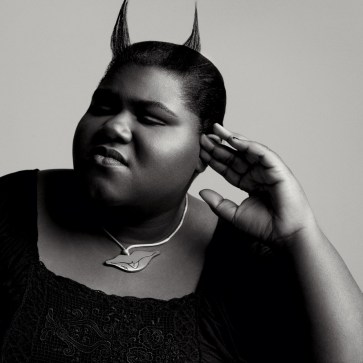
Gabourey Sidibe, from Interview Magazine, Photography by Vinoodh Matadin and Inez Van Lamsweerde
Further, meme-ing Jeantel as Precious solidifies her working class background and ultimately her testimony as a threat to Trayvon Martin’s (re)deemed middle class respectability as a portal of victimization. Returning to Cooper’s observations of Jeantel’s use of hybrid-linguistics, it is Jeantel’s sonic delivery that most threatens Martin’s perceived and scripted middle class respectability. Jeantel’s use of so-called “broken” English has overwhelmingly been heard by what Jennifer Stoever-Ackerman calls America’s dominant “listening ear” in “Reproducing U.S. Citizenship in Blackboard Jungle” as a marker of her working class background – not her trilingual background – and thus, it sonically aligns Martin with the black working class and voids prospects of him being considered a victim of violence rather than its perpetrator. Don West’s treatment of Jeantel on the witness stand attempted to impose a parallel between Jeantel’s alleged “illiteracy” and Martin’s criminality. The “crime” of illiteracy within the courtroom and supposed “crime” of Martin beating Zimmerman into shooting him co-exist within a policed space of (white) respectability that black bodies are frequently forced to adhere.

Jeantel retaliated against West’s attempts to back her into this tight space, however, with her emphatic use of “sir.” Jeantel’s brilliantly subversive tactic demonstrates ratchety resistance because it provides a subtle inversion of the white supremacist discourse directed towards her. Her use of “sir” reminded me of the unnamed protagonist’s grandfather at the beginning of Ralph Ellison’s Invisible Man, who on his deathbed commanded his family to “live with your head in the lion’s mouth:” “I want you to overcome ‘em with yeses, undermine ‘em with grins, agree ‘em to death and destruction, let ‘em swoller you till they vomit or bust wide open” (16). Indeed, Jeantel busted “the lion’s mouth” wide open vis-à-vis a hybridized slang and an emphatic “yes sir” or “no sir.” Most importantly, Jeantel sustained her dignity and self-respect in the process. Jeantel’s mastery of a low, monotone “sir” signifies her existence outside of the politics of respectability that frame not only black women’s experiences but blacks’ submission to white supremacy.
Where West and others focused on her facial features or even her delivery of “sir” as a sign of (dis)respect, what was lost upon many was how her aurally subversive delivery of arguably the most hyper-respectable word in (American) English kept her in command of her testimony.
 Rachel Jeantel is ratchety brilliance. She witnessed, performed, and sounded her truths in ways that complicated if not contradicted the normative discourse policing black women’s bodies. Although much of her cunning was shortsightedly heard as uncouth and aural evidence of a lack of (middle class) home training, Jeantel signifies the usefulness of ratchet as a form of resistance to the white privilege that dictates respectable spaces like the U.S. courtroom. Sir.
—
R.N. Bradley recently graduated with a PhD in African American Literature at Florida State University and is a regular writer for Sounding Out!
—
REWIND! . . .If you liked this post, you may also dig:
Death Wish Mixtape: Sounding Trayvon Martin’s Death–Regina Bradley
Hearing the Tenor of the Vendler/Dove Conversation: Race, Listening, and the “Noise” of Texts–Christina Sharpe
The Noise of SB 1070: or Do I Sound Illegal to You?–Jennifer Stoever-Ackerman
Share this:


Current Top Posts





April 2021

January 2020

November 2019

October 2019

August 2019

April 2014

November 2017

March 2015

December 2017

October 2015
 Sounding Out!
Recent Comments