
A Day on the Dial in Cap Haïtien, Haiti
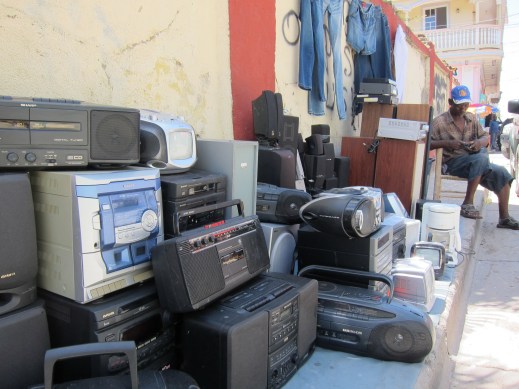

Radyo Ayisyen
Learning from other scholars’ work on Haitian radio was, and still is, one of the greatest pleasures in the process of writing Isles of Noise: Sonic Media in the Caribbean (UNC 2016). People living in or from Haiti widely acknowledged and almost took for granted radio’s outsized role in public and political life. Edwidge Danticat and Jonathan Demme also understood this and paid tribute in Claire of the Sea Light and The Agronomist respectively, but historians remained largely fixated, understandably, on pivotal moments in Haiti’s rich history. Radio is different. Not pivotal, but witnessing the pivotal. Less dramatic and more long lasting and adhering to the same format for days, years, decades. It speaks to people who wouldn’t read newspapers or books. It floods private and public space with the sounds of music, talking, ruling, dissenting, explaining, satirizing, creating, crying, testifying, lying. But it leaves few archival traces. This is why the work of the five scholars in this series is so important. They allow us to hear a little and honor the listeners who make the medium what it is.
Liveness, and company: Ian Coss’s finely tuned account of a “day in the life” of a radio station follows the programming rhythm of days and nights, from rollicking to quiet and back again. Radio is a predictable presence, an intimate friend who anticipates your needs even before you do. Coss draws from his years of listening to the listeners as he marks radio time and space in Cap Haïtien. Guest Editor– Alejandra Bronfman
——-
Fabrice Joseph is a mender, set up on a street corner in Cap Haïtien, Haiti’s second largest city. He shows me a red plastic toolbox filled with supplies — thread, wires, scraps of fabric—which he can use to fix a jammed zipper or stitch up a torn backpack strap. I stop because he’s cradling a radio set in his hands, tuned to the city’s most popular station: Radio Venus.
We meet on a quiet day; Fabrice has been sitting on the stoop for five hours already with no work. Another day he’s engrossed in assembling a large umbrella—the kind food vendors use for shade—but the radio is still on, now propped on a ledge just behind his head. He replaces the batteries almost weekly, because the radio is always on. In the morning Radio Venus plays news, Fabrice tells me, followed by music as the day heats up. Then in the afternoon he’ll hear sports or perhaps a religious program, before the station returns to music in the evening.
This arc Fabrice describes is designed to follow the arc of his day. In this post, I trace that link: between the rhythms of radio programming and the rhythms of daily life, to show how formatting choices create a heightened sense of ‘liveness’ on Haiti’s airwaves, with all content located in a specific moment: the present moment.

In a technical sense, terrestrial radio broadcasting has always been defined by real time or ‘live’ transmission (an dirèk in Creole), a characteristic that is often invoked in discussions of the medium’s capacity to create shared experiences or even ‘imagined communities.’ And yet where I live in the United States, the passage of time is barely discernible on most commercial stations. Where radio schedules once varied from hour to hour (often reflecting gendered and classed norms of listening), today market research has driven the rise of so-called “format stations” that target specific interest groups and demographics with an equally targeted form of programming: non-stop sports, news, top 40, easy listening, etc.
When I first visited Haiti in 2015, I was surprised to find a radio format unlike any I had grown up with, and not unlike those broadcast schedules of the 1920s and 1930s. While doing research in Cap Haïtien, I conducted a series of bandscans—systematic reviews of the entire radio dial—in order to identify the different types of programming heard on stations throughout the day there. I found the full range of talk and music-oriented shows you might expect, and yet of the 31 stations I picked up, only a handful carried the same type of programming all day. The vast majority carried every kind of program, including Fabrice’s favorite station, Radio Venus.
The Radio Venus studio sits on top of a three-story building, with a door leading straight out onto an open roof deck where the transmitter tower rises several more stories up in the air. That tower operates at 10 watts, just enough to relay the signal to a nearby mountain, where it’s then rebroadcast at roughly 450 watts, blanketing the country’s whole Northern Department. The person in charge of this whole system, as well as the overall flow of the day’s programs, is known as the opérateur. The station employs four operators—Molliere, Louis, Wilkonson and Simon—who work in shifts to cover the 24-hour schedule. This rotation provides stability as the hosts (or animateur) of different programs come and go—often showing up late, and sometimes not showing up at all. For long stretches of the day there is no host, so the operator just cues up a folder of songs in Windows Media Player, occasionally leaning over to trigger a station ID: a chesty voice that declares, “W’ap koute Radio Tele-Venus”—‘You are listening to Radio Tele-Venus.’
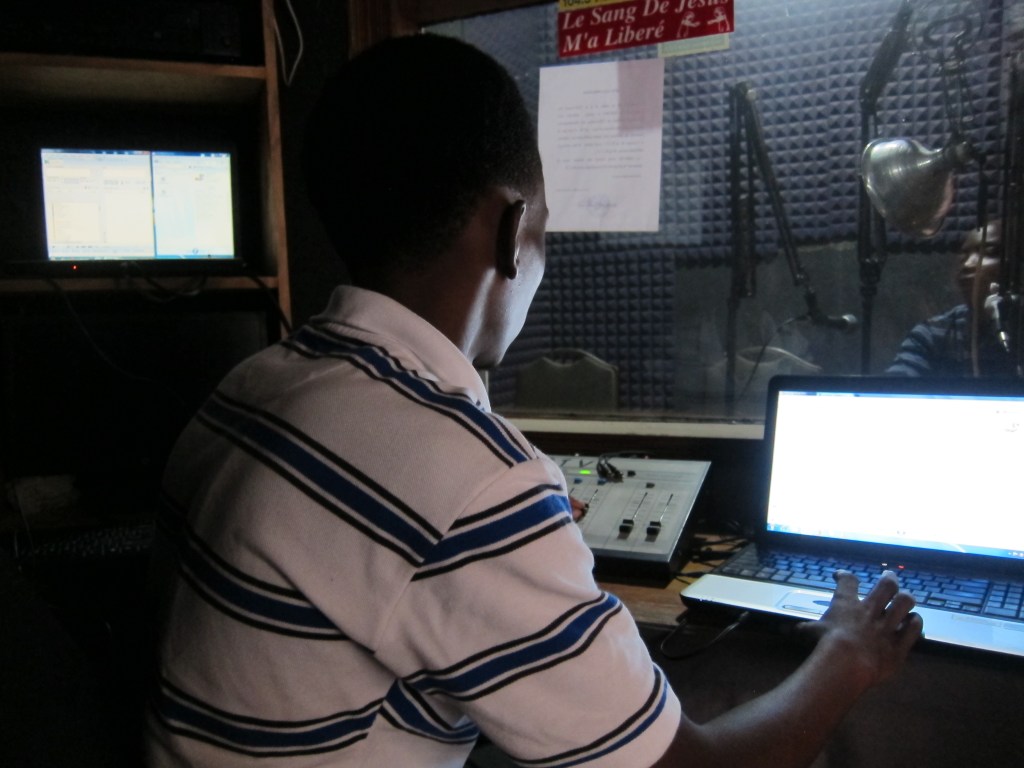
One day, while sitting behind the board of the cramped control room, Simon explains that the goal of the station’s format is to satisfy all of the listeners’ interests and to provide “stability” in their often unstable lives. That last descriptor, “estabilite,” strikes me as somewhat ironic, given that the station’s programming is constantly changing. But for Haitians like Fabrice, who listen all day while they work, the description fits: he never needs to touch the dial, and at the same time he knows exactly what he will hear. Indeed, most of the radio listeners I meet in Cap Haïtien praise the medium’s consistently variable nature; if they wanted to hear the same thing all day they could get a stereo that takes a kat memwa—a memory card—and load it up with their favorite mp3s. Radio should change with the hours of the day; that’s part of what makes it radio.
Many of the staff at Radio Venus describe the art of matching programming to the mood of the moment, in terms of ‘hotness’ (cho). For example, it’s important to have a lively host on the air between about 10am to noon, usually playing konpa music, so that the radio ‘heats up’ to give listeners more energy for their day. This shift takes place simultaneously across virtually every station on the dial, such that it’s literally audible on the street, from countless battery-powered radio sets. The timeliness of this ‘heating up’ is further emphasized by the host—at Venus, a local favorite named Don Lolo—who constantly reads the exact hour and minute off of a large analog clock on the studio wall. Lolo’s job is to make the music live in the moment; to make it ‘hot.’ By the same token, when I interview the overnight operator, Louis, he tells me that since many listeners keep the radio on all night, it’s important that he doesn’t play any music that’s ‘too hot,’ so as not to disturb their sleep. Everything in its right time.
The most dramatic shift in programming, however, begins on Friday evening. For the entire weekend, the station drops most of its talk-oriented shows and plays constant music—almost all of which is bootlegged recordings of live concerts. The idea is to convey the freewheeling mood of a night out on the town, even for those who won’t be at a bar or concert. To keep up this atmosphere, the station operators can choose from whole folders of “konpa live” tracks dating back decades—most of which run twelve to fifteen minutes long. Again, this programming convention of playing live recordings on weekends is ubiquitous across the dial, and indeed across Haiti. Turn on the radio on a Saturday night and you will be hard pressed to find any music that was recorded in a studio.

My first weekend at Radio Venus, I step out of the studio at dusk, and find the station’s signal is suddenly all around me—far more present than just a few hours earlier. Around the corner from the station, an electronics store has set up a row of folding chairs in the street, and is blasting Radio Venus for a small audience. At the end of the same block is a barbershop; there too the stereo is tuned to Venus, with one cabinet speaker set in its arched entryway.
At this hour, both the street and the shop are definitively male spaces—save for some market women packing goods and a mother overseeing her son’s haircut, those listening in public are men. A cell card vendor is perched on top of the stereo speaker itself; a man with two live chickens—their heads poking out of the bottom of plastic shopping bags—stops by and quickly exchanges some money with one of the barbers, who plays some air guitar as the next customer takes his seat. One of the other remaining barbers is perched sideways in his stool, feet in the air and a bottle of Barbancourt rum in one hand. The energy is loose, encouraged by the radio announcer.
Back at the station, the small studio is lit only by a single fluorescent bulb, whose harsh light spills through the glass pane into the neighboring control room. Don Lolo is on the air once again, but his style is different. No more telling the time or giving long monologues. Instead he sings along in a full-throated voice, occasionally adding personal shout-outs. We learn that Gerald is celebrating a birthday today, just as Claire and Alex are marking their anniversary. When his phone then rings, instead of picking it up Lolo silences the call and responds by radio: “Sorry, I can’t talk now!”
It’s late when Don Lolo wraps up his show and we head out of the studio, leaving Louis alone to cool the music back down for the overnight shift. The evening operator, Simon, offers to walk me home. At this hour, we can stroll down the middle of the street side by side, the city’s elaborate facades cast in silhouette by the occasional streetlight. As we head up the hill towards my place, Simon cocks his head and gestures across the street. I turn just in time to catch the station ID—“W’ap koute Radio Tele Venus”—coming out of a barbershop. The radio is still on.
Tune into a livestream of Radio Tele-Venus via Tune In: https://tunein.com/radio/Radio-Tele-Venus-1043-s181945/
—
Featured Image: “An electronics vendor in Cap Haïtien, Haiti” by Ian Coss
—
Ian Coss is an audio producer, composer and sound designer whose work spans the worlds of podcasting and performance. He has produced several critically acclaimed series with the Radiotopia network, including Ways of Hearing, The Great God of Depression, and Over the Road. His audio work has been reviewed by the New Yorker and the Guardian; featured on NPR, Al Jazeera and the BBC; and recognized with an Edward R. Murrow Award for ‘excellence in sound.’ Additionally, Ian has premiered live sound works at the Boston Museum of Science and Harvard University, and collaborated on immersive audio tours for the Isabella Stewart Gardner Museum, Richmond ICA, and other major art institutions. Ian holds a PhD in ethnomusicology from Boston University, where he conducted research on Haitian radio broadcasting and Indonesian shadow-puppetry. He continues this work as musical director for The Brothers Čampur, an international puppetry collaborative that has performed at major festivals in Indonesia, and at universities throughout the eastern United States. More on all these projects at iancoss.com.
—

REWIND! . . .If you liked this post, you may also dig:
Radio de Acción: Violent Circuits, Contentious Voices: Caribbean Radio Histories–Alejandra Bronfman
Radio Ambulante: A Radio that Listens –Carolina Guerrero
The Sweet Sounds of Havana: Space, Listening, and the Making of Sonic Citizenship–Vincent Andrisani
Share this:

Contemporary Television’s Construction of Sonic New Jersey

At the start of The Soprano’s sixth season, in the wake of being accidentally shot by his dementia-suffering uncle, New Jersey mob boss Tony Soprano enters a coma-induced dreamstate in which he reimagines his life as a successful precision optics salesman. A show interested in Freudian psychology, The Sopranos is full of dream sequences, but this one stands out as the longest and most frustrating, as first-time viewers must watch as the hour-long plotline follows Tony’s convoluted dream while his family waits in agony at his hospital bedside. Within the dream sequence, Tony awakens to find himself at a sales conference, where he has mistakenly taken someone else’s briefcase, and he attempts to find its rightful owner. Despite the frustrating circumstances, Tony has lost his tough, mob boss demeanor: instead, he’s professional, polite, and patient, qualities that the former Tony rarely exhibits throughout the show’s six seasons.

Screenshot from YouTube video “The Sopranos – Join The Club /When It’s Cold I’d Like to Die 720p”
But what immediately strikes me about this dream sequence is the sudden loss of Tony’s thick Jersey accent. Gone is the fast-paced speech filled with dropped ‘r’s’ and long ‘a’s’ and ‘o’s’. Instead, Tony’s way of speaking is relatively accentless, aligning with what is considered a neutral North American accent. By dreaming of himself as an upwardly mobile, white-collar worker, Tony has not only imagined a new career, he’s also imagined a new way of speaking, one that lacks any clear markers of region, class, or ethnicity. This transformation ultimately tethers Tony’s New Jersey accent to his identity as an Italian American mobster with working-class roots, and it reinforces the idea that speech is indicative of one’s class. The dream sequence is one instance in which television constructs the New Jersey accent as signifying a certain brand of whiteness—not quite white trash, but perhaps one step above it, a form of whiteness lacking sophistication, riddled with ignorance and superficial wealth.
Here I examine contemporary television’s construction and performance of the Jersey accent in order to understand what it confers about class status and ethnic identity. As others have argued, New Jersey dialects are actually quite eclectic, though contemporary television tends to represent the state’s accent as defined by long vowels and quick, poorly articulated speech:
I’m interested in how television shows such as The Sopranos, Jersey Shore, and Real Housewives of New Jersey, among others, construct the Jersey accent as a homogenous indicator of ethnicity and social class. Within these predominantly white shows, the Jersey accent is associated with whiteness, situating characters at a distance from dialects susceptible to scrutiny and violence, such as nonwhite immigrant accents or who embody what Nina Sun Eidsheim calls sonic blackness, but it also signifies that these characters do not come from respectable backgrounds or generational wealth.

Screenshot from Season 1 Episode 1 of MTV’s Jersey Shore
New Jersey has served as a popular setting for contemporary television, and reality television in particular has capitalized on the state’s materialistic and ostentatious reputation. As Alisha Gaines argues, reality television has a “full-blown crush” on the state, as its geography serves as “a stage for class and social passing, a late capital playground of ethnic representation.” MTV’s Jersey Shore is the most well-known reality TV show to emerge out of New Jersey. Although only a few of the show’s main characters originate from the state, they all embrace a stereotypical Jersey aesthetic: the big hair, the tanned bodies, and yes, the accent. Like The Sopranos, Jersey Shore’s Italian American characters claim to have a complicated relationship to whiteness. The characters attempt to reclaim the derogatory term “guido” (or “guidette,” in the case of the show’s female characters) and admit to not fully identifying as white: “I’m not white,” the show’s Nicole Polizzi (Snooki) says at one point. “I’m tan. That’s what I am.”
In Episode 7 of the show’s first season, Snooki meets Keith, a man she’s surprised to have hit it off with not only because he’s not Italian, but also because “he talks like a cowboy.” Yet Keith does not have a Southern accent, as one might expect, but instead speaks in a standard North American accent. Snooki’s assertion that he speaks “like a cowboy,” then, points to not only how accents are perceived (in the eye of the beholder), it also centers and normalizes the characters’ Jersey accents and calls into question how American television audiences have been trained to experience and think about accented subjects.
Predictably, within New Jersey shows, accents and “improper” ways of speaking often become the butt of the joke. For instance, in The Sopranos episode “Cold Stones,” Tony gifts his wife Carmela a Louis Vuitton wallet containing thirty grand in cash. “This is the real Louis Vee-toon,” he assures her, butchering the pronunciation of the French designer’s name. Tony may be able to afford the “real thing” (and then some), but his inability to sonically perform it gives him away: this is not a lifestyle he inherited or was born into; it does not come natural to him.
In a similar vein, Bravo produces blooper reels of the New Jersey Real Housewives mispronouncing common words (skooers instead of skewers, lopter instead of lobster, bought instead of brought, for instance).
Here, these characters’ mispronunciations are intended to indicate their ignorance and lack of education, echoing the show’s hints that their female characters have mob affiliations and primarily live off their husbands’ money. Within the Real Housewives of New Jersey and other Jersey-based shows, commenting on the state’s accent often functions as a way of implying that their characters are not to be taken too seriously, thereby influencing how audiences perceive this way of speaking beyond these shows (see, for instance, this Reddit thread).
As it pertains to whiteness and class, the privilege that the Jersey accent does or does not confer is difficult to unpack. Scholars such as Jennifer Stoever and Shilpa Davé have shown how nonwhite accents are subject to surveillance and violence in ways that white accents are not. Similarly, Christie Zwahlen argues in her Sounding Out! post “Look Who’s Talking, Y’all” that “In contradistinction to ‘foreign’ sounding accents, Southern accents are a classic symbol of American cultural belonging, like apple pie for the ears.” But what version of whiteness, and more specifically, Americannes, does the Jersey accent connote? While within the shows examined here, the accent is spoken primarily by characters belonging to immigrant groups that have been encompassed within the category of whiteness (often Italian and Jewish Americans), the legitimacy of these characters’ social class and education level is often under scrutiny. These characters’ interest in flashy outfits, gold jewelry, and French Chateau style decor (you know it when you see it) is represented as trashy and artificial, a performance of wealth rather than the actual embodiment of it.
In many ways, the “improperness” of the Jersey accent becomes another way of indicating that these characters are not highly educated and therefore their words, thoughts, and even their wealth, are deserving of suspicion. And a show like The Sopranos, in which most characters have organized crime affiliations, confirms that this suspicion is well-warranted. Indeed, this is not the whiteness or social status assumed to accompany standard English or American accents.

“New Jersey” by Flickr user Doug Kerr, CC BY-SA 2.0
Unsurprisingly, these shows’ centering of middle-class whiteness and its sonic registers ignores the disparity that exists across New Jersey’s geographies. While the state is one of the nation’s wealthiest, it’s also home to poorer cities of color that continue to suffer from the effects of suburbanization and neoliberal urban development. For example, scholars such as Kevin Mumford and Ana Y. Ramos-Zayas show how a city like Newark (a frequent setting on The Sopranos) has been heavily shaped by inequitable and volatile racial politics. And yet, the shows examined here eschew these socioeconomic and racial differences, erasing New Jersey’s communities of color from the state’s cultural discourses.
In an episode of HBO’s Boardwalk Empire, set in Atlantic City during Prohibition, Irish immigrant Margaret Schroeder expresses her fear that her Irish accent makes her “sound like an immigrant,” to which city treasurer Nucky Thompson responds, “But we’re all immigrants, are we not?” While his response echoes the assimilationist myth of the U.S.-as-melting-pot, it hits on something precise about New Jersey: as the state with the third-largest immigrant population, the homogeneity of the region’s accent is largely a construct. While contemporary television presents audiences with an all-encompassing Jersey accent, in actuality, the state’s diversity makes it nearly impossible to pin down exactly what New Jersey “sounds like.” Examining New Jersey’s representations in popular television reveals how the accent has become one of the state’s most prominent and recognizable features, and shows how these representations have the potential to reductively categorize an entire population.
—
Featured image: “Memorial Day Weekend” by Flickr user SurFeRGiRL30, CC-BY-2.0
—
Shannon Mooney is a PhD student in English and American Studies at the University of Massachusetts Amherst. She received her M.A. in English from the University of Connecticut in 2018. Shannon studies contemporary multi-ethnic U.S. literature, television, and film, with a focus on cultural geography and critical race theory. Her work examines how multi-ethnic writers and artists from New Jersey engage with the state’s natural and industrial landscapes to make sense of their positions as political and historical subjects. Shannon is also the Creative Director of Paperbark Literary Magazine, a publication rooted in sustainability and environmental justice.
—
 REWIND! . . .If you liked this post, you may also dig:
Teach Me How to Dougie Like A Mediocre White Man-Justin Burton
Speaking American-Leslie McMurtry
Vocal Gender and the Gendered Soundscape: At the Intersection of Gender Studies and Sound Studies — Christine Ehrick
Share this:


Current Top Posts





April 2021

January 2020

November 2019

October 2019

August 2019

April 2014

November 2017

March 2015

December 2017

October 2015
 Sounding Out!
Recent Comments